
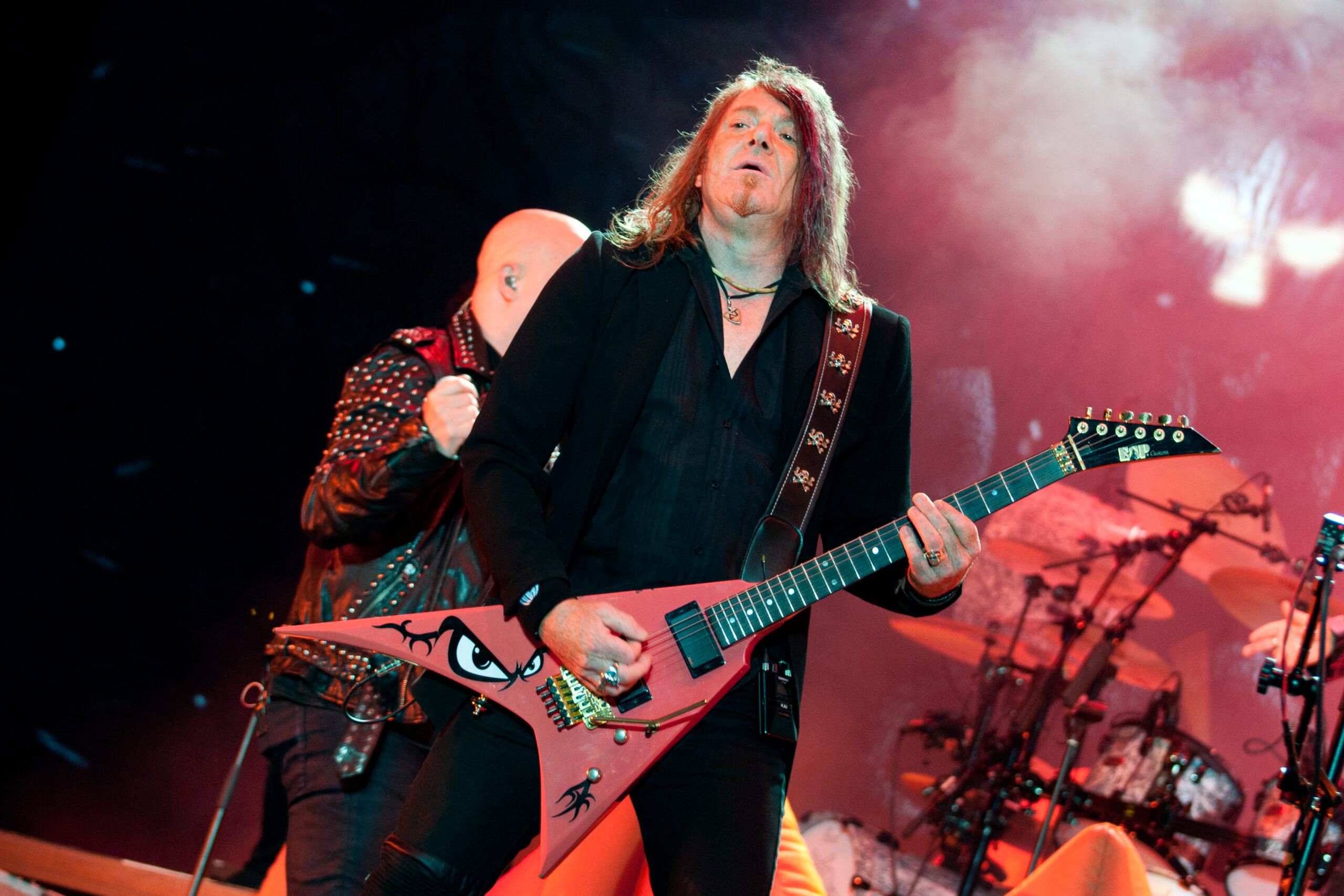
“I’ve played with JMP-1 [rack mounted pre-amp] with a Marshall power amp for years now which is pretty reliable.” Kai Hansen said this to Paul Southwell in the 2007 article “Age of Metal” for Stroppy Baby — and the statement is so characteristically understated for a musician who is called “the godfather of power metal” and “the grandfather of power metal” in equal measure. “Pretty reliable.” For a musician who co-founded Helloween (one of the most influential metal bands in the history of the genre), wrote “I Want Out” and “Keeper of the Seven Keys” and “Future World” (three of power metal’s foundational compositions), departed Helloween in 1989 when it became “too big,” formed Gamma Ray (a band that maintained the original Helloween creative direction and has released eleven studio albums), and then returned to Helloween for the celebrated Pumpkins United reunion tour of 2017-2022 — “pretty reliable” is the gear assessment of a musician who has spent more time thinking about songs than about equipment. His primary guitar for the Gamma Ray period: the ESP RV-300KH — a pink/red Randy Rhoads-shaped ESP with the specific Rhoads offset-V design. His primary amplifier: the ENGL Powerball II E645/2 (current), preceded by the Marshall JMP-1 rack preamp into a Marshall power amp. His first guitar: a white Ibanez Les Paul copy. He is the “master of writing harmonised guitar parts” (Dinosaur Rock Guitar) — the specific technique of playing two guitar melodies simultaneously in harmonic thirds, sixths, or octaves that is the defining musical characteristic of power metal’s guitar approach, and that Hansen helped establish as the genre’s primary compositional method. He is sixty-three years old. The harmonized riffs continue. The Marshall JMP-1 was pretty reliable.
The Journey
Kai Michael Hansen was born on January 17, 1963, in Hamburg, West Germany. His early musical influences stemmed from glam rock and KISS — the specific combination of hard rock melodicism and theatrical performance that characterizes the early power metal tradition. He co-founded Helloween with guitarist Michael Weikath, bassist Markus Grosskopf, and drummer Ingo Schwichtenberg in 1984 (with earlier band activity as “Gentry” and “Second Hell” from 1983). The Helloween debut Helloween (mini-LP, 1985), Walls of Jericho (1985), and the two Keeper of the Seven Keys albums (Part I: 1987, Part II: 1988) established the specific power metal template: the fast tempos, the melodic vocal harmonies, the twin-guitar harmonized riffs, and the light/serious tonal balance that became the genre’s defining characteristics. Hansen departed Helloween in 1989 — citing burnout from touring and songwriting demands, alongside tensions with the band’s evolving direction and Noise Records issues. He formed Gamma Ray in Hamburg in 1989, initially with Ralf Scheepers on vocals, before eventually taking over vocal duties himself. He rejoined Helloween for the Pumpkins United world tour in 2017-2022. He is sixty-three years old.
Background: Hamburg West Germany, KISS and Glam Rock, Helloween 1983/1984, Keeper of the Seven Keys I+II 1987/88, Left to Form Gamma Ray 1989, “Godfather of Power Metal,” Pumpkins United 2017
Hansen’s specific position in the history of heavy metal is the most foundational in the power metal subgenre — Gemtracks: “He is regarded as the godfather of power metal, having founded three seminal bands in the genre.” The specific creative contribution of the Keeper of the Seven Keys albums is the template-setting document for power metal: the specific combination of extreme speed (inherited from American thrash), melodic vocal accessibility (inherited from British heavy metal’s NWOBHM tradition), harmonized guitar lead work (inherited from the Judas Priest/Iron Maiden dual-guitar approach, extended to more systematic harmonic deployment), and the specific lyrical themes (fantasy, optimism, freedom) that distinguishes power metal from thrash metal’s aggression and heavy metal’s straightforward hard rock. This template — created on two consecutive albums when Hansen was twenty-three and twenty-four years old — is the foundational reference for every subsequent power metal band.
His departure from Helloween in 1989 is the biographical event that produced the creative bifurcation of the band’s subsequent history: Helloween with Michael Kiske and then (post-1993) with Andy Deris as vocalist maintained the commercial trajectory; Gamma Ray with Hansen as vocalist/guitarist maintained the more direct creative line of the original Hansen-era vision. The Pumpkins United reunion (2017-2022) — where Hansen and Kiske both returned to Helloween for a world tour and album alongside current members — resolved the bifurcation temporarily into a celebratory statement of the full Helloween history. The live document of the reunion is one of the most celebrated events in power metal’s history.
Dinosaur Rock Guitar’s characterization of his guitar approach is the most specific available: “Kai is a master of writing harmonised guitar parts. Both in Helloween and Gamma Ray harmonised guitar-parts was/is a trademark. It is not unusual that the solos ends this way. Harmonised intros are another favourite of his. Soloing wise he is very melodic. His solos always have purpose and… Kai Hansen have that ‘I am gonna tear your head off with my guitar’-attitude and you feel it when he plays.” The combination of compositional sophistication (harmonized guitar parts as a systematic compositional approach) and physical aggressive intensity (“tear your head off”-attitude) is the specific paradox of power metal’s guitar tradition: melodically sophisticated but physically aggressive.
The Rig: Kai Hansen’s Guitars, Amps, and Effects
Guitars
Kai Hansen’s primary guitar for the Gamma Ray period is the ESP RV-300KH — specifically described in the Equipboard Gamma Ray band page as “the ESP RV-300KH Pink.” The RV designates the Randy Rhoads-style offset V body shape — the asymmetric V design developed by Randy Rhoads and ESP/Jackson that differs from the Gibson Flying V’s symmetrical V shape. The specific offset-V shape’s acoustic properties (the specific resonance of the asymmetric body) and the visual identity (connecting Hansen to the Randy Rhoads tradition of melodically sophisticated metal guitar) make the RV-300KH the specific instrument associated with the Gamma Ray era. The Grokipedia documentation: “Key among his signature ESP guitars is the RV-300KH, a red/pink Randy Rhoads shape ESP” — the pink/red finish making it one of the more visually distinctive ESP models in power metal.
The Grokipedia documentation: “Early in his career, he favored Flying V-style instruments, including a Gibson Korina Flying V equipped with Seymour Duncan JB Model humbuckers in the bridge and an SH-6N Distortion in the neck for solo and overdub recordings.” The Gibson Korina Flying V — Korina (African Limba wood) body, the same material used in the original 1958 Gibson Flying V — is one of the most celebrated Flying V variants for its specific warm, resonant, slightly darker character compared to the standard mahogany Flying V. The Seymour Duncan JB (the Jazz-Blues humbucker, one of the most versatile and celebrated humbuckers available) in the bridge position and the SH-6N Distortion in the neck provide the specific high-output, harmonically rich character for studio solo work. The choice of the Korina Flying V specifically for solos and overdubs (rather than live rhythm work) reflects a preference for its specific tonal character in the focused, isolated recording context.
The Grokipedia documentation: “Kai Hansen began his musical journey with a white Ibanez Les Paul copy as his first electric guitar.” The white Ibanez Les Paul copy — the same type of Japanese-made guitar that appears as the starting point for multiple guitarists in this section (Mille Petrozza’s B.C. Rich, Jeff Hanneman’s black Les Paul) — connects him to the specific entry point of the early 1980s German metal scene, where Japanese copies of American guitars were the affordable option for teenage musicians who could not yet afford genuine Gibson or Fender instruments.
The Grokipedia documentation: “He transitioned to ESP’s mahogany-bodied models, prized for their sustain in power metal contexts, evolving from earlier Ibanez copies to custom designs that supported his high-gain, harmonized riffing style.” ESP’s mahogany construction provides the specific warm, sustaining character that suits power metal’s extended melodic passages — the sustained notes of harmonized guitar riffs require guitars that maintain sustain without losing definition, which mahogany’s specific density and resonance supports.
The NamuWiki documentation: “He occasionally models Randy Rose and Gibson. Flying V models are also used, and Ibanez and Les Paul are also used.” And Grokipedia: “he has maintained a personal collection featuring classic models such as Stratocasters, Les Pauls, and additional Flying Vs.” The breadth of his personal collection — Stratocasters, Les Pauls, Flying Vs alongside the ESP primary — reflects the instrument diversity of a musician who has been playing and collecting guitars for forty-plus years.
Amps
The Equipboard Gamma Ray band page confirms: “Amplified by the ENGL Powerball II E645/2, their music achieves a powerful, tube-driven warmth.” The ENGL Powerball II E645/2 — ENGL’s flagship high-gain tube head, a 100-watt all-tube amplifier with four channels (Clean, Crunch, Lead 1, Lead 2) using EL34 power tubes — is Hansen’s current primary live amplification. The ENGL Powerball II’s specific character: extremely tight, defined high-gain with the specific warm, harmonically rich character of German amplifier manufacturing. Its four channels allow the full range from clean to extremely high gain within a single performance without requiring multiple amplifiers. ENGL amplifiers are the same brand documented for Mille Petrozza — a specific German amplifier brand preference that both prominent German thrash/power metal guitarists share.
The Equipboard documentation of the 2007 Stroppy Baby interview quote: “I’ve played with JMP-1 [rack mounted pre-amp] with a Marshall power amp for years now which is pretty reliable.” The Marshall JMP-1 — a rack-mounted tube preamp that provides the Marshall’s specific EL34 tube preamp character in a 1U rack format, paired with a separate Marshall power amplifier — was Hansen’s primary live amplification during the mid-2000s and earlier. The JMP-1’s specific character: Marshall’s specific tube preamp voicing (the warmth and harmonic complexity of EL34 tube saturation) available in a rack format that allows MIDI-controlled channel switching without the physical footprint of a standard Marshall head.
The Equipboard documentation: “In the music video for ‘Rise’ by Gamma Ray you can clearly see 2551BV cabinets stacked up all around the studio. At 2:50 there is a clear shot of the band backed by cabinets and you can see Kai’s ENGL Straight on top of a mic’d cabinet on the left. These cabinets can also be seen in live Gamma Ray performances such as Wacken Open Air 2003.” The ENGL 2551BV cabinets with his ENGL head document the specific ENGL stack setup in the early-to-mid 2000s Gamma Ray live performances.
Effects
The most important “effect” in Kai Hansen’s guitar approach is not a pedal or a rack unit but a compositional technique: the harmonized guitar part. Dinosaur Rock Guitar: “Kai is a master of writing harmonised guitar parts. Both in Helloween and Gamma Ray harmonised guitar-parts was/is a trademark.” The specific technique: two guitar melodies played simultaneously, with the second melody harmonized a third, fourth, fifth, or sixth above the first. The interval choice determines the specific harmonic character — thirds produce the warm, European romantic harmony of classical music; fifths produce the open, powerful character of power metal’s most characteristic passages. This technique, applied systematically across both rhythm riffs and lead solos, is the defining characteristic of Hansen’s compositional approach and of the power metal genre he helped define.
The Marshall JMP-1’s MIDI capability — allowing program-change messages to switch between the preamp’s different channels and settings — provided the specific live performance control that modern metal touring requires: instant switching between clean rhythm, crunchy mid-gain, and full-gain lead sounds without manual knob adjustment. This MIDI-controlled rack preamp approach was the standard professional touring configuration for 1990s-2000s metal before Kemper and Axe-FX profiling became widespread.
His 2007 comment about the JMP-1 being “pretty reliable” reflects the specific professional priority of a touring musician: reliability first, tone second (within the quality range available). The emphasis on reliability — the Floyd Rose on the ESP for tuning stability, the JMP-1 for amp reliability — is the consistent theme in his gear philosophy. Everything in the rig must work at every show, in every climate, under every touring condition.
Playing Style & Tone Philosophy
Kai Hansen’s playing style is the most compositionally systematic in this section — the approach of a guitarist whose primary creative identity is as a songwriter and arranger of guitar parts rather than as a virtuoso soloist. The Dinosaur Rock Guitar characterization captures both his strength and his specific character: “Soloing wise he is very melodic. His solos always have purpose and… Kai Hansen have that ‘I am gonna tear your head off with my guitar’-attitude and you feel it when he plays.” The combination of melodic purpose (solos that tell a story and have a beginning, middle, and end) and aggressive physical energy (the “tear your head off” quality) is the specific power metal guitar paradox that Hansen embodies better than any other guitarist in the genre.
His tone philosophy is the systematic harmony philosophy: the ESP’s mahogany sustain through the ENGL Powerball’s tight high-gain, providing the specific combination of warmth and definition that allows harmonized guitar parts to be heard as two distinct melodic voices rather than as a single blurred high-gain texture. The specific technical requirement of harmonized guitar playing — the two guitar parts must be clearly audible as separate voices — demands an amplifier with enough definition at high gain to maintain that separation. The ENGL Powerball II’s specific tight, defined character (the same quality that makes it popular for precision thrash rhythm playing) serves the harmonized approach’s requirements for individual voice clarity.
How to Sound Like Kai Hansen
Guitar: ESP RV-300KH (Randy Rhoads V-shape, mahogany, ESP humbuckers) for the primary Gamma Ray tone. Gibson Korina Flying V (Seymour Duncan JB + SH-6N) for studio solos. Any mahogany-body guitar with humbuckers providing adequate sustain for harmonized riff playing.
Amp: ENGL Powerball II (100W, EL34, four-channel) for the current character. Marshall JMP-1 rack preamp + Marshall power amp for the 2000s-era character.
Amp Settings (ENGL Powerball II — Gamma Ray Power Metal):
| Control | Setting (0–10) | Notes |
|---|---|---|
| Gain | 7–8 | High-gain but not maximum — the ENGL retains definition at this range |
| Bass | 5 | Moderate — harmonized guitar needs defined bass, not excessive |
| Mid | 6–7 | Forward — melodic lead lines need midrange presence |
| Treble | 6 | Present — attack definition for the fast rhythmic passages |
| Presence | 5–6 | Natural — projects the harmonized guitar voices clearly |
The harmonized guitar approach: Record the primary guitar melody (typically pentatonic minor or Aeolian/harmonic minor scale). Record a second guitar part harmonized a diatonic third above (in major-sounding passages) or a diatonic third below (for the warmer, darker harmony). Pan the two voices left and right for the specific stereo width of the power metal dual-guitar harmony. This compositional technique — not a pedal, not an amp setting — is the foundational “effect” of the Hansen sound.
Influence & Legacy
Kai Hansen’s influence on power metal is the most foundational — “the grandfather of power metal” — specifically as the guitarist who co-created the Keeper of the Seven Keys albums that established the specific template for the genre’s guitar approach: the harmonized riffs, the melodic lead solos, the combination of extreme speed and melodic accessibility. The subsequent European power metal tradition — Blind Guardian (who featured him as guest vocalist), Angra (on whose debut he played guitar solos), Sonata Arctica, Stratovarius, and dozens of other bands — draws directly from the template he established with Helloween.
His connection to Michael Weikath as the essential Helloween guitar partner reflects the same dual-guitar synergy as the Mercyful Fate partnership documented in the previous two articles — Hansen’s songwriting and harmonic approach paired with Weikath’s different but complementary guitar identity creating the full Helloween guitar sound. His connection to Mille Petrozza as a fellow German extreme metal pioneer who formed a foundational genre-defining band in the same early 1980s Teutonic metal context reflects the shared historical position. His connection to Jeff Hanneman as a fellow guitarist who wrote the foundational songs of his subgenre as a teenager reflects the shared creative precocity.
Frequently Asked Questions: Kai Hansen Helloween Gamma Ray Guitars & Gear
What guitar does Kai Hansen use?
Hansen’s primary Gamma Ray guitar is the ESP RV-300KH — a pink/red Randy Rhoads-shape ESP. For studio solos and overdubs: the Gibson Korina Flying V with Seymour Duncan JB (bridge) and SH-6N Distortion (neck) pickups. His first guitar: a white Ibanez Les Paul copy. His personal collection includes Stratocasters, Les Pauls, additional Flying Vs, and Ibanez models. ESP’s mahogany-bodied custom models are valued for their sustain in power metal contexts.
What amplifier does Kai Hansen use?
Current primary: ENGL Powerball II E645/2 — 100 watts, EL34, four channels. Previous: Marshall JMP-1 rack-mounted tube preamp with a Marshall power amplifier — “I’ve played with JMP-1 [rack mounted pre-amp] with a Marshall power amp for years now which is pretty reliable.” ENGL 2551BV cabinets documented at Wacken Open Air 2003 and the Gamma Ray “Rise” music video.
Why is Kai Hansen called “the godfather of power metal”?
Hansen co-founded Helloween with Michael Weikath in 1984 and wrote or co-wrote the Keeper of the Seven Keys albums (Part I: 1987, Part II: 1988) that established the foundational template for power metal: extreme speed, melodic vocal harmonies, harmonized guitar lead work, and optimistic fantasy-themed lyrics. He subsequently founded Gamma Ray (1989), which maintained and extended this template. He is credited with establishing the specific musical characteristics that define power metal as a distinct subgenre.
What is the harmonized guitar technique that defines Hansen’s approach?
Dinosaur Rock Guitar: “Kai is a master of writing harmonised guitar parts. Both in Helloween and Gamma Ray harmonised guitar-parts was/is a trademark.” The technique: two guitar melodies played simultaneously, with the second harmonized a diatonic third, fourth, fifth, or sixth above or below the first. Third harmonies create warm, European romantic harmony; fifth harmonies create the open, powerful character of power metal’s most characteristic passages. This compositional approach — applied to both rhythm riffs and lead solos — is the defining characteristic of power metal’s guitar vocabulary and of Hansen’s compositional identity.
Why did Kai Hansen leave Helloween?
Hansen left Helloween in 1989 following the success of the Keeper of the Seven Keys albums. He cited burnout from touring and songwriting demands, alongside tensions with the band’s evolving direction and issues with Noise Records. Grokipedia: “Hansen claimed that Helloween had become too big for him to handle, although the group’s troubles with financial issues and their record company, Noise Records, most likely played a part as well.” He founded Gamma Ray in Hamburg in 1989.
What was the Pumpkins United reunion?
The Pumpkins United tour (2017-2022) reunited both the current Helloween lineup and former members Hansen and Michael Kiske for a world tour celebrating the band’s history. It was one of the most celebrated events in power metal history, featuring the full span of Helloween vocalists and guitarists on stage simultaneously. The reunion produced the Helloween studio album (2021) and concluded with an extensive world tour that included stadium and festival shows across multiple continents.
What is Kai Hansen’s connection to Blind Guardian and Angra?
Hansen appeared as guest vocalist on Blind Guardian’s Follow the Blind (1989) and Tales from the Twilight World (1990) — early Blind Guardian albums recorded in the same period as Hansen’s departure from Helloween and formation of Gamma Ray. He and Gamma Ray bandmate Dirk Schlächter also collaborated on Angra’s debut Angels Cry (1993), both playing guitar solos on “Never Understand.” These collaborations document Hansen’s role in the broader power metal community as a foundational figure whose creative involvement extended beyond his own bands.
Related stories
Wayne Kramer Guitars & Gear: The Complete Guide to MC5’s Proto-Punk Guitar Insurrectionist’s Rig
Wayne Kramer guitars & gear: MC5's proto-punk guitar insurrectionist. Star-spangled Strat, Big Muff Triangle, Marshall stacks, MXR Jail Guitar Doors Drive — the complete rig.
Wes Montgomery Guitars & Gear: The Complete Guide to the Jazz Master’s Rig
Wes Montgomery's guitars, amps, and effects — the complete guide. Gibson L-5 CES, Standel amps, thumb picking technique, flatwound strings, and how to nail that warm jazz tone.
Yngwie Malmsteen Guitars & Gear: The Complete Guide to the Shred Master’s Rig
Yngwie Malmsteen's guitars, amps, and effects — the complete guide. The Duck Stratocaster, scalloped fretboard, Marshall wall, DiMarzio HS3, and how to nail that neoclassical metal tone.