
Gear Timeline
“My favorite device is the Hyperspace Pedal as I call it. There’s only two in existence, I built them a long, long time ago. As I became more adept at using them, I was able to create all those out-of-this-world sounds that people are used to hearing on Boston albums, but haven’t heard before, most likely.” Tom Scholz said this to PBS’s Nova — and the specific instrument he is describing is not commercially available, has never been commercially available, exists in only two copies, and was built by Scholz himself. A homemade pedal that produces all the out-of-this-world sounds on the Boston albums. This is the foundational Scholz gear fact: not the guitars (though the 1968 Gibson Les Paul Goldtop nicknamed “Mighty Mouse” is specific), not the amplifiers (though the Marshall Super Lead 100W is the primary), but the homemade signal-processing devices that Scholz engineered himself because the sounds he wanted didn’t exist yet. He graduated from MIT with a master’s degree in mechanical engineering. He had a 4.8 out of 5.0 GPA. He worked as an engineer at Polaroid. He spent a fortune assembling a recording studio in the basement of his Watertown, Massachusetts apartment. He recorded the Boston debut album essentially by himself, with only drummer Sib Hashian and vocalist Brad Delp required for parts he couldn’t provide himself. That basement studio, the Marshall Super Lead cranked loud through the Power Soak attenuator he invented, the MXR equalizer driving the amp’s front end, the Hyperspace Pedal, and the 1968 Les Paul Goldtop — this is the complete Boston guitar signal chain. It produced “More Than a Feeling.” It produced “Smokin’.” It produced one of the best-selling debut albums in rock history. The sounds required tools that didn’t exist. He built the tools. He is seventy-eight years old. “Don’t get me started on the many shortcomings of digital sound.”
The Journey
Thomas Augustine Scholz was born on March 10, 1947, in Toledo, Ohio. He graduated from Ottawa Hills High School in Toledo in 1965 with a 4.8 GPA out of 5.0, then attended MIT, graduating with both a bachelor’s and a master’s degree in mechanical engineering. He worked as a product design engineer at Polaroid, applying his engineering training to camera and optical product development, while spending evenings and weekends in the basement studio he had assembled with the proceeds of his Polaroid salary. The Boston debut album (1976, Epic Records) was recorded substantially in this basement studio, with band members overdubbing onto Scholz’s pre-recorded tracks. It sold seventeen million copies. The subsequent Boston albums — Don’t Look Back (1978), Third Stage (1986), Walk On (1994), Corporate America (2002), Life, Love & Hope (2013) — reflect Scholz’s perfectionism (the eight-year gap between Infinity and Third Stage) and the specific legal battles with Epic Records that complicated the band’s history. He founded Scholz Research & Development (SR&D) in 1980. He is seventy-eight years old.
Background: Toledo Ohio, MIT Master’s Degree Mechanical Engineering, Polaroid Engineer, Watertown Massachusetts Basement Studio, Boston Debut 1976 Seventeen Million Copies, SR&D 1980, Power Soak 1980 Rockman 1982
Scholz’s specific professional background — MIT-trained mechanical engineer, Polaroid product designer — is the most formally technical in this guide. His engineering training gave him the specific ability to design and build custom signal-processing devices (the Power Soak attenuator, the Rockman headphone amp, the Rockmodules, and the private Hyperspace Pedal) that addressed specific sonic needs when no commercial product could. Premier Guitar: “the MIT graduate and Polaroid engineer Tom Scholz pioneered the Rockman—a pocket-sized headphone amp producing such robust analog effects as compression, distortion, cabinet simulation, chorus, and reverb.”
The Watertown basement studio is the specific creative location where the Boston sound was developed: “the group’s roots date back to the mid-’70s, when Scholz spent a fortune assembling a recording studio in the basement of his Watertown, Massachusetts, apartment, holing up there when he wasn’t working at Polaroid.” This specific combination — the Polaroid engineering salary funding the basement studio, the engineering training enabling the homemade equipment development, the nocturnal recording sessions producing the sounds that Scholz heard in his head — is the most specifically self-made studio creation story in this guide.
His perfectionism — the specific quality that produced both the extraordinary sonic detail of the Boston recordings and the eight-year gap between Don’t Look Back and Third Stage — is documented throughout the interviews: “his tendency to record many variations of even the smallest details in a song, tirelessly experimenting until he found a magical combination of sounds.” The engineering mindset applied to music production: not satisfied until the sound precisely matches the mental model, and willing to continue iterating indefinitely toward that precision. “I don’t think you can repeat the same thing over and over again and still consider it art,” he said — the artist’s self-awareness from within the perfectionist’s practice.
The Rig: Tom Scholz’s Guitars, Amps, and Effects
Guitars
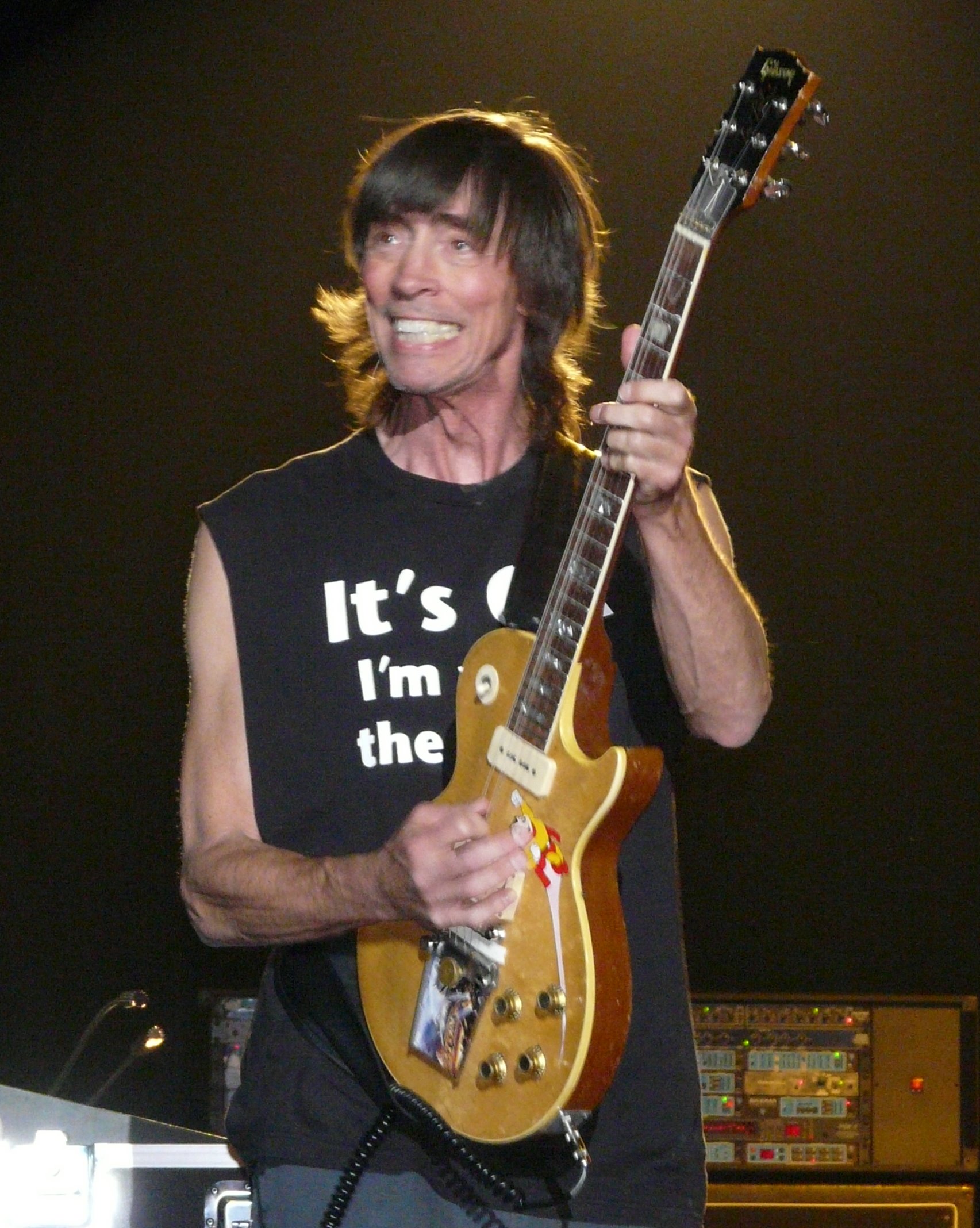
Tom Scholz’s primary guitar is the 1968 Gibson Les Paul Goldtop he calls “Mighty Mouse.” The Equipboard documentation: “Two of Tom’s main guitars: a 1968 Gold top. Initially fitted with two P90 soap bar pickups, It seems shortly after purchasing this guitar, Tom had routed out the P90 cavity and installed a Super Distortion Humbucker in the Bridge position. He refers to his #1 Les Paul as ‘Mighty Mouse’, after stripping the gold finish and applying a Mighty Mouse decal. His other #2 1968 Gold Top has two DiMarzio Super Distortions and its gold finish remained.” The 1968 Gibson Les Paul Goldtop — a specific year of Les Paul production (after the Les Paul Standard had been replaced by the SG design and then reinstated as the Les Paul in 1968) — with the factory P-90 soapbar pickups replaced by a DiMarzio Super Distortion humbucker in the bridge position. The DiMarzio Super Distortion (the high-output ceramic-magnet humbucker documented for Greg Ginn, Jeff Hanneman, and others) provides the specific high-output, aggressive character that the Boston recordings require. The “Mighty Mouse” name and decal — a cartoon mouse, applied to a guitar from which the gold finish had been stripped — is the specific aesthetic statement of a guitarist who was more interested in the instrument’s tonal performance than in its monetary value or visual prestige.
The Equipboard documentation of the second primary guitar: “His other #2 1968 Gold Top has two DiMarzio Super Distortions and its gold finish remained.” Two 1968 Goldtops, both fitted with DiMarzio Super Distortions, one stripped and decaled (Mighty Mouse), one with the original gold finish — both serving as primary Boston performance and recording guitars.
Guitar Player’s characterization of his compositional approach: “his knack for writing catchy, singable guitar melodies… Scholz also employed his harmony guitar approach quite creatively in his solos… Notice how the notes in the two parts are simply doubled an octave apart during the first two bars then switch to a climbing harmony of diatonic 3rds in bars 3 and 4, culminating with wailing, synchronized high bends and vibratos.” The harmonized guitar approach — two guitar melodies played simultaneously in diatonic thirds and octaves — is the foundational compositional technique of the Boston guitar sound. Applied both to the rhythm passages (the thickening effect of doubled guitar lines) and to the solos (the synchronized harmonized bends and vibratos), the technique gives the Boston recordings their specific dimensional fullness. This is the same harmonized guitar approach documented for Kai Hansen and Michael Weikath — confirming that the harmonized guitar approach is one of the foundational technical contributions of the 1970s arena rock tradition.
Amps
The Equipboard documentation: “In this PremierGuitar article, Scholz’s gear list includes a Marshall Super Lead 100.” The Marshall Super Lead 100 — the handwired, EL34-powered British tube head documented throughout this guide — is Scholz’s primary recording amplifier for the Boston albums. Its specific character (the warm, harmonically complex EL34 saturation at high volume) combined with the Power Soak attenuator (which allowed the Marshall to run at full saturation without the full volume output) produced the specific rich, compressed, sustaining guitar sound of the Boston recordings. The Marshall cranked to full power through the Power Soak at manageable volume is the foundational Boston studio setup.
Sweetwater: “Initially released in 1980, the Power Soak was the first guitar amplifier attenuator ever to be produced commercially, enabling guitarists to crank their tube amps to the point of saturation while maintaining a reasonably low volume level.” The Power Soak — Scholz’s first commercial product from Scholz Research & Development — allowed him to crank the Marshall Super Lead to full power (achieving natural power-amp tube saturation) while attenuating the speaker output to a practical recording level. This is the specific technical solution that made the Boston basement studio recordings possible: the Marshall’s natural saturation at full power, without the full volume that would have made the Watertown apartment uninhabitable. The Power Soak went through two more iterations, dubbed Model II and Model III, released in 1981 and 1992, respectively.
The Equipboard documentation: “Tom Scholz used MXR equalizers early on to drive the front end of various tube amplifiers, in order to create his guitar sound.” The MXR Equalizer used as a boost/drive pedal before the Marshall’s input — boosting specific frequency ranges to push the Marshall’s input stage harder and sculpt the specific tonal character before the amp’s own processing. This approach (the EQ pedal as frequency-shaping amp driver) predates the widespread use of the Tube Screamer and other overdrive pedals as amp boosters.
Effects and Inventions
Hyperspace Pedal (Homemade — Two Exist, Source of All “Out-of-This-World” Boston Sounds): The most important and most specifically irreplaceable effect in Scholz’s arsenal: From NOVA “Secret Life of Scientists and Engineers” interview: “I had to build devices to create certain sounds that I was looking for. My favorite device, is the Hyperspace Pedal as I call it. There’s only two in existence, I built them a long long time ago. As I became more adept at using them, I was able to create all those out-of-this-world sounds that people are used to hearing on Boston albums, but haven’t heard before, most likely.” The Hyperspace Pedal — homemade, two examples existing in the world, built by Scholz before the Boston debut — is the specific signal-processing device that produces the distinctive sonic character of the Boston guitar sound. No commercial product duplicates its function; the specific sounds it produces are available only on the Boston albums and in Tom Scholz’s basement studio. The name “Hyperspace” — an allusion to the science-fiction concept of faster-than-light travel, possibly also reflecting the MIT engineering culture’s specific vocabulary — reflects the specific quality of the sounds it produces: beyond the conventional range of guitar effects.
SR&D Rockman (1982 — First Commercial Amp Simulator, Forerunner of Multi-Effects): Sweetwater: “Unveiled in 1982, the Rockman was a portable headphone guitar amplifier with built-in effects and an integrated amplifier simulator. The Rockman included Distortion, Edge, two Clean modes, and echo and chorus effects.” Guitar Player: “The Boston founder’s Rockman invention was the precursor to amp sims and multi-effects.” The Rockman — a handheld device the size of a Sony Walkman, running on eight AA batteries — contained an amp simulator (compressor, distortion circuit with Clean, Edge, and Distortion modes, and a cabinet simulator) plus stereo chorus and echo. Sweetwater: “The guitar tones produced by the Rockman were voiced similarly to those Scholz used on Boston’s albums, giving them a studio-quality sheen that sounded amazing through headphones.” Guitar Player notes: “it didn’t take long for guitarists like Phil Collen, Steve Clark and Joe Satriani to realize the Rockman made a great DI for recording.”
SR&D Rockmodules (1986 — Professional Rack Effects): Sweetwater: “Rockmodules were another SR&D release. First introduced in 1986, Rockmodules were professional-level rackmount guitar effects designed to capitalize on the burgeoning ‘guitar rack’ trend. Several units were released, including the Sustainor and Distortion Generator amplifier simulators, as well as Instrument EQ, Guitar Compressor, Smart Gate, Stereo Chorus, Stereo Echo, and Stereo Chorus/Delay.” The Rockmodules extended the Rockman’s circuit into professional rack-mount form, with individual modules providing specific effects functions. Phil Collen and Steve Clark of Def Leppard used Rockmodules for the specific studio tone of Pyromania (1983) and Hysteria (1987).
“Don’t Get Me Started on the Many Shortcomings of Digital Sound” (Anti-Digital Philosophy): Premier Guitar: “‘Don’t get me started on the many shortcomings of digital sound,’ he says.” Scholz’s specific anti-digital position — from the engineer who invented the first commercial amp simulator, who pioneered the concept of recorded analog tone — is the most specifically paradoxical gear position in this guide. He invented the forerunner of amp simulators and digital multi-effects. He dislikes digital sound. The analog analog systems he built (the Power Soak, the Rockman, the Hyperspace Pedal) are superior in his view to the digital systems that subsequently built on his foundational work. His Life, Love & Hope album used “vintage gear, much of which has been in service since the debut album.”
Playing Style & Tone Philosophy
Tom Scholz’s playing style is the most engineer-informed in this guide — the approach of a musician whose guitar playing cannot be fully separated from his engineering practice. The specific quality of the Boston guitar tone — the compressed, harmonically rich, singing quality of “More Than a Feeling” — is as much the product of signal-processing engineering (the Marshall through the Power Soak, the MXR EQ driving the front end, the Hyperspace Pedal adding the specific “out-of-this-world” dimension) as of pure guitar playing. Guitar Player: “his engineering skills enabled him to design and build his own effects gear when he simply couldn’t find another way to create the sounds in his head.”
His tone philosophy is the “build it if it doesn’t exist” philosophy: “Tom designed and built several rack mount effects that he used in his studio to obtain the signature Boston sound.” The specific sounds he wanted — the compressed, harmonically rich, stereo guitar sound of “More Than a Feeling” — could not be achieved with the commercial equipment available in the mid-1970s. The Marshall Super Lead ran through the Power Soak at full saturation; the MXR EQ shaped the frequency response before the amp; the Hyperspace Pedal added the specific Boston quality that no other device in the world can produce. The Rockman was subsequently built to make these specific sounds available to other guitarists. The engineering mind and the musical mind in complete creative synthesis.
How to Sound Like Tom Scholz
Guitar: Gibson Les Paul Goldtop (1968 or similar) with a DiMarzio Super Distortion humbucker in the bridge position. The harmonized guitar approach: play the primary melody, record a second guitar part harmonized a diatonic third above throughout the passage. Pan them in the stereo field. This is the Boston guitar sound at its compositional foundation.
Amp: Marshall Super Lead 100W (cranked to full power, through a power attenuator for volume management). SR&D Power Soak or equivalent attenuator to maintain Marshall saturation at practical recording levels.
Amp Settings (Marshall Super Lead 100W — Boston Guitar Tone):
| Control | Setting (0–10) | Notes |
|---|---|---|
| Volume | 10 — FULL | Full power through Power Soak — natural EL34 saturation |
| Bass | 5 | Moderate — balanced through the MXR EQ shaping |
| Mid | 6–7 | Present — the harmonized guitar’s midrange content is the character |
| Treble | 6 | Bright but not harsh — the “out-of-this-world” Hyperspace character sits here |
| Presence | 5 | Natural — the MXR EQ and Power Soak handle the tonal shaping |
Signal chain: 1968 Les Paul Goldtop (DiMarzio Super Distortion) → MXR Equalizer (boost mids, front-end drive) → Marshall Super Lead 100W (full power) → SR&D Power Soak (attenuation) → cabinet/recording. The Hyperspace Pedal is somewhere in this chain, but you’ll need to build it yourself — and there are only two in existence, both owned by Scholz. The Rockman provides the accessible version of the Boston studio sound. The Rockmodule Sustainor/Distortion Generator provides the professional rack version. Digital sound: don’t get him started on its shortcomings.
Influence & Legacy
Tom Scholz’s influence on rock guitar and recording is specifically the influence of a musician-engineer who created the foundational tools that enabled a new approach to electric guitar recording and performance. Sweetwater: “the Power Soak was the first guitar amplifier attenuator ever to be produced commercially, enabling guitarists to crank their tube amps to the point of saturation while maintaining a reasonably low volume level.” Before the Power Soak, getting a tube amplifier’s natural saturation required the full volume of the amp. Guitar Player: “The Boston founder’s Rockman invention was the precursor to amp sims and multi-effects.” Every amp simulator, every digital multi-effects unit, every practice pedal with built-in amp modeling traces its commercial lineage to the Rockman.
His connection to Rick Nielsen as a fellow arena rock guitarist of the same generation whose songwriting craftsmanship — Scholz’s meticulous, perfectionist engineering approach versus Nielsen’s “I haven’t practised since 1967” spontaneity — represents opposite creative methodologies arriving at equally celebrated commercial results. His connection to Matthew Bellamy as a fellow guitarist who uses harmonized guitar as a primary compositional tool (Bellamy’s Manson guitars with built-in electronics, Scholz’s homemade Hyperspace Pedal) reflects the shared harmonized-guitar tradition. His connection to Devin Townsend as a fellow producer-guitarist whose studio engineering skill is integral to the final recorded character of his music reflects the shared tradition of the musician-as-engineer.
Frequently Asked Questions: Tom Scholz Boston Guitars & Gear
What guitar does Tom Scholz play?
Scholz’s primary guitar is a 1968 Gibson Les Paul Goldtop nicknamed “Mighty Mouse” — after stripping the original gold finish and applying a Mighty Mouse cartoon decal. It was originally fitted with P-90 soapbar pickups; Scholz replaced the bridge P-90 with a DiMarzio Super Distortion humbucker. His second primary guitar is another 1968 Goldtop with two DiMarzio Super Distortions, gold finish retained. His compositional approach: harmonized guitar parts (two guitars simultaneously in diatonic thirds and octaves) that give the Boston sound its specific dimensional fullness.
What is the Hyperspace Pedal?
The Hyperspace Pedal is a homemade signal-processing device built by Scholz: “My favorite device is the Hyperspace Pedal as I call it. There’s only two in existence, I built them a long long time ago. As I became more adept at using them, I was able to create all those out-of-this-world sounds that people are used to hearing on Boston albums, but haven’t heard before, most likely.” No commercial product duplicates its function; the specific sounds it produces are unique to Scholz’s studio and to the Boston recordings.
What is the SR&D Power Soak and why did Scholz invent it?
“Initially released in 1980, the Power Soak was the first guitar amplifier attenuator ever to be produced commercially, enabling guitarists to crank their tube amps to the point of saturation while maintaining a reasonably low volume level.” Scholz needed the Marshall Super Lead to run at full power (for natural tube saturation) while recording in his Watertown apartment basement — full Marshall volume was impractical in an apartment. The Power Soak solved this by attenuating the speaker output while the amplifier ran at full power, enabling the natural saturation at manageable volume.
What is the Rockman?
The Rockman (1982, Scholz Research & Development) was “a portable headphone guitar amplifier with built-in effects and an integrated amplifier simulator. The Rockman included Distortion, Edge, two Clean modes, and echo and chorus effects.” The guitar tones were voiced similarly to those Scholz used on Boston albums. It ran on eight AA batteries or AC power. It was “the precursor to amp sims and multi-effects” — every amp simulator and digital multi-effects unit commercially traces its lineage to the Rockman. Phil Collen, Steve Clark, and Joe Satriani recognized it as a great DI for recording.
What was Tom Scholz’s engineering background?
Scholz graduated from Ottawa Hills High School in Toledo, Ohio in 1965 with a 4.8/5.0 GPA, then attended MIT, earning bachelor’s and master’s degrees in mechanical engineering. He worked as a product design engineer at Polaroid while developing his basement studio and building the custom signal-processing devices. He founded Scholz Research & Development (SR&D) in 1980 with the proceeds of Boston’s success. His engineering training was directly applied to building the specific tools (Power Soak, Rockman, Hyperspace Pedal) that created the Boston sound.
Why did it take eight years between Don’t Look Back and Third Stage?
Multiple factors contributed to the eight-year gap (1978-1986): Scholz’s perfectionism (“his tendency to record many variations of even the smallest details in a song, tirelessly experimenting until he found a magical combination of sounds”), legal battles with Epic Records over the band’s recording contract, and the band member changes required to record Third Stage. Premier Guitar notes that “Boston fans have had to wait roughly a decade between album releases, either due to legal battles or Scholz’s perfectionism.” Scholz’s own characterization: “I don’t think you can repeat the same thing over and over again and still consider it art.”
What does Tom Scholz think of digital sound?
Premier Guitar: “‘Don’t get me started on the many shortcomings of digital sound,’ he says.” The irony: Scholz invented the Rockman (1982), which was the first commercial amp simulator and the direct forerunner of digital amp modeling. He prefers analog circuits — his Boston albums use vintage gear, “much of which has been in service since the debut album.” The specific compressed, harmonically rich, analog warmth of his signal chain (Marshall through Power Soak, MXR EQ, Hyperspace Pedal) is the sound he prefers, and he regards digital reproduction of that sound as inferior to the original analog sources.
Related stories
Vernon Reid Guitars & Gear: The Complete Guide to Living Colour’s Guitar Genius’s Rig
Vernon Reid's guitars, amps, and effects — the complete guide. Parker MaxxFly, PRS Vela VR, Mesa Dual Rectifiers, Roland VG-99, Eventide H9, Living Colour gear guide.
Warren DeMartini Guitars & Gear: The Complete Guide to Ratt’s Torch Guitarist’s Rig
Warren DeMartini guitars & gear: Ratt's Torch guitarist. Charvel Bomber, snakeskin, Jose-modded Plexi, Fender Super Champ, RTM pickup, slapback echo — the complete rig.
Warren Haynes Guitars & Gear: The Complete Guide to Gov’t Mule’s Guitar Master’s Rig
Warren Haynes' guitars, amps, and effects — the complete guide. Gibson Les Paul Chester, Soldano SLO-100 modified, Klon Centaur, Emma Discombobulator, and how to nail that Gov't Mule blues-rock tone.