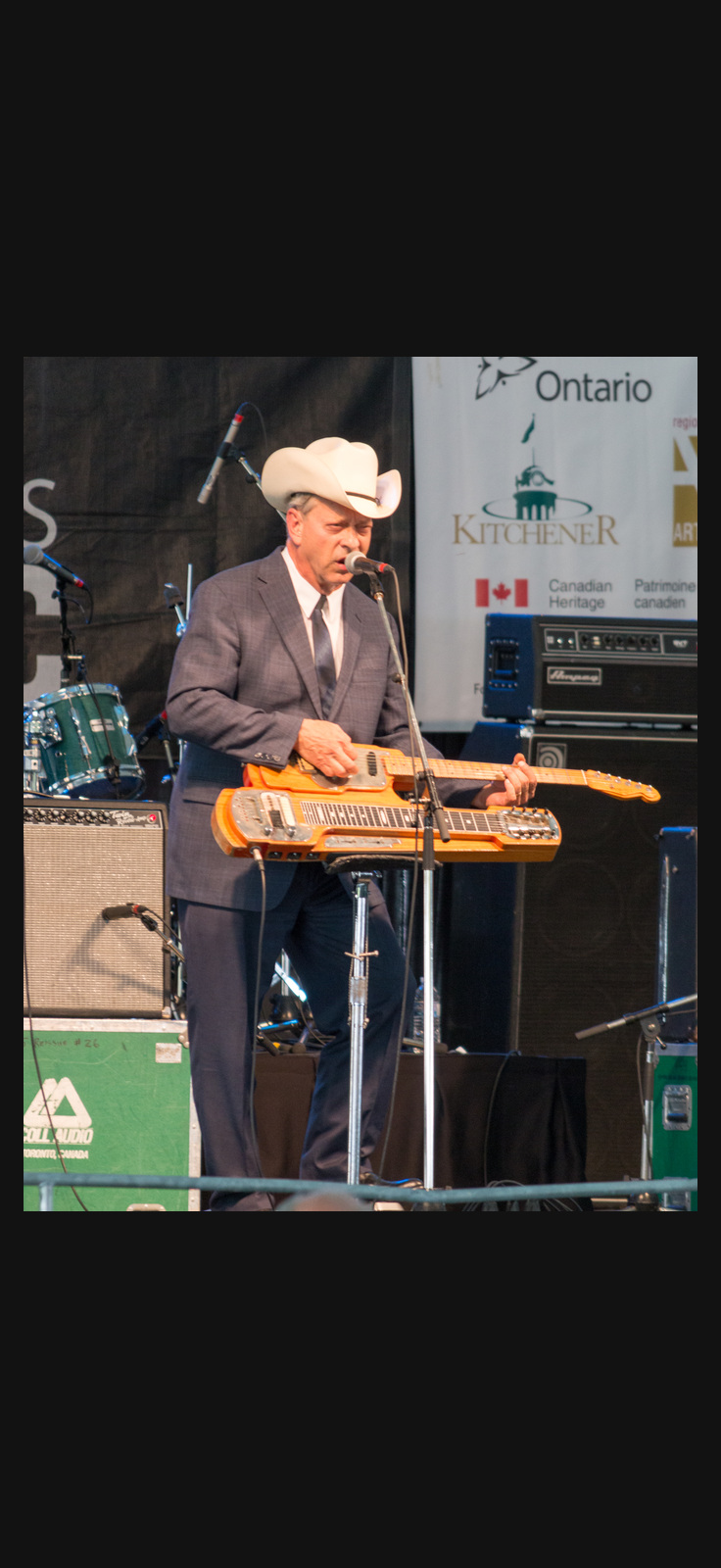
Redd Volkaert Guitars & Gear: The Complete Guide to the “Titan of the Telecaster’s” Honky Tonk Bakersfield Rig
Redd Volkaert's guitars, amps, and effects — the complete guide. 1953 Fender Telecaster blackguard primary, Fender Esquire first guitar at 13 father won in pool game used 25 years, Fender Twin Reverb 'ideally it's a Twin Reverb', 'I turn tone all way up I like them really clean volume all way up', LaBella 11-52 strings heavy picks, Roy Nichols Don Rich Jimmy Bryant top 3, Merle Haggard Strangers 1997-2016, Vancouver British Columbia 1958, Austin Continental Club, Telewacker, Grammy nominee 2004, and Titan of the Telecaster's complete rig.
“I used it for twenty-five years steady — only one I had, all I could afford at the time. I got it when I was thirteen. My dad won it in a pool game. It was an Esquire.” Redd Volkaert said this to Gear Patrol — and the specific origin story of his first guitar is the most specifically humanizing and most economically honest in this section of the guide. His father won it in a pool game. It was a Fender Esquire — the single-pickup version of the Telecaster. He used it for twenty-five years because it was the only guitar he had and he couldn’t afford another one. And then, from that foundation, he became what Guitardoor calls “arguably the greatest living exponent of traditional Telecaster playing.” Not despite the poverty of starting with one pool-game-won Esquire, but through twenty-five years of continuous use of that single instrument until every aspect of its character was as familiar as his own hands. His current primary instrument is a 1953 Fender Telecaster blackguard. His amplifier of choice: “ideally, it’s a Twin Reverb for me.” His tone philosophy, stated simply: “I turn the tone all the way up on the guitar, and to record I get the volume all the way up to get the ultimate sound out of the amp; I like ’em really clean.” Tone knob maxed. Volume maxed for recording. Really clean. His strings: La Bella HRS-BL .011 to .052. His picks: heavy. His top three Telecaster players: Roy Nichols, Don Rich, Jimmy Bryant. He was the lead guitarist for Merle Haggard’s band The Strangers from 1997 until Haggard’s death in 2016 — approximately 100 shows per year for nineteen years. He is sixty-seven years old. He holds a residency at Austin’s Continental Club. The 1953 blackguard Telecaster. Clean. Volume all the way up. Just play.
Redd Volkaert was born on March 6, 1958, in Vancouver, British Columbia, Canada. He began performing at sixteen, playing clubs six nights a week in Canada until the mid-1980s. He moved to Los Angeles in 1986, working clubs and private gigs at night while giving guitar lessons and recording during the day. He relocated to Nashville in 1990, playing clubs seven nights a week on Broadway, Printer’s Alley, and around town. He joined Don Kelley’s band for several years and built his reputation in the Nashville session world. In 1997, he was recommended for the lead guitar position in Merle Haggard’s Strangers by five of the band’s eight members after Haggard heard of his session work — he joined and remained through Haggard’s death in 2016, playing approximately 100 shows annually for nineteen years. He has released solo albums including Telewacker (1998) and No Stranger to a Tele (2001). He was nominated for a Grammy for Best Country Instrumental Performance in 2004. He relocated to Austin, where he holds a long-standing residency at the Continental Club. He is sixty-seven years old.
Background: Vancouver British Columbia, Guitar at 13 Father Won Esquire in Pool Game, Playing Clubs Six Nights a Week at 16, Los Angeles Nashville, Merle Haggard Strangers 1997-2016, Grammy Nominee 2004, Austin Continental Club
Volkaert’s specific path — from Vancouver to Los Angeles to Nashville to Austin, with the continuous thread of Telecaster playing in every honky-tonk, club, session, and major-artist supporting role — is the classic sideman’s biography: years of professional development in increasingly demanding contexts, each stage requiring higher technical and musical standards, culminating in the most demanding single position available in traditional country guitar (the Merle Haggard Strangers lead guitar spot) and then the sustained creative work of his own solo career and live residency.
His top three Telecaster players — Roy Nichols (Merle Haggard’s guitarist for decades before Volkaert), Don Rich (Buck Owens’s Buckaroos guitarist, the architect of the Bakersfield sound’s specific guitar vocabulary), and Jimmy Bryant (the 1950s virtuoso who established the Telecaster as the primary instrument of Western swing and honky-tonk) — are the specific historical lineage in which he situates himself. Vintage Guitar: “My favorites are still Roy Nichols (Merle Haggard), Don Rich (Buck Owens), and Jimmy Bryant. For Tele guys, they’re the top three.” By joining the Haggard Strangers in 1997, he stepped into the specific chair that Roy Nichols had occupied — the most specific possible form of tribute to and continuation of the tradition he cites.
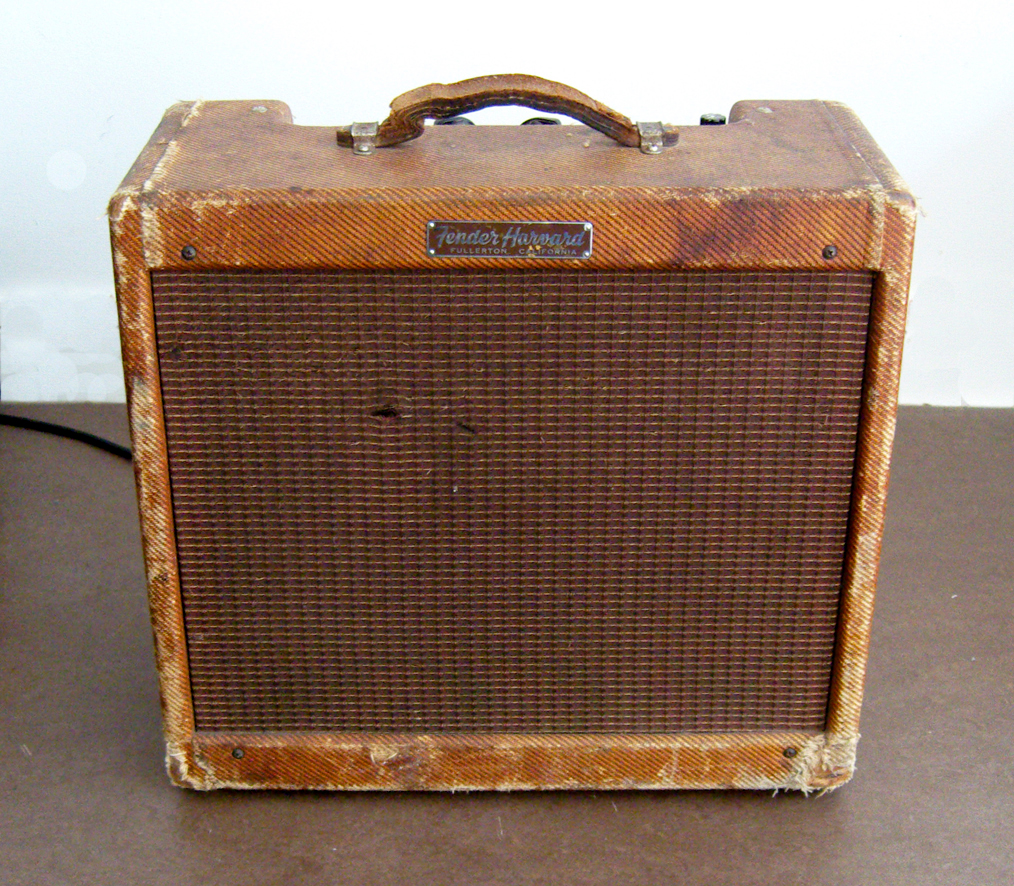
The Country Standard Time description: “as comfortable with jazz and rockabilly as he is with the classic Bakersfield sound of his boss, Merle Haggard.” The Guitardoor characterization: “His live shows are the stuff of legend—a showcase of his incredible improvisational skill, where he can take a simple country tune and launch it into the stratosphere with long, inventive, and technically dazzling solos.” The range — honky-tonk, Western swing, rockabilly, bop jazz — all played on a 1953 Telecaster through a Twin Reverb, clean. This is the Volkaert rig: the specific simplicity that contains the entire range of American roots guitar music.
The Rig: Redd Volkaert’s Guitars, Amps, and Effects
Guitars
The Gear Patrol interview quote is the foundational Volkaert guitar origin story: “I used it for twenty-five years steady — only one I had, all I could afford at the time. I got it when I was thirteen. My dad won it in a pool game. It was an Esquire.” The Fender Esquire — the single-pickup version of the Telecaster, first produced in 1950 as Fender’s original solidbody electric guitar — is the instrument on which Volkaert developed his foundational Telecaster technique. A pool-game-won Esquire, used for twenty-five years as the sole guitar, is the specific economic and biographical reality of his development: not a collection of instruments with which to experiment, but a single instrument so completely mastered that its specific character became the foundation of everything.
Country Standard Time: “Stick his ’53 Fender Telecaster in his hands, though, and it’s clear that the man is one of the finest country guitarists of his generation.” And the Guitar Player Magazine 1998 feature (as reported by Ask Zac): “In the accompanying photo, he was captured holding a number of Roy Nichols-era Haggard albums, and cradling a number of vintage Telecasters, including a blackguard.” The 1953 Fender Telecaster blackguard — the “blackguard” designation referring to the black pickguard of the early Telecaster production (1950-1954), as opposed to the later white “whiteguard” — is the specific vintage instrument that defines his primary sound. The 1953 blackguard Telecaster has a specific tonal character distinct from later Telecasters: the alder or ash body of the specific 1953 production, the original single-coil pickups with their particular wind and magnet specifications, and the specific maple neck with its early-1950s profile and fretboard radius. Ask Zac: “I had longed to hear the tunes played with a Tele and a JBL-equipped Fender amp” — the specific combination of vintage Telecaster and Fender amplification that Volkaert brought back to the Haggard Strangers position.
The Guitar Player 1998 feature documentation confirms “a number of vintage Telecasters, including a blackguard” — plural, multiple vintage Telecasters in his collection beyond the 1953 primary. The Guitardoor characterization: “a simple guitar, a great amp, and a lifetime of dedication to the craft.” His instrument collection, while documented as including multiple vintage Telecasters, is consistently reported as Telecaster-centric — the man and the instrument are inseparable in the documentation.
Volkaert’s specific tone knob approach — leaving the Telecaster’s tone control at maximum (bypassing the tone-shaping capacitor) — provides the full-bandwidth, unfiltered signal of the Telecaster pickup. The tone control on a Telecaster rolls off high frequencies as it is turned down; at maximum, all high-frequency content passes through. This “tone all the way up” approach gives the Telecaster its most cutting, most direct character — the specific brightness and clarity that distinguishes his tone from darker, tone-rolled-off country playing styles. Vintage Guitar: “I turn the tone all the way up on the guitar, and to record I get the volume all the way up to get the ultimate sound out of the amp; I like ’em really clean.”
Amps
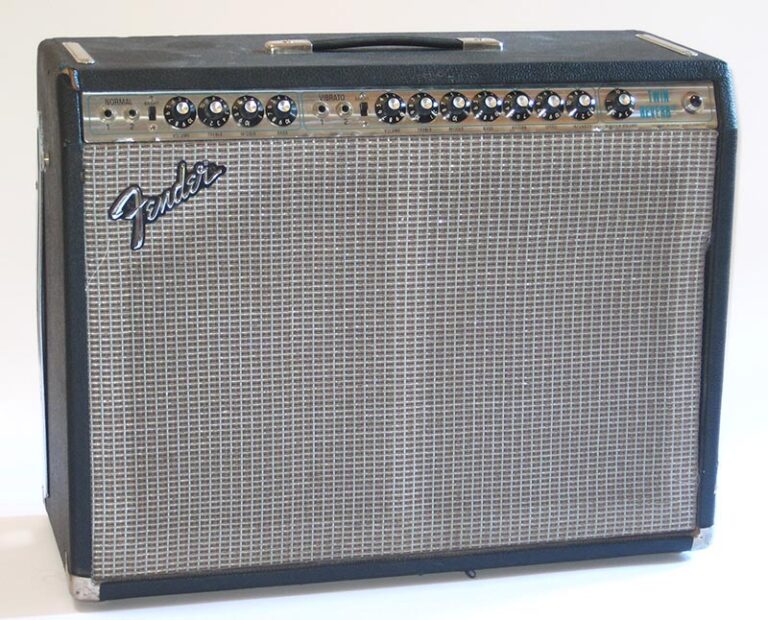
Vintage Guitar: “ideally, it’s a Twin Reverb for me.” The Fender Twin Reverb — 100 watts, two 12-inch speakers, the clean American tube character of the CBS-era Fender design — is Volkaert’s stated ideal amplification. At high volume, the Twin Reverb’s 6L6 power tubes begin to saturate naturally, producing the specific warm, clean breakup of American clean-to-crunch that is the foundational character of the traditional Telecaster tone. His preference for high volume (“to record I get the volume all the way up to get the ultimate sound out of the amp”) reflects the same approach documented for Gary Rossington and other direct-signal guitarists: the natural saturation of the amplifier at working volume, not from a drive pedal but from the amplifier’s tubes working at their intended power level.
Vintage Guitar: “I have a couple ’70s Peavey LTD 400s, but ideally, it’s a Twin Reverb for me.” The Peavey LTD 400 — a Peavey solid-state combo amp from the 1970s, known for its specific clean American tone and its use in country music contexts — appears as his alternative when the Twin Reverb is not available. The Peavey LTD 400’s reputation in country guitar circles: a solid-state amplifier that produces a specific clean, punchy American tone that complements Telecaster playing. The Ask Zac fan documentation: “I had longed to hear the tunes played with a Tele and a JBL-equipped Fender amp” — confirming that the vintage Tele into JBL-equipped Fender amplification is the archetypal Volkaert sound.
Effects and Strings
No Effects (Clean, Direct Philosophy — “A Simple Guitar, a Great Amp, and a Lifetime of Dedication”): Guitardoor: “In a world of digital effects and fleeting trends, he stands as a monument to what can be achieved with a simple guitar, a great amp, and a lifetime of dedication to the craft.” Volkaert’s approach is the most direct documented in this guide for a working country guitarist: no overdrive, no delay, no reverb pedals (beyond the Twin’s built-in spring reverb), no modulation. The 1953 blackguard Telecaster into the Fender Twin Reverb at high volume, tone control maxed. The technique — including the specific chicken-pickin’ hybrid picking approach, the bop jazz vocabulary, the Western swing chromatic runs, the honky-tonk two-position picking precision — provides all the expressive range without any electronic processing beyond the amplifier’s own character.
La Bella HRS-BL Electric Guitar Strings .011 to .052 (“Blues Light” Gauge): La Bella Strings: “Redd Volkaert uses the HRS-BL series. The HRS-BL series is a perfectly balanced set.” The La Bella HRS-BL Electric Guitar Blues Light (.011 to .052) is a heavier-than-average gauge for electric guitar playing in the country context — .011 on the first string provides additional tension and mass for the specific hybrid-picking and chicken-pickin’ attack that his playing requires. Vintage Guitar: “I use heavy picks and LaBella strings .011 to .052.”
Heavy Picks (Technique Foundation — “I Use Heavy Picks”): His “heavy picks” preference — thicker, stiffer plectrums that provide more attack and less flex — provides the specific precise, percussive attack character of his picking approach. The combination of heavy pick and .011 strings through a bright Telecaster tone (tone control maxed) into a clean Twin Reverb produces the specific clear, punchy, precise character of his lead playing. No softening of the attack through thin picks or rolled-off tone.
Playing Style & Tone Philosophy
Redd Volkaert’s playing style is the most technically comprehensive within the traditional country guitar tradition — the approach of a musician who can “effortlessly summon the authentic sounds of old-school honky-tonk, sophisticated Western swing, blistering rockabilly, and harmonically rich bebop jazz, often all within the same improvised solo” (Guitardoor). His specific tonal aspirations: “I’ve always wanted the big, thick, fat, clear jazzy sort of steel guitar tone – more neck pickup, use the lower end as much as you can” — the neck pickup’s warmth combined with the tone-maxed brightness creates the specific “thick clear” paradox that gives his jazz vocabulary its character within the country context.
His tone philosophy is the maximum-signal philosophy: tone all the way up, volume all the way up for recording, amplifier at full power for natural tube saturation. “I like ’em really clean.” Clean through the entire dynamic range — not pedal-gained but naturally saturating tubes and natural string dynamics providing the full range of expression. This is the most direct signal chain documented for a working virtuoso guitarist in this guide, and it produces some of the most technically sophisticated playing in the American roots music tradition.
How to Sound Like Redd Volkaert
Guitar: Fender Telecaster or Esquire (1950s blackguard vintage for the ideal character; any Telecaster for the approach). Tone control at maximum (10). Bridge pickup for chicken-pickin’ and articulate lead work; neck pickup for the “big thick fat clear jazzy” character. La Bella .011 to .052 strings. Heavy pick.
Amp: Fender Twin Reverb (ideally vintage, 1960s-1970s silver or blackface era) at high volume — “to record I get the volume all the way up to get the ultimate sound out of the amp.” JBL speakers in the cabinet for the specific defined character. No effects pedals.
Amp Settings (Fender Twin Reverb — Bakersfield/Western Swing Clean):
| Control | Setting (0–10) | Notes |
|---|---|---|
| Volume | 8–10 (for recording); 5–7 (for live) | “Volume all the way up to get ultimate sound out of the amp” |
| Treble | 6–7 | Present — the tone-maxed Tele adds brightness; amp treble provides shape |
| Bass | 4–5 | Moderate — “use the lower end as much as you can” (neck pickup strategy) |
| Reverb | 2–3 | Minimal spring reverb — the Haggard Strangers sound is dry |
| Vibrato | Off | Dry — the playing provides all the expression |
Essential technique: The hybrid picking approach (pick and fingers simultaneously) for chicken-pickin’; the bop jazz chromatic vocabulary for Western swing runs; the pentatonic minor/major combined approach for honky-tonk. Tone maxed. Volume high. No effects. “A simple guitar, a great amp, and a lifetime of dedication to the craft.” The first step is the pool-game-won Esquire. The twenty-five years are non-negotiable.
Influence & Legacy
Redd Volkaert’s influence is specifically as the living guardian of the traditional Telecaster-based country guitar tradition — “the greatest living exponent of traditional Telecaster playing” (Guitardoor) — and as the musician who brought that tradition back to the Merle Haggard Strangers for the final nineteen years of Haggard’s career. His influence on subsequent Telecaster-oriented country guitarists is the influence of direct example: a working musician who demonstrates nightly at the Austin Continental Club what the Telecaster is capable of in the hands of someone who has played almost nothing else for fifty-plus years.
His connection to Gram Parsons as a fellow artist in the country and roots music tradition reflects the shared roots. His connection to Danny Gatton as a fellow Telecaster master from the same tradition who was also a “musician’s musician” known within the guitar community more than to the mainstream reflects the shared position. His connection to Peter Green as a fellow guitarist whose reputation within the musician community vastly exceeds his mainstream public recognition reflects the shared “musician’s musician” status.
Frequently Asked Questions: Redd Volkaert Guitars & Gear
What guitar does Redd Volkaert play?
Volkaert’s primary guitar is a 1953 Fender Telecaster blackguard. His first guitar — and the one he used for twenty-five years — was a Fender Esquire: “I used it for twenty-five years steady — only one I had, all I could afford at the time. I got it when I was thirteen. My dad won it in a pool game. It was an Esquire.” The Guitar Player 1998 feature photographed him “cradling a number of vintage Telecasters, including a blackguard.” He is widely regarded as “among the country’s top Telecaster guitar slingers.”
What amplifier does Redd Volkaert prefer?
Vintage Guitar: “I have a couple ’70s Peavey LTD 400s, but ideally, it’s a Twin Reverb for me.” His primary ideal amplification is the Fender Twin Reverb — “I turn the tone all the way up on the guitar, and to record I get the volume all the way up to get the ultimate sound out of the amp; I like ’em really clean.” High volume, natural tube saturation, clean character. The Peavey LTD 400s serve as practical alternatives when the Twin Reverb is not available.
What is Redd Volkaert’s tone philosophy?
Vintage Guitar: “I turn the tone all the way up on the guitar, and to record I get the volume all the way up to get the ultimate sound out of the amp; I like ’em really clean.” Maximum tone control (no high-frequency rolloff), maximum volume (natural tube saturation), clean amplifier character. La Bella HRS-BL .011 to .052 strings and heavy picks provide the specific attack character. No effects pedals. Guitardoor: “a simple guitar, a great amp, and a lifetime of dedication to the craft.”
Who are Redd Volkaert’s primary Telecaster influences?
Vintage Guitar: “My favorites are still Roy Nichols (Merle Haggard), Don Rich (Buck Owens), and Jimmy Bryant. For Tele guys, they’re the top three.” Roy Nichols (Haggard’s guitarist, “thicker, more midrange barking sound”), Don Rich (“a real thin sort of chicken-pickin’ sound”), and Jimmy Bryant (1950s Western swing virtuoso). His stated tonal aspiration: “I’ve always wanted the big, thick, fat, clear jazzy sort of steel guitar tone – more neck pickup, use the lower end as much as you can.”
How did Redd Volkaert join Merle Haggard’s Strangers?
In 1997, after the departure of previous lead guitarist Joe Manuel, Volkaert was recommended for the Strangers position by five of the band’s eight members after Haggard heard of his Nashville session work at Robert’s Western World. He joined the band and remained through Haggard’s death on April 6, 2016 — approximately 100 shows annually for nineteen years. He stepped into the chair previously occupied by Roy Nichols, one of his three cited top Telecaster players, playing Nichols’s parts with his own personal approach.
What are Redd Volkaert’s solo albums?
Volkaert has released several solo albums on HighTone Records, including Telewacker (1998) and No Stranger to a Tele (2001). Country Standard Time: “It’s along the same lines as the last one in that it’s six (vocal numbers) and eight instrumentals.” He was nominated for a Grammy for Best Country Instrumental Performance in 2004. He currently holds a long-standing residency at Austin’s Continental Club, where he performs regularly with his own band.
What is the “Titans of the Telecaster” designation?
Wikipedia: “Volkaert frequently performs in the company of his fellow Telecaster stalwart Bill Kirchen, formerly of Commander Cody and the Lost Planet Airmen. Together, they are often referred to as the ‘Titans of the Telecaster’ due to their ability and notoriety with the instrument.” The “Titans of the Telecaster” designation for Volkaert and Kirchen acknowledges both musicians as the primary living masters of traditional country Telecaster playing — the specific honky-tonk, Western swing, and Bakersfield-sound Telecaster vocabulary that has been the backbone of traditional country guitar since the 1950s.
Image credits
- A Fender Harvard amplifier: Mfretton, Wikimedia Commons, CC0.
- Fender Twin Reverb: Micahmedia, Wikimedia Commons, CC BY 3.0.