
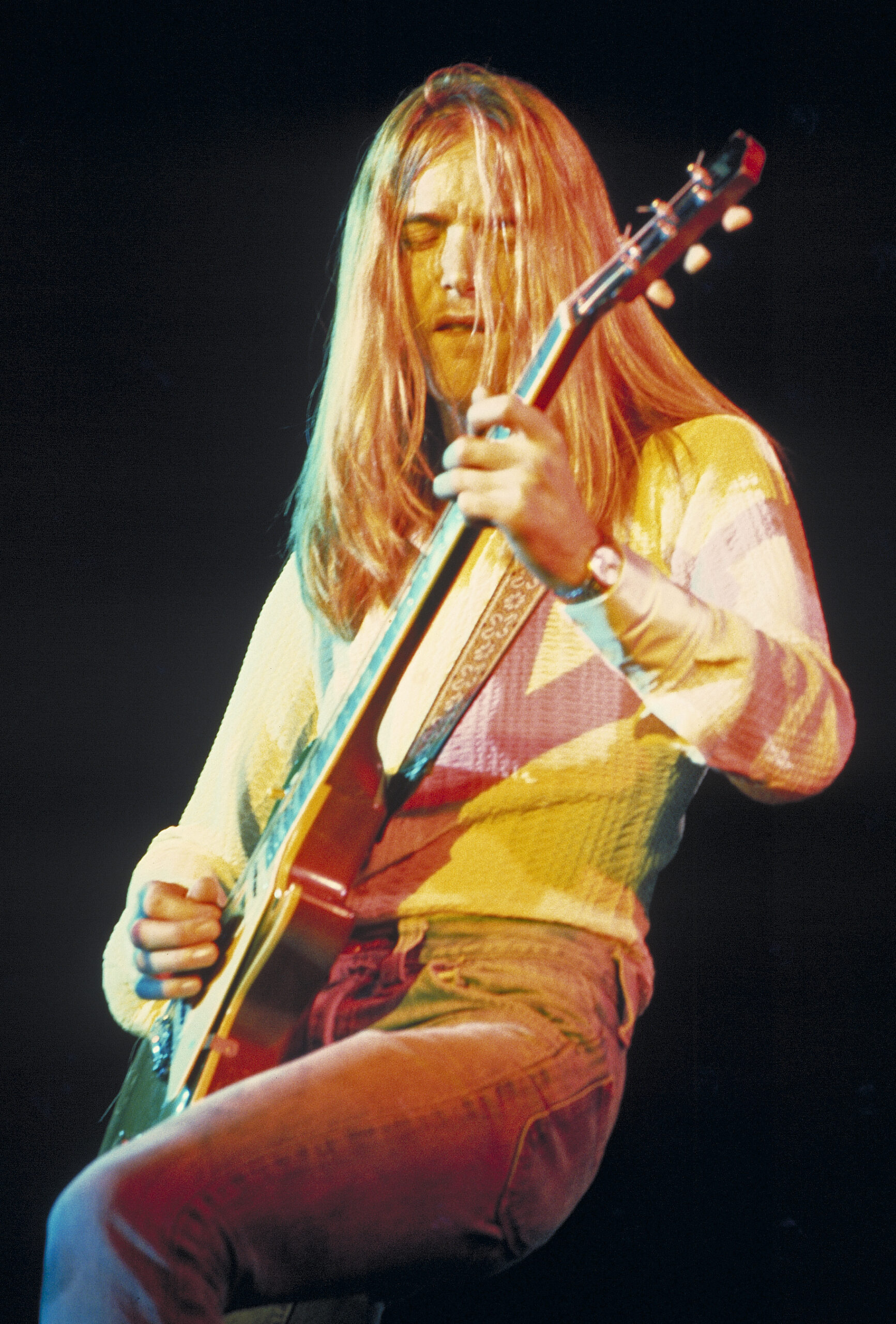
If British blues-rock had a founding father nobody talks about enough, it’s Kim Simmonds. While the world was busy making legends of Clapton, Beck, and Page, Simmonds was doing the exact same work — arguably more faithfully — fronting Savoy Brown from 1966 until his death in December 2022, a run of musical dedication so long and so consistent it makes most careers look like a gap year. He wasn’t chasing trends. He wasn’t reinventing himself every album cycle. He was playing the blues, playing it with authority, playing it on exceptional equipment, and playing it for whoever showed up — which, across half a century, was a lot of people.
The Journey
Gear Timeline
The gear Simmonds used across his career is a roadmap through the golden age of British blues tone: pre-CBS Fenders, vintage Gibsons, cranked British valve amplifiers, and a signal chain that prioritised feel over flash at every turn. If you want to understand how a blues-rock guitarist sounds genuinely organic and alive rather than processed and modern, Simmonds is the masterclass. This is the full breakdown.
Background
Kim Simmonds was born on December 5, 1947, in Newbridge, Monmouthshire, Wales. He founded Savoy Brown Blues Band — quickly shortened to Savoy Brown — in London in 1966, making him a direct contemporary of the players who would ignite the British blues explosion. What’s remarkable is that while most of those contemporaries moved on — into folk rock, art rock, hard rock, or outright commercial pop — Simmonds stayed. Savoy Brown remained a working blues-rock band for over fifty-five years, with Simmonds as the sole constant member through literally dozens of lineup changes.
The classic Savoy Brown era runs from 1969 through 1972 — albums like Blue Matter (1969), Raw Sienna (1970), Looking In (1970), and Street Corner Talking (1971) represent the band’s commercial and artistic peak. These records featured vocalist Chris Youlden and a rotating cast of players who somehow, under Simmonds’s musical direction, produced a series of remarkably cohesive and powerful blues-rock documents. Street Corner Talking in particular is an underappreciated masterpiece of the genre.
Simmonds was also a serious visual artist, and this sensibility extended to his relationship with his instruments. He understood equipment aesthetically as well as functionally, and his gear choices were never arbitrary. He knew what a 1950s Les Paul Goldtop sounded like versus a 1960 Standard. He knew the difference between a pre-CBS Fender and a post-’65 CBS model. He was a collector and connoisseur as much as a working musician, and this knowledge infused both his playing and his sound.
He continued recording and releasing albums well into the 2010s and early 2020s — Snake Drive (2019) and Ancient Connections (2020) demonstrated that his playing had not diminished with age. He died on December 13, 2022, in Syracuse, New York, leaving behind one of the most quietly remarkable bodies of work in British blues-rock.
The Rig: Kim Simmonds’s Guitars, Amps, and Effects
Guitars
This is the instrument most closely associated with Kim Simmonds in the classic Savoy Brown period. The 1957 Goldtop — finished in the distinctive gold lacquer Gibson used from 1952 through 1957 — was fitted with a pair of P-90 single-coil soapbar pickups, Gibson’s design that predated the humbucker and which has a uniquely aggressive, harmonically rich character that humbuckers don’t replicate. The P-90 has a wider coil than a standard single-coil but is not hum-cancelling like a PAF humbucker, giving it a slightly raw, present quality with more midrange bite. The 1957 Goldtop’s mahogany body and neck with rosewood fretboard produced a characteristically warm, woody tone that fed beautifully into Simmonds’s cranked British amplifiers. The trapeze tailpiece configuration of earlier Goldtops had been replaced by the wrap-around stoptail by 1955, giving better sustain and intonation. This guitar is heard all over the classic Savoy Brown recordings.
Simmonds also used late-1950s/early-1960s Les Paul Standards, the legendary “burst” configuration with sunburst finish and Seth Lover’s Patent Applied For (PAF) humbuckers. The PAF humbucker — wound on a bobbin by hand to approximately 7.5k–8.5k ohms DC resistance with Alnico II or Alnico V magnets depending on production batch — delivers a warmer, more compressed tone than the P-90 with dramatically reduced hum. The transition between P-90 and PAF Goldtops and Standards in Simmonds’s playing produced subtly different tonal characters: the P-90 guitars are brighter and more aggressive, the humbucker guitars warmer and more sustaining. He was fluent in both.
Simmonds was a devoted user of pre-CBS Fender Stratocasters, particularly examples from the late 1950s and early 1960s with the original single-coil pickups. Pre-CBS Strats — those built before CBS Corporation acquired Fender in January 1965 — are distinguished by their slab rosewood fretboards (1959–1962) or round-lam rosewood boards (1962–1965), nitrocellulose lacquer finishes, and the Fender original tremolo with six individual saddles. The pre-CBS Strat’s tone is leaner and more dynamic than post-CBS examples, with the original Alnico V single-coil pickups producing a bright, glassy, transparent sound that contrasted strikingly with his Les Paul tones. On recordings where you hear Simmonds producing that sparkling, slightly funky clean tone, a pre-CBS Strat is almost certainly the instrument.
Telecasters appeared in Simmonds’s arsenal at various points, particularly for material requiring that distinctive Tele snap and twang. The single-coil bridge pickup of a vintage Tele produces arguably the most aggressively articulate clean tone of any production guitar, and Simmonds used this characteristic to cut through ensemble textures with precision. Vintage Teles from the 1950s and early 1960s used the same Alnico V single-coil philosophy as the Stratocaster but in a simpler, more direct configuration that produces even greater top-end definition.
Semi-hollow body Gibsons, specifically the ES-335 — introduced in 1958 as the world’s first commercially produced semi-hollow thinline electric — appeared in Simmonds’s live and studio work. The ES-335’s laminated maple top with solid mahogany centre block combines the acoustic warmth and feedback characteristics of a full hollow body with the sustain and feedback resistance of a solid body. Fitted with PAF-spec humbuckers, the ES-335 produces a characteristically warm, rounded tone with exceptional note bloom — perfectly suited to slow blues and expressive lead work.
The SG Standard — introduced in 1961 as the replacement for the Les Paul (before Les Paul demanded his name be removed) and featuring a double-cutaway mahogany body, glued-in neck at the 22nd fret for extreme upper-register access, and PAF-transitional or Patent Number humbuckers — also appeared in Simmonds’s setup. The SG’s lighter weight and more aggressive midrange character compared to the Les Paul gave a different tonal palette for specific material.
Simmonds favoured light-to-medium gauge strings — typically .010–.046 or .011–.049 — consistent with the approach of most blues players of his generation who needed sufficient string mass for expressive bending while keeping playability manageable across long touring schedules. He was known to use Ernie Ball and GHS Boomers at various points in his career.
Amps
The JTM45 was Marshall’s first production amplifier, introduced in 1962 and based closely on the Fender Bassman 5F6-A circuit with modifications by Jim Marshall and Ken Bran. The JTM45 uses KT66 output tubes (early models) or EL34s (later versions), a GZ34 rectifier tube, and produces approximately 45 watts RMS. Its circuit topology — long-tailed pair phase inverter, cathode-follower tone stack — produces a characteristically warm, slightly saggy tone with excellent note separation and a natural compression that responds intuitively to pick attack. Simmonds used JTM45 heads — typically into 4×12 cabinets loaded with Celestion G12 speakers (either the original Celestion T530 alnico models or the later ceramic G12M “Greenback”) — as his primary live and studio amplification during the classic Savoy Brown period. The JTM45’s clean headroom combined with its smooth overdrive character were ideally matched to the P-90 and PAF-equipped Gibsons.
The 1959 Super Lead — Marshall’s 100-watt EL34-powered head that became the defining amplifier of British hard rock — also appeared in Simmonds’s setup as Savoy Brown’s sound evolved toward heavier territory in the early 1970s. The 1959 uses four EL34 output tubes in push-pull configuration, two ECC83 (12AX7) preamp tubes plus an ECC83 phase inverter, and produces approximately 100 watts RMS. Cranked into a 4×12 cabinet, it delivers the saturated, harmonically complex lead tone heard on recordings like Street Corner Talking.
The original tweed Fender Bassman in its 5F6-A circuit configuration — four 10-inch Jensen P10R speakers in a piggyback cabinet, 4x6L6 output tubes producing approximately 45–50 watts — was a foundational blues amplifier that directly inspired the JTM45 design. Simmonds used vintage Bassman heads as both studio and live tools, particularly paired with his Fender guitars. The 5F6-A circuit’s cathode-biased topology produces extraordinary touch sensitivity and natural compression, making it one of the most expressive blues amplifiers ever built.
The Vox AC30 — 30 watts from four EL84 output tubes, with the Top Boost modification adding a separate treble and bass control for the second channel — produces a characteristically chiming, harmonically rich clean tone that is distinct from both Marshall and Fender. Simmonds occasionally used AC30s for specific tonal requirements, particularly when recording material that needed the Vox’s particular quality of clean sparkle and natural compression at moderate volumes.
Laney’s Supergroup amplifiers — built in Birmingham and sharing circuit topology with the Marshall 1959 but with specific component differences that give a slightly different tonal character — appeared in Simmonds’s rig during touring. The LA100BL uses EL34 tubes and produces 100 watts with an aggressive midrange character similar to but distinct from the Marshall equivalent.
Simmonds used Marshall 1960A and 1960B 4×12 cabinets loaded with Celestion G12M “Greenback” 25-watt speakers (featuring the characteristic ceramic magnet and 20oz magnet weight that gives Greenbacks their compressed, harmonically complex character) throughout the classic period. The Greenback’s 75Hz resonant frequency and 98dB sensitivity suited the JTM45 and 1959 Super Lead’s output characteristics perfectly.
Effects
The original Dallas Arbiter Fuzz Face — a two-transistor fuzz circuit using NKT275 or BC108 germanium PNP transistors — was a standard tool in Simmonds’s early blues-rock setup. Germanium Fuzz Faces are notoriously temperature-sensitive and variable between units, but the best examples produce a warm, singing fuzz with excellent note separation that cleans up beautifully when the guitar’s volume is rolled back. Simmonds used the Fuzz Face to push already-overdriving amplifiers into more sustained, harmonically complex territory for lead work.
The original Vox V846 wah — using a Fasel inductor, 100k audio taper potentiometer, and the original Clyde McCoy circuit topology — was Simmonds’s primary wah pedal during the classic period. The V846’s tonal sweep is broader and warmer than many later wah designs, producing a vocal quality particularly well suited to blues lead playing. The Fasel inductor’s resonant peak characteristic gives the V846 a more pronounced and musical sweep than inductors used in later production models.
The Dallas Electronics Rangemaster Treble Booster — a single-transistor germanium circuit using an OC44 PNP transistor, designed to boost the treble frequencies that early British amplifiers (particularly the AC30) rolled off — was a foundational device in the British blues-rock signal chain. Running before an already-overdriving Marshall or Vox, the Rangemaster adds harmonic richness, increased sustain, and a characteristic mid-forward push that defines a great deal of classic British blues tone. Simmonds used a Rangemaster or similar treble booster to drive his amplifiers harder and add sustain without resorting to heavy pedal fuzz.
The Sola Sound Coloursound Tonebender MkII — a three-transistor fuzz using OC75 or OC81D germanium PNP transistors — produces a warmer, more sustaining fuzz character than the two-transistor Fuzz Face. The Tonebender MkII’s circuit produces a characteristic mid-forward, almost velvet-smooth fuzz at high sustain settings while retaining clarity at moderate settings. It appeared in Simmonds’s setup alongside or in alternation with the Fuzz Face depending on the material being recorded.
The Maestro Echoplex EP-2 — a tape-based echo unit using a 1/4-inch recording tape loop, tube preamp (12AX7), and variable tape speed for delay time adjustment — provided Simmonds with warm, organic tape echo that added dimension to lead lines without the sterile quality of later digital delay. The EP-2’s tube preamp stage adds a subtle harmonic warmth to the signal even when the echo effect itself is set to short repeats or minimal mix level. Simmonds used tape echo primarily in the studio for adding depth to solos.
A passive volume pedal — either Ernie Ball’s 6166 or the DeArmond 1602/1610 — was present in Simmonds’s live rig for controlling dynamics between rhythm and lead passages and for executing slow swells on ambient or atmospheric sections.
Playing Style & Tone Philosophy
Kim Simmonds was, in the most precise sense possible, a blues guitarist. Not a blues-influenced rock guitarist, not a guitarist who occasionally played blues — a blues guitarist who happened to work in a band context that amplified and electrified the tradition. His touchstones were the Chicago electric blues masters — Muddy Waters, Buddy Guy, Otis Rush — and the Texas players like Freddie King and T-Bone Walker, absorbed through records and filtered through the particular sensibility of a Welsh kid in 1960s London who found in the blues something that spoke to him in a way nothing else did.
His pick technique was authoritative without being aggressive — he played with a medium-gauge pick and a relatively relaxed grip that allowed the pick to give slightly on contact with the string, producing a rounder, warmer attack than the more percussive approach of his contemporaries. This quality is audible in the recording: Simmonds’s notes arrive with weight rather than sharpness, which is partly technique and partly tone but mostly an expression of musical philosophy. He wasn’t trying to cut through the mix at any cost; he was trying to communicate something specific with every note.
Vibrato was central to his expressiveness. His left-hand vibrato — applied by rotating the wrist rather than the more limited finger-only approach — was wide, slow, and consistent, modelled closely on the Chicago and Texas blues tradition. The vibrato on a sustained Simmonds note is itself a musical statement: it has shape, it has direction, it has emotional content. This is not something you develop in a practice room in six months; it’s the product of years of devoted listening and playing, of studying the source material at the level of individual inflections.
His relationship with feedback and controlled distortion was sophisticated. He understood that a humbucker-equipped Gibson driving a cranked JTM45 would produce feedback at certain frequencies and certain angles to the speaker, and he incorporated this into his playing rather than fighting it. Controlled feedback — allowing a note to sustain into feedback and then resolving it — is one of the most expressive tools in electric blues and is one of the things that gives Simmonds’s live recordings their sense of danger and spontaneity.
Tonally, Simmonds had a deep conviction that less processing was more. His signal chain was designed to amplify and extend the natural character of his instruments rather than transform them. The guitar — almost always a vintage instrument with a distinctive individual voice — ran into minimal processing (perhaps a treble booster or fuzz at need) and then directly into a valve amplifier that was doing most of the tonal heavy lifting. The result is a tone that sounds like it comes from a real room, played by a real person, on a real guitar, through a real amp — which, increasingly, is the rarest luxury in recorded music.
How to Sound Like Kim Simmonds
Guitar Approach
A vintage-correct or vintage-inspired instrument is strongly recommended for authentic Simmonds tone. A Gibson Les Paul Standard with PAF-spec humbuckers (Gibson ’57 Classics, Seymour Duncan Seth Lover SH-55, or Throbak SLE-101 PAF clones) will get you into the ballpark for his Les Paul tones. For the P-90 character, a Gibson Les Paul Junior, Special, or a Standard fitted with Lindy Fralin P-90s or Jason Lollar P-90s will deliver the brightness and aggression of his Goldtop work. For Strat-based Simmonds tones, a Fender American Vintage II 1957 Stratocaster or a pre-CBS reissue with period-correct Alnico V pickups is the target.
Set your guitar’s tone control around 7–8 rather than full up — this rolls off just enough high-end harshness to give the tone a slightly more vintage character, particularly through a driven amplifier. Keep the volume full up and let the amp do the work. Use a medium-gauge celluloid or tortex pick — approximately 0.88mm–1.0mm — and focus on pick angle and attack consistency.
Amp Approach
A vintage-circuit Marshall — JTM45 reissue, 1987x Plexi reissue, or a quality boutique equivalent like a Ceriatone JTM45, Two-Rock Classic Reverb Signature, or Friedman BE-50 Deluxe — is the target amplifier. Run it into a 2×12 or 4×12 cabinet loaded with Celestion G12M Greenback 25-watt speakers, which are critical to achieving the compressed, harmonically rich character of the classic British blues tone. Set the master volume to push the output tubes into natural compression — you want the amp working hard, not sitting at bedroom levels. Add a germanium treble booster (Dallas Rangemaster clone, Catalinbread CB30, or Analogman Beano Boost) in front for additional harmonic richness and sustain without heavy fuzz.
| Control | Setting (0–10) | Notes |
|---|---|---|
| Gain / Preamp Volume | 7–8 | Natural valve overdrive — JTM45-style saturation, not modern high-gain |
| Bass | 5–6 | Controlled warmth — don’t go above 6 or humbuckers will get muddy |
| Mids | 7–8 | Forward and present — this is the spine of British blues tone |
| Treble | 5–6 | Enough clarity for P-90 articulation, not brittle |
| Presence | 4–5 | Moderate — JTM45 presence circuit is subtle, don’t overdo it |
| Master Volume | 7–9 | Push the output tubes — the natural compression is the point |
| Reverb | 2–3 | Light spring reverb — Simmonds rarely used heavy reverb |
| Treble Booster (front of amp) | 6–7 | Germanium Rangemaster-style booster — sustain and harmonic density |
Add a germanium Fuzz Face clone (Dunlop GermaniumFuzz, Analogman Sunface NKT275, or BC108 version for brighter attack) for lead work. Keep the fuzz’s sustain control around 6–7 — you want singing sustain, not gated splat. Run the Vox V846 wah or a Dunlop 535Q (set to mimic the V846’s warmer sweep) before the fuzz for wah-fuzz combinations. Tape echo (Echoplex EP-2 clone, Fulltone Tube Tape Echo, or T-Rex Replicator) at 200–350ms for lead depth.
Influence & Legacy
Kim Simmonds and Savoy Brown were present at the creation of the British blues-rock genre — not as observers but as founding architects. The band’s 1966 formation predates the Blues Breakers, the Jeff Beck Group in its live form, and the earliest Led Zeppelin rehearsals. Simmonds was playing amplified British electric blues before it had a name, before it had a commercial infrastructure, before the music press knew what to do with it.
His influence on subsequent generations of blues-rock players is real but diffuse — the kind of influence that doesn’t necessarily come through direct citation but through the accumulated weight of recordings that defined what the genre could sound like. The Savoy Brown records of 1969–1972 are in the libraries of serious blues-rock guitarists from every subsequent decade, and the approach Simmonds embodied — vintage instruments, valve amplifiers, minimal processing, maximum expressiveness — is now the orthodoxy of the genre worldwide.
Among his direct contemporaries, the comparison with Peter Green is instructive and unavoidable: both players used vintage Gibsons through British valve amplifiers to produce electric blues of extraordinary emotional depth, both were deeply faithful to the source material, and both ultimately demonstrated that British musicians could not merely replicate American blues but could find something genuinely their own within it. The contrast with Rory Gallagher — another fiercely dedicated blues purist of the same generation — illuminates Simmonds’s particular approach to tone and arrangement: where Gallagher was rawer and more physical, Simmonds was slightly more refined, more studio-conscious, more interested in the ensemble context of the guitar rather than the guitar as solo statement. And the connection to Mike Bloomfield — Simmonds’s American counterpart in the project of translating Chicago blues into the language of a plugged-in generation — reveals how the same source material could produce such different but equally valid results on either side of the Atlantic.
Simmonds played until the end. His final albums were serious, committed, musically alive. He never phoned it in, never coasted, never stopped being curious about the blues and what it still had to teach him. That kind of devotion to craft is, in the end, the thing he leaves behind — more valuable than any individual recording, more lasting than any single riff.
Frequently Asked Questions: Kim Simmonds Guitars & Gear
What was Kim Simmonds’s main guitar?
Simmonds is most closely associated with a 1957 Gibson Les Paul Goldtop fitted with P-90 soapbar single-coil pickups — the pre-humbucker configuration that gives the Goldtop its characteristic aggressive, bright, and harmonically complex tone. He also used late-1950s Les Paul Standards with original PAF humbuckers and pre-CBS Fender Stratocasters, making his guitar arsenal a who’s-who of the most collectible vintage instruments in existence.
What amplifier did Kim Simmonds use on the classic Savoy Brown records?
The Marshall JTM45 — Marshall’s original production amplifier, based on the Fender Bassman 5F6-A circuit and using KT66 or EL34 output tubes — was central to Simmonds’s classic tone. He also used the Marshall 1959 Super Lead 100-watt head as Savoy Brown moved toward heavier territory in the early 1970s, and vintage Fender Bassman heads with his Fender guitars. The combination of a P-90-equipped 1957 Goldtop into a cranked JTM45 through a Celestion Greenback 4×12 is the sound of the classic Savoy Brown period.
Did Kim Simmonds use a treble booster?
Yes — the Dallas Electronics Rangemaster Treble Booster, a single-transistor germanium circuit using an OC44 PNP transistor, was a component of Simmonds’s signal chain. The Rangemaster boosts the upper midrange and treble frequencies, driving the front end of a valve amplifier harder and adding harmonic richness and sustain. It’s a device closely associated with the entire British blues-rock generation and is fundamental to achieving the correct vintage British blues tone rather than a more modern, processed approximation.
What fuzz pedal did Kim Simmonds use?
Simmonds used both the Dallas Arbiter Fuzz Face — specifically early germanium versions using NKT275 transistors — and the Sola Sound Coloursound Tonebender MkII, which uses OC75 or OC81D germanium PNP transistors for a warmer, more velvet-smooth fuzz character. Both are classic British fuzz designs of the late 1960s, and Simmonds used them to push already-overdriving Marshall amplifiers into higher-sustain, more harmonically complex territory for solo work.
What made Kim Simmonds’s blues tone different from other British players of the era?
Simmonds’s tone was characterised by its warmth, its dynamic range, and its faithfulness to the acoustic character of vintage instruments. Where players like Beck and Page were already pushing toward rock and experimental territory, Simmonds stayed closer to the blues source material — choosing tonal approaches that emphasised expressiveness and feel over power and aggression. The combination of P-90-equipped Goldtops, JTM45 amplification, and a germanium signal chain produced a sound that was simultaneously raw and refined, clearly descended from Chicago and Texas electric blues but uniquely its own.
Did Kim Simmonds use any unique guitar tunings or techniques?
Simmonds worked primarily in standard tuning, consistent with the Chicago and Texas blues tradition he drew from. His distinguishing technical characteristics were his left-hand vibrato — wide, wrist-rotated, and emotionally expressive in the manner of Buddy Guy and Otis Rush — his dynamic control through pick attack variation, and his sophisticated use of controlled amp feedback for sustain in live performance. He did not pursue alternate tunings or extended technique for its own sake; his focus was always on emotional expression within the conventional vocabulary of electric blues.
How many albums did Kim Simmonds record with Savoy Brown?
Kim Simmonds recorded approximately 35 studio albums with Savoy Brown across his career, from the debut Shake Down in 1967 through to Ancient Connections in 2020 — a recording career spanning over fifty years. This extraordinary longevity, combined with consistent quality particularly in the classic 1969–1972 period and the later albums from the 2010s, makes Simmonds one of the most prolific and dedicated figures in the entire British blues-rock genre.
Related stories
Ted Turner Guitars & Gear: The Complete Guide to Wishbone Ash’s Twin Guitar Pioneer’s Rig
Ted Turner guitars & gear: Wishbone Ash's twin-lead pioneer. Stratocasters, Firebird, Orange amps, and the Argus-era tone fully explained.
The Edge Guitars & Gear: The Complete Guide to U2’s Guitar Genius’s Rig
The Edge's guitars, amps, and effects — the complete guide. Gibson Explorer, Vox AC30, dotted eighth-note delay, Korg SDD-3000, and how to nail that massive U2 tone.

Tim Henson Guitars & Gear: The Complete Guide to Polyphia’s Guitar Innovator’s Rig
Tim Henson's guitars, amps, and effects — the complete guide. Ibanez TOD10, TOD10N nylon, Fractal Axe-FX, Neural DSP Archetype, hybrid picking, and how to nail that Polyphia clean-crunch tone.