
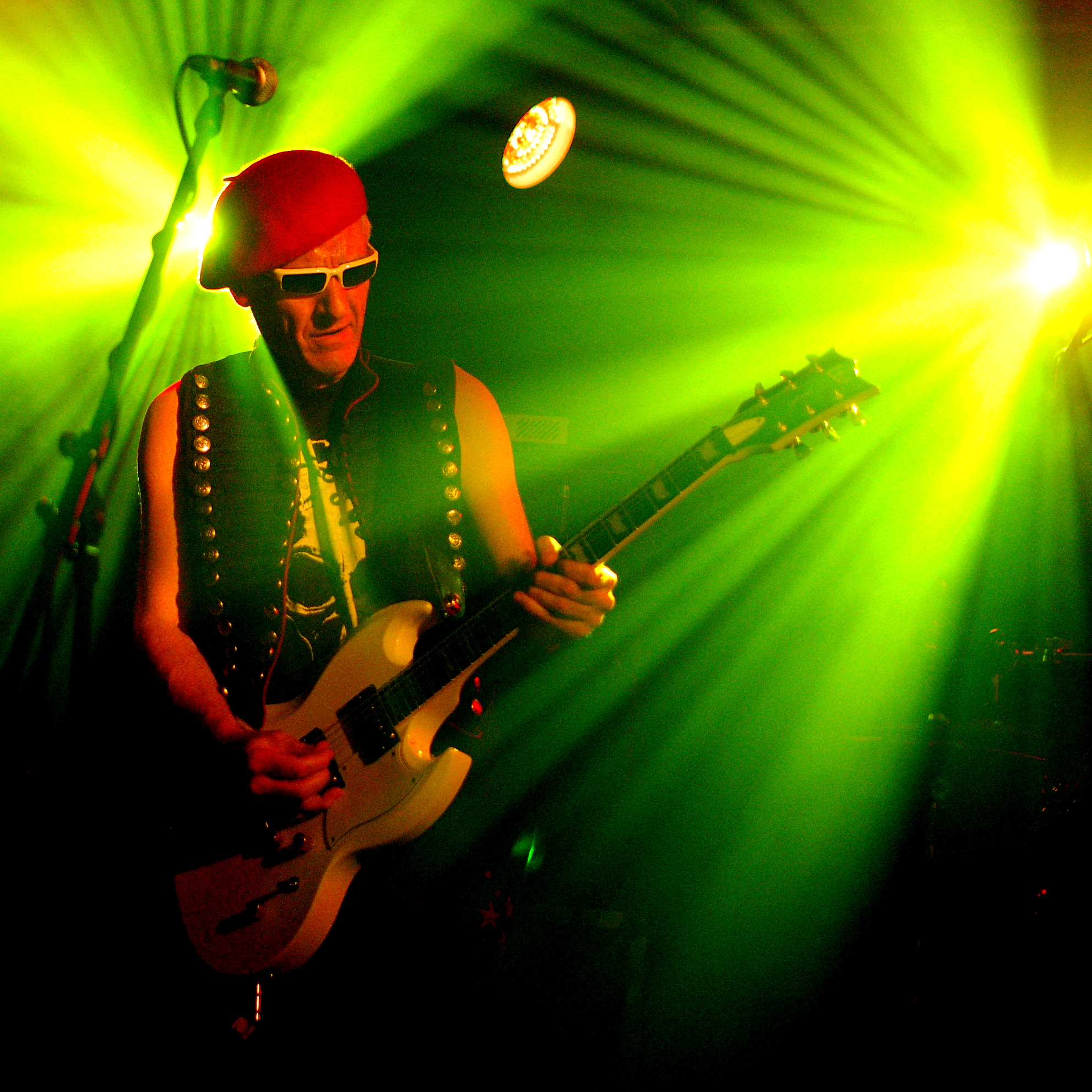
Captain Sensible guitars gear is the subject of British punk’s most deceptively skilled guitar setup — the equipment and approach of a player who appeared to most observers as a cartoon figure of anarchic punk chaos but who was in fact a guitarist of genuine technical accomplishment and musical breadth operating within a genre that actively discouraged both. Raymond Ian Burns — born in Balham, South London, and known professionally as Captain Sensible since The Damned’s formation in 1976 — was playing lead guitar for one of Britain’s founding punk bands while simultaneously absorbing the psychedelic rock, progressive rock, and avant-garde influences that would give The Damned a musical ambition that most of their punk contemporaries didn’t share. The Damned were the first British punk band to release a single (“New Rose,” 1976), the first to release an album (Damned Damned Damned, 1977), and arguably the most genuinely musically diverse of the movement’s first generation.
The Journey
His parallel solo career — which produced the inexplicable 1982 UK number one single “Happy Talk” (from South Pacific, of all things) and several albums demonstrating a range from punk through pop through psychedelia — demonstrated that the Captain Sensible persona was a deliberate artistic choice rather than a limitation, and that the musician beneath the name had interests and abilities well beyond the three-chord punk context in which he became famous. This is the complete breakdown of Captain Sensible guitars gear, technique, and tonal philosophy.
Background
Raymond Ian Burns was born on April 23, 1954, in Balham, South London — a working-class area south of the Thames that gave him the specific cultural background that would shape The Damned’s specific brand of British punk: not the art school conceptualism of the Sex Pistols’ Malcolm McLaren circle, not the reggae-influenced political consciousness of the Clash, but a more anarchic, musically adventurous, and somewhat gleefully absurd approach that distinguished The Damned from their contemporaries and occasionally frustrated the punk purists who wanted every band to sound the same.
He began playing guitar in his early teens, developing a genuine musical education that included careful study of the rock tradition — particularly the heavy blues-rock and psychedelic rock of the late 1960s and early 1970s — before channelling that education into the furious, abbreviated format of British punk. His exposure to Jimi Hendrix, the MC5, the Stooges, and the British blues-rock tradition gave him a technical foundation that most of his punk contemporaries hadn’t bothered to develop, and this foundation would become increasingly apparent as The Damned’s music evolved from the raw three-chord aggression of the first album through the gothic rock and psychedelic diversions of later records.
The Damned formed in 1976 with Sensible on guitar, Dave Vanian on vocals, Rat Scabies on drums, and Brian James on guitar — eventually settling into configurations that varied over the decades as members departed and returned. Their first album Damned Damned Damned (1977), produced by Nick Lowe, established their specific combination of punk energy and musical craft that distinguished them from both the pure garage band approach and the more deliberately theatrical Art Punk. Subsequent albums — Music for Pleasure (1977), Machine Gun Etiquette (1979), The Black Album (1980), Strawberries (1982), Phantasmagoria (1985), and beyond — showed a band consistently developing their musical range while maintaining the essential energy and irreverence that gave them their identity.
Captain Sensible Guitars Gear: The Complete Rig
Guitars
The Fender Stratocaster has been Captain Sensible’s primary electric guitar throughout The Damned’s career — a choice that placed him in the tradition of British blues-rock Strat players (Hendrix, Clapton in his Cream period, Rory Gallagher) rather than the Gibson-based heavy rock tradition or the new-wave’s more angular instrument choices. His Stratocasters have ranged from vintage pre-CBS examples to custom-painted and modified instruments reflecting the Captain Sensible aesthetic — garish colours, sometimes deliberately kitsch visual presentations that combined with his nurse outfit and beret stage presence to give him a visual identity both absurd and somehow appropriate to The Damned’s gleefully anarchic spirit. The Stratocaster’s tonal qualities — the single-coil clarity, the dynamic responsiveness, the in-between position “quack” — gave his lead playing a specific brightness and expressiveness that suited the faster tempos and more melodically adventurous passages in The Damned’s catalogue. His primary Strats were typically set up with the tremolo floating for expressive arm use — not the extreme Floyd Rose application of later metal players but the subtle, rock-style vibrato arm technique that players from Hank Marvin through Hendrix had established as part of the Stratocaster vocabulary.
Sensible’s Stratocasters were frequently custom-painted in bold, often deliberately garish colour schemes that matched the Captain Sensible visual identity — polka dots, checkerboard patterns, and other deliberately anti-serious visual treatments that made a statement about the relationship between image and music in punk rock. These custom-painted instruments were not merely visual props; they were professionally set up instruments that happened to look like a visual joke, which was itself part of the joke. The disconnect between the “serious guitar player” signal (a Stratocaster, a recognisable professional instrument) and the “not taking it seriously” signal (the custom paint job, the nurse outfit) was itself a punk gesture — using the conventions of rock music to subvert the conventions of rock music.
Gibson instruments — Les Pauls and SGs in various configurations — appeared in Sensible’s documented setup for specific recording and live applications where the humbucker warmth and sustain gave a different tonal quality from the Stratocaster. His Gibson use was selective rather than primary, consistent with his fundamental commitment to the Stratocaster as his primary voice.
Fender Telecasters and various other production and modified instruments appeared in Sensible’s early Damned setup, reflecting the practical constraints of early punk’s low-budget reality — you used what you could get hold of, modified it if necessary, and made it work. The Telecaster’s specific tonal character — the bridge pickup’s aggressive twang, the neck pickup’s warmth — gave a different quality from the Stratocaster and suited certain Damned passages appropriately.
As his career developed and his instruments became more specifically configured, Sensible used various replacement pickups — Seymour Duncan vintage-spec single-coils (SSL-1, SSL-5) and Fender Custom Shop pickups — to give his Stratocasters specific tonal characters appropriate to different applications. His pickup choices reflected a developing tonal sophistication that went beyond the “whatever came stock” approach of his early punk career.
Sensible used standard light-gauge strings — Ernie Ball Regular Slinky (.010–.046) or equivalent — on his Stratocasters. The light gauge gave bending ease for the expressive lead work and the standard Stratocaster feel that his technique was built around. His practical approach to strings — using standard production strings rather than specialist or boutique alternatives — reflected the same pragmatic, anti-pretension approach that characterised his entire musical philosophy.
Amps
Marshall amplifiers — in various configurations across the span of The Damned’s career — formed the backbone of Sensible’s live and studio amplification. His Marshall use was consistent with the overwhelming dominance of Marshall in British rock and punk of the late 1970s: you played through a Marshall because every serious British rock guitarist played through a Marshall, and the sound of British rock guitar was the sound of a Stratocaster or a humbucker-equipped guitar through a Marshall. His specific Marshall models evolved from the older JMP heads used in the early Damned period through the JCM800 that became the dominant British rock amplifier from the early 1980s onward. His Marshall settings for the Damned context: input volume at moderate-to-high (6–8) for natural overdrive, with EQ settings that emphasised the midrange presence appropriate to punk’s aggressive, cutting character.
The Marshall JCM800 2203 — 100 watts, four EL34 output tubes, cascaded high-gain preamp — became Sensible’s primary amplification from the early 1980s onward, as The Damned’s music evolved from the raw punk aggression of the first album toward the more sophisticated gothic and psychedelic rock of albums like The Black Album and Strawberries. The JCM800’s high-gain character gave both the aggressive, cutting tone for the heavier Damned material and the sustained quality for the more melodic lead work of the later material. His JCM800 settings: moderate gain (6–7) for the lead work, slightly higher (7–8) for the heavier rhythm passages, with the EQ adjusted for the forward, present midrange that gave his Stratocaster the cutting quality needed in the dense Damned ensemble.
The Vox AC30 — 30 watts, class-A EL84, the quintessential British jangle amp — appeared in Sensible’s setup for specific clean and lightly overdriven applications where the AC30’s characteristic chime and jangle suited the material. The British psychedelic and pop influences on The Damned’s later work — influences that reflected Sensible’s genuine appreciation for the Beatles, the Who, and the classic British pop tradition — found a specific tonal home in the Vox’s characteristic sound. For the more Syd Barrett-influenced psychedelic passages in The Damned’s more adventurous material, the Vox gave an appropriate British psychedelia tone reference.
Fender amplifiers — particularly the Blues DeVille series (60 watts, two 6L6GC output tubes, two 12-inch speakers) — appeared in Sensible’s setup for clean and light-gain applications in his solo work and for specific Damned passages where the American clean tone gave a different tonal quality from the Marshall alternatives. His Fender use was selective — reaching for the American clean when the British Marshall character was less appropriate for the material.
Sensible ran his Marshall amplifiers into standard 4×12 cabinets — Celestion Greenback 25-watt speakers for the more vintage punk and early Damned material, Celestion Vintage 30 for the later higher-gain applications. The Greenback’s vintage character and mechanical compression suited the rawer, more urgent material of The Damned’s early period; the V30’s tighter, more extended character suited the more sophisticated amplifier setup of later recordings.
Effects
The Electro-Harmonix Big Muff Pi was one of the most important effects in Captain Sensible’s signal chain — providing the smooth, sustained fuzz character that gave both the aggressive early Damned material its specific sonic weight and the more psychedelic later material its Syd Barrett-influenced texture. His Big Muff use was comprehensive rather than selective — the Big Muff was deployed for significant portions of The Damned’s heavier and more sonically dense material rather than merely for specific passages. Different Big Muff versions (the original Violet face, the later Russian Big Muff, the various reissues) give slightly different tonal characters, and Sensible used whichever version gave the most appropriate result for the specific application.
The MXR Distortion+ — LM741 op-amp, 1N270 germanium diode clipping — appeared in Sensible’s signal chain for lead boost and light distortion applications. The Distortion+’s transparent overdrive character — less mid-forward than the Tube Screamer, more open and dynamic than the DS-1 — gave a specific quality to his lead tone that suited the more melodically ambitious lead work in The Damned’s post-punk evolution. Used at moderate settings into a Marshall at moderate gain, the Distortion+ gave additional sustain and harmonic complexity without the harsh, aggressive character of harder clipping alternatives.
Wah pedals — the Dunlop Cry Baby and the Vox V846 — appeared in Sensible’s setup for expressive wah-filtered lead work in the Hendrix tradition he had absorbed and was applying in the punk context. His wah use was physically committed and musically expressive — the wah deployed as a primary lead expression tool for specific passages rather than as a decoration. His Hendrix influence was most directly apparent in his wah technique: wide, physically engaged, tracking the harmonic content of the music rather than merely rocking back and forth metronomically.
The Boss CE-2 or CE-3 BBD chorus appeared in Sensible’s setup for specific chord texture applications and clean passage dimensional width. His chorus use was selective and restrained — light, slow modulation for specific passages requiring dimensional width rather than as a constant tonal modifier. The CE-2’s warm BBD character suited the analogue sensibility of his overall approach.
The Electric Mistress appeared in Sensible’s setup for specific psychedelic flanger effects — the thick, BBD-based flanging that gave The Damned’s more psychedelic passages their characteristic sonic depth and movement. His Electric Mistress use was consistent with The Damned’s willingness to explore sounds far beyond the standard punk vocabulary — the band’s openness to psychedelia, prog influences, and sonic experimentation that distinguished them from the more rigidly anti-pretension end of the punk spectrum.
The Boss DD-3 digital delay provided spatial enhancement for Sensible’s lead passages — the standard 200–350ms, one to two repeat approach for melodic depth. His delay use was moderate and selective, consistent with the practical, music-serving approach that characterised his overall effects philosophy.
Various other analog pedals appeared in Sensible’s setup across different periods — Electro-Harmonix vintage units (Small Stone phaser, Small Clone chorus), boutique overdrive pedals, and various other devices that caught his interest and gave specific tonal qualities appropriate to particular applications. His openness to unusual and unconventional effects reflected The Damned’s general philosophy of musical eclecticism — using whatever gave the right sonic result regardless of genre appropriateness.
Playing Style & Tone Philosophy
Captain Sensible is the most technically underestimated guitarist of the first British punk generation — a player who could have been a straightforward hard rock or blues-rock guitarist in the traditional mold but chose instead to apply those skills within punk’s deliberately anti-technical framework, producing a guitar vocabulary that was simultaneously more sophisticated than most of his contemporaries and more irreverent about that sophistication than any serious musician would typically permit themselves to be. The punk context, for Sensible, was not a limitation but a creative choice — the constraint of the format gave his musical ideas a focus and urgency that the more indulgent contexts of progressive rock or jazz would have diffused.
His lead playing drew directly from the British blues-rock and psychedelic traditions he had absorbed before punk arrived: Jimi Hendrix’s physical commitment and wah expressiveness, the British blues players’ wide vibrato and emotional directness, and the psychedelic tradition’s willingness to use the guitar as a texture-generation device rather than purely a melody instrument. These influences gave his lead work in The Damned a richness and depth unusual in punk — the solos on Machine Gun Etiquette and The Black Album demonstrated a player thinking about harmonic structure and tonal architecture that most of his punk contemporaries hadn’t developed or prioritised.
His rhythm playing in The Damned context reflected the punk tradition’s emphasis on directness and physical impact — the downstroke authority and aggressive picking attack that gives punk rhythm guitar its characteristic urgency. But unlike some punk guitarists who deliberately avoided developing technical skills (seeing technical accomplishment as artistically suspicious), Sensible brought genuine technique to the punk context and applied it selectively — using the technical vocabulary when it served the music and suppressing it when the simpler approach was more appropriate. This selection — knowing when to deploy the full range of one’s abilities and when to restrain them — is itself a form of musical intelligence that the “can’t play anything complicated” narrative about punk obscures.
His tonal philosophy evolved across The Damned’s career as the band’s music evolved. The raw, aggressive Stratocaster-through-Marshall sound of the first albums gave way to a more sonically diverse approach on the later records: the Big Muff’s psychedelic fuzz, the Electric Mistress’s BBD depth, the Vox AC30’s British jangle all appeared in service of a musical vision that had outgrown the pure punk aesthetic without abandoning the energy and irreverence that gave punk its purpose. His openness to sonic experimentation — his willingness to reach for the Electric Mistress or the Big Muff when the Marshall alone wasn’t giving the right result — distinguished The Damned from the bands that remained rigidly committed to punk minimalism and helped the band maintain musical relevance across four decades.
Tonally, Captain Sensible guitars gear philosophy reflects the specific combination of British punk’s directness and the psychedelic rock tradition’s sonic adventurousness — two traditions that seem incompatible but that The Damned managed to synthesise into a genuinely distinctive musical identity. The Stratocaster’s transparency and dynamic responsiveness gave his playing its expressive range; the Marshall’s natural overdrive gave the heavy material its authority; the Big Muff’s smooth fuzz gave the psychedelic passages their sonic depth; and the various modulation effects gave specific passages their atmospheric dimension. Each element served a specific musical purpose within a vision that was simultaneously more ambitious and more irreverent than either tradition alone would have permitted.
The Vox AC30’s class-A output stage — central to its distinctive tonal character and relevant to Captain Sensible guitars gear’s use of the amplifier for specific psychedelic and pop-influenced applications — operates on a fundamentally different principle from the class-AB output stages of Marshall and most other guitar amplifiers. In a class-AB amplifier (the standard approach), the output tubes work in complementary pairs: one pair amplifies the positive half of the audio signal, the other amplifies the negative half, with each pair operating at reduced bias (closer to cutoff) when not amplifying its half of the signal. This arrangement gives better power efficiency but introduces a small “crossover distortion” where the two pairs’ signals join — a distortion at low signal levels that gives class-AB amplifiers a specific quality at the threshold between clean and overdriven. In the AC30’s class-A configuration, all output tubes operate at full bias continuously — always amplifying, both halves of the signal simultaneously. This is less power-efficient (the tubes are always dissipating heat regardless of signal level) but gives a different distortion character: the saturation is more gradual, more even across the signal level, and lacks the crossover distortion of class-AB designs. The EL84 output tubes in the AC30 class-A configuration give a specific bright, chimey harmonic content when they saturate — the “top boost” quality that distinguishes the AC30’s driven tone from the warmer, lower-midrange EL34 saturation of British Marshall amplifiers. For Sensible’s psychedelic applications — passages derived from the Syd Barrett era of British rock where the AC30’s specific jangle and chime were part of the sonic vocabulary — this class-A EL84 character gave the most historically appropriate tonal reference.
The Electro-Harmonix Electric Mistress’s specific role in The Damned’s psychedelic passages deserves connection to the broader history of BBD-based effects and their relationship to British psychedelia. When Captain Sensible deployed the Electric Mistress for the more adventurous passages in The Damned’s catalogue, he was reaching for the same family of sonic effects that defined the psychedelic rock tradition he had absorbed before punk: the flanging, phasing, and spatial effects of late-1960s British psychedelia (Syd Barrett’s guitar on early Pink Floyd, the Who’s “Baba O’Riley” synthesizer-driven texture, the specific sonic adventurousness of the psychedelic period) were direct antecedents of the Electric Mistress’s BBD character. The Electric Mistress’s specific liquid, sweeping quality — thicker and more immersive than the sharper metallic flange of some alternatives — connected The Damned’s mid-period psychedelic passages to this tradition in ways that more contemporary effects could not have done with equal cultural specificity. The Captain Sensible persona’s irreverence extended to this cultural borrowing: taking the most self-serious aspects of 1960s psychedelia (the sonic experimentation, the willingness to go completely off the rails tonally) and applying them in a punk context where self-seriousness was the most transgressed value. This combination — genuine engagement with the psychedelic tradition’s most adventurous sonic qualities, delivered in a context that made the engagement seem simultaneously sincere and absurd — was itself a punk gesture of considerable sophistication.
The British punk scene’s relationship to musical skill — and Captain Sensible’s specific navigation of that relationship — reflected a genuine tension at the heart of punk ideology. The punk movement’s stated position on musical skill was often (particularly in journalism and press releases) anti-technical: skill was bourgeois, technical accomplishment was the property of the hated rock establishment, and the democratization of music meant that anyone could pick up a guitar and play. But the actual musical reality of the CBGB and London punk scenes was considerably more complicated: Television were virtuosic by any standard; the Clash had members who had studied music seriously; the Buzzcocks’ Pete Shelley was a skilled arranger; and The Damned’s own Brian James had absorbed the hard rock tradition deeply enough to give the early band material of genuine riff quality. Captain Sensible’s specific navigation of this tension — genuine technical skills deployed with apparent irreverence, complicated musical ideas presented with maximum punk energy — was a more sophisticated artistic position than the straightforward technical player who simply demonstrated skills without irony. His Captain Sensible guitars gear was not the gear of someone who didn’t know better; it was the gear of someone who knew exactly what they were doing and chose to do it in a way that made the knowing seem incidental.
The Stratocaster’s floating tremolo — and Sensible’s use of it in the Hendrix tradition — requires specific examination because the Stratocaster tremolo’s design philosophy is fundamentally different from the Floyd Rose and similar double-locking systems. Leo Fender’s original synchronized tremolo (introduced with the Stratocaster in 1954) uses six spring-loaded saddles that pivot on the bridge plate, with a large spring block in the body cavity connected to a spring claw. The bridge floats when set to float — pivoting forward (pulling the pitch up) when the arm is pressed down, and pivoting back (pushing the pitch down) when the arm is released. The Stratocaster tremolo’s tuning stability under this use is significantly inferior to a Floyd Rose — the nut does not lock the strings, and the bridge’s knife-edge pivot on the body edge gives less precise return-to-pitch consistency than the Floyd Rose’s precision pivot. Hendrix’s approach — and Sensible’s in the same tradition — was to use this mechanical imprecision as an expressive element: the slightly wonky return-to-pitch after wide arm use was part of the character, not a flaw to be eliminated. The subtle detuning after an arm manoeuvre could be corrected by touch or accepted as part of the performance’s organic quality. This approach — accepting mechanical imperfection as expressive character rather than technical failure — connected Captain Sensible guitars gear to the same British blues-rock tradition that had absorbed and naturalised the Stratocaster’s quirks rather than replacing them with Floyd Rose engineering.
How to Sound Like Captain Sensible
Guitar Approach
A Fender Stratocaster — vintage pre-CBS for the most authentic sound, or a current American Professional II or American Vintage II for accessible quality — with Alnico V single-coil pickups, floating tremolo (for subtle vibrato arm use in the Hendrix-influenced tradition), and Ernie Ball Regular Slinky (.010–.046) strings is the foundation of Captain Sensible guitars gear tone. The visual presentation is optional (nurse outfit and beret are harder to source than a Strat) but the musical intention — genuine technical accomplishment applied with deliberate irreverence — is the specific quality that distinguishes his approach from both the technically serious and the deliberately amateurish ends of the punk guitar spectrum.
Use all five pickup positions: the bridge for aggressive punk rhythm; positions 2 and 4 for the characteristic Strat “quack” on specific clean passages; the neck for warm, Hendrix-influenced lead work. The expressive technique — wide vibrato, wah application, Big Muff fuzz for specific passages — is as important as the instrument and amplifier combination.
Amp Approach
A Marshall JCM800 2203 (or the Plexi-circuit Marshall for the earliest Damned material) into a 4×12 with Celestion Greenback 25-watt speakers for the punk and early Damned material; Vox AC30 for the more psychedelic and British pop-influenced material. The Big Muff Pi as an essential supplement for the fuzz applications that give The Damned’s heavier and more psychedelic material its character.
| Control | Setting (0–10) | Notes |
|---|---|---|
| JCM800 Preamp Volume (lead) | 6–7 | Moderate gain — enough for sustained lead work, melodic without excessive compression |
| JCM800 Preamp Volume (rhythm) | 7–8 | Higher for aggressive punk rhythm — cutting, urgent, forward |
| Bass | 5 | Neutral — Stratocaster’s balanced response needs support but not excess bass |
| Middle | 7 | Forward — midrange presence gives the Strat its cutting quality through the Marshall |
| Treble | 6 | Present — Alnico V single-coils are already bright; complement rather than over-emphasise |
| Master Volume | 6–7 | Push the EL34 output stage for natural compression and harmonic complexity |
| Big Muff Sustain (fuzz) | 6–7 | Moderate-high sustain — smooth, compressed fuzz for psychedelic and heavy passages |
| Big Muff Tone | 5–6 | Neutral to slightly treble-forward — matches the Strat’s natural brightness |
| Big Muff Volume | 7 | Above unity — maintains output level when engaged |
| Boss DD-3 Delay | 200–300ms, 1 repeat, 15% mix | Subtle spatial depth for melodic lead passages |
The Big Muff Pi (any era — Violet face, Russian, current reissue all give useful but different characters) for fuzz applications. The Electro-Harmonix Electric Mistress for specific psychedelic flanger passages. MXR Distortion+ at moderate settings for transparent lead boost. Boss CE-2 for light chorus on clean chord textures. Cry Baby or Vox V846 wah for Hendrix-influenced expressive lead work. Boss DD-3 for lead spatial depth. The Vox AC30 as an alternative amplifier for the more pop and psychedelic-influenced Damned material. Keep the chain appropriate to the material — punk passages need directness; psychedelic passages need sonic depth; the full range of Captain Sensible guitars gear serves both.
Influence & Legacy
Captain Sensible’s influence on British rock guitar is somewhat paradoxical — he was simultaneously more technically accomplished than most of his punk contemporaries and more insistent on disguising that accomplishment behind the Captain Sensible persona and the broader punk context’s anti-technical ethos. This made his influence more diffuse than it might have been: players who wanted straightforward technical guitar influence didn’t look to the punk scene for it, and players who wanted punk guitar influence didn’t necessarily look for technical sophistication. But those who paid attention got both.
His contribution to The Damned’s specific musical identity — the combination of genuine guitar skill, sonic adventurousness, and the specific ability to make technically complex music sound viscerally immediate — gave the band a musical range that most of their first-generation punk contemporaries didn’t have. The Damned’s willingness to explore psychedelia, gothic rock, and even baroque pop sensibility within the punk framework was in significant part a product of Sensible’s genuine breadth as a guitarist and songwriter, and this breadth has kept the band musically relevant across decades when more rigidly punk-committed contemporaries became period pieces.
The comparison with Brian James — his direct guitar partner in The Damned’s original and most influential lineup — illuminates the specific dual-guitar dynamic that gave the early Damned their sound: James’s more straightforwardly aggressive, hard rock-derived approach alongside Sensible’s more technically nuanced and tonally adventurous contribution. The parallel with Johnny Thunders — the New York Dolls and Heartbreakers guitarist whose similarly disreputable public image concealed considerable technical accomplishment and a deep engagement with the Chuck Berry and blues tradition that punk drew from — shows the pattern of the technically serious musician operating within anti-technical genre conventions. And the connection to East Bay Ray — the Dead Kennedys guitarist whose similarly virtuosic, technically sophisticated approach to punk guitar (surf-influenced, sci-fi tremolo, unexpected harmonic complexity) paralleled Sensible’s in the American punk context — places Captain Sensible guitars gear in the broader tradition of genuinely skilled guitarists who chose punk as their creative framework rather than being constrained by it.
Frequently Asked Questions: Captain Sensible Guitars & Gear
What guitar does Captain Sensible play?
Captain Sensible’s primary guitar throughout The Damned’s career has been the Fender Stratocaster — in various configurations from vintage pre-CBS examples to custom-painted instruments reflecting the Captain Sensible visual identity. His Stratocasters use Alnico V single-coil pickups with floating tremolo setup, consistent with the Hendrix-influenced expressive playing approach he absorbed before punk and applies in The Damned context. Gibson instruments (Les Paul, SG) appeared for specific recording applications, and Fender Telecasters served in early Damned documentation and specific applications where the Telecaster’s different tonal character was appropriate.
What amplifier does Captain Sensible use?
Captain Sensible’s primary amplification has been Marshall throughout most of The Damned’s career — JMP heads in the earliest period, Marshall JCM800 2203 from the early 1980s onward, running into 4×12 cabinets with Celestion Greenback or Vintage 30 speakers. The Vox AC30 appears for specific clean and psychedelic applications where the British jangle and class-A EL84 character suited the material better than the Marshall. Fender amplifiers served specific clean applications in his solo work.
What role did Captain Sensible play in The Damned?
Sensible joined The Damned as bassist in 1976, subsequently adding guitar (and occasionally keyboards) as the band’s musical needs expanded. He became the primary lead guitarist from Machine Gun Etiquette (1979) onward, and his guitar work — drawing from his genuine technical background in blues-rock and psychedelia — gave The Damned a musical sophistication unusual for a first-generation British punk band. He also became an increasingly important songwriter, contributing to The Damned’s evolution from raw punk through gothic rock and psychedelia. His “Happy Talk” solo single (UK number one, 1982) demonstrated his willingness to embrace musical territory completely at odds with his punk identity — itself a punk gesture by its sheer unexpectedness.
Why was Captain Sensible technically accomplished for a punk guitarist?
Sensible developed as a guitarist before punk arrived, absorbing the British blues-rock and psychedelic rock traditions of the late 1960s and early 1970s — Jimi Hendrix, Rory Gallagher, and the psychedelic rock of the Syd Barrett period were explicit influences. This pre-punk musical education gave him a technical foundation that most of his punk contemporaries had either not developed or deliberately rejected. His choice to apply this technical background within the punk format — rather than joining a blues-rock or psychedelic band — was itself a creative decision reflecting his genuine affinity for punk’s directness and energy alongside his musical breadth.
What is the Electro-Harmonix Big Muff and why is it important for The Damned’s sound?
The Electro-Harmonix Big Muff Pi is a fuzz pedal using a multi-stage transistor circuit that produces a smooth, highly sustained fuzz character with a specific creamy overdrive quality distinct from the more aggressive, splatty character of vintage germanium fuzz designs. Its sustained, smooth fuzz suited both the aggressive early Damned material and the more psychedelic, Syd Barrett-influenced passages of the later records. The Big Muff’s specific character — smooth, compressed, with a full low-end and a specific creamy midrange — gave The Damned’s heavier passages their sonic weight without the harshness that some alternative distortion pedals would introduce through a Stratocaster’s single-coil brightness.
What was The Damned’s musical relationship to punk?
The Damned occupied a specific position in the British punk landscape: they were genuinely punk in their energy, irreverence, and three-chord directness at the aggressive end of their output, but simultaneously more musically adventurous, more willing to incorporate influences from outside punk, and more interested in sonic experimentation than either the Sex Pistols (ideologically purist) or the Clash (politically focused). Their openness to psychedelic, gothic, and even baroque pop influences reflected the band members’ genuine musical breadth and gave The Damned a musical range that sustained them across decades. Captain Sensible’s specific contribution to this breadth was significant: his genuine technical ability and his openness to the psychedelic tradition gave The Damned guitar work more tonal and compositional variety than a strictly punk-orthodoxy approach would have allowed.
What is “Happy Talk” and why does it matter for understanding Captain Sensible?
“Happy Talk” is a song from the 1949 Rodgers and Hammerstein musical South Pacific that Captain Sensible recorded as a solo single in 1982, featuring a full pop-orchestra arrangement and an exuberant vocal performance entirely at odds with the Captain’s punk identity. It went to number one in the UK, selling in excess of 500,000 copies — an outcome so thoroughly unexpected that it became its own kind of punk gesture, demonstrating that the most effective subversion of rock music’s conventions was not necessarily playing faster or louder but simply doing something completely unpredictable and succeeding spectacularly at it. The recording demonstrates Sensible’s genuine musical range and his willingness to ignore genre boundaries — qualities that inform his guitar playing in The Damned even when those same boundaries are not being crossed quite so obviously.
The MXR Distortion+’s specific circuit topology — and its relationship to the Stratocaster single-coil signal in Sensible’s setup — gives a particular result worth examining. The Distortion+ uses a single LM741 op-amp in a non-inverting gain configuration, with a single 1N270 germanium diode in the feedback path for asymmetric soft clipping. The LM741’s specific operational characteristics (a relatively low bandwidth compared to modern op-amps, a specific gain-bandwidth product that limits high-frequency amplification) give it a naturally warm, slightly rounded response that contributes to the Distortion+’s characteristic openness — less mid-forward than the JRC4558D-based Tube Screamer, less hard-clipping than the RC4558 DS-1. The single germanium 1N270 diode in the feedback path gives asymmetric soft clipping — the positive half of the audio signal clips at a different level from the negative half, producing a mix of second and third harmonic distortion (richer even-harmonic content than symmetric silicon diode clipping) that gives the Distortion+ its specific organic warmth. For Sensible’s Stratocaster into a Marshall, the Distortion+’s transparent warmth and gentle asymmetric clipping gave additional harmonic content and sustain without the harsh edge that harder clipping alternatives would add through the single-coil’s natural brightness. This is Captain Sensible guitars gear at its most technically specific: a carefully chosen combination of single-coil pickup character, asymmetric germanium soft clipping, and Marshall EL34 saturation that gave a complete tonal picture appropriate to both the aggressive punk and the melodic lead work that The Damned’s career required.
A final observation about Captain Sensible guitars gear and its place in the broader history of this series: Sensible represents the most complete demonstration in this series of the principle that technical accomplishment and apparent simplicity are not mutually exclusive — that genuine skill applied with deliberate understatement can produce music that sounds simpler than it is while being more effective for that apparent simplicity. His absorption of the blues-rock and psychedelic traditions, his development of genuine technique, and his deliberate application of both within punk’s anti-technical framework produced a guitar approach that served The Damned’s specific music more completely than either pure technical demonstration or pure punk amateurism could have achieved. The Captain Sensible persona — the nurse outfit, the beret, the UK number one cover of a Rodgers and Hammerstein song — was not a disguise for the guitarist but an extension of the same creative sensibility: the willingness to be simultaneously serious and ridiculous, technically accomplished and apparently unconcerned with that accomplishment, was itself the artistic position.
Related stories
Sylvain Sylvain Guitars & Gear: The Complete Guide to the New York Dolls’ Gretsch, Les Paul Junior & Automatic Guitar Proto-Punk Rig
Sylvain Sylvain guitars & gear: New York Dolls guitarist. Les Paul Junior 'automatics', Gretsch Golden Anniversary, white Les Paul Custom stolen by Steve Jones — proto-punk tone.
Ted Nugent Guitars & Gear: The Complete Guide to the Motor City Madman’s Byrdland Rig
Ted Nugent guitars & gear: the Motor City Madman's Byrdland rig. 12 vintage Gibson Byrdlands, Fender Twin Reverbs, Peavey 6505, zero effects, and the Stranglehold tone.
Ted Turner Guitars & Gear: The Complete Guide to Wishbone Ash’s Twin Guitar Pioneer’s Rig
Ted Turner guitars & gear: Wishbone Ash's twin-lead pioneer. Stratocasters, Firebird, Orange amps, and the Argus-era tone fully explained.