
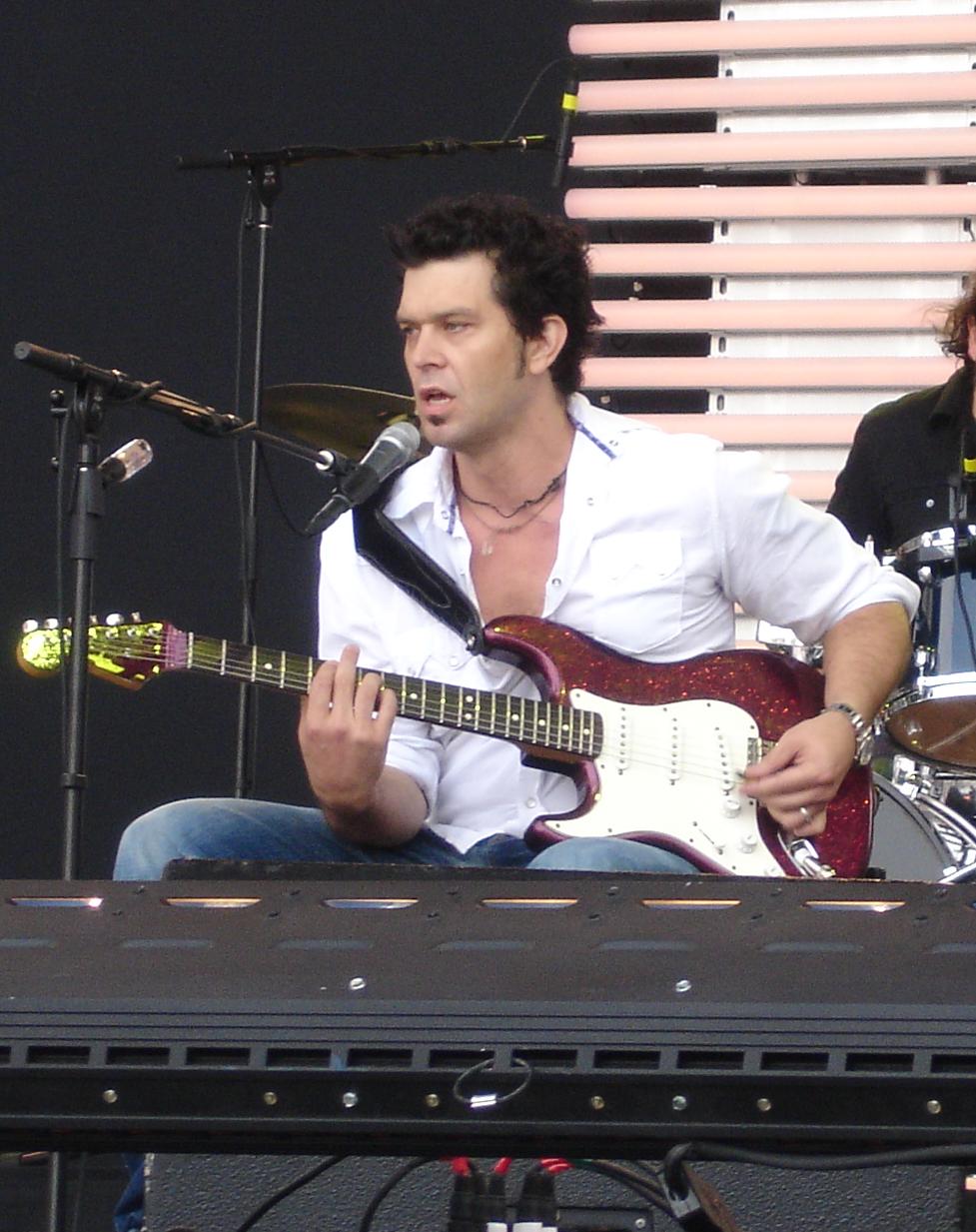
Investigate Doyle Bramhall II guitars gear and you find the equipment of one of the most distinctive and physically unconventional guitar voices in contemporary blues rock — a Dallas-born guitarist who plays a right-handed Stratocaster strung left-handed and upside-down without reversing the nut, creating a reversed string configuration (high E at the top) that gives his playing its specific tonal signature and contributes to the angular, sliding approach that makes his technique immediately recognisable. The son of blues drummer and songwriter Doyle Bramhall, Bramhall II grew up at the centre of the Austin-Dallas blues world that produced Stevie Ray Vaughan, Arc Angels, and the contemporary Texas blues revival, and his career — from the Arc Angels through his long association with Eric Clapton and Roger Waters to acclaimed solo recordings — represents one of the most comprehensive engagements with the blues tradition by a musician of his generation.
This guide covers Bramhall II’s complete equipment picture: the inverted Stratocasters that define his unique approach, the amplification that gives his playing its warm, full-bodied tone, the effects chain he has developed across two decades of professional work, and the playing philosophy of a guitarist whose unconventional physical approach to the instrument produces conventional musical values — blues feeling, emotional directness, technical mastery in service of expression. Understanding Doyle Bramhall II’s gear is understanding how an idiosyncratic physical relationship with the guitar can produce a completely personal musical voice.
Background
Doyle Bramhall II was born on December 24, 1968, in Dallas, Texas — the son of Doyle Bramhall Sr., who was a blues drummer, songwriter, and longtime associate of Stevie Ray Vaughan. Growing up in this specific musical environment — at the heart of the Texas blues world that was producing some of the most significant American blues music of the late twentieth century — gave Bramhall II an early and direct connection to the tradition that shaped his playing. He absorbed the Texas blues vocabulary from players he knew personally rather than from records alone, which gave his technique and his understanding of the music a directness and authenticity that purely academic study of the tradition couldn’t provide.
He began playing guitar left-handed on a right-handed instrument strung upside-down — following the approach of Albert King, who famously played a Flying V right-handed but strung left-handed, producing the specific string tension and pitch-bending character that gave King’s playing its singular quality. Bramhall II’s specific version of this approach — a Stratocaster strung left-handed but played right-handed, without reversing the nut or the string arrangement — produces different bending characteristics from both a conventionally strung right-handed instrument and a reversed left-handed instrument, giving his bends their particular character.
The Arc Angels — the band he co-founded with Charlie Sexton in Austin in the early 1990s — produced one acclaimed self-titled album (1992) that demonstrated his playing and songwriting at an early stage of their development. The band’s powerful twin-guitar dynamic, with Sexton’s melodic approach complementing Bramhall II’s bluesier, more physically intense style, showed what two exceptional guitarists with complementary rather than identical approaches could create together.
His long association with Eric Clapton — playing in Clapton’s touring band and appearing on several Clapton studio recordings — brought his playing to its widest audience. Clapton’s specific choice of Bramhall II as a touring and recording guitarist reflected the same musical values that had led Clapton to other Texas blues-influenced players: a genuine connection to the blues tradition, technical accomplishment that served emotional expression rather than displaying itself, and the professional musicianship that the demands of international touring at the highest level require.
His solo recordings — Doyle Bramhall II (1996), Jellycream (1999), Welcome (2001), Rich Man (2016) — have shown an artist of expanding range who has moved beyond the Texas blues context of his formation toward a broader musical conception that encompasses soul, R&B, psychedelic rock, and world music alongside the blues foundation.
Doyle Bramhall II Guitars Gear: The Complete Rig
Guitars
Doyle Bramhall II’s guitar setup is defined by its physical idiosyncrasy — an idiosyncrasy that was not a fashion statement or a deliberate attempt to be different but the natural result of a left-handed player learning on an instrument that was more readily available in right-handed configuration and developing a technique adapted to the resulting upside-down string arrangement.
His primary instrument is a Fender Stratocaster — a right-handed instrument that he plays left-handed, strung with left-handed string gauges (from low to high: E, A, D, G, B, E, but positioned with the high E nearest to the floor rather than nearest to the ceiling). The nut is not reversed, which means the string spacing at the nut is reversed from what a true left-handed instrument would provide — an arrangement that, over years of playing, becomes natural but that creates specific technical differences in how chords are fretted and how single notes are articulated.
The reversed string arrangement has specific acoustic and technical consequences. When Bramhall II bends strings, he is bending in the direction that corresponds to downward movement in the standard orientation — pulling strings toward the floor rather than pushing them toward the ceiling. This reversed bending direction produces a different physical sensation and a somewhat different quality of pitch change from conventional bending, and it is one of the contributors to the specific character of his note-bending approach. Albert King’s famous crying bend quality — the specific sound that has influenced generations of blues guitarists — came partly from this same reversed bending direction, and Bramhall II’s absorption of King’s influence extends to this specific physical approach.
The pickups in his Stratocasters are typically Fender Custom Shop Texas Special pickups — the overwound single-coils that Fender developed in collaboration with Stevie Ray Vaughan and that have become the standard “heavy Texas blues Strat” pickup configuration. The Texas Specials measure approximately 6.4k to 6.7k ohms in the middle and neck positions and approximately 7.0k ohms at the bridge — significantly hotter than vintage Stratocaster pickups of the 1950s and 1960s — with Alnico V magnets that provide the specific combination of output level and magnetic strength that drives an amplifier into overdrive more readily than lower-output vintage pickups. This higher output gives Bramhall II’s playing the natural drive character that Texas blues guitar requires without excessive reliance on effects pedals for gain staging.
He has also maintained a relationship with Fender Custom Shop for specifically built instruments that incorporate his particular requirements — instruments with specific neck profiles, fret specifications, and hardware choices that suit his unconventional left-handed playing approach. The Custom Shop’s ability to produce instruments to exact specifications allowed him to refine the physical feel of his instruments to optimally serve his specific technique in ways that standard production instruments couldn’t provide.
His string gauges are heavier than most rock guitarists use — typically .013 gauge high E and proportionally heavier gauges throughout (reversed from standard orientation, so .013 is nearest the floor). Heavy strings suit the bending and vibrato work that Texas blues guitar requires, providing the string mass and tension that make bends sustain and vibrato feel physical and committed rather than light and tentative.
Amps
Doyle Bramhall II’s amplification philosophy is rooted in the Texas blues tradition — Fender amplifiers, specifically the Dumble and Fender variants that Stevie Ray Vaughan had established as the standard for that tradition, combined with Marshall amplification for specific harder-rocking contexts. His amp choices reflect both the musical tradition he works within and the specific demands of large-scale professional touring.
His primary amplifier has been the Dumble Overdrive Special — the hand-built American valve amplifier made by Alexander “Howard” Dumble that has become something of a legend in the guitar world for its specific quality of clean-to-driven tone and its extraordinary cost and rarity. The Dumble’s specific circuit — a modified Fender circuit with Dumble’s characteristic modifications to the tone stack and gain staging — produces a clean tone of unusual warmth and presence that breaks into a specific smooth, vocal-quality overdrive as the volume increases. The 6L6 output valves’ American character and the specific preamp design’s smooth breakup quality give the Dumble a tone that suits blues and blues-rock playing with unusual specificity.
For touring contexts where the Dumble’s cost and fragility made it impractical, Bramhall II has used Fender Super Reverb amplifiers — the 4×10 combo running four 6L6 output valves at approximately 40-45 watts, with the specific character of the Fender blackface clean tone and Jensen P10R speakers. The Super Reverb’s specific combination of 6L6 warmth, four-speaker cabinet spread, and Jensen P10R speaker character produces a different quality of clean and lightly driven tone from the Dumble, with more of the specific Fender character that is itself part of the Texas blues tonal tradition.
He has also used Marshall 4×12 cabinet configurations loaded with Celestion speakers — typically the Vintage 30 or G12H-30 — for the harder-rocking material in his set and for the specific heavy British character that some passages require. The combination of a Dumble or Fender into a Marshall 4×12, or a Marshall head into the same cabinet, gave him access to both the American clean-to-driven character he preferred for blues material and the British drive character for heavier rock material.
Effects
Bramhham II’s effects chain has evolved through his career from a relatively simple blues-appropriate signal chain toward a more sophisticated setup that reflects his expanding musical ambitions. The core principles remain consistent: effects in service of specific musical purposes, not as a constant presence.
A Maxon OD808 overdrive — the Japanese version of the Ibanez TS-808 Tube Screamer, using the same JRC4558 op-amp circuit in a slightly different configuration — has been central to his gain staging. The OD808’s smooth, mid-forward overdrive, adding harmonic richness and sustain to the Stratocaster’s signal before it reaches the amplifier, suits the Texas blues approach: not a high-gain distortion pedal but a smooth, touch-sensitive overdrive that enhances the amplifier’s natural character rather than replacing it. His use of the OD808 as a boost before the amplifier — relatively low gain but with the volume boosted to push the amp harder — is the classic Texas blues approach that Vaughan had popularised.
A Uni-Vibe — originally a rotating speaker simulator designed to approximate the sound of a Leslie cabinet but used by Jimi Hendrix and subsequently by blues and rock guitarists for its specific shimmering, pulsing modulation effect — has been a consistent element of his chain for specific textural passages. The Uni-Vibe’s combination of chorus and vibrato — the two effects blended in proportions that create the specific “underwater” shimmering quality — suits the psychedelic and soul-influenced material in his catalogue that the straightforward Texas blues approach doesn’t serve as well.
A wah pedal — the Dunlop Cry Baby in standard configuration — appears in his rig for the swept filter effects that blues lead guitar has always used. His wah technique is musical and rhythmic rather than merely decorative, reflecting the blues tradition where the wah is an expressive tool rather than a background texture.
A Dallas Rangemaster-style treble booster — a germanium transistor treble booster circuit that was the standard front-end boost for British blues rock guitarists of the late 1960s — has appeared in his chain for specific applications where the aggressive, bright front-end boost character it produces was more appropriate than the smoother OD808. The Rangemaster-style circuit’s germanium transistor character produces a different quality of clipping from silicon transistor or op-amp designs — softer, warmer, with a specific vintage character that suits older blues and rock material.
A delay pedal — various Boss and TC Electronic units at different points — provides the spatial dimension and echo effects for specific passages. His delay use is tasteful and musical — adding atmosphere without creating obvious rhythmic repetition.
Playing Style & Tone Philosophy
Doyle Bramhall II’s playing is defined by a specific physical approach — the reversed string arrangement — that has produced a genuinely distinctive musical voice. The idiosyncrasy of his physical setup is not a gimmick but a genuine technical difference that shapes how he approaches bending, vibrato, and chord voicings in specific ways that make his playing immediately recognisable to listeners familiar with the Texas blues tradition.
His bending technique reflects the Albert King influence most directly. King’s reversed string arrangement gave his bends their specific crying, descending quality — the physical sensation of pulling a string is different from pushing it, and this physical difference translates into a different quality of pitch change and vibrato. Bramhall II’s bends have this same quality of physical commitment and specific pitch arc that distinguishes players with the reversed arrangement from conventionally strung players who have studied and attempted to imitate King’s approach without the physical foundation that produces it.
His rhythm playing draws on both the Texas blues shuffle tradition and the soul and R&B influences that characterise his solo recordings. The specific quality of groove in his chord playing — the rhythmic feel, the specific dynamics of attack and release, the way chords lock with the rhythm section — reflects deep absorption of these traditions through years of performance in contexts where the quality of the groove was the primary musical value.
His lead playing vocabulary combines the Albert King and Stevie Ray Vaughan influences most directly — the big-interval bending, the aggressive vibrato, the physical intensity of attack — with a melodic sensibility that reflects his exposure to Clapton’s more European blues approach through the years of touring together. This synthesis of Texas and British blues influences gives his lead playing a breadth that purely regional blues approaches don’t achieve.
Tonally, his philosophy is the Texas blues guitarist’s philosophy: the tone comes from the hands, the guitar, and the amplifier, with effects as selective additions rather than as the primary tonal tools. The Stratocaster’s single-coil character through a well-set-up Dumble or Fender amplifier is the foundation; everything else is refinement and extension of that foundation in service of specific musical requirements.
How to Sound Like Doyle Bramhall II
Guitar Approach
A Fender Stratocaster with Texas Special or similar overwound single-coil pickups is the starting point. For the authentic reversed-string experience, a right-handed Stratocaster strung left-handed and played left-handed — or, if you’re right-handed, studying his specific picking and bending techniques from video and applying them within a conventional string arrangement to approximate the feel rather than the exact physical configuration. Heavy strings (.013 high E or similar) provide the string mass that his bending and vibrato technique requires.
The most important element is the Albert King bending vocabulary — study King’s specific note choices, bending approach, and vibrato technique alongside Stevie Ray Vaughan’s extension of the same tradition. These are the specific technical foundations that Bramhall II absorbed from his formation, and understanding them at the level of genuine musical knowledge rather than mere imitation is the path to playing in the tradition rather than merely copying it.
Amp Approach
A Fender Super Reverb or comparable 6L6-based Fender amp provides the most accessible route to the core Texas blues tone that underpins his approach. A Maxon OD808 (or Ibanez TS-808) as a front-end boost — low gain, volume boosted to push the amplifier harder — is the standard Texas blues gain staging approach. For the specific Dumble character, various boutique amplifiers aim to capture the Dumble’s specific clean-to-driven transition; the Bludotone, the Carol-Ann OD-2, and various others have been cited as useful approximations.
| Control | Setting | Notes |
|---|---|---|
| Volume | 6–8 | Working into natural 6L6 breakup — Texas blues tone lives here |
| Treble | 6 | Moderate — Texas Specials are hot, treble stays manageable |
| Middle | 6–7 | Mids present — blues requires midrange authority |
| Bass | 4–5 | Controlled bass for definition |
| Reverb | 3–4 | Spring reverb at moderate level — traditional Texas blues ambient quality |
| OD808 (before amp) | Low gain, volume ~7 | Boost the amp rather than distort the signal — classic Texas blues approach |
Influence & Legacy
Doyle Bramhall II’s legacy is the specific legacy of a musician who has served the Texas blues tradition with exceptional depth and authenticity while also pushing it toward new musical territory through his solo recordings. Within the tradition, his position is similar to Stevie Ray Vaughan’s — the next generation of Texas blues guitarists who absorbed Vaughan’s contribution and extended it rather than merely repeating it.
His work with Eric Clapton has brought the Texas blues approach to audiences who might not have sought it in its purely traditional form, and the specific musical chemistry between Clapton’s British blues sensibility and Bramhall II’s Texas blues foundation has produced recordings and live performances of genuine quality. The Clapton association has also served as a kind of validation — Clapton’s consistent choosing of Bramhall II as his musical partner reflecting the older player’s recognition of genuine quality in the younger one.
The reversed-string approach that defines his physical identity as a guitarist has attracted specific attention from players interested in the Albert King legacy, and his playing has served as a demonstration that this unconventional approach is musically viable and producible at the professional level. This demonstration has encouraged other players with unconventional physical setups to pursue their specific approaches rather than conforming to conventional methods.
For players exploring the Texas blues tradition that Bramhall II inhabits, the rigs of Chris Rea — whose British approach to the same blues-from-the-source aesthetic shows how different cultural starting points can arrive at similar musical values — and the Arc Angels recordings, which document the twin-guitar partnership with Charlie Sexton that was his most important early musical context, provide essential comparison. The Stratocaster-based Texas blues tradition that defines his approach is illuminated through Andy Fairweather Low‘s Telecaster-based British blues work, showing how the same essential values — directness, emotional commitment, technique in service of expression — produce different specific sounds through different instruments and traditions.
The Dumble Mystique: Why This Amplifier
The Dumble Overdrive Special deserves specific examination in the context of Bramhall II’s rig because the amplifier’s legendary status — its extraordinary cost, its extreme rarity, the reverence with which it is discussed in guitar circles — can obscure the specific musical reasons it suits his playing better than more readily available alternatives. Understanding what the Dumble actually does, acoustically and electronically, illuminates why players of Bramhall II’s specific musical values seek it out despite the practical difficulties its rarity and cost present.
Alexander “Howard” Dumble began building custom amplifiers in the late 1960s, initially for musicians in the San Francisco Bay Area, and his designs evolved through decades of refinement into the specific circuit configurations that characterise the Overdrive Special and related models. The Dumble’s circuit is fundamentally a modified Fender design — the Fender blackface circuit’s specific combination of preamp topology, tone stack design, and 6L6 output configuration — with Dumble’s characteristic modifications to the preamp gain staging, the tone stack voicing, and the quality of the components used throughout. These modifications produce a specific quality of clean-to-driven transition that makes the Dumble distinctive: the clean tone is unusually warm and present, the breakup as volume increases is unusually smooth and musical, and the fully driven sound retains a vocal, harmonically complex quality that many high-gain amplifiers sacrifice in favour of raw saturation.
For Bramhall II’s specific Texas blues approach — which requires a clean tone of warmth and presence for chord work, a smooth natural breakup for lighter drive passages, and the ability to push into full saturation for heavier material — the Dumble’s specific clean-to-driven character is more appropriate than either a very clean amplifier (too little natural drive) or a high-gain amplifier (too much, and the wrong quality of distortion). The Dumble produces the specific midrange warmth that Texas blues guitar requires for emotional directness, without the nasal boxiness that some high-gain amplifier designs develop at working volumes.
The 6L6 output valves’ American character — warmer in the low end and with a different midrange voicing from EL34 European-style amplifiers — suits the Texas blues tradition specifically, because the tradition developed through players using Fender amplifiers with 6L6 output valves. Stevie Ray Vaughan’s use of Dumble amplifiers alongside Fender Super Reverbs was the direct precedent for Bramhall II’s own setup, and the Dumble’s specific quality of 6L6 character pushed to its musical limits was the specific tonal territory that both players sought.
The Arc Angels: Twin-Guitar Chemistry
The Arc Angels — the band Bramhall II co-founded with Charlie Sexton in Austin in the early 1990s — represent one of the most productive twin-guitar partnerships in contemporary American blues rock, and examining that partnership illuminates both Bramhall II’s specific guitar approach and how his equipment served the specific dynamic of two exceptional guitarists playing together.
Charlie Sexton’s guitar approach was fundamentally different from Bramhall II’s in ways that made their pairing productive rather than redundant. Sexton — who had been a teenage guitar prodigy and had absorbed influences from across American and British rock history — brought a more melodically oriented, harmonically sophisticated approach that complemented Bramhall II’s more physically intense, bends-and-vibrato-based Texas blues style. Where Bramhall II’s playing was characterised by big-interval bending, aggressive vibrato, and the specific tonal weight of his reversed-string Stratocaster through a Dumble, Sexton’s playing was more melodically linear, more harmonically varied, and less dependent on the specific physical intensity that distinguished Bramhall II.
The equipment that Sexton brought to the partnership — different guitars, different amplifiers, a somewhat different effects chain — created a tonal contrast between the two guitar voices that was immediately audible in the mix. The two guitars occupied different sonic spaces, served different musical functions within the arrangements, and created between them a guitar texture richer than either alone could have produced. This is the model of the productive twin-guitar partnership — genuine difference in service of a common musical vision — and the Arc Angels’ debut album remains one of the most complete demonstrations of this model available in contemporary blues rock.
The specific Bramhall II equipment on the Arc Angels recording — the inverted Stratocaster through the Dumble, with the OD808 and Uni-Vibe as primary effects — gave his guitar parts their specific character in the twin-guitar context: warm, physically committed, tonally distinctive in ways that complemented rather than duplicated Sexton’s somewhat brighter, more harmonically varied guitar voice. The equipment served the music’s specific requirement for two clearly differentiated guitar personalities operating within a shared blues rock framework.
The Clapton Years: Serving the Master
Bramhall II’s extended association with Eric Clapton — as a touring and recording guitarist whose relationship with Clapton spans two decades — presents the clearest available test of his professional musicianship: the ability to play alongside one of the most carefully watched guitarists in rock history while making a musical contribution that is genuinely additive rather than merely supportive.
Clapton’s specific musical values — the British blues approach shaped by the original recordings of Robert Johnson, Muddy Waters, and Freddie King, refined through decades of professional performance at the highest level — are both deeply compatible with and distinctly different from Bramhall II’s Texas blues approach. The compatibility lies in the shared blues foundation and the shared commitment to emotional directness over technical display; the difference lies in the specific regional character of the two traditions, with the British blues approach emphasising a particular quality of melodic singing quality and harmonic restraint that the Texas approach supplements with more physical intensity and more aggressive bending.
This specific complementarity — compatible values, different specific expression — is what made the Clapton-Bramhall II pairing musically productive rather than redundant. In a live context where Clapton’s playing was the primary musical statement, Bramhall II’s role was to provide textural support, harmonic completion, and rhythmic energy that enhanced rather than competed with Clapton’s own playing. His specific equipment — the warm, present Stratocaster through the Dumble or Super Reverb, with the OD808 adding smooth drive — served this supporting role by providing warmth and authority without the kind of tonal dominance that a more aggressive setup would have imposed.
The recordings they made together — on Clapton’s albums and in Bramhall II’s own solo work with Clapton as a guest — document a musical partnership of genuine quality and genuine mutual respect. The equipment that made Bramhall II effective in this context was the same equipment he had developed for his own musical vision; the fact that it served both his solo musical identity and the supporting role in the Clapton context reflects the genuine musical coherence of his approach. Equipment that serves one musical purpose effectively and another musical purpose equally effectively is not versatile in the sense of being neutral or characterless — it is versatile because it is genuinely right rather than merely available.
The Texas Special pickup’s specific technical characteristics — worth examining in detail for players considering this option — reflect the specific requirements of the Texas blues approach that Vaughan had established as the standard and that Bramhall II has maintained and extended. The higher DC resistance of the Texas Special (approximately 6.4k to 7.0k ohms depending on position) compared to vintage Stratocaster pickups (typically 5.6k to 6.2k ohms) produces a higher output level that drives the amplifier’s input stage harder, generating more natural overdrive at any given volume level. The Alnico V magnets maintain the single-coil’s characteristic bright, clear top end while the higher output compensates for any perceived lack of fullness compared to humbucking pickups. For the Texas blues approach specifically — where the single-coil’s clarity and dynamic sensitivity are essential musical values but where the output needs to be sufficient to drive a big Fender amplifier into its natural overdrive zone at performance volume — the Texas Special’s specific specifications represent an optimal compromise between these competing requirements. Bramhall II’s consistent use of Texas Special or comparable overwound single-coils reflects an understanding of this specific acoustic requirement that goes beyond brand loyalty or tradition to genuine technical understanding of what his music needs from the pickup stage of his signal chain.
The Uni-Vibe’s specific role in Bramhall II’s effects chain — for the psychedelic and soul-influenced material that increasingly characterised his solo recordings as his career developed — reflects both his expanding musical ambitions and his understanding of how specific effects serve specific musical traditions. The Uni-Vibe was designed in the late 1960s by Shin-ei in Japan as a rotating speaker simulator, attempting to recreate the Doppler and phase effects of a Leslie cabinet rotating at various speeds. The original circuit uses four photocell-LED pairs to create a slow phase shift that modulates in both amplitude (chorus) and pitch (vibrato) — the combination producing the characteristic pulsing, shimmering quality that gives the effect its specific character. Jimi Hendrix’s use of the Uni-Vibe on recordings like “Machine Gun” and “Hey Baby” established it as a psychedelic blues effect, and Bramhall II’s use of it connects his work explicitly to that tradition. The Uni-Vibe adds a dimension of movement and atmosphere to sustained chord and single-note passages that no other effect produces in quite the same way, and its specific vintage character — warm, slightly imprecise, with the natural variation of the photocell-LED circuit — suits blues and psychedelic material better than any more precise digital approximation. Bramhall II’s deployment of it for specific musical moments rather than as a constant presence reflects the same musical intelligence that characterises every aspect of his effects use.
Doyle Bramhall II’s continuing development as both a guitarist and a solo artist — his solo recordings showing an expanding musical conception that has moved well beyond the Texas blues context of his formation while maintaining its essential values — reflects a musician who understands that the tradition he works within is a living language rather than a historical museum. The reversed-string Stratocaster, the Dumble or Super Reverb, the OD808 and Uni-Vibe — these are his specific tools for this specific musical language, and their continued rightness for the music he makes reflects the coherence of both the musical vision and the equipment that serves it. The Texas blues tradition, transmitted through his father’s generation, filtered through his own profound assimilation of Albert King and Stevie Ray Vaughan, and extended through his engagement with the broader world of blues, soul, and psychedelic rock, continues to produce music of genuine quality in his hands. The gear tells part of the story; the playing tells the rest.
The Roger Waters association — which added another major dimension to Bramhall II’s professional profile alongside the Clapton connection — is worth noting as evidence of the breadth of his appeal across different musical contexts. Waters’ music, while rooted in a very different tradition from the Texas blues that defines Bramhall II’s primary identity, shares certain fundamental values: emotional directness, the primacy of the song over individual technical display, and the willingness to use the guitar as an atmospheric and textural instrument as well as a melodic lead voice. Bramhall II’s ability to serve these values in the Waters context — adapting his specific Texas blues approach to serve the more theatrical, atmospheric requirements of Waters’ material — reflects the same musical intelligence that made his Clapton work effective. The equipment didn’t fundamentally change for the Waters work; the musical application of that equipment adapted to the specific requirements of a different musical context. This adaptability — using the same fundamental equipment choices to serve very different musical requirements through adjustments of technique, dynamics, and specific effect deployment rather than through wholesale equipment replacement — is one of the marks of a complete professional musician, and Bramhall II has demonstrated it consistently across the most diverse professional contexts of any guitarist working primarily in the blues tradition today.
One final technical observation about the Fender Super Reverb’s specific role in Bramhall II’s touring rig as a practical alternative to the Dumble: the Super Reverb’s four-speaker configuration — four Jensen P10R 10-inch speakers rather than the single or paired 12-inch speakers of most guitar amplifiers — produces a specific frequency response and directional pattern that contributes to the amplifier’s characteristic sound in ways that are not fully captured by its circuit specifications alone. The four P10R speakers, each handling a quarter of the amplifier’s output power, operate well within their linear range at the volumes Bramhall II uses, allowing them to reproduce the full frequency range of the guitar signal without the power compression that pushes speakers toward breakup at higher power levels. The four-speaker array’s radiation pattern — spreading the sound in a wider vertical arc than a single large speaker — also affects how the amplifier interacts with the room, giving the Super Reverb’s sound a more diffuse, enveloping quality that suits the blues tradition’s preference for guitar that fills the room rather than projecting from a single point. These acoustic considerations — the specific interaction between the amplifier’s output, the speaker array’s characteristics, and the room’s acoustic response — are part of the reason specific amplifier configurations become associated with specific musical traditions, and the Super Reverb’s association with Texas blues guitar is as much a product of these acoustic realities as of any historical accident or brand loyalty.
Doyle Bramhall II’s place in the lineage of Texas blues guitar — from T-Bone Walker through Freddie King to Albert Collins, Albert King, Stevie Ray Vaughan, and now Bramhall II himself — is as a genuine heir to the tradition who has absorbed it deeply enough to extend it rather than merely replicate it. His specific physical idiosyncrasy — the upside-down Stratocaster — connects him explicitly to Albert King, whose influence on the tradition is as profound as any single player’s, and his willingness to embrace that idiosyncrasy rather than conforming to conventional playing technique reflects the same kind of commitment to musical authenticity that the best blues musicians have always demonstrated. The Texas blues tradition is not a museum exhibit but a living musical practice, and Bramhall II’s continued engagement with it — through solo recordings that push its boundaries, through collaborative work that connects it to other musical traditions, and through the sustained quality of his live performance — keeps it alive and developing in the twenty-first century. The equipment he uses to pursue this: the Stratocaster strung for a left-handed player and held by a right-handed player, the Dumble or Super Reverb running hot, the OD808 as a front-end boost, the Uni-Vibe adding its vintage shimmer — all of it is exactly right for exactly this music, played by exactly this musician, in the service of exactly this tradition. That is the complete Doyle Bramhall II gear story.
Frequently Asked Questions: Doyle Bramhall II Guitars & Gear
Why does Doyle Bramhall II play guitar upside-down?
Bramhall II plays a right-handed Stratocaster strung left-handed and played left-handed — following the approach of Albert King, his primary guitar influence, who played a right-handed Flying V with left-handed stringing. He grew up playing this way, and the specific reversed string arrangement gave his playing its distinctive bending and vibrato character that makes it immediately recognisable. The reversed strings mean high E is nearest the floor rather than nearest the ceiling, producing different bending physics and a different physical relationship with the instrument from either a conventional right-handed or a conventional left-handed setup.
What guitar does Doyle Bramhall II play?
His primary guitar is a Fender Stratocaster — typically Fender Custom Shop instruments built to his specific requirements, fitted with Texas Special or comparable overwound single-coil pickups. He plays right-handed Stratocasters strung and played left-handed, without reversing the nut. His string gauges are heavy (.013 gauge high E or equivalent), consistent with the Texas blues tradition that requires string mass for bending and vibrato authority.
What amp does Doyle Bramhall II use?
His primary amplifier has been the Dumble Overdrive Special — the hand-built American valve amplifier known for its specific quality of clean-to-driven tone and extraordinary cost. For touring contexts, he has used Fender Super Reverb amplifiers (4×10, 6L6, blackface) as the primary American clean-driven tone source, with Marshall cabinet configurations for specific harder-rocking applications.
What effects does Doyle Bramhall II use?
His key effects include a Maxon OD808 overdrive (as a front-end boost rather than high-gain distortion), a Uni-Vibe for shimmering modulation on psychedelic and soul-influenced passages, a Dunlop Cry Baby wah, a Dallas Rangemaster-style treble booster for specific vintage British character, and delay for atmospheric spatial dimension. His effects use is purposeful and context-sensitive — each element deployed when the music specifically requires it.
What is the Albert King influence on Doyle Bramhall II’s playing?
Albert King — who played a right-handed guitar with left-handed stringing, creating a reversed string arrangement — is Bramhall II’s most direct physical and musical influence. King’s specific bending approach, produced by pulling strings upward (in King’s orientation, toward his body) rather than pushing them, gave his bends their characteristic crying, descending quality. Bramhall II’s adoption of the same physical setup produces similar bending characteristics, and his absorption of King’s melodic vocabulary makes the influence explicit in his playing.
What are the Arc Angels?
The Arc Angels were an Austin, Texas blues rock band co-founded by Doyle Bramhall II and Charlie Sexton in the early 1990s. Their self-titled debut album (1992) is considered one of the finest American blues rock records of the decade, featuring the twin-guitar partnership of Bramhall II and Sexton alongside a powerful rhythm section. The band demonstrated both Bramhall II’s fully formed guitar voice and his ability to function in a complementary twin-guitar context — providing a heavier, bluesier counterpoint to Sexton’s more melodically oriented approach.
What are Doyle Bramhall II’s best solo recordings?
His most critically acclaimed solo recording is Rich Man (2016), which showed the full range of his musical evolution — Texas blues foundation expanded to encompass soul, R&B, psychedelic rock, and world music influences, with production that captured his live energy without excessive polish. Jellycream (1999) and Welcome (2001) from his earlier solo period are also strong documents of his playing and songwriting. The Arc Angels debut (1992) is essential for understanding his early development and his specific twin-guitar chemistry with Charlie Sexton.
Genre:
Blues Rock
Decades:
1990s | 2000s | 2010s | 2020s
Related stories
Ted Nugent Guitars & Gear: The Complete Guide to the Motor City Madman’s Byrdland Rig
Ted Nugent guitars & gear: the Motor City Madman's Byrdland rig. 12 vintage Gibson Byrdlands, Fender Twin Reverbs, Peavey 6505, zero effects, and the Stranglehold tone.
Ted Turner Guitars & Gear: The Complete Guide to Wishbone Ash’s Twin Guitar Pioneer’s Rig
Ted Turner guitars & gear: Wishbone Ash's twin-lead pioneer. Stratocasters, Firebird, Orange amps, and the Argus-era tone fully explained.
The Edge Guitars & Gear: The Complete Guide to U2’s Guitar Genius’s Rig
The Edge's guitars, amps, and effects — the complete guide. Gibson Explorer, Vox AC30, dotted eighth-note delay, Korg SDD-3000, and how to nail that massive U2 tone.