
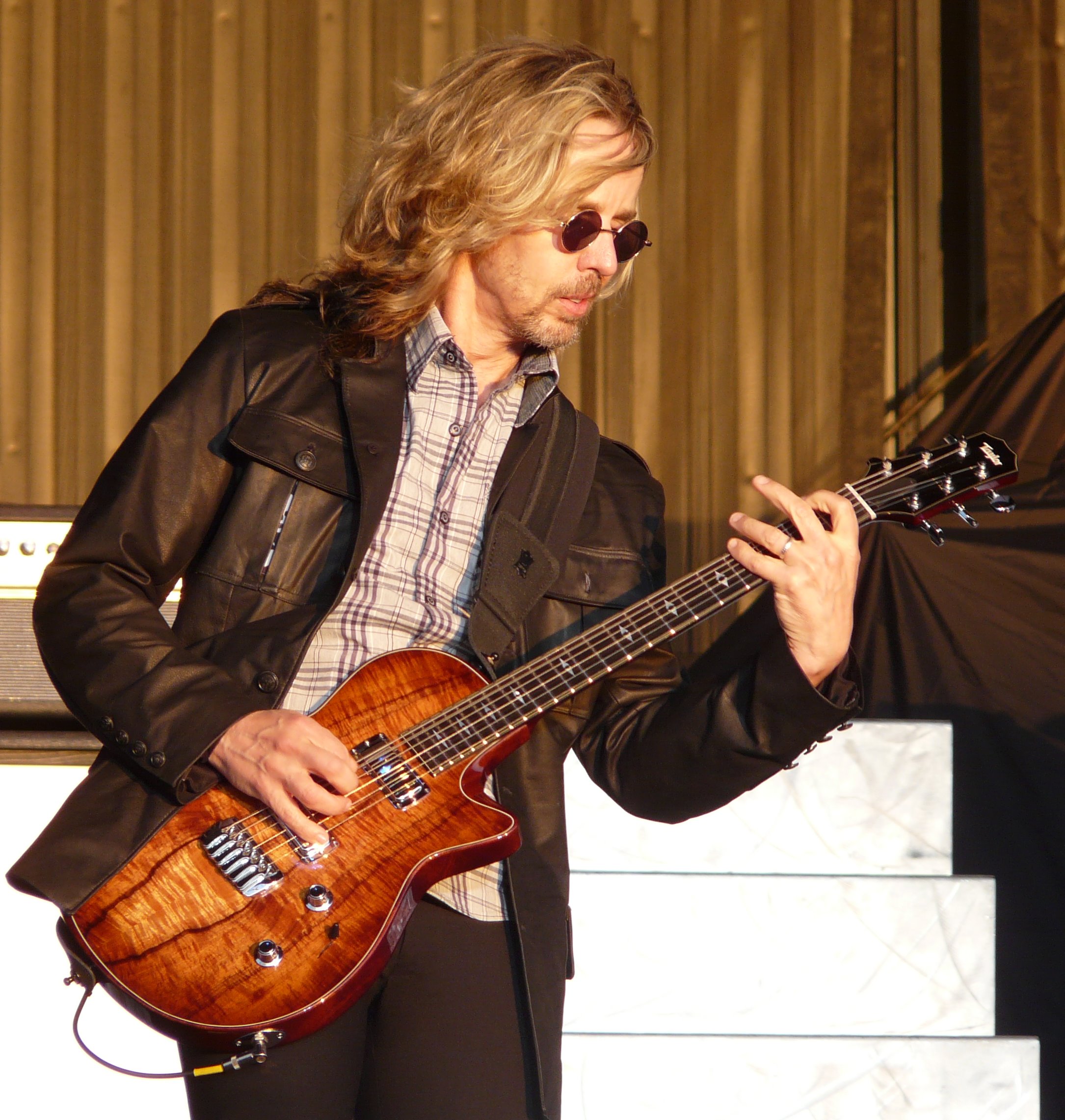
Investigate Tommy Shaw guitars gear and you find the equipment behind one of arena rock’s most melodically gifted and most commercially successful guitarists — an Alabama-born musician who joined Styx in 1975 and became the band’s primary guitar voice and one of their most important songwriters, whose specific combination of technical ability, melodic sensibility, and the specific warmth of his Les Paul through Marshall gave Styx their particular guitar character during their most commercially dominant period from the late 1970s through the mid-1980s. Shaw was not the most technically shredding guitarist of the era — his playing was defined by melodic intelligence and emotional expressiveness rather than by technical velocity or complexity — but his specific guitar voice gave Styx recordings their specific quality of radio-friendly melodicism combined with genuine rock authority that made them one of the most commercially successful American rock bands of their era.
The Journey
This guide covers Shaw’s complete equipment picture: the Gibson Les Paul guitars that defined his warm melodic tone, the Marshall amplification that gave his playing its driven authority, his effects chain, and the playing philosophy of a musician who always prioritised melody and emotional communication over technical display. Understanding Tommy Shaw’s gear is understanding how arena rock achieved commercial scale without sacrificing genuine musical quality.
Background
Thomas Richard Shaw was born on September 11, 1953, in Montgomery, Alabama. His early musical formation encompassed the full range of rock and rock-adjacent music that defined his generation — the British Invasion, Jimi Hendrix, the Southern rock tradition that his Alabama background placed him close to geographically, and the broader arena rock and progressive rock that was developing as his professional career began in the early 1970s.
He joined Styx in 1975 — replacing John Curulewski as the band’s second guitarist — and his arrival transformed the band’s commercial trajectory. The specific combination of his melodic guitar approach and his songwriting contributions — “Fooling Yourself (The Angry Young Man),” “Renegade,” “Blue Collar Man,” “Too Much Time on My Hands,” and other major Styx hits were either written by Shaw or co-written with other band members — gave Styx the commercial identity that made them one of the biggest American rock acts of the late 1970s and early 1980s.
His parallel career with Damn Yankees — the supergroup he co-founded in 1989 with Ted Nugent, Jack Blades, and Michael Cartellone — gave his guitar work a more prominent and more aggressive solo spotlight than the Styx ensemble context had provided, showing the full range of his technical and melodic capabilities in a less arrangement-constrained context.
Tommy Shaw Guitars Gear: The Complete Rig
Guitars
Shaw’s guitar choices were built around the warm, sustaining instruments that suited his melodic approach — Gibson designs that gave his playing the specific combination of warmth and sustain that melodic arena rock required.
His primary guitar was a Gibson Les Paul Standard — the mahogany and maple solid body with PAF-spec or later humbucking pickups that provided the warm, sustaining tone that his melodic single-note lead work required. The Les Paul’s specific combination of warmth and sustain — the humbucker’s double-coil character giving notes their harmonic richness, the mahogany body’s natural sustain giving them their singing duration — suited the melodic lead approach of his Styx work with specific acoustic appropriateness.
He also used a Gibson Les Paul Custom — the three-pickup variant with ebony fingerboard that gave slightly different tonal character from the Standard. The Custom appeared for specific recording and performance contexts where its slightly brighter character suited the material better than the Standard’s somewhat warmer overall tone.
Various Gibson SG models appeared for specific applications — the SG’s lighter weight making it practical for extended live performance, and its slightly different tonal character (somewhat brighter and more aggressive than the Les Paul) suiting specific heavier passages in the Styx and Damn Yankees material.
His association with Fender Stratocasters appeared for specific material requiring the single-coil brightness — particularly for the more atmospheric and more pop-inflected passages in Styx’s commercial radio-oriented material where the warmer Les Paul character was less appropriate than the Stratocaster’s brighter, more open-sounding single-coil.
String gauges were medium — .010–.046 — appropriate for the melodic lead approach while maintaining adequate warmth and sustain.
Amps
Shaw’s amplification was primarily Marshall — the British EL34 designs that gave his melodic arena rock playing its specific combination of warmth and driven authority.
His primary amplifiers were Marshall JMP and JCM800 heads — the late-vintage and early-production master-volume Marshalls that provided the EL34 character in a more stage-manageable format than the vintage Plexi designs. The JMP’s specific character — straddling the vintage Plexi and the subsequent JCM800 in its gain structure and tonal character — gave his Les Paul playing its specific combination of warmth and drive that suited the melodic arena rock context.
He ran the Marshalls into Marshall 4×12 cabinets with Celestion speakers — the standard professional arena rock guitar configuration that gave the sound its specific combination of projection and authority in large performance venues.
Various other amplifiers appeared across his diverse career with Styx, Damn Yankees, and solo work — different amplifiers serving different specific contexts within the overall Marshall-centred approach.
Effects
Shaw’s effects chain was developed and musically motivated — serving the melodic arena rock approach with specific tools for specific expressive purposes.
A wah pedal — Vox or Dunlop Cry Baby — for specific expressive passages where the vocal quality served the melodic character of the material. His wah use was selective and musical rather than habitual.
Various chorus and modulation effects — the chorus adding dimensional shimmer to specific chord and arpeggio passages that gave the Styx recordings their characteristic atmospheric quality. The 1980s arena rock aesthetic used chorus extensively as a textural element, and Shaw’s use of it was consistent with the production values of the period’s most commercially successful recordings.
A delay pedal — for atmospheric depth on both lead passages and specific chord work. The arena rock production aesthetic of the Styx period made extensive use of delay as a spatial and atmospheric element, and Shaw’s delay use served this production aesthetic as much as any specific musical preference.
An overdrive pedal — Tube Screamer or similar — for front-end boost on the most driven passages, the standard approach of pushing the Marshall’s natural saturation harder without changing its fundamental EL34 character.
Playing Style & Tone Philosophy
Tommy Shaw’s playing style was defined by the specific combination of melodic intelligence and rock guitar conviction that made him effective in the arena rock context — the ability to construct lead guitar lines that were simultaneously technically accomplished and immediately emotionally communicative to an audience of 20,000 people. Arena rock’s specific demands on the lead guitarist were different from the jazz guitarist’s or the blues guitarist’s demands: the music needed to communicate immediately and powerfully across large acoustic distances, needed to provide the melodic satisfaction of well-constructed single-note lines, and needed to do both with the physical energy that distinguished genuine rock from more polished commercial alternatives.
His melodic approach — the specific quality of his lead guitar lines that made them singable and memorable rather than merely technically impressive — was the primary quality that distinguished his playing from technically comparable but less melodically organised alternatives. The best Styx guitar solos were as melodically constructed as the vocal melodies that surrounded them, reflecting a specific compositional approach to guitar soloing that prioritised the musical statement over technical display.
His rhythm playing showed the same melodic intelligence — chord voicings chosen for their harmonic contribution to the song’s specific emotional content, and rhythmic placements that served the song’s specific groove rather than merely demonstrating rock guitar technique.
Tonally, his philosophy was the arena rock guitarist’s melodic philosophy: warm, sustaining Les Paul through the driven Marshall, with the chorus and delay adding the spatial dimension that the arena rock production aesthetic required. The warmth gave his melodic lines their singing quality; the sustain gave them their presence over the full duration of each note; and the Marshall’s natural saturation gave the driven passages their authority.
How to Sound Like Tommy Shaw
Guitar Approach
A Gibson Les Paul Standard or Custom — the warm, sustaining humbucker character is essential for the melodic arena rock approach. Medium strings (.010–.046). The most important element is the melodic approach to lead playing — constructing guitar solos that are as singable as vocal melodies rather than as technically impressive as possible. Study Shaw’s actual solos on the major Styx recordings: the melodic construction, the specific note choices, and the overall orientation toward emotional communication over technical display.
Amp Approach
A Marshall JMP or JCM800 into a 4×12 cabinet. Tube Screamer boost for the most driven passages. Chorus for the atmospheric dimension of specific chord and arpeggio passages. Delay for spatial depth on lead lines.
| Control | Setting | Notes |
|---|---|---|
| Volume | 6–8 | Natural EL34 warmth and drive — melodic Les Paul arena zone |
| Treble | 6 | Moderate — Les Paul warmth doesn’t need treble boost |
| Middle | 6–7 | Present mids — melodic lead needs midrange authority |
| Bass | 4–5 | Controlled — Les Paul adds natural low-end warmth |
| Presence | 5 | Moderate for melodic clarity without harshness |
| Chorus | Light to moderate | Dimensional shimmer for atmospheric chord passages |
Influence & Legacy
Tommy Shaw’s legacy was the specific legacy of a musician who helped define American arena rock’s melodic approach at its commercial peak — the Styx recordings of the late 1970s and early 1980s were among the most commercially successful and most consistently melodically intelligent of the arena rock era, and his guitar work was central to both the commercial success and the melodic quality.
His songwriting legacy was as important as his guitar playing — the specific Styx songs that Shaw wrote or co-wrote were among the era’s most enduring radio staples, and their continued presence on classic rock radio four decades after their initial release showed the specific quality of melodic construction that gave them their staying power.
His Damn Yankees work showed a harder, more aggressive dimension of his playing that the ensemble Styx context hadn’t always allowed to be fully featured — the supergroup format providing the individual spotlight that his guitar capabilities deserved.
For players exploring the arena rock melodic guitar tradition that Shaw helped define, the rigs of Rick Emmett — whose Triumph work showed how similar melodic intelligence and similar technical accomplishment produced a different but comparably distinguished arena rock guitar approach — and Brad Whitford, whose Aerosmith work showed how similar Gibson-through-Marshall warmth and drive served a rawer, blues-oriented arena rock vision, provide illuminating comparison. The Styx melodic approach connects to Tom Scholz‘s Boston guitar work, which shows how similar commitment to melodic guitar clarity and harmonic sophistication produced one of arena rock’s most distinctive and most immediately recognisable guitar sounds.
The Grand Illusion Era: Styx at Their Commercial Peak
The Grand Illusion (1977) — the Styx album that launched their commercial breakthrough and began the most successful period of their career — showed Shaw’s guitar approach at its most completely realised within the Styx ensemble context. The album’s combination of melodic rock, atmospheric synthesiser textures, and Shaw’s specifically warm, melodic guitar gave Styx their distinctive arena rock identity and produced the commercial breakthrough that would sustain them through the subsequent five years of arena dominance.
The guitar tones on the album — Shaw’s Les Paul through the Marshall at working performance volume, with the chorus adding dimensional shimmer to specific passages — showed the specific warmth and presence of his primary playing approach: every sustained note had the singing quality that the humbucker’s warmth and the EL34’s natural compression provided, every chord had the fullness that the double-coil pickup character gave to the Les Paul’s mahogany and maple resonance, and the overall guitar character had the specific quality of warm authority that distinguished arena rock from either lighter pop rock or heavier hard rock.
The album’s guitar solo on the title track showed Shaw’s melodic approach at its most clearly articulated — the specific quality of constructing a guitar solo that moved through harmonic space with the logic and the memorability of a vocal melody rather than the technical ambition of a guitar showcase. The solo’s specific note choices, its specific rhythmic placement within the song’s structure, and its overall orientation toward emotional communication over technical display were the primary qualities that gave it its staying power on classic rock radio four decades after its original release.
Renegade: The Guitar that Defined an Era
“Renegade” — Shaw’s own composition from Pieces of Eight (1978) — was as complete a single-track expression of his melodic guitar approach as any in his Styx catalogue. The song’s signature guitar figure — the arpeggiated introduction that announced the song’s character before the rhythm section entered — showed the specific quality of his melodic guitar thinking: a figure that was immediately memorable, melodically complete in itself, and appropriate to the song’s specific emotional character.
The guitar tone on “Renegade” — the Les Paul’s neck-pickup warmth through the Marshall’s natural drive — was the sound of Shaw’s melodic approach at its most warm and most sustained: the neck pickup’s specific character of warmth without darkness, sustain without muddiness, and the Marshall’s natural EL34 saturation giving each note its appropriate harmonic richness. This specific combination — warm Les Paul neck pickup through naturally saturating Marshall at working volume — was the acoustic foundation of his most melodically characteristic work, and understanding it as a complete acoustic system rather than as separate instrument and amplifier choices gives the most accurate picture of how the specific character of these recordings was achieved.
Shaw’s specific guitar work on the song’s solo section showed the same melodic intelligence as the introduction — the solo’s specific note choices and specific rhythmic placement serving the song’s dramatic arc rather than the guitarist’s technical ambitions, giving the music the emotional satisfaction of a well-constructed melodic statement rather than the technical satisfaction of an impressive display. This specific orientation — guitar in service of the song’s emotional content — was the most fundamental philosophical principle of his approach and the quality that gave his best Styx work its specific quality of enduring emotional appeal alongside its commercial accessibility.
Blue Collar Man: Hard Rock with Melodic Heart
“Blue Collar Man (Long Nights)” — another Shaw composition from Pieces of Eight — showed the harder, more driving dimension of his guitar approach alongside the melodic intelligence that was always his primary quality. The song’s specific guitar character — more aggressive and more physically driving than the atmospheric album tracks but maintaining the same melodic intelligence in its guitar figure construction — showed that his melodic approach was not limited to slow or atmospheric material but could serve harder, more physically committed rock without losing the melodic quality that gave the material its specific character.
The guitar tone on “Blue Collar Man” — Les Paul bridge pickup through the Marshall at higher drive settings — showed the more aggressive dimension of his tonal range: the bridge pickup’s slightly brighter and more cutting character giving the driving guitar figure its appropriate definition and attack, and the Marshall’s increased saturation at the higher drive setting giving the aggressive passages their specific quality of driven authority. This more aggressive character was still warm — the Les Paul’s double-coil warmth and the EL34’s even-order harmonic character giving the driven sound its musical quality rather than harsh aggressiveness — but it showed a dimension of his approach that the more atmospheric Styx material didn’t always provide the opportunity to feature.
Damn Yankees: The Solo Spotlight
The Damn Yankees project — Shaw’s most significant extra-Styx musical association — gave his guitar work the more individually featured role that the Styx ensemble context hadn’t always provided. Understanding what specifically the Damn Yankees format allowed him to demonstrate that the Styx format hadn’t gives a more complete picture of his full musical capabilities.
Ted Nugent’s presence in Damn Yankees — one of rock’s most guitar-centric performers, whose own playing was physically aggressive and technically demanding — created a specific ensemble dynamic that pushed Shaw’s guitar toward more overtly impressive technical expression than the melodic, song-service orientation of the Styx context. Playing alongside Nugent required a more assertive guitar presence than playing within Styx’s keyboard-heavy ensemble, and Damn Yankees’ recordings showed dimensions of Shaw’s playing that the Styx format hadn’t always needed.
The Damn Yankees debut album’s hit “High Enough” — perhaps the most commercially successful recording Shaw was associated with outside of Styx — showed his melodic guitar approach in a more intimate, more emotionally direct context than the arena rock spectacle of the Styx peak period recordings. The song’s acoustic guitar passage and its electric guitar bridge showed the full range of his melodic capability in a commercial pop rock context that brought his playing to the widest audience it had reached outside of Styx.
Tommy Shaw’s career — from the Alabama formation through the Styx breakthrough, the arena rock commercial peak, the Damn Yankees interlude, and the continued Styx reunion and solo activity — was one of arena rock’s more musically distinguished and more commercially sustained careers. His equipment: the warm, sustaining Les Paul Standards and Customs through the Marshall’s natural EL34 drive, with chorus for atmospheric dimension and delay for spatial depth — was exactly right for exactly this music. The gear served the melody; the melody served the song; and the song served an audience of millions who responded to the specific combination of genuine rock authority and melodic intelligence that Tommy Shaw delivered consistently across four decades of professional recording and performance.
The chorus effect’s specific role in Shaw’s Styx recordings — adding dimensional shimmer to chord and arpeggio passages in the way that the 1980s arena rock production aesthetic consistently valued — reflected both a practical production choice and a genuine acoustic contribution to the music’s specific character. Chorus effects in the late 1970s and early 1980s were primarily produced by bucket-brigade delay circuits — analogue electronic devices that created pitch-modulated copies of the input signal and mixed them with the direct signal to produce the characteristic shimmering dimensional quality. The specific warmth of bucket-brigade chorus circuits — produced by the analogue nature of the delay and modulation rather than the more clinical digital processing of later digital chorus alternatives — gave the effect a specific quality of warm dimensional shimmer that suited the arena rock production aesthetic of the period. Shaw’s use of chorus on specific Styx passages reflected both his understanding of the production aesthetic that the period’s most commercially successful arena rock had established and his genuine appreciation for what the effect contributed to the specific atmospheric character of the material where he deployed it.
The James “JY” Young relationship — the two-guitar dynamic within Styx that shaped how Shaw’s specific guitar role was defined — was as important to understanding his specific approach as any individual equipment or technique choice. Young’s guitar approach was more straightforwardly rock-oriented than Shaw’s more melodic lead guitar identity, providing the driving, rhythmically assertive dimension of the Styx guitar sound that complemented Shaw’s more melodically focused contributions. The specific division of guitar roles between them — not rigidly defined but generally oriented toward Shaw’s melodic lead and Young’s rock driving rhythm — gave Styx their specific two-guitar character that was more than the sum of either individual’s contribution. Shaw’s equipment choices — the warmer Les Paul character, the chorus-enhanced atmospheric quality of specific passages — reflected his specific role within this two-guitar dynamic as much as any abstract personal tonal preference.
The Paradise Theatre album (1981) — Styx’s conceptual double album that represented both their commercial peak and the beginning of the creative tensions that would eventually fragment the band — showed Shaw’s guitar work in the most ambitious context of his Styx career. The album’s concept — a meditation on the decline of a movie palace as a metaphor for the loss of American industrial and cultural optimism — required music of both commercial accessibility and genuine thematic depth, and the guitar work needed to serve this dual requirement with equal conviction. Shaw’s melodic guitar was as central to the album’s thematic expression as to its commercial accessibility, providing the specific quality of warm, humanistic guitar emotion that gave the album’s ambitious themes their personal and emotional dimension alongside the more cerebral concept.
The Alabama formation that gave Shaw his early musical character — the specific Southern rock adjacency that distinguished his approach from either pure Northern rock or pure British rock influence — showed in specific aspects of his guitar playing that reflected the Southern rock tradition’s emphasis on blues-rooted expressiveness within rock music. The specific quality of his vibrato, the specific emotional directness of his melodic lead lines, and the overall orientation toward communication over display were all consistent with the Southern rock values that had developed from the Allman Brothers and Lynyrd Skynyrd traditions, even as Shaw’s specific arena rock context gave these values a different commercial expression from their Southern rock origins. The Les Paul’s warm humbucker character served this emotional directness with specific acoustic appropriateness — the warmth giving each melodic note its emotional weight, and the sustain giving it the duration needed for the emotional content to develop fully before the next note arrived.
The Fender Stratocaster’s occasional role in Shaw’s Styx work — appearing for specific material where the single-coil brightness suited the song’s specific character better than the Les Paul’s warmer humbucker character — illustrated the same context-specific instrument intelligence that the best comprehensive arena rock guitarists showed. The Styx catalogue was broad enough in its stylistic range — from driving hard rock to atmospheric ballads to more pop-inflected commercial material — that no single instrument served all contexts equally well, and Shaw’s maintenance of Stratocasters alongside his primary Les Paul collection reflected practical musical intelligence about which specific instrument character suited which specific song’s specific musical requirements. The Stratocaster’s brighter, more open-sounding single-coil character was genuinely more appropriate for certain lighter, more atmospheric Styx passages than the Les Paul’s warmer, more sustaining humbucker character, and his willingness to use the right instrument for the right specific purpose rather than maintaining a rigid signature instrument identity showed the musical service orientation that had always been one of his most valuable professional qualities.
The Montgomery, Alabama cultural formation — less immediately associated with arena rock than the industrial Midwest cities that produced many of the genre’s primary practitioners — gave Shaw’s guitar approach a specific quality of Southern warmth and emotional directness that distinguished it from the more technically precise approaches of some arena rock contemporaries. The Southern musical tradition’s emphasis on emotional communication as the primary value — a value that ran from the blues through country through Southern rock through gospel — was consistent with the melodic, communication-focused approach that always characterised Shaw’s best guitar work, and the specific warmth of his Les Paul through Marshall reflected this Southern musical value as directly as any conscious equipment choice. The gear had the warmth; the warmth served the melody; and the melody served the emotional communication that was ultimately the point of every note he played in the service of the music he spent his career making.
The Les Paul Standard’s maple cap’s contribution to Shaw’s specific tonal character — and how the carved maple top modified the mahogany body’s natural warmth in ways that gave his playing its specific combination of warmth and articulate upper-midrange presence — was the same acoustic relationship discussed in the Mick Ronson entry: the mahogany’s warmth providing the fundamental resonance, and the maple cap’s brightness adding the specific definition that gave melodic lead lines their clarity within the full band arrangement. For Shaw’s specific arena rock context — where the guitar needed to be audible and melodically clear above a full band arrangement of keyboards, bass, drums, and a second guitar — the maple cap’s specific brightness contribution was as important as the mahogany’s warmth. Without the maple’s contribution, the guitar might have been warm but potentially blended into the keyboard-heavy Styx arrangements; with it, the specific melodic lines cut through the arrangement while maintaining the warmth that distinguished them from the more clinical brightness of single-coil alternatives. This specific acoustic balance — warm enough to have emotional weight, bright enough to have melodic definition — was what made the Les Paul Standard the right instrument for Shaw’s specific arena rock melodic role.
The Too Much Time on My Hands recording — one of Shaw’s most radio-successful Styx compositions from Paradise Theatre — showed his guitar work in the most explicitly keyboard-driven and most commercially polished context of his Styx career. The song’s opening synthesiser figure established the tonal character before the guitar entered, and Shaw’s guitar needed to complement the synthesiser’s electronic character with the organic warmth that distinguished real instrument tone from electronic simulation. The Les Paul’s specific warmth — the natural resonance of wood and wire rather than the programmed character of the synthesiser — gave the guitar its specific role in the arrangement as the organic counterpart to the electronic elements, and this specific acoustic role was as musically important as the melodic content of the guitar lines themselves. Understanding the guitar’s role within the complete arrangement — not just what notes it played but what acoustic function it served in relation to the other instrumental voices — was part of the ensemble musical intelligence that gave Shaw’s Styx work its specific quality of being both individually excellent and compositionally appropriate.
The Cornerstone album (1979) — the Styx album that showed their most pop-oriented and most commercially polished face, and that produced “Babe” (one of their biggest hits) alongside more rock-oriented material — showed Shaw’s guitar serving the widest range of commercial musical contexts within the Styx framework. The more pop-oriented material on the album required guitar contributions of a different specific character from the heavier arena rock material — lighter voicings, more atmospheric textural contributions, and an overall guitar personality that served the pop production aesthetic without losing the rock guitar authority that kept the music grounded in rock rather than pure pop. Shaw’s ability to calibrate his guitar approach across this spectrum — from the driving rock material to the atmospheric ballad material — within a single album showed the same comprehensive musical intelligence that had always given his Styx work its specific quality of serving the full range of the band’s commercial ambitions while maintaining genuine musical quality throughout.
The Marshall JMP’s specific character — positioned between the vintage Plexi designs and the subsequent JCM800 in terms of both circuit design and tonal character — gave Shaw’s Les Paul playing a specific quality of warmth and drive that suited the melodic arena rock context with particular appropriateness. The JMP (introduced as Marshall moved from the vintage Plexi panel to the more modern design while maintaining the fundamental circuit architecture) maintained the EL34 output stage character that gave vintage Marshalls their specific warmth at saturation, while adding specific preamp gain structure improvements that gave the amplifier more practical management of the gain character at different volume levels. For the arena rock touring context where consistent performance across different venue acoustics was a practical requirement, this improved gain controllability was as valuable as any specific tonal advantage. Shaw’s use of JMP designs for the arena rock touring context reflected both the specific tonal character he valued and the practical professional advantages of amplifiers that maintained consistent character across the diverse acoustic environments of major venue touring.
The Styx reunion recordings and tours that occupied Shaw’s later career — the various lineup reforms that brought him back to the Styx context after periods of solo work and the Damn Yankees association — showed his guitar approach maintaining the same fundamental qualities across decades of continued professional development. The Les Paul’s warmth and the Marshall’s drive remained the primary tonal foundation; the melodic orientation of the lead playing remained the primary musical value; and the orientation toward serving the song’s specific emotional content rather than showcasing individual technical accomplishment remained the fundamental philosophical principle. This consistency — of approach, of equipment, and of values — across more than four decades of professional recording and performance was one of the most significant qualities of Tommy Shaw’s guitar career, and it reflected the same genuine musical intelligence that had given his approach its specific commercial and musical value from the beginning of his Styx association.
The Arena rock genre’s specific demands on its guitarists — the need to communicate emotionally across large acoustic distances, to maintain genuine rock authority within a polished commercial production aesthetic, and to serve the song’s melodic needs while maintaining technical credibility — were as musically demanding in their specific way as the technical demands of other guitar genres. Tommy Shaw served these specific demands as completely and as consistently as any arena rock guitarist of his era, and the equipment that served this service — warm Les Paul through driven Marshall with atmospheric chorus and delay — was as specifically appropriate for the arena rock melodic guitar context as any equipment could be. The gear served the music; the music served the arena; and the arena — forty thousand people singing along to “Renegade” or “Blue Collar Man” — was the ultimate validation of the specific quality of melodic guitar playing that Tommy Shaw’s career had always represented.
The Fooling Yourself (The Angry Young Man) guitar work — the opening track of The Grand Illusion and one of Shaw’s most complete single-song demonstrations of his melodic approach — showed his guitar playing in the role it served best: providing the melodic counterpart to a vocal melody that was itself melodically strong, creating a guitar-and-vocal dialogue that gave the song its specific quality of musical richness. The guitar’s melodic lines in the song — the fills between vocal phrases, the solo passage that served as the emotional climax of the track — all showed the same orientation toward melodic completeness and emotional communication that characterised his best work. Every guitar figure was singable; every melodic choice was harmonically appropriate; and the overall guitar contribution gave the song a specific quality of melodic richness that the keyboard-dominated Styx arrangement alone couldn’t have produced. Understanding this song’s guitar work as a model of how melodic lead guitar should serve a melodically rich vocal song gives a more complete picture of the specific playing approach that made Shaw’s Styx contributions as enduring as the songs themselves.
The Pieces of Eight album (1978) — the follow-up to The Grand Illusion and the recording that consolidated Styx’s commercial dominance — showed Shaw’s guitar approach across the widest range of material he had worked within up to that point in the Styx career. The album’s diversity — from the driving hard rock of “Blue Collar Man” through the atmospheric album tracks to the melodic pop-rock that the band’s commercial instincts inclined toward — required guitar work that was as diverse in its specific character as the material was in its overall aesthetic. Shaw’s guitar served each context with the appropriate specific approach, showing the same comprehensive musical intelligence that allowed him to move between diverse Styx material with equal conviction. The specific equipment — Les Paul Standard’s warmth for the sustained melodic passages, its bridge pickup for the more aggressive material, and the Marshall’s natural EL34 saturation serving the full dynamic range across the album’s diverse content — was versatile enough to serve this diversity while maintaining the consistent warmth and authority that gave the album its specific Styx guitar identity.
The delay pedal’s specific atmospheric contribution to Shaw’s Styx guitar work — adding spatial depth to lead passages and giving specific chord and arpeggio work their dimensional quality — connected his guitar approach to the broader arena rock production aesthetic of the late 1970s and early 1980s, where the use of delay as an atmospheric element was as characteristic of the period’s sound as any specific guitar or amplifier choice. The specific delay settings that served the arena rock aesthetic — medium delay times calibrated to the song tempo, with limited feedback to create a single clean repeat rather than a wash of repeated signals — gave the guitar a specific quality of spatial presence that suited both the large acoustic environments of arena performance and the layered production style of the studio recordings. Shaw’s consistent use of delay for these specific atmospheric purposes reflected both his understanding of the period’s production aesthetic and his genuine appreciation for what the effect contributed to the specific musical character of the material where he deployed it. The gear was period-appropriate; the period aesthetic was commercially astute; and the commercial success that resulted gave Tommy Shaw’s guitar work its widest possible audience.
Frequently Asked Questions: Tommy Shaw Guitars & Gear
What guitars does Tommy Shaw play?
Tommy Shaw’s primary guitars include Gibson Les Paul Standards and Customs (for the warm, sustaining melodic lead work), Gibson SG models (for specific heavier passages), and Fender Stratocasters (for specific material requiring single-coil brightness). His consistent preference for warm, sustaining Gibson instruments reflected the specific requirements of his melodic arena rock approach.
What amp does Tommy Shaw use?
His primary amplifiers are Marshall JMP and JCM800 heads into Marshall 4×12 cabinets. The Marshall’s EL34 natural saturation at working volume gave his Les Paul the specific combination of warmth and driven authority that suited the melodic arena rock context.
What songs did Tommy Shaw write for Styx?
Shaw wrote or co-wrote many of Styx’s most successful songs, including “Fooling Yourself (The Angry Young Man),” “Renegade,” “Blue Collar Man (Long Nights),” “Too Much Time on My Hands,” “Half-Penny, Two-Penny,” and others. His songwriting contributions were as important to Styx’s commercial success as his guitar playing, and the specific melodic intelligence of his compositions showed the same quality of melodic construction that characterised his lead guitar work.
What was Damn Yankees?
Damn Yankees was the supergroup Shaw co-founded in 1989 with Ted Nugent, Jack Blades (Night Ranger), and Michael Cartellone. The group’s self-titled debut album and its follow-up Don’t Tread (1992) gave Shaw a harder, more individual guitar spotlight than the ensemble Styx context had always provided, showing the full range of his technical and melodic capabilities. The debut album produced the hit “High Enough,” which showed Shaw’s melodic guitar approach in a particularly clear and commercially successful context.
What effects does Tommy Shaw use?
His key effects include a wah pedal (for specific expressive passages), chorus (for the atmospheric dimension of chord and arpeggio passages, consistent with 1980s arena rock production values), delay (for spatial depth), and a Tube Screamer in boost mode (for front-end drive of the Marshall). His effects use served both specific musical purposes and the production aesthetic of the arena rock era.
What is the Styx guitar approach?
Styx used a two-guitar lineup — Shaw and James “JY” Young — with each guitarist taking different specific roles in different specific songs. Shaw’s approach was primarily melodic lead guitar and rhythm guitar with harmonic sophistication; Young’s approach was more rock-oriented and more straightforwardly driving. The combination of the two different guitar personalities gave Styx’s guitar sound its specific character of melodic richness combined with rock authority.
What are Tommy Shaw’s most important recordings?
His most significant Styx recordings include Grand Illusion (1977), Pieces of Eight (1978), Cornerstone (1979), and Paradise Theatre (1981) — the albums that represented Styx’s commercial peak and that showed Shaw’s guitar work at its most fully developed within the arena rock context. The Damn Yankees debut (1990) showed his playing in a more individually featured context. His solo recordings, beginning with Girls with Guns (1984), documented his individual musical vision.
Genre:
Classic Rock / Arena Rock
Decades:
1970s | 1980s | 1990s | 2000s
Related stories

Yngwie Malmsteen Guitars & Gear: The Complete Guide to the Shred Master’s Rig
Yngwie Malmsteen's guitars, amps, and effects — the complete guide. The Duck Stratocaster, scalloped fretboard, Marshall wall, DiMarzio HS3, and how to nail that neoclassical metal tone.
Sylvain Sylvain Guitars & Gear: The Complete Guide to the New York Dolls’ Gretsch, Les Paul Junior & Automatic Guitar Proto-Punk Rig
Sylvain Sylvain guitars & gear: New York Dolls guitarist. Les Paul Junior 'automatics', Gretsch Golden Anniversary, white Les Paul Custom stolen by Steve Jones — proto-punk tone.
Ted Nugent Guitars & Gear: The Complete Guide to the Motor City Madman’s Byrdland Rig
Ted Nugent guitars & gear: the Motor City Madman's Byrdland rig. 12 vintage Gibson Byrdlands, Fender Twin Reverbs, Peavey 6505, zero effects, and the Stranglehold tone.