Maton EBG808TE: The Small-Bodied Australian That Conquered Fingerstyle
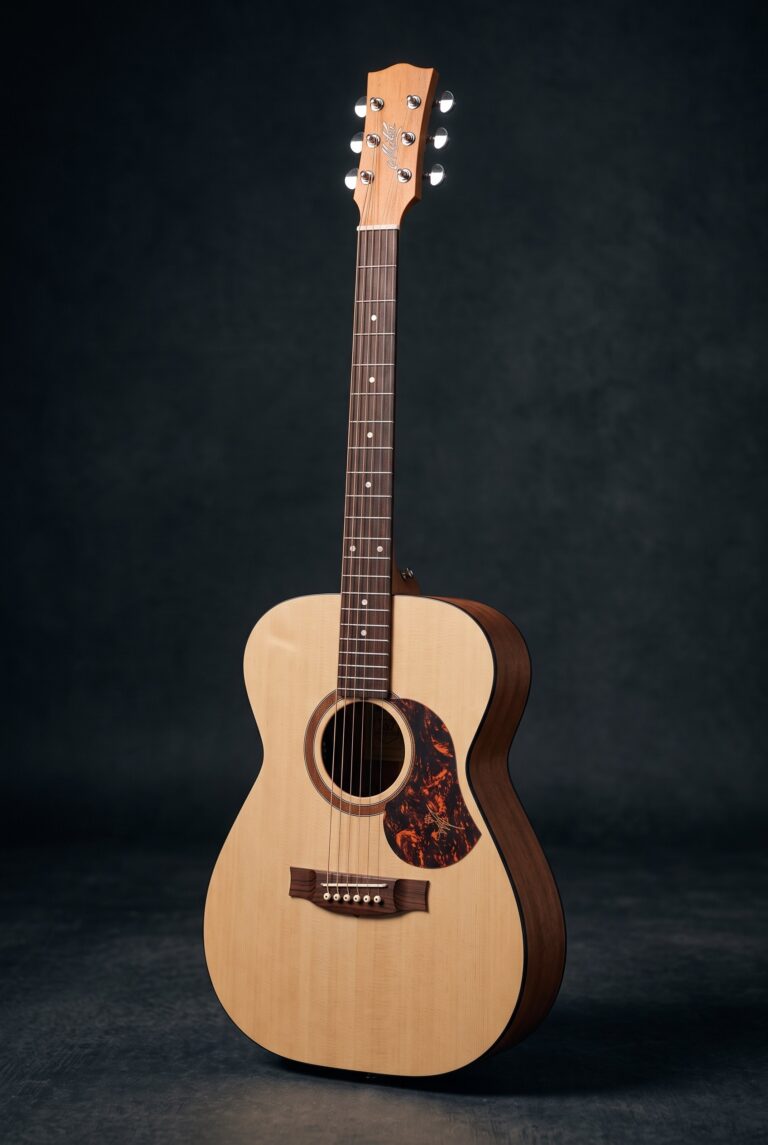
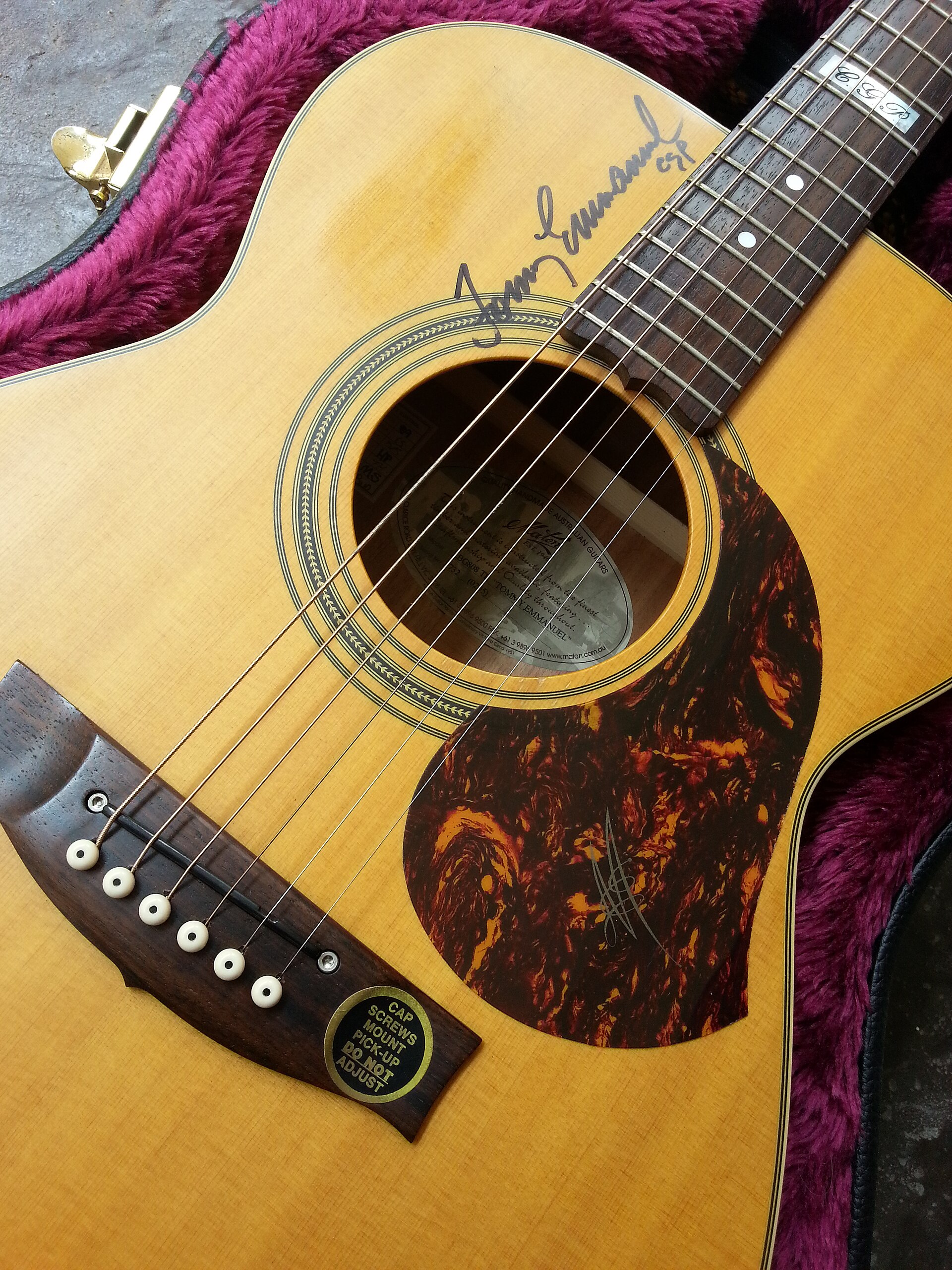
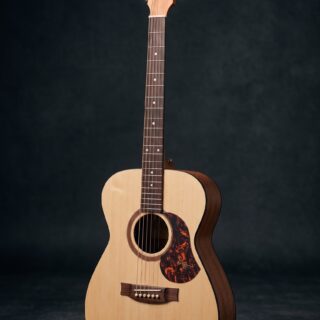
A 2005 Maton EBG808TE. Photo: YuWan Ker, CC BY 2.0, via Wikimedia Commons.
Inside the Maton EBG808TE Tommy Emmanuel signature: the 808 shape's 1978 origin story, AP5 Pro pickup, verified specs, tone recipes and buying advice.
There is a moment in almost every Tommy Emmanuel concert where the guitar stops sounding like a guitar. He hits the top with the heel of his hand, the bass note rings on, a melody appears somewhere above it, and the whole thing comes out of the PA sounding like a band that forgot to show up. Half the audience assumes there is a loop pedal. There isn’t. There is a small-bodied Australian acoustic with a microphone bolted inside it, and it has been doing this job on the world’s stages for three decades.
The Maton EBG808TE is what happens when a guitar company builds exactly what one obsessive player asked for and then, unusually, sells it to everyone else without watering it down. It is not a cosmetic signature model. It is not a standard guitar with a famous name on the truss rod cover. It is a genuinely different instrument — a 00-sized body with dreadnought depth, an unusually long 25.5-inch scale for a guitar this size, Queensland maple back and sides instead of the rosewood or mahogany the rest of the world defaults to, and a pickup system that most acoustic players describe as the reason they bought the guitar in the first place.
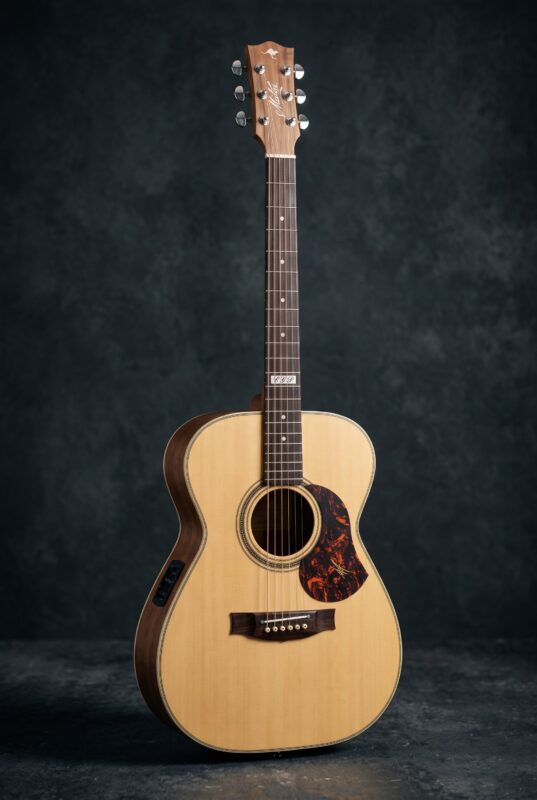
It is also, on the evidence, one of the few signature acoustics where the artist actually plays the production model. That is rarer than the marketing would have you believe, and we will get into exactly how rare shortly.
Maton: The Australian Guitar Company Nobody Outside Australia Knew About
Start with the name, because everyone mispronounces it. Maton is “MAY-tonne,” a contraction of “May Tone” — after Bill May, the Melbourne-born jazz musician, woodwork teacher and luthier who founded the company with his brother Reg in a Thornbury, Victoria garage in 1946.
The founding story is the classic post-war one. Quality American instruments were nearly impossible to import into Australia. May, who needed a good guitar and could not buy one, built one instead. His stated philosophy — still quoted on the company’s own history page — was flatly practical: “If you make a good guitar, the right guitar, people will want it.”
He was right, and the company outgrew the garage inside six years, moving to Canterbury in 1952. What followed is a timeline that reads like a series of near-misses with global fame:
- 1957 — Elvis Presley plays a Maton HG 100 in Jailhouse Rock.
- 1958 — Maton expands into electrics and amplifiers with the MS500 Mastersound.
- 1961 — Two brothers from New South Wales, Tommy and Phil Emmanuel, get their first Maton guitars. They are MS500s. Tommy is six years old.
- 1963 — George Harrison is photographed with an MS500 in Liverpool.
- 1969 — Keith Richards plays a Maton SE777 on “Gimme Shelter.”
- 1978 — Maton develops the 808 body shape.
- 1994 — Tommy Emmanuel’s “Mouse” is born.
Note the 1961 entry. That is not retrofitted marketing. Maton’s relationship with Tommy Emmanuel predates his career, predates the 808 shape, and predates the company’s international expansion by roughly forty years. When the EBG808TE finally arrived, it was not a brand courting a star. It was a company building a guitar for someone who had been in the family since childhood.
Bill May died in 1993. His daughter Linda Kitchen and son-in-law Neville Kitchen had become directors in 1989; David Steedman joined in 2003 as the third generation. Maton moved to Bayswater in 1990 and Box Hill in 2003, and today employs more than seventy people and remains one hundred percent family owned. In 2026 the company marks eighty years of hand-built instruments.
The 808 Shape: A Wrecked Martin, a Melbourne Folk Club, and a Very Good Repairman
The single most important thing to understand about the EBG808TE is that the body shape it is built on was not designed for Tommy Emmanuel. It was designed nearly twenty years before he had a signature model, by a man most guitar players have never heard of, in response to a car crash.
Chris Ffinch started at Maton in 1966 — two days after arriving in Australia from England — and by 1978 was one of the finest builders in the factory and one of the best repairers in Melbourne. He was also deep in the Melbourne folk scene, and he had noticed something at Frank Traynor’s Folk and Jazz Club, the city’s premier folk venue: the singers were all playing small-bodied guitars, and they were almost all Martins. Maton had nothing to offer them.
Then, sometime in 1978, the Australian folk guitarist Gordon McIntyre had a car accident that badly damaged his Martin 00-18. He took it to Ffinch to see if it could be saved. With a smashed 00-18 on the bench, Ffinch had the perfect opportunity to take dimensions and design a Maton version of the small-bodied guitar.
What he produced was not a Martin copy. Maton’s own account of the design is specific about what made it different, and every one of those differences still defines the guitar today:
- A small 00-style silhouette combined with full body depth. Most 00-sized guitars are shallow as well as narrow. The 808 keeps the compact waist and lower bout but retains a deep body cavity, which is where the low end comes from.
- A 25.5-inch scale length. Most small-bodied guitars run 24.9 inches, occasionally 25.4. The longer scale means higher string tension at pitch, which means more headroom, more attack, and tighter bass definition — exactly what a fingerstyle player who hits hard needs.
- A 100mm soundhole rather than the 95mm typical of small bodies. (Maton changed this spec to 95mm in 2014 as part of a range-wide redesign, and the current EBG808TE lists 95mm.)
The original BG808 shared materials with Maton’s CW80: Sitka spruce top, Queensland maple sides with a basswood interior ply, three-ply basswood back, Queensland maple neck, Indian rosewood board, bridge and headstock veneer, satin finish over a honey-stained top with walnut-stained back, sides and neck, and ivory-coloured ABS binding. If that list sounds familiar, it should — the modern EBG808TE is recognisably the same recipe, upgraded.
Maton sold 133 of them across 1978–79, and they found their way to notable Australian performers, John Williamson being the best known at the time.
What Does “EBG808” Actually Mean?
Even Maton is not entirely sure. In the company’s own published account, the “BG” is generally taken to stand for Bluegrass — which makes no sense at all, since the iconic bluegrass guitar is a loud mahogany dreadnought and this little fingerstyle box is the opposite of that. Ffinch himself thought it may have started life as “Blues Guitar” and drifted. As for “808,” the theory is that “80” refers to the CW80 the design borrowed from, and the final 8 may be a comment on the pronounced figure-eight of the body shape. Or, as Maton puts it, perhaps it just sounded good — Bill May came up with all the model names and numbers, and the reasoning went with him.
The “E” prefix denotes the electric/pickup-equipped version. “TE” is Tommy Emmanuel. A “C” on the end (EBG808TEC) means cutaway. It is refreshingly literal once you know the code.
How the TE Model Actually Came to Exist
The origin story of the signature model is worth telling because it explains the guitar’s character better than any spec sheet.
Maton approached Emmanuel about building guitars for him and presented a prototype. He sent it back with an extensive list of modifications covering everything from neck geometry to the electronics. Maton rebuilt it to his specifications. He played it, reported that the guitar itself was much improved — and said the electronics still did not compare to what was already on the market. Maton went away and produced an entirely new pickup system. Emmanuel suggested some final adjustments, and only then endorsed the guitar and started playing it.
That electronics fight is the important part. Maton did not put a name on an existing model; the company was pushed into developing a pickup system it did not previously have, which eventually became the AP5 and then the AP5 Pro — now widely considered one of the best factory-fitted acoustic systems in the industry, and fitted across Maton’s entire acoustic range. An artist demanding better electronics ended up upgrading the whole company.
The hand-built side of the relationship continued in parallel. Andy Allen, formerly Maton’s chief luthier, built Emmanuel’s personal instruments and worked with him on design ideas over many years. Those became the TE Personal models — and the 1994 “Mouse,” listed in Maton’s official timeline as its own historical event, which tells you how the company regards it.
Specifications: Maton EBG808TE
A Note on Spec Drift — and Maton’s Own Contradiction
Two things are worth flagging honestly, because a lot of published information about this guitar disagrees with itself.
First, the series name. Maton’s own product page for the EBG808TE displays it under “The Signature Series” in the breadcrumb and page header — and then, in the specification table on the same page, lists “Series Name: Artist Series.” Both appear on the same URL. This is a website data artefact, not two different guitars; the EBG808TE is a Signature Series instrument and sits alongside the EBG808TEC and EBG808TEC Burst there, while the non-signature EBG808 Artist is a separate model in the Artist Series. If you see the guitar described both ways online, that is why.
Second, the fingerboard. Maton’s current spec table says Indian rosewood board and bridge. A significant number of dealer listings — including for guitars sold new — describe streaky or striped ebony. Both are plausible: older production runs and some variants did use ebony, and the industry-wide CITES-driven shifts in tropical hardwood sourcing have moved plenty of makers between the two. Treat the manufacturer page as authoritative for a current-production guitar and check the actual instrument for anything used. This matters slightly for tone (ebony is denser and marginally brighter in the attack) and rather more for resale-listing accuracy.
Famous Players: A Signature Model the Artist Actually Plays
We are habitually sceptical of signature-model artist claims in this series, because most brands recycle the same handful of famous names across a whole catalogue regardless of what those players actually own. The Maton EBG808TE is one of the cleaner cases we have looked at, and it deserves credit for that.
Tommy Emmanuel — verified, with an important nuance
Emmanuel’s own official website publishes a gear page. Under Guitars, it lists three instruments:

- Maton 808 TE Personal, Queensland maple
- Maton 808 TE Personal with a slightly thinner body
- Maton EBG808TE/C
That is the artist’s own site naming the production model. It is about as good as artist verification gets, and it is confirmed by his Maton artist page and by countless hours of concert footage.
The nuance — and it is an honest one that no dealer will volunteer — is the order of that list. Emmanuel’s primary touring instruments are the hand-built TE Personal models, made by Andy Allen and, latterly, offered through Maton’s Master Built range. Those are custom instruments with individually specified body depths, built one at a time. The production EBG808TE/C is on the list, it is real, and he plays it. But if you buy an EBG808TE expecting the exact guitar you heard on the last tour, you are buying the same architecture, the same shape, the same scale, the same pickup and the same design philosophy — from the same factory, in the same country, with the same person’s fingerprints on the specification — rather than an identical instrument. That is a much better deal than most signature models offer, and it is worth stating plainly.
The “C.G.P.” Inlay and What It Actually Signifies
The mother-of-pearl block at the twelfth fret is engraved “C.G.P.” — Certified Guitar Player, a title invented and conferred by Chet Atkins. It was a genuine honour with an absurdly small membership. Alongside Emmanuel, Maton names three other holders: John Knowles, Jerry Reed and Steve Wariner. (Atkins himself used the designation, and the count of who “officially” holds it varies slightly depending on whether you count Atkins and how you treat the honorific’s informal awards — but the point stands: it is a list of four or five people, not a marketing badge.)
This is the single detail that most reveals what kind of instrument the EBG808TE is. The inlay does not say “Tommy Emmanuel.” It does not carry a signature on the headstock. It carries a three-letter reference to a lineage — Atkins to Emmanuel, the thumb-and-fingers tradition running back through Merle Travis — that most casual buyers will not even recognise. That is a confident piece of design.
The Wider Maton Roster — Verified, and Genuinely Interesting
Maton’s historical artist connections are unusually well documented, because the company keeps a museum and publishes archival research rather than a generic legends list. Verified from Maton’s own historical record: Elvis Presley with an HG 100 in Jailhouse Rock (1957), George Harrison photographed with an MS500 in Liverpool (1963), and Keith Richards playing an SE777 on “Gimme Shelter” (1969). More recently the company built the BB1200JH signature model for Josh Homme in 2004 and the first Mini Maton in collaboration with Mark Lizotte (Diesel) in 2005.

Those are electric and archtop connections, not 808 connections, and we are not going to pretend otherwise. On the 808 itself, the documented early adopters were Australian folk players — John Williamson most prominently — before Emmanuel’s international profile turned the shape into an export product. If someone tells you a British Invasion legend played an 808, ask for the date: the shape did not exist until 1978.
How It Sounds, and Why
The EBG808TE does not sound like a Martin 000, despite being descended from a smashed one. Three design decisions push it somewhere else entirely.
Queensland maple back and sides. Despite the name, Queensland maple is not a true maple — it is an Australian rainforest hardwood with a density and stiffness profile that sits somewhere between mahogany and true maple. In practice it does what maple does: it stays out of the way. It adds relatively little colouration of its own, which means the top’s voice and the player’s right hand dominate the result. For a fingerstyle player producing bass, melody and percussion simultaneously on one instrument, that separation is the whole point. Rosewood’s rich low-mid bloom, gorgeous on a strummed dreadnought, would smear exactly the frequencies where a solo arrangement needs air.
Full depth on a small body. The 808 has the note-to-note clarity and midrange focus of a 00 with a low end that a 00 has no business producing. It will never move air like a dreadnought, but it does not thin out when you drop to DADGAD or a dropped-D bass line.
The 25.5-inch scale. Higher tension at pitch means the strings resist harder, which yields a snappier attack, better sustain in the treble, and — critically for percussive players — a top that does not go floppy when you hit it. It also makes the guitar slightly harder work under the fingers than a 24.9-inch short-scale, which is a fair trade for what you get.
The overall character: bright, articulate, quick, with a punchy midrange and a tight, present bass. Strummed hard it can sound a touch aggressive compared to a mahogany dreadnought. Played with fingers, it is one of the most legible acoustic guitars in production — every voice in a dense arrangement stays where you put it.
The AP5 Pro Pickup System
This is the reason a lot of working musicians own Matons, and it deserves its own explanation.
The AP5 Pro combines an under-saddle piezo transducer with an internal condenser microphone on an adjustable arm, blended together. That combination is common in aftermarket systems and expensive in third-party installations; Maton fits it as standard and voices it in-house on the guitar it will live in.
Why it matters: piezo alone gives you attack, string definition and enormous feedback resistance, but also the characteristic brittle “quack” that makes plugged-in acoustics sound like a synthesiser impression of a guitar. A microphone alone gives you the actual sound of the instrument in the room — body resonance, fingernail texture, the thump of a palm hit — and feeds back savagely at stage volume. Blending them lets you dial in as much of the real guitar as the room will tolerate, then lean on the piezo for the rest.
The AP5 Pro was a ground-up redesign of the long-serving AP5. The improvements Maton documents: control potentiometers with resistance curves designed specifically for the system, giving a more linear feel to bass, treble and mid; an expanded FQ mid-sweep covering 600Hz to 2.4kHz, which reaches lower than the previous system and covers a wider band; a redesigned microphone system; miniature surface-mount components on a single bolted-in PCB, making the assembly smaller, quieter, more rigid and less likely to rattle after years of touring; and — a small thing that working players love — a switch from a 9-volt battery to 2 × AA cells, which occupy roughly the same space but store almost twice the energy. The battery terminals are phosphor bronze, the same corrosion-resistant alloy used for ship propellers, so a leaking cell does not write off the contacts.
Tone Recipes and Settings
Solo Fingerstyle, Seated, Small Venue
The classic Emmanuel-adjacent application. On the AP5 Pro: mic blend at roughly 50–60% toward the microphone, bass at noon or very slightly cut, mids flat, treble backed off by 1–2 clicks from noon. Set the FQ mid sweep around 1kHz and cut a small amount — that is where boxy piezo honk lives on a small-bodied guitar. Run into a full-range acoustic amp (an AER Compact or a Udo Roesner if you want to follow Emmanuel’s own choices) or straight to a DI. Add reverb from the front-of-house desk rather than the guitar, and keep it modest: a plate or small hall at 15–20% wet is plenty. Too much reverb is the single most common way to destroy the clarity that this guitar exists to provide.
Percussive Playing, Loud Stage
Body-hitting through a microphone at volume is where things go wrong. Pull the mic blend back to 25–30%, sweep the FQ down to 250–350Hz and cut 3–4dB — that is the boom band, where a full-depth body and a slapped soundboard conspire against you. Keep the bass control near flat rather than boosting it; on this guitar the low end is already there. If you are still getting a howl, a soundhole feedback buster is the last resort, not the first, because it will audibly rob the acoustic voice the mic exists to capture.
Recording: The Two-Source Method
Do not record the AP5 Pro alone. Put a small-diaphragm condenser about 30cm out, aimed at the twelfth fret rather than the soundhole, and take a DI from the guitar simultaneously. Time-align the two in the DAW, then use the mic for body, air and fingernail detail and blend the DI in underneath at 15–25% for attack definition and pick-hand transient. On a guitar this articulate, that small amount of DI is often the difference between a track that sits in a mix and one that disappears behind a piano.
Strummed Accompaniment in a Band
The 808 shape’s midrange focus is an advantage here rather than a limitation — it occupies a narrower slice of the spectrum than a dreadnought and therefore fights less with a bass guitar and a vocal. Blend to about 40% mic, cut 2–3dB around 400Hz to make room for the bass, and add a small presence lift with the FQ around 2kHz so the strum pattern reads over a drum kit. Lighter strings (.011s) will take some of the edge off the long-scale tension if you are playing barre chords all night.
Altered Tunings
DADGAD and drop-D suit the guitar particularly well, because the long scale keeps a dropped low string from going slack and indistinct. If you spend most of your time in low tunings, consider moving up to a .013 set — Emmanuel himself uses both light (.012–.054) and medium (.013–.056) Martin SP Flexible Core sets, and the medium set is a legitimate option on this scale length rather than an act of masochism.

The following are starting points, not gospel. Every room, every PA and every pair of hands is different.
How It Compares
EBG808TE vs. EBG808TEC (Cutaway)
The cutaway costs several hundred dollars more and gives you comfortable access above the fourteenth fret. Conventional wisdom says a cutaway removes air volume and therefore bass response; in practice on a body this size the difference is small and most players will not identify it blind. The real question is repertoire. If your arrangements live above the twelfth fret — and a lot of modern fingerstyle does — buy the cutaway and stop agonising. If they do not, the non-cutaway is the more traditional-looking instrument and marginally cheaper. Emmanuel’s own gear list names the model as “EBG808TE/C,” declining to pick a side.
EBG808TE vs. the TE Personal / Master Built
The Master Built TE Personal is the hand-built version: individually made, custom body depths available, built by the luthiers who make Emmanuel’s own instruments, and priced accordingly — comfortably into five figures in some markets. It is a different purchase decision. The production EBG808TE is a factory instrument built to a repeatable spec by a seventy-person workshop, and that consistency is a feature, not a compromise, if you intend to actually gig it.
EBG808TE vs. the Maton SRS808
Worth understanding before you spend the money. The Solid Road Series 808, introduced when Maton overhauled its build process in 2011 to move to all-solid-timber construction, gives you the same body shape and the same AP5-family electronics at a substantially lower price, with different tonewoods and a plainer cosmetic package. If the 808 shape is what you want and the C.G.P. inlay is not, the SRS is the value play in the range and a genuinely serious instrument. The EBG808TE buys you the AAA-select top, the Queensland maple back and sides, the herringbone rosette and binding package, and the specification Emmanuel argued Maton into.
EBG808TE vs. a Martin 000-28 or OM-28
The most direct international comparison, and the ancestral one — the 808 descends from a 00-18, after all. The Martin is rosewood-backed, giving a warmer, more complex, more harmonically dense voice that flatters strummed chords and singer-songwriter work. The Maton is drier, faster, more articulate, and considerably better suited to solo arrangements where several musical parts have to coexist. The Maton also arrives with a professional-grade blended pickup system as standard; putting an equivalent system into the Martin is a several-hundred-dollar aftermarket job with an installer’s drill involved. For a player who plugs in every night, that alone can settle it.
EBG808TE vs. a Taylor 814ce
The Taylor is the other obvious plugged-in fingerstyle contender, and the comparison mostly comes down to pickup philosophy. Taylor’s Expression System 2 is a very good behind-the-saddle piezo design with no microphone; it is exceptionally reliable, feedback-resistant, and consistent. The Maton’s blended mic-plus-piezo approach can sound more like an actual acoustic guitar in a well-behaved room, and more troublesome in a bad one. Taylor’s slim necks and low actions make the 814ce arguably the easier guitar to play fast; the Maton’s longer scale and fuller neck reward a stronger hand.
Where It Sits Against Other Guitars We’ve Covered
Against carbon-fibre engineering solutions like the Ovation Adamas 1687GT, the Maton is the traditionalist: wood, glue, scalloped X-bracing and a bolted-in preamp, versus a composite soundboard and a fibreglass bowl. Both are answers to the same question — how do you make an acoustic guitar survive and project on a professional stage — arrived at from opposite directions. Against the more affordable Ovation Celebrity Elite CE44, the gap is one of tier rather than philosophy. And against the nylon-string world of the Kremona Solea, José Ramírez 1a or Alhambra 4P, the comparison is really about what a solo instrument has to do: classical guitars solve the multiple-voice problem with a wide flat fingerboard and nylon’s forgiving decay, while the 808 solves it with tension, scale length and a top that separates frequencies mechanically.

Buying Guide
New
Expect roughly US$2,800 for the EBG808TE and around US$3,350 for the EBG808TEC cutaway in 2026, with genuine variation by market — Matons are considerably cheaper in Australia and carry an import premium in North America and Europe. A Maton standard hard case is included, which is not a given at this price point. Left-handed instruments are available to order rather than off the shelf, so plan ahead.
Buy from an authorised Maton dealer. This matters more than usual for two reasons: warranty registration runs through Maton directly, and authorised repairers for the AP5 Pro system are a defined network rather than “any guitar tech.” Maton publishes both lists.
What to Check on a Used Example
- The electronics, first and at length. Plug it in before you look at anything else. Sweep every control through its full range listening for crackle. Move the mic arm and confirm the blend actually changes. Check whether it is an AP5 or an AP5 Pro — the Pro arrived in 2024 and uses 2 × AA batteries where the older system uses a 9V, which is the quickest way to tell them apart without opening anything. An AP5 is not a problem; it was the industry benchmark for over a decade. But it should be priced as an AP5.
- Battery compartment corrosion. A leaked cell in an older instrument can damage the terminals. The Pro’s phosphor-bronze terminals are designed to survive this; earlier ones are less forgiving.
- The top around the bridge and soundhole. Percussive players hit these guitars. Look for finish wear that has gone through to bare wood, hairline cracks radiating from the bridge, and any lifting at the bridge’s back edge.
- Neck relief and saddle height. A 25.5-inch scale is unforgiving of a rising fourteenth-fret area. If the saddle has already been shaved to a sliver to keep the action playable, a neck reset may be in the guitar’s near future.
- Fingerboard material. As noted above, listings disagree between ebony and Indian rosewood. Look at the actual instrument. Neither is a defect; misdescription is a negotiating point.
- Serial and origin. Every EBG808TE is built in Australia. Maton also produces imported lines under other names; if a listing is vague about where a guitar was made, ask directly.
Which Years to Look For
Two dates structure the used market. In 2011 Maton introduced the AP5 Pro’s predecessor as a mature system and overhauled its build process for the SRS range. In 2014 the 808 soundhole changed from 100mm to 95mm as part of a range redesign. Neither is a quality cliff — a pre-2014 100mm-soundhole 808 is a lovely guitar and slightly different in voicing, with a touch more openness in the low mids — but they help you place an instrument. Post-2024 examples carry the AP5 Pro.
Living With It
Humidity. This is a solid-top instrument made in Melbourne, a temperate climate. It will not enjoy a Nordic winter with the radiators on or a desert summer. Keep it in the case with a humidifier when it is not being played and aim for 45–55% relative humidity. Spruce tops crack; Queensland maple back and sides are no more forgiving than any other solid hardwood.
Batteries. The AA change was a real quality-of-life improvement — expect meaningfully longer life than a 9V system — but the mic circuit still draws current whenever a cable is plugged in. Unplug the guitar when you finish playing. Every acoustic player learns this once, usually forty minutes into a gig.
Strings. Elixir Nanoweb Phosphor Bronze .012–.053 from the factory. Coated strings suit a guitar with a blended mic system, because the mic hears finger squeak and dead-string thud that a piezo would politely ignore. If you want to follow Emmanuel exactly, he uses Martin SP Flexible Core “Tommy’s Choice” MXF740 light .012–.054, and MXF750 medium .013–.056.
Setup. The 12-inch radius and 1.736-inch nut give a comfortable middle ground — wider than a vintage-spec Martin, narrower than a dedicated fingerstyle 1.75-inch. Most players find the factory action a little on the high side for percussive work and get a professional setup within the first year. Do this before deciding whether you like the guitar; a long-scale instrument with high action feels much stiffer than it needs to.
The satin finish marks more readily than gloss but also touches up far more gracefully, and it does not show the arm wear that turns a gloss top into a mirror of your forearm. It is the right choice for a working instrument.
Frequently Asked Questions
Does Tommy Emmanuel actually play the EBG808TE, or is it just his name on it?
He plays it. His own official gear page lists a “Maton EBG808TE/C” alongside two hand-built 808 TE Personal instruments. The honest caveat is the ordering: the TE Personals are his primary touring guitars, with individually specified body depths, built by hand. The production model is genuinely in his hands and genuinely built to his specification, but it is not literally the same instrument as the one-off customs.
What does the “C.G.P.” inlay mean?
Certified Guitar Player — a title created and awarded by Chet Atkins to a tiny handful of players. Maton names John Knowles, Jerry Reed and Steve Wariner alongside Emmanuel. It is an honour, not a certification anyone can apply for.
Is the 808 a small guitar? Will it sound thin?
The outline is 00-sized, but the body is full depth, which is unusual for that footprint and is precisely the point of the design. It has more low end than a comparable small-bodied guitar and less than a dreadnought. It will not disappear underneath a band, but it is not a bluegrass cannon either — despite the “BG” in the name, which nobody at Maton can fully explain.
Why is the scale 25.5″ when most small-bodied guitars are shorter?
Deliberate design from 1978. Chris Ffinch combined the small body with a long scale specifically to differentiate the guitar from the Martins it was competing with. The higher string tension gives more attack, tighter bass and more headroom — ideal for a fingerstyle player who plays hard, less ideal if you want the loose, easy feel of a short-scale parlour.
What is Queensland maple, and is it really maple?
No. Queensland maple (Flindersia brayleyana) is an Australian rainforest hardwood named for its visual resemblance to true maple, not its botanical relationship. Tonally it behaves in a broadly maple-like way — relatively neutral, letting the top and the player dominate — which is exactly why it suits a solo fingerstyle instrument where multiple voices need to stay separate.
Should I buy the cutaway version?
If your playing goes above the fourteenth fret, yes, and do not worry unduly about lost bass response — the difference on a body this size is marginal. If it does not, save the several hundred dollars. Emmanuel’s gear list names the model as “EBG808TE/C” without distinguishing, which is a reasonable position to take.
How good is the AP5 Pro compared to a LR Baggs or Fishman system?
It is competitive with, and by many players’ reckoning better than, comparable blended aftermarket systems — largely because it is designed for, voiced in, and installed in this specific guitar at the factory rather than retrofitted. The mic-plus-piezo blend gives you a more convincing acoustic sound than piezo-only systems at the cost of somewhat more feedback management on loud stages. If you play seated in listening rooms, it is close to ideal.
Is the EBG808TE worth roughly $2,800 when a Martin 000 or Taylor costs similar?
It depends entirely on whether you plug in. As a purely acoustic instrument it is excellent but not obviously superior to its American rivals; as a plugged-in professional tool it comes with a pickup system that would cost several hundred dollars plus installation to approximate elsewhere, in a body shape that no American maker offers. Add the all-Australian hand-built construction and the included hard case, and the value case is solid. If you never leave the sofa, a comparable rosewood-backed American flat-top may serve you better.
Image credits
- Tommy Emmanuel: Martin Rulsch, Wikimedia Commons, CC BY-SA 4.0.
- Keith Richards: Raph_PH, Wikimedia Commons, CC BY 2.0.
- Tommy Emmanuel: Janet Spinas Dancer, Flickr, CC BY 2.0.
- Top image: A 2005 Maton EBG808TE, YuWan Ker, Wikimedia Commons, CC BY 2.0.
- Maton EBG808TE: AI-generated illustration by GuitarGangsters, based on the manufacturer’s product design (not a photograph).
- Tommy Emmanuel: Martin Rulsch, Wikimedia Commons, CC BY-SA 4.0.
Latest News
Related

On This Day
Wednesday 11 November
From this week: