Maton SRS808: The All-Solid Australian That Turned “Working Guitar” Into a Compliment
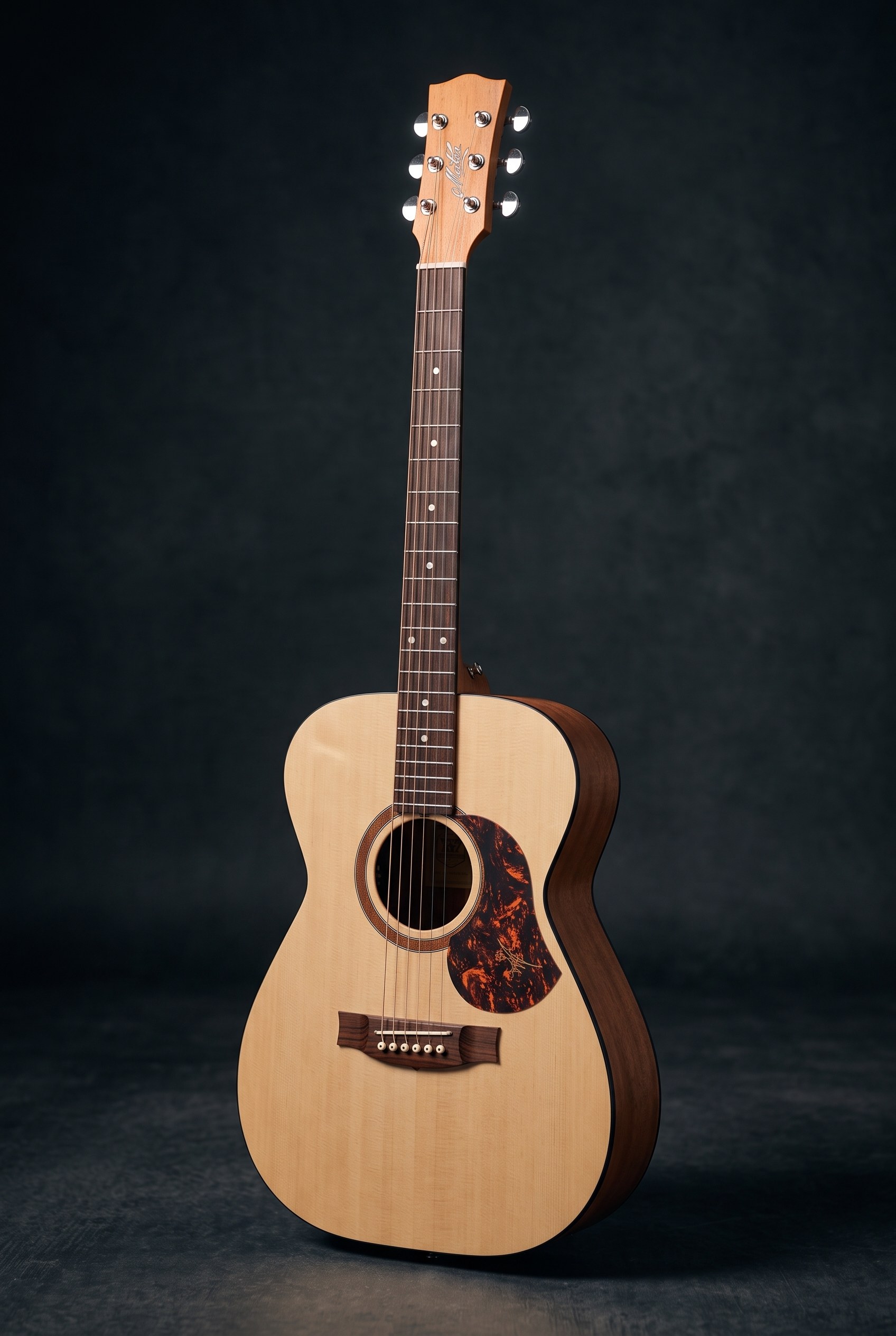
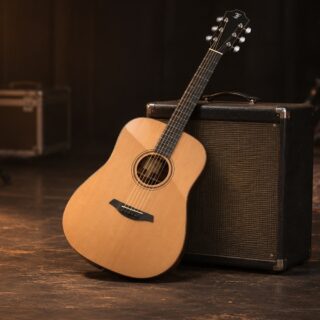
An AI-generated illustration of the Maton SRS808.
The Maton SRS808 in full: all-solid blackwood build, the cedar-to-spruce spec change, AP5 Pro pickup, tone settings and which famous players really own one.
There is a particular kind of guitar that never gets a magazine cover and never needs one. It lives in a hard case in the back of a van. It goes on stage six nights a week, gets plugged into a house PA run by whoever showed up, and sounds like a guitar rather than like a piezo pickup having a bad night. It gets handed to a support act who has just snapped a string, and it comes back fine. Nobody photographs it. Everybody who plays it remembers it.
The Maton SRS808 is that guitar. The name is not romantic — Solid Road Series, 808 body shape — and Maton has never tried to make it romantic. What the company did instead, in June 2011, was quietly move its mid-tier range to all-solid timbers, throw out the old bracing pattern, redesign the back arch, and then keep the price low enough that a working musician could actually justify it. Fifteen years later the SRS808 is one of the most-gigged small-body acoustics on earth, and one of the few guitars in its price bracket whose plugged-in sound is genuinely the point rather than an afterthought.
This is not a review. This is the story of what the SRS808 actually is, where the shape came from, what changed under the hood between the early runs and the current ones, which famous players really do own one and which credits fall apart the moment you check them, and how to get the thing to sound like a guitar through a PA.
Melbourne, 1946: A Woodwork Teacher With a Jazz Habit
Maton starts with Bill May, a Melbourne jazz musician and woodwork teacher who set up in a Thornbury garage in 1946 with his brother Reg. The name is a contraction of “May Tone” — pronounced MAY-tonne, not MAT-on, a distinction Australians will correct you on with some enthusiasm. The company moved to Canterbury in 1952, Bayswater in 1990, and Box Hill in 2003, where it still is. It has never been sold. Bill May died in 1993; his daughter Linda Kitchen and Neville Kitchen took over as directors in 1989, and third-generation David Steedman joined in 2003. Vera May, Bill’s widow, died in 2022 aged 102. In 2026 Maton turns eighty, and it remains one of a vanishingly small number of guitar companies that are both family-owned and building at scale in a high-wage country.
That last fact matters more than it sounds. Almost every acoustic guitar sold between US$1,500 and US$2,500 is built in Asia — usually very well, but built there. Maton builds the SRS808 in suburban Melbourne with a dovetail neck joint, which most manufacturers reserve for instruments costing three times as much. The price of an SRS808 buys you an all-solid, hand-built, Australian-made instrument. There is no other sentence quite like that in the acoustic market.
Where the 808 Shape Came From: A Car Crash and a Broken Martin
The 808 body is not a Maton invention in the abstract sense — it is a specific answer to a specific problem, and the story is documented on Maton’s own site.
In 1978, Chris Ffinch — who had joined Maton in 1966, two days after arriving from England, and had become both the company’s top builder and Melbourne’s best repairer — had a smashed Martin 00-18 on his bench. It belonged to folk guitarist Gordon McIntyre, who had crashed his car with the guitar in it. Ffinch was active in the Melbourne folk scene, and he had noticed that the singers at Frank Traynor’s Folk and Jazz Club almost all played small-bodied Martins. With the 00-18 in pieces in front of him, he took the dimensions.
What he built from them was not a Martin copy. Ffinch kept the 00 silhouette but gave it a full body depth, a 25.5-inch scale — long, where small-bodied guitars traditionally use 24.9 or 25.4 — and a 100mm soundhole where 95mm was typical. The result was a compact guitar with far more air and far more string tension than its outline suggested. The first version was the BG808; 133 were built across 1978 and 1979. Maton itself has never fully resolved the name: “BG” was nominally Bluegrass, though Ffinch thought it might have started as Blues Guitar, and “808” was possibly 80 borrowed from the CW80 model plus 8 for the figure-eight body. Bill May named everything, and Bill May is not available for comment.
One detail every used-market buyer should know: the soundhole went from 100mm to 95mm in a range-wide 2014 redesign. If you are comparing an older 808-shaped Maton to a current one and the older one sounds slightly looser in the low mids, that is one of the reasons.
Nothing before 1978 can be an 808. Any claim that a 1960s or early-70s artist played a Maton 808 is automatically false — Maton’s Elvis, George Harrison and Keith Richards connections are all electrics and archtops (HG 100, MS500, SE777). The shape simply did not exist.

June 2011: What “Solid Road Series” Actually Changed
The SRS launch was not a cosmetic refresh. Maton describes it as the beginning of a new era, and the engineering list backs that up. Four things changed at once:
- All-solid timbers throughout the range. Not solid top over laminate — solid top, solid back, solid sides, at a price point where the competition was still laminating the sides.
- Forward-shifted X bracing. Moving the X toward the soundhole frees up more of the lower bout to move, which is the classic route to a bigger low end from a small box.
- Scallop peaks relocated to nodal points. Rather than scalloping to a generic profile, Maton positioned the high points of the scallops where the soundboard’s own vibrational nodes sit, removing mass where it costs output and leaving it where it does structural work.
- A second parallel tone bar. Shifting the X forward left room for an additional tone bar, and because there are now two, both can be scalloped. Load is spread across two members instead of concentrated on one, so total bracing mass goes down while stiffness stays put.
The fourth change is the one nobody talks about and it may be the most audible: Maton locked the back to a 15-foot radius arch and adjusted brace heights to match. The goal, in the company’s own words, was “plate resonance separation” — deliberately tuning the top and the back so their primary resonances do not sit on top of each other. When top and back resonate at the same frequency you get a loud, boomy, one-note bass response that turns to mud through a PA. Separate them and you get low end that is full but defined, which is exactly what the SRS808 does.
Maton’s summary of the result is unusually plain for marketing copy: “The new 808 series sounds a whole lot bigger than a small bodied guitar should.” That is the whole design brief in one sentence.
Specifications
The Cedar Question: Two Different Guitars Wearing the Same Name
Here is the single most useful thing to know about the SRS808 before you buy one used, and it is the kind of detail that gets lost in every spec sheet round-up.
Maton’s current product page lists the top as “A” Grade Spruce and the fingerboard and bridge as Indian Rosewood. Maton’s series-level page agrees: “a Spruce top… complemented by a Rosewood fingerboard and bridge.”
But go back a few years and dealer listings for the same model number describe something else entirely: “A” Grade Western Red Cedar top, streaky ebony fingerboard and bridge, Dunlop 6260 fretwire. Artisan Guitars in Franklin, Tennessee — one of the largest Maton specialists outside Australia — listed an SRS808 at US$1,899 with exactly that spec, serial 24418, and their description explicitly sold it on the cedar: “combines the warm, full tones of Blackwood with the top end sparkle of Cedar… very popular with fingerstyle players who work with a lighter string attack, suited to the responsive Cedar soundboard for excellent dynamics with subtle playing.”
Compare Maton’s current wording for the same model: “combines the warm, full tones of Blackwood with the top end clarity of Spruce.” Same sentence structure, two different woods, one word swapped.
This is not a documentation error. It is a real running change, and it matters, because cedar and spruce are not interchangeable:
- Cedar is softer, lower in density, and reaches its full output at a lower input energy. It responds immediately to a light touch, has a darker and slightly compressed top end, and does not gain much when you dig in. Fingerstyle players love it. Heavy strummers find it runs out of headroom.
- Spruce is stiffer, has more dynamic range, takes longer to open up over the years, and gives you more when you hit it harder. It has a brighter, more articulate treble and a harder attack transient — which, notably, translates better through a piezo pickup into a loud PA.
Given that the SRS is explicitly the road series and ships with a pickup system designed for stage use, moving to spruce reads as a deliberate decision to favour the plugged-in, high-volume, mixed-technique player over the quiet fingerstylist. If you are shopping used, you are not choosing between two conditions of the same guitar — you are choosing between two voices. Find out which top you are buying before you send money. Cedar is noticeably pinker-brown and more uniformly coloured; spruce is paler, whiter, and usually shows more pronounced grain lines and cross-silking.
Blackwood: The Timber That Made Maton’s Reputation
Australian Blackwood is Acacia melanoxylon, a close relative of Hawaiian koa, and it sits tonally almost exactly where you would guess from that relationship: between rosewood and mahogany, with koa’s characteristic midrange push. Rosewood gives you scooped mids, deep bass and glassy overtones. Mahogany gives you a dry, fundamental-heavy, midrange-forward sound with fast decay. Blackwood gives you rosewood’s low-end weight with mahogany’s midrange presence and a slightly compressed, sweet upper register that keeps it from ever sounding harsh.
For a small-bodied guitar this is close to ideal. The 808 shape does not have the internal air volume to produce dreadnought bass, so a rosewood-style scoop would leave it sounding thin. Blackwood pushes the mids forward, which is precisely where a small body already wants to live, and the result is a guitar that cuts through a band mix without any EQ intervention.
There is also a supply-chain argument. Blackwood is grown and harvested in Australia and Tasmania under Australian forestry regulation. Unlike Brazilian rosewood or, increasingly, Indian rosewood, it carries no CITES Appendix I baggage and no border-crossing anxiety. If you tour internationally, the back and sides of this guitar will never be the reason you are having a conversation at customs.
The AP5 Pro: The Real Reason This Guitar Is on Stages
Strip away the timber and the bracing, and the reason working musicians keep choosing Maton over better-known American brands in the same money is the pickup. Maton has been building its own acoustic electronics for decades, and the AP5 became a genuine industry benchmark for over ten years. The AP5 Pro is its successor and it comes standard on every SRS model — not as an upgrade, not as an option.
The system is a blend of an undersaddle piezo and an internal condenser microphone on an adjustable arm. That combination is not unique. What Maton did to it is:
- Custom resistance curves on the controls, so bass, mid and treble sweep feels linear to the hand rather than doing nothing for 60% of the travel and then everything at once.
- An expanded mid sweep from 600Hz to 2.4kHz — lower and wider than the previous generation. This is the money feature. The frequencies where an amplified acoustic turns to boxy honk or brittle quack live right in that band, and being able to find and pull the exact offending frequency at the guitar, before the signal ever reaches a house desk, is the difference between sounding good in a bad room and not.
- A redesigned microphone system with better tonal definition and simpler operation.
- Miniature surface-mount components on one bolted-in circuit board, which is smaller, quieter, mechanically rigid and — crucially for an instrument that lives in a van — far less prone to developing rattles.
- Two AA cells instead of a 9V block. Roughly double the stored energy in the same physical space, with phosphor-bronze terminals (the same corrosion-resistant alloy used for ship propellers).
That last point is also the fastest way to identify which generation you are looking at on the used market. Open the battery compartment: 9V means AP5, two AAs means AP5 Pro.
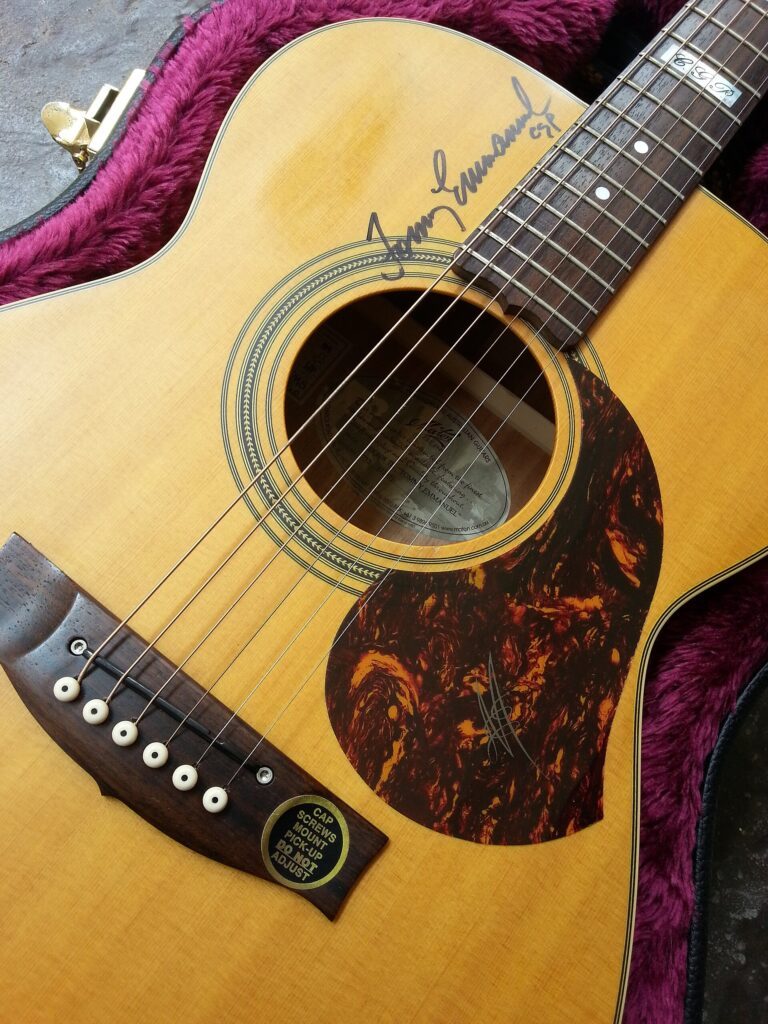
The AP5 Pro exists because of a complaint. When Maton presented Tommy Emmanuel with a prototype signature model, he sent it back with an extensive list of modifications running from neck geometry to electronics. Maton rebuilt it, and Emmanuel’s verdict was that the guitar was now far better but the electronics still lagged the market. Rather than argue, Maton developed an entirely new pickup system — which became the AP5, and eventually the AP5 Pro fitted to the SRS808. An artist’s dissatisfaction upgraded an entire company’s product line, and every SRS buyer benefits from it. You can read the full story in our feature on the Maton EBG808TE Tommy Emmanuel.
Famous Players: What Actually Checks Out
This is where most gear articles start inventing things, so let us be careful. Maton makes three claims at the series level and three at the model level, and they hold up to very different degrees.
Peter Frampton — verified, but on the cutaway
Peter Frampton is the strongest documented connection, and it is documented outside Maton’s own marketing. In October 2021, coinciding with the paperback release of his memoir Do You Feel Like I Do?, Frampton opened an official Reverb shop selling stage- and studio-used gear from his collection. Guitar World covered it and photographed the instruments. Among them: the Maton SRS808C he used on Finale: The Farewell Tour, sitting alongside a Guild Aristocrat he bought after seeing Keith Richards play one, and a Gibson Hummingbird from his acoustic-collecting phase before the 2016 Raw: An Acoustic Tour.

Note the C. Frampton’s guitar was the SRS808C, the single-cutaway version — same timbers, same bracing philosophy, same electronics, different access above the 14th fret and marginally less body volume. If you want the guitar Frampton actually toured, you want the cutaway. If you want the fuller, rounder version of the same voice, you want the plain SRS808. Both are honest answers; they are not the same guitar.
What makes the Frampton credit meaningful is the context. This is a player with access to literally any acoustic guitar on earth, including a personal collection deep enough that he described himself as having been “collecting acoustics like crazy,” and the instrument he chose to take on a globally-touring farewell run was a mid-priced Australian production guitar. That is not an endorsement deal talking. That is a working decision about what survives a tour and what sounds right through a large PA.
Phil Palmer, Tommy Emmanuel, Joe Robinson — listed by Maton, with a caveat
Maton’s own SRS808 page carries a “Played by” section naming Phil Palmer, Tommy Emmanuel and Joe Robinson.

Phil Palmer is a genuinely serious credit if it holds — he is one of the most in-demand session and touring sidemen alive, with a CV covering George Michael, Dire Straits (the 1992 tour), Tina Turner, Eric Clapton, Roger Daltrey, Bob Dylan, Iggy Pop, Joan Armatrading, the Pet Shop Boys and frequent work with producer Trevor Horn. He has a dedicated Maton artist page. He is unambiguously a Maton player.
But here is the honest problem, and it applies to all three names: Maton’s “Played by” module is a content-management-system relationship, not a photographic record. It tells you these artists are Maton artists and that the site has associated them with this model page. It does not, on its own, prove any of them has been photographed on stage with an SRS808 specifically.
The clearest illustration is Tommy Emmanuel himself. His own official gear page — the one he maintains, not Maton’s — lists his guitars as: a Maton 808 TE Personal in Queensland Maple, a second 808 TE Personal with a slightly thinner body, and the production EBG808TE/C. The SRS808 is not on it. Emmanuel is a Maton artist, he plays the 808 shape, he is undoubtedly picked up an SRS808 more than once — but his working instruments are hand-built TE Personals, and anyone buying an SRS808 to “get Tommy’s guitar” is buying the wrong model. Buy the EBG808TE for that.
Joe Robinson, the Australian fingerstyle player the New York Times described as producing “real-time acoustic guitar solos, filled with so much springy counterpoint that sometimes it’s hard to believe he’s playing alone,” is likewise a confirmed Maton artist. Which specific SRS instrument he uses at any given moment is not something we can establish from the artist listing alone.
The Offspring and the Roger Waters band — brand-level, series-level, unproven at model level
Maton’s SRS series page states that Solid Road Series guitars “can be found on stage with the likes of The Offspring, Peter Frampton and the Roger Waters band.” Frampton checks out independently. The other two do not — not because they are false, but because we could find no independent photographic or interview evidence tying either act to an SRS808 specifically. The Offspring’s guitar identities are overwhelmingly Ibanez electrics (Noodles has signature Talman-based models; Dexter Holland has his own Ibanez signature), and an acoustic used for one song on a set list is exactly the kind of instrument that never gets documented. The Roger Waters touring band has rotated through a large roster of players over decades.
Treat both as plausible brand associations at the series level, which is exactly what Maton claims, and not as evidence about the SRS808 in particular. Anyone who tells you Dexter Holland plays an SRS808 is repeating a series-level marketing line as a model-level fact.
Tone Recipes: Getting It to Sound Like a Guitar
1. The honest solo-performer setting
Mic blend around 40%, piezo 60%. Bass flat, mid sweep parked around 900Hz and cut about 3dB, treble down 1–2dB. The piezo gives you the attack and the feedback resistance; the mic gives you body and air. Cutting at 900Hz removes the boxy honk that small bodies produce through a PA without touching the fundamental. This is the setting to walk into a room with.
2. Loud band, drums behind you
Mic down to 15–20% or off entirely, piezo dominant. Mid sweep up to 1.6–1.8kHz and boost 2–3dB. Bass cut 3dB. In a loud mix, low end is where your guitar disappears and where feedback lives; the presence band around 1.7kHz is where a strummed acoustic remains audible against cymbals and electric guitars. Counterintuitive but reliable: cut what you feel, boost what you hear.
3. Fingerstyle, quiet room
Mic up to 55–60%. Bass flat, mid sweep at 700Hz with a small boost, treble +1dB. On a cedar-topped example, back the treble off instead — cedar’s top end is already softened and adding to it just brings up string squeak. Light strings help here; the 25.5″ scale means factory .012s are under noticeably more tension than they would be on a 24.9″ guitar, and dropping to .011s makes fingerstyle bends and slurs considerably easier without gutting the tone.
4. Studio, two sources
Take a DI from the AP5 Pro and a small-diaphragm condenser about 30cm out, aimed at the 12th fret rather than the soundhole. Check phase, then blend with the microphone dominant and the DI underneath purely for attack definition — usually 70/30 in favour of the mic. The DI is not there to be heard; it is there to give the pick attack a hard edge that a room mic softens. On the SRS808 specifically, the blackwood midrange means you will need less EQ correction than you expect.
5. Open tunings and DADGAD
The long scale is your friend. Dropping to DADGAD or open D on a 24.9″ guitar can leave the bottom string feeling like a rubber band; at 25.5″ it stays taut and articulate. Bass flat to +1dB, mid sweep at 500Hz cut 2dB to keep the drone strings from crowding everything, treble +1dB for harmonic clarity. This is where the 15-foot back radius earns its keep — the low D stays defined instead of blooming into everything above it.
The SRS808 is a genuinely easy guitar to make sound good, which is a low bar that a startling number of amplified acoustics fail to clear. These are starting points, not gospel.
How It Compares
SRS808 vs SRS808C
The cutaway costs slightly more and gives you clean access to the upper frets. It also removes a small amount of body volume, which in practice means marginally less low-end bloom. Frampton toured the C. If you play above the 14th fret regularly or you sing over your own high-register work, take the cutaway. If you are a rhythm player and a fingerstylist, the non-cutaway is fractionally fuller and costs less.
SRS808 vs Maton EBG808TE
Roughly a US$900–1,000 step up to the EBG808TE. What the money buys: AAA Select Sitka rather than “A” grade, Queensland Maple back and sides rather than blackwood, herringbone rosette and triple-pinstripe binding rather than a sapele ring and black binding, a C.G.P. pearl block at the twelfth fret, and gloss-adjacent appointments throughout. Same shape, same scale, same pickup, same factory, same builders. The SRS808 is not a lesser guitar structurally — it is the same architecture with plainer clothes and different back-and-side timber. That is an unusually honest range hierarchy.
SRS808 vs an American small body
At this money you are up against Martin’s Road Series and the lower Taylor Grand Concerts. The Martins will generally give you a drier, more traditional, more mahogany-flavoured voice and much stronger brand resale. The Taylors will give you a brighter, faster, more modern voice and the Expression System pickup. What neither gives you is blackwood, a 25.5″ scale on a small body, a dovetail joint at this price, or the AP5 Pro — and the AP5 Pro is materially better than what either competitor fits as standard. If the guitar is going to be plugged in more than half the time it is played, that is not a close call.
SRS808 vs a European all-solid
The Czech-built Furch Yellow Deluxe Gc-CR occupies almost exactly the same territory — all-solid, European-built, small body, working-musician price — and approaches it from a different direction with more traditional tonewood pairings and a different bracing philosophy. Worth playing back to back if you can.
SRS808 vs a roundback
If your priority is a plugged-in stage guitar that resists feedback, the other classic answer is a composite-bowl Ovation Celebrity Elite CE44 or, at the top end, an Adamas 1687GT. Ovation gets there by removing wood from the equation entirely. Maton gets there by building a wooden guitar well and putting a better pickup in it. Both work; they sound nothing like each other, and the Maton is the one that also sounds like a good acoustic guitar when it is unplugged in a living room.
Buying Guide
New. Expect around AU$2,429 in Australia and roughly US$1,899 through specialist dealers elsewhere; the case is included, which is not universal at this price. Outside Australia, Maton distribution is thinner than the major brands, so a specialist dealer is worth seeking out — they will have set the guitar up and will know the model.
Used. This is where the SRS808 becomes an extremely strong buy, and where the homework matters:
- Establish the top wood. Cedar or spruce — ask, and ask for a clear, well-lit photo of the top. This is the single biggest variable between examples.
- Check the battery compartment. Two AAs = AP5 Pro. A 9V block = older AP5. The older system is still good; it is not the current one, and the price should reflect that.
- Check the fingerboard. Streaky ebony indicates an earlier run; Indian rosewood indicates current spec. Neither is better, but they should agree with the seller’s description.
- Satin finish tells the truth. Unlike gloss, satin does not hide much and it wears visibly where a forearm and a pick hand sit. Heavy satin polish-through on the top and upper bout means a genuinely gigged guitar — which is not a problem in itself, but check the frets and the saddle height while you are at it.
- Play it plugged in before you commit. The AP5 Pro is the value proposition. A dead mic capsule or a scratchy pot is a repair, not a disaster, but it should be priced in.
- Look at the bridge and the top around it. A 25.5″ scale with .012s puts real tension through the soundboard. Any bellying behind the bridge or lifting at the bridge edges is worth walking away over.
Living With One
The satin finish is honest and easy to maintain — no swirl marks, no polishing regime, just a dry cloth. It will burnish to a semi-gloss where you touch it most, and most owners come to like that.
Humidity is the real job. This is an all-solid instrument built in Melbourne’s temperate climate, and it will move if you take it somewhere very dry or very wet. A case humidifier in winter in a heated northern-hemisphere home is not optional. The good news is that blackwood is a fairly stable timber and Maton’s dovetail joint is about as robust as neck joints get.
Strings: the factory Elixir Nanoweb Phosphor Bronze .012–.053 are a good match and the coating lasts. If the guitar feels stiff, drop to .011s and accept a slightly thinner low end — the long scale gives you enough tension to get away with it. If you tune down regularly, go the other way to .013s.
Batteries: two AAs, and they last a long time. Carry spares anyway. Every acoustic player who has ever had a battery die three songs into a set carries spares.
Frequently Asked Questions
Is the Maton SRS808 all solid wood?
Yes. Solid top, solid blackwood back, solid blackwood sides. That was the entire point of the Solid Road Series when it launched in June 2011 — it marked Maton’s move to all-solid construction throughout the mid-range, not just a solid top over laminated back and sides.
Does the SRS808 have a cedar or a spruce top?
Both, depending on when it was built. Current production is “A” Grade spruce, per Maton’s own product page. Earlier runs used “A” Grade Western Red Cedar, and dealer listings from that period describe the cedar version explicitly. Cedar is warmer, softer and more responsive to a light touch; spruce is brighter, has more dynamic headroom and tends to translate better through a piezo at volume. Verify which one you are buying.
What is the difference between the SRS808 and the SRS808C?
The C is the single-cutaway version. Same timbers, same bracing, same AP5 Pro electronics, same factory. The cutaway gives upper-fret access at the cost of a small amount of body volume and therefore a fraction less low-end bloom. Peter Frampton toured an SRS808C.
Which famous guitarists actually play a Maton SRS808?
Peter Frampton is the best-documented, and it was the SRS808C — he used it on Finale: The Farewell Tour and later sold it through his official Reverb shop, photographed and covered by Guitar World in October 2021. Maton’s own SRS808 page lists Phil Palmer, Tommy Emmanuel and Joe Robinson as associated artists; all three are genuine Maton players, though that listing is a website relationship rather than photographic proof of this specific model. Maton’s series page also names The Offspring and the Roger Waters band at series level, which we could not independently verify at model level.
Is the SRS808 the guitar Tommy Emmanuel plays?
No. Emmanuel’s own gear page lists two hand-built Maton 808 TE Personal instruments and the production EBG808TE/C. The SRS808 shares the 808 shape and the AP5 Pro pickup but uses different timbers and appointments. If you want Emmanuel’s production model, the EBG808TE is the one.
What does the AP5 Pro pickup actually do that others don’t?
It blends an undersaddle piezo with an internal condenser microphone, and gives you a mid sweep covering 600Hz to 2.4kHz — wide and low enough to find and remove the specific frequencies where an amplified acoustic turns boxy or brittle. It runs on two AA cells rather than a 9V, and its surface-mount board is bolted in rather than floating, which makes it quieter and less rattle-prone in a touring instrument.
Where is the Maton SRS808 made?
Box Hill, Victoria, Australia. Maton has been family-owned since Bill May founded it in a Thornbury garage in 1946 and has never outsourced production. Every Maton, including the SRS808, uses a dovetail neck joint — a construction method most manufacturers reserve for far more expensive instruments.
Is the 808 body shape a copy of a Martin 000?
It started from a Martin 00-18 — literally, from a smashed one on Chris Ffinch’s repair bench in 1978 — but it is not a copy. Ffinch kept the 00 outline and then gave it a full body depth, a 25.5″ scale where small bodies traditionally use 24.9″, and a larger soundhole. The result is a compact guitar with considerably more air, tension and projection than the silhouette suggests, which is why Maton’s marketing line for the model is “small body, big sound.”
Is the SRS808 good for beginners?
It is well beyond what a beginner needs to spend, but it is not a difficult guitar to play — 12″ radius, a comfortable 1.736″ nut, low factory action. The long scale means factory .012s feel firmer than on a shorter-scale guitar; a set of .011s solves that. As a first serious guitar for someone who already plays and intends to gig, it is one of the strongest arguments in its price range.
Image credits
- A hand tuning a twelve-string acoustic guitar: Nenad Stojkovic, Wikimedia Commons, CC BY 2.0.
- Keith Richards: Raph_PH, Wikimedia Commons, CC BY 2.0.
- Tommy Emmanuel: Martin Rulsch, Wikimedia Commons, CC BY-SA 4.0.
- Top image: AI-generated illustration by GuitarGangsters, based on the manufacturer’s product design (not a photograph).
- Peter Frampton: ceedub13, Wikimedia Commons, CC BY 2.0.
Latest News
Related
On This Day
Monday 9 November
From this week: