The Giant Never Blinked: Inside the Fender ’68 Custom Twin Reverb
85 watts, Celestion G12V-70 speakers, Bassman Custom channel — the '68 Custom Twin Reverb is Fender's modified silverface giant, made in Mexico since 2013.
There is a photograph that guitar players know before they know the photographer’s name. It is a stage shot of some large venue — the exact venue barely matters — and in the back left corner, behind whoever is playing, there is a white-grille combo amp with a silver-and-turquoise control panel. It is as recognisable as a particular silhouette of guitar headstock or the shape of a wah-wah enclosure. It is the Twin Reverb, and it has been a primary data point in professional guitar rigs for well over six decades. Not for nothing: it stays cleaner, louder, and fuller at the moment a lesser amp would be begging for mercy.
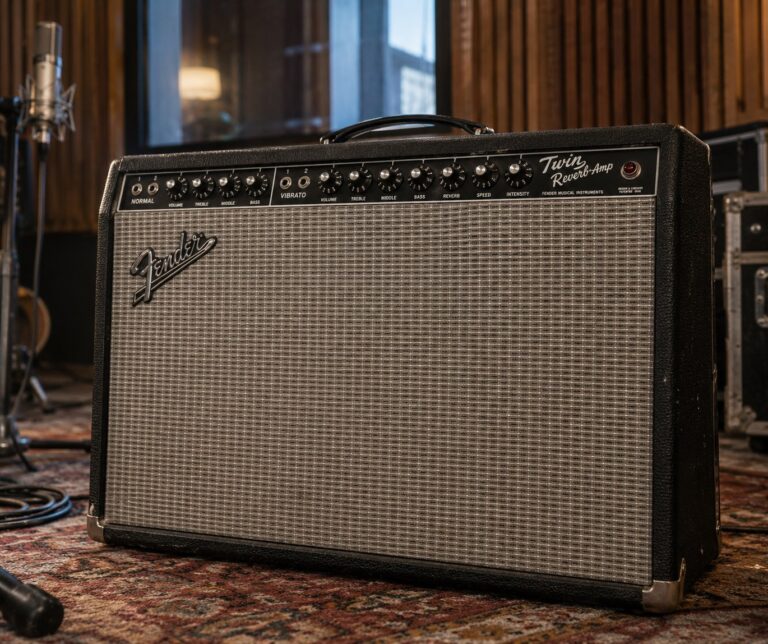
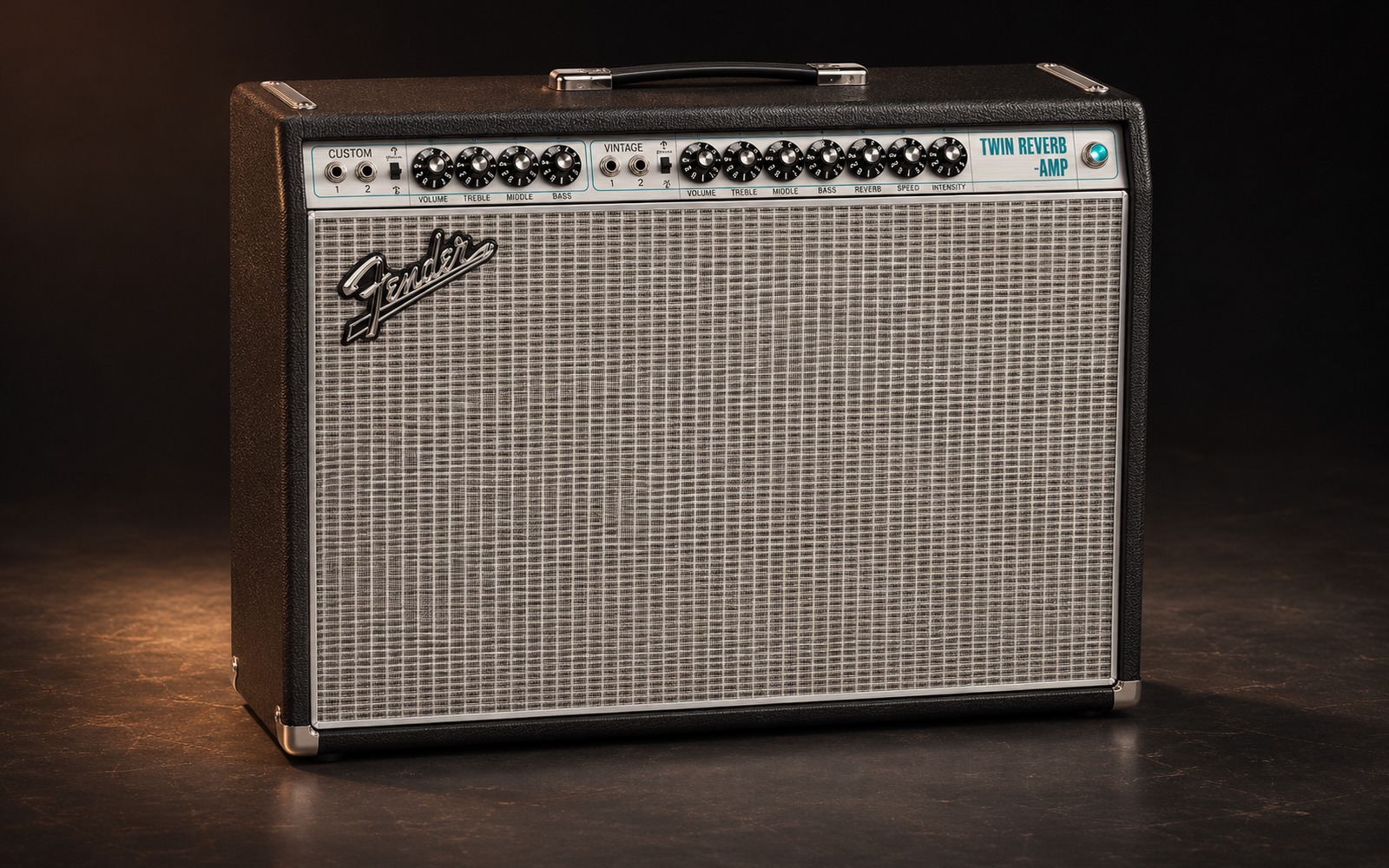
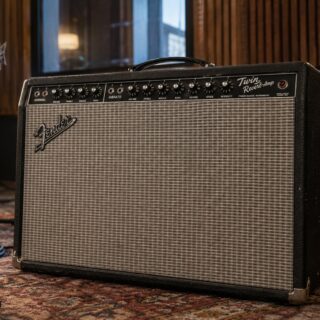
The Fender ’68 Custom Twin Reverb is the contemporary expression of that platform. Launched in late 2013 as the flagship of Fender’s ’68 Custom Series, it wears the late-Sixties silverface cosmetics that define a generation of backline aesthetics — silver-and-turquoise control panel, “drip-edge” aluminium grille trim, period-correct tailed logo badge — while deliberately departing from vintage circuit topology in three directions that make it a more useful instrument for modern gigging. It is not a museum piece. Fender says so explicitly. It is 85 watts of modified tube logic through a pair of Celestion G12V-70 speakers, produced in Ensenada, Mexico, and sold at $1,999.99 in July 2026. Understanding why those three circuit departures matter — and why they sometimes get misrepresented — is the whole story of the ’68 Custom Twin.
From 1952 to 1968: A Brief but Necessary History
The Twin predates the Stratocaster. Fender introduced the first “Twin” amplifier in 1952 — two years before the Strat, four years before the Jazzmaster — as a two-speaker, high-power alternative to the single-speaker combos that dominated the market. It was, from the beginning, a statement about headroom. Every subsequent Twin, Twin Reverb, and Twin-derived reissue is built on that same founding premise: the loudest, cleanest Fender in the room.
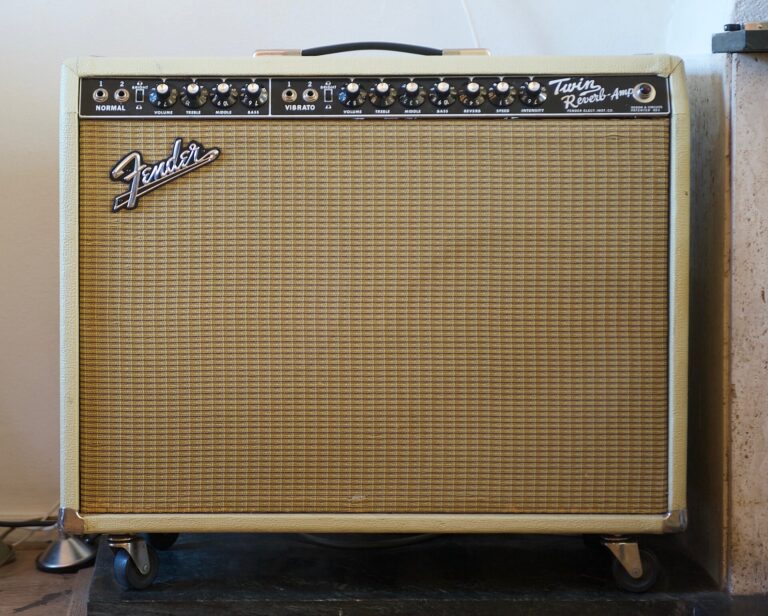
The Twin Reverb proper arrived in 1963 as part of Leo Fender’s “blackface” era, alongside the Deluxe Reverb, Princeton Reverb, and the rest of what became the canonical Fender lineup. The circuit designation was AB763 — named, per Fender’s internal convention, for the August 1963 schematic finalisation — and it ran four 6L6GC power tubes, four 12AX7 preamp tubes, two 12AT7 tubes for reverb and phase inversion, and a solid-state rectifier. The rectifier choice is significant: the Twin’s 85-watt output stage draws far more sustained current than a tube rectifier can reliably supply, so solid-state rectification was baked in from the start. There is no 5AR4 or 5Y3 to swap for sag, and there never was. The Twin has always been tight, fast, and stiff at the bottom end.
The “1968” in the amp’s name refers to the silverface cosmetic transition, which Fender rolled out beginning in January 1968. The original silver-and-blue control panels, the drip-edge aluminium trim on the grille, the blue-sparkle grille cloth: all of these were 1968 introductions. Crucially, the first silverface Twin Reverbs retained the blackface AB763 circuit intact until approximately May 1968, when Fender switched to the revised AC568 circuit. The January–May 1968 units — often called “drip-edge” after the aluminium trim that was phased out in mid-1969 — are the most sonically faithful silverfaces, near-identical to the blackface models they cosmetically replaced.
This matters for understanding the ’68 Custom because Fender’s marketing pitch is rooted in cosmetics, not in circuit fidelity. The amp looks like a drip-edge 1968 silverface. It does not sound like one, and Fender never claimed it does. The word “Custom” in the series name carries real weight: it signals intentional departures from 1968 spec. Those departures are three, they are documented, and they are the most important thing to understand about this amp.
What “Custom” Actually Means: Three Circuit Decisions
Fender has been explicit in its marketing and editorial material about what distinguishes the ’68 Custom series from vintage silverface amps. There are three circuit modifications applied to the Twin Reverb version specifically, and each one changes the amp’s practical character in a measurable way.
One: The Bassman Tone Stack on the Custom Channel
The original 1960s Twin Reverb had two channels: Normal and Vibrato. Both channels used the same basic tone control arrangement — Treble and Bass, with no dedicated Mid control — derived from the AB763 circuit family. The ’68 Custom’s Custom channel replaces the Normal channel and substitutes a Bassman-derived tone stack: Treble, Middle, Bass, with a dedicated mid control. This is the same EQ architecture used in the Bassman (and, as followers of prior ’68 Custom articles will know, the ’68 Custom Princeton Reverb and Deluxe Reverb similarly use the Bassman stack on their Custom channels).
The practical consequence: the Custom channel sits in a different place in a mix than the original Normal channel did. The Bassman stack pushes more low-mid energy, responds differently to drive pedals, and gives you parametric-style control over a frequency range that the Treble/Bass stack can’t isolate. Fender describes this channel as “more pedal-friendly” — which is accurate, though it understates the significance of the voicing shift. A Tube Screamer into the Custom channel behaves differently than a Tube Screamer into the Vintage channel, and both of those are distinct from what either would have done into a real 1968 Twin Reverb’s Normal channel.
Two: Reverb and Tremolo on Both Channels
On a vintage silverface Twin Reverb, the Normal channel is dry. No reverb, no tremolo — these are Vibrato-channel-only features on the original. The ’68 Custom flips this: both the Custom and Vintage channels have access to the spring reverb and bias-modulated tremolo. The reverb level, tremolo speed and intensity controls appear on the Vintage channel panel; the settings apply globally when the effects are engaged via footswitch. This means a player running split-channel tones — clean Vintage, edge-of-breakup Custom — can maintain the same reverb bloom across both rather than losing it the moment they switch channels.
The reverb is genuine spring, not digital. The cabinet is large enough to accommodate a physical 4-spring reverb tank (part number 4AB3C1B, 8Ω), which gives it the characteristic splash and decay of an analogue spring unit rather than the digital hall simulation Fender had to use in the much shallower ’68 Custom Vibro Champ Reverb cabinet. Boutique spring reverb tone is what this amp does when you turn the control past 3 and play single-note lines; it is part of the Twin Reverb’s whole identity.
Three: Reduced Negative Feedback
This is the modification that most directly changes the playing feel. Negative feedback (NFB) is a circuit loop that samples some of the output signal and feeds it back into the preamp out of phase, which stabilises the amp, reduces distortion, and tightens the response. The higher the NFB, the more linear and controlled the amp feels. The lower the NFB, the more touch-sensitive and dynamically alive — but also the quicker it reaches gain onset.
Fender reduced the negative feedback in all ’68 Custom models. On the Twin Reverb, this produces an amp that feels more reactive to pick attack — quiet picking yields a cleaner, more contained tone; firm picking drives the front end harder. You’re not getting a different amount of total headroom (the 85-watt output stage hasn’t changed), but you’re moving through the available dynamic range more quickly. The amp opens up earlier. At equivalent volume settings on the Vintage channel, a ’68 Custom will exhibit more give and harmonic texture than an identical-era ’65 Twin Reverb Reissue running conventional negative feedback. For pedal players who want the amp to breathe behind a Tube Screamer or a compressor, this is a meaningful difference. For players who want maximum transparency and control, the ’65 Reissue’s tighter NFB may suit them better.
Full Specifications
The following data is drawn from the Fender.com product page (model 2273000000, confirmed July 2026) and the Sweetwater product listing.
Two hardware details are worth flagging here. First, there is no effects loop, which is increasingly unusual at this price tier and worth considering if you run time-based effects after preamp gain. Second, the twin parallel speaker jacks mean you can run an external cabinet in addition to the internal speakers — the combined load drops to 2Ω at that point, which you should verify your output transformer can handle; plugging a single 8Ω external cab into one speaker jack while leaving the internal speakers connected will load the transformer incorrectly. When running an extension cab, disconnect the internal speakers first and confirm impedance matching with a technician.
A Note on the EU Tremolo Modification
US-market ’68 Custom Twin Reverbs use the original opto-tremolo circuit with a light-dependent resistor (cadmium sulphide photocell). EU/UK units cannot legally ship with this component due to RoHS restrictions on cadmium compounds. Fender’s solution is an analogue sub-PCB inside the chassis that replicates the photocell’s behaviour using alternative components. Chris Vinnicombe at MusicRadar (July 2014 review) confirmed that UK units with this modification showed no audible downside in listening tests: “the tremolo sounds are nothing short of lush.” Practically speaking, the modification is transparent; EU/UK buyers are not getting an inferior tremolo. But if you are buying used and the circuit matters to you — for example, if you plan to service or modify the tremolo stage — it is worth knowing which version you have.
Famous Players
Four players are attributed to the ’68 Custom Twin Reverb: Stevie Ray Vaughan, Albert Collins, Paul Gilbert, and James Burton. All four attributions fail per-SKU verification. The reasons differ in each case, and in two cases the failures are verifiable by calendar alone — the cheapest, fastest, most airtight falsification method available.
Stevie Ray Vaughan
Stevie Ray Vaughan died on August 27, 1990, in a helicopter crash in Wisconsin. The Fender ’68 Custom Twin Reverb was introduced in late 2013. The gap between those two dates is twenty-three years. No further verification is required. SRV did use Fender Twin Reverbs among many other amplifiers across his career — they appear in stage photographs alongside his Vibroverbs, Dumbles, and various boutique heads. He played vintage instruments, not a twenty-three-years-later reissue of cosmetically adjacent design. His name appearing on a modern gear attribution for this amp is the same brand-roster inflation pattern documented across this series: the name is accurate at the family level, wrong at the SKU level, and impossible at the chronological level.
Albert Collins
Albert Collins died on November 24, 1993, at age 61 in Las Vegas. The ’68 Custom was launched in late 2013. That is a twenty-year gap. The calendar impossibility alone ends the claim. But there is a second layer of inaccuracy: Collins was not primarily a Twin Reverb player. His amp of choice was the Fender Quad Reverb — a 100-watt combo with four 12-inch speakers, essentially a Twin Reverb cabinet scaled up with twice the speaker complement and twice the cone area. He drove it with bass set to zero, mid control cranked, everything else wide open, using the treble control as his primary volume knob depending on room size. The Quad Reverb is a distinct product from the Twin Reverb in every published gear account of Collins’s stage setup. Attributing him to a Twin Reverb, let alone to a twenty-years-posthumous reissue of one, compounds a chronological impossibility with an amp-family misidentification.
Paul Gilbert
Paul Gilbert is a Marshall amp player. His stage rigs across his career have been built on Marshall JCM 800s, JCM 900s, and various custom configurations, with pickslanting technique and Marshall crunch as the central sonic identity. Mid-2026 Guitar World coverage reports that he has recently shifted toward Tone Master digital modelling amps in some contexts — but not toward a 85-watt clean Fender Twin. There is no primary source placing Gilbert on any Twin Reverb in any configuration.
James Burton
James Burton — Elvis Presley’s lead guitarist, later John Denver’s and Ricky Nelson’s, and a Rock and Roll Hall of Fame inductee in 2001 — did use Fender Twin Reverbs across his career. He died on August 27, 2023, at 83. The documented instrument in his late touring life is a Fender ’65 Twin Reverb Reissue, confirmed by a Reverb.com listing of his personal ’65 Twin Reverb used during the Elvis TCB band’s 2006 world tour. His official gear page lists Fender Twin Reverb, Fender Concert, Vibrosonic, and Music Man 212-HD among his amplifiers — all consistent with a career defined by Telecaster twang through Fender clean headroom. The ’65 Reissue and the ’68 Custom are different products. The ’65 is a USA-built, blackface-circuit-derived amp with Jensen C-12K speakers; the ’68 Custom is a Mexico-built, Bassman-channel-modified amp with Celestion G12V-70s. No primary source places Burton specifically on the ’68 Custom. His connection to the Twin Reverb family is genuine; his connection to this specific variant is not documented.
The Verified Name: Noel Gallagher
In September 2016, Noel Gallagher posted an Instagram photograph of himself playing a Fender Jazzmaster through a Fender ’68 Custom Twin Reverb, describing it in the caption as a newly acquired amp. This is exactly the kind of per-SKU verification this series demands: the musician’s own documentation, naming the amp, with photographic evidence of the specific model. The ’68 Custom series had been on sale for three years at that point, so there is no chronological ambiguity. The amp’s silver-turquoise panel is visible in the photograph. Gallagher’s amp choices across his career have been eclectic — Marshall Bluesbreakers and JTM45s are central to the Oasis identity, but his solo and later work has incorporated Fender clean headroom more explicitly. The ’68 Custom Twin Reverb is a legitimate Noel Gallagher amp in the way that few instruments in this series can claim for their famous-player sections.
The Broader Equipboard Picture
Equipboard lists 79 artists for the ’68 Custom Twin Reverb, which sounds like a strong endorsement until you look at who several of the top-listed names are: Kurt Cobain (died April 1994), John Lennon (died December 1980), Jerry Garcia (died August 1995), Richard Wright (died September 2008). The ’68 Custom was introduced in late 2013. Every one of these players used vintage Fender Twin Reverbs — real silverface and blackface units — during their careers. Equipboard is conflating the Twin Reverb family with the specific ’68 Custom reissue, which is the single most persistent attribution error in modern amp documentation. The platform (Twin Reverb) and the product (this specific 2013-onwards reissue) are not interchangeable. Cobain in particular is strongly associated with vintage silverface Twins among his documented backline equipment; the attribution is real at the family level, wrong at the SKU level, and twenty years past the SKU’s existence at the chronological level.

Eric Johnson appears on Equipboard’s ’68 Custom list and is one of the most documented Twin Reverb players alive. Sweetwater’s biography of Johnson describes him relying on his “vintage ’68 Silverface Twin” for specific tonal character. The word “vintage” and the year “1968” are both in that description — and they refer to an actual 1968 production-year unit, not the 2013 Custom series reissue. The cosmetic similarity between a real drip-edge 1968 Twin and the ’68 Custom makes conflation easy; the sonic and historical distance between them makes it inexact. Johnson’s vintage 1968 Twin is one of the most cherished amps in his collection. The ’68 Custom is a different thing.
For players interested in other documented users of the Twin Reverb platform: Jerry Cantrell of Alice in Chains is a confirmed Twin Reverb user across his career, with a playing style that exploits the amp’s clean headroom as a foundation for heavy pedal stacking. Thurston Moore of Sonic Youth has been photographed with a Fender Twin Reverb in his distinctive dual-input configuration (one input from guitar signal, one from a microphone into a Jazzmaster pickup, per his documented stage setup description on Equipboard). Neither man’s documented rig has been specifically attributed to the ’68 Custom variant in a primary source — both are consistent with the broader Twin Reverb family claim.
Five Tone Recipes and Settings
1. Gallagher Clean — Classic Rock Jangle
Use the Vintage channel. Volume 4, Treble 7, Middle 5, Bass 4, Bright switch engaged. Reverb 3, Speed 4, Intensity 2. This is a chimey, slightly scooped clean with just enough spring reverb to breathe — the Noel Gallagher Jazzmaster sound, essentially. A Stratocaster or Jazzmaster in the neck or middle position will sing through this setting. Keep the guitar volume at about 7 for a compressed, almost studio-grade clean; roll it to 10 and you’ll feel the reduced negative feedback doing its thing, adding harmonic texture without breaking up.
2. Albert Collins Reference Tone — Bright Blues Channel
Use the Custom channel (the one with the Bassman stack). Volume 6, Treble 9, Middle 3, Bass 1, Bright switch engaged. Collins himself used a Quad Reverb with bass at zero, mids cranked, treble controlling his volume — this is the inverse EQ portrait, filtered through the Custom channel’s Bassman stack. A Telecaster bridge pickup in open minor tuning will produce the chilly, cutting tone Collins called his own. The lower bass and upper treble pull the fundamental back while the string attack punches through. No reverb — Collins was famously dry, using long extension cables as his primary “effect.”
3. Surf and Spring Shimmer
Vintage channel. Volume 3, Treble 8, Middle 6, Bass 5. Reverb 7, Speed 3, Intensity 4. The ’68 Custom’s spring tank is physical and full-sized, and at reverb 7 it produces the cascading wash that defined 1960s surf guitar. A Stratocaster with single-coils in positions 2 or 4 and a capo at the third fret delivers the full Dick Dale/Duane Eddy effect. The tremolo at these settings is subtle enough to undulate rather than chop — a soft, oceanic pulse rather than a rhythmic effect.
4. The Pedal Platform — Pushed but Patient
Custom channel. Volume 6, Treble 6, Middle 7, Bass 5. No bright switch. Into this setting, run your compressor first (ratio 4:1, attack 8ms, release 200ms, threshold set for mild gain reduction), then an overdrive — a Ibanez TS9 Tube Screamer or a Boss BD-2 Blues Driver at moderate gain. The Bassman tone stack and reduced negative feedback make the Custom channel one of the most transparent, dynamic overdrive platforms in the current Fender lineup. The amp breathes around the pedal rather than fighting it. Roll the guitar volume back to 6 for a tighter response; push it to 10 for the full gain structure. This is why “pedal-friendly” appears in every review of the ’68 Custom series: it is factually correct, and nowhere is it more pronounced than in the larger headroom margin of the Twin.
5. Post-Rock Walls — Shimmer and Swell
Vintage channel. Volume 5, Treble 5, Middle 7, Bass 6. Reverb 5, Speed 6, Intensity 5. Add a volume swell pedal (or disengage your guitar’s volume knob) before a delay set for 600–700ms at about 30% wet. The Twin’s headroom and physical driver area (two 12-inch speakers, 85 watts) produce a wall-of-clean that delay-into-reverb can build into the “arctic sheets of clean tone” MusicRadar described in its 2014 review. This is a standard post-rock and ambient country setting — the Twin at moderate volume with time-based effects stacked in front.
The ’68 Custom Twin Reverb’s control layout gives you a lot of flexibility that the original silverface didn’t. These settings assume the amp has been warmed up for at least twenty minutes and that the power tubes are matched and well-biased.

Comparisons
Fender ’65 Twin Reverb Reissue
The ’65 Reissue is the direct sibling. Same 85 watts, same four 6L6s, same physical size — but it’s built in Corona, California (not Mexico); it uses Jensen C-12K reissue speakers instead of Celestion G12V-70s; it runs higher negative feedback for a tighter, more linear response; and it gives you the blackface-derived AB763 circuit architecture on both channels rather than the Bassman modification on one. Players who want maximum vintage circuit fidelity lean toward the ’65 Reissue. Players who want the dual-channel flexibility, the Bassman voicing on the Custom channel, and the reduced-NFB dynamic feel prefer the ’68 Custom. At identical list prices in 2026 (the ’65 Reissue is approximately $1,800–$2,100 at current retail), the choice is sonic rather than economic.
Fender ’68 Custom Deluxe Reverb
The smaller sibling in the ’68 Custom family uses the same dual-channel architecture, same Bassman tone stack on the Custom channel, same reduced negative feedback. But it is 22 watts (not 85), one 12-inch speaker (not two), roughly 40 lbs (not 64), and its lower wattage means you hit natural power-tube saturation at more manageable stage volumes. If you want the ’68 Custom voicing and circuit philosophy in a room-appropriate format that actually breaks up before the neighbours call the police, the Deluxe Reverb is the move. The Twin Reverb is the choice when headroom is non-negotiable — outdoor stages, large venues, situations where you need to run clean under a drummer who genuinely hits hard.
Fender ’68 Custom Princeton Reverb
The smallest ’68 Custom family member is 12 watts, one 10-inch speaker, and defined by its cathodyne phase inverter topology — a fundamentally different circuit approach from the Twin’s long-tailed pair PI. The cathodyne clips asymmetrically, producing even-order harmonics and a warm, complex crunch that’s tonally distinct from the Twin at equivalent gain stages. The Princeton is a studio and intimate-venue amp. The Twin is a backline amp. The two coexist in the same family without overlapping much in application.
Fender ’68 Custom Vibro Champ Reverb
The Vibro Champ is a 5-watt, single-6V6, Class A single-ended amp — the philosophical opposite of the Twin Reverb at every dimension. It was the last ’68 Custom model to ship (January 2021, versus 2013 for the Twin), uses digital hall reverb because the cabinet is too shallow for a spring tank, and produces the unique preamp-tube bias-shift tremolo that is the deepest, slowest tremolo in the current Fender lineup. Comparing these two is comparing a scalpel to a wrecking ball. They are in the same cosmetic family and nothing else.
Vox AC30
The AC30 is the British alternative to the Twin Reverb as a high-headroom, clean-to-edge-of-breakup large combo. At 30 watts through two 12-inch alnico Blue speakers, it is significantly lower-powered than the Twin, which means it begins to saturate earlier at stage volumes — and that early breakup is part of the AC30’s identity, not a limitation. The Twin runs cleaner, louder, and cooler at high volumes. The AC30 has a more compressed, harmonically rich response at the same dial settings. Single-coil players who want pristine clean through a band mix typically prefer the Twin; players who want the amp itself contributing texture and warmth alongside pedals often prefer the AC30.
Buying Guide
The ’68 Custom Twin Reverb has been in continuous production since late 2013, which means there is a meaningful used market. New retail is $1,999.99. Used specimens in excellent condition typically trade in the $1,100–$1,450 range at major online markets in 2026, with price variation driven primarily by overall condition, speaker health, and whether the tube complement has been recently serviced. Below approximately $1,000, inspect carefully: at that price point on a 85-watt combo, you are likely looking at a unit with speaker damage, worn power tubes, or cosmetic issues that have not been photographed honestly.
Key things to check on a used ’68 Custom Twin Reverb:
Speaker condition — the Celestion G12V-70s are the most tonally important component in the amp. Gently push the cone of each speaker with a fingertip: a tear or scratch in the surround or cone material will produce a paper-on-paper rubbing sound. Damaged speakers at current new Celestion prices ($80–$120 per driver) can quickly erode the value of a “deal.” Play the amp through its full volume range; distortion or buzzing at specific frequencies indicates cone or voice coil damage.
Tube condition — a freshly serviced amp will have documentation. If none is available, factor in the cost of a matched 6L6 quad ($70–$110), new preamp tubes ($25–$50 total), and a bias check by a technician ($60–$100). This is standard maintenance, not a red flag on its own — but it is a cost that should be reflected in the asking price.

Reverb tank — plug in, set reverb to 5, and physically vibrate the cab slightly by tapping the side panel. A healthy spring tank produces a gentle whooshing surge. If the reverb is completely silent or produces a harsh metal clang with no spring character, the tank may be damaged, disconnected at the RCA jacks, or have a failed driver tube (V3).
PCB inspection — if the seller allows chassis access, look for burn marks, cold solder joints (dull rather than bright), and capacitors that appear to be swollen or leaking at the top. PCB repairs are more expensive than eyelet-board repairs; factor this into negotiation if the chassis shows any signs of heat damage.
Weight expectation — 64 lbs / 29 kg. This is not light. Before purchasing, be honest with yourself about the performance contexts you’re planning: outdoor festival stages, large clubs, situations where a backline crew is available. For everything smaller, the ’68 Custom Deluxe Reverb at roughly 42 lbs, or the Tone Master Twin Reverb at 33 lbs with equivalent clean headroom performance, may be more practical answers.
Ownership Notes
Weight and Gigging Reality
At 64 lbs, the Twin Reverb is the most commonly cited gear-related back injury in guitar player history, and that is only a slight exaggeration. The tilt-back leg system helps with on-stage projection, but it does not help you load it into a transit van at 1 a.m. A quality furniture dolly with locking wheels is the single most practical investment for Twin Reverb ownership. A two-person lift protocol — not because the amp is fragile, but because asymmetric lifting of a 64-lb object at awkward angles is exactly how disc injuries happen — should be standard practice.
Tube Maintenance
Four 6L6 power tubes is a more expensive replacement cycle than two. Budget approximately $70–$110 for a matched quad of quality 6L6s (JJ, Tung-Sol, or Groove Tubes equivalent) every 18–24 months of regular gigging. The amp runs class AB, which is more efficient than the Princeton’s class A single-6V6 approach, but four tubes still draw consistent current and wear at a predictable rate. The preamp tubes (four 12AX7s and two 12AT7s) are far longer-lived — five or more years of regular use is typical — and can be replaced individually rather than as a set. The amp has a solid-state rectifier, so there is no rectifier tube to maintain.
Bias
The ’68 Custom Twin Reverb requires chassis removal for bias access. This is not a job for kitchen-table DIY: the filter capacitors in an 85-watt 4×6L6 amp store enough charge to cause serious injury even after the amp has been powered off. Professional bias service is the only appropriate recommendation. When installing a new 6L6 quad, have a technician set bias to approximately 70% of maximum plate dissipation for an appropriate balance of tone and tube life.
Speaker Swaps
The factory Celestion G12V-70 speakers are mid-range ceramic drivers with a British voicing — fuller bass response and more assertive mids than a Jensen C12N original, less crystalline high end. Players who want to push the amp toward vintage blackface tone can install Jensen C-12K reissue speakers (approximately $70–$80 each), moving closer to the ’65 Reissue sound. Players who want extended low-end weight for baritone or seven-string work sometimes install Eminence Governor or EVM-12L-style speakers. There is no single correct swap — the stock G12V-70s are a legitimate tonal choice, not a compromise to be immediately undone.
The Effects Loop Absence
There is no effects loop. For drive pedals, this does not matter — all drive pedals belong in front of the preamp anyway. For time-based effects (delay, reverb, chorus), no effects loop means these run into the preamp, which colours them more than a post-preamp send/return would. Many players prefer the colouration; it integrates the effect more deeply into the overall amp sound. Players who require pristine, completely uncoloured delay or reverb trails will need to use an attenuator-and-loop solution or choose an amp that includes an FX loop from the factory.
Frequently Asked Questions
Is the ’68 Custom Twin Reverb a faithful reissue of a 1968 Twin Reverb?
No, and Fender says so. The word “Custom” in the series name signals deliberate departures from 1968 spec: the Custom channel uses a Bassman tone stack (the original Normal channel did not), both channels have access to reverb and tremolo (the original Normal channel did not), and the amp runs lower negative feedback than vintage silverface units. Fender describes this as a silverface-cosmetic, modified-circuit amp targeting modern players. Players who specifically want a circuit-accurate vintage 1968 silverface Twin Reverb should look at original units, early silverface units from before May 1968 (which retained the AB763 blackface circuit), or the ’65 Twin Reverb Reissue, which uses a more conservative blackface-derived circuit approach.
What’s the difference between the Custom channel and the Vintage channel?
The Custom channel uses a Bassman tone stack (Treble, Middle, Bass — three controls). The Vintage channel uses the same three-control EQ but is voiced for a more traditional 1960s silverface character. More practically: the Custom channel pushes more low-mid frequency content, responds differently to overdrive pedals, and sits differently in a band mix. The Vintage channel is the more neutral, transparent option. Both channels share the reverb and tremolo circuit, with controls on the Vintage channel panel applying globally when effects are engaged.
Why does the amp use a solid-state rectifier instead of a tube rectifier?
The Twin Reverb has used a solid-state rectifier since 1963. At 85 watts with four 6L6 power tubes, the current demands of the output stage exceed what a tube rectifier can reliably supply without significant voltage sag and shortened rectifier life. Solid-state rectification provides tighter, more consistent plate voltage delivery. If you are specifically seeking the compression and “sag” character associated with tube rectifiers in smaller amplifiers like the Princeton Reverb’s 5AR4, the Twin Reverb is not the instrument for that effect — and never was, regardless of era.
How loud is 85 watts, practically speaking?
Louder than almost every venue permits at full volume. The Twin Reverb is designed for applications where clean headroom must be maintained through a drummer hitting hard, in a large room with no PA support, or on an outdoor stage where the amp is the primary driver of monitor level. At a moderate club gig with FOH support, Volume 3–5 is typically sufficient. The amp’s practical usefulness for most players lies not in running it at high volume, but in the reserve of headroom that allows clean tone to remain clean under the kind of playing dynamics that would push a smaller amp into distortion.
Where is the ’68 Custom Twin Reverb made?
Ensenada, Mexico — the same facility that produces the ’68 Custom Deluxe Reverb and Princeton Reverb. This is distinct from the ’65 Twin Reverb Reissue, which is manufactured in Corona, California. The Mexico production does not indicate inferior quality; Fender’s Ensenada factory produces a range of professional-grade amplifiers and has done so for decades. The build difference most relevant to players is construction method: the ’68 Custom is PCB-built, while the hand-wired American series products (like the ’64 Custom Princeton and Deluxe Reverb) use point-to-point construction. PCB construction means DIY modifications and hands-on servicing require more care to avoid trace damage; professional servicing is straightforward.
What were the original 1968 speakers, and why does the ’68 Custom use Celestions instead?
Fender used various speaker brands throughout the silverface era — Jensen, Oxford, Utah, JBL — but never Celestions in any vintage Twin Reverb production run. Celestion G12V-70s are a 2013 design decision by Fender, not a period-correct restoration choice. MusicRadar’s 2014 review noted this explicitly: “it’s interesting that the company should opt to ‘go British’ — albeit via China — with a pair of Celestion G12V-70s.” The G12V-70 has a fuller bass response, more assertive midrange, and softer high end compared to original Jensen C12N or Oxford units. Players who want the ’68 cosmetic look on a Jensen-voiced amp are better served by the ’65 Reissue, which uses C-12K reissue speakers.
Can I use the ’68 Custom Twin Reverb as a pedal platform?
Yes, and the Custom channel is specifically designed for this application. The Bassman tone stack gives you parametric control over the midrange that the standard blackface tone stack doesn’t provide, and the reduced negative feedback makes the amp more reactive to subtle playing dynamics. A compressor into a Tube Screamer into the Custom channel at volume 5–6 is the canonical “pedal platform” use case. The amp’s clean headroom also means that your pedal’s gain character is preserved without the amp itself adding unwanted saturation before you want it. The lack of an effects loop means time-based effects should be patched in front of the input and will be coloured by the preamp — which is a stylistic choice that many players prefer.
Should I buy the ’68 Custom or the Tone Master Twin Reverb?
These are fundamentally different products that share cosmetic DNA. The Tone Master Twin Reverb is a 200-watt solid-state Class D amplifier that digitally models the Twin Reverb circuit; it weighs 33 lbs and includes an attenuator and adjustable power levels. The ’68 Custom is a real tube amplifier with real tubes, real transformer saturation, and real speaker interaction. The Tone Master is the correct answer for players who need Twin Reverb tone but cannot manage 64 lbs on a regular basis, play venues where an 85-watt amp at any volume would be antisocial, or need the practicality of power-level switching. The ’68 Custom is the correct answer for players who want the actual tube experience — the feel of tubes under your fingers, the way the amp responds to pick attack through a circuit that has electrical mass and inertia, and the specific voicing of the G12V-70 drivers in that birch/pine cabinet at gig volume.
Image credits
- Top image: GuitarGangsters AI-generated reference illustration, not a photograph.
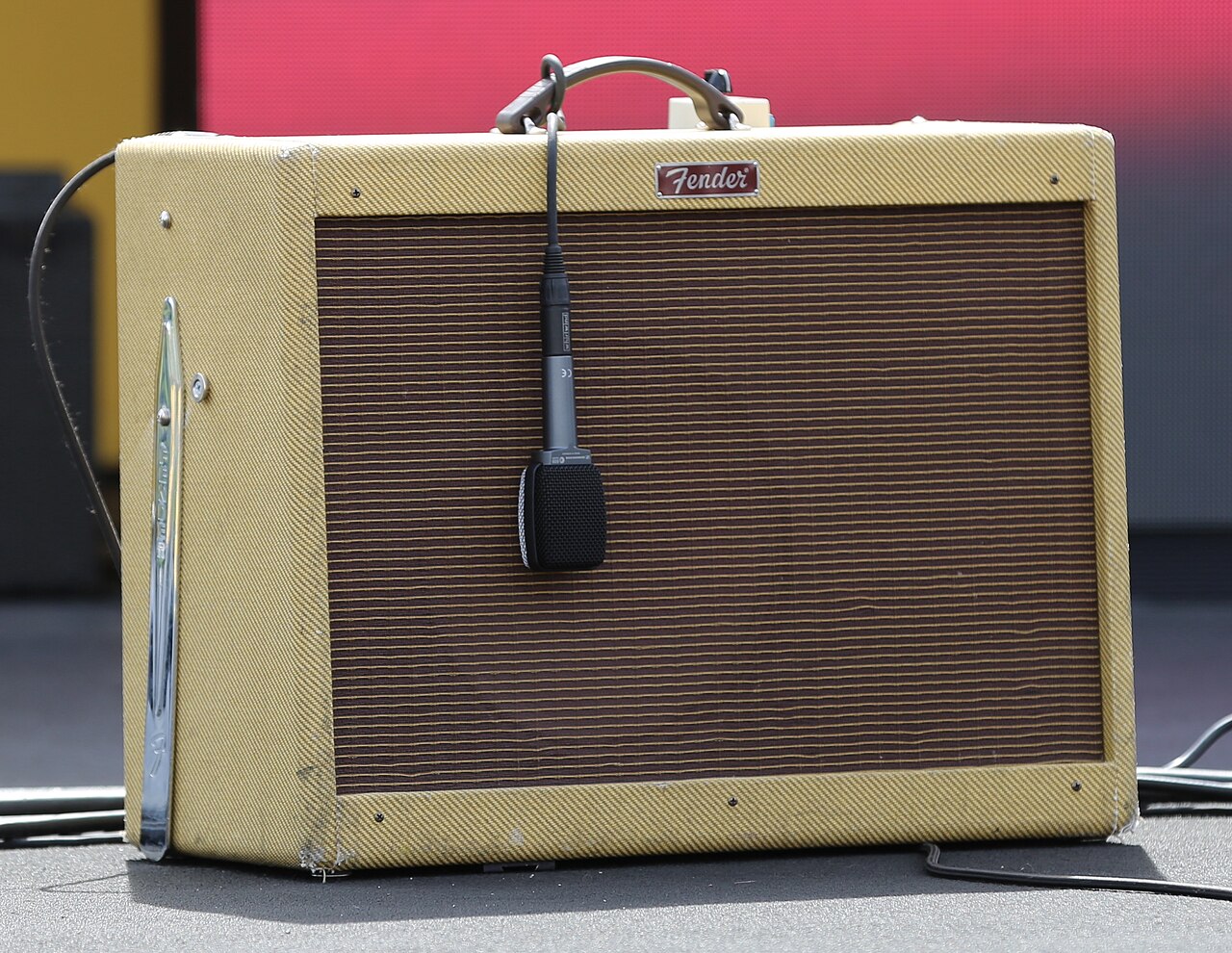
- A Fender Blues Deluxe guitar amplifier with a microphone in front: TaurusEmerald, Wikimedia Commons, CC BY-SA 4.0.
- Paul Gilbert: matt barsden, Wikimedia Commons, CC BY-SA 2.0.
- Noel Gallagher: Freddyballo, Wikimedia Commons, CC BY-SA 4.0.
- Noel Gallagher: Raph_PH, Wikimedia Commons, CC BY 2.0.
Latest News
Related
On This Day
Monday 9 November
From this week: