The Djent Architect’s Blueprint: Inside the Peavey Invective.120
Misha Mansoor's signature 120W tube head: 3 channels, built-in noise gate, MIDI recall and MSDI DI — the successor to the 6505 crown explained in full.
For the better part of a decade, Misha Mansoor ran his live rig the same way most forward-thinking heavy guitarists did: a digital preamp into the effects return of a Peavey 5150, using the old warhorse as a power amp and cab driver while the actual tone generation happened inside a rack. The 5150/6505 power section — four 6L6GC bottles, 120 watts, a transformer wound in Meridian, Mississippi — was simply the best power amp he could find at any price. When Peavey came knocking, Mansoor did not ask for a 6505 with his name on the faceplate. He asked for something built from scratch, and that is exactly what he got.
The Peavey invective.120, announced at NAMM in January 2017, is not a cosmetically refreshed 6505. It shares the DNA — the 4× 6L6GC power section, the 120-watt output, the Mississippi origin — but everything above the power tubes is new engineering. Three channels with individual channel boosts. Separate EQ for the clean channel and shared EQ for the drive channels. Per-channel independent pre- and post-gain controls on both Crunch and Lead. A noise gate built into the preamp. A MIDI controller with nine presets included in the box. An MSDI direct output with its own level and tone controls. Two 9VDC auxiliary jacks to power pedals off the back panel. It is a professional tool designed by someone who had spent years working around the limitations of the amp it replaced, and those years of field research show in every decision.
From Mississippi to Modern Metal: The Invective’s Origin
Peavey Electronics was founded in 1965 by Hartley Peavey in Meridian, Mississippi — built on the radical premise that American musicians could buy professional gear at prices they could actually afford. For most of the company’s history, Peavey occupied the same structural position as Ibanez or Yamaha in guitars: excellent working-musician value, slightly overlooked by prestige-obsessed critics, quietly beloved by the people actually playing shows every night.
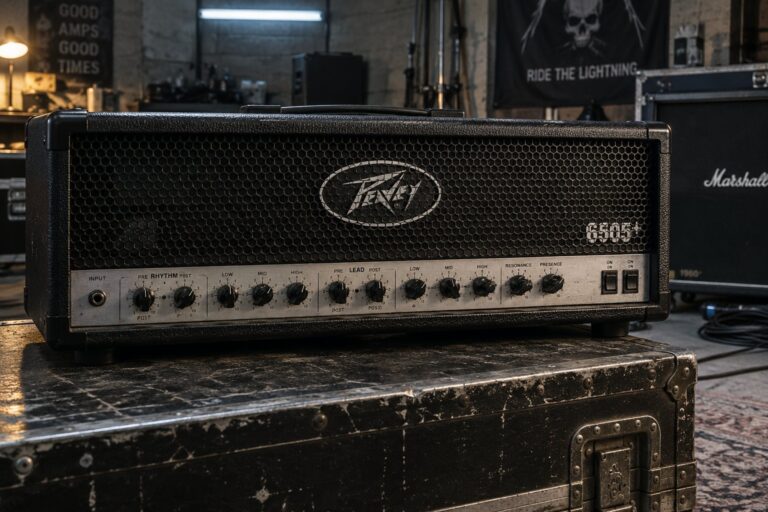
That changed in 1992 when Eddie Van Halen co-designed the 5150 head. The collaboration gave Peavey something money cannot ordinarily buy: credibility at the extreme end of the market. The 5150 became the defining metal amp of the 1990s and early 2000s. When EVH departed in 2004 and took the “5150” trademark with him, Peavey renamed the circuit the 6505. The circuit did not change; only the name did. The 6505 and its per-channel EQ sibling the Peavey 6505+ Head continued to dominate underground metal for another decade. By the time the Invective was announced, the Peavey 6505 Head was 25 years old as a circuit design and still the first amp recommended on any djent or progressive metal forum.
Misha Mansoor had been a vocal Peavey advocate since his earliest online tutorials under the handle “Bulb.” His documented history with the brand runs from the original Peavey 5150 through the Peavey 5150 II — used as a power amp for his Fractal Audio Axe-Fx II rig with Periphery — and eventually the Invective design commission. The collaboration was announced in January 2017 at NAMM: Peavey describing it as built “from the ground up” and “designed to exacting standards in collaboration with Misha Mansoor.” The Guitar World review (Chris Gill, published February 2018) confirmed that “unlike most signature amps bearing the names of relative newcomers, the invective.120 is not a slightly modified version of a pre-existing model but rather an entirely new guitar amp designed from the ground up with Mansoor’s input.”
Full Specifications
The Channel Architecture: What Makes It Different
The 6505 has one 3-band EQ stack shared between both of its channels. That is a fundamental constraint that anyone who has gigged with one knows: when you switch from clean to lead, you are switching into the same EQ curve, and getting genuinely different clean and lead tones requires either two completely different amp setups or a strategic compromise on both ends. The Invective solves this at the architecture level.
The Clean channel has its own independent Bass, Mid, and Treble controls, entirely separate from the drive channels. This is not a small detail. It means you can dial the clean channel for a full, hi-fi jazz or funk sound — scooped, wide, airy — and the Crunch and Lead channels for a scooped, tight, mid-forward metal sound, and both settings live simultaneously without any EQ compromise. The Guitar World review noted that the clean channel “remains absolutely clean even with the Pre and Post Gain cranked all the way up,” which is another departure from 6505 behaviour. MusicRadar’s Nick Guppy (published February 10, 2019) went further: “The clean channel is a huge improvement, combining very high headroom with a boost, which adds a warm, vocal quality that raises the bar for amps in this genre. It’s unlikely, perhaps, but if you want to play jazz through an Invective 120, you can do it with total authority.”
The Crunch and Lead channels share a 3-band EQ but have completely independent Pre Gain and Post Gain controls. On the 6505, the two drive channels share both an EQ and have a single gain structure; getting genuinely different lead and rhythm textures requires careful use of the presence and resonance controls. On the Invective, Crunch can be set with a relatively moderate Pre Gain for tight rhythm work, while Lead can have its Pre Gain pushed further for singing sustain and harmonic density, and both settings recall instantly via the MIDI footswitch.
The Boost function is another design generation ahead. Each channel — all three — has its own Boost circuit with an on/off switch and independent Level and Tone controls. This is not a simple volume lift; it is closer to a built-in transparent overdrive with a tone control, functioning like the Ibanez TS9 that metal players typically stack in front of a 6505 to tighten the input. The difference is that it is built in, footswitchable per-preset, and tunable per-channel. On the drive channels, engaging Boost with the Tone rolled counterclockwise tightens the low end and increases note definition for palm muting. With the Tone raised, it adds midrange push for lead playing. These are not subtle adjustments.
The noise gate deserves specific attention. It is a fast-attack design placed in the preamp section of the Crunch and Lead channels, with a single Threshold knob. At its tightest setting, it produces the machine-like gate chop that defines djent rhythm playing — notes cut off precisely and immediately after the attack transient fades, with zero bleed into the silence between palm-muted hits. The Guitar World review confirmed it “works like a charm” for replicating “machine-like blasts” of rhythm playing. At looser settings it functions as a conventional noise gate for removing hum between phrases. The Tight button on the front panel adds another layer of control: it reduces input gain while simultaneously increasing string-to-string definition, which is particularly useful with high-output pickups that can over-saturate the first gain stage and turn fast passages into a wall of undifferentiated distortion.
The Circuit’s DNA: 6505 Legacy and the Invective’s Departures
The question on every metal guitarist’s mind when the Invective was announced was straightforward: is this better than a 6505+, and how much of it is the same circuit? The answer is nuanced and worth being precise about.
The power section is in the same family. Both amps use four 6L6GC output tubes for 120 watts. The transformer architecture is broadly similar. The characteristic Peavey 6L6 power stage — tight, articulate, with a faster attack and slightly less sag than a comparable EL34 design — is present in the Invective. Players who love the defined, percussive low end of the 6505 family will recognise that quality in the Invective.
The preamp is a different story. The 6505/6505+ uses five 12AX7 preamp tubes. The Invective uses six, and the sixth is not decorative — it enables the additional gain stages that allow the Crunch and Lead channels to reach their distortion levels while the Clean channel maintains its crystalline headroom without interaction between channel gain structures. The separate boost circuits are fed by dedicated gain stages that are architecturally borrowed more from the high-end boutique world than from the 6505 circuit sheet.
The tube-swapping flexibility of the Invective is a genuine feature that the 6505 family does not offer. The 6L6GC power tubes can be swapped for EL34 (for a more British character with increased upper-midrange harmonic content and slightly earlier power compression), 6CA7 (similar to EL34, with a slightly fuller low end), 6550 (the tightest and most linear response, favoured in bass amps and classical music applications), KT66 (warmer, less aggressive than 6L6, a classic British vintage character), or KT88 (the most powerful and extended, with the most headroom before saturation). Top-loaded bias test points and an adjustment pot make re-biasing straightforward without full amp disassembly. This is the kind of feature found on boutique amps costing considerably more.
The MSDI — Microphone Simulated Direct Interface — is Peavey’s in-house cab simulation output, and on the Invective it receives its own dedicated Level and Tone controls rather than the single output level of older Peavey designs. MusicRadar’s Guppy called it “excellent” and noted it “greatly simplifies connection to a PA or recording console.” For live use without a microphone, or for silent recording direct to an interface, it represents a significant workflow improvement over running a standard DI from the effects send.
Famous Players
Misha Mansoor — Periphery
Misha Mansoor is the primary artist and co-designer of the invective.120, documented on the amp by multiple independent primary sources. Peavey’s own artist page ties him specifically to the invective.120. Premier Guitar’s 2017 Rig Rundown with Periphery confirmed that Mansoor was using Invective.120 heads live on tour, running his Fractal Audio Axe-Fx II XL+ through the amp’s effects return into Peavey Invective 412 cabinets — the power-amp use case he had already been using with the 5150 II, now expanded to the amp he designed. His Equipboard page lists the invective.120. Musicians Friend published a first-person interview with Mansoor about the amp’s design process, confirming his direct involvement in every channel’s voicing. This is not a guest-appearance endorsement; he is the reason the amp exists.

The Axe-Fx-into-effects-return setup is worth explaining to players unfamiliar with it. Mansoor bypasses the Invective’s preamp entirely, plugging the Axe-Fx stereo output into the effects return jacks — one for each of the two effects loops — and using the Invective as a power amp only. The 4× 6L6GC output stage provides the tube saturation, dynamic response, and power compression that digital modellers struggle to replicate convincingly on their own, while the Axe-Fx handles all tone-shaping and effects. The cabinet — a Peavey invective.412 loaded with Celestion speakers — then adds the final acoustic dimension. The result is a hybrid rig that gets the best of digital signal processing and analogue power amplification simultaneously.
Mark Holcomb — Periphery
Premier Guitar’s 2017 Periphery Rig Rundown confirmed that Mark Holcomb was also running Peavey Invective.120 heads live on the same tour — “both guitarists using Peavey Invective120 heads.” Holcomb’s setup mirrored Mansoor’s: Fractal Audio Axe-Fx II XL+ running into the Invective’s effects return, out to Invective 412 cabinets. This makes the 2017 Periphery live rig a fully Invective-powered stage setup from both guitarists simultaneously — about as strong a real-world endorsement as a new amp can receive.
Eddie Van Halen — The Honest Assessment
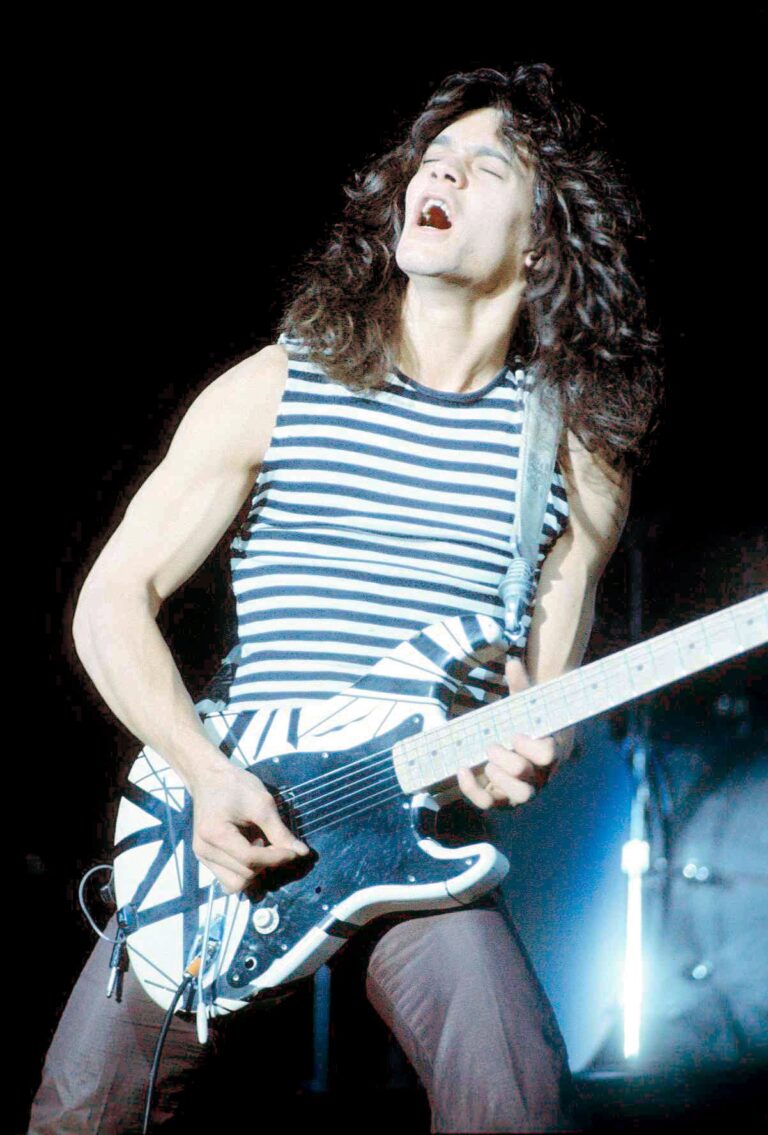
The spreadsheet lists Eddie Van Halen among the Invective’s famous players. This requires clarification. EVH co-designed the original 5150 circuit in 1992, and that circuit is the ancestor of both the 6505 line and, more loosely, the Invective’s power section DNA. However, Eddie Van Halen left Peavey in 2004 and took the 5150 trademark with him; from 2004 onward, his signature amp was the EVH 5150 III, built by Fender under the EVH brand — a different company entirely. The Invective was announced in January 2017, at which point EVH had been gone from Peavey for thirteen years. No primary source of any kind places Eddie Van Halen on a Peavey Invective.120. He is the grandfather of the circuit lineage, not a user of this amp.
Wolfgang Van Halen
No primary source places Wolfgang Van Halen on a Peavey Invective.120. His documented live rig for Mammoth WVH uses EVH 5150 III equipment — a different amp brand entirely, despite the family name connection. This is the same debunk that has applied to every Peavey article in this guide: the “Van Halen” association with Peavey ended when the senior Van Halen left the company in 2004.
Joe Satriani
Joe Satriani’s primary Peavey association was the JSX — his own signature head with its own distinct voicing — followed by his transition away from Peavey entirely after the JSX era. No primary source documents Satriani using or endorsing the Invective.120.

Ola Englund
Ola Englund, the Swedish guitarist and YouTube reviewer whose channel Solar Guitars AB also runs, produced demo videos of the Invective.120 and the Invective.MH (the mini version released subsequently). His primary documented Peavey amp has been the 5150 II / 6505+ series, which he has used and recommended extensively in blind shootout format. His Invective content is demo/reviewer territory rather than primary touring rig confirmation. Not confirmed as a touring Invective.120 player; mentioned as an engaged community advocate with documented hands-on time with the amp.
Tone Recipes and Settings
1. Mansoor Djent — Tight Rhythm, Axe-Fx Style
Clean channel with Boost engaged, Tone at 9 o’clock, into effects return of amp (bypass preamp), Axe-Fx handling preamp voicing. If running the amp’s preamp directly: Lead channel, Pre Gain 5, Post Gain 6, Bass 7, Mid 4, Treble 5, Gate on with Threshold at 10 o’clock, Tight switch engaged, Boost on with Level at 2 and Tone at 8 o’clock. This recreates the “gate chop into wall of definition” sound. Works identically with a Fractal or Kemper Profiler feeding the effects return. String spacing at 8 and 7-string territory benefits from the Tight switch to keep the low B from turning into mud.
2. Crunch Channel — Classic Metal Rhythm
Crunch channel, Pre Gain 6, Post Gain 7, Bass 6, Mid 5, Treble 5, Boost off, Gate on (Threshold 9 o’clock), Resonance 6, Presence 5. This produces the “6505 family” classic metal rhythm character — the forward attack on the initial pick transient, the tight low end, the compressed midrange harmonic stack that sits just below lead frequencies. Works for everything from thrash to modern metalcore. Adding 2–3 dB at 2 kHz in the desk EQ adds edge for cutting through dense mixes.
3. Lead Channel — Sustain and Overtone Singing
Lead channel, Pre Gain 7, Post Gain 6, Bass 5, Mid 6, Treble 5, Boost on with Tone at noon, Level at noon, Gate off (or Threshold very loose at 7 o’clock for just hum removal), Presence 6, Resonance 5. Pre gain at 7 on the Lead channel creates the harmonic density where individual notes are surrounded by singing overtones — the upper harmonics appear naturally without conscious effort. A noise gate entirely bypassed lets long bends and vibrato sustain through without being chopped. A Wampler Tumnus or Klon-style transparent overdrive pushed at low gain in front tightens note definition without adding fizziness.
4. Clean Channel — Pedal Platform for Synth-Like Tones
Clean channel, Pre Gain 4, Post Gain 8, Bass 6, Mid 6, Treble 7, Boost off, Resonance 5, Presence 5. The clean channel’s extraordinary headroom makes it a better pedal platform than almost any other amp in this price range. A high-quality drive pedal into a pristine, loud, transparent clean produces exactly the tone that the pedal’s designer intended — not a compressed, already-distorting amp character layered under the pedal’s character. A Boss DS-1 or Ibanez TS9 in front produces entirely different results than the same pedal into a cranked 6505 channel because there is no preamp saturation fighting the pedal’s own clipping architecture.
5. EL34 Swap — British Hi-Gain Character
With EL34 power tubes (re-biased after swap), Lead channel, Pre Gain 6, Post Gain 7, Bass 5, Mid 7, Treble 4, Boost on with Tone at 1 o’clock. The EL34 power section changes the harmonic character of the output stage: more upper-midrange harmonic content, a slightly earlier compression point, and what many describe as a “singing” quality versus the 6L6’s punchier, more linear attack. The overall sound is still unmistakably high-gain, but with an upper-midrange character that sits differently in a mix — pushed rather than neutral. This is the closest the Invective gets to a Soldano or EVH 5150 III El Diablo voicing without external processing.
Invective.120 vs. the Competition
Against the Peavey 6505+ Head, the Invective is the clear winner on features: separate Clean EQ, per-channel boosts with tone controls, MIDI preset recall, MSDI with level/tone, two effects loops, and aux power jacks. The 6505+ is simpler to operate and currently used on the used market for considerably less — $825–$1,000 versus $2,499.99 new for the Invective. Players who need the Invective’s feature set will know it immediately; players who need only two channels and a shared EQ will save substantial money with the 6505+.
Against the Peavey 5150 II, the relationship is the same: the Invective is the architectural successor but at a higher price and complexity tier. The 5150 II/6505+ is simpler, cheaper on the used market, and in some ways more direct. The Invective wins on everything except price and simplicity.
Against the Mesa Boogie Dual Rectifier Solo Head, the comparison is tonal character more than feature set. The Rectifier uses EL34 or 6L6 switchable power sections with silicon- or tube-rectified power supplies and a sag/bold response switch — it has a more compressed, vocal, slightly warm quality in the low end versus the Invective’s more articulate, linear, high-definition attack. Both are industry standards in different communities. The Rectifier dominates post-hardcore and alternative metal; the Invective (and the 6505 family) dominate technical metal and djent. Neither is universally superior.
Against the Marshall JCM800 2203, the difference is essentially an era. The JCM800 is a single-channel amp from 1981 that achieves its gain through cascaded preamp stages and a cranked output transformer — the sound of classic heavy metal and hard rock rather than modern high-gain. The Invective is not trying to replace the JCM800 and the JCM800 is not trying to compete with the Invective; they occupy different sonic categories entirely, though interesting hybrid rigs have used the Invective’s clean channel as a pedal platform to approximate JCM800 character with a Klon plus a boost.
Against the Soldano SLO-100, the Invective has more features at a lower price and a more extreme gain range. The SLO-100 has a warmer, more musical-feeling overdrive that many players describe as “organic” versus the Invective’s “surgical.” These are legitimate aesthetic differences. The SLO-100 is beloved by the blues-into-rock-into-high-gain community; the Invective is designed for players who want defined, clinical, articulate metal tones at modern technical standards.
Against the Peavey 6505 MH Mini Head, the Invective is the full-size professional option from a different product category entirely. The 6505 MH is 20W, bedroom/studio-oriented, two-channel, no MIDI, no aux power jacks — useful for recording and practice. The Invective is a 120W touring-level professional head with MIDI and feature parity with boutique competition.
Buying Guide
The invective.120 is currently listed at $2,499.99 on peavey.com (down from a list price of $3,499.99), and is described as in stock for direct purchase with free shipping. This is a meaningful change from the launch era, when the Guitar World review in early 2018 cited a list price of $1,899.99 — the amp has gone up in price over seven years, which is unusual for discontinued or stagnant products and suggests continued demand and production. Reverb shows used examples in the $1,200–$1,800 range depending on condition and included footswitch.
If buying new: purchase from peavey.com directly or an authorized dealer. The amp ships with the 10-button MIDI footswitch included — this is important because the footswitch is the primary control interface for accessing the nine presets and managing channel switching in a live context. Without it, you are using the manual channel select switch on the front panel, which is awkward mid-show.

If buying used: confirm the footswitch is included. A replacement Peavey invective.fs footswitch is available but adds cost. Ask for photos of all four 6L6GC tubes — if tubes have been swapped for alternatives, verify what is installed and that the bias has been adjusted to match. Test all three channels, both effects loops, and the MSDI output. The MSDI circuit is simple and rarely fails, but verifying it works saves grief in the studio.
The matching invective.212 cabinet is the recommended pairing: it uses one Celestion Vintage 30 and one Celestion Creamback H 12-inch speaker in a solid pine cabinet, which Peavey designed specifically to pair with the Invective’s tonal character. The Vintage 30 provides the familiar scooped, piano-key clarity that the metal community has relied on for decades; the Creamback H has more warmth and a fuller low-mid response, and the combination produces a more balanced full-range sound than either speaker alone. The invective.412 is available for players who need more volume and dispersion at large-venue stage volumes.
Ownership Notes
The Invective’s 26.1 kg shipping weight (57.5 lb) is typical for a 120-watt all-tube head with a substantial toroid transformer. A road case adds additional weight. Plan for two-person loading when the head is cased, and ensure stage risers are rated for the combined head-plus-case weight before placing them on flimsy shelving.
Power tube changes are straightforward by the amp’s own design. The bias test points are top-loaded on the chassis — accessible by removing the top cover, no chassis-out disassembly required. Peavey recommends re-biasing any time power tubes are changed. If swapping from 6L6GC to EL34 or another tube type, an amp technician bias check is advisable for the first swap; after you understand the procedure and the correct target voltage, subsequent swaps are owner-serviceable with a multimeter and a bias trim tool.
The two effects loops are independently remote-switchable from the MIDI footswitch. This enables rigs with, for example, a time-based effects chain (delay, reverb) in Loop 1 assigned only to leads and a modulation chain (chorus, flanger) in Loop 2 assigned to clean channel playing — both recalled automatically when you change channels or presets. This level of live rig programmability would have required a separate MIDI routing system in previous generations of touring equipment.
The 9VDC auxiliary power jacks supply 500mA each — enough for most standard single-effect pedals but not enough for hungry digital units like multi-effects processors or wireless systems. Use them for the Ibanez TS9, Boss DS-1, or similar low-current analogue pedals. Do not use them for larger digital gear; use a dedicated isolated power supply for current-hungry units.
The half-power switch reduces output from 120W to 60W by taking two of the four power tubes out of operation. This is useful for studio situations where full output would push the room beyond comfortable microphone levels, and for small venue situations where 120W through a 4×12 is simply too loud before the master volume reaches a usable position. Note that it does not change the preamp character — the preamp is always running at full gain regardless of power switch position.
Frequently Asked Questions
Is the Invective.120 a modified 6505?
No. It shares the same power section family (4× 6L6GC, 120W, Peavey transformer) but the preamp architecture is an entirely new design with separate clean channel EQ, per-channel boost circuits, six preamp tubes versus five in the 6505, and features not present in any 6505 variant (MIDI recall, two effects loops, aux power jacks). Guitar World’s Chris Gill confirmed in 2018 that it is “not a slightly modified version of a pre-existing model but rather an entirely new guitar amp designed from the ground up.”
Can I use it with an Axe-Fx or Kemper the way Misha Mansoor does?
Yes, and this is one of its strongest use cases. Connect the Fractal Axe-Fx, Kemper Profiler, or Neural DSP Quad Cortex stereo output to the two effects return jacks (bypassing the Invective’s preamp entirely) and use the amp as a power amp driving your chosen cab. You get the tube power section’s natural compression, sag behaviour, and interaction with the speaker without the Invective’s preamp colouring your tone.
What is the Tight switch?
The Tight switch reduces the input gain slightly while simultaneously increasing string-to-string definition and note separation — think of it as a built-in, non-adjustable version of the “presence boost” effect that some players get by adding a resistor to the input tube grid. It is most useful with high-output pickups (DiMarzio D-Activator, Seymour Duncan Black Winter, EMG 81) that can over-saturate the first gain stage of the preamp, turning fast technical passages into an undifferentiated wall of distortion. With the Tight switch engaged, individual notes in rapid-fire picking sequences retain more articulation.
Which power tube alternative gives the biggest tonal change?
EL34 is the most commonly chosen alternative and the most dramatic change. EL34s emphasise upper-midrange harmonics in a way 6L6GCs do not, and their compression curve is slightly earlier and softer — the result is a character that many describe as “more vocal” or “more British.” 6550s go in the opposite direction: tighter, more linear, more headroom, less saturation at the power stage. KT66s provide a vintage warm character associated with early Marshall JTM45 and similar designs. All require re-biasing after swapping.
Does the amp come with a footswitch?
Yes. The invective.120 includes the Peavey invective.fs 10-button MIDI footswitch, which controls all three channels, Gate, Drive Boost, both FX loops, Master Boost, and MIDI CC4. It stores up to nine user-programmable presets. The footswitch is essential for live use; without it, manual channel switching is done from the front panel, which is not practical on stage.
How does the MSDI output compare to a proper microphone setup?
MusicRadar (Nick Guppy, 2019) rated the MSDI output “excellent” for connection to a PA or recording console, and the Invective’s implementation — with its own independent Level and Tone controls — is a significant upgrade over older Peavey MSDI circuits. For recording demos, live DI use, or silent practice, it is genuinely useful. For major label album recording, most engineers will still prefer a well-placed SM57 or Sennheiser e906 in front of a cab — the speaker and room interaction remains unreplicable in analogue direct circuits, even good ones.
Is the invective.120 still in production?
Yes, as of mid-2026. Peavey’s website lists the invective.120 as “In stock” with a direct purchase price of $2,499.99 (down from the list price of $3,499.99). The invective series has expanded since 2017 with the addition of the invective.MH mini head, the invective.112 combo, the invective.212 and invective.412 cabinets. The flagship .120 head remains the top of the line.
What is the “invective” naming scheme about?
Peavey has never officially explained the etymology, but “invective” as a word means “harsh or violent language used to express blame or censure” — which maps neatly onto the amp’s purpose as an instrument of aggressive sonic expression. The lowercase styling and period-separated number (invective.120, invective.MH) is consistent branding across the product family and is Misha Mansoor’s aesthetic preference: clean, minimal, unshowboating — letting the sound do the talking.
Image credits
- Joe Satriani: livepict.com, Wikimedia Commons, CC BY-SA 3.0.
- Eddie Van Halen: Anirudh Koul, Wikimedia Commons, CC BY 2.0.
- Misha Mansoor: Markus Felix, Wikimedia Commons, CC BY-SA 3.0.
- Eddie Van Halen: Carl Lender, Wikimedia Commons, CC BY 2.0.
Latest News
Related
On This Day
Tuesday 10 November