Adrian Belew Guitars & Gear: The Complete Guide to the Guitar Innovator’s Rig
Adrian Belew's guitars, amps, and effects — the complete guide. 1969 Stratocaster, Parker Fly, Roland JC-120, Roland GR-300 synth, Big Muff, and how to create those King Crimson experimental guitar sounds.
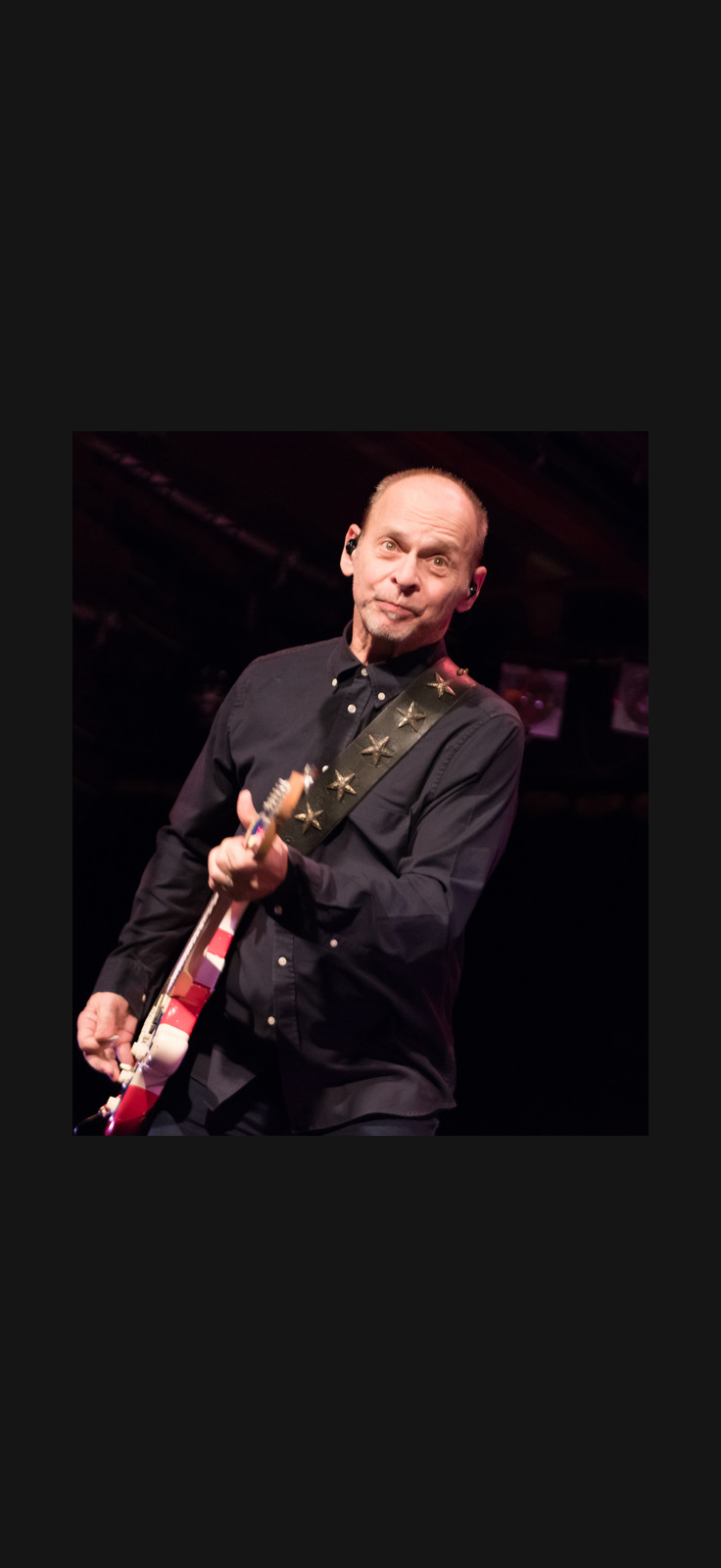
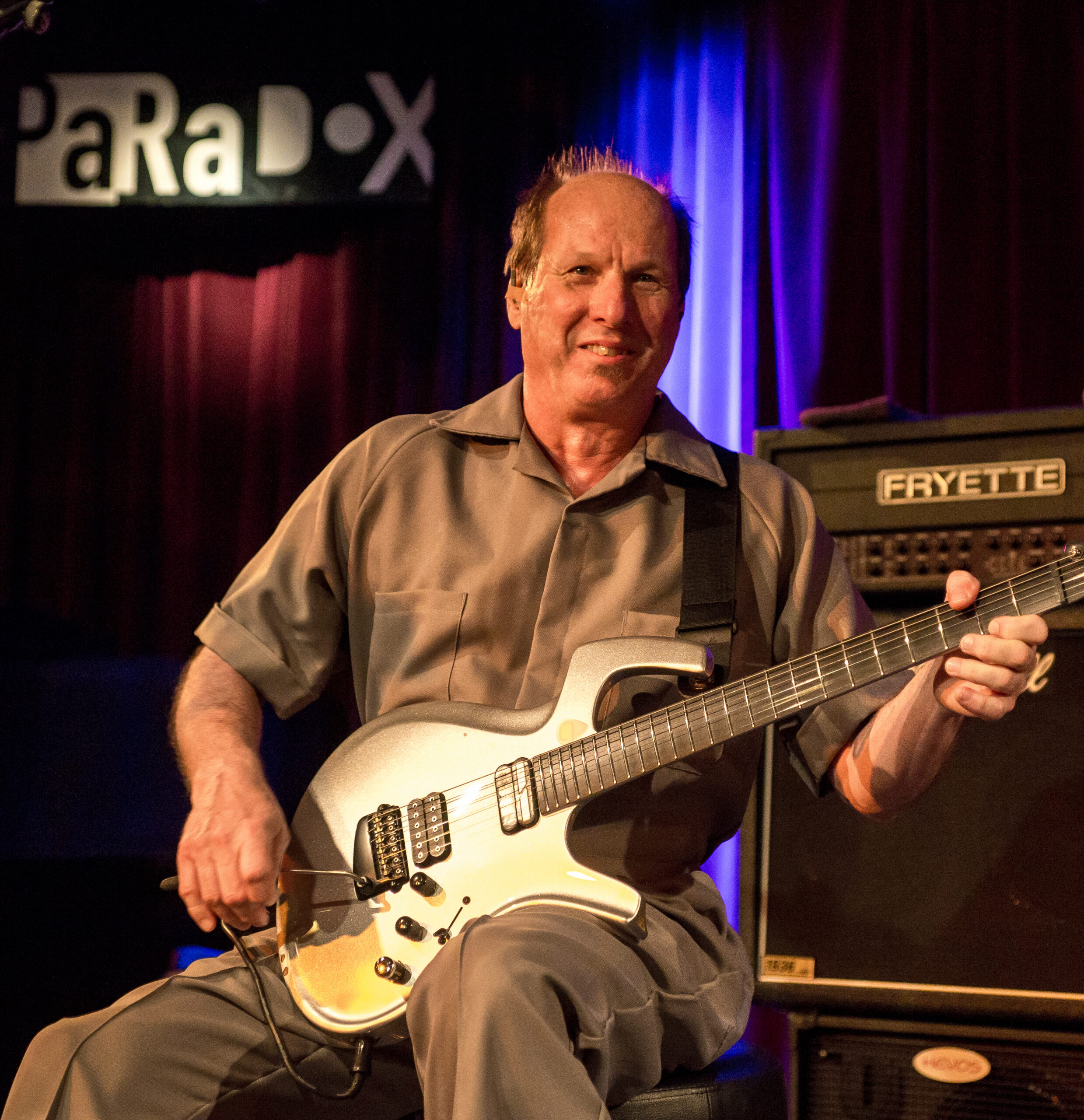
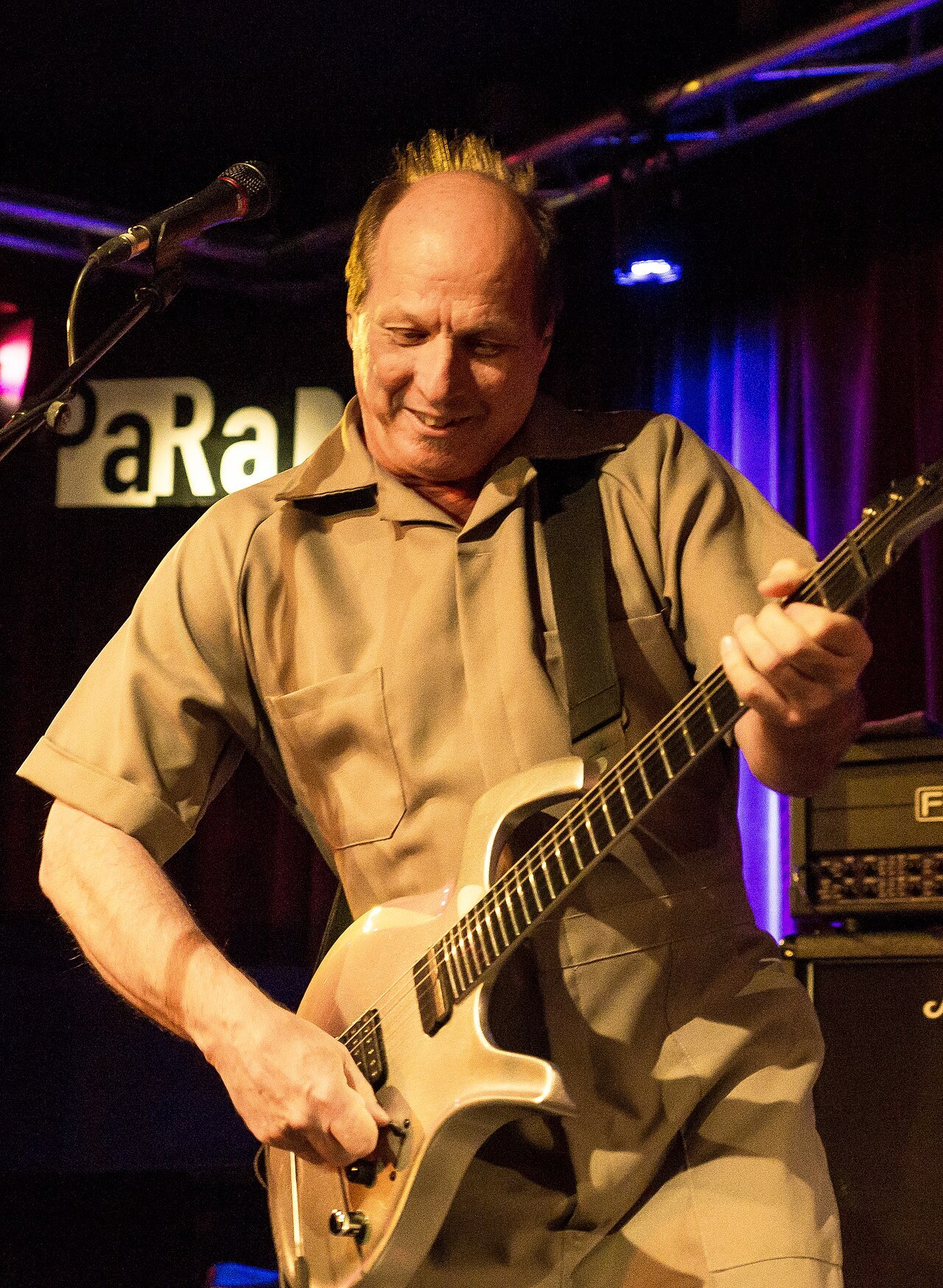
Photo by Paolo51janssen (Wikimedia Commons user), licensed under CC BY-SA 4.0 (https://commons.wikimedia.org/wiki/File:Adrian_Belew_live_20160224b.jpg)
Gear Timeline
He was in a lounge band playing disco covers and hating every minute of it. He was so frustrated with the music that he sold his Gibson Firebird to buy a Ludwig drum kit and spent two and a half years playing drums in the lounge band instead of guitar. When he finally went back to guitar professionally, he bought a Stratocaster. Then Frank Zappa heard him in a Cincinnati club in 1977 and offered him a job. Then David Bowie hired him. Then Talking Heads. Then Robert Fripp called. In the decade between leaving the lounge band and joining King Crimson, Adrian Belew went from disco lounge covers to Frank Zappa’s tour to David Bowie’s Lodger tour to Talking Heads’ Remain in Light to King Crimson’s Discipline — one of the most extraordinary series of professional associations in rock guitar history, across which he was simultaneously developing the specific guitar language of synthesized, processed, extended-technique playing that defines his contribution to the instrument.
Robert Steven Belew was born on December 23, 1949, in Covington, Kentucky, just across the river from Cincinnati. He is a guitarist, vocalist, drummer, pianist, and bassist who has played with Frank Zappa (Sheik Yerbouti, 1979), David Bowie (Lodger, 1979), Talking Heads (Remain in Light, 1980), King Crimson (Discipline through The Power to Believe, 1981-2009), Nine Inch Nails (The Downward Spiral, 1994; Further Down the Spiral, 1995), Paul Simon (Graceland tour), and dozens of others. His solo catalog includes eighteen albums. He co-founded the Bears, the power-pop quartet whose run extends from the 1980s through the present. He is one of the most recorded and most versatile guitarists in rock history, and his specific contribution — the development of guitar synthesis, feedback control, and extended technique as a primary musical vocabulary rather than an experimental supplement — places him in the tradition of Jimi Hendrix and Robert Fripp as a guitarist who expanded what the instrument itself is.
“My two amps are Roland JC-120s — I’ve used one on everything from 1977 on,” he said in a 1986 interview. This single piece of gear information — one specific amplifier model used on everything from 1977 onward — encompasses Frank Zappa, David Bowie, Talking Heads, King Crimson, Nine Inch Nails, Paul Simon, and his entire solo catalog. The Roland Jazz Chorus JC-120 is the foundation on which all of it was built. But understanding why — and understanding what he plugged into it to produce the sounds that could not have been produced by the guitar-and-amp-alone combination — is the full gear story.
Background: From Covington to Zappa to King Crimson
Belew grew up in Covington, Kentucky, directly across the Ohio River from Cincinnati — a suburban working-class environment with limited direct exposure to the music that would eventually define his career. He taught himself guitar from records, studying Les Paul, Chet Atkins, Andrés Segovia, Jimi Hendrix, Jeff Beck, and George Harrison in his early period. “Early on I studied everything I liked — everything from Les Paul to Chet Atkins to Segovia to current heroes at the time; people like Jimi Hendrix, Jeff Beck, George Harrison.” This eclecticism — the willingness to absorb guitar from any tradition that produced interesting sounds — is the foundation of his specific synthesis.
The lounge band period — the disco-covers frustration, the Ludwig drum kit, the two and a half years away from guitar — is significant because it represents the crucible of creative dissatisfaction that preceded the creative explosion. When he returned to guitar and Zappa found him in Cincinnati, the accumulated frustration of the lounge period was channeled into the specific experimental approach that produced the Zappa record’s guitar work. Frank Zappa’s ear for unusual sounds, unusual approaches, and unusually talented musicians identified Belew immediately: Zappa heard him in a bar, offered him a job, and within months Belew was recording on Sheik Yerbouti. David Bowie then heard Belew in Zappa’s band, offered him a job, and the Lodger period of Bowie’s Berlin trilogy produced guitar work that was genuinely experimental in the studio-production sense.
The Talking Heads connection — specifically Brian Eno’s involvement in Remain in Light and the specific intersection of Belew’s guitar approach with Eno’s studio methodology — produced some of the most distinctive guitar textures in that record’s catalog. “Elephant Talk” (King Crimson, 1981) begins with Belew’s guitar making sounds that don’t seem to come from a guitar at all — the Big Muff pushing the Roland JC-120’s built-in chorus into oscillation, producing the swelling, writhing electronic mass that announces the Discipline-era King Crimson sound. This approach — using effects to transform the guitar’s signal into something that sounds like an entirely different instrument or class of sounds — is Belew’s specific contribution to guitar playing’s vocabulary.
The specific arc of his career through the 1980s — working with figures who were each at the cutting edge of their respective genres simultaneously — reflects both the specific community that experimental rock had created by that point and Belew’s specific reputation within it. Frank Zappa and David Bowie were not arbitrarily connected to each other; both operated in the experimental territory between rock and avant-garde music, both worked with unusual musicians, and both recognized Belew’s specific capabilities. Brian Eno, who bridged the Bowie and Talking Heads connections, was the specific figure who most closely understood what Belew was doing and why it was valuable: Eno’s own approach to studio production as composition rather than documentation was philosophically aligned with Belew’s approach to effects as compositional tools. The Remain in Light sessions were the fullest realization of this alignment — Eno’s production methodology combined with Talking Heads’ rhythmic sophistication and Belew’s experimental guitar providing a specific convergence that produced one of the most innovative records of the 1980s.
The King Crimson period (1981-2009) — the longest single professional association of his career — gave him the most ambitious compositional context for his specific approach. With Robert Fripp’s equally experimental guitar sensibility as a partner, and with the specific compositional ambition of the Discipline, Beat, and Three of a Perfect Pair albums, Belew’s guitar work achieved both its greatest complexity and its most commercially visible platform. The interlocking polyrhythmic guitar patterns of “Discipline,” the extended synthesized textures of “The Sheltering Sky,” the animal sounds and sound effects vocabulary that runs through the King Crimson 1980s catalog — all of these are Belew’s contributions, developed within Fripp’s compositional framework and expressed through the specific signal chain described in this guide.
His work with Nine Inch Nails — playing guitar on The Downward Spiral (1994) and Further Down the Spiral (1995) — represents a specific bridge between the King Crimson experimental tradition and the industrial rock context that Nine Inch Nails represented. Trent Reznor’s specific use of guitars in industrial rock — as texture sources rather than melodic lead instruments, as noise generators and distortion creators rather than chord players — aligned with Belew’s approach in ways that made him a natural collaborator. The specific sounds he produced on those records contribute to their industrial character while remaining specifically guitar-derived in a way that lesser players might not have achieved.
The Rig: Adrian Belew’s Guitars, Amps, and Effects
Guitars
Adrian Belew’s first Stratocaster — a 1969 model — is the guitar he used on Frank Zappa’s Sheik Yerbouti, David Bowie’s Lodger, Talking Heads’ Remain in Light, and in his early days with King Crimson. This single guitar was present at what amounts to a concentrated sequence of landmark recordings in experimental and progressive rock history. He has a fourth guitar described in a 1986 interview: “The fourth guitar is my battered 1967 Stratocaster from the David Bowie period, with a broken bass pickup [laughs] and it feeds back better than any other guitar I have.” This specific guitar — with a broken pickup that is precisely wrong for conventional use and precisely right for Belew’s feedback-based playing — exemplifies his approach to instrument selection: find the specific guitar that does the specific thing you need, regardless of whether the specific thing is conventionally desirable.
By the early 1980s, Belew had switched to Mustang models. The 1966 “Twang Bar King” Fender Mustang — which appeared on the cover of his solo album Twang Bar King (1983) — features a vibrato bar (the Mustang’s built-in Fender vibrato) and Belew’s specific modifications. He has said: “I loved the Mustangs” — but acknowledged “they weren’t going to hold up for live work.” The Mustang’s vibrato system was less stable than Floyd Rose-equipped instruments for the demanding live performance requirements of King Crimson’s touring schedule.
When the Mustangs proved insufficiently robust for live touring, Belew had the Fender Custom Shop build him three identical Stratocasters to precise specifications: Kahler tremolo systems, Sperzel locking tuners, Lace Sensor pickups, Sustainiac sustainer pickup (which drives the strings with an electromagnetic signal for infinite sustain without feedback), and Roland GK-2A synth pickup with controls mounted under the pickguard. He repainted them in different colors for every tour he did — Crimson, Bowie, solo — using the same three guitars across multiple projects with different visual identities. These Strats were his main live guitars until the Parker Fly came along.
The Parker Fly — Ken Parker’s revolutionary composite-construction guitar that Parker described as “the most revolutionary development since Teles, Strats, and Les Pauls” — became Belew’s primary guitar once it was available. His specific quote: “It simply is the best guitar that I’ve ever played. It makes me play better, smoother, more fluidly, faster.” The Parker Fly’s radical design — a carbon fiber/glass fiber composite body that is both extremely light and extremely resonant, a special fret system that uses extremely thin stainless steel frets for a playing feel unlike any other guitar, a piezo pickup at the bridge for acoustic guitar simulation, and standard magnetic pickups for electric guitar tones — suits Belew’s approach to the guitar as a multi-timbral sound source. The combination of magnetic pickups and the piezo acoustic simulation gives the Fly the range to cover both conventional guitar tones and acoustic-like textures within a single instrument. The Adrian Belew signature model adds a Variax system (for the additional tonal modeling that Line 6 Variax provides) alongside the standard Fly electronics.
Adrian Belew’s first fretless guitar was a Fender Musicmaster that he purchased in the early 1980s and had Seymour Duncan convert to fretless. The fretless guitar — removing the frets that define discrete pitch positions, allowing continuous pitch slide like a violin or cello — gives the guitar access to microtonal expressiveness and the specific sliding, portamento quality of unfretted string instruments. Belew used this guitar on his solo albums for specific tonal textures unavailable from fretted instruments.
A late-1980s Dobro with 33S body and round neck appears in Belew’s documented collection — used to write the song “1967” and many other songs on his acoustic experimental work. The Dobro’s resonator-based amplification and its specific metallic, sustaining tone give it a character entirely different from both his electric Stratocasters and Parker Fly, providing acoustic textural variety in his compositions.
The Eastwood Airline 59 — a reissue of the vintage Airline model that Jack White made famous — appears in Belew’s documented gear for its specific vintage character and its resonance with the history of early electric guitar design.
For the Roland GR-300 and GR-700 synthesizer systems, Belew used Roland’s dedicated guitar controllers — the G-808 and G-303 models — whose hex pickups transmit individual string signals to the synthesizer for pitch tracking. He also had the Roland GK-2A hex pickup installed under the pickguards of his Custom Shop Strats, integrating the synth controller into conventional guitar bodies.

Amps
“My two amps are Roland JC-120s — I’ve used one on everything from 1977 on.” This statement encompasses the entirety of Belew’s professional recording career: every record on which he has appeared since the late 1970s, from the Frank Zappa Sheik Yerbouti to the King Crimson catalog to Nine Inch Nails to Paul Simon’s Graceland, has featured his guitar through a Roland JC-120. The JC-120’s specific character — crystalline, solid-state clean amplification with built-in stereo chorus — provides the clean, transparent platform that Belew’s extensive effects processing requires. Where a tube amplifier would add coloration and compression to the signal, the JC-120 transmits the guitar and its effects with maximum clarity and minimal amplifier-induced character.

His specific exploitation of the JC-120’s built-in chorus is crucial to understanding his most famous sounds. The “Elephant Talk” opening — the swelling, oscillating electronic mass that precedes King Crimson’s first track on Discipline — was produced by pushing the Big Muff fuzz into the JC-120’s chorus at extreme settings: overloading the channel with a Big Muff and 10-band EQ with the mids pushed, and manipulating the chorus parameters to create oscillations. The JC-120’s chorus, driven past its normal operating range by the Big Muff’s output, becomes an unstable oscillator rather than a modulation effect. This specific technique — using the amplifier’s own circuitry as an effect by pushing it beyond its designed operating parameters — is Belew’s most distinctive amplifier approach and the origin of some of King Crimson’s most distinctive sounds.
Effects
Belew acquired a Roland GR-300 whilst in King Crimson. He has used the GR-300 for orchestration and to create textures rather than replacing key aspects of his guitar playing. On Discipline, the GR-300 appears on “The Sheltering Sky” and “Thela Hun Ginjeet” — early examples of how innovative musicians take new technology and use it in ways beyond the imagination of the instrument maker. Roland’s own reaction, after meeting with Belew following Discipline’s release: “When we were in Japan, Roland met with Adrian and told him that we were using their guitar synthesizers in a way that they had never anticipated.” This is the highest possible testimony to Belew’s approach: the manufacturer of the instrument telling the musician that he had discovered uses for it that the designers hadn’t imagined.
His philosophical approach to the guitar synthesizer was different from Fripp’s at the Discipline rehearsals. During the initial rehearsals he experimented, like Fripp, with the Roland guitar synth. But then he changed his strategy: “I realized, ‘Hey, I’m not playing my guitar. I’m just basically sounding like Robert. Where’s my voice in this?’ So I picked up my Stratocaster, restrung it, and everything changed… When I started making my sounds and doing my thing, everybody kept saying, ‘Yeah, Adrian, you’re finally into the band.'” The guitar synthesizer became an orchestration tool — for specific textures and timbres that the guitar couldn’t produce — rather than a substitute for his guitar playing. The guitar playing remained central; the synthesizer surrounded and supported it.
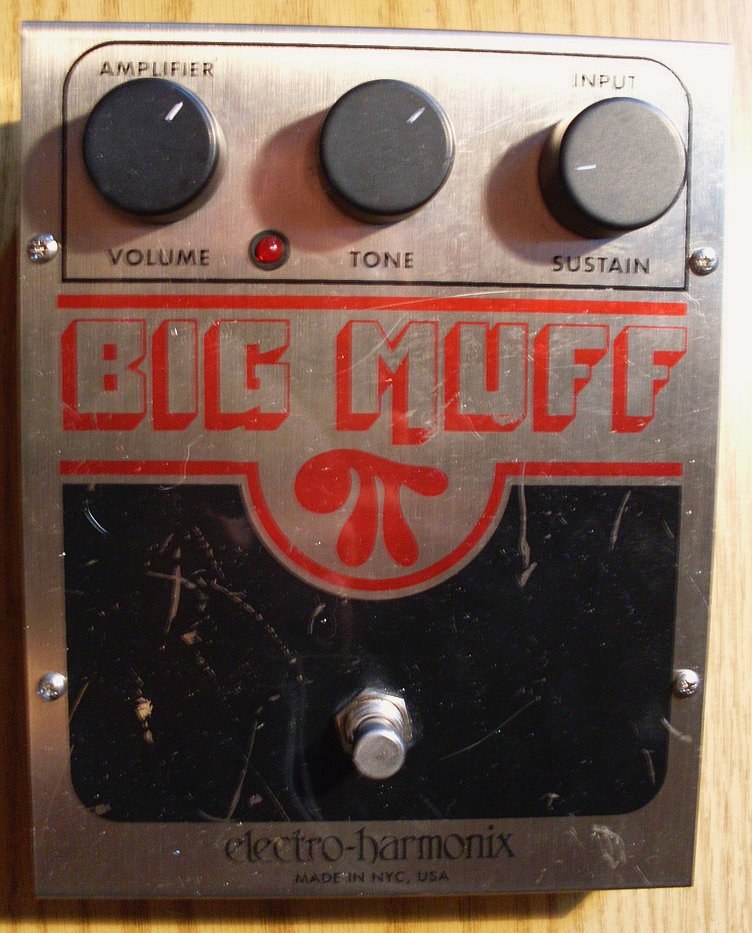
The Electro-Harmonix Big Muff Pi — the same massive fuzz that Jack White used as his primary effect in the White Stripes, that David Gilmour used for specific Pink Floyd solos — is central to Belew’s most extreme sounds. The specific “Elephant Talk” application: the Big Muff pushed into the JC-120’s input at extreme levels, overloading the amplifier’s solid-state circuit into the oscillation that creates the swelling, writhing sound. He also used the Big Muff conventionally as a primary fuzz distortion source across King Crimson and solo recordings.
The EH 16-Second Digital Delay — the same pedal that was central to Robert Fripp’s digital Frippertronics transition — appears in Belew’s documented rig, converted to do backwards tape loops. He described the conversion in a 1986 interview: “the Electro-Harmonix 16-second delay, which I’ve had converted to do backwards tape loops.” This backwards loop capability — the ability to record a phrase and play it back reversed — adds a specific surreal, disorienting quality to looped passages that forward-play loops don’t provide.
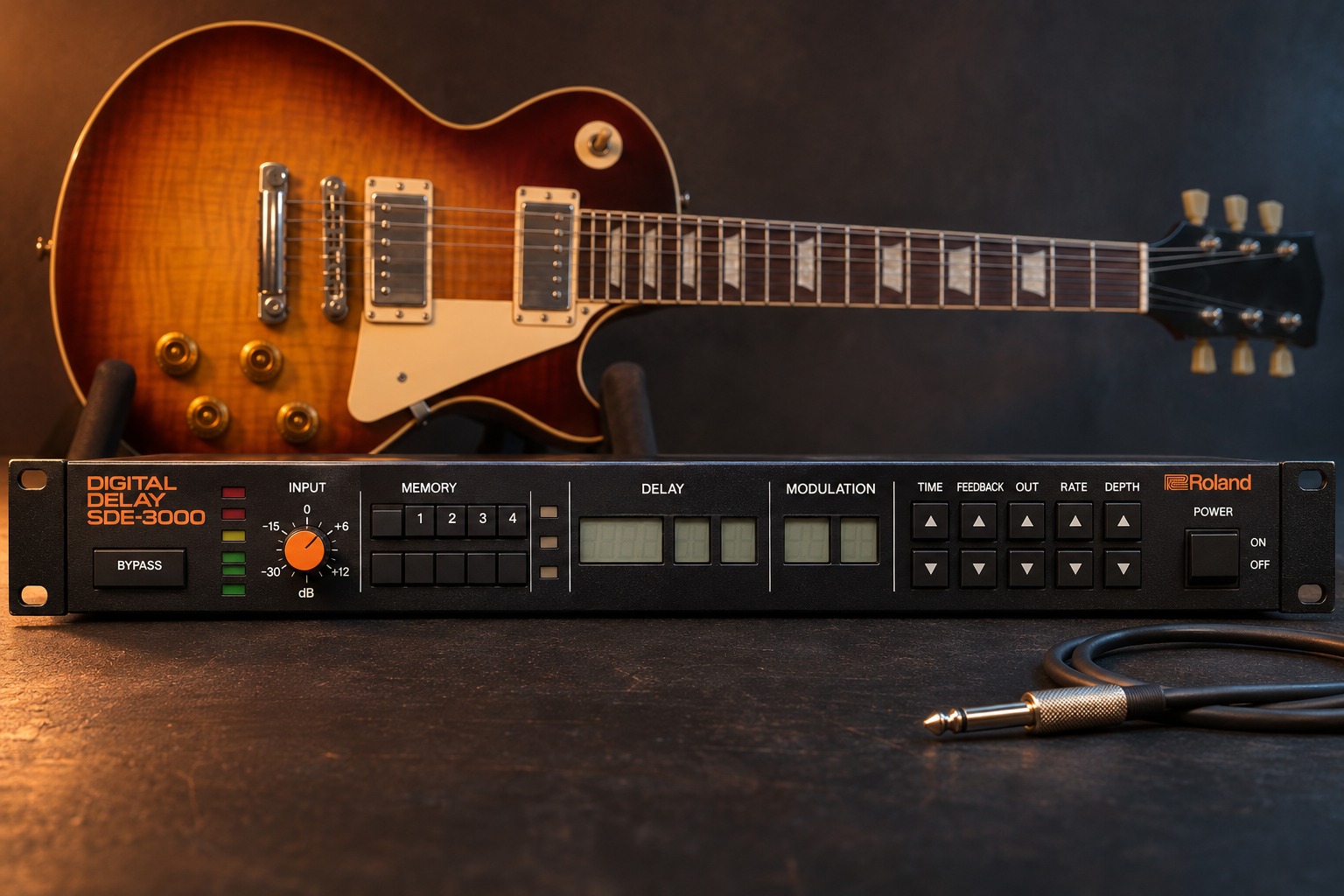
The Roland SDE-3000 digital delay appears in Belew’s documented 1986 rig, providing the clean digital delay that gives his guitar textures their spatial depth. The SDE-3000’s delay effects complement the JC-120’s built-in chorus to create the layered spatial quality of Belew’s distinctive sound.
An Ibanez harmonizer appears in his documented rig, providing pitch shifting and harmonizing effects that are distinct from the guitar synthesizer’s pitch generation. The harmonizer’s specific pitch-shift effects add additional tonal dimensions to his guitar playing, allowing two-voice harmony from a single note.
He mentions “a Roland compressor — I always use lots of compression” in his 1986 interview — consistent with Belew’s approach to effects as creative rather than signal-management tools. The Roland pitch shifter adds additional pitch manipulation capability beyond the harmonizer.
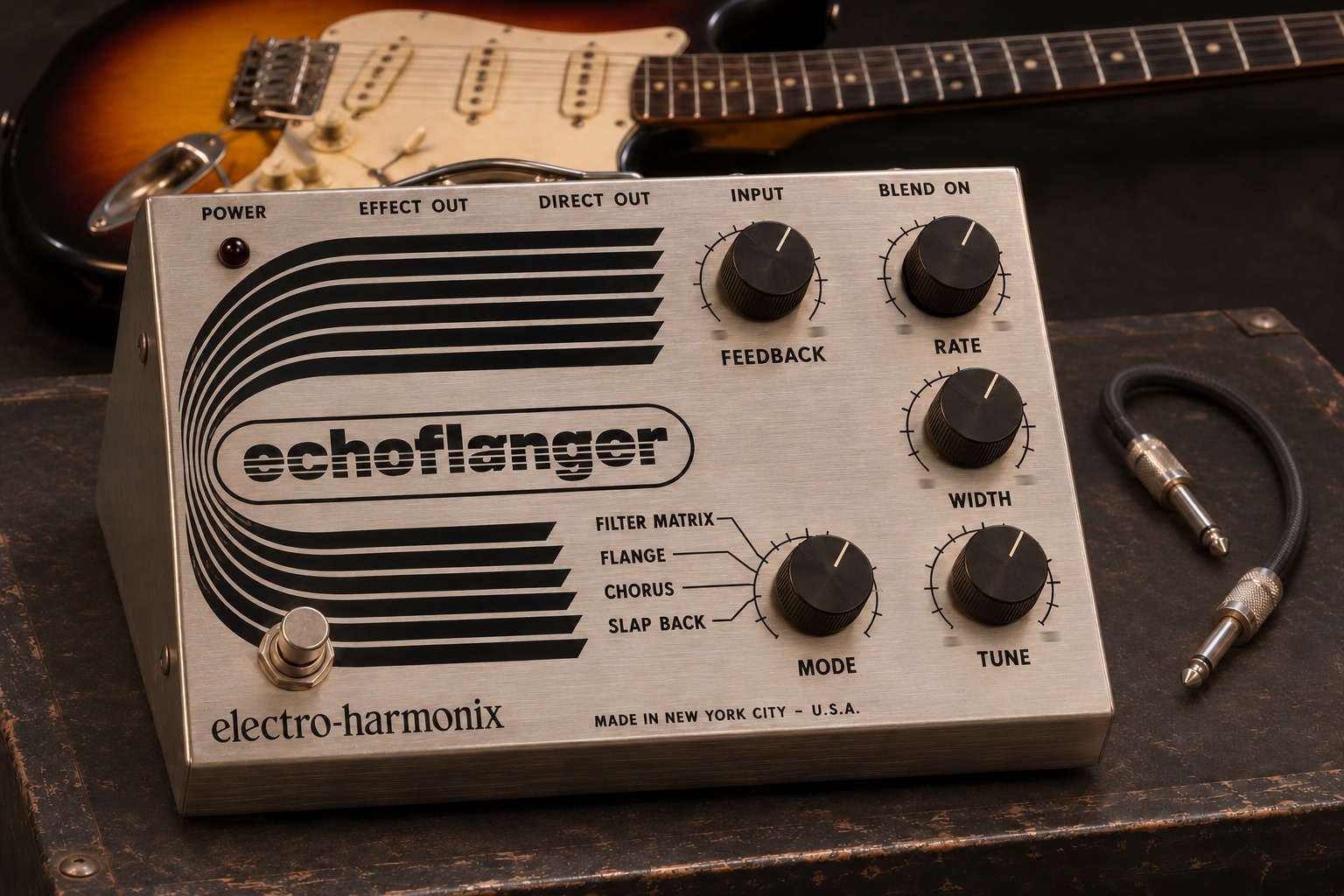
The Electro-Harmonix Echo Flanger — “which makes the wonderful metallic insect sounds on Desire” — is the specific effect responsible for one of Belew’s most distinctive textures in his solo work. The echo flanger combines flanging modulation with delay feedback in a way that produces the specific metallic, insectile quality he references.
The Sustainiac pickup — installed in his Custom Shop Stratocasters — drives the guitar’s strings electromagnetically, keeping them vibrating indefinitely without the feedback issues that conventional infinite-sustain approaches require. This gives Belew the ability to sustain notes at any volume level, in any stage position relative to the amplifier, without the feedback management that sustaining at high volume would otherwise demand.
A DigiTech Harmony Man appears in more recent Belew documentation, providing the intelligent pitch harmonization that adapts to the key of the song to produce contextually appropriate harmony lines. This represents the evolution of his harmonizer effects from the mid-1980s Ibanez units to contemporary digital intelligent harmonizers.
Playing Style & Tone Philosophy
Adrian Belew’s playing style is the most sonically extreme in this series of one hundred guitarists — and this statement is not about technical speed or theoretical complexity but about the willingness to make sounds with a guitar that no one previously understood a guitar was capable of making. The bird calls, the elephant sounds, the oscillating mechanical insects, the backwards loops, the synthesized orchestration, the feedback-induced pitches hovering at the edge of musical intelligibility — all of these come from the same physical instrument (a guitar) through the same basic signal chain (pickup-effects-amplifier) used by every other guitarist in this series. What is different is the imagination applied to the tools and the systematic exploration of what the tools could do beyond their design intentions.
His approach to the Roland JC-120’s built-in chorus — pushing it into oscillation with the Big Muff rather than using it as a subtle modulation effect — exemplifies his entire methodology: take a tool designed for one purpose, apply it in a context outside its design parameters, and discover what it does. The Electro-Harmonix 16-Second Delay converted to do backwards tape loops is another example: a tool designed for forward delay, repurposed for reverse playback. The Sustainer pickup that eliminates the physical constraint of sustain — the requirement that a guitar’s note must eventually decay — is another. Belew approaches guitar equipment as an experimental musician approaches laboratory equipment: the designed function is a starting point, and the interesting things happen when you go beyond it.
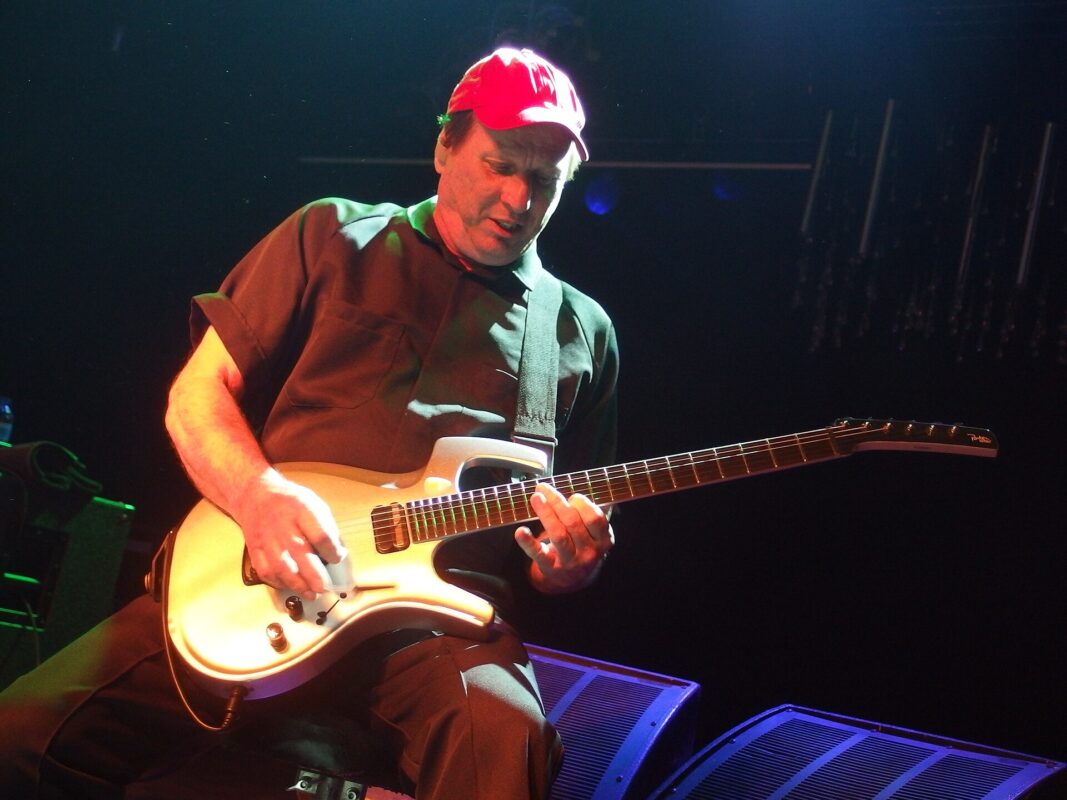
His tone philosophy is expressed most clearly in his relationship with the Parker Fly: “It makes me play better, smoother, more fluidly, faster.” The guitar’s physical properties — the lightweight composite body, the thin stainless steel frets, the specific ergonomics — produce a playing experience that affects the music being made. This is the player’s understanding that the instrument is not neutral, that the guitar’s physical character shapes what is played on it. The Fly’s character makes him play in ways the Stratocaster didn’t; the Stratocaster with the broken pickup feeds back in ways a functional Stratocaster wouldn’t; the Mustang’s vibrato bar suggests phrases that wouldn’t occur on a fixed-bridge guitar. Every instrument in his collection is a different conversation partner in the compositional process.
His specific relationship with the sounds of animals and nature — the bird calls, the elephant sounds, the metallic insects — is one of the more distinctive and most immediately recognizable elements of his guitar vocabulary. These sounds are not imitations (no attempt to perfectly replicate the sound of an elephant); they are guitar sounds that evoke the emotional quality or the physical character of those sounds through specific effects combinations. The Big Muff into the oscillating JC-120 chorus produces something that sounds like it could belong in the same sonic world as the sounds animals make — large, complex, slightly unpredictable, alive in a way that conventional guitar sounds aren’t. This is a compositional approach to effects: not “what effect can I add?” but “what is the emotional or physical quality I’m looking for, and which combination of effects produces something in that territory?” The fact that some of the territory Belew was exploring sounded like elephants and birds and insects is a reflection of his specific compositional imagination rather than an attempt to produce novelty effects.
His relationship with the guitar as an instrument is one of consistent modification and extension — finding what the guitar can’t do in its standard configuration and modifying it until it can do that thing. The Sustainiac pickup eliminates the physical constraint of sustain. The Roland GK-2A synth pickup eliminates the electronic constraint of pitch-only guitar signals. The Parker Fly’s composite construction eliminates the physical constraint of weight and the playability constraints of wooden necks with conventional frets. Each modification is a specific solution to a specific problem: what can’t the guitar do that I want it to do? Fix that. And then discover what new possibilities the fix opens up. This is the engineering mindset applied to musical instruments, and it is what keeps his approach fresh across fifty years of professional playing.
How to Sound Like Adrian Belew
Approximating Belew’s specific sounds is partly about equipment and primarily about attitude: the willingness to push effects beyond their designed parameters and accept the unexpected results. No equipment list will produce his sounds without the experimental approach that generates them.
Guitar: Parker Fly Adrian Belew signature for the most authentic current approach. Any Stratocaster with Sustainiac and synth pickup for the late 1980s Crimson approach. A Fender Mustang for the early 1980s character.
Amp: Roland JC-120 Jazz Chorus — non-negotiable for the “Elephant Talk” and Crimson sounds. Two of them in stereo for the full effect. The built-in chorus is the point; no other amplifier provides the specific oscillation behavior that he exploits for his most extreme sounds.
Amp Settings (Roland JC-120 with Big Muff — “Elephant Talk” configuration):
| Control | Setting (0–10) | Notes |
|---|---|---|
| Volume | 7–8 | Working volume — the Big Muff overloads the input at high volume |
| Bass | 5 | Neutral |
| Mid | 8–10 | Boosted — 10-band EQ with mids pushed is the “Elephant Talk” setting |
| Treble | 5 | Neutral |
| Chorus Rate | 7–9 | Fast — approaching oscillation speed, not gentle modulation |
| Chorus Depth | 8–10 | Maximum — the chorus must be at full depth to oscillate |
Big Muff: Set Sustain high (7-9), Tone midpoint (5), Volume moderate (4-5). The Big Muff’s output should be sufficient to push the JC-120’s input into overload. This is the specific “Elephant Talk” configuration — adjust until the chorus begins to oscillate rather than modulate.
Influence & Legacy
Adrian Belew’s influence on guitar playing is the demonstration that the guitar is not a finished instrument — that its tonal possibilities extend far beyond what any tradition has established, that experimental approaches to effects, synthesis, and extended technique can produce genuinely new musical vocabularies from existing equipment. Every guitarist who uses feedback as a compositional tool, who applies effects in non-standard configurations to produce unexpected results, who approaches the guitar synthesizer as a texture generator rather than a pitch replacement — all of these are working in a tradition that Belew developed as fully as anyone since Jimi Hendrix.
His specific influence on progressive rock guitar — through the King Crimson period — changed what the guitar’s role in that genre could be. Where Steve Howe and Robert Fripp had established jazz archtop warmth and tape-loop experimentation as progressive rock guitar’s primary approaches, Belew added the avant-garde synthesis and extreme effects processing that gave Discipline-era King Crimson its specific sonic identity. The sounds he produced with the Big Muff and JC-120 chorus on Discipline had no precedent in progressive rock, and they opened possibilities that subsequent generations of experimental guitarists have explored.
For context on where Belew fits in the progressive experimental guitar tradition, the comparison with Robert Fripp’s Frippertronics and experimental approach is the most direct — the two guitarists spent nearly thirty years in creative dialogue within King Crimson, each pushing the other’s approach toward greater complexity and greater sonic adventurousness. The interlocking polyrhythmic guitar patterns of Discipline represent both men’s contributions; the separation of their distinct voices within the ensemble — Fripp’s clean, sustained tones versus Belew’s more processed, textural approach — demonstrates how different two equally experimental guitarists can be.
The comparison with Tom Morello’s approach to guitar as sonic experiment shows the generational transmission: Morello’s systematic creation of unexpected sounds from a guitar and effects chain draws from the same experimental tradition that Belew developed in the late 1970s and 1980s. The methodology is shared; the sonic territory is different.
And the comparison with Frank Zappa’s approach to guitar as experimental laboratory illuminates the most direct biographical connection — Belew’s first major professional engagement was with Zappa, who recognized in him the same experimental approach that Zappa himself embodied in his own guitar playing. The specific sounds Belew produced on Sheik Yerbouti were as unusual as anything Zappa himself had done; the recognition between two experimental guitarists is the story of that professional relationship.
Adrian Belew is seventy-six years old in 2026. He continues to perform with the Adrian Belew Power Trio and other projects. The Roland JC-120 is still in use — the same amplifier he has used on everything since 1977. The Parker Fly signature is still the best guitar he’s ever played. The Big Muff is still capable of pushing the JC-120’s chorus into oscillation. And somewhere in the space between what the guitar was designed to do and what Belew discovered it could do, the most interesting sounds in his career have always lived.

The Bear project — the power-pop quartet he has maintained alongside all his other work — provides a different context for understanding his musical range. Where King Crimson required extreme technical sophistication and experimental commitment, the Bears required the songwriting craft and pop accessibility that Belew’s other career context never highlighted. The fact that he can do both — the most extreme experimental guitar work and the most melodically accessible pop songwriting — within the same professional career is evidence of the comprehensive musicianship that his early study of everything from Les Paul to Segovia to Hendrix produced. He absorbed the full spectrum of guitar music; the different professional contexts simply allowed different portions of that spectrum to be expressed at different moments.
His solo albums — eighteen of them across his career — represent the most complete expression of his individual musical vision, free from the collaborative constraints of any ensemble context. The range across those albums — from the song-based pop of Lone Rhino and Twang Bar King through the purely instrumental Desire Caught by the Tail through the experimental Mr. Music Head and Desire to his more recent work — demonstrates the full breadth of what his musical intelligence encompasses when given complete freedom. No other figure in this series of one hundred guitarists has produced as diverse a solo catalog across as many musical territories.
Adrian Belew is seventy-six years old in 2026. The Roland JC-120 is still in use. The Parker Fly is still probably the best guitar he’s ever played. And somewhere in the space between what the guitar is designed to do and what it turns out it can do when you push it past the design parameters — somewhere in that space, which Belew has been exploring since Frank Zappa found him in a Cincinnati bar in 1977 — are sounds that don’t sound like a guitar, sounds that sound like nothing else that has ever existed, and sounds that continue to surprise and to matter fifty years into the exploration.
Frequently Asked Questions: Adrian Belew Guitars & Gear
What guitar does Adrian Belew play?
Adrian Belew’s primary guitar since the 2000s has been the Parker Fly Adrian Belew Signature model — a composite-construction guitar that combines extreme lightness, thin stainless steel frets, a piezo acoustic pickup at the bridge, standard magnetic pickups, and in the signature model, a Variax modeling system. He has described it as “simply the best guitar I’ve ever played.” His primary earlier guitars: a 1969 Fender Stratocaster (used on Frank Zappa’s Sheik Yerbouti, David Bowie’s Lodger, Talking Heads’ Remain in Light, and early King Crimson), a 1966 Fender Mustang “Twang Bar King” (early 1980s), and three identical Custom Shop Stratocasters with Kahler trems, Sperzel locking tuners, Lace Sensor pickups, Sustainiac pickups, and Roland GK-2A synth pickups. He also owns a Fender Musicmaster converted to fretless and a Dobro for acoustic experimental work.
What amp does Adrian Belew use?
Adrian Belew has used Roland JC-120 Jazz Chorus amplifiers as his primary amplification since 1977 — since touring with David Bowie. “My two amps are Roland JC-120s — I’ve used one on everything from 1977 on.” He runs two in stereo. The JC-120’s solid-state, crystalline clean amplification and its built-in stereo chorus are both essential to his specific sound — the chorus particularly, which he exploits by overloading it with the Big Muff fuzz to create the oscillating, swelling sounds heard on “Elephant Talk” and other King Crimson recordings. The JC-120 appears on every major record in his career: Frank Zappa, David Bowie, Talking Heads, King Crimson, Nine Inch Nails, Paul Simon.
How did Adrian Belew create the “Elephant Talk” sound?
The opening sound of “Elephant Talk” — the swelling, oscillating electronic mass that begins King Crimson’s Discipline album — was created by overloading the Roland JC-120’s built-in chorus circuit with the Electro-Harmonix Big Muff Pi fuzz. Belew pushed the Big Muff into the JC-120’s input at high levels, with a 10-band EQ boosting the mids, and manipulated the JC-120’s chorus parameters to push the circuit past its normal operating range and into oscillation — the chorus becoming an unstable feedback oscillator rather than a modulation effect. This technique of exploiting an amplifier’s built-in circuitry by operating it outside its designed parameters is characteristic of Belew’s experimental approach.
What is the Parker Fly and why does Belew prefer it?
The Parker Fly is a radically designed guitar developed by luthier Ken Parker in the early 1990s, featuring a composite-construction body (carbon fiber and glass fiber) that is extremely lightweight and resonant, ultra-thin stainless steel frets bonded directly to the neck for a unique playing feel, a piezo acoustic pickup at the bridge that simulates acoustic guitar tones, standard magnetic pickups for electric guitar tones, and — in the Belew signature model — a Line 6 Variax modeling system for additional tonal options. Belew called it “the most revolutionary development since Teles, Strats, and Les Pauls” and described it as making him “play better, smoother, more fluidly, faster.” The combination of extreme lightness, the unique fret feel, and the range of tonal options (electric, acoustic, modeled) made it his ideal performance instrument.
What is Adrian Belew’s connection to Talking Heads?
Adrian Belew performed on Talking Heads’ Remain in Light (1980) and the accompanying live recordings. Brian Eno — who was co-producing Remain in Light with the band and had also worked with Belew on David Bowie’s Lodger — brought Belew into the sessions. His guitar work on Remain in Light provides the texture and experimental sound that complements Eno’s studio methodology and the band’s evolving Afrobeat/funk-influenced direction. The connection followed from the David Bowie Lodger period — Belew touring with Bowie in 1977 after Zappa, then Eno recognizing his specific experimental approach for the Talking Heads project.
Why did Belew not use the Roland guitar synth in the same way as Fripp?
During King Crimson’s initial Discipline rehearsals, Belew experimented with the Roland guitar synthesizer like Robert Fripp. But he then realized he had lost his distinctive voice: “I realized, ‘Hey, I’m not playing my guitar. I’m just basically sounding like Robert. Where’s my voice in this?’ So I picked up my Stratocaster, restrung it, and everything changed.” He maintained the Roland GR-300 and GR-700 systems for specific orchestration and texture applications — using them to create sounds that the guitar alone couldn’t produce — while keeping the guitar itself as his primary expressive instrument. He confirmed that Roland later told him the band was using their guitar synthesizers in ways the company had never anticipated.
Is Adrian Belew in the Rock and Roll Hall of Fame?
As of 2026, Adrian Belew has not been inducted into the Rock and Roll Hall of Fame as a solo artist. He has appeared on multiple Rock and Roll Hall of Fame recordings as a sideman — most notably through his King Crimson connection. His career includes recordings with Frank Zappa, David Bowie, Talking Heads, Nine Inch Nails, and Paul Simon — all Hall-relevant artists — as a performing member rather than as the artist himself. His solo career and his foundational role in King Crimson’s most commercially and critically celebrated period have established his significance within guitar culture, but formal Hall recognition as a solo or primary artist has not followed.
Image credits
- Electro-Harmonix Echo Flanger (Metallic Insect Sounds): GuitarGangsters AI-generated reference illustration, not a photograph.
- Roland SDE-3000 Digital Delay (Primary Delay): GuitarGangsters AI-generated reference illustration, not a photograph.
- Adrian Belew: Paolo51janssen, Wikimedia Commons, CC BY-SA 4.0.
- Adrian Belew: Kevin Dooley, Wikimedia Commons, CC BY 2.0.
- Top image: by Paolo51janssen, Wikimedia Commons, CC BY-SA 4.0.
- Adrian Belew: photo by Mark Finch, via Wikimedia Commons, CC BY-SA 2.0.
- Adrian Belew: photo by Mogwai73, via Wikimedia Commons, CC BY-SA 4.0.
- Roland JC-120: Solomon203, Wikimedia Commons, CC BY-SA 4.0.
- Electro-Harmonix Big Muff Pi: Roadside Guitars, Flickr, CC BY-SA 2.0.
- Adrian Belew live: Rosenborg BK Fan, Wikimedia Commons, CC0.
- Roland G-303: GuitarGangsters AI-generated reference illustration, not a photograph.