
Gear Timeline
When Adrian Smith was seventeen years old, he worked a full summer on a building site to save enough money to buy a Gibson Les Paul Goldtop. It cost him £235. When he later appeared on the DVD for Iron Maiden’s A Matter of Life and Death and was asked about his guitars, he said of the Goldtop: “It’s still probably the best guitar I’ve got.” He has been playing guitar professionally since the late 1970s. He has played in Iron Maiden for most of the last forty years. He has played Ibanez Destroyers, Stratocasters with Floyd Rose tremolos, Jackson custom superstrats, Jackson King Vs, and multiple signature Jackson models. And the guitar he bought with a summer of building site savings at seventeen is still probably the best guitar he’s got. This is not a statement about nostalgia; it is a statement about the specific quality of a 1972 Gibson Les Paul Goldtop that has outlasted several decades of gear evolution and a rotating cast of signature models.
The Journey
Adrian Frederick Smith was born on February 27, 1957, in Hackney, East London. He bought his first guitar from his childhood friend Dave Murray — a Woolworths “Top 20” model — for five pounds. He painted it gold, then sold it for twelve pounds (a four-hundred-percent guitar trading profit at the age of eleven). He and Murray formed their first band Urchin while still at school, with Smith as lead singer and lead guitarist. Urchin released one single before Murray joined Iron Maiden and Smith continued with various bands until Steve Harris invited him to replace Dennis Stratton as Iron Maiden’s second guitarist for the Killers album in 1981. He has been part of Iron Maiden’s “classic” lineup since then — the six-piece band with three guitarists (Murray, Smith, and Janick Gers) that has been Maiden’s touring lineup since 1999 — and his songwriting contributions include some of Maiden’s most celebrated compositions: “Two Minutes to Midnight,” “Wasted Years,” “Can I Play with Madness,” and the Smith/Dickinson co-write “The Wicker Man.”
His guitar playing is described in one assessment as “rooted in the blues,” which distinguishes him from most of his 1980s heavy metal contemporaries: Smith’s unique style is largely drawn from blues, rather than traditional rock or metal guitar playing. He cites Pat Travers and Johnny Winter as two of his key influences. Alongside Gary Moore, Michael Schenker, and Joe Satriani, these influences explain the specific melodic quality of his guitar work — the single-note lines that have emotional directness rather than technical display, the solos that build and resolve like musical sentences rather than technical exercises. He is the guitarist who helped create Iron Maiden’s twin-lead and three-guitar harmony approach, one of the most imitated and most celebrated elements of the band’s sound. This is the complete guide to the instruments, amplification, and effects through which he has contributed to that sound for four decades.
Background: From Woolworths Five Pounds to Killers to Live After Death
The specific sequence of Smith’s musical development — the Murray friendship, the Urchin band, the building site summer for the Les Paul Goldtop, the years of London club circuit before Iron Maiden — is a biography of a working musician finding his way into the professional ranks through persistence and musicianship rather than through any industry-assisted shortcut. Murray’s success with Iron Maiden gave him the contact; his own playing ability got him the audition; and the specific musical intelligence he brought to the job — the songwriting, the harmonic thinking, the blues-rooted melodic approach — earned him the position within the band’s creative hierarchy that subsequent decades confirmed.
His primary influences place him in a specific tradition of 1970s British and American guitar that predates the heavy metal genre he became associated with. Thin Lizzy’s twin-guitar harmonies (Brian Robertson and Scott Gorham) are the most directly visible influence on the Iron Maiden twin-lead approach. Wishbone Ash’s melodic twin-guitar work (Ted Turner and Andy Powell) is another documented influence. Gary Moore, Pat Travers, and Michael Schenker provide the blues-rock single-note vocabulary. And more recently, Joe Satriani’s influence — absorbed in the period following his initial Iron Maiden departure and before the reunion with Bruce Dickinson — gave him additional technical vocabulary that appears in the more melodically developed solo work of the later Maiden albums.
His departure from Iron Maiden in 1989 — shortly after the Seventh Son of a Seventh Son album — was a decision to pursue solo and side projects rather than the result of conflict. He formed ASAP (Adrian Smith And Project), which released Silver and Gold in 1989. He subsequently formed Psycho Motel, which released State of Mind in 1996 and Welcome to the World in 1997. His most celebrated non-Maiden work came through the Bruce Dickinson solo projects: Accident of Birth (1997) and The Chemical Wedding (1998) — critically acclaimed metal albums on which Smith’s guitar work is among the finest of his career. He rejoined Iron Maiden in 1999 for the Brave New World album and has been a member of the three-guitar lineup since.
His songwriting partnership with Bruce Dickinson — both in Maiden and in the solo projects — is worth documenting as a creative relationship that has produced some of the finest music in both men’s careers. Accident of Birth (1997) and The Chemical Wedding (1998) were received as Dickinson’s strongest solo albums and as significant achievements in their own right — records that would have enhanced any career even absent the Iron Maiden connection. Smith’s guitar work on these albums demonstrates what he can do without the organizational context of a three-guitar ensemble: lead parts that are longer, more developed, and more melodically ambitious than the Maiden context typically allows. The Chemical Wedding in particular is a dark, complex, heavy album whose guitar work is among the most accomplished of Smith’s career. Roy Z produced both albums with an approach that emphasized the orchestral qualities of Smith’s guitar alongside more programmatic elements that the Maiden live context couldn’t accommodate.
The Smith/Kotzen collaboration — the self-titled album with Richie Kotzen (2021) and Psycho Vertigo (2023) — represents his most recent non-Maiden creative outlet and demonstrates his willingness to engage with musical approaches (Kotzen’s blues-soul fusion) that extend beyond Maiden’s heavy metal context. The Smith/Kotzen albums show the blues foundation of his playing in the most unobstructed way: without the Maiden context of heavy rhythm sections and twin-lead harmonies, Smith’s intrinsic melodic character is more clearly audible.
His purchase of the five-pound Woolworths guitar from Dave Murray — the founding transaction of a professional relationship that would span fifty years — deserves one more look as a biographical detail. Murray charged him five pounds; Smith painted it gold and sold it for twelve. This early guitar trading instinct — the impulse to modify and improve on what he had received — prefigures the decades of guitar modification that would follow: the DiMarzio Super Distortion fitted to the Stratocaster’s bridge, the Samarium Cobalt Noiseless pickups replacing the standard single-coils, the Floyd Rose added to guitars designed without floating tremolos. Smith has consistently taken the available instrument and modified it toward his specific tonal requirements rather than accepting what the manufacturer provided. The five-pound guitar was the first expression of an approach he has maintained throughout his professional life.
The Rig: Adrian Smith’s Guitars, Amps, and Effects
Guitars
On the A Matter of Life and Death DVD, Smith says the first guitar he bought was a Gibson Les Paul Goldtop that cost him £235 when he was 17; he’s still using it, and “it’s still probably the best guitar I’ve got.” He had to work on a building site all summer to pay for it. The 1972 Gibson Les Paul Goldtop’s specific character: a maple cap/mahogany body Les Paul with P-90 or humbucker pickups (1972 Goldtops typically used low-impedance pickups or standard humbuckers depending on the production year) and the specific warm, resonant tonal character of the Les Paul body with Goldtop finish. Its status as “still probably the best guitar I’ve got” after fifty years of professional playing is a testimony to both the instrument’s quality and its biographical significance to Smith.
Smith used his Ibanez Destroyer throughout the 80s. If you saw an Iron Maiden gig during this time, you likely saw Adrian Smith playing this guitar. Smith used this guitar during the recording of The Number of the Beast as well as the supporting tour and the “Run to the Hills” music video. The Ibanez Destroyer is a double-cutaway guitar with an aggressive, angular body design based loosely on the Gibson Explorer, featuring active or high-output passive pickups and the specific Japanese-quality construction of Ibanez’s early 1980s professional range. The Destroyer’s bright red finish in Smith’s Number of the Beast-era photographs is one of the more recognizable visual elements of Iron Maiden’s early commercial peak period. What Smith reportedly loved about the guitar was the locking tuning mechanism — Eddie Van Halen had popularized Floyd Rose-style locking tuners, and Smith’s preference for tuning stability in live performance made this specific feature important.
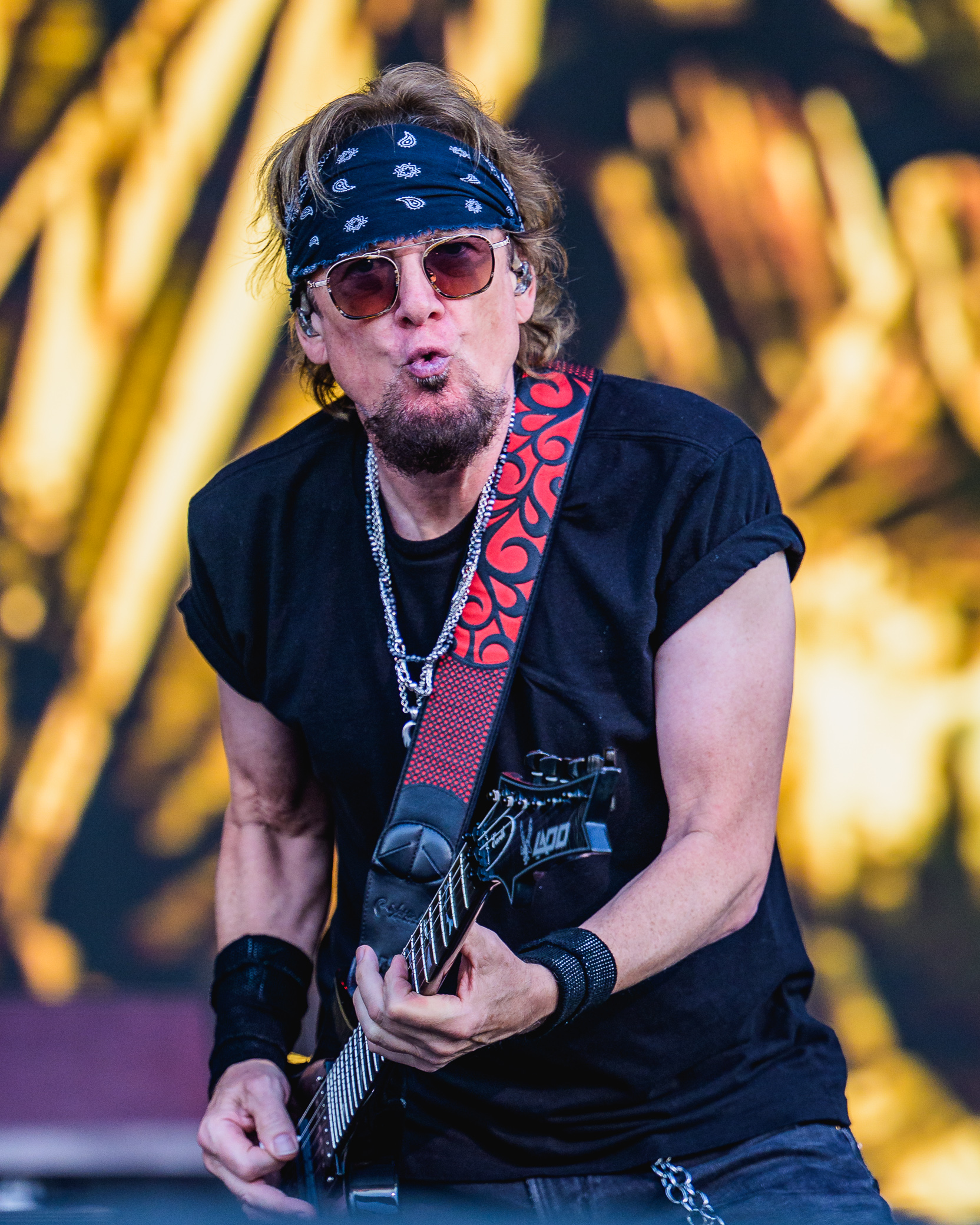
While Smith has been synonymous with playing Strats for a long time, he actually didn’t pick up a Strat until he rejoined Maiden in 1999. The switch to Stratocasters was motivated partly by wanting to complement the sound of the other two Maiden guitarists (Murray and Gers both playing Strats) and partly by the Strat’s specific tonal character suiting his playing approach. His current Stratocaster configuration is specifically modified: a DiMarzio Super Distortion fitted in the bridge position, with Samarium Cobalt Noiseless pickups in the neck and middle positions to counteract any feedback and buzzing incurred by Smith’s high-gain guitar tone, an ebony fretboard, a Floyd Rose floating bridge, locking tuners, and only two controls: one volume, one tone.
The DiMarzio Super Distortion in the bridge is a critical tonal choice: one of the highest-output passive humbuckers available, with a specific midrange character that cuts through the mix in a way that standard Stratocaster bridge single-coils cannot. The Samarium Cobalt Noiseless pickups in the middle and neck positions provide hum-canceling capability for the single-coil positions without the magnetic character of conventional humbucker-sized replacements. The Floyd Rose provides tuning stability for the wide bends and vibrato effects that appear in his solos.
This Adrian Smith prototype is heavily based on a Fender Stratocaster, with a few updates to better suit Iron Maiden’s needs. The guitar has an aftermarket DiMarzio Super Distortion fitted in the bridge position and Samarium Cobalt Noiseless pickups in the middle and neck positions, an ebony fretboard, a Floyd Rose floating bridge, and locking tuners. Jackson’s ASDX Adrian Smith Signature San Dimas Dinky formalizes the Stratocaster-based design with Jackson’s specific build quality and the custom specifications that Smith has developed across years of touring. The San Dimas designation places it within Jackson’s most prestigious American-built Dinky series, with the ebony fingerboard that Smith has consistently preferred for its bright, fast feel.
At least seven Jackson/Charvel custom Stratocasters/Superstrats, one of them with integrated MIDI systems, and at least four custom Lados (two Lado Earths, one Lazer with MIDI system, and a Lado custom Strat) appear in Smith’s documented collection. The transition through multiple Jackson and Charvel custom instruments — the period before his Fender Strat adoption — produced a range of superstrat-style guitars that reflected the specific requirements of Iron Maiden’s touring demands in the 1980s and early 1990s.
Two Gibson SGs (the second normally used as a backup guitar) appear in Smith’s documented touring setup. For his solo work with Bruce Dickinson and with Maiden on occasion, he has used (at least live) a Jackson King V guitar tuned down to D, providing a darker and heavier sound. The Gibson SG provides the drop-D resonance for specific Maiden and Dickinson solo material where lower tuning suits the song’s tonal requirements.
Adrian uses gauge 9 strings and has his action set slightly higher than average. The .009 gauge is lighter than many hard rock and metal guitarists prefer, but suits Smith’s blues-influenced bending style — the lighter strings allow the wide bends and vibrato that give his solos their expressive character without excessive physical demand. The slightly higher action compensates for the lighter gauge by providing the string height that prevents buzzing during aggressive bends.
Amps
The Marshall JCM800 — the standard British high-gain amplifier of the 1980s heavy metal era — was Smith’s primary amplification during Iron Maiden’s classic Piece of Mind through Somewhere in Time period. The JCM800’s aggressive, mid-forward preamp character provided the tonal foundation for Iron Maiden’s twin-lead sound of the mid-1980s. The JCM800 provided the amplification for the Somewhere in Time tone and the Seventh Son of a Seventh Son recording.
Two 300-Watt Marshall 1960A Angled-Front 4×12 cabinets provide the speaker infrastructure for Smith’s touring setup — the angled front design providing better on-stage dispersion and monitoring for a band playing at arena-sized volumes.
By the time of Seventh Son, both Murray and Smith switched to Gallien-Krueger solid state amps for a while. The GK solid-state amps provided a different tonal character from the Marshall tube amplifiers — cleaner, more precise, with less natural tube compression — that suited the more processed, synth-influenced production of Seventh Son of a Seventh Son. This transition reflects a period of experimentation within Iron Maiden’s sonic approach as they incorporated keyboards and more complex studio production into their sound.
Back in 2008 when Blackstar was still in its infancy, Blackstar sent Adrian Smith a HT-5 mini stack. Adrian then went on to use this and a Series One 100 head to record some of the guitar tracks on the album The Final Frontier. The Blackstar HT-5’s small size and its specific EL84-driven character gave The Final Frontier recordings a different tonal color from the Marshall-based setups of earlier Maiden records. The HT-5’s power and the Series One 100’s more comprehensive high-gain character together provided a tonal range suited to the album’s production approach.
The Marshall JVM series — the modern Marshall that succeeded the JCM2000 — appears in Smith’s current live setup, providing the contemporary version of the Marshall character that he has maintained throughout his career. The JVM’s four channels and its programmable switching give modern access to the full range of Marshall tonal options that previous single-channel heads couldn’t provide.
Effects
In the Piece of Mind era, Smith was content with an Ibanez chorus and a Tube Screamer as his effects. The Ibanez TS9 — the same pedal that Stevie Ray Vaughan used to boost his Dumble amp, that Eric Johnson uses as a gain shaper, and that has appeared in dozens of major guitarist setups in this series — provided the mild overdrive boost that Smith used to push his amplifier’s preamp into the sweet spot of natural saturation. The TS9’s specific midrange boost character suits British amplifier inputs in ways that complement the Marshall’s own tonal character.
By the time of Somewhere in Time, Smith was heavily processing his sound with Ibanez and Boss delays, Lexicon reverbs, a Boss chorus, and Furman EQs — all run through a Peter Cornish Relay Switching Control Unit. The Somewhere in Time era represented the peak of Iron Maiden’s studio production complexity — the “futuristic” aesthetic of the album (inspired by Blade Runner) incorporated synthesizers, complex effects processing, and layered production that required a comprehensive effects system. The Peter Cornish switching unit managed all of these effects professionally, allowing Smith to access different combinations via remote switching during performance.
According to this gear diagram, by Guitar Geek, Adrian Smith used a Yamaha MFC10 MIDI Foot Controller in 2006. The MIDI foot controller manages the switching between amp channels, effects combinations, and preset recalls — giving Smith access to his full tonal range via footswitch without manual knob adjustment during performance.
A Boss Noise Gate appears in Smith’s documented effects chain — essential for managing the noise inherent in a high-gain, multi-effects signal chain in large arena environments where power supply fluctuation and electromagnetic interference can introduce significant noise.
Perhaps oddly, despite the Schenker influence, Smith was never a wah guy. For a guitarist in the NWOBHM tradition who cites Michael Schenker (a prominent wah user) as an influence, the absence of wah from Smith’s effects chain is notable. It reflects his specific blues approach to expression — bending, vibrato, and phrasing rather than the filter-sweep expressiveness of the wah — and distinguishes his tonal approach from the many heavy metal guitarists who use wah as a primary lead effect.
Playing Style & Tone Philosophy
Adrian Smith’s playing style is the most blues-rooted in Iron Maiden’s three-guitarist lineup — and in one of the most celebrated heavy metal bands in history, this blues foundation is simultaneously one of the most unexpected and most defining elements of his specific contribution. The blues vocabulary — the wide bends, the specific vibrato character, the phrase construction that implies harmonic movement rather than stating it explicitly, the willingness to leave space between notes — gives his solos an emotional directness that purely technical metal playing often lacks.
His approach to guitar harmonies within Maiden’s three-guitar lineup reflects the Thin Lizzy twin-lead tradition he absorbed: the specific intervals (thirds, sixths) of the melodic harmony lines that characterize Iron Maiden at their most immediately recognizable. “Two Minutes to Midnight,” “Wasted Years,” “The Trooper” — the harmonized guitar melodies that make these songs immediately identifiable are Smith and Murray’s collaborative construction, each guitarist taking one voice of the harmony and playing it in unison at the third or sixth above or below the other. This technique — Thin Lizzy’s Robertson and Gorham working it out in the 1970s, Smith and Murray extending it into the NWOBHM context — is Iron Maiden’s most imitated musical characteristic.
His tone philosophy, across all the guitar changes and amplifier transitions, has been remarkably consistent: the bridge humbucker (DiMarzio Super Distortion in his Strats), the Marshall-style high-gain amplification, the moderate effects chain that enhances rather than transforms the guitar’s natural character. He has never been drawn to the extreme saturation that characterizes the most aggressive metal guitar tones; his guitar sounds like a professional blues-rooted rock guitarist who happens to be in one of heavy metal’s most celebrated bands, which is exactly what it is.
How to Sound Like Adrian Smith
Getting Adrian Smith’s tone requires a Stratocaster-style guitar with a high-output bridge humbucker — the DiMarzio Super Distortion’s specific tonal character is important — and a Marshall-style high-gain amplifier.
Guitar: The Jackson ASDX Adrian Smith Signature San Dimas Dinky is the current authentic choice. A Stratocaster with DiMarzio Super Distortion at the bridge and either Samarium Cobalt Noiseless or other noiseless single-coils at neck and middle gives the HSS configuration he uses. Ebony fretboard for the specific bright, fast feel. Floyd Rose for tuning stability.
Amp: Marshall JCM800 or JVM for the authentic tone. The Marshall’s mid-forward, British character — combined with the Super Distortion’s high output driving the input — produces the specific sound. Blackstar HT-5 or Series One for the Final Frontier era.
Amp Settings (Marshall JCM800 or JVM):
| Control | Setting (0–10) | Notes |
|---|---|---|
| Gain | 6–8 | High but not extreme — blues soul needs gain without saturation |
| Bass | 5–6 | Full but controlled — Strat body needs some bass support |
| Mid | 5–7 | Present — Smith’s tone is more mid-present than scooped |
| Treble | 6–7 | Bright — single-coil clarity even from the humbucker bridge |
| Presence | 6–7 | Clear and cutting in the Iron Maiden three-guitar mix |
For the Maiden harmony approach: Learn both voices of the harmony independently before attempting to play them together. The lower harmony (typically a third below) and the upper harmony (a third above) must be equally well-prepared. In Iron Maiden’s live performance, Smith and Murray each play one voice; in practice, you can play both as a solo exercise to understand the harmonic relationships of both parts. The specific scale choice (major and minor thirds, sixths, within the key of the song) defines which intervals harmonize correctly.
Influence & Legacy
Adrian Smith’s influence on guitar playing is primarily through the Iron Maiden tradition of twin-lead harmonies — one of the most imitated approaches in heavy metal and hard rock — and through his specific demonstration that a blues-rooted playing approach can be as effective in a metal context as any more technically aggressive or more genre-specific technique. His songwriting contributions to Maiden — “Two Minutes to Midnight,” “Wasted Years,” “Aces High,” “Can I Play with Madness” — are among the band’s most loved songs, and his specific melodic sensibility in those compositions reflects the same blues-influenced aesthetic that characterizes his guitar playing.
His collaboration with Richie Kotzen in Smith/Kotzen (2021 and 2023) extended his influence into a different musical community — the guitar-oriented hard rock and blues-rock audience that follows Kotzen’s work. The Smith/Kotzen albums demonstrate that his blues foundation is not just a biographical footnote but an active musical resource that produced work of genuine quality in a non-Maiden context.
For context on where Smith fits in the Iron Maiden guitar tradition, the comparison with his bandmate Dave Murray’s complementary approach illuminates the specific division of labor within Maiden’s twin-lead system. Dave Murray and Adrian Smith are 70s style guitarists who happened to enjoy their greatest success in the 80s. This characterization — two guitarists whose fundamental approach was formed in the 1970s classic rock and NWOBHM tradition but whose commercial breakthrough came in the 1980s metal world — is the most accurate description of what gives Iron Maiden’s twin-guitar work its specific character: the melodic sophistication of 1970s classic rock applied to the heavier, more aggressive context of 1980s metal.
The comparison with Thin Lizzy’s twin-guitar tradition that Smith specifically absorbed shows the direct lineage: Robertson and Gorham’s harmonized guitar approach in Thin Lizzy is the specific model that Smith and Murray developed into Iron Maiden’s three-guitar format. The Lizzy tradition of melodic, harmonized twin-guitar playing is the foundation of one of heavy metal’s most celebrated sonic identities.
And the comparison with Gary Moore’s blues-based heavy rock guitar approach — one of Smith’s explicitly cited influences — shows the specific connection between the British blues tradition and the NWOBHM guitar approach. Moore’s combination of blues vocabulary and heavy rock energy was the model; Smith’s adaptation of that combination to the Iron Maiden context is the specific contribution.
The Woolworths guitar for five pounds. The building site summer for the Les Paul Goldtop. The five-pound guitar sold for twelve. The Goldtop bought for £235, still probably the best guitar he’s got. And somewhere in the harmony lines of “Two Minutes to Midnight,” in the bends and vibrato of the “Wasted Years” solo, in the specific blues-rooted melody of everything he has played in Iron Maiden for four decades — somewhere in all of that is the sound of a musician who learned from Dave Murray, Pat Travers, Johnny Winter, and Thin Lizzy, and built those influences into one of heavy metal’s most recognizable guitar voices. Not bad for five pounds invested in a Woolworths guitar at eleven years old.
The Iron Maiden three-guitar format — Smith, Murray, and Gers since 1999 — is one of the more unusual ensemble configurations in rock history, and Smith’s specific role within it deserves documentation. In a three-guitar lineup, each guitarist has a distinct function within the ensemble architecture: Murray typically handles the lower harmony line and the essential rhythm parts; Gers handles the higher harmony line and more theatrical live presentation elements; Smith handles the primary melody lines, the more technically developed solos, and the songwriting that gives many of Maiden’s recent albums their compositional direction. The division of labor is not rigid — all three play rhythms when appropriate, all three take solos — but the specific harmonic and compositional role that Smith occupies within the three-guitar system reflects his specific musicianship: the melodic intelligence, the blues-informed phrasing, and the compositional craft that distinguishes his contributions from purely technical or visual approaches to guitar playing.
His relationship with Marshall amplification — spanning from the Killers period in 1981 through the present, with the Gallien-Krueger and Blackstar diversions representing temporary departures rather than permanent transitions — is one of the longer sustained artist-amplifier relationships in heavy metal. The Marshall JCM800’s specific character — aggressive, mid-forward, with the natural preamp saturation that British tube amplifiers produce — suited Smith’s Ibanez Destroyer and later Stratocaster-based approach because the amplifier’s character complemented rather than contradicted the guitars’ specific tonal identity. The DiMarzio Super Distortion’s output drives the Marshall’s preamp into a specific saturation zone that provides the gain and tonal complexity Smith’s playing requires without the extreme compression and saturation of lower-quality high-gain amplifiers. This guitar-amplifier interaction — the pickup output driving the amplifier into its optimal response zone — is the foundation of his live and recorded tone across four decades.
The Les Paul Goldtop that still might be his best guitar is a touchstone beyond its instrumental function. It connects him to the blues tradition he absorbed — the Les Paul is the instrument of Clapton’s Bluesbreakers period, of Peter Green, of the entire lineage of British blues guitarists who formed the foundation of everything that NWOBHM built upon. When Smith says it’s still probably the best guitar he’s got, he’s saying something about where his musical values actually sit: in the specific warmth and resonance of a well-built hollow-and-solid guitar, in the PAF-era pickup’s specific character, in the Les Paul’s fundamental identity as an instrument designed to produce the most expressive possible acoustic representation of the electric guitar signal. The Destroyer had the locking tuning mechanism he loved. The Stratocaster had the single-coil clarity and the Floyd Rose stability. The Jackson has the build quality and the ebony fretboard. But the Goldtop — the one he saved for all summer on a building site — still probably sounds the best. Some things don’t need to be replaced, only maintained. Some investments made at seventeen pay dividends for life.
The NWOBHM scene that Smith emerged from — the New Wave of British Heavy Metal of the late 1970s and early 1980s, with its twin-guitar attack, its galloping rhythms, its melodic sophistication above the brute-force riffing of earlier metal — produced several distinct guitar approaches that defined subsequent decades of heavy music. Smith’s specific contribution was the blues-inflected melodic lead style that brings emotional directness to technically accomplished playing — the Pat Travers and Johnny Winter influence operating within a metal context that those players never inhabited. The twin-guitar harmony tradition he and Murray developed from the Thin Lizzy blueprint is the element that most clearly distinguishes Iron Maiden’s sound from any other NWOBHM band, and it is the element most consistently cited by guitarists across multiple genres when asked about Maiden’s specific contribution to guitar culture. Two voices in harmony, building melodic lines that neither could play alone, in the tradition of a specific type of British melodic rock that Smith and Murray absorbed as teenagers and transformed into one of heavy metal’s most recognizable sonic signatures.
Adrian Smith is sixty-eight years old in 2026. Iron Maiden continues to tour. The Jackson ASDX signature is in the flight case. The 1972 Goldtop is at home, still probably the best guitar he’s got. The Marshall stacks are in the truck. And somewhere in the harmony lines of the songs he wrote — “Two Minutes to Midnight,” “Wasted Years,” “The Wicker Man” — is the sound of a Woolworths guitar player who worked a building site to buy a Les Paul, befriended Dave Murray, and built from those specific origins one of the four decades’ most consistent and most celebrated guitar careers in heavy metal.
Frequently Asked Questions: Adrian Smith Guitars & Gear
What guitar does Adrian Smith play?
Adrian Smith’s primary guitars have evolved across his career. In Iron Maiden’s classic early period (1981-1988), his primary guitar was the Ibanez Destroyer (used on The Number of the Beast and its supporting tour). After rejoining Maiden in 1999, he switched to Fender Stratocasters configured with a DiMarzio Super Distortion humbucker at the bridge, Samarium Cobalt Noiseless pickups in the middle and neck positions, Floyd Rose tremolo, locking tuners, ebony fretboard, and minimal controls (one volume, one tone). His current primary guitar is the Jackson ASDX Adrian Smith Signature San Dimas Dinky — based on his Stratocaster prototype. His first professional guitar — a 1972 Gibson Les Paul Goldtop purchased at seventeen for £235 after a summer on a building site — he has described as “still probably the best guitar I’ve got.” He uses .009 gauge strings with action set slightly higher than average.
What amplifiers does Adrian Smith use?
Adrian Smith’s primary amplification has been Marshall throughout most of his career — the JCM800 for the Piece of Mind through Somewhere in Time period, and the JVM series for contemporary touring. Two Marshall 1960A angled 4×12 cabinets provide his speaker setup. During the Seventh Son era, both Smith and Dave Murray briefly switched to Gallien-Krueger solid-state amps. For The Final Frontier (2010) recording, he used Blackstar HT-5 and Series One 100 heads. He has also used Randall MTS heads in documented live configurations.
What effects does Adrian Smith use?
Adrian Smith’s effects history: Piece of Mind era — Ibanez TS9 Tube Screamer and Ibanez chorus. Somewhere in Time era — more complex setup with Ibanez and Boss delays, Lexicon reverbs, Boss chorus, and Furman EQs run through a Peter Cornish Relay Switching Control Unit. 2006 era — Yamaha MFC10 MIDI Foot Controller for switching management, Ibanez TS9. Current — Boss Noise Gate plus minimal effects. Notably, despite Michael Schenker’s wah pedal use being an influence, Smith has never been a wah user. He uses a wireless system for live performances.
What are Iron Maiden’s guitar harmonies and how did Smith contribute to them?
Iron Maiden’s twin-guitar harmonies — the simultaneous playing of a melody in two-part harmony, typically at the interval of a third or sixth — are inspired by the Thin Lizzy twin-guitar tradition (Brian Robertson and Scott Gorham). Smith and bandmate Dave Murray each play one voice of the harmony, creating the specific two-part melodic lines that appear in songs like “Two Minutes to Midnight,” “The Trooper,” and “Wasted Years.” Smith specifically co-wrote several of Maiden’s most celebrated songs, including “Two Minutes to Midnight,” “Wasted Years,” “Can I Play with Madness,” and “The Wicker Man.” The three-guitar format (Smith, Murray, and Janick Gers since 1999) extends the twin-lead approach further, allowing more complex harmonies and greater textural variety.
Why did Adrian Smith leave Iron Maiden in 1989 and when did he return?
Adrian Smith left Iron Maiden in 1989 after the Seventh Son of a Seventh Son album to pursue solo projects rather than due to conflict with the band. He formed ASAP and subsequently Psycho Motel before collaborating with Bruce Dickinson on the acclaimed solo albums Accident of Birth (1997) and The Chemical Wedding (1998). He rejoined Iron Maiden in 1999 for the Brave New World album, becoming part of the six-piece three-guitar lineup (with Dave Murray and Janick Gers) that has been Maiden’s touring and recording lineup ever since. The three-guitar format, rather than returning to the original two-guitar setup, was maintained to accommodate both Smith’s reunion and Gers’ established role.
What is Smith/Kotzen?
Smith/Kotzen is the collaborative project between Adrian Smith (Iron Maiden) and Richie Kotzen (The Winery Dogs, Mr. Big, Poison). The self-titled debut album was released in 2021, followed by Psycho Vertigo in 2023. The collaboration brings together Smith’s melodic heavy rock approach and Kotzen’s blues-soul guitar virtuosity and lead vocal ability, producing hard rock albums that demonstrate the blues foundation underlying both players’ apparently different musical contexts. Smith wrote and sang on tracks alongside Kotzen’s lead vocals, making it a genuine creative partnership rather than a guest-appearance project.
Is Adrian Smith in the Rock and Roll Hall of Fame?
As of 2026, Adrian Smith and Iron Maiden have not been inducted into the Rock and Roll Hall of Fame. Iron Maiden became eligible in 2000 (twenty-five years after their 1975 formation) and has been regularly discussed as a candidate given their commercial impact (90+ million records sold), their influence on heavy metal’s development, and their consistent touring and recording career spanning over fifty years. The Hall’s historical tendency to underweight heavy metal relative to rock, pop, and R&B genres has kept several significant metal bands from induction despite commercial and cultural achievements that would qualify them in any genre-neutral assessment.
Related stories
Sylvain Sylvain Guitars & Gear: The Complete Guide to the New York Dolls’ Gretsch, Les Paul Junior & Automatic Guitar Proto-Punk Rig
Sylvain Sylvain guitars & gear: New York Dolls guitarist. Les Paul Junior 'automatics', Gretsch Golden Anniversary, white Les Paul Custom stolen by Steve Jones — proto-punk tone.
Ted Nugent Guitars & Gear: The Complete Guide to the Motor City Madman’s Byrdland Rig
Ted Nugent guitars & gear: the Motor City Madman's Byrdland rig. 12 vintage Gibson Byrdlands, Fender Twin Reverbs, Peavey 6505, zero effects, and the Stranglehold tone.
Ted Turner Guitars & Gear: The Complete Guide to Wishbone Ash’s Twin Guitar Pioneer’s Rig
Ted Turner guitars & gear: Wishbone Ash's twin-lead pioneer. Stratocasters, Firebird, Orange amps, and the Argus-era tone fully explained.