Frank Zappa Guitars & Gear: The Complete Guide to the Experimental Maestro’s Rig
Frank Zappa's guitars, amps, and effects — the complete guide. Baby Snakes SG, Hendrix burned Stratocaster, Marshall JMP, Green Ringer, wah pedal, Synclavier, and the complete sonic laboratory.
Gear Timeline
One night in the 1970s, an unknown man appeared backstage during a Frank Zappa concert in Phoenix, Arizona. He was carrying a Gibson SG — or what appeared to be a Gibson SG. It was actually a counterfeit, a custom-made copy of uncertain origin. He offered it to Zappa. Zappa paid him $500 for it. The guitar became “Baby Snakes” — his primary guitar, the instrument at the center of his most celebrated touring rigs, from the early 1970s through to 1993 when prostate cancer ended his life at fifty-two. Five hundred dollars at a backstage door for a fake Gibson, and the result was one of the most iconic guitars in experimental rock history. This is a Zappa story: the conventional, the orthodox, the properly sourced and officially validated are beside the point. What matters is what the thing does, what sounds it makes, whether it serves the music. Baby Snakes served the music.
Frank Vincent Zappa was born on December 21, 1940, in Baltimore, Maryland, and grew up primarily in California. He died on December 4, 1993, in Los Angeles, from complications of prostate cancer that had metastasized. He was fifty-two years old, and across his fifty-two years he produced more than sixty albums as a solo artist and with the Mothers of Invention, composed orchestral works that have been performed by major ensembles including the London Symphony Orchestra and the Ensemble InterContemporain, made two feature films, testified before the United States Senate Commerce Committee about music censorship in 1985 (delivering one of the most eloquent defenses of free expression in the history of Congressional testimony), had four children with Gail—Moon, Dweezil, Ahmet and Diva, and played guitar solos described by Guitar World as sounding like “a gander with a bad sinus condition.” This last description is meant as a compliment. It is.
His gear was a laboratory. Frank Zappa’s most iconic guitars were the Baby Snakes SG, the Hendrix Stratocaster, and his extensively modified Les Paul Custom, all featuring custom electronics that allowed unprecedented control over feedback and tone shaping. Luthier Rex Bogue built and modified instruments for him; the Dan Armstrong Green Ringer circuit added harmonic multiplication to specific guitars; onboard preamps provided up to 18dB of boost from the guitar itself. He approached each instrument as a system to be engineered rather than a tool to be accepted as delivered. This is the complete guide to what he built and why.
Background: From Baltimore to the Freak Out to Everything After
Frank Zappa grew up listening to Edgard Varèse’s orchestral compositions and R&B records from the Eastside Los Angeles scene. These two seemingly incompatible influences — the European modernist tradition of prepared sounds, dissonance, and complex rhythmic structure, and the physical, groove-centered tradition of American R&B guitar — defined everything he subsequently made. He played drums in high school, learned guitar in his teens from listening to R&B records, and formed a series of bands in Cucamonga, California, before moving to Los Angeles and forming the Mothers of Invention in 1964.
Freak Out! (1966) — the Mothers of Invention’s debut double album — was one of the first concept albums in rock music history, a satirical commentary on American cultural conformity that was also, in its guitar sections, a significant piece of playing. The guitar at this point was, per his own 1977 Guitar Player interview: “Besides the Switchmaster guitar — just a Fender Deluxe amp, that’s all. After the Switchmaster I got a Les Paul gold-top and used that for a couple of albums. And eventually I got a Gibson SG.” The simplicity of this early setup — the ES-5 Switchmaster into a Fender Deluxe — contrasts with the elaborately modified, preamp-equipped, Green Ringer-loaded rig of his mature years. The sophistication accumulated over decades of equipment experimentation.
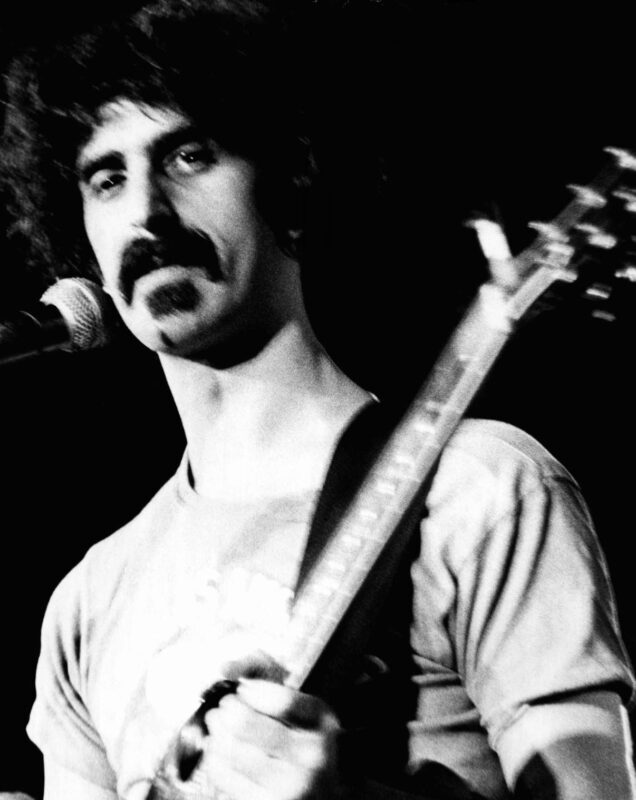
His guitar playing was always controversial within the broader context of his extraordinary compositional output. Guitar World noted that he was “incontestably one of the most interesting guitar soloists of all time” — but the complexity of his orchestral compositions and the satirical wit of his lyrics often overshadowed the guitar work in critical discussion. Those who listened carefully to the guitar specifically found something unusual: a bluesman who had absorbed the full vocabulary of R&B guitar and applied it in contexts that had nothing to do with blues, combined with the harmonic sophistication of someone who had studied twentieth-century orchestral composition, combined with a sense of humor that was more genuinely present in guitar solos than in any other guitarist’s work. The wah pedal was central to this — Zappa made brilliant use of a wah wah pedal, and was one of the few guitarists of the ’70s and ’80s to exploit the lower strings and fret positions to their full potential.
His later career embraced digital technology — specifically the Synclavier, which he used to compose and realize orchestral pieces that would have been prohibitively expensive or physically impossible with live musicians. The Synclavier’s ability to precisely execute complex rhythmic and harmonic material at any tempo, without the human limitations of timing inconsistency and physical fatigue, suited his compositional ambitions in ways that no human ensemble could. The final albums — Jazz from Hell (1986), The Yellow Shark (1993, recorded with the Ensemble Modern shortly before his death) — represent the fullest realization of his compositional vision. The guitar recedes in importance. The composition is everything.
The Rig: Frank Zappa’s Guitars, Amps, and Effects
Guitars
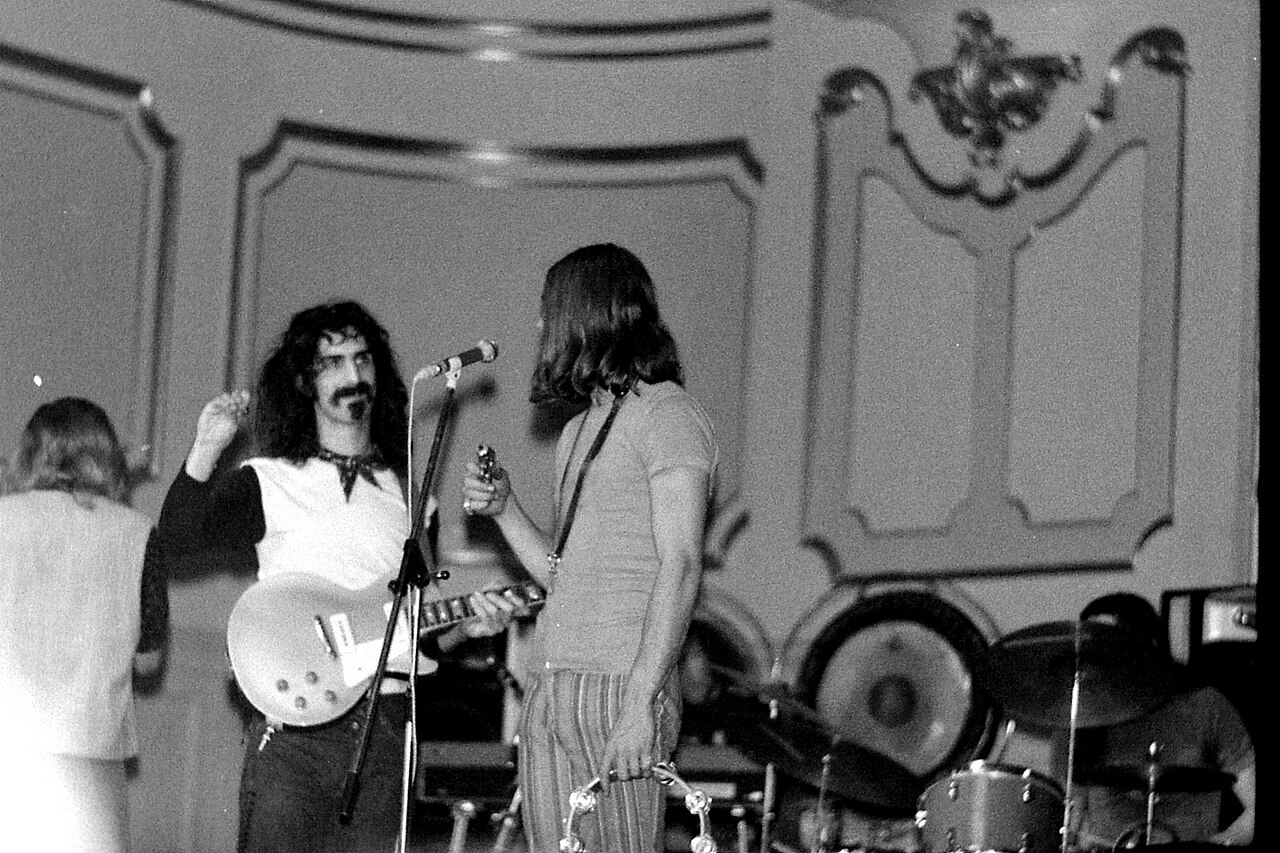
Frank Zappa primarily played Gibson SG style guitars. His most iconic guitar is likely his “Baby Snakes” SG which was a counterfeit Gibson guitar. He acquired Baby Snakes in the early 1970s and it remained one of his favorite guitars up until his death in 1993. The guitar is a custom-made SG copy — not an actual Gibson — acquired backstage in Phoenix from an unknown seller for $500. Though its feel is a lot like that of a Gibson SG, closer inspection reveals such non-Gibson details as a 23rd fret and some nifty inlays and ornamental woodwork. Luthier/electronics maker Rex Bogue — the man who Zappa also tasked to bring Hendrix’s charred Miami Pop Festival Strat back to life — added various delights to this guitar, such as phase switches and an onboard preamp. The onboard preamp provided up to 18dB of boost — an extraordinary amount, far beyond any conventional guitar electronics. This boost allowed Zappa to drive his amplifiers with a hot signal from the guitar itself rather than relying entirely on pedal-based gain stages, giving him specific control over the amp’s input saturation that conventional pickup output couldn’t achieve.
The “Roxy” SG saw action on 1974’s Roxy & Elsewhere record. This is why it got its nickname. “This is the same guitar used and pictured on the 1974 Roxy & Elsewhere album. Though the two non-stock switches on the guitar’s lower horn were present in the Roxy era, the guitar has been augmented since those days with a mirrored top and various preamps, phasing switches, and active-filter circuits.” Dweezil Zappa subsequently adopted the Roxy SG as his main guitar, inheriting not only the instrument but the specific sonic infrastructure his father had built into it. The mirror top is the most visually distinctive modification — not a tonal choice but an aesthetic one, reflecting stage lighting in patterns that matched the theatrical nature of Zappa’s live performances.
One of the most remarkable instruments in Zappa’s collection was a Fender Stratocaster that Jimi Hendrix had burned at the Miami Pop Festival in 1968 — not the famous Monterey Pop burning (a different guitar) but a separate burned instrument. Zappa made some modifications to a red Fender Stratocaster burned by Jimi Hendrix: Zappa put new pickups and a Performmance neck with the Gibson SG measures. This guitar was very feedbacky, so Zappa didn’t play it very often; but he used it several times in the studio. You can hear this guitar in the “Drowning Witch” and “Zoot Allures” solos. Rex Bogue was also the luthier who brought this guitar back to playing condition after the burning damage. Installed in one of Zappa’s Les Pauls and the Hendrix-burned Miami Stratocaster, as mentioned by guitar tech Arthur “Midget” Sloatman in this October 1995 Guitar Player interview — the Dan Armstrong-designed Green Ringer is “a low-pass filter into a DC rectifier circuit. Because it’s trying to convert AC to steady DC, it produces an abundance of a second harmonic.”
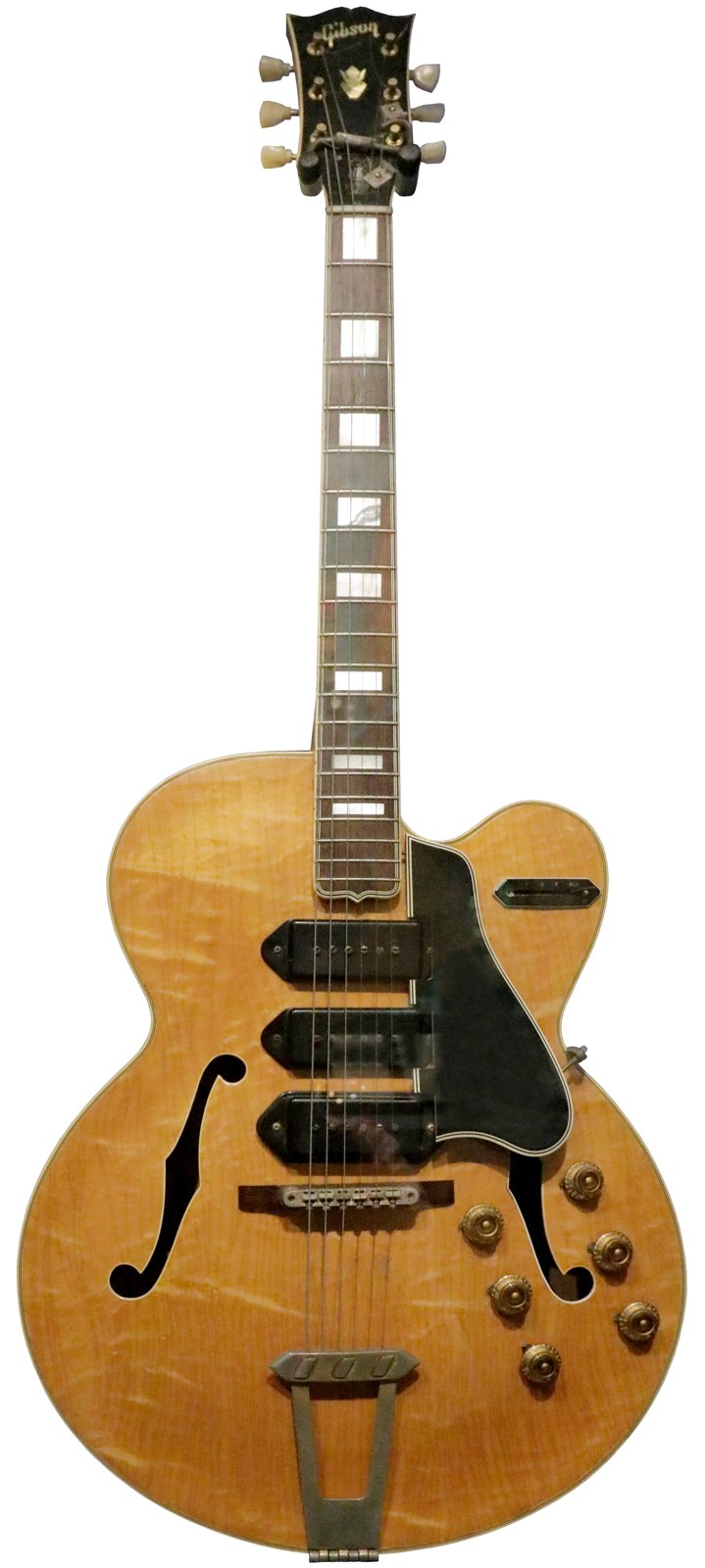
One of the most interesting guitars in Frank’s collection was the unusual Gibson ES-5 Switchmaster. This weird model was in production between 1955 and 1962. It’s not certain which year Zappa’s Switchmaster was produced. ES-5 is a fully hollow-body instrument with three pickups. The Switchmaster variant came with a total of six knobs. Each pickup had one volume and one tone control. Per his 1977 Guitar Player interview: “Besides the Switchmaster guitar — just a Fender Deluxe amp, that’s all.” The ES-5 Switchmaster represented the traditional jazz archtop heritage at the foundational stage of his career, before the heavily modified SG-style instruments became central to his live rig.
During the first 80s, Zappa’s main guitar was a red Gibson Les Paul Custom with DiMarzio pickups. This Les Paul Custom also housed the Dan Armstrong Green Ringer circuit alongside the DiMarzio pickups, providing the specific second-harmonic doubling effect that Zappa valued for sustain and tonal complexity. The Les Paul Custom’s mahogany/maple construction gave it a thicker, more sustaining tonal character than the SG, which suited specific recording applications where the SG’s characteristic brightness and mid-forward character was less appropriate.
One of Zappa’s most technically advanced instruments was his custom “Performance” guitar, built specifically for complex compositions. This guitar featured advanced electronics including parametric EQ circuits and multiple pickup switching options. The Performance guitar represented Zappa’s vision of what an electric guitar could become with proper engineering and modification. The Performance guitars — there were several — featured the parametric filtering and onboard EQ that Zappa’s interest in precise tonal control demanded. Where most guitarists use amplifier and pedal controls to shape their tone, Zappa wanted tone-shaping capability built into the guitar itself, allowing him to adjust frequency response from the instrument without changing amp or pedal settings.
The Dan Armstrong Green Ringer is not a pedal but a circuit installed inside Zappa’s guitars — specifically the Les Paul Custom and the Hendrix Stratocaster. The Dan Armstrong-designed Green Ringer is “a low-pass filter into a DC rectifier circuit. Because it’s trying to convert AC to steady DC, it produces an abundance of a second harmonic.” This second-harmonic doubling — the guitar signal combined with a frequency-doubled version of itself — gives the guitar a specific harmonic richness and sustain that differs from conventional distortion or overdrive. The Green Ringer doesn’t add gain; it adds harmonic content by doubling the fundamental frequency one octave up, creating a richer, more complex waveform.
Until that period, Zappa used to install Fender and Gibson pickups in his guitars; but, from the first 80s, he tended to search more specific tones, and he started replacing the original pickups by DiMarzio. The DiMarzio replacements — installed in the Les Paul Custom, in Stratocasters, and in other instruments — provided the higher output and more aggressive tonal character that suited his increasingly complex live rig. DiMarzio’s specific pickup designs — the Super Distortion, the PAF, the FS-1 — each provided distinct tonal characters that Zappa selected based on the specific requirements of each guitar’s role in his setup.
Amps
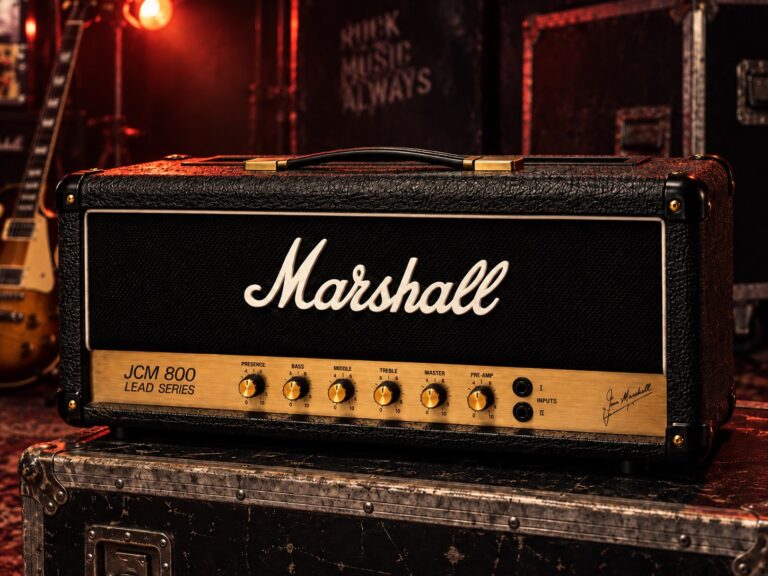
Zappa primarily used Marshall JMP 2203 Mk II amplifiers (100-watt heads) from 1974-1984. This stock, mid-Seventies 100-watt Marshall JMP head was a mainstay in Zappa’s setup from 1974 on through the 1979-84 tours. The Marshall JMP 2203 is the master-volume version of the classic Marshall JMP series — featuring the master volume control that allows the amp’s preamp to be driven hard (for gain and saturation) while the master volume controls overall output level. This capability — driving the preamp without necessarily driving the power amp to maximum — gave Zappa the specific preamp saturation character of the classic Marshall at controlled stage volumes.
The Fender Deluxe was Zappa’s primary amplifier for the Freak Out! recordings — the early period when the ES-5 Switchmaster was his main guitar and the setup was, by later standards, simple. The Deluxe’s specific character — the warm, American tube tone of a small Fender combo — provided the foundation for the early Mothers of Invention recordings before the Marshall-centered live rig became established.
This era featured the introduction of the Pignose amplifier that became central to his signature sound. The Pignose — a small, battery-powered practice amplifier not intended for professional use — was used by Zappa for its specific tonal character when pushed: the small speaker’s response to being overdriven, the specific compressed, saturated quality that a tiny amp produces when asked to do more than it was designed for. This approach — deliberately using “wrong” equipment because it produces a tonally interesting result — is characteristic of Zappa’s experimental approach to gear selection.
The New England Digital Synclavier was not a guitar or an amplifier but a complete digital audio workstation — the most sophisticated and most expensive music computer available in the early 1980s. Zappa used it first for its sample-replay capabilities (recording orchestral instruments and replaying them in precisely notated compositions) and then for its direct digital synthesis capabilities. The Synclavier allowed him to compose orchestral music of arbitrary complexity and realize it without hiring orchestral musicians — practically necessary for compositions whose rhythmic complexity would have required hundreds of hours of rehearsal time from even the finest professional ensembles. Jazz from Hell (1986) and the Synclavier compositions that appear throughout his late career represent the fullest realization of his compositional vision, freed from the human limitations of live performance.
Effects
The wah pedal is the single effect most clearly and consistently associated with Frank Zappa’s guitar sound across his entire career. He made brilliant use of a wah wah pedal, and was one of the few guitarists of the ’70s and ’80s to exploit the lower strings and fret positions to their full potential. Where most guitarists use the wah as a sweep device — rocking the pedal through its range to produce the “wah” filter sweep — Zappa used it as a fixed or slowly modulated filter, often parking it at a specific position in its travel to use the wah’s circuit as a tone control rather than a dynamic sweep. This “parked wah” approach gave his guitar tone a specific midrange presence — the “sinus condition” quality Guitar World described — that was entirely different from the obvious wah-wah effect.
Frank devised a way to make that happen by fitting his guitars with onboard preamps that put drastic EQ control at his fingertips, and kicked out a ridiculous amount of boost — up to 18dB. These onboard preamps — built by Rex Bogue and subsequently by other builders — were installed inside the guitar bodies, accessible via controls on the guitar’s surface. An 18dB boost is a six-times increase in signal amplitude — far beyond the few dB that most onboard active systems provide. This extraordinary boost level allowed Zappa to drive his amplifiers’ input stages into saturation from the guitar itself, without relying on external pedal-based gain stages.
Phase-reversal switches — installed in Baby Snakes, the Roxy SG, and other instruments — allowed Zappa to switch individual pickups out of phase with each other, producing the characteristic hollow, quacking tonal quality that out-of-phase pickup combinations create. These were guitar-integrated rather than pedal-based, giving him instant phase access without footswitch operation.
The active filter circuits — parametric EQ built into the guitar’s electronics — provided continuous frequency shaping from the instrument itself. Unlike passive tone controls that can only cut frequencies, active filters can boost or cut specific frequency ranges with precision, giving Zappa the ability to sculpt his guitar’s frequency response at the source before the signal reaches any amplifier or external effect.
He played also a Stratocaster with DiMarzio pickups, a Floyd Rose and a little electronic system specially designed to evaluate the quantity of feedback that a concrete hall could generate, and, with a little preamp/eq adjustment, control this parameter. This feedback evaluation and control system — which analyzed the acoustic properties of each venue and allowed Zappa to adjust his guitar’s electronics to control how the hall’s acoustic environment interacted with his instrument — is one of the most technically sophisticated applications of electronics to guitar performance in the instrument’s history. Most guitarists control feedback by volume and distance from the amplifier; Zappa analyzed the specific acoustic properties of each hall and adjusted the guitar’s frequency response to control the feedback precisely.
Playing Style & Tone Philosophy
Frank Zappa’s guitar playing style is the most difficult to describe in this series of one hundred guitarists, because it is simultaneously blues-rooted and deliberately anti-blues, technically grounded and often deliberately uncommitted to conventional guitar technique values, deeply connected to the R&B tradition he absorbed as a teenager and perpetually skeptical of any tradition’s claim to authority. He was a composer first — the guitar was an instrument he played with genuine distinction, but always in the context of a musical intelligence that was organizing the guitar’s contribution to a larger compositional whole. This is different from how most of the players in this series relate to their instrument.
The blues foundation is real and specific. His early guitar heroes were R&B players — the Eastside Los Angeles scene, Johnny “Guitar” Watson, Guitar Slim, the full vocabulary of electric blues guitar absorbed in his teens. This vocabulary is audible in his guitar work throughout his career: the bends, the vibrato, the phrase construction, the wah pedal application all derive from the blues tradition even when the musical context is entirely unlike the blues. He approaches the guitar as a blues musician who happens to be composing atonal orchestral pieces, which produces a guitar style unlike anything in either tradition.
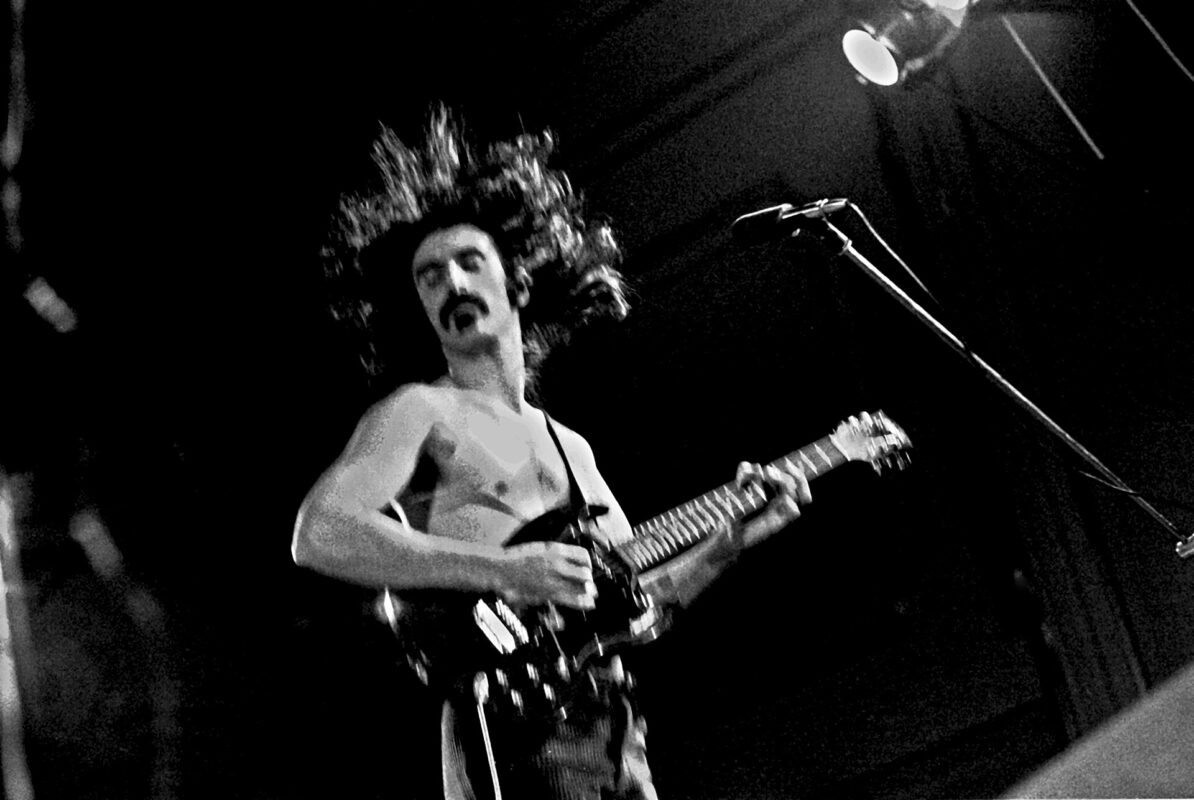
His approach to improvisation is worth examining specifically because it is different from every other major rock guitarist in this series. Most players improvise by deploying learned patterns — the pentatonic scale runs, the blues licks, the arpeggio sweeps that become familiar from practice — in response to the harmonic and rhythmic context of the song. Zappa improvised differently: “I record the solos as I play them. And it seems that what happens in a solo is kind of a spontaneous composition. Whatever I play is a composition as it comes out of my fingers.” This is not the same as playing patterns; it is constructing melodic and rhythmic relationships in real time, with each note chosen for its relationship to what came before and what the harmonic environment requires. The compositions that resulted — audible across his dozens of live albums — have a specific quality of actual musical thinking rather than pattern deployment, which is why they remain interesting decades after they were played.
The humor in his guitar playing is specific and intentional. Guitar solos in which a serious technical passage suddenly gives way to a deliberately comic phrase, or where the phrasing suggests specific conversations or emotional states, are characteristic of his approach. This is not a failure to be serious; it is the serious application of compositional intelligence to the guitar solo’s emotional and communicative possibilities. The guitar solo as joke, the guitar solo as conversation, the guitar solo as commentary on the song it appears in — these are compositional approaches, not random improvisational gestures. He described his solos as compositions even when improvised: each note chosen for its specific relationship to the surrounding musical material rather than as the output of learned pattern-deployment.
His tone philosophy was systematic and technical rather than aesthetic. The onboard preamps, the feedback control systems, the phase switching, the Green Ringer circuit — each of these was an engineering solution to a specific sonic problem. The problem was always: how do I get the specific sound that the specific musical moment requires, with maximum control and minimum unpredictability? The guitar engineer and the guitar composer were the same person, working on the same instrument to the same compositional end.
How to Sound Like Frank Zappa
Approximating Zappa’s guitar tone is complicated by the extreme modification of his instruments — the onboard preamps, the active filters, the phase switches are all inside the guitar, not in the signal chain. The fundamental character, however, is accessible from more conventional starting points.
Guitar: A Gibson SG — preferably older and with the SG’s characteristic thin mahogany body and dual humbucker brightness — is the most authentic starting point for the Baby Snakes character. Any SG with medium-to-high output humbuckers.
Amp: A Marshall JMP or JCM 800 at working volume — the preamp driven moderately, the master volume used to control output level. The Marshall’s specific high-midrange character and natural preamp saturation are the foundation of the 1970s-1980s Zappa tone.
Amp Settings (Marshall JMP or JCM 800):
| Control | Setting (0–10) | Notes |
|---|---|---|
| Preamp Volume | 7–9 | Working hard — Zappa drove the input with the onboard preamp |
| Master Volume | 4–6 | Controls output level separately from preamp drive |
| Bass | 4–6 | Moderate — SG’s thin body doesn’t need bass emphasis |
| Mid | 6–8 | Forward — the “sinus condition” quality lives in the mids |
| Treble | 5–7 | Present — SG brightness needs treble support |
| Presence | 5–7 | Adds the cutting quality in ensemble contexts |
Wah pedal: The Dunlop Cry Baby or any quality wah. The Zappa approach: use it parked at a specific position (approximately 1/3 of the way through the sweep, emphasizing the lower-mid frequency range) rather than continuously rocking it. This “parked wah” position filters the guitar’s frequency response continuously, adding the specific nasal, mid-forward quality that defines his tone. Rock it occasionally for dramatic effect; leave it parked for the characteristic Zappa guitar voice.
Influence & Legacy
Frank Zappa’s influence on guitar playing operates primarily through his example of treating the guitar as a component in a complete compositional system rather than as the primary expressive vehicle of a career. Most guitarists in this series are guitarists who also compose and record; Zappa was a composer and bandleader who also played guitar with genuine distinction. The distinction matters because it produces a different relationship with the instrument — the guitar serves the composition rather than the composition serving the guitar’s display.
His specific influence on guitar technology is significant: the onboard preamp approach he pioneered — active electronics in the guitar itself for gain, EQ, and tonal shaping — has become standard in contemporary high-end guitar design. Active guitars from EMG, Fishman Fluence, and other manufacturers all owe something to Zappa’s and Rex Bogue’s early experiments with active guitar electronics. The feedback control system — analyzing a venue’s acoustic properties and adjusting the guitar’s signal to manage feedback — anticipates the sophisticated acoustic environment management that contemporary professional guitarists use.
For context on where Zappa fits in the experimental rock guitar tradition, the comparison with Jimi Hendrix’s approach to guitar as sonic experiment is the most direct parallel — Zappa literally owned one of Hendrix’s burned guitars and considered Hendrix among the most significant influences on his electric guitar work. Both pushed the guitar’s sonic boundaries; Hendrix through performance and feel, Zappa through engineering and compositional intelligence.
The comparison with Tom Morello’s approach to guitar as sonic experiment illuminates the generational transmission: Morello’s systematic exploration of unconventional guitar sounds — using the guitar as a synthesis and noise source rather than a tone-production device — draws from the same experimental tradition that Zappa explored in the 1970s and 1980s, applied to a different musical context.
And the comparison with Les Paul’s foundational instrument innovation shows the tradition of guitarist-as-inventor that Zappa inhabits — both men approaching the guitar’s technical possibilities as engineering problems to be solved rather than limitations to be accepted. Les Paul invented multitrack recording and the electric solid-body guitar as a studio tool; Zappa built active preamps into his instruments and designed feedback control systems for venue-specific acoustic management. Both understood that the instrument is not finished when the manufacturer ships it.
Frank Zappa died on December 4, 1993. Baby Snakes — the $500 backstage purchase in Phoenix — is presumably in the Zappa Family Trust’s archive. The Roxy SG is in Dweezil’s hands, who has adopted it as his primary instrument. The Hendrix Stratocaster has been sold at auction. The Synclavier compositions still play. And the wah pedal, parked at approximately a third of its travel, is still producing the specific nasal, mid-forward frequency emphasis that Guitar World called “a gander with a bad sinus condition.” It remains one of the most honest and specific compliments ever paid to a guitarist’s tone.
His congressional testimony in 1985 — delivered to the Senate Commerce Committee during the PMRC hearings on music content labeling — is relevant to any discussion of Zappa’s cultural position, including his guitar playing. The hearing was about whether popular music lyrics should carry warning labels. Zappa argued against such labeling with specific constitutional arguments, comparing the proposed system to “treating dandruff by decapitation.” He sat alongside Dee Snider of Twisted Sister and John Denver in what remains one of the stranger Senate Commerce Committee hearings in the body’s history. The testimony demonstrated the full range of what Zappa was: a musician who also read the Constitution, argued constitutional law, composed orchestral works, and played guitar solos that sounded like geese in distress. The breadth is genuinely unusual. Most rock musicians are rock musicians. Zappa was a complete intellectual engagement with the world who also happened to play electric guitar in configurations that included a Green Ringer circuit installed inside the body.
His influence on the culture of experimental and progressive music — beyond the guitar community specifically — is one of his most important legacies. The composers who acknowledge Zappa’s influence include figures across classical, jazz, rock, and electronic music traditions, because his work existed in none of these categories specifically and all of them simultaneously. The guitar was one tool through which he expressed this cross-genre compositional intelligence. The Synclavier was another. The Mothers of Invention were a third. The congressional testimony was a fourth. All of it was Frank Zappa: the systematic mind applied to whatever the moment required.
Zappa’s guitar discography — the specific recordings where his playing is most fully realized — includes the live albums that document his touring bands at their best: Roxy & Elsewhere (1974), Zappa in New York (1978), Shut Up ‘n Play Yer Guitar (1981, three volumes of guitar solos drawn from live performances), Make a Jazz Noise Here (1991), and the Läther box set. Shut Up ‘n Play Yer Guitar is the most specific documentation: three volumes of nothing but guitar solos, extracted from live recordings across multiple tours, arranged sequentially to demonstrate the range and consistency of his improvised compositional approach. Listening to these records, the specific quality of his guitar becomes unmissable — the wah’s specific parked position, the onboard preamp’s drive into the Marshall, the Green Ringer’s harmonic doubling, the humor, the blues vocabulary applied in contexts that have nothing to do with blues. This is what Frank Zappa’s guitar sounds like. It sounds like nothing else that has ever been played on an electric guitar.
The book Zappa Gear — an official Zappa Family Trust publication lavishly illustrated with over 180 photographs of Frank Zappa’s guitars and equipment taken at UMRK studio in LA — is the definitive documentation of his instrument collection. Its existence reflects how seriously the guitar-equipment dimension of his work is taken by the people who knew him and his work best. A foreword by Dweezil Zappa frames the documentation of the instruments with the context of what they meant musically. The book is not a catalog of collectibles; it is a documentation of a sonic laboratory’s contents. Each instrument in the collection served a specific function. Each modification addressed a specific musical requirement. Baby Snakes is in there. The Hendrix Strat is in there. The ES-5 Switchmaster is in there. And the photographs, taken at the home studio where Zappa spent his final years composing on the Synclavier, show them in their natural environment: instruments in the service of an inexhaustible compositional intelligence, used until they were needed no longer.
Frequently Asked Questions: Frank Zappa Guitars & Gear
What guitar did Frank Zappa play?
Frank Zappa’s primary guitar was the “Baby Snakes” SG — a counterfeit Gibson SG acquired backstage in Phoenix for $500 from an unknown seller, which remained his main performance guitar from the early 1970s until his death in 1993. The guitar was heavily modified by luthier Rex Bogue with phase switches, an onboard preamp providing up to 18dB of boost, and a 23rd fret not present on actual Gibson SGs. His other major guitars included the “Roxy” Gibson SG (used on the 1974 Roxy & Elsewhere album, with a mirror top added later), a Fender Stratocaster that Jimi Hendrix had burned at the Miami Pop Festival (modified with new pickups and a Performance neck), a red Gibson Les Paul Custom with DiMarzio pickups (his primary early 1980s guitar), and the Gibson ES-5 Switchmaster used on his first albums.
What amplifiers did Frank Zappa use?
Frank Zappa’s primary stage amplifier from 1974 through the 1979-1984 tours was a stock mid-1970s Marshall JMP 2203 MkII 100-watt head. This master-volume Marshall allowed the preamp to be driven hard for saturation while the master volume controlled output level. His earliest significant amplifier was a Fender Deluxe, used for the Freak Out! recordings with the ES-5 Switchmaster. He also used a Pignose small battery-powered amplifier for specific applications where its overdriven character suited the music, and later adopted various professional amplification systems as his rig became more complex.
What is the Dan Armstrong Green Ringer?
The Dan Armstrong Green Ringer is an electronic circuit designed by Dan Armstrong that was installed inside Frank Zappa’s guitars — specifically his Les Paul Custom and the Hendrix-burned Stratocaster. It is a low-pass filter feeding into a DC rectifier circuit. Because the rectifier attempts to convert AC audio signal to steady DC, it produces an abundance of the second harmonic — a frequency doubling effect that adds harmonic richness and sustain to the guitar’s signal. The effect is not conventional distortion or overdrive; it adds harmonic content at double the fundamental frequency, creating a richer, more complex waveform. The Green Ringer was installed inside the guitar rather than as an external pedal, giving Zappa access to it without changing his footboard setup.
What was Zappa’s relationship with the Synclavier?
Frank Zappa adopted the New England Digital Synclavier — an early digital audio workstation — in the early 1980s as a compositional tool that could realize his most complex orchestral ideas without the human limitations of live musicians. The Synclavier could execute music of arbitrary rhythmic and harmonic complexity at any tempo, precisely as notated, without timing variation or fatigue. Zappa used it for sample-replay composition (recording orchestral instruments and reprogramming them in new contexts) and for direct digital synthesis. Jazz from Hell (1986) was composed and realized entirely on the Synclavier. The Yellow Shark (1993), recorded with the Ensemble Modern shortly before his death, brought the Synclavier compositions into live performance for the first time.
What was the “Baby Snakes” SG?
“Baby Snakes” was Frank Zappa’s primary guitar — a counterfeit Gibson SG acquired backstage at a Phoenix concert in the early 1970s for $500 from an unknown seller. Despite being a copy rather than an actual Gibson, it served as Zappa’s primary performance guitar for approximately two decades. Luthier Rex Bogue modified it extensively: adding a 23rd fret (not present on real Gibson SGs), phase switches, and an onboard preamp providing up to 18dB of boost. The guitar’s name comes from the title of Zappa’s 1979 concert film. It is often described as Zappa’s most iconic guitar, and its origins — a $500 backstage purchase of an undocumented counterfeit — are characteristic of Zappa’s indifference to provenance and his focus on functional sonic quality.
Did Frank Zappa own Jimi Hendrix’s burned guitar?
Yes, though not the famous Monterey Pop Festival burning. Frank Zappa owned a Fender Stratocaster that Jimi Hendrix had burned at the Miami Pop Festival in 1968 — a separate guitar-burning event from the more famous Monterey incident. Luthier Rex Bogue — who also extensively modified Baby Snakes — restored the Miami Stratocaster to playing condition. Zappa then modified it further with new pickups, a Performance neck sized to the same specifications as his Gibson SG neck, and the Dan Armstrong Green Ringer circuit. The guitar was reportedly very feedback-prone and was used selectively — it can be heard on “Drowning Witch” and “Zoot Allures” solos. It was later sold at auction.
What made Zappa’s guitar tone unique?
Frank Zappa’s guitar tone was shaped by several specific elements: the wah pedal parked at approximately one-third of its travel (producing a fixed mid-range frequency emphasis rather than the obvious sweep effect — Guitar World called the result “a gander with a bad sinus condition”), onboard preamps providing up to 18dB of boost that drove Marshall amplifiers harder from the guitar’s own signal, the Dan Armstrong Green Ringer circuit adding second-harmonic doubling to specific guitars, phase switches that could reverse pickup polarity for the characteristic hollow out-of-phase quality, and an overall approach of treating the guitar’s electronics as a system to be engineered rather than accepted as delivered. His blues-based phrasing applied in non-blues contexts, combined with these engineering choices, produced a tone of genuine distinctiveness.
Image credits
- Frank Zappa: ThomasFHH, Wikimedia Commons, CC BY-SA 4.0.
- Top image: Fotopersbureau De Boer, Wikimedia Commons, CC0.
- Frank Zappa: photo by Jay L. Handler, public domain, via Wikimedia Commons.
- Frank Zappa: photo by Heinrich Klaffs, via Wikimedia Commons, CC BY-SA 2.0.
- Marshall JCM800 2203: GuitarGangsters AI-generated reference illustration, not a photograph.
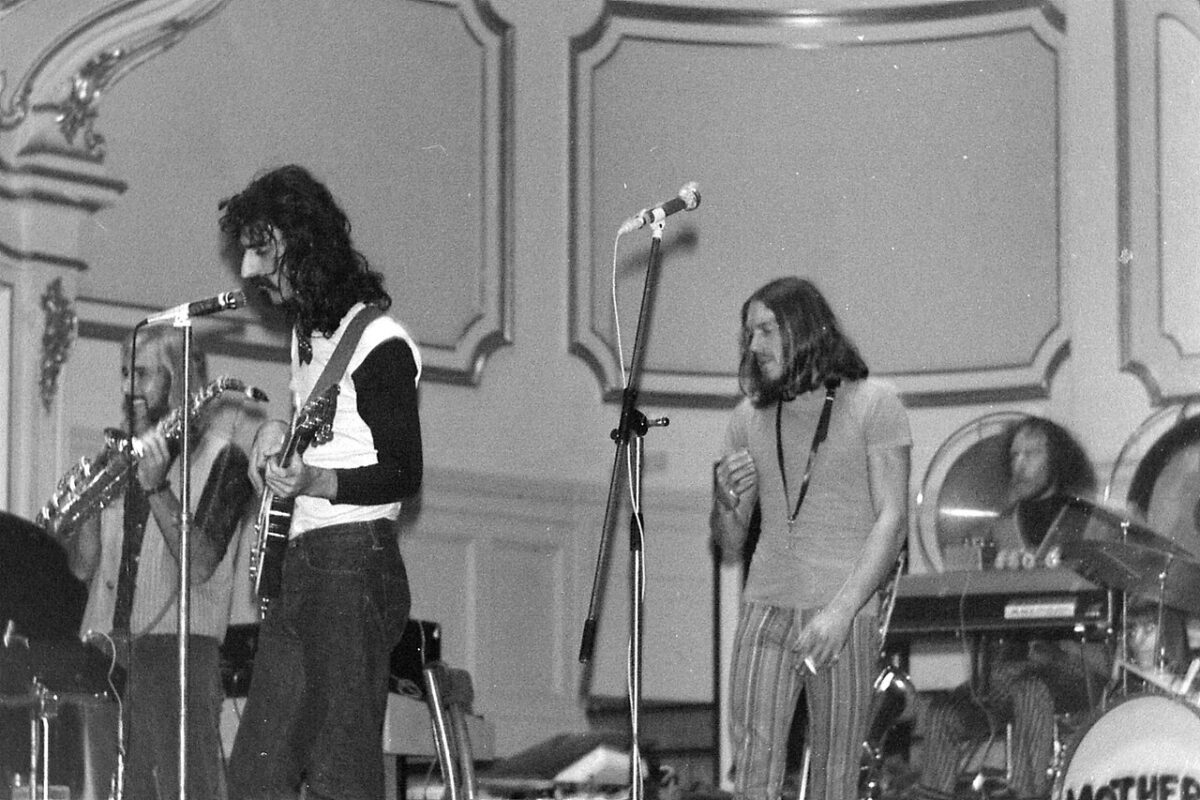
- Frank Zappa live: ThomasFHH, Wikimedia Commons, CC BY-SA 4.0.
- Gibson ES-5 Switchmaster: Claude Humbert, derivative work, Wikimedia Commons, CC BY-SA 4.0.