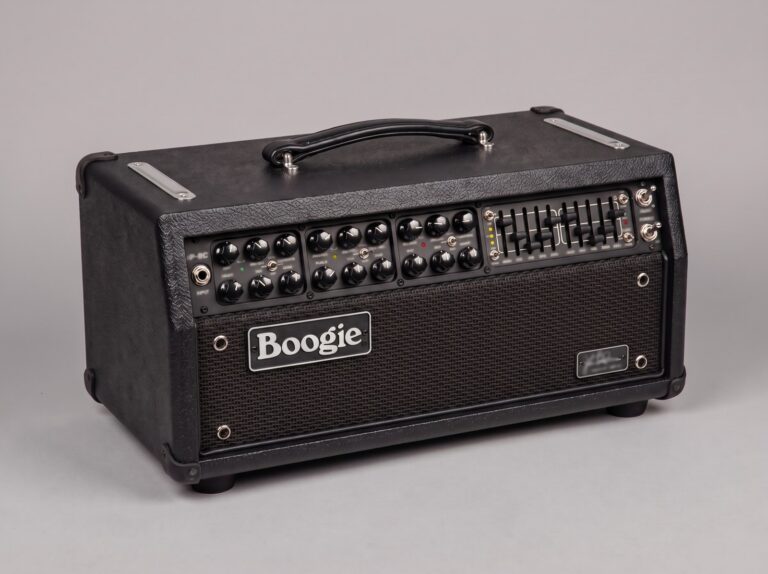
One Box, Six Modes, Zero Excuses: The Mesa/Boogie Mark Five: 35 Combo
The Mesa/Boogie Mark Five: 35 Combo packs six modes and 35W of EL84 power into one hand-wired 1×12 box. Full specs, tone recipes, and used buying guide.
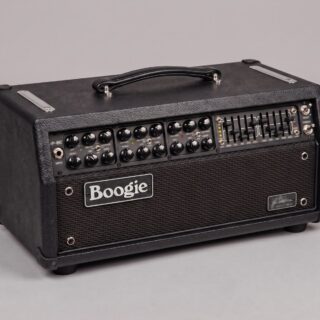
There is a particular kind of satisfaction in walking into a rehearsal with one amp, one cable, and nothing else — no extension cab, no speaker switcher, no hand truck. The Mesa/Boogie Mark Five: 35 Combo exists for that guitarist. It packs the same two-channel, six-mode, 35/25/10-watt EL84 circuit as the standalone head into a single marine-grade Baltic birch cabinet with a Celestion Custom 90 loaded and ready, a CabClone direct output for the soundman or the headphones, and a four-button footswitch tucked behind the grille. You plug in. You play. The amp handles the rest.
That sounds simple. It is not simple. The Mark Five: 35 Combo is one of the most complex pieces of hardware in the under-twenty-inch combo format — a hand-wired, fan-cooled, relay-switching machine with twenty-two relays counted inside the chassis, three PCBs worth of Mesa circuitry, and a preamp section that traces its lineage directly to the Mark IIC+ that powered the recording of Master of Puppets. The word “combo” implies modest. This one is not.
Origin: What the Mark Five: 35 Is and Where It Came From
Randall Smith built the first Boogie out of a Fender Princeton in the late 1960s, stuffed a 100-watt power section into it as a joke, and handed it to Carlos Santana to play. Santana was staggered. Smith began selling the modification, then the instrument, and the Mark Series — each generation a refinement of that original high-gain preamp topology — became the defining technical platform of melodic rock lead tone across four decades.
The Mark V was the culmination of that lineage: three channels, nine modes, 10/45/90 watts of Simul-Class 6L6 power, a bewildering rear panel, and a reputation for needing a flow chart to set up. Beautiful amp. Not the simplest first encounter.
In 2014–2015, Mesa took a different approach. Rather than scaling down the Mark V’s complexity, they rebuilt the preamp — same six modes, same channel-independent GEQ, same Mark IIC+ and Mark IV voice algorithms — and paired it with a new EL84 power section. The result was the Mark Five: 25 (two EL84s, 25/10 watts) and, in November 2015, the Mark Five: 35: four EL84s, 35/25/10 watts, larger transformers, long-spring reverb per channel, and the same CabClone direct output. The 35 head launched at $1,599. The combo appeared alongside it at $1,799 — two hundred dollars more, because you were getting the 1×12 cabinet and the Celestion Custom 90 included.
Both the head and the combo are now listed on Mesa’s legacy site subdomain, meaning they are officially discontinued. The used market is where you find them, and that is where the value argument lives. For a full circuit deep-dive — every mode, all the switching architecture, the Mid/Boost control’s dual role, the CabClone voicings — see the Mark Five: 35 Head article. This article focuses on what changes when the chassis goes into a box.
Specifications
| Format | 1×12 Combo |
|---|---|
| Announced | November 6, 2015 |
| Status | Discontinued (legacy.mesaboogie.com) |
| Channels | 2 |
| Modes | 6 (Ch1: Clean / Fat / Crunch; Ch2: Mark IIC+ / Mark IV / Extreme) |
| Power | 35 / 25 / 10W Multi-Watt, channel-assignable |
| Power Tubes | 4× Mesa EL84 (Fixed Bias, Dyna-Watt) |
| Preamp Tubes | 6× Mesa 12AX7 |
| Rectifier | Silicon diodes (no tube option) |
| Speaker | 1× 12″ Celestion Custom 90 (8 Ω) |
| GEQ | 5-band (footswitchable, per-channel assignable) |
| Reverb | All-tube, long-tank spring; independent rear-panel per-channel |
| FX Loop | Fully buffered series |
| CabClone | Built-in; Open Back / Vintage / Closed Back voicings; internal load; speaker on/off; ground lift; headphone output; XLR out |
| Solo | Footswitchable, channel-independent; wired parallel with channel Master |
| Footswitch | 4-button included (Ch1/Ch2 / EQ / Solo Ch1 / Solo Ch2) |
| Speaker Outputs | 1× 8Ω, 2× 4Ω |
| Dimensions | 18⅛” H × 18¾” W × 11½” D |
| Weight | 44 lbs |
| Cabinet | Marine-grade Baltic birch; Black Taurus or Black Bronco vinyl; Black Jute grille |
| Construction | Hand-wired, fan-cooled, Petaluma, California |
| Launch Price | $1,799 / £1,949 / €2,790 |
| Used Price (2026) | ~$850–$1,200 |
The Speaker: Celestion Custom 90, Not a Vintage 30
The first thing that surprises guitarists who pick up a used Mark Five: 35 Combo after years of running heads into external cabs loaded with Vintage 30s is the speaker. The combo ships with a Celestion Custom 90 — the same driver Mesa branded for years as the “Black Shadow.” It is a 12-inch, 8-ohm, 90-watt speaker, and it sounds nothing like a Vintage 30.
The Vintage 30 is a mid-forward, slightly compressed speaker with a characteristic 2–3 kHz presence peak that pushes rock lead tones out of a mix and adds bloom to the low mids. It has 60 watts of power handling and a ceramic magnet. The Custom 90 is a different animal entirely: 90 watts, ceramic magnet, linear midrange response, extended high-frequency clarity, and a tighter, more controlled low end. Where the Vintage 30 flatters and colours the signal, the Custom 90 resolves it. You hear the amp’s topology more clearly. The IIC+ mode’s ragged treble edge comes through intact; the Clean mode’s blackface headroom is audible rather than compressed into warmth. For some players this is exactly what they want. For players who expected Vintage 30 character, it can sound clinical at first.
There is a practical consequence: the Custom 90 handles the amp’s full 35 watts with room to spare — it was specced at 90 watts for a reason. You can push the power section into saturation in the 35-watt Pentode setting without the speaker getting confused. The Vintage 30 in a head’s external cab can be driven harder into its own contribution to the tone, but it also compresses earlier. Neither is wrong; they are different instruments.
One note for used buyers: Mesa offered limited-edition finish variants of the combo — British Cabernet, Wine Taurus, certain special-order configurations — that came with a Celestion Vintage 30 instead of the Custom 90. This is not documented on a single spec sheet in one place; it is scattered across dealer listings. If you are buying used and the speaker matters to you (it should), ask the seller to open the back and read the speaker label before you wire the money.
Famous Players: What the Mark Series Actually Sounds Like on Record
Mesa’s own marketing for the Mark Series — across every generation — has always leaned on the same names: Carlos Santana, James Hetfield, Larry Carlton. All three are genuine Mark Series players. None of them is documented playing a Mark Five: 35 Combo. Here is what actually happened with each.
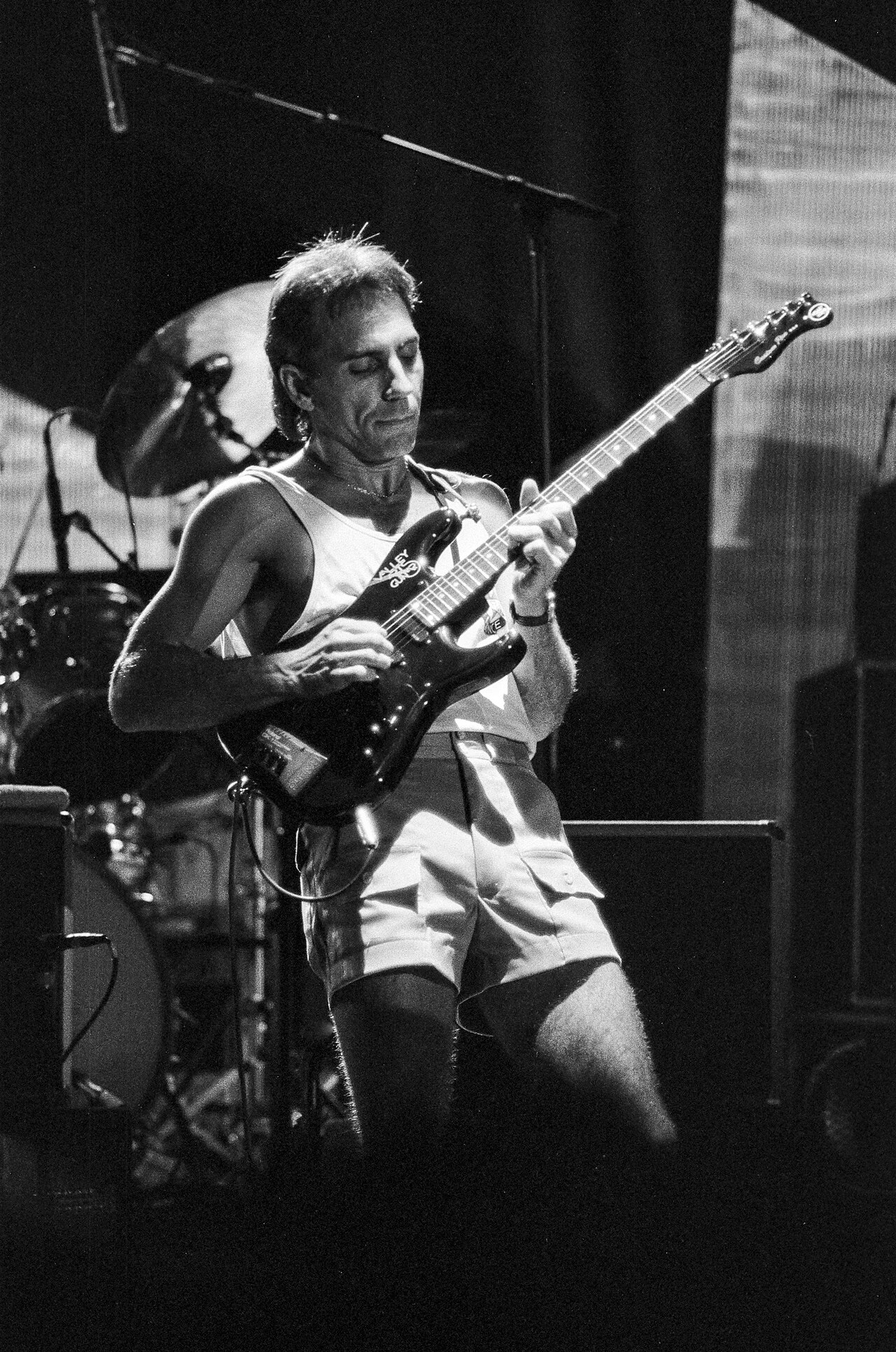
Santana’s famous Mark Series tone — the violin-like sustain, the compressed warmth — came from a modified Mark I Princeton chassis, the direct ancestor of the Series. He played a 1969 Gibson SG Special into a prototype Boogie combo. That amp was decades removed from the Mark Five: 35 in circuit, but the preamp philosophy is a direct descendant. The Mark Five: 35’s Clean mode on Channel 1 chasing Santana’s tone is a legitimate exercise; the IIC+ mode is not what you want for it.
Hetfield’s iconic distorted rhythm sound on Master of Puppets (1986) and …And Justice for All came from Mesa/Boogie Mark IIC+ heads — the specific circuit mode that lives in this amp’s Channel 2. The Mark Five: 35’s IIC+ mode is Mesa’s attempt to replicate that voicing in the current architecture: edgier upper midrange than the Mark IV mode, less bass looseness than Extreme, the characteristic “scream” that defined late-1980s high-gain lead. Whether the EL84 power section delivers the same density as the IIC+’s 6L6 output stage is a genuine question; the answer is that it is close in voicing, slightly tighter and more compressed in feel. Hetfield himself has no documented history with EL84 Mesa amplifiers. He has remained on 6L6 heads throughout his career.
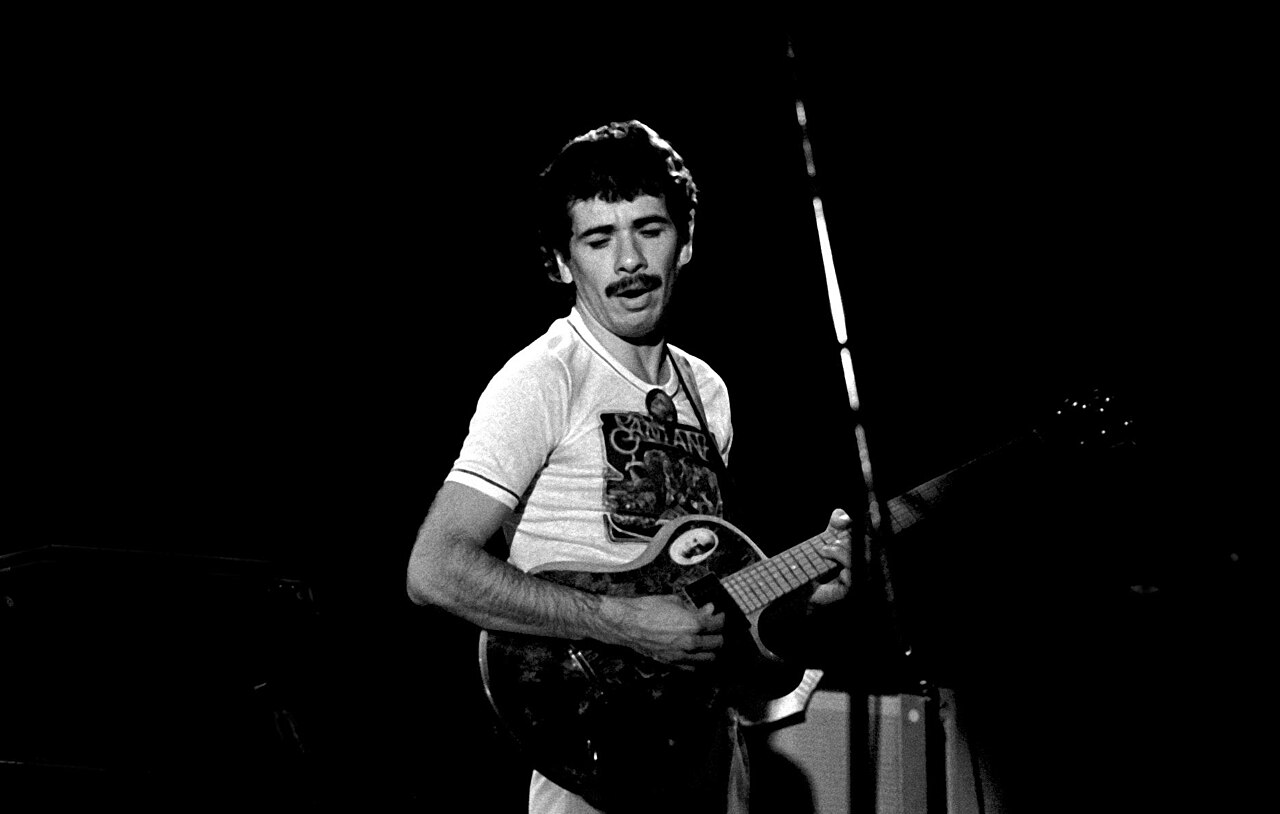
Larry Carlton‘s “Room 335” tone — the semi-hollow ES-335 through a Mark I — is one of the most referenced Boogie sounds in jazz-fusion history. Carlton moved to Dumble amplifiers in the 1980s and has not been publicly associated with any Mark Five product. His name appears on Mark Series promotional material as a legacy player, which it is. The Mark Five: 35’s Clean and Fat modes on Channel 1 are credible tools for Carlton-adjacent territory; the amp will not conjure a Dumble.
Steve Lukather of Toto has a documented long-term relationship with Mesa/Boogie amplifiers, stretching from the Mark II era through the 1980s and into more recent decades. His specific association with the Mark Five: 35 Combo in particular — as opposed to the broader Mark line or Roadster heads — has not been established in primary sources. He is a legitimate point of reference for the Mark Series’ studio precision and the way the GEQ’s 750 Hz band shapes a lead tone in a dense pop-rock arrangement. Whether he played this exact model is a different question.
John Petrucci‘s situation is the most nuanced: he visited the Mesa factory in April 2014 and played through a Mark Five: 25 prototype. Mesa’s own Amplitudes blog documented the session with settings published. His touring rig is the JP-2C — a purpose-built signature head derived from the Mark IIC+ preamp — rather than any Mark Five product. The connection is documented and real; the touring rig claim is false.
The verified Tone Sessions players from the head’s launch — Paul Waggoner and Dustie Waring of Between the Buried and Me, John Browne of Monuments, Angel Vivaldi, Nick Johnston — all used the head format during those Mesa-sponsored sessions. None documented the combo specifically. This is consistent with touring players’ preference for heads with matching cabs; the combo format is primarily a studio and rehearsal tool at this level of the market.
Tone Recipes and Settings
1. Blackface Clean (Channel 1, Clean Mode)
This is the Mark Five: 35 Combo’s most accessible voice and the one that benefits most from the Custom 90’s linearity. Set Channel 1 to Clean. Power at 35 watts. Gain at 3. Treble at 6, Mid at 4, Bass at 5, Presence at 5. Master at your room volume. GEQ flat. Let a Telecaster or Strat do the talking. The Custom 90’s extended high end and tight low end translates the blackface character without adding the artificial warmth of a Vintage 30 — you get the clean’s actual character rather than a speaker-coloured version of it. For pedals: a clean boost or transparent overdrive (Klon-style, Timmy) into this setting gives you push without losing the headroom.
2. Touch-Sensitive Crunch (Channel 1, Fat Mode)
Fat mode raises the midrange and adds subtle drive while keeping the response extremely dynamic. Gain at 5. Mid/Boost at 4 (below the 5-threshold, so it functions as a conventional mid control). Treble at 6, Bass at 4, Presence at 6. Master at performance volume. GEQ: push the 750 Hz slider to +3. Guitar volume at 7 gives you a tight crunch; at 10, the preamp opens into a forward, singing gain. This is the combo’s blues-rock mode — not IIC+ shred, not Fender clean, but the wide band in between that most professional rock records live in. The long-tank spring reverb at 4 on Channel 1’s rear-panel control adds room without washing the pick attack.
3. IIC+ Lead Tone (Channel 2, Mark IIC+ Mode)
The circuit reason to own this amp. Gain at 6.5. Treble at 5.5, Mid at 4.5, Bass at 5.5, Presence at 6.5. Master at room volume. GEQ: cut 80 Hz by 2 stops, boost 2.2 kHz by 2 stops. This is the voice that defined high-gain soloing in the mid-1980s — mid-forward, articulate even at full gain, with a characteristic upper-midrange “scream” that separates the note from the harmonic bloom. The EL84 power section delivers this mode tighter and more compressed than a 6L6-powered IIC+ head; sustain is excellent but feels slightly more immediate in decay. Pick with intention. Reduce the Master to 10 watts for breakup at bedroom volumes.
4. Mark IV Modern Lead (Channel 2, Mark IV Mode)
The Mark IV mode rounds off the IIC+’s sharp treble edge and gives more bass body — closer to the modern Mesa/Metalcore reference. Gain at 7. Treble at 5, Mid at 4, Bass at 6, Presence at 5. GEQ: boost 240 Hz by 1, boost 2.2 kHz by 2, cut 6.6 kHz by 1. The 35-watt Pentode setting at performance volume gives this mode its maximum punch. Use the footswitch to activate the GEQ for lead solos over a rhythm that runs the GEQ off. The Custom 90 handles the extended bass without the low-mid mudding that a Vintage 30 can introduce under heavy gain.
5. Late-Night Studio Headphone Mix (CabClone, Closed Back, 10W Triode)
Channel 1, Clean mode, 10 watts Triode, Master at 8. CabClone to XLR out into your interface or to the headphone output. Select Closed Back on the CabClone voicing switch. Add a condenser mic on the Custom 90 and blend the CabClone signal with the mic signal 60/40 in your DAW — the CabClone provides definition and the mic adds cabinet resonance and room. Reverb at 5. This is the Mark Five: 35 Combo’s sleeper feature: it is a self-contained recording studio in a box at midnight, with no neighbours to upset and no studio time to book. The long-tank spring reverb records beautifully into the mic path; the CabClone path captures the direct signal clean.
Comparisons: Where the Combo Sits
Mark Five: 35 Head vs Combo — The Real Weight Argument
The head weighs 27 lbs. The combo weighs 44 lbs. That sounds like the head wins on portability until you remember that the head needs a cabinet. A Rectifier 2×12 Horizontal weighs approximately 65 lbs empty. A 1×12 extension is typically 25–35 lbs. So: head plus a 1×12 extension = 52–62 lbs total, loaded into two separate pieces. The combo is 44 lbs in one piece. For the guitarist who gigs without a crew, the combo wins on logistics. For the guitarist who wants to leave the head racked and swap cabinets — or who needs the stage volume of a 4×12 — the head wins on flexibility. Neither is the wrong answer; they serve different workflows.
Mark Five: 35 Combo vs Mark Five: 25 Head
The 25 has 2× EL84 to the 35’s 4×, and shorter-tank reverb vs the 35’s long-tank. In the combo format the difference is audible: the 35 has noticeably more headroom on the clean mode, more power-section saturation at full Pentode, and a longer, smoother reverb decay. The 25 is lighter (16.5 lbs as a head) and more truly apartment-friendly, but you will want a cab for it too. The 35 Combo at $200 over the head’s launch price delivered a meaningfully different amplifier experience, not just more watts.
Mark Five: 35 Combo vs Mark V:90
The Mark V:90 is three channels, nine modes, 10/45/90W of Simul-Class 6L6 — the flagship. It requires a cabinet and weighs considerably more. It is a more complex amplifier to navigate. The Mark Five: 35 Combo gives up the third channel (Tweed/Edge modes) and the 6L6 power section’s specific density and headroom, but it delivers six modes in a self-contained box that weighs less than the V:90 head alone. For two-channel players — clean-to-lead, no in-between channel — the Mark Five: 35 Combo is a cleaner, more liveable solution.
Mark Five: 35 Combo vs JCM800 2203 Head
These are philosophically opposite amplifiers. The JCM800 is one channel, one sound, 100 watts of EL34 brutality — its complexity is in your hands and your pedal board. The Mark Five: 35 internalises the tonal palette: six modes, per-channel GEQ, per-channel reverb and solo, built-in DI. Neither substitutes for the other. The JCM800’s “one great sound in the room, maximum volume” approach remains irreplaceable for players who want all their variation in the signal chain. The Boogie is for players who want all their variation in the amp head and prefer to keep the pedal board minimal.
Mark Five: 35 Combo vs JP-2C
The JP-2C is a Mark IIC+ preamp redesigned with John Petrucci’s input: two channels of IIC+ topology, MIDI switching, and a significant touring-rig architecture. It is not a combo. It does not have Clean/Fat/Crunch modes or a Mark IV voice. It is the IIC+ circuit taken as far as it goes on that single axis. The Mark Five: 35 Combo gives you the IIC+ mode as one of six, inside a self-contained rehearsal and recording package. These are different tools for different players.
Buying Guide
The Mark Five: 35 Combo is discontinued. You are buying used. Prices in 2026 run approximately $850–$1,200 for a clean example with the footswitch; units missing the footswitch typically list $100–$150 lower. The four-button footswitch is a $50–$100 replacement on the used market and accepts standard DIN connectors — do not overpay for a bundled unit if the amp is otherwise pristine.
Check the speaker label before committing. Standard production units shipped with the Celestion Custom 90. Select limited-edition finish units shipped with a Celestion Vintage 30. This is not a defect in either direction — both are legitimate Mesa factory configurations — but the tone difference is significant enough that you should know which one you are getting. Custom 90: tighter, more linear, higher-output handling. Vintage 30: more mid-coloured, compressed, with the familiar V30 bloom. Open the back, read the label, make the decision consciously.
Power tube condition matters. The V:35 runs 4× EL84 in Fixed Bias — no adjustment, no user interaction. Mesa’s Fixed Bias system means the amp selects its operating point automatically, which is convenient but means a weak tube set will degrade performance without triggering an obvious fault. Budget $60–$90 for a matched quad of EL84s as a first-ownership expense if the seller cannot confirm when the tubes were last changed. The six 12AX7 preamp tubes are extremely long-lived and rarely need attention.
Listen for the channel-switching pop documented by MusicRadar. Every Mark Five: 35 pops when switching channels — this is an inherent design characteristic, not a fault. A seller who presents the pop as a “known issue being worked on” or quotes a repair estimate for it is either misinformed or trying to lower their asking price for a functioning amp. The pop is the amp. Discount that claim accordingly.
Fan cooling is normal. The chassis is fan-cooled; you will hear the fan run. This is expected behavior, not a sign of overheating. If the fan is louder than expected or sounds rough, the fan bearing is a cheap replacement and should not affect price negotiation significantly.
Living with a Mark Five: 35 Combo
The Mark Five: 35 Combo is not a living-room amp in the traditional sense. At 44 lbs and 18¾” wide, it is not particularly large by 1×12 combo standards — it fits in the footwell of most back seats — but it is not light. The handle is centred and well-built; solo carry is manageable for most adult players over short distances. For regular gigging without crew, a 1×12 combo cart (Gator, SKB, Intrepid) turns it into a rolling piece of luggage.
The fan is audible in dead-quiet rooms. Recording directly with the CabClone bypasses the speaker entirely — the internal load takes the power and the XLR out feeds a clean signal — so fan noise does not affect recorded tracks. Mic’ing the combo in a quiet room will pick up the fan at low volumes; it disappears under any realistic playing level.
The 10-watt Triode setting genuinely changes the amplifier’s character: more sag, faster saturation, slightly darker response. It is not a practice-level power reduction in the same way a physical attenuator is. The amp is still producing real tube power through the speaker. At 10 watts into the Custom 90, the room is still getting amp. For genuinely low-volume use — neighbours-through-the-wall scenarios — the CabClone into headphones is the right answer.
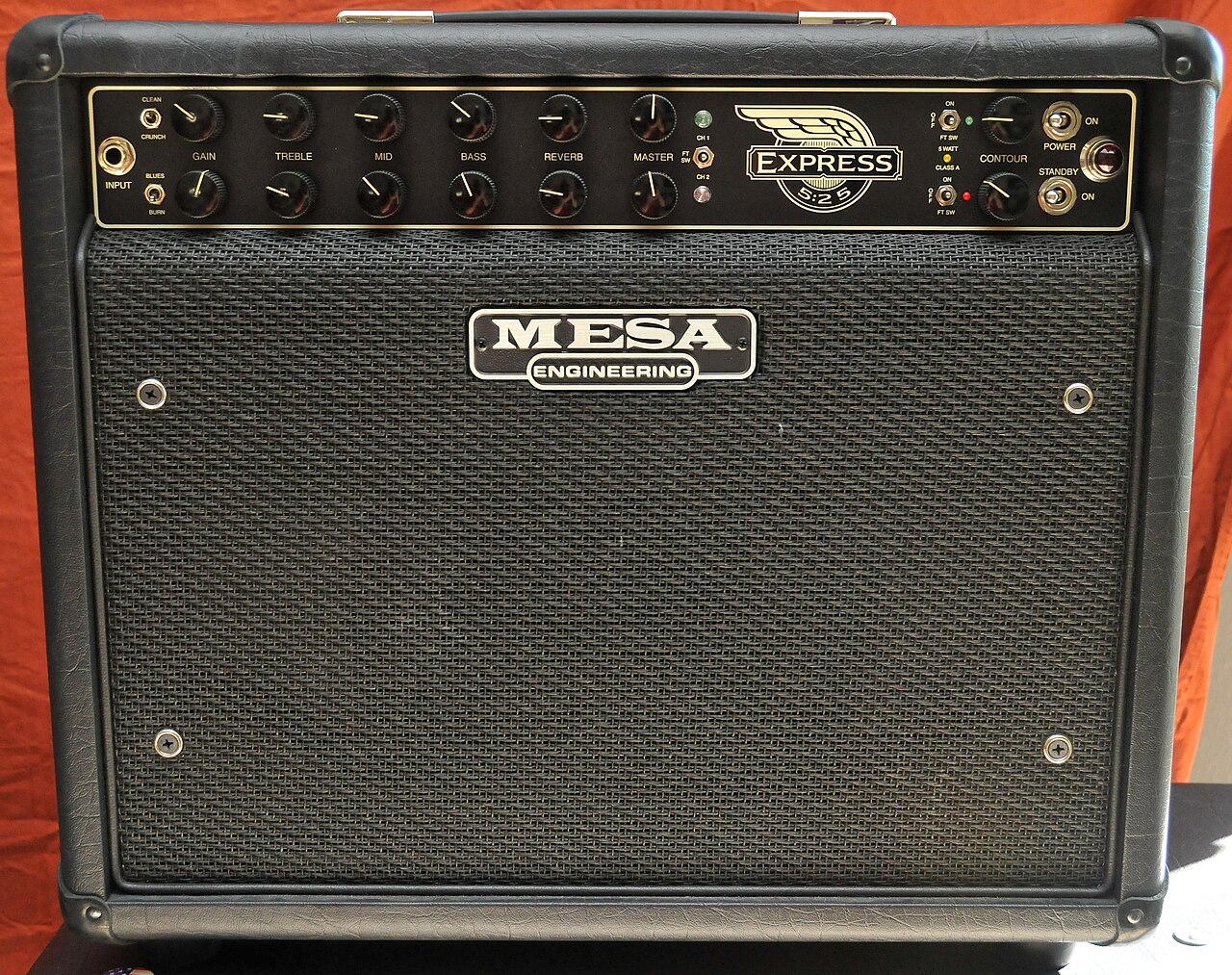
Per-channel reverb controls live on the rear panel. This is a deliberate design choice by Mesa: set the reverb level once, recall it with the channel, forget it. It is excellent for players who want channel one to have light room verb and channel two to be dry. It is slightly inconvenient for players who want to change reverb depth mid-set. If this matters to you, leave the amp’s reverb flat and use an external reverb pedal in the loop.
Frequently Asked Questions
What speaker does the Mark Five: 35 Combo ship with?
Standard production units came with a Celestion Custom 90 (8 Ω), which Mesa branded internally as the “Black Shadow.” Some limited-edition finish variants shipped with a Celestion Vintage 30. If you are buying used, open the back and check the speaker label — do not rely on the listing description alone.
Is the Mark Five: 35 Combo the same as the Mark Five: 35 Head internally?
Yes. The same aluminium chassis, same PCBs, same tube complement, same channel and mode architecture, same CabClone circuit. The only difference is the cabinet format: the combo adds a ported 1×12 cabinet with the Celestion Custom 90 and costs $200 more at launch. The head offers more cabinet flexibility; the combo delivers a complete self-contained amplifier in one piece.
Why does it pop when I switch channels?
All Mark Five: 35 units pop when switching channels. This is documented by MusicRadar in their March 2016 review and acknowledged as an inherent design characteristic of the relay-switching architecture. It is not a fault. It is not repairable. It should not influence your buying decision or price negotiation unless you find it genuinely intolerable in your workflow.
Can I run it at 10 watts for apartment use?
You can reduce the power output to 10 watts Triode per channel, which meaningfully changes the feel and brings the breakup threshold lower. The amp is still producing real speaker output through the Custom 90. For genuinely low-volume use without disturbing neighbours, use the CabClone into headphones or a silent recording interface — the internal load takes the power and no speaker signal leaves the cabinet.
What is the difference between the Mark Five: 35 and Mark V:90?
The Mark V:90 is three channels, nine modes, and up to 90 watts of Simul-Class 6L6 power — the flagship of the full Mark V line. The Mark Five: 35 has two channels, six modes, and 35 watts maximum of EL84 power. The V:90 is more complex, heavier, and more expensive. The Mark Five: 35 covers the most tonally distinct modes — clean, crunch, IIC+, Mark IV, Extreme — in a lighter and more liveable format, at the expense of the Tweed and Edge voices and the 6L6 power section’s specific density.
Does the Mark Five: 35 Combo work well for recording?
Exceptionally well. The CabClone provides a built-in speaker-emulated XLR output in three cab voicings (Open Back, Vintage, Closed Back) with an internal amplifier load — the speaker can be turned off entirely for studio silent recording. Blending the CabClone signal with a close-mic on the Celestion Custom 90 (typically 60% CabClone, 40% mic) gives a full-bodied studio recording without room noise or headphone bleed management. The long-tank spring reverb records cleanly into the mic path.
Is this a good pedal platform?
Channel 1 in Clean mode at 35 watts is an excellent pedal platform — headroom is generous, the Custom 90’s linear response does not colour incoming pedal signals the way a Vintage 30 does, and the FX loop handles time-based effects cleanly. Channel 2 in any mode is a high-gain voice that does not need front-end drive; stacking overdrives into the IIC+ or Extreme modes adds thickness but can compress the dynamics significantly. The amp’s own gain stages are sufficiently deep that most players run fewer pedals in front of it, not more.
What happened to Mesa/Boogie? Is the brand still active?
Gibson acquired Mesa/Boogie in 2021. The Mark Five: 35 had already been announced for discontinuation by that point. Mesa continues to produce amplifiers — the Mark VII, the Badlander, the Triple Crown — under Gibson ownership in Petaluma, California. The Mark Five: 35, head and combo, is a pre-acquisition design and represents the final expression of Randall Smith’s direct influence on the Mark line before the company changed hands.
Image credits
- A Mesa Boogie Express 5:25 1×10 amplifier: ArtBrom from Seattle, Wikimedia Commons, CC BY-SA 2.0.
- Carlos Santana: Heinrich Klaffs, Wikimedia Commons, CC BY-SA 2.0.
- Larry Carlton: Kenneth C. Zirkel, Wikimedia Commons, CC BY-SA 4.0.
Latest News
Related
On This Day
Tuesday 10 November
From this week: