Thirty Years in the Making: The Mesa/Boogie JP-2C and the Amp That Changed Everything
An AI-generated representative illustration of the Mesa/Boogie JP-2C, made from reference photos of the model.
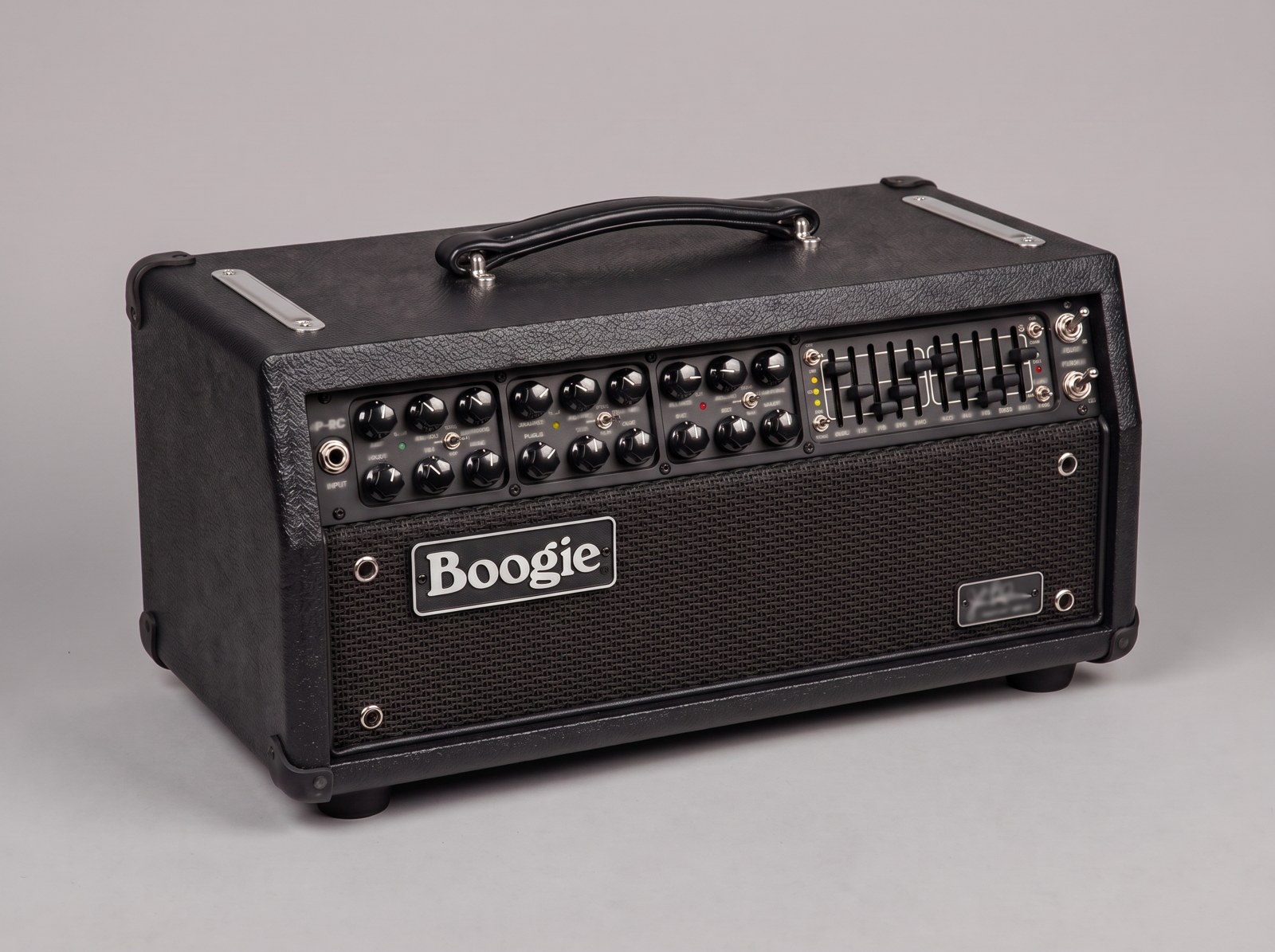
The Mesa/Boogie JP-2C is John Petrucci's signature head — a full Mark IIC+ reissue with 3 channels, Shred mode, dual graphic EQs and CabClone DI.
In the hierarchy of guitar amplifiers, a handful of models have achieved something approaching mythological status — instruments so tonally decisive that entire genres bent around their particular character. The Fender Tweed Deluxe. The Marshall Plexi. And above all others in the high-gain world: the Mesa/Boogie Mark IIC+. Built for fewer than six years between 1980 and 1986, the IIC+ was already out of production before most players knew it existed. By the late 1990s, a clean example commanded three to five times its original price, and by the 2010s, a documented pro-owned unit could cross five figures. Everyone who had ever heard one on a record wanted one. Almost nobody could find one.
John Petrucci could find one. In fact, he found several — and spent the better part of thirty years on what he called “a personal tone mission,” building a collection and a working knowledge of the original IIC+ that few living players could match. When Mesa/Boogie approached him about a signature amplifier, the decision required no deliberation: it had to be the IIC+, reborn, refined, and equipped for the realities of professional touring in the twenty-first century. The result, announced at NAMM in January 2016, was the Mesa/Boogie JP-2C John Petrucci Signature Head — and it remains one of the most consequential amp releases of the past decade.
This is not a review. Guitar Gangsters doesn’t do star ratings. What we do is dig into the history, the engineering, and the honest player context around gear that actually matters. The JP-2C matters.
The Holy Grail Problem: Why the Mark IIC+ Was Almost Impossible to Own
Understanding the JP-2C requires understanding why the original Mark IIC+ occupied such an elevated position in player mythology. Mesa/Boogie introduced the Mark IIC+ in 1980, building on Randall Smith’s cascading gain topology that had already defined the Mark I and Mark II. The “C+” designation signalled a specific voicing refinement — a dialled-in sweet spot between the IIC’s already-formidable gain structure and a more liquid, harmonically complex sustain character that players found almost addictive. The same big transformer that gave the amp its authority and punch was discontinued in the mid-1980s; when Mesa moved to the Mark III and beyond, the exact combination of transformer windings, circuit topology, and tube complement that made a C+ a C+ was gone.
The result was a secondary market defined more by folklore than fact. Players — including Petrucci himself — learned to look for hidden inscriptions on the rear panel: a “+” written in black marker by technician Mike B., indicating which Mark IIC chassis had received the specific upgrades. Not every IIC was a C+. Not every claimed C+ was genuine. And across the 1990s and 2000s, as vintage units changed hands at escalating prices, an entire cottage industry of C+ folklore emerged. Which transformer variant? Which tube complement? Which vintage Sylvania tubes in which positions?
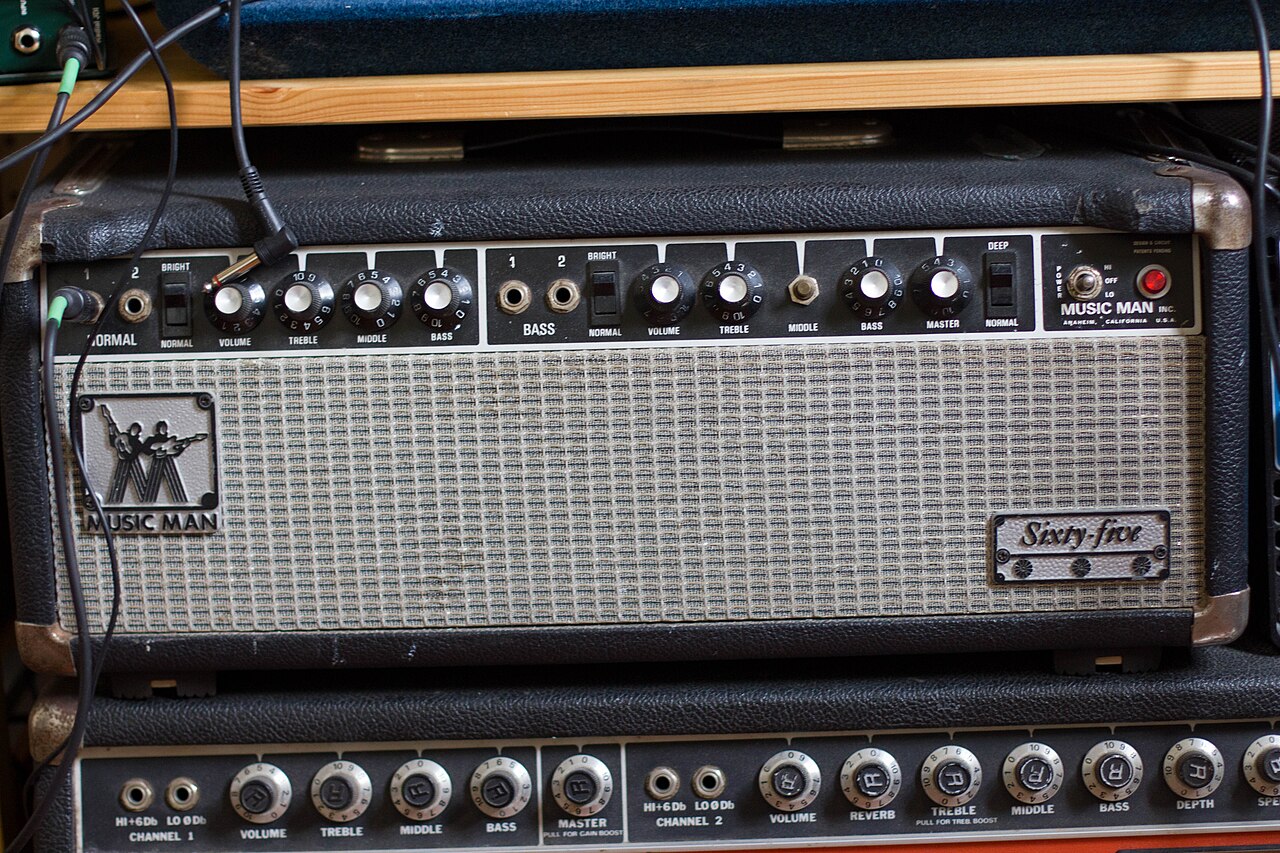
The documented IIC+ players form a roll call of hard rock’s most tonal moments. James Hetfield and Kirk Hammett ran IIC+ heads on Master of Puppets in 1986, establishing what “tight high-gain” meant for a generation of metal guitarists. Joe Satriani built his early signature tone on an IIC+ — that compressed, singing sustain that made “Surfing with the Alien” sound like no other guitar record of 1987. Neal Schon of Journey used the circuit’s clean tones and mid-drive sounds to anchor some of the decade’s biggest arena records. The IIC+ was not a one-genre tool. It could do crystalline clean, crunchy rhythm and liquid lead from the same chassis, at a time when that versatility was genuinely rare.

By the time Mesa/Boogie acquired the institutional knowledge to attempt an authentic reissue, those original transformer specs, circuit boards and construction techniques had to be re-engineered from scratch — partly from surviving schematics, partly from pulling apart and measuring original units. The Mesa/Boogie Mark IIC+ reissue (the “HRG” model) that preceded the JP-2C was a careful historical exercise. The JP-2C was something else: a working musician’s specification for what an IIC+ should be in 2016, built with thirty years of actual professional use as the design brief.
John Petrucci and Thirty Years With Mesa
Petrucci’s relationship with Mesa/Boogie is not an endorsement arrangement that began when a marketing department called his manager. It predates Dream Theater’s major-label career. Growing up on Long Island in the early 1980s, he was directed to a local music store by an older player whose word, he later wrote, “was taken as scripture.” He plugged in, heard the roar of an all-tube American-made amp fill a small room, and was immediately and permanently converted. What the hell was this thing? He would spend the next three decades finding out.
The professional progression mapped almost exactly onto Mesa’s own product history. Petrucci’s first substantial order — a Quad Preamp, a 295 Power Amp, a Midi Matrix and an Abacus controller — arrived at his Long Island home like a personal Christmas. The delivery van. The waiting. The first sound. He would go on to run, at various points, the Studio Preamp, Quad preamp, Dual Rectifier, Triple Rectifier, Road King, TriAxis, Formula Preamp, Lone Star, and every Mark from the IIB through the Mark V. Every Dream Theater album, live and studio, from the early records through A Dramatic Turn of Events and beyond, was cut through a Mesa/Boogie amplifier. The company was not a tool. It was a relationship.
The IIC+ revelation came through Mark Snyder — rack-builder, now wine mogul — who invited Petrucci to plug into a C+ at his place in Brooklyn. “All I can say is that the experience was…religious,” Petrucci wrote in Mesa’s own Amplitudes blog in June 2016. “I just knew that from that moment, my life of tonal pursuit had been forever changed.” He subsequently became what he called “somewhat of a C+ connoisseur” — researching the transformer variations, the Sylvania tube batches, the specific chassis that carried the “+”. He learned to look for Mike B.’s marker inscription. He built a collection. And when the time came to design a signature amplifier, the answer was obvious to both him and to Randall Smith.
The development process — which Petrucci describes as a genuine multi-year collaboration at the Petaluma factory — centred on a single principle: authentic first, modern second. The JP-2C would carry the same large transformer and the same IIC+ circuit board as the original. It would sound like a C+ because it was a C+, not because it approximated one. The modern additions — three fully independent channels, dual 5-band graphic EQs, MIDI switching, a built-in CabClone DI output, and the new Shred mode — were layered on top of that authentic foundation, not substituted for it.
Unveiled: NAMM January 2016
Mesa/Boogie announced the JP-2C on January 18, 2016, at Winter NAMM in Anaheim — the first day of the show. The announcement had the effect of a genuine industry event. Players who had been chasing original C+ units for a decade suddenly had an alternative from the source. In a Total Guitar interview published at the same time, Petrucci said the album Dream Theater had just finished recording — The Astonishing, released the following week on January 29 — “was recorded with the JP-2C exclusively.” More precisely, it was recorded with the prototype: the production amp had not yet reached dealers, but Petrucci had been building the record around the pre-production units as they were finessed at the factory.
The recording setup for The Astonishing was documented in Mix magazine: a pair of Mesa 1×12 speaker cabinets placed in an isolation room surrounded by Roxul insulation bales to create a near-anechoic capture environment, miked with a Royer 121, a Mojave FET 301, and a Shure SM57 — a combination chosen to capture the IIC+ circuit’s full harmonic depth without the room colour that can obscure its particular upper-register complexity. Three microphones, three different capture characters, blended to taste in Pro Tools. The amp was performing at the level of its heritage before it reached a single retail shelf.
Three formats were available from launch: the standard Head (£2,749 UK launch price), a Rackmount Head (£2,749), and a Limited Edition Head (£3,849) limited to 325 units worldwide, autographed by both John Petrucci and Randall Smith, with a private-reserve flame maple front panel, mother-of-pearl Boogie inlay, and a signed certification plate. The Limited Edition sold out quickly and is now an out-of-production collector’s item. The standard Head and Rackmount remain in active production; the 1×12 Combo format — announced in 2024 to celebrate 40 years of the Mesa/Petrucci relationship — was added to the line subsequently.
Specifications
Circuit Architecture: What “IIC+ With Modern Twists” Actually Means
The JP-2C’s architecture is built on a simple but radical premise: every channel is a Mark IIC+. Not one clean channel that happens to sound nice, and two “gain” channels that work at high saturation. Three independent channels, each voiced to a specific region of the original IIC+ operating envelope, with their own EQ sections, their own master controls, and their own graphic EQ assignments. The IIC+ had one channel. The JP-2C gives you three of them, independently accessible by footswitch or MIDI, without any shared gain structure compromising any other channel’s setting.
Channel 1 captures the IIC+ at its most pristine — that crystalline, wide-bandwidth clean that the original circuit produced when the gain was low and the headroom was high. The unique control here is the Mid/Boost, a single knob with two distinct functions: from 1 to 5 it operates as a standard midrange tone control; pushed past 5, it transitions into a variable gain boost — a sweet harmonic overdrive from subtle to blistering that operates without changing any other channel’s setting. This is the clean or near-clean channel; it cleans up with picking dynamics, accepts pedals with exceptional transparency, and can be pushed into mild crunch by rolling the gain up and engaging the Mid/Boost at high settings.
Channels 2 and 3 both operate in either standard Mark IIC+ Gain voicing or the new Shred mode, independently switchable per channel via MIDI or a pull switch in the lower-right corner of the EQ section. In the standard IIC+ Gain voicing, the circuit delivers the amp’s defining character: a gain structure with sympathetic compression, complex harmonic layering in the upper midrange, a tight low end that doesn’t bloom into flub even at high saturation, and a sustain profile that holds a note’s harmonic content rather than simply sustaining the fundamental. Additional gain boost is available on each lead channel via a pull function on the Gain control. Presence features a Pull Frequency Shift that re-centres the high-frequency contour for different cab and speaker combinations.
Shred mode, Petrucci’s primary addition to the IIC+ formula, enhances the top-end harmonic layering — adding an additional layer of upper harmonic content that increases cut, edge, and perceived detail in modern high-gain contexts. The practical effect is a brighter, more articulate version of the standard Gain voicing: faster transient response, more apparent pick attack, and additional definition in the 2–6kHz range where guitar presence sits in a dense mix. At bedroom volumes, Shred mode can sound almost too bright; at live levels, or into cabs loaded with Celestion Vintage 30s or similar mid-forward speakers, it becomes a clinical precision tool. Users report scaling it back when running the master volume above 4 on stage, since the amp’s natural compression at higher power levels provides the harmonic density that Shred adds at lower volumes.
The dual 5-band graphic EQs are a genuine departure from every previous Mark Series design — a fact Petrucci himself noted in his first interviews about the amp, calling it something that “has never been done before on a Mesa amp.” Each EQ covers 80Hz, 250Hz, 750Hz, 2.2kHz, and 6.6kHz — the full guitar frequency range from bass weight to presence shimmer — and each can be independently assigned to any channel (or multiple channels), toggled footswitchably, or set to static on or off. This means a player can have EQ1 assigned to Channel 1’s clean tone (boosting low mids for an R&B warm warmth) and EQ2 assigned to Channel 3’s lead (cutting mids and boosting presence for a stadium rock solo lift) simultaneously. Two graphic EQs, independently routed — no amp in Mesa’s history had that before the JP-2C.
The CabClone DI output deserves particular attention because it changes the JP-2C’s deployment picture significantly. With the CabClone active, the amp can drive a speaker cabinet normally while simultaneously sending a cab-simulated signal to a PA or recording interface — or, with the Speaker On/Off switch engaged, run silently as a direct recording or IEM-driven stage tool without any speaker load requirement. Closed Back, Open Back, and Vintage voice options on the rear panel provide three distinct cab characters. Combined with the internal load circuit, this means the JP-2C can function as a full touring head into a 4×12, a silent direct recording tool in a studio, or a hybrid that feeds both simultaneously. For a working professional playing arenas, this is not a luxury: it is a liability management tool that separates “amp fails on stage” from “show goes on.”
Famous Players
The JP-2C is one of the few signature amplifiers in the GuitarGangsters series where the artist connection requires no careful qualification. John Petrucci did not endorse this amplifier. He designed it. His initials are in the model name. He recorded Dream Theater’s The Astonishing (2016) with the prototype before it reached a single dealer. He uses it on every subsequent Dream Theater record and continues to run it in his live rig alongside Fractal Audio effects processing through Mesa 2:90 power amplifiers. The Ernie Ball Music Man Majesty — his other signature instrument, loaded with DiMarzio Illuminator pickups — plugs into a JP-2C at every show. There is no “does he actually use it?” question here. The jp-2c was built by, for, and around one specific guitarist’s requirements, and he has never stopped using it.
The IIC+ players who form the JP-2C’s historical context are worth examining individually, because the “if you like X player’s tone, the JP-2C gives you the circuit” argument is part of how the amp is legitimately marketed — and the underlying claims are largely accurate, though with the usual caveats about production eras and individual unit variation.
James Hetfield and Kirk Hammett ran Mark IIC+ heads on Master of Puppets (1986), produced by Flemming Rasmussen and recorded at Sweet Silence Studios in Copenhagen. The Metallica IIC+ connection is one of the most documented in metal recording history: Mesa themselves confirmed it, producer interview transcripts confirm it, and the tight, articulate rhythm character of the album’s guitar tone — that palm-muted precision, the way each note speaks individually without blur — is identifiable as IIC+ to anyone who has played one. What the JP-2C inherits from Hetfield’s IIC+ is the underlying circuit DNA, not necessarily the specific amp (which ran different tubes in a different decade) or the production chain (Solid State Logic desk, AMS reverbs, the specific mic placement in the Copenhagen room). But the basic gain character, the low-end tightness, the way the attack speaks — that comes from the same topology.
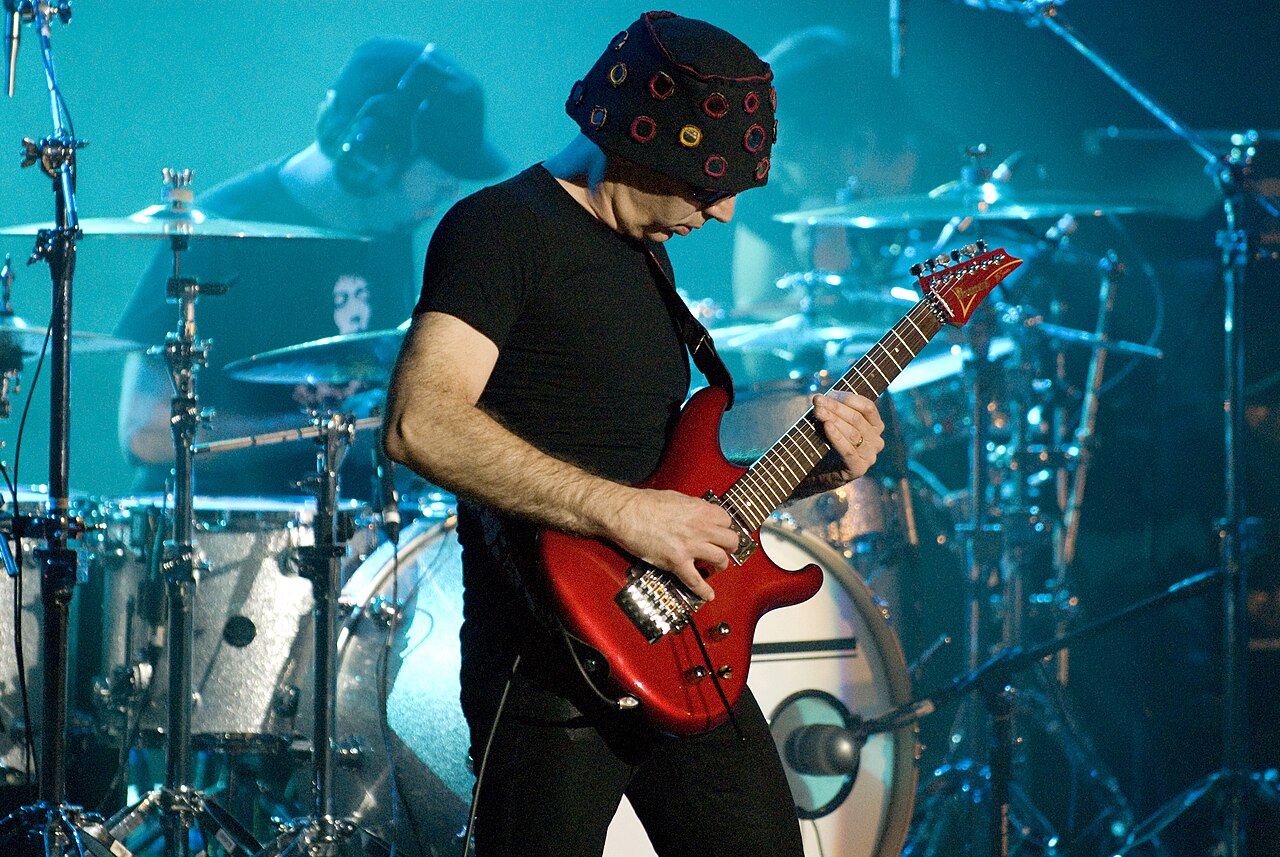
Joe Satriani used Mark IIC+ circuitry across his early and career-defining work, including Surfing with the Alien (1987). Satriani’s IIC+ deployment focused on the mid-gain singing sustain of the circuit — that compressed, vocal quality where a note holds its harmonic identity across a four-bar phrase — rather than the ultra-high-gain metal applications. The JP-2C’s Channel 3 in standard Gain mode, with the gain control at 6–7 and the graphic EQ shaped to flatten the mid-forward character, can get close to that territory: warm, present, and sustaining without edginess.
Neal Schon of Journey used the IIC+ circuit’s range across both clean and driven sounds, taking advantage of the amp’s unusually transparent clean at low gain settings. That quality — an IIC+ clean is noticeably more dimensional and harmonically present than a typical solid-state-clean or even a Fender blackface clean — carries directly into the JP-2C’s Channel 1 design. It cleans up genuinely, responds to pick dynamics, and does not artificially flatten the natural harmonic envelope of the guitar.
For completeness: Carlos Santana’s documented Mesa use centres on the Mark I circuit; Larry Carlton’s documented amp history is primarily Mark I and Dumble territory. Neither is a JP-2C story, and the amp’s marketing material is careful not to claim them. The IIC+ players above are the verified lineage. Everyone else is a fan of the circuit’s descendants.
How It Sounds: The IIC+ Character and What the JP-2C Does With It
The Mark IIC+ tonal character occupies a specific and identifiable register in the amplifier landscape — and the JP-2C, as an authentic circuit reissue, lives in the same place. The clean end of the amp is wide, detailed, and genuinely three-dimensional: the IIC+ clean is not the warm darkness of a 6L6-driven Fender, nor the bright cut of a Marshall blackface-influenced circuit. It sits somewhere between — a transparent, full-range picture of what the guitar is doing, with enough headroom to stay clean at playing levels that would have a Fender Deluxe breaking up. The Mid/Boost control makes this clean channel more flexible than any single-knob approach: at 5 it’s neutral, below 5 it scoops the mid for a glassy sparkle, above 5 it begins to drive the preamp into progressively warmer saturation.
The gain channels — the reason most players are interested — operate with a specific character that distinguishes the IIC+ from the Rectifier series that followed it. Where a Dual Rectifier saturates with a sag and bloom that favours lower-tuned rhythms, the IIC+ circuit is fundamentally a precision instrument: it retains pick attack at high gain settings, keeps the low end tight under palm muting, and shapes its saturation around the upper harmonic series rather than simply compressing the transient. Notes speak clearly. Chords retain identifiable intervals even at high gain. Single-note lines hold their pitch identity across their full sustain arc. This is exactly why Hetfield‘s rhythm guitar on Master of Puppets sounds the way it does — that is not a guitarist playing with extraordinary clarity despite a dirty amp, it is a circuit that is designed to be maximally precise at high gain.
The Shred mode’s high-frequency enhancement is real and usable. Applied to Channel 2 at moderate gain (5–6) it transforms the standard crunch voice into a presence-forward, articulate rhythm character that cuts through a dense live mix without requiring painful treble settings. Applied to Channel 3 at lead gain levels, it pushes the amp toward what some players describe as “surgical” — every note’s attack is defined, every bend’s arrival is etched, and the release of a note is characterised by complex high-harmonic content. The trade-off: at low volumes, Shred mode can be fatiguing. It is a live and loud feature, not a bedroom tone feature.
The long-tank spring reverb is a significant contributor to the amp’s studio and home usefulness. Long-tank reverbs move more air, have a lower flutter frequency, and produce the surf-adjacent shimmer that characterises the best vintage spring sounds. The JP-2C gives you independent rear-panel reverb level controls per channel, so a clean Channel 1 setting can run with substantial lush reverb while Channel 3’s lead tone runs reverb-dry for solo clarity — without either choice compromising the other.
Tone Recipes: Five Settings for the JP-2C
1. Petrucci-Style Liquid Lead (Channel 3)
This gets you close to the Dream Theater lead voice — the singing, complex sustain of “Glasgow Kiss” or “Hollow Years.” Gain: 7. Treble: 6. Mid: 5.5. Bass: 3.5. Presence: 5. Pull Gain Boost: engaged. Shred: off. GEQ1 assigned to Ch3: 80Hz flat, 250Hz +2, 750Hz +1, 2200Hz −1, 6600Hz flat. Reverb: 2 (rear panel). The gain boost on top of the 7 setting brings the compression into the liquid zone without descending into noise; the GEQ gives the mid-band the warmth the IIC+ circuit naturally wants to produce. Switch Shred on if you want to cut harder in a loud stage mix.
2. Classic Metal Rhythm (Channel 2)
The Hetfield-adjacent tight rhythm character — palm muting with note definition intact. Gain: 6.5. Treble: 6. Mid: 5. Bass: 3. Presence: 6.5. Shred: on. GEQ2 assigned to Ch2: 80Hz flat, 250Hz −2, 750Hz +1, 2200Hz flat, 6600Hz +1. Reverb: 1. The low bass setting is intentional — the IIC+ circuit’s low-end tightness is a design feature, not a compromise, and cutting the bass control prevents even that tight low end from adding thickness in a full-band mix. The Shred mode’s high-frequency boost at this gain setting functions as a presence enhancer rather than a brightness problem.
3. Full-Range Clean (Channel 1)
Wide-bandwidth IIC+ clean — pedal-platform quality, takes overdrives transparently. Gain: 2.5. Treble: 6.5. Mid/Boost: 5 (neutral). Bass: 6. Presence: 4.5. Reverb: 3. GEQ: off. At these settings, the amp is essentially showing you what the guitar sounds like through a high-quality preamp with tube-defined headroom. Add a Tube Screamer or equivalent in front of Ch1 for classic pushed-clean rhythm tones in the JCM800 tradition, but with the IIC+’s characteristic mid-presence replacing the Marshall’s upper-mid aggression.
4. Compressed Melodic Lead — Satriani Territory (Channel 3)
For singing, vocal-quality solo sustain without the modern-metal tightness. Gain: 6. Treble: 5.5. Mid: 6. Bass: 4. Presence: 5. Pull Gain Boost: off. Shred: off. GEQ1 assigned to Ch3: 80Hz flat, 250Hz +1, 750Hz +3, 2200Hz +1, 6600Hz −1. Reverb: 3. The GEQ mid bump at 750Hz is what separates this from a generic high-gain lead voice — it adds the warmth and vocal quality that characterises Satriani‘s early lead tone, where the guitar sounds like it’s speaking rather than screaming.
5. Edge of Breakup — Jazz/Fusion Crunch (Channel 1)
Using Channel 1’s Mid/Boost above 5 to bring in harmonic saturation without switching channels — useful for jazz fusion, blues rock, or any context where clean-to-crunch happens in real time. Gain: 4. Treble: 6. Mid/Boost: 7 (gain boost region). Bass: 5.5. Presence: 4. GEQ: off. Reverb: 2.5. The Mid/Boost control in boost territory is one of the JP-2C’s most underused features: it adds crunch character that tracks picking dynamics — hit softly and it cleans up, dig in and it saturates. This is a genuinely touch-responsive voice that most players associated with single-channel boutique amplifiers.
These are starting points, verified against published player settings and the amp’s circuit behaviour. All assume a standard single-coil or humbucker-equipped guitar; adjust gain down 1–1.5 points for active pickups.
Comparisons
The Mesa/Boogie Mark IIC+ — the original, in either vintage or HRG reissue form — is the obvious starting comparison, and the JP-2C’s answer is simply: it is the Mark IIC+, with three of them stacked in a single chassis and modern professional infrastructure around them. If you need one IIC+ voice and nothing else, a vintage unit (if you can find a clean one) or the HRG reissue is the more direct path. If you need that voice accessible in multiple gain states simultaneously, with MIDI programmability and a CabClone for modern direct recording, the JP-2C is the more complete tool.
The Mesa/Boogie Mark V:90 is the main multi-voice Mark Series alternative, offering access to voicings from across the Mark family — Mark I, III, IV and V sounds in a single chassis with extensive mode switching. Where the Mark V:90 is a chameleon, the JP-2C is a specialist: everything it does traces back to the IIC+ circuit, which means it lacks the softer cleans of the Mark I and the midrange density of the Mark IV but surpasses both in the specific IIC+ harmonic character. Players who need one great sound — the IIC+ — choose the JP-2C. Players who need five different Marks choose the V:90.
The Mesa/Boogie Mark IV represents an interesting middle position. The Mark IV’s Lead channel shares circuit ancestry with the IIC+ but was revised toward a slightly different gain character — more mid-forward compression, a different harmonic distribution at peak saturation. Players who have compared the two often describe the Mark IV as “darker” or “woolier” in the lead channel, and the JP-2C as “more present” or “more precise” — differences that matter in different musical contexts. The Mark IV is the right answer for a more vintage-leaning Southern rock or blues lead tone; the JP-2C is the right answer for contemporary progressive rock, metal, or any context where definition matters more than bloom.
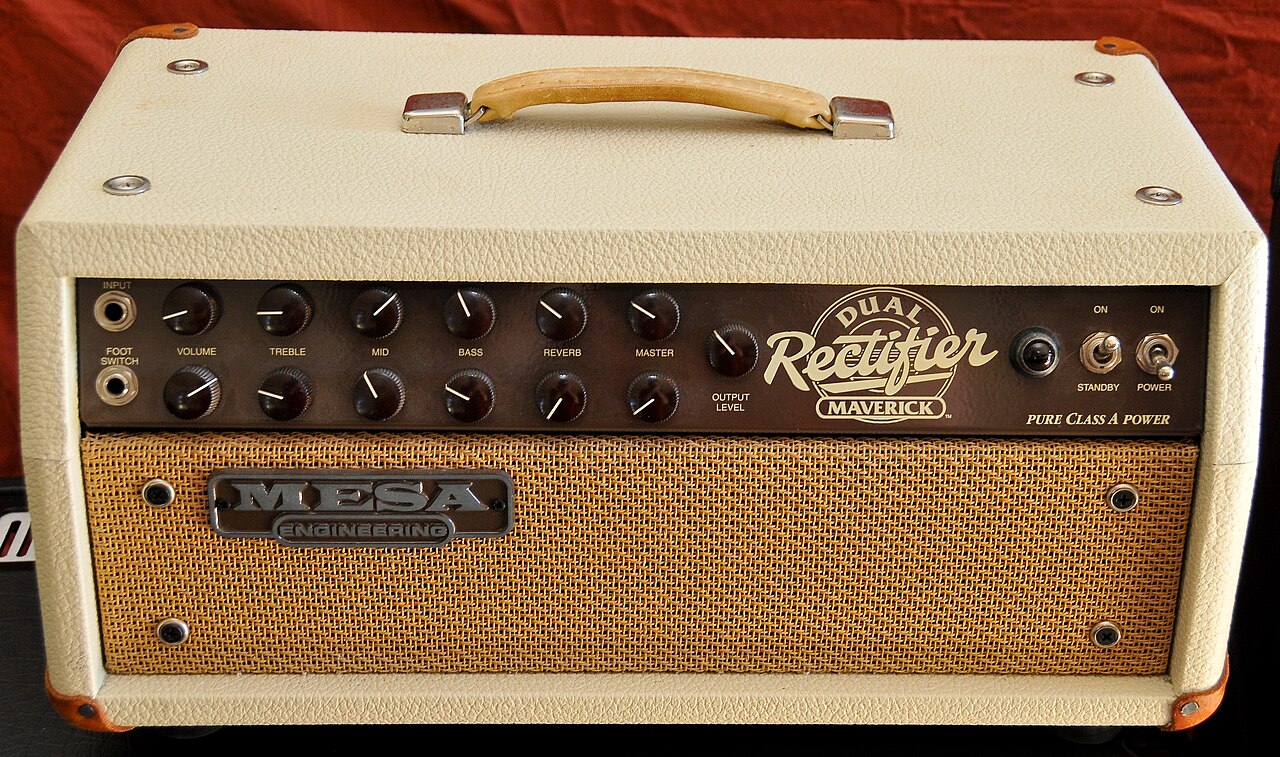
The Dual Rectifier — the amp that defined the Mesa sound for an entire generation of metal players, and part of Petrucci’s own touring history — operates from a fundamentally different circuit philosophy. The Rectifier’s sag, bloom and low-frequency mass are the antithesis of the IIC+ tight precision; they suit down-tuned rhythm guitar and wall-of-sound production approaches that the JP-2C’s surgical low-end handling is not optimised for. These are different tools for different jobs. Petrucci ran Dual Rectifiers for years before the JP-2C existed; the presence of a signature amp bearing his name on the IIC+ circuit is as much a statement about which amp he considers tonally decisive as it is a commercial exercise.
The Mesa/Boogie Mark VII — the current flagship in the Mark Series — adds a seventh channel-mode configuration and extensive modern features to the Mark family tree. It can approximate the IIC+ in its Mark IIC+ mode setting, but “approximate” is the operative word: the JP-2C carries the original transformer and circuit board, while the Mark VII uses a contemporary circuit design that nods toward the IIC+ character without reproducing it from source material. For players who want the full modern Mark feature set, the Mark VII is the choice. For players for whom the IIC+ sound is the non-negotiable baseline, the JP-2C is the more authentic path.
Buying Guide: New, Used, and Which Format
The standard JP-2C Head is in active production at approximately $3,659 new (Sweetwater, 2026). Used examples in clean condition are trading in the $1,950–$2,500 range, depending on condition, tubes, and whether the original footswitch and cover are included. The gap between new and used is meaningful: used examples represent a genuine saving on a high-cost amp, and unlike many Gibson-era Mesa products, the JP-2C has not had significant quality-control complaints that would make buying used inherently riskier than buying new.
The Limited Edition Head — 325 units worldwide, autographed by Petrucci and Randall Smith, with private-reserve flame maple panel and mother-of-pearl inlay — is out of production and commands a collector premium. Expect $3,500–$5,000 or more for clean examples with original documentation. The Limited Edition is not tonally superior to the standard head; the circuit is identical. The premium is purely for the collectible status and cosmetics. Unless you are buying it as an investment or for display, the standard head is the better use of the difference in cost.
The Rackmount format is worth considering for players who build their rigs around rack architecture — the same circuit in a different chassis, designed to sit in a standard 19″ rack unit. Tour professionals who run multiple amp heads through a switching system often prefer the rackmount for the physical security of rack mounting and the tidiness of a rack-system integration. For everyone else, the standard head into a quality 4×12 or 2×12 is the more conventional and arguably more appropriate deployment.
The 1×12 Combo format (announced 2024) packages the JP-2C circuit into a combo with a single 12″ speaker — “a wolf in sheep’s clothing,” per Guitar World’s coverage. At 40+ lbs with a speaker included, it is not appreciably lighter than the head alone, and it limits cabinet choice to the integrated speaker. The combo makes sense for players who want a self-contained JP-2C setup without the cost or footprint of a separate cabinet. For everyone else, the head’s flexibility with different cabinet configurations is worth the separation.
What to check on a used JP-2C: pull one power tube and compare it to the others — matched sets degrade at different rates in fixed-bias designs, and mismatched power tubes affect both output and tonal character. The rear-panel reverb controls are independent from the front-panel reverb knobs; make sure both function across their range. The CabClone output should be verified in all three voice settings. If the amp has had significant mileage, factor tube replacement into your price — a matched quad of Mesa 6L6s and a full set of 12AX7 preamp tubes will run $100–$200 depending on supplier.
Ownership Notes
The JP-2C is fan-cooled, which means the cooling system is actively managing the thermal load of 100W Class A/B operation. Fan noise is audible in a dead quiet recording environment when recording direct through the CabClone; if the fan noise is problematic in your studio setup, consider the 60W power switch setting (which runs 2× 6L6 instead of 4×) — the reduced power demand runs cooler and the fan cycles less aggressively.
Fixed bias means the amp does not have user-adjustable bias controls. This is a deliberate design decision: fixed bias provides consistent, maintenance-free performance without the setup variables of adjustable-bias designs. The trade-off is that power tube swaps must use Mesa-rated tubes matched to the fixed bias point. Sourcing Mesa-branded 6L6 tubes directly ensures compatibility. Some players use tested commercial 6L6 variants (Groove Tubes, JJ, Tung-Sol) with good results, but any significant deviation from the factory tube spec can affect both tonal character and the bias operating point.
The 40 lbs head weight is manageable but not trivial. Plan your hardware around it: a sturdy amp stand or head-capable flight case, and consider the combined weight with your preferred 4×12 cabinet if you’re loading in and out regularly. The Mark V:90 weighs 44 lbs; the JP-2C, at 40 lbs, is approximately the same physical category of amplifier.
The MIDI implementation is full-featured and designed for professional touring use. The 256 preset locations are enough to store independent per-song configurations without overlap. MIDI CC and PC messages control channels, EQs, Shred mode, reverb and FX loop — essentially every function that can be footswitched can also be MIDI controlled. If you’re building a MIDI switching system around a Mesa 128-channel switcher or a Fractal AXE-FX III in 4-cable method, plan the MIDI channel assignments before your first gig rather than discovering conflicts during soundcheck.
The amp runs hot in the standard cabinet environment. Do not block the rear ventilation grille with cables, racks, or amp covers during operation. Allow five minutes of warm-up time before committing to a final recording take — the first ten minutes of operation are when tube thermal drift is most significant, and the amp will be its most consistent after stabilising.
Frequently Asked Questions
Is the JP-2C’s circuit identical to a vintage Mark IIC+?
The stated design intent — and confirmed by both John Petrucci and Randall Smith — is that the JP-2C carries the same large transformer and the same circuit board as the original IIC+. Modern component tolerances and manufacturing processes mean that no two production runs produce mathematically identical results, and individual vintage IIC+ units varied from each other due to component drift, tube variations and factory tolerances of the original era. What the JP-2C does is reproduce the IIC+ topology from the original engineering source material, as closely as modern manufacturing allows, with Randall Smith’s explicit goal of “surpassing the original.” Most players who have compared JP-2C units side-by-side with well-maintained vintage IIC+ examples find the circuits effectively equivalent in character; some find vintage units slightly warmer due to aged component drift. The JP-2C is the most authentic IIC+ circuit available new.
What does the Shred mode actually do?
Shred mode, available on Channels 2 and 3, adds a high-frequency harmonic enhancement layer to the standard IIC+ Gain voicing. Practically: it boosts upper harmonic content in the 4–8kHz range, increases perceived attack and definition, and makes the amp cut harder in a loud live mix. The name is accurate but also limiting — it suggests a use case narrower than the actual function. Shred mode at moderate gain settings on Channel 2 produces an articulate crunch character useful for everything from hard rock rhythm to country chicken-picking. At high gain on Channel 3, it produces the aggressive precision that Petrucci uses for contemporary lead work. It does remove bass content; if your cabinet is already light in the low end, compensate with the graphic EQ.
How does the dual graphic EQ system work in practice?
Each of the two 5-band graphic EQs can be independently assigned to any channel via the EQ Assignment switches adjacent to each channel’s controls, set to On (always active for that channel), Off, or Footswitchable (triggerable via the included 6-button footswitch or MIDI). This means EQ1 could be set to a mid-boosted curve for Channel 3’s solo lift, EQ2 to a V-shaped rhythm scoop for Channel 2, and Channel 1 left EQ-bypassed for maximum natural clarity. None of these assignments affect each other. The practical workflow is to set each EQ’s curve first, then assign it to the channel(s) that benefit from it. Channels 2 and 3 can share the same EQ if you want a common rhythm and lead footprint, or each can have its own.
Can the JP-2C be used for silent recording?
Yes — this is one of the amp’s most practically useful features for studio work. With the CabClone output active and the Speaker On/Off switch set to Off, the JP-2C’s entire preamp and power amp circuit runs through an internal load resistor (no speaker required), and the signal is then passed through the CabClone’s cab simulation with your choice of Closed Back, Open Back, or Vintage voice. The result is a directly recorded guitar signal that captures the amp’s circuit behaviour — including the power amp’s Class A/B saturation and compression characteristics — without a speaker, a microphone, or a treated room. Headphone monitoring is available from the same output section. The quality is appropriate for professional tracking; the MusicRadar review of the Mark Five: 35 (which shares the CabClone hardware) described it as capturing the amp’s essential character accurately.
What’s the difference between the 100W and 60W settings?
The 60W setting engages 2 of the 4 power tubes (switching 2 tubes out of the signal path) for a “small-block” power character — slightly more apparent power amp saturation at a given master volume setting, and a fractionally warmer low-end response due to the reduced headroom of a two-tube configuration. The 100W setting runs all four tubes in parallel, producing the “big-block” authority and clean headroom that characterises full-power operation. Most players at studio or club volumes prefer 60W for the additional power-stage warmth; live players in large venues generally prefer 100W for headroom and presence. The switch is global and not MIDI controllable.
Does the JP-2C work with cabinets other than Mesa’s own?
Yes. The four speaker outputs (16Ω, 8Ω, two 4Ω) accommodate standard cab impedances. The JP-2C is not specifically voiced to depend on Mesa-branded cabinets; players run it through Marshall 4×12s, Bogner 2×12s, and a wide variety of boutique cab options with reported success. The amp’s high-frequency character — particularly with Shred mode engaged — can interact significantly with speaker choice. The bright, present upper-mid character of a Celestion Vintage 30 (which Mesa uses in many of its own cabinets) complements the JP-2C’s lead channels. The smoother rolloff of a Celestion G12M Greenback or a Celestion Creamback softens the Shred mode’s top-end addition if the standard voicing is too bright for your application.
How does the JP-2C compare to modern high-gain alternatives like the PRS MT 15 or EVH 5150 III?
It doesn’t, really — they operate from different tonal philosophies and at different price points. The PRS MT 15 ($799) and EVH 5150 III ($1,999) are excellent high-gain designs with their own distinct characters. The MT 15 has a more refined boutique quality in its clean channel and a compressed modern saturation in its lead; the 5150 III’s brown-channel saturation is voiced around Van Halen’s specific gain structure. Neither attempts to reproduce the Mark IIC+ circuit. The JP-2C at $3,659 is in a different market segment — it is essentially a bespoke professional touring amplifier with the build quality, circuit authenticity, and professional feature set (MIDI, CabClone, dual EQs) to justify the price to players for whom those specific qualities are the non-negotiables. If you simply need high-gain tube tone at a reasonable price, the alternatives are more practical. If you need the IIC+ circuit in a modern professional chassis, the JP-2C has no peer.
What guitars pair best with the JP-2C?
Petrucci’s own rig is built around the Ernie Ball Music Man Majesty — neck-through mahogany construction with alder wings, a thick maple top, and DiMarzio Illuminator humbucker pickups voiced for the IIC+ circuit’s input characteristics. High-output humbuckers with good pick definition work best: the amp’s precision is most audible with a guitar that itself has transient clarity, not one that blurs at the pick attack. Active pickups (EMG, Fishman Fluence) can work but typically require the gain control rolled back 1.5–2 points from passive equivalents, since they drive the preamp harder. The guitar’s tone controls interact meaningfully with the Mid/Boost on Channel 1 — rolling the guitar’s tone control back to 7 or 8 while pushing the Mid/Boost above 5 creates a thick, complex mid-gain voice that neither control alone can produce.
Image credits
- A tube amp head: David Hilowitz from San Antonio, USA, Wikimedia Commons, CC BY 2.0.
- A Mesa Boogie Maverick short head in an angled view: ArtBrom from Seattle, Wikimedia Commons, CC BY-SA 2.0.
- A Mesa Boogie Maverick short head amplifier: ArtBrom from Seattle, Wikimedia Commons, CC BY-SA 2.0.
- Joe Satriani: livepict.com, Wikimedia Commons, CC BY-SA 3.0.
- Kirk Hammett: DoD News Features, Wikimedia Commons, CC BY 2.0.
- Top image: GuitarGangsters AI-generated reference illustration, not a photograph.
Latest News
Related
On This Day
Monday 9 November
From this week: