Ibanez AZ2402 Prestige: The One Name on the List That Actually Checks Out
For once the spreadsheet's shred list isn't wrong — Tim Henson genuinely plays the Ibanez AZ2402, a guitar he helped shape before it even existed.
Tim Henson genuinely plays an Ibanez AZ2402 Prestige — documented in his own studio tour, caught on camera at a live soundcheck, and tied directly to the origin story of the entire AZ series. Steve Vai, Joe Satriani, Paul Gilbert, and Nita Strauss have no verifiable connection to this specific model.
And Henson isn’t even the guitar’s most interesting story. That belongs to Jack Gardiner, a UK-born, Switzerland-based fusion guitarist who liked the 22-fret AZ2204 enough to ask Ibanez, directly, for a 24-fret version — and got one. The AZ2402 exists, in part, because a working session player asked for it.
A Guitar Two Artists Helped Shape
From Custom Prototype to Catalog Model
The AZ series launched in 2018, and its roots trace back further than the catalog suggests. Before the AZ existed as a production line, Ibanez’s LA Custom Shop built Tim Henson a satin-finish prototype in a bright hot pink he gave a cheekily explicit nickname to on social media. That prototype — fitted with Music Man/EVH-style Illuminator pickups at his request — became the template both Henson and Polyphia bandmate Scott LePage would eventually build their own signature guitars around. The production AZ series that followed inherited its asymmetrical body shape and oval-profile neck directly from that one-off build.
Still Built in Japan, Still Current
Like the AZ2204 Prestige, the AZ2402 remains in active production, built in Japan by FujiGen as part of Ibanez’s current Prestige lineup. It’s the 24-fret, dual-humbucker sibling to the AZ2204’s 22-fret HSS layout — a genuinely different guitar under a very similar name, not just a fret-count upgrade.
Anatomy of the AZ2402 Prestige
Body and Finish
The AZ2402 uses the same alder body as its AZ2204 sibling, chosen for a balanced, resonant tone with a punchy midrange that reviewers consistently describe as cutting through a mix without turning harsh. The body carries a shallow rear contour and a generous forearm cut, and — like the rest of the AZ line — different radii on each body edge to keep the guitar comfortable whether you’re standing on a stage or sitting in a session chair. Current finishes include Apple Green Metallic, Tri Fade Burst Flat, Pearl White Flat, Black Flat, Gray Metallic, and Roadster Orange Metallic, with earlier production runs having included other colorways — including the Ice Blue Metallic finish visible in Tim Henson’s own studio tour footage — that have since rotated out of the standard catalog.
Neck and Fretboard
The neck is the same S-Tech Wood roasted maple construction found across the AZ Prestige range, oil-sealed for a broken-in feel straight out of the case, in the brand’s signature Oval C profile — chunkier and rounder than Ibanez’s famous Wizard necks, closer in hand-feel to a well-worn vintage Fender. Twenty-four jumbo stainless steel frets get the same Prestige fret edge treatment used across Ibanez’s top tier, with black dot inlays and Luminlay side dots for stage visibility. The all-access neck joint, carried over from the rest of the AZ range, is frequently singled out by owners as a real improvement over the blockier neck heels found on older Ibanez designs, giving genuinely unimpeded access to the upper frets.
Electronics
Where the AZ2204 runs three pickups in HSS configuration, the AZ2402 simplifies to a pair of Seymour Duncan Hyperion humbuckers — passive, Alnico V-loaded units chosen for clarity under distortion without sacrificing dynamic response. The switching system steps up accordingly: dyna-MIX10 offers ten distinct tonal combinations rather than the AZ2204’s nine, built around a five-way blade switch and a two-way Alter mini-toggle. The standout feature is what Ibanez calls Power Tap mode — rather than a conventional coil split that simply disables one coil, the Alter switch taps a single coil of each humbucker to produce a genuinely convincing single-coil tone without losing as much output or definition as a true coil-split typically costs you.
Bridge and Hardware
The Gotoh T1802 tremolo carries over from the AZ2204 — a floating two-point design with machined titanium saddles and a solid steel block, 10.5mm string spacing for comfortable string-skipping, and a snap-and-hold arm socket that makes loading the whammy bar quick. Gotoh Magnum Lock tuners with height-adjustable posts round out the hardware, alongside an oil-impregnated bone nut. Multiple long-term owners specifically praise the tuning stability this non-double-locking system delivers, describing it as exceptional for a guitar that isn’t relying on a fully decked, double-locking trem to hold pitch.
Who Actually Played It — And This Time, One Name Checks Out
Tim Henson: A Documented Connection
Tim Henson’s connection to this guitar is documented from multiple independent angles rather than a single grainy photo. He’s shown an Ice Blue Metallic AZ2402 Prestige directly in a studio tour posted to his own YouTube channel, and separate footage from a live soundcheck for Polyphia’s “40oz” shows him playing the same model. That’s on top of the deeper structural connection — Henson’s own custom prototype effectively fathered the entire AZ platform this guitar belongs to, which means his name showing up on an AZ2402 spec sheet isn’t a coincidence or a stretch. It’s genuinely closer to the source than almost any other artist connection uncovered across this project’s Ibanez coverage. Henson has since moved on to his own dedicated Ibanez signature instrument, the THBB10, but the AZ2402 remains a documented part of his working guitar collection rather than a guitar he’s simply been photographed near once.

Jack Gardiner: The Guitarist Who Asked Ibanez to Build This Exact Guitar
Jack Gardiner is a Liverpool-born, Switzerland-based session and solo fusion guitarist, mentored in his teens by fusion player Tom Quayle, who by 2017 was touring with Stu Hamm’s Greatest Hits Tour and playing in the ’80s pop-rock band China Crisis. He became an official Ibanez artist and, in a Guitar World interview, explained exactly how the AZ2402 came to exist in its current form: he loved the 22-fret AZ2204 but found himself unable to get comfortable on 22 frets specifically because of how the symmetry of the fretboard’s upper register affected his playing, so he asked Ibanez for a 24-fret HSS AZ. Ibanez told him the extra frets required reworking the body shape to get the neck pickup positioned correctly — and built it. Gardiner has since been photographed and filmed with several AZ-family guitars, including the AZ2204B and the AZ2402 itself, and Ibanez has featured him directly in AZ-series demo content. It’s a rare case in this project of an artist connection running in the opposite direction — not a famous player picking up an existing guitar, but a working guitarist’s specific request shaping what Ibanez decided to build.
Mario Camarena: Another CHON Guitarist, Another AZ Convert
Mario Camarena, guitarist for the instrumental math rock band CHON, appears in a full YouTube playthrough of the song “Sleepy Tea” playing what multiple sources confirm carries the same specs as the AZ2402, including its coil-tap function. Camarena’s connection to the AZ platform didn’t stop there — Ibanez has since built him his own signature model, the MAR10, based on the same Oval C neck profile and dyna-MIX switching philosophy this guitar established. It’s a similar arc to Nili Brosh’s path through the AZ2204 platform toward her own signature model — the AZ series has become something of a proving ground before Ibanez commits to building an artist their own dedicated instrument.
More Names Across the Genre Map
The rest of the AZ2402’s documented players span a genuinely wide stylistic range. Marcelo Barbosa, guitarist for the veteran Brazilian power/progressive metal band Angra, is seen playing one during a solo in a recorded jam session. Tim Howley, guitarist for the metalcore band Fit for an Autopsy, is confirmed using the model loaded with its stock Seymour Duncan Hyperion humbuckers. Jeremy Martin, guitarist and bassist for Fleshwater, used a black AZ2402 Prestige across performances from 2022 to 2024 — including one show where it was smashed onstage by a bassist from the band Vein.fm during a festival set. Italian session and rock guitarist Marco Sfogli posted himself using one on Instagram back in 2019, and guitarist Kfir Ochaion directly confirmed his own gear in a cover video, telling viewers plainly, “the guitar I’m playing is the Ibanez AZ 2402.” Between them, that’s math rock, power metal, metalcore, session rock, and solo cover content — a spread that, once again, looks nothing like a shred-guitar fanbase and everything like a well-built, versatile instrument finding homes across very different corners of the guitar world.
Setting the Record Straight on the Rest of the List
Steve Vai, Joe Satriani, Paul Gilbert, and Nita Strauss remain without any documented connection to the AZ2402 specifically. Each has spent decades building an identity around their own dedicated Ibanez signature lines — Vai’s JEM and PIA guitars, Satriani’s JS series, Gilbert’s PGM line, and Strauss’s JIVA series — and none of them turn up in the verified artist tracking for this model.
The AZ2402 Family Tree
Beyond the standard alder-body model, Ibanez has released a genuinely wide spread of AZ2402 variants over the years: the AZ2402L (left-handed), the AZ24027 (seven-string), the AZ2402K (koa top), the AZ2402Q (quilted maple top), the AZ2402MW (myrtle top), the AZ2402FF (flame maple top and matching flame maple fretboard), and the AZ2402BWB (Bastogne walnut top) — alongside region-exclusive spot models like the candy-apple-red IKAZ04 made for Japanese retailer Ikebe Gakki and the white-with-gold-hardware KSAZ01 made for Kurosawa Gakki. A related 22-fret cousin, the AZ2202A, swaps in an ash body. Zooming out further, the AZ2402 sits directly below the artist-driven instruments its own platform helped inspire: Tim Henson’s THBB10 signature, Mario Camarena’s MAR10, and — new to the 2026 catalog — jazz-fusion guitarist Lari Basilio’s AZS-based LB1. It’s a rare case of a mid-tier production model sitting at the literal root of a signature-guitar family tree, rather than being a scaled-down copy of one.
Tone Recipes for the AZ2402
Math Rock and Fusion Cleans (Camarena/Gardiner Territory)
Neck humbucker in Power Tap mode, amp clean with light compression, a touch of chorus. This gets a bright, articulate near-single-coil tone without losing the humbucker’s underlying warmth — ideal for intricate, syncopated clean passages.
Metalcore and Modern Metal Rhythm (Howley/Martin Territory)
Bridge humbucker, full output, gain pushed hard with tight low-end EQ. The Hyperion bridge pickup’s moderate output keeps palm-muted chugs defined even at high gain, without the mud that can creep in on hotter aftermarket pickups.
Prog and Power Metal Leads (Barbosa Territory)
Both pickups combined in the center switch position, amp gain around 6-7, mids pushed forward rather than scooped. Add a Tube Screamer-style boost — the Ibanez TS9 is the obvious pairing — for extra push on extended lead lines.
Session and Cover-Gig Versatility (Sfogli/Ochaion Territory)
Both humbuckers combined, Alter switch in standard mode, amp clean-to-edge-of-breakup. This is the AZ2402 doing the broadest possible job — covering rhythm and lead duties across a cover set or session date without needing a guitar swap between songs, which is exactly the scenario session players like Sfogli and Ochaion are solving for.
The AZ2402 Against Its Own Family
Set beside the AZ2204 Prestige, the choice mostly comes down to switching complexity and fret count: the AZ2204’s HSS layout and dyna-MIX9 system trade some output for tonal range and a single-coil-adjacent voice in more positions, while the AZ2402’s HH dyna-MIX10 setup leans slightly hotter and simpler to navigate, with two extra frets for players who — like Jack Gardiner — want the extra real estate. Against the shred-focused Ibanez Prestiges already covered in this project, including the S6570SK Prestige and RG8570Z J.Custom, the AZ2402 again represents the opposite design philosophy — a rounder neck, a gentler tremolo, and pickups voiced for clarity over raw aggression. Multiple owners directly compare the AZ2402 to Suhr and Tom Anderson boutique guitars costing significantly more, and several report choosing it over five-figure PRS and Ernie Ball Music Man options specifically for its neck feel and pickup clarity.
Buying Guide
- Know your fret count before you shop. The AZ2402 (24 frets, HH) and AZ2204 (22 frets, HSS) are genuinely different guitars despite the similar naming and shared body — don’t assume interchangeability based on model number alone.
- Watch for finish-specific variants. The AZ2402 has appeared in numerous limited colorways over the years, including a Sea Foam Green edition and various flame-maple and koa-top variants (AZ2402F, AZ2402K, AZ2402Q) that carry different top woods than the standard alder-body model.
- The neck takes some acclimation. Multiple long-term owners describe an adjustment period moving from thinner Ibanez Wizard necks or rounder Music Man profiles to the AZ’s Oval C shape, with most reporting it becomes their preferred feel after a few weeks.
- Consider a nut upgrade if you gig hard. Some players report swapping the stock bone nut for a Black TUSQ or roller nut to further improve tuning stability under aggressive bends and dive-bombs, even though the stock setup already performs well for a non-locking system.
Living With One: Ownership Notes
Owner sentiment on the AZ2402 runs strongly positive, with particular praise for fret work, neck stability across climate changes, and the guitar’s ability to go from clean jazz tones to high-gain rock without feeling like a compromise in either direction. The input jack’s angled position draws consistent approval for avoiding the cable-bending issues common on downward-facing jacks, though a few owners note that longer or angled cables help when playing in a classical seated position. The most common modification isn’t a pickup swap but a nut upgrade or a hyperswitch installation for players who want to blend the AZ2402’s HH switching options with HSS-style tonal variety. Quality control complaints are rare in the available owner discussion, with most criticism centered on personal preference around neck feel rather than build defects. One detailed long-term review, written by a player with a collection spanning Ibanez S Prestige, Music Man JP6, and Schecter NJ Diamond Series instruments, singled out the AZ2402’s neck as sitting in a genuinely distinct comfort zone between those other guitars — not as thin as the S Prestige, not as substantial as the Music Man, landing somewhere that took real time to appreciate but ultimately won the reviewer over as a daily player.
Frequently Asked Questions
Does Tim Henson actually play the Ibanez AZ2402 Prestige?
Yes. Henson has shown an Ice Blue Metallic AZ2402 Prestige in his own studio tour and been filmed playing one at a live soundcheck. His own custom Ibanez prototype also directly shaped the AZ series’ design before it existed as a production line.
Did Steve Vai, Joe Satriani, Paul Gilbert, or Nita Strauss play this guitar?
No. All four remain without any documented connection to the AZ2402 specifically, and all four have their own dedicated Ibanez signature lines built around a different design philosophy entirely.
What’s the difference between the AZ2402 and the AZ2204?
The AZ2402 has 24 frets and a dual-humbucker (HH) configuration with the dyna-MIX10 switching system, while the AZ2204 has 22 frets and an HSS layout with dyna-MIX9. They share the same body, neck construction, and general design philosophy but are meaningfully different instruments.
What pickups come stock in the AZ2402?
Two Seymour Duncan Hyperion humbuckers, passive with Alnico V magnets, wired through a five-way blade switch and two-way Alter mini-toggle for ten total tonal combinations via the dyna-MIX10 system.
Is the AZ2402 still in production?
Yes, it remains part of Ibanez’s current Prestige lineup, built in Japan by FujiGen and available new through major retailers, though specific finishes rotate in and out of the catalog over time.
How much does an Ibanez AZ2402 Prestige cost?
New pricing generally runs around $2,199 depending on finish and retailer, in line with the rest of Ibanez’s Japanese-built AZ Prestige range.
Image credits
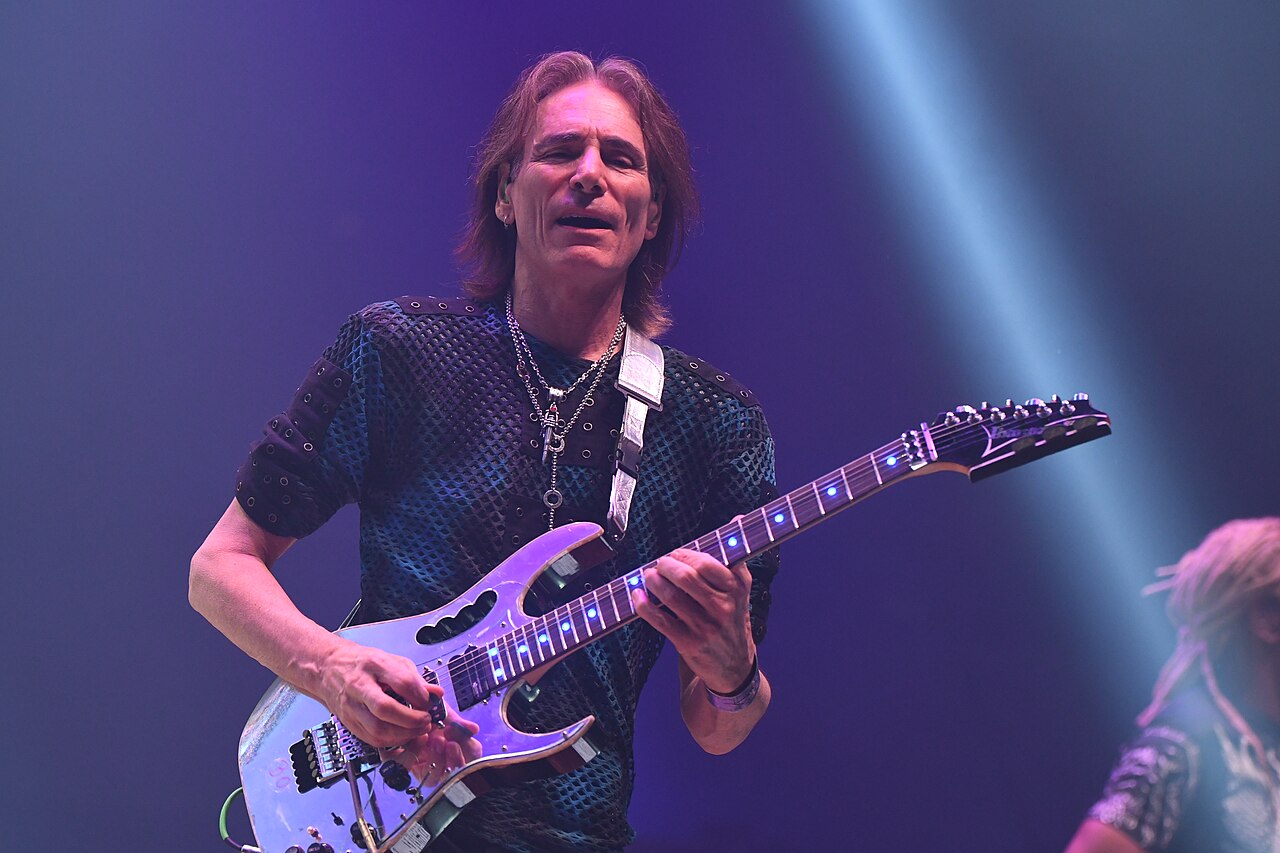
- Steve Vai: Wojciech Pędzich, Wikimedia Commons, CC BY 4.0.
- Tim Henson: by Drew de F Fawkes from Guildford, Wikimedia Commons, CC BY 2.0.


Latest News
On This Day
Monday 9 November
From this week: