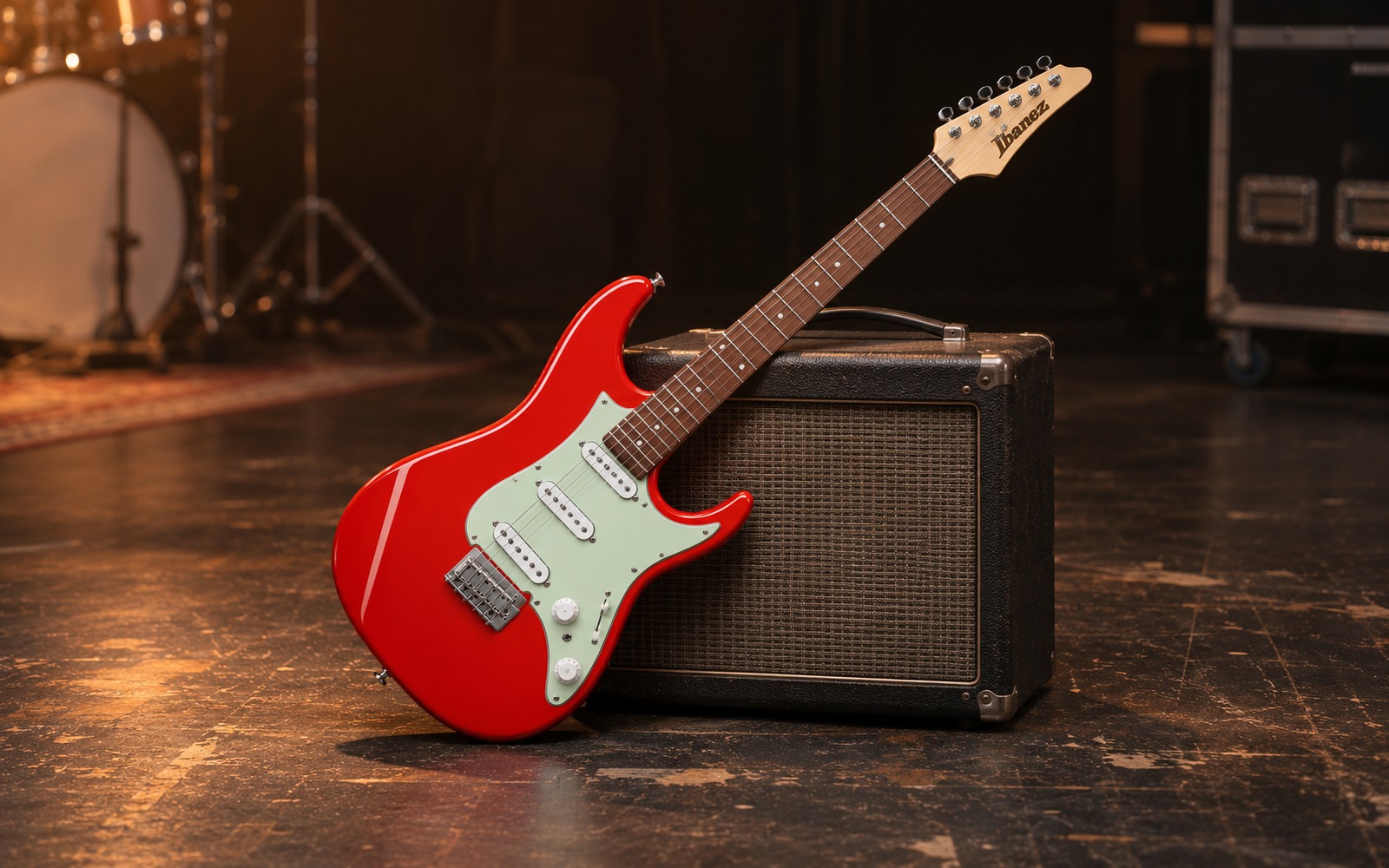
Ibanez AZES31: The Guitar John Mayer’s Teacher Built
No Ibanez shredder ever touched the AZES31 — it was designed by Tomo Fujita, the Berklee professor who mentored a young John Mayer.
The Ibanez AZES31 is a $299 beginner instrument, and Equipboard’s own tracking shows zero professional artists documented using it at all. No touring shredder builds a rig around a hardtail single-coil starter guitar.
But the AZES31 does have a real designer story, and it’s arguably more interesting than another recycled shred name would have been. This guitar was built in direct collaboration with Tomo Fujita, the Berklee College of Music professor who spent years mentoring a young John Mayer, along with Soulive’s Eric Krasno and Lettuce’s Adam “Shmeeans” Smirnoff during their own formative years at the school. The AZES31 isn’t a guitar any famous player picked up. It’s a guitar a famous teacher helped design.
A Budget Guitar With an Unusual Pedigree
Tomo Fujita: The Teacher Behind the Design
Fujita moved to the United States in 1986 on a full scholarship to Berklee, became the first Japanese winner of the Boston Guitarist Competition in 1991, and joined Berklee’s guitar faculty in 1993, where he remains today. His teaching philosophy centers on feeling over technical showmanship — injecting real emotion into every phrase, whatever the genre — and it’s a philosophy that shaped some genuinely well-known students. Beyond Mayer, Krasno, and Smirnoff, Fujita has gone on to mentor UK musician and producer Tom Misch and multiple Latin Grammy winner Juanes through his online lesson platform, Guitar Wisdom. He’s shared stages with Phil Collins, bassist Darryl Jones (Miles Davis, Sting, the Rolling Stones), and blues guitarist Ronnie Earl, and spent a stint performing in the Tony Award and Pulitzer Prize-winning musical Rent. His own performing history extends well beyond the classroom — he’s played alongside Will Lee, Steve Gadd, Bernard Purdie, and Steve Jordan, and more recently sat in with blues guitarists Eric Gales, Josh Smith, and Kirk Fletcher, funk favorites Pigeons Playing Ping Pong, and even joined Cory Wong for a session in Tokyo. He also remains closely tied to Japan’s guitar scene despite three decades living in the US, touring the country several times a year, where his Japanese-language instructional books and videos have sold more than 160,000 copies.
Why the AZES Line Exists
When Ibanez approached Fujita about designing a beginner instrument, he framed the goal around removing friction between a new player and the joy of playing, telling Guitar World the project was meant to “focus on what makes guitar playing fun.” The result, launched in October 2021 alongside its HSS-and-tremolo sibling the AZES40, extends the AZ series’ design philosophy — the same oval-profile neck comfort and versatile switching found on the pricier AZ2204 and AZ2402 Prestige models — down into genuinely beginner-friendly territory, built in Indonesia rather than Japan and priced at a fraction of the Prestige tier’s cost.
Where the AZES Sits in Ibanez’s Broader Lineup
Ibanez’s electric guitar catalog runs on a fairly clear tier system: J.Custom and Prestige at the top (both Japanese-built), Premium in the upper-middle tier, and a wide field of Indonesian and Chinese-built Standard, Iron Label, GIO, and Essentials-branded guitars filling out the accessible end of the range. The AZES line occupies a genuinely distinct pocket within that budget tier — rather than simply scaling down an existing shred-oriented design the way many entry-level GIO guitars do, it was built from the ground up as its own beginner-focused interpretation of the AZ platform, with an actual working musician-educator shaping the brief from day one rather than a marketing team reverse-engineering a cheaper version of an existing flagship.
Anatomy of the AZES31
Body and Neck
The body is poplar, chosen for a lightweight feel and a well-balanced tone with more thickness than its low price might suggest. It’s bolted to a maple neck in Ibanez’s own AZES C profile, paired with a jatoba fretboard — a reddish-brown tonewood praised for a rich midrange and crisp top end, increasingly common on budget-tier guitars as a rosewood alternative. The scale length is a slightly shortened 25 inches rather than the standard 25.5, a deliberate choice Ibanez says makes the guitar more approachable for younger or smaller-handed players without feeling like a toy. Twenty-two medium frets sit on a 250mm (roughly 10-inch) fretboard radius — flatter than a vintage Fender curve, rounder than a shred-oriented board, landing in genuinely comfortable territory for both chords and single-note lines. The nut measures a relatively narrow 42mm, worth knowing if you’re coming from a wider-necked guitar.
Electronics
Three Essentials single-coil pickups — passive, ceramic-magnet units built specifically for this line — sit in an SSS configuration, delivering the bright, spanky voice associated with classic single-coil guitars. What elevates the electronics well beyond typical beginner-guitar territory is the dyna-MIX8 switching system: a standard five-way blade switch paired with a two-way Alter mini-toggle, together unlocking eight distinct tonal combinations, including a series-wired mode that convincingly approximates a humbucker tone from two single coils. It’s the same switching philosophy found on Ibanez’s considerably pricier AZ Prestige models, scaled down but not stripped of its actual functionality — genuinely unusual generosity at this price point.
Bridge and Hardware
A hardtail F106 bridge with comfort-round steel saddles handles tuning stability, paired with Ibanez’s own split-shaft die-cast machine heads — a design that protects against dust ingress and speeds up string changes. The AZES31 also carries over two details usually reserved for much higher-tier Ibanez guitars: an all-access neck joint for genuinely unimpeded upper-fret reach, and a mono-unit output jack machined from a single piece of material specifically to prevent the loosening and crackling that plagues cheaper jack assemblies over years of use.
Who Actually Played It — Setting the Record Straight
Steve Vai, Joe Satriani, Paul Gilbert, Nita Strauss, and Tim Henson remain, as they have across this entire run of Ibanez coverage, without any documented connection to this specific guitar — and here, the mismatch isn’t even close. Each of the five has spent their career on dedicated high-end signature instruments built for extended technique and high-gain tone: Vai’s JEM and PIA guitars, Satriani’s JS series, Gilbert’s PGM line, Strauss’s JIVA series, and Henson’s THBB10 and AZ-based instruments. None of them has any professional reason to be photographed with a $299 hardtail single-coil beginner guitar, and Equipboard’s own artist-usage tracking for the AZES31 confirms it — the listing shows no documented professional players at all, a clean, honest zero rather than a stretched connection.

What the guitar does have is Tomo Fujita’s own enthusiastic use of it in his instructional content, along with a small but genuinely devoted community of hobbyist owners on his Guitar Wisdom subscription platform. Fujita has stayed personally engaged with that community well past the guitar’s launch, responding directly to fan posts about their own AZES31 purchases, colorway preferences, and setup questions years after the model first shipped. Several owners in that community describe buying two or three AZES31s in different finishes simply because they enjoy the guitar so much, and at least one specifically uses their AZES31 as a dedicated travel companion for a portable practice amp — a small but telling sign of a guitar that’s found genuine long-term affection rather than being outgrown the way beginner instruments often are. It’s a different kind of endorsement than a festival headliner’s signature model — closer to a trusted teacher’s own students sticking with the gear their teacher recommended.
The AZES31’s Place in Ibanez’s Family Tree
The AZES31 and AZES40 remain, as of this writing, the only two models in the AZ Essentials sub-line, distinguishing them from the far larger AZ2204/AZ2402 Prestige family and the deeper GIO and Iron Label catalogs elsewhere in Ibanez’s budget offerings. Where those other budget lines generally scale down specs from an existing higher-tier model, the AZES pair was conceived as its own project from the outset, with Fujita involved in decisions down to the fretboard radius and switching logic rather than simply having his name attached after the fact. That distinction matters for how the guitar plays: reviewers consistently note the AZES31 doesn’t feel like a stripped-down AZ2204 so much as its own complete instrument that happens to share a family resemblance.
Tone Recipes for the AZES31
Classic Spank and Twang
Bridge single-coil alone, amp clean channel, light reverb. This is the AZES31 doing its most obvious job — the bright, cutting tone the SSS layout was built for, ideal for country, funk, and classic rock rhythm work.
Blues and Funk Rhythm (Fujita Territory)
Positions 2 or 4 on the five-way switch (neck-plus-middle or middle-plus-bridge), amp with a touch of breakup. These in-between “quack” tones are where a lot of blues and funk rhythm playing lives, and the AZES31’s pickups handle them with genuine clarity for the price.
Rock Lead with the Alter Switch Engaged
Neck and bridge pickups combined via the Alter switch’s series mode, amp gain pushed moderately. This is the closest the AZES31 gets to a humbucker-style lead tone — thicker and less brittle than a standard single-coil combination, useful for players who want one guitar to cover both clean and driven territory without a pedal in front of it.
First-Recording Practice Tones
Middle pickup alone, amp or interface clean channel with a touch of compression. The middle single-coil’s balanced output makes it a forgiving starting point for anyone recording practice takes on a phone or laptop, avoiding both the thin edge of the bridge pickup and the slightly boomy low end some single-coil necks carry.
Getting the Most Out of a First AZES31
New owners tend to get the best results by leaving the stock D’Addario EXL110 strings (.010-.046 gauge) in place for the first several months — they’re a genuinely sensible medium gauge for the guitar’s 25-inch scale, and swapping to lighter strings before developing calluses can actually make early bends and vibrato harder to control rather than easier. Pairing the guitar with a small modeling amp or interface, rather than jumping straight to a full tube stack, tends to suit the AZES31’s clear, versatile pickup voicing particularly well — the guitar’s eight-way switching already offers enough tonal variety that a simple clean-to-light-breakup amp setup can cover an enormous range of practice material without needing a pedalboard. For players who do eventually want to experiment with modifications, a treble-bleed circuit on the volume pot is the most commonly recommended first step, preserving high-end clarity when rolling the volume down for rhythm work — a cheap, reversible upgrade that doesn’t require touching the guitar’s core electronics.
The AZES31 Against Its Family and Its Competition
Within its own family, the AZES31’s closest relative is the AZES40, which trades the third single-coil for an Accord humbucker at the bridge and adds a T106 tremolo bridge — a meaningfully different guitar for players who want vibrato and a hotter bridge tone rather than the AZES31’s simpler, more vintage-leaning hardtail approach. Stepping up in the AZ family, the AZ2204 and AZ2402 Prestige carry the same design philosophy — versatile switching, a comfortable oval neck — into genuinely professional-grade territory with Seymour Duncan pickups and Japanese construction, at roughly seven times the price.
Against its actual budget-tier competition — Squier Stratocasters, Yamaha Pacificas, and similar entry-level instruments — reviewers consistently note the AZES31 punches meaningfully above its price bracket. The dyna-MIX8 switching system alone offers more tonal range than most guitars at this price point even attempt, and construction details like the all-access neck joint and mono-unit output jack are the kind of refinements typically reserved for guitars costing two or three times as much. One owner comparison specifically singled out the AZES31’s factory setup and fretwork as competitive with guitars from Ibanez’s own higher Standard tier, a genuinely unusual compliment to pay an instrument built to sell at $299.

Buying Guide
- Know your colorway. The AZES31 launched in Vermilion (VM) and Ivory (IV), with an Arctic Ocean (AOC) finish added later — check which colors are currently in stock, since availability shifts by region and season.
- Budget for a gig bag separately. Reviewers consistently note the AZES31 doesn’t include a case or gig bag at this price point — a reasonable trade-off, but one to plan for if you need to transport the guitar right away.
- The electronics cavity runs narrow. Players looking to modify the guitar with full-sized pots note the control cavity is closer in size to entry-level guitars like the Squier Bullet than to a standard-size cavity, so factor that in before planning upgrades.
- Don’t assume “beginner” means “temporary.” Multiple long-term owners — including some using it as a dedicated travel guitar alongside portable amps — describe keeping the AZES31 in active rotation well past their beginner years, a genuine testament to the build quality Ibanez packed into this price point.
- Check regional pricing before buying. The AZES31 launched at $299 in the US and £299 in the UK, but currency conversion and import costs mean the actual retail price can vary more than a simple exchange-rate calculation would suggest — worth comparing a couple of retailers before committing.
- Availability fluctuates by finish and region. As a lower-margin, high-volume model, individual colorways periodically go out of stock for months at a time rather than being permanently available — if you have a specific finish in mind, it’s worth checking multiple retailers rather than assuming direct availability.
Living With One: Ownership Notes
Owner sentiment on the AZES31 is close to unanimously positive, with particular praise for out-of-the-box setup quality — reviewers repeatedly note good factory action, clean fretwork with no sprout, and accurate intonation straight from the box, a genuine rarity at this price point. The neck draws consistent compliments for its smooth feel, with at least one detailed owner report noting that a simple Tru-Oil refinish on the back of the neck brought the feel up to a level comparable with much pricier Music Man necks. The most common owner-side modification isn’t a pickup swap but small electronics tweaks, since the stock volume and tone pots (B500K and A500K respectively) are already considered a sensible baseline rather than something in obvious need of replacement. The most frequently repeated criticism across owner discussion isn’t about tone or build quality at all — it’s the missing gig bag, a minor gap at a price point where most buyers are picking up their very first guitar case as well.
Perhaps the most telling piece of owner feedback comes from a buyer who described owning seven Ibanez guitars across a career of collecting — six built in Indonesia and one in Japan — and singled out the AZES31 as the best value of the entire collection, a genuinely striking endorsement from someone with direct comparison points across Ibanez’s full range of tiers rather than a first-time buyer with no frame of reference.
Frequently Asked Questions
Did any famous Ibanez artists play the AZES31?
No documented professional artist connections exist for this model — Steve Vai, Joe Satriani, Paul Gilbert, Nita Strauss, and Tim Henson all have their own high-end signature Ibanez instruments built for a completely different purpose. The AZES31’s real story is its design collaboration with Berklee professor Tomo Fujita, mentor to John Mayer and other well-known players.
Who is Tomo Fujita and why did he design a budget Ibanez guitar?
Tomo Fujita is a Berklee College of Music guitar professor who has taught since 1993, with former students including John Mayer, Soulive’s Eric Krasno, and Lettuce’s Adam Smirnoff. He worked directly with Ibanez to design the AZES31 and AZES40, aiming to build an affordable instrument good enough that beginners could focus on playing rather than fighting the guitar.
What’s the difference between the AZES31 and the AZES40?
The AZES31 has three single-coil pickups (SSS) and a hardtail bridge, while the AZES40 swaps in an Accord humbucker at the bridge (HSS configuration) and adds a tremolo system. They share the same body, neck construction, and dyna-MIX switching philosophy.
Is the AZES31 a good first guitar?
Yes — it’s specifically designed for that purpose, with consistently positive reviews noting excellent factory setup, comfortable neck feel, and genuinely versatile electronics via the dyna-MIX8 system, all at a beginner-friendly price point.
What pickups come stock in the AZES31?
Three Essentials single-coil pickups, passive with ceramic magnets, in an SSS configuration wired through a five-way blade switch and two-way Alter mini-toggle for eight total tonal combinations.
Does the AZES31 come with a case or gig bag?
No — the guitar is sold on its own, and reviewers consistently flag a case or gig bag as a worthwhile separate purchase, particularly for younger players who will be transporting the guitar to lessons.
How much does an Ibanez AZES31 cost?
New pricing runs around $299, with used listings sometimes available below $200 depending on condition and retailer.
Image credits
- Top image: GuitarGangsters AI-generated reference illustration, not a photograph.
- Paul Gilbert: matt barsden, Wikimedia Commons, CC BY-SA 2.0.
- Steve Vai: Wojciech Pędzich, Wikimedia Commons, CC BY 4.0.
Latest News
Related


On This Day
Monday 9 November
From this week: