Ibanez JS2410 Joe Satriani Signature: The Guitar That Finally Caught Up With Satch
The Ibanez JS2410 finally solved Joe Satriani's 24-fret dilemma. History, specs, tone recipes, and honest ownership notes on the Muscle Car Orange icon.
In the spring of 2026, Joe Satriani and Steve Vai are doing something they have never done in nearly fifty years of friendship: touring as a proper band. The SATCHVAI Band’s “Surfing With the Hydra” run crosses North America this year, two teenage guitar students from Long Island now sharing a stage as co-leaders rather than teacher and pupil. It’s a fitting moment to look at the guitar that carries Satriani’s own name into that spotlight — the Ibanez JS2410, the model that took a twenty-three-year-old promise and finally, properly, delivered on it.
That promise was simple: Satriani wanted 24 frets on his signature guitar without sacrificing the tone of his beloved neck humbucker. It took Ibanez until 2010 to solve the puzzle, and three more years after that to refine the solution into the JS2410 — the guitar most JS players consider the high-water mark of the entire series. Dressed in a paint job inspired by a 1970s muscle car and built around a set of pickups designed specifically for it, the JS2410 is where three decades of collaboration between one guitarist and one guitar company reached its most complete expression.
A Guitar Born From a Teacher-Student Bond
The JS story doesn’t start with Satriani walking into Ibanez’s offices. It starts two years earlier, on Long Island, in a guitar lesson. Steve Vai was Satriani’s student in high school, two years behind him, and it was Vai who years later put in the word that brought his old teacher to Ibanez’s attention. By 1987 Satriani had just finished recording “Surfing with the Alien,” an album that would go platinum and turn an unassuming guitar teacher into one of the most influential instrumentalists of his generation. Vai, already deep into what would become the JEM partnership (a story told in full in our look at the JEMJR and PIA3761), sent Satriani an Ibanez guitar to get his opinion on the build quality. Satriani loved it, and particularly loved its Floyd Rose-style bridge — a real upgrade from the Kramer Pacer he’d used on his first three records.
That first guitar, delivered through Ibanez artist relations man Rich Lasner, became the instrument fans now call the “Black Dog”: a battered, hand-doodled workhorse that Satriani played through the late ’80s and into the ’90s while Ibanez used it as a template for what would eventually become the JS series. The Black Dog was never meant to be a finished product — it was a testing ground, refined again and again as Satriani and Ibanez’s engineers worked out exactly what a Satriani signature guitar should feel like. When the series formally launched in 1990 with the JS1, JS2 (“Chromeboy”), and JS3, it was already the product of three years of prototyping between one player and one factory.
From JS1 to JS2410: Twenty-Three Years to Solve One Problem
The JS1 evolved steadily through the ’90s — a neck refinement in 1991, another in 1992 that also brought an HSH pickup configuration and the Lo Pro Edge tremolo, then a rebrand to JS1000 in 1994 once the original run ended. The JS1200 arrived as the Prestige-tier flagship, instantly recognizable in its Candy Apple Red finish and carrying a neck pickup — the PAF Joe — built specifically to Satriani’s spec. For most of two decades, this was the ceiling of the JS line: a 22-fret, basswood-bodied superstrat with a personalized neck profile and a small, devoted following among players who wanted Satriani’s exact feel.
The 22 frets bothered Satriani more than most fans realized. In an interview years before the eventual fix, he explained the tension directly: I’ve always liked the idea of having those frets up there
— but he refused to simply shove the neck humbucker further from the fingerboard to make room, the way most 24-fret guitars solve the problem, because it would have wrecked the tone he’d spent years dialing in. The compromise finally arrived in 2010 with the JS2400, which used a specially engineered DiMarzio Pro Track — a full humbucker built into a single-coil-sized housing — to squeeze into the tighter space near the 24th fret without losing output or character. It was the first 24-fret JS in history, built on a basswood body with a one-piece maple neck, and it proved the concept could work.
The JS2410, introduced in 2013, is what happened when Ibanez took that proof of concept and rebuilt it as a proper flagship. Rather than simply repeating the JS2400’s formula, Satriani asked for a different body wood entirely. I was looking for a body that would give me a bit more punch,
he said of the switch, landing on alder for its brighter, more articulate low end compared to basswood’s softer voice. It was the first JS body ever made from alder, and it came paired with the JS series’ first three-piece neck — maple with a center strip of bubinga for added stiffness and sustain — rather than the one-piece maple used on every JS before it.
Muscle Car Orange and the Satch Track
The JS2410’s signature finish has its own small piece of automotive folklore behind it. During a Chickenfoot rehearsal, Satriani wandered into a shop across the street and found a 1973 Camaro finished in a striking orange with chrome trim spilling out from under the hood. He photographed it on the spot, and the color stuck with him for years before Ibanez finally matched it for the guitar’s launch finish, officially dubbed Muscle Car Orange. Satriani had originally wanted the full Camaro treatment — orange with white racing stripes — but Ibanez couldn’t guarantee consistent stripe alignment across a full production run, so the stripes were dropped and the orange stayed. A Sky Blue finish joined the lineup in 2021, and the hardware on early orange units was finished in a matte “Cosmo Black” rather than chrome to match the retro theme, though most later production reverted to standard chrome.
Under the hood, the JS2410 also introduced a new pickup. The JS2400’s Pro Track was retuned into the DiMarzio Satch Track, voiced with less midrange and bass and considerably more top-end clarity than its predecessor, still paired with the familiar Mo’ Joe humbucker at the bridge. Both pickups route through a three-way toggle and a pair of push/pull controls: a volume knob with an always-available high-pass filter that keeps top end intact even at lower volumes, and a tone knob with a coil-split for thinner, more Strat-like voicings on demand. The JS2410 was also the guitar that introduced Ibanez’s Ultralite Tremolo Arm, a carbon-fiber replacement for the standard steel bar that Satriani and Ibanez tested through months of touring on the Chickenfoot and Unstoppable Momentum cycles before it went into production — a detail that later became standard across the entire JS Prestige range.
On the Road and in the Studio
The JS2410 arrived in Satriani’s rig right as he was touring behind “Unstoppable Momentum” (2013), and it became a recurring stage instrument through the Chickenfoot years and into his later solo albums, including “Shockwave Supernova” (2015) and “What Happens Next” (2018). It’s rarely been his sole guitar on any given tour — Satriani typically rotates between several JS models depending on tuning and song — but the JS2410’s brighter alder-driven voicing made it a favorite for the more aggressive, riff-heavy material in his catalog, where the JS1200’s rounder basswood tone doesn’t cut through a dense mix quite as cleanly.
Full Specifications
Dialing In Satch’s Tone: Amp and Pedal Recipes
Satriani’s amp history is a moving target — Marshall in the early years, a Peavey JSX signature series through the Chickenfoot era, and a return to Marshall in 2010 with a customized JVM410HJS that remains his main live amp today. His own advice on the subject is worth taking at face value: Don’t worry about Peavey vs Marshall; worry about what sets you free.
That said, three usable recipes:
Recipe 1: Clean Channel Foundation
Amp clean channel, moderate gain, generous headroom. Add a Vox Satchurator (or any tight-clipping distortion pedal) in front for crunch and lead tones rather than relying on the amp’s own gain stages — this mirrors Satriani’s own long-running preference for pedal-driven distortion into a clean, spacious amp platform.
Recipe 2: Vintage Fusion Voice
Bridge pickup (Mo’ Joe), tone control rolled back slightly, coil-split engaged via the push/pull tone knob for a thinner, quack-adjacent voice reminiscent of Satriani’s more melodic instrumental work. Pair with a touch of plate reverb and light compression.
Recipe 3: Solo Lead Tone
Both pickups, tone and volume wide open, high-pass filter engaged. Add an overdrive like the Xotic BB Preapmp as a clean boost into a cranked amp channel, finished with a wah (Vox Big Bad Wah or similar) rocked partway for a vocal, mid-forward lead sound.
JS2410 vs. Its Siblings
The JS2410 doesn’t exist in isolation — it sits in a small, tightly related family of 24-fret JS models that can be confusing to compare from spec sheets alone.
JS2400 (2010-2015): The trailblazer. Basswood body, one-piece maple neck, DiMarzio Pro Track neck pickup. Softer, rounder tone than the JS2410 thanks to the basswood body, and the model that proved 24 frets could work on a JS without sacrificing the neck pickup’s character.
JS2410 (2013-present): The refinement covered in this article. Alder body, three-piece maple/bubinga neck, Satch Track pickup, Ultralite Tremolo Arm, Muscle Car Orange or Sky Blue finish.
JS2450 (2014-present): Essentially a JS2410 in a different outfit — same alder body and 3-piece neck, but finished in a deep “Muscle Car Purple” sparkle with chrome-covered pickups rather than the JS2410’s color-matched bobbins.
JS1200: The 22-fret Prestige flagship that predates the 24-fret models and remains in production alongside them for players who prefer the more traditional JS proportions and the PAF Joe neck pickup over the Satch Track.
JS24P / JS100: Lower-tier entries built to more accessible price points, with simpler woods and finishes; useful as an entry into JS ownership but generally regarded by long-time owners as a step down in neck quality from the Prestige-tier models.
Buying Guide: Which JS Is Right for You
If you want the most complete expression of what a modern JS can be — alder punch, the refined Satch Track pickup, and the smoother-playing Ultralite tremolo arm — the JS2410 is the one to chase, whether new or used. If you specifically want Satriani’s classic, decades-proven 22-fret tone and don’t need the extra two frets, the JS1200 remains a legitimate alternative and tends to sell for similar money on the used market. Players drawn purely to color and willing to pay a premium for rarity might prefer hunting down a JS2450 in Muscle Car Purple, functionally identical to the JS2410 but visually distinct. Avoid the entry-level JS100 if your goal is to actually experience Satriani’s neck feel — multiple long-time JS owners describe it as a different (and lesser) instrument entirely, built to a price rather than to spec.
One more consideration for used buyers: the JS2410’s alder body and 3-piece neck construction sets it apart tonally from every basswood JS that came before it, so if you already own an older JS1000 or JS1200 and are considering the JS2410 as a second guitar rather than a replacement, expect a genuinely different voice rather than a marginal upgrade — brighter, tighter low end, and a touch more percussive attack from the Satch Track’s ceramic magnet compared to the Alnico-loaded PAF Joe found on the JS1200.
Living With a JS2410: Ownership Notes and Known Quirks
Out-of-box quality on the JS2410 is consistently praised in owner reports — fretwork in particular draws repeat comments about needing little to no setup work beyond minor action adjustments, a testament to the FujiGen factory’s Prestige-tier attention. The satin neck finish is a near-universal favorite, and more than one owner comparing the JS2410 side by side with older JS1000s and JS1200s has noted that the newer guitar’s rounded edge contouring makes older, squarer-edged Ibanez designs feel comparatively unrefined by comparison.
Two recurring complaints are worth flagging honestly. First, a “sunken paint” cosmetic issue has been reported around edges and contours on some Muscle Car Orange units — a finish-shrinkage problem that doesn’t affect playability or tone but is a fair ding against a guitar in this price bracket. Second, at least one long-term owner has reported the Satch Track neck pickup developing microphonic squeal and feedback at high gain over time, requiring careful height adjustment to balance against the Mo’ Joe bridge pickup without losing output. Neither issue appears to be universal, but both are worth checking for on a used purchase.
Worth noting for anyone with larger hands: the JS2410’s neck, while wider than a typical Ibanez Wizard profile, still measures on the smaller side compared to a lot of modern superstrats, and the guitar’s ergonomics generally favor players with small-to-medium hand sizes. Players coming from thicker vintage-style necks may want to try one in person before buying sight unseen.
The Satriani Circle
Satriani’s own playing history is inseparable from a remarkable list of former students who went on to shape rock and metal in their own right — Metallica’s Kirk Hammett, Testament’s Alex Skolnick, Primus’s Larry LaLonde, and Charlie Hunter all passed through his teaching studio in the Bay Area before Satriani’s own solo career took off with “Surfing with the Alien” in 1987. That teaching lineage, paired with his three-decade partnership with Ibanez and his ongoing musical partnership with Vai — now touring together as bandmates rather than mentor and student for the first time in their nearly fifty-year friendship — makes the JS2410 less a single artifact and more a snapshot of an entire ecosystem of instrumental rock guitar that Satriani helped build from the ground up.
That ecosystem also includes the G3 tour, which Satriani founded in 1996 pairing himself with two other lead guitarists each run — Vai and Eric Johnson on the original outing, with later editions featuring everyone from John Petrucci and Yngwie Malmsteen to Steve Lukather and Kenny Wayne Shepherd. The original G3 lineup reunited in 2024 for a sold-out run captured on the live album “Reunion Live,” a reminder that Satriani’s influence runs through both the students he taught directly and the generation of virtuosos he’s shared stages with for three decades.
FAQ
Is the JS2410 still in production?
Yes, alongside the JS2450 and JS1200, the JS2410 remains part of Ibanez’s current JS Prestige lineup as of 2026.
What’s the real difference between the JS2410 and JS2400?
Body wood (alder vs. basswood), neck construction (3-piece maple/bubinga vs. 1-piece maple), and pickup voicing (Satch Track vs. Pro Track). The JS2400 was discontinued in 2015; the JS2410 continues.
Does the JS2410 have a coil-split?
Yes, activated via the push/pull tone control, alongside a separate push/pull high-pass filter on the volume control.
Is the JS2410 a good guitar for beginners?
Not really the target market — its thinner-than-average neck profile favors intermediate to advanced players, and the price point puts it well above typical beginner instruments.
What amp does Joe Satriani actually use live?
A customized Marshall JVM410HJS since 2010, following an earlier run with his own Peavey JSX signature amp during the Chickenfoot years.
Image credits
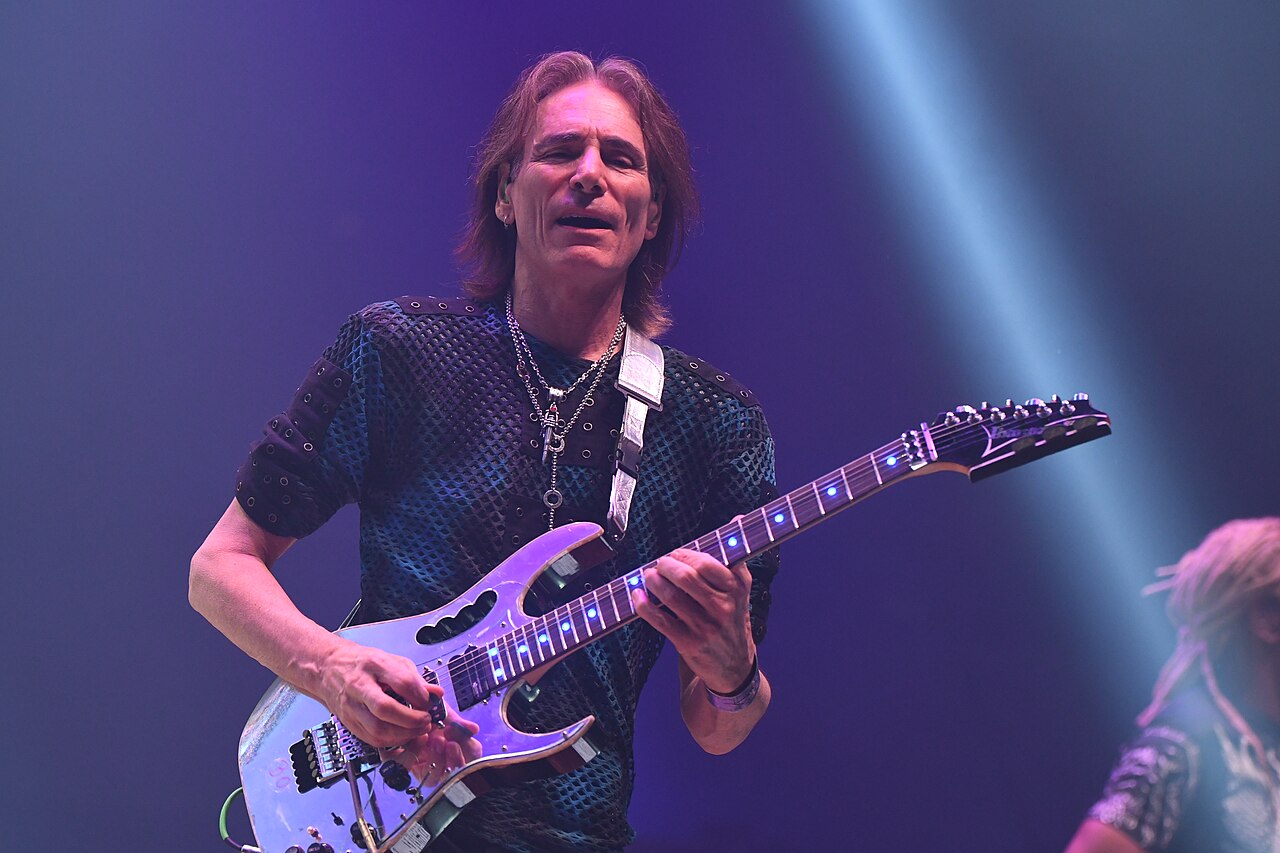
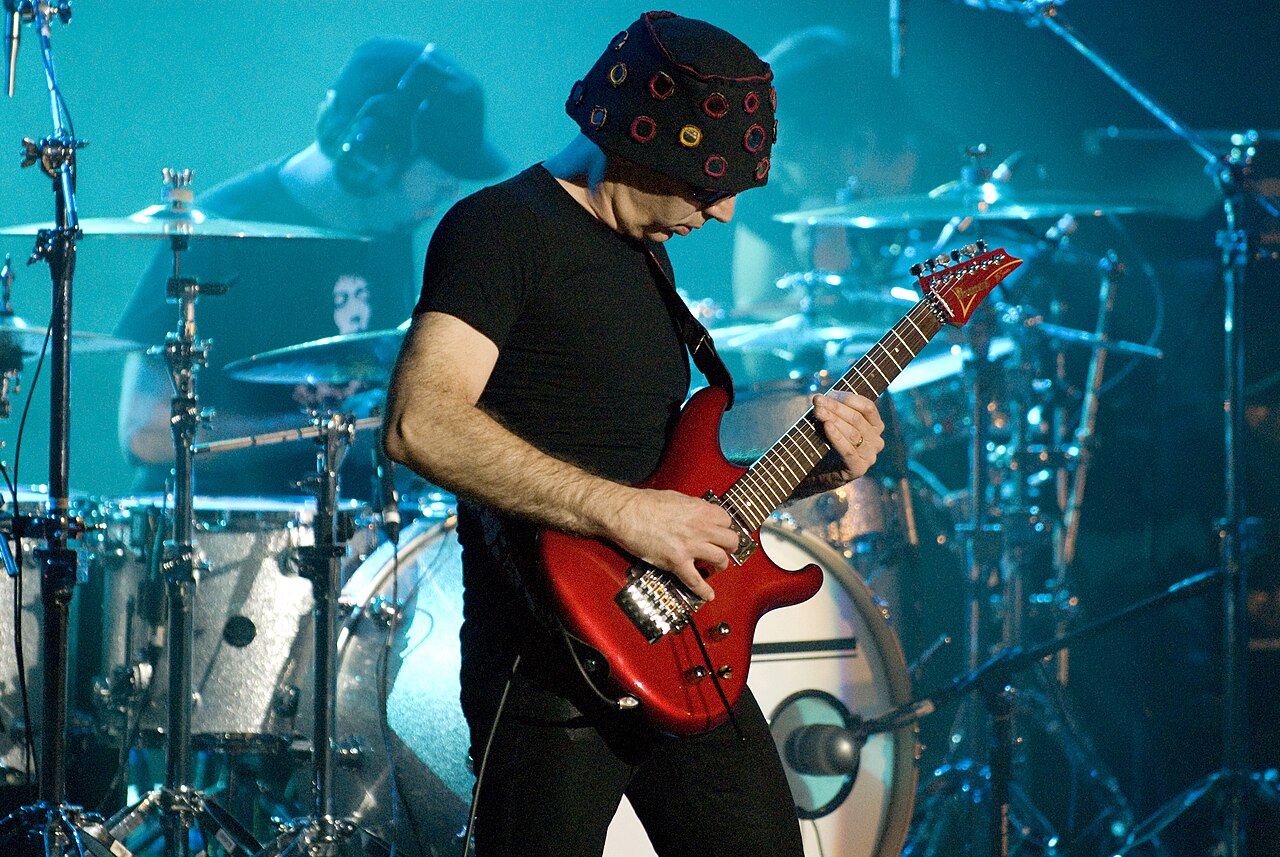
- Joe Satriani: livepict.com, Wikimedia Commons, CC BY-SA 3.0.
- Steve Vai: Wojciech Pędzich, Wikimedia Commons, CC BY 4.0.
Latest News
Related
On This Day
Monday 9 November
From this week: