Alex Skolnick Guitars & Gear: The Complete Guide to Testament’s Jazz-Schooled Shred Guitar Hero’s Rig
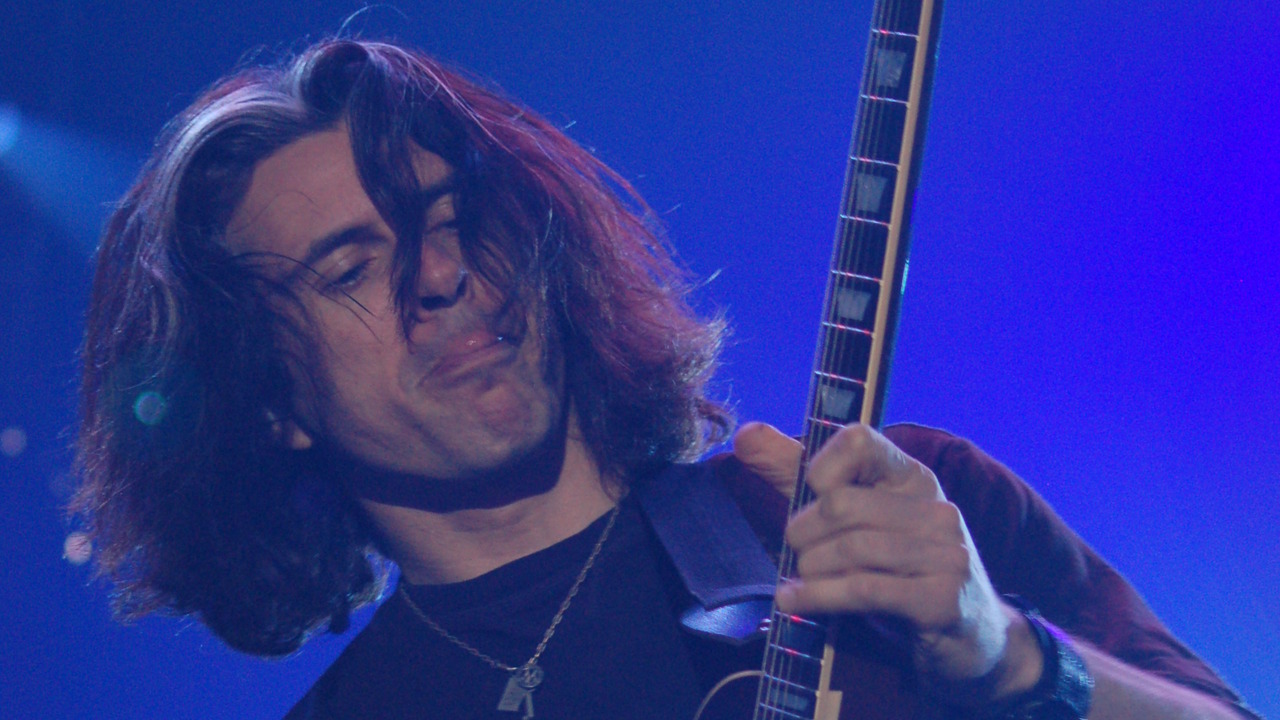
Alex Skolnick with Testament at Metalmania, 24 March 2007. Photo: Małgorzata Miłaszewska (Lilly M), “Metalmania 2007 - Testament - Alex Skolnick 03”. Source: https://commons.wikimedia.org/w/index.php?curid=1888014. CC BY-SA 2.5: https://creativecommons.org/licenses/by-sa/2.5/. Cropped to a 16:9 portrait and resized; this derivative is also CC BY-SA 2.5.
Alex Skolnick is the only guitarist in this series who left one of the Big Four thrash metal bands at the peak of their commercial success to go study jazz — not to hedge his career bets, not as a promotional strategy, but because jazz was genuinely what he needed to learn and thrash metal, for a period, was not giving him what he needed musically. He left Testament in 1993 after The Ritual album, spent twelve years developing his jazz vocabulary through the Alex Skolnick Trio and serious formal study, and returned to Testament in 2005 with a musical intelligence that had been expanded in directions that thrash metal alone couldn’t have produced. The result is one of the most complete guitarists in heavy metal: a player who can execute technically demanding thrash metal lead work at the highest level, improvise over complex jazz changes with genuine harmonic sophistication, and move between these two apparently contradictory musical contexts with the fluency of someone who has understood both deeply enough to see how they relate. Guitar World identified “Alex’s note choices, use of scales and arpeggios, and classy vibrato” as “a perfect recipe for his metal guitar legend status.” The jazz education is why those qualities are present. The thrash metal foundation is why they hit as hard as they do.
Alex Skolnick was born on September 29, 1968, in Berkeley, California — a biographical detail that is simultaneously the least surprising and most revealing fact about him. Berkeley in the 1960s and 70s was the epicenter of every musical and cultural experiment that the broader American counterculture produced, and growing up in that environment — with its deep jazz tradition, its classical music culture, its progressive politics, and its specific quality of intellectual seriousness about artistic questions — produced a musician who took the question of what guitar playing could be with a depth of engagement that the purely genre-focused approach doesn’t easily accommodate. He began playing guitar at eight, studied jazz theory formally, and at thirteen encountered Joe Satriani as a teacher — the same Satriani who taught Steve Vai, Kirk Hammett, and Larry LaLonde, and whose pedagogical approach combined rigorous technical demands with genuine musical context. The Satriani teaching relationship gave Skolnick both the technical foundation he needed for the thrash metal context and the broader musical vocabulary that the jazz studies subsequently developed.

He joined Testament in 1983 at fourteen — an age at which most guitarists are still working out their first scales — and his recorded contributions to the classic Testament catalog (The Legacy, 1987; The New Order, 1988; Practice What You Preach, 1989; Souls of Black, 1990; The Ritual, 1992) established him as the most harmonically sophisticated lead guitarist in Bay Area thrash. Where the genre’s guitar vocabulary was predominantly pentatonic and chromatic-passing-note based, Skolnick’s leads incorporated modal awareness, arpeggiated melodic figures, and a compositional approach to solo construction that reflected his formal musical training. The “Electric Crown” solo from The Ritual is the canonical example: a lead passage of genuinely unusual melodic intelligence for its context, executed at thrash metal speed, demonstrating that the genre’s technical demands and genuine musical sophistication are not mutually exclusive but can coexist in the work of a guitarist who has taken both seriously.
His gear approach reflects both worlds: for Testament, the core tone is a boosted Marshall or modern high-gain amplifier with the characteristic aggressive midrange of thrash metal lead and rhythm playing; for the Alex Skolnick Trio, a completely different signal chain — cleaner, warmer, more transparent — appropriate for jazz playing that requires the guitar to blend with acoustic bass and drums rather than cut through a wall of metal amplification. The ESP signature guitar functions for Testament; Heritage guitars function for the jazz context. The Kemper Profiler handles smaller gigs for both contexts, providing the tonal flexibility that a single physical amp cannot. He is, in gear terms as well as musical terms, the guitarist who operates comfortably in both worlds and has built the equipment arsenal to support that dual identity.
The return to Testament in 2005 — after twelve years of jazz work — was not the return of a prodigal son but the arrival of a more complete musician. The Dark Roots of Earth album (2012), the Brotherhood of the Snake (2016), and subsequent Testament recordings demonstrate a lead guitarist whose jazz vocabulary has been integrated into his metal approach rather than substituted for it: the harmonic sophistication is present in the note choices, the melodic intelligence is present in the solo construction, and the technical precision is present in the execution, but it’s all in service of the specific, aggressive musical environment of modern Testament. The jazz education made the metal playing better. This is the specific outcome that Skolnick’s career proves possible.
Background: Berkeley, Joe Satriani, and the Jazz Sabbatical That Made the Metal Better
The Testament origin story is one of thrash metal’s younger-prodigy chapters: Skolnick joined at fourteen, began recording professional metal albums at eighteen, and was established as one of the genre’s leading lead guitarists by his early twenties. The specific quality that distinguished him within the Bay Area thrash scene — the harmonic awareness, the compositional intelligence of the solo structures, the specific sound of a guitarist who knew more music theory than his genre usually required — was the direct product of the Berkeley musical environment and the Satriani teaching relationship that had preceded the Testament years.
Joe Satriani’s influence on Skolnick is documented and acknowledged: Skolnick studied with Satriani as a teenager in the Bay Area, during the same period that Satriani was developing the pedagogical approach that would later produce Steve Vai, Kirk Hammett, and others. The specific Satriani teaching philosophy — rigorous technical demands, genuine musical context, the understanding that technique serves musical expression rather than existing for its own sake — is directly visible in Skolnick’s approach to the guitar solo as a compositional form rather than a technical showcase. The “Electric Crown” solo is not primarily fast; it is primarily musical. The speed is in service of the melodic ideas, not the point of them.
His departure from Testament in 1993 — which occurred during the production of The Ritual album — came from genuine creative dissatisfaction rather than commercial calculation. The thrash metal scene’s commercial contraction in the grunge era made his timing practically difficult, but his motivation was authentic: he needed to learn jazz, and learning jazz required his full attention. The twelve years between 1993 and 2005 during which he developed the Alex Skolnick Trio and pursued formal jazz education represent one of rock music’s more serious artistic commitments — a guitarist at the top of his commercial genre choosing to be a student again because the music required it.
The Alex Skolnick Trio’s output — Goodbye to Romance: Standards for a New Generation (2002), Transformation (2004), Last Day in Paradise (2008), and subsequent recordings — documents the jazz development: straight-ahead jazz trio playing, covering standards and originals with the harmonic sophistication of someone who has absorbed the jazz tradition deeply enough to contribute to it rather than merely cite it. These albums are not vanity projects or genre experiments; they are serious jazz recordings that stand on their own terms and that demonstrate the musical breadth that the subsequent return to Testament then brought back to metal.
The Rig: Alex Skolnick’s Guitars, Amps, and Effects
Guitars
ESP Alex Skolnick Signature (Primary Testament Guitar — Handcrafted)
Skolnick’s primary guitar for Testament and heavy projects like Metal Allegiance is his ESP signature model, described in the Vintage Guitar interview as handcrafted and capturing everything he wants: “It feels effortless for moving around the neck and its fluidity. And, it has many tones. It’s my go-to guitar for Testament and other heavy projects.” The ESP Skolnick signature features a mahogany body with a contoured feel, a maple neck with an ebony fingerboard, Seymour Duncan JB humbucker in the bridge position and Seymour Duncan ’59 (or Jazz) in the neck position. The JB’s high-output, mid-forward character provides the aggressive attack needed for Testament’s rhythm guitar and the sustain necessary for thrash-tempo lead work; the ’59 or Jazz in the neck provides the warmer, more vintage-voiced character for the cleaner, more melodic lead tones that Skolnick’s jazz-informed approach requires in the neck position. The ESP is also available as the LTD Alex Skolnick signature — the more accessible production version of his ESP Custom Shop specification. He carries three ESP signatures on Testament tours: a silverburst model tuned to Eb (the primary tuning for most Testament songs), a tobacco-burst model for songs in C#, and a backup.
Heritage Alex Skolnick Signature (Jazz Context — Kalamazoo-Built)
For the Alex Skolnick Trio and jazz contexts, Skolnick uses his Heritage Guitar signature model — built in Kalamazoo, Michigan, at Heritage’s factory in the former Gibson plant. Heritage has his signature on the headstock; the guitar features a mahogany body, maple top, and Seymour Duncan ’59 Jeff Beck humbuckers — a significantly different specification from the ESP’s more metal-oriented configuration. The ’59 Jeff Beck pickups provide the warm, vintage-voiced character appropriate for jazz playing; the mahogany/maple body construction produces the balanced, warm tone that suits acoustic-adjacent trio contexts. The Heritage signature represents Skolnick’s dual-instrument philosophy: different guitars for genuinely different musical contexts, not the same guitar serving all purposes.
Ibanez Saber and SA Series (Classic Era — The New Order Through The Ritual)
The classic Testament recordings — The New Order, Practice What You Preach, Souls of Black, The Ritual — were recorded with Ibanez guitars, specifically the Saber series (S-style instruments with push/pull coil-splitting). The Saber’s push/pull coil-split configuration enabled the single-coil-like tones that some listeners have noted in Skolnick’s classic-era lead work — the “Electric Crown” solo’s specific tonal quality suggesting single-coil character that the coil-split Ibanez humbucker was providing. The Saber was a professional-quality superstrat that suited the technical demands of Bay Area thrash lead playing while providing the tonal flexibility of the coil-split pickup configuration.
Seymour Duncan JB (SH-4/TB-4) Bridge and ’59 (SH-1) or Jazz (SH-2) Neck (Signature Pickup Configuration)
The Seymour Duncan JB in the bridge and ’59 or Jazz in the neck is Skolnick’s consistent pickup pairing across his ESP signature instruments — a configuration that balances the aggressive bridge output needed for Testament’s high-gain lead work with the warmer, more melodically expressive neck character appropriate for the jazz-influenced melodic passages in his solos. “My guitars come equipped with Seymour Duncan pick-ups, a ’59 and JB,” he confirmed in the Metalsucks rig rundown, while noting he was developing a signature pickup with Seymour Duncan. The jazz education’s influence is directly visible in the pickup choice: the ’59 neck pickup has a significantly more vintage, more harmonically transparent character than the high-output alternatives that some thrash metal players prefer — a choice that reflects a guitarist who values the neck pickup’s tonal quality for genuinely musical reasons rather than just high gain.
Amps
Marshall Mode 4 Head (Primary Live — Heritage Guitar Era Rig Rundown)
The Premier Guitar Rig Rundown from the Heritage Guitar era documents a Marshall Mode 4 Head as Skolnick’s primary live amplification for Testament touring of that period. The Marshall Mode 4 is a solid-state Marshall head with a transistor-based preamp producing a high-gain character designed specifically for modern metal applications — an unusual choice given the general preference for valve amplification documented throughout this series, but consistent with the Mode 4’s specific high-gain character and its reliable, consistent performance across different touring environments.
Marshall JCM800 with Tube Screamer Boost (Classic Era — The New Order)
The classic Testament tone — the albums from The Legacy through The Ritual — was a boosted Marshall. “For ‘The New Order,’ that was an old Marshall, I think JCM 800, with a tube screamer. Also, I’d just gotten an ADA MP-1 pre-amp and may have used that.” The JCM800 with Tube Screamer boost is the foundational tonal approach — the same combination documented throughout this series as the standard for bay area thrash metal — with the ADA MP-1 providing additional preamp capability for specific passages. The Rig-Talk community research adds detail: “He used a Marshall Super Lead and ran an ADA MP-1 into the front of it and then into a ’70s Marshall 4×12 loaded with reconed 25-watt Celestions.” The combination of the ADA preamp’s complex gain architecture with the Marshall Super Lead’s EL34 power section and vintage 25-watt Celestions produces a specific, warm-but-aggressive tonal character that the classic Testament recordings document.
Budda AS Preceptor Signature Amp (2013 — NAMM Debut)
The Budda AS Preceptor is Skolnick’s signature amplifier, introduced at NAMM 2013. “This is my new signature amp, the Budda AS Preceptor, photo taken on the first day I played it at NAMM, 2013.” Budda (now owned by Peavey) produces boutique valve amplifiers known for their warm, vintage-character clean tones and their specific quality of natural harmonic saturation in the gain stages. The AS (Alex Skolnick) Preceptor represents Budda’s collaboration with Skolnick to produce an amplifier that could serve both the Testament metal context and the Alex Skolnick Trio jazz context — a genuinely challenging design requirement given the tonal distance between the two applications.
Kemper Profiling Amplifier (Smaller Gigs — Both Contexts)
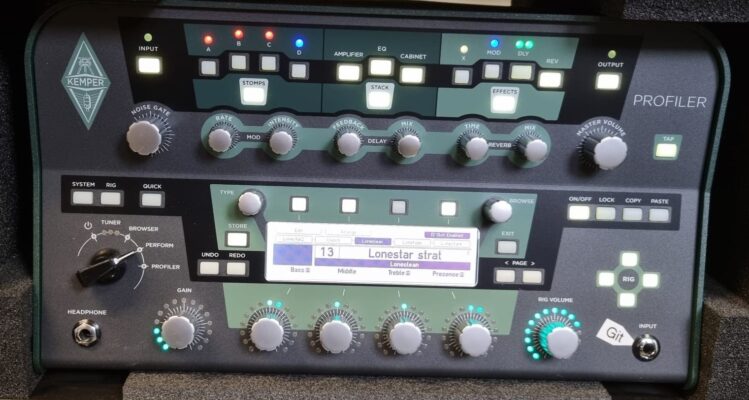
According to the Premier Guitar rig rundown, Skolnick uses a Kemper Profiler PowerHead for smaller gigs. The Kemper’s amp profiling capability — capturing the tonal character of physical amplifiers in digital form for consistent reproduction across different performance environments — suits Skolnick’s dual-context career particularly well: profiles of both his metal and jazz amplification can be stored in the same unit and recalled for different gig contexts without physically transporting multiple amplifiers. For a guitarist who genuinely operates in both the Testament arena metal context and the intimate jazz trio context, the Kemper’s flexibility is practically and tonally valuable.
Ampeg B4 (Documented — Specific Application)
The Ampeg B4 appears in Skolnick’s documented equipment from Premier Guitar — an Ampeg bass amplifier used for specific guitar applications. Its presence suggests a guitarist willing to experiment with non-guitar-specific amplification for specific tonal results, consistent with his general approach of using whatever equipment best serves the specific musical context.
Effects
JAM Pedals TubeDreamer 88 (Primary Overdrive Boost)
The JAM Pedals TubeDreamer 88 is Skolnick’s primary overdrive pedal for the Testament context, mentioned specifically in the Metalsucks rig rundown. The TubeDreamer 88 is a high-quality Greek boutique pedal company’s take on the Tube Screamer circuit — the same warm, midrange-boosting overdrive philosophy as the Ibanez TS9, implemented with premium components and specific circuit refinements. Its function in Skolnick’s signal chain is the classic thrash metal overdrive role: pushing the Marshall or modern high-gain amplifier’s input stage harder with midrange emphasis for tighter, more focused rhythm playing and additional sustain for lead passages.
Tone Concepts Distillery (Drive — Testament Live Rig)
The Tone Concepts Distillery overdrive/distortion appears in Skolnick’s Testament live rig rundown — a boutique drive pedal providing an additional gain option alongside the TubeDreamer. The combination of two different drive pedals gives Skolnick flexibility: different gain characters for different musical passages, or the ability to stack them for maximum drive on the most extreme passages.
Dunlop EVH Phase 90 (Phase Modulation — Both Rigs)
The Dunlop EVH Phase 90 — the Eddie Van Halen signature Phase 90 with the script-logo vintage circuit — appears in both Skolnick’s Testament live rig (confirmed in the Premier Guitar rundown) and his ongoing equipment documentation. Like Scott Ian’s MXR EVH Phase 90 inclusion, Skolnick’s choice of the EVH Phase 90 connects to the specific Van Halen influence on his approach to phase modulation in hard rock contexts.
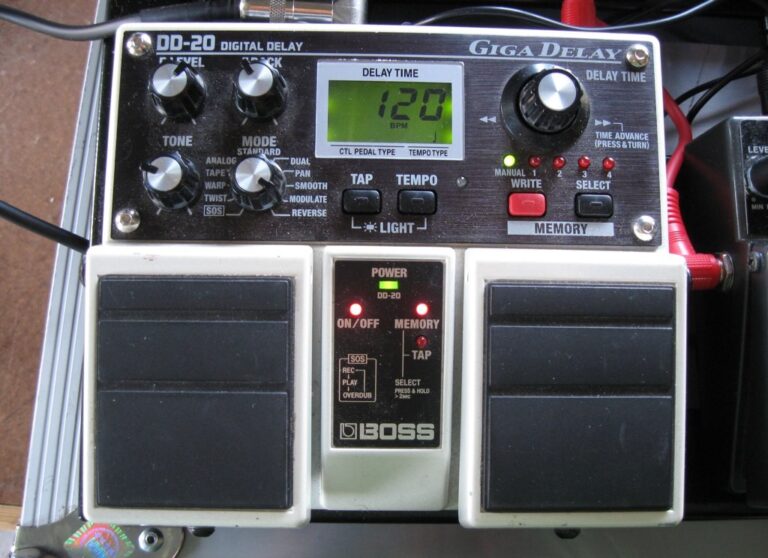
Boss DD-20 Giga Delay (Primary Delay — Testament Live)
The Boss DD-20 Giga Delay appears in the Premier Guitar Testament live rig rundown as Skolnick’s primary delay unit — running through the amp’s effects loop rather than in the front of the signal chain. The DD-20’s versatile delay algorithms and compact, reliable format make it a standard professional touring delay. Its placement in the effects loop rather than in front of the amp ensures that the delay repeats have the same tonal character as the dry signal — no additional signal chain coloration.
Rocktron Reaction Digital Delay (Alternative Delay)
The Rocktron Reaction digital delay is documented as an alternative to the Boss DD-20 — “either a Boss DD-20 or a Rocktron Reaction digital delay patched through the amp’s effects loop.” The availability of two delay options allows Skolnick to choose the specific delay character appropriate for different sets or different songs.
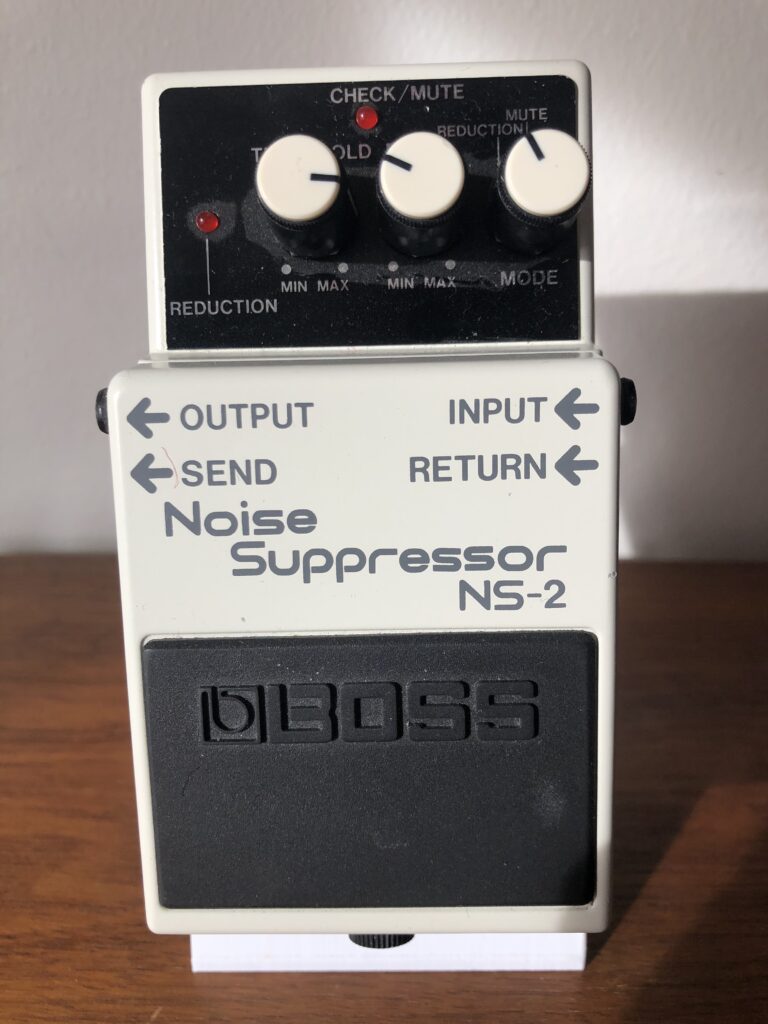
Boss NS-2 Noise Suppressor (Gate)
The Boss NS-2 Noise Suppressor — Boss’s professional noise gate, capable of muting both the direct signal path and a configured loop — appears in Skolnick’s signal chain between the drive pedals and the amp. The NS-2’s dual-function design (gate plus loop) allows it to suppress noise from both the guitar signal and the effects loop in a single unit. Its placement after the drive pedals ensures that the high-gain signal’s noise floor is controlled before reaching the amplifier.
Moollon Signal Boost (Front-End Enhancement)
The Moollon signal boost appears in the Premier Guitar rig rundown — a Korean boutique signal enhancer providing transparent level boost without significant tonal coloration. Its function in Skolnick’s chain is to provide clean level increase at specific points in the signal chain where additional gain is needed without the tonal character that a drive-based boost would introduce.
Hughes & Kettner Tube Factor (Drive — Documented)
The Hughes & Kettner Tube Factor pedal appears in Skolnick’s documented equipment from Premier Guitar. The Tube Factor is H&K’s boutique overdrive unit with a genuine dual-triode tube in the signal path — providing tube-based warmth and harmonic complexity in a pedal format. Its presence alongside the JAM TubeDreamer and Tone Concepts Distillery confirms Skolnick’s systematic approach to drive options: multiple different gain architectures available for different tonal requirements.
MXR M134 Stereo Chorus (Documented)
The MXR M134 Stereo Chorus appears in Skolnick’s documented gear — a high-quality analog stereo chorus unit. Its presence in the rig confirms Skolnick’s broader interest in harmonic modulation effects beyond just the phase pedal, appropriate for both the atmospheric passages in the Testament material and the more subtle harmonic enhancement that jazz trio playing sometimes benefits from.
Eb Standard Tuning with C# Drop (Performance Approach)
Skolnick’s performance tuning approach is specific and documented: the silverburst ESP is tuned to Eb (a half-step below concert pitch) for most Testament songs; the tobacco-burst ESP is tuned to C# (a full step and a half below concert pitch) for the songs that require it. “I prefer the action and tone of Eb, so simply drop the low string to C# and figure out the songs accordingly” rather than retuning to full C# like the rest of the band — a guitarist’s specific preference for the feel and sound of Eb strings that leads him to find workarounds for the lower-tuned material rather than compromising his preferred string tension.
The Metal Allegiance connection — the all-star metal collective that Skolnick has been a core member of alongside Dave Ellefson, Mike Portnoy, and various guest vocalists — provides additional professional context for his dual role. Metal Allegiance performs classic metal songs from across the genre’s history in live settings, with Skolnick’s role as a lead guitarist requiring him to inhabit the tonal and technical vocabulary of songs originally recorded by different guitarists. This requires not just technical ability but genuine stylistic breadth — the capacity to authentically represent different guitar approaches across a single performance. The jazz education’s gift of harmonic and stylistic awareness is directly applicable to this kind of genre-spanning performance work.
His ongoing work with Testament co-founder Eric Peterson provides the rhythmic foundation for his lead work. Peterson’s EMG-equipped Dean guitars through aggressive high-gain amplification produce the specific rhythm guitar platform on which Skolnick’s lead work occurs — a dense, aggressive rhythm context that requires lead guitar of genuine assertiveness to project above it. The contrast between Peterson’s raw, high-gain rhythm approach and Skolnick’s harmonically sophisticated lead work is exactly the productive tension that makes the Testament guitar dynamic one of the genre’s most interesting: two guitarists who come from genuinely different musical orientations — Peterson the pure metal approach, Skolnick the jazz-informed one — creating between them a combined guitar sound more interesting than either would produce alone.
Playing Style & Tone Philosophy
Alex Skolnick plays thrash metal lead guitar with the theory knowledge of a jazz musician and the physical intensity of a thrash guitarist — a combination that, in the best Testament recordings, produces lead work genuinely unlike anything else in the genre. The Guitar World assessment — “mixing alternate picking with smooth legato runs, book-smart theory with the instincts of a berserker” — captures this dual quality accurately. The “instincts of a berserker” are the physical, aggressive execution of fast thrash metal passages at full intensity. The “book-smart theory” is the harmonic intelligence of note choices, scale employment, and solo architecture that reflects twelve years of serious jazz study and the foundational Satriani teaching that preceded it.
The Eb tuning preference — maintaining Eb when the band tunes to C# rather than retuning with them — is a concrete expression of his playing approach’s specificity. The difference in feel between Eb and C# strings at the same gauge is real and physically meaningful: the string tension, the resistance to bending, the acoustic resonance of the instrument in that tuning — all of these affect the playing experience in ways that a guitarist with Skolnick’s physical sensitivity to his instrument notices and acts on. The workaround — dropping only the low string to C# and transposing the parts — requires more musical knowledge than simply retuning, but it preserves the playing feel he has optimized for. This is the jazz musician’s precision applied to the thrash metal context: not accepting the default but identifying the optimal and working toward it.
The jazz sabbatical’s influence on his metal playing is most clearly audible in the compositional quality of his solos: they have a beginning, middle, and end; they develop themes rather than simply running scales; they make harmonic choices that reflect awareness of the underlying chord structure rather than defaulting to pentatonic patterns over everything. The “Electric Crown” solo from 1992 — before the jazz sabbatical — already demonstrates this compositional quality, confirming that the Satriani teaching and the Berkeley musical environment had established the foundation that the subsequent jazz studies then deepened.
His dual-identity gear approach — ESP for Testament, Heritage for jazz, Kemper for smaller gigs in either context — is not a compromise but a specific tool-matching philosophy: different musical contexts require genuinely different tonal characteristics, and having the right instrument and amplification for each context produces better musical results than using one setup for everything. This is the musician’s pragmatism, applied to a career that genuinely spans two musical worlds that most guitarists keep carefully separate.
How to Sound Like Alex Skolnick
The classic Testament lead tone — The New Order through The Ritual — requires: an Ibanez-style superstrat with coil-splitting capability (or ESP signature with JB/Jazz pickup combination), a Marshall JCM800 or equivalent, a Tube Screamer or JAM TubeDreamer 88 for boost and midrange emphasis, and the specific combination of alternate picking and legato that characterizes Skolnick’s lead approach. The jazz-informed note choices require musical knowledge that no equipment provides; the technical execution requires the alternate picking precision that his years of practice have developed.
| Control | Setting (0–10) | Notes |
|---|---|---|
| JAM TubeDreamer 88 / Tube Screamer Boost | Drive: 3; Level: 7; Tone: 5 | Low drive, higher level — the classic Tube Screamer function as midrange boost and input level increase. Pushes the Marshall harder with warm midrange emphasis. Tightens the low end for more focused riffing. Adds sustain for lead playing. The “classic Testament tone is a boosted Marshall” — this is the boost element. |
| Marshall JCM800 Gain | 7 | Moderate-to-high gain — the JCM800 with the TS boost provides the combined saturation needed for Testament’s lead tone. Individual notes in fast runs should remain distinct; the goal is aggressive crunch with articulation, not compressed saturation that blurs fast passages. |
| Bass | 6 | Controlled bass — the TS boost’s midrange emphasis already provides sufficient weight in the mid-bass range. Moderate amp bass prevents the Skolnick lead tone from becoming loose or undefined at high gain levels. |
| Mid | 7 | Present midrange — the combination of the JB’s ceramic midrange and the TS boost’s midrange emphasis produces the “classy” forward tone that Guitar World identifies in Skolnick’s playing. The jazz education’s harmonic choices live in the midrange frequency content. |
| Treble | 6–7 | Moderate-to-present treble for the definition needed in fast alternate-picking passages. The note articulation that distinguishes Skolnick’s leads from less technically precise approaches requires treble support for clarity at speed. |
| Boss DD-20 Delay (Effects Loop) | Time: 300ms; Mix: 20%; Feedback: 2 | Short, ambient delay in the effects loop — adds spatial dimension to lead lines without cluttering the rhythmic precision of the playing. The mix at 20% keeps the delay subtle; the time at 300ms is long enough for dimension but short enough to follow fast lead passages without pile-up. |
| Dunlop EVH Phase 90 (Selective Lead) | Speed: 9 o’clock (slow) | Slow phase modulation — adds harmonic texture to sustained lead notes. Used selectively rather than as an always-on texture. The EVH Phase 90’s specific vintage-circuit character adds warmth without the more mechanical quality of some phase pedal designs. |
| Musical Approach | Jazz-informed; modal awareness; compositional solos | The most important element. No equipment produces Skolnick’s note choices — those come from the harmonic knowledge accumulated through years of jazz study and the Satriani teaching. Learn scales modally (not just pentatonically). Understand the underlying chord changes. Build solos with a beginning, middle, and end. The gear amplifies the musical intelligence; it does not substitute for it. |
Influence & Legacy
Alex Skolnick’s influence on thrash metal guitar is specific and significant: he demonstrated, through the Testament recordings and subsequently through the jazz sabbatical and return, that the technical vocabulary of metal and the harmonic sophistication of jazz are not mutually exclusive but can coexist in the same guitarist’s playing when that guitarist has taken both seriously enough. Every subsequent thrash and progressive metal guitarist who brings genuine harmonic awareness to a genre context that doesn’t require it is working in territory that Skolnick helped open.
His dual career — the only guitarist in this series who maintains genuinely active parallel careers in metal and jazz at a professional level — is the most complete demonstration of what a complete musical education produces when applied to the electric guitar across different genres. The Alex Skolnick Trio recordings stand alone as jazz documents; the Testament recordings stand alone as thrash metal documents; and both benefit from each other’s influence in ways that neither context alone could have produced.
For the broader Testament context and thrash metal rhythm guitar tradition, Gary Holt’s Exodus approach at #28 provides the closest parallel in Bay Area thrash lead guitar development. The Joe Satriani teaching lineage that shaped Skolnick connects to Satriani’s gear and teaching history at #41 — the same pedagogue whose students include Steve Vai, Kirk Hammett, and Skolnick himself. And the Scott Ian rhythm guitar approach that provides the foundation on which Skolnick’s leads are built is explored at Scott Ian’s gear history at #43 — the definitive East Coast thrash rhythm guitarist whose downstroked authority gave Skolnick’s lead work the physical ground to stand on.

He left a thrash metal band at their commercial peak to study jazz. He came back twelve years later with a more complete musical vocabulary. The ESP signature handles Testament; the Heritage handles the Trio. The Kemper handles everything else. The jazz education made the metal better. This is the correct outcome. And the Budda AS Preceptor signature amp — unveiled at NAMM 2013 with a photograph of the moment he first played it — is perhaps the most complete summary of his dual identity: an amplifier bearing his name, capable of the warmth required for jazz and the aggression required for thrash metal, built because no existing amplifier served both equally well. He designed the amp he needed for the career he chose. That is the Alex Skolnick approach.
Frequently Asked Questions: Alex Skolnick Guitars & Gear
What guitar does Alex Skolnick use for Testament?
Alex Skolnick’s primary guitar for Testament and heavy projects is his ESP signature model — a handcrafted instrument that he describes as capturing everything he wants and feeling “effortless for moving around the neck.” The ESP signature features a mahogany body with maple neck and ebony fingerboard, Seymour Duncan JB humbucker in the bridge and ’59 or Jazz humbucker in the neck. The LTD version provides a more accessible production alternative to the ESP Custom Shop specification. He carries three ESP signatures on Testament tours: a silverburst model tuned to Eb for most songs, a tobacco-burst model for songs in C#, and a backup. For jazz contexts with the Alex Skolnick Trio, he uses his Heritage Guitar signature — a Kalamazoo-built instrument with mahogany body, maple top, and Seymour Duncan ’59 Jeff Beck pickups.
What was the classic Testament guitar tone?
The classic Testament tone — from The New Order through The Ritual — is a boosted Marshall. Skolnick confirmed: “For ‘The New Order,’ that was an old Marshall, I think JCM 800, with a tube screamer. Also, I’d just gotten an ADA MP-1 pre-amp and may have used that.” Additional research identifies a Marshall Super Lead with the ADA MP-1 run into the front and a 1970s Marshall 4×12 loaded with reconed 25-watt Celestions. The Ibanez Saber guitars of the era, with their push/pull coil-split configuration, provided the specific tonal character — including the single-coil-like neck tones — that listeners identify in solos like the one on “Electric Crown.” The combination of Tube Screamer boost, JCM800 or Super Lead EL34 amplification, and vintage Celestion speakers produced one of thrash metal’s most celebrated lead guitar tones.
Why did Alex Skolnick leave Testament to study jazz?
Skolnick left Testament in 1993 after The Ritual album because jazz was genuinely what he needed to learn — not as a career strategy or promotional move, but because he had absorbed the musical vocabulary that thrash metal was providing and needed the harmonic and compositional sophistication that jazz offered to continue developing as a musician. He spent twelve years developing the Alex Skolnick Trio and pursuing serious jazz study, returning to Testament in 2005 with a musical intelligence substantially broader than he had left with. His own assessment is that the jazz education made the metal playing better: the harmonic awareness, the solo construction’s compositional quality, and the specific note choices in his Testament playing since 2005 reflect the jazz education’s integration into his metal approach.
What effects does Alex Skolnick use?
Skolnick’s Testament live signal chain runs: Boss TU-3 tuner → JAM Pedals TubeDreamer 88 → Tone Concepts Distillery → Boss NS-2 Noise Suppressor → Dunlop EVH Phase 90 → Boss DD-20 or Rocktron Reaction digital delay (in the amp’s effects loop). He has also used a Moollon signal boost, Hughes & Kettner Tube Factor, and MXR M134 Stereo Chorus at various stages of his touring career. The Kemper Profiler PowerHead is used for smaller gigs in both metal and jazz contexts. His classic-era studio effects included the TC Electronic Booster/Distortion and Boss pedals appropriate for the 1980s recording context.
Who taught Alex Skolnick guitar?
Alex Skolnick studied with Joe Satriani as a teenager in the San Francisco Bay Area — the same teacher who also taught Steve Vai, Kirk Hammett (who called Satriani when he got the Metallica job), Larry LaLonde, and other significant guitarists. Satriani’s pedagogical approach — rigorous technical demands combined with genuine musical context and compositional thinking — is directly visible in the quality of Skolnick’s solo construction and harmonic awareness. He also underwent serious formal jazz study during the 1993-2005 period when he was not with Testament, developing the harmonic vocabulary of the jazz tradition through study and performance with the Alex Skolnick Trio.
What is the Alex Skolnick Trio?
The Alex Skolnick Trio is Skolnick’s jazz group, formed during his sabbatical from Testament and continuing as an active parallel project alongside his Testament work. The Trio format — guitar, bass, and drums — is the classic jazz guitar trio configuration of the Wes Montgomery, Joe Pass, and Jim Hall tradition. The Trio has released several albums including Goodbye to Romance: Standards for a New Generation (2002), Transformation (2004), and Last Day in Paradise (2008), covering jazz standards and originals with the harmonic sophistication of genuinely engaged jazz playing. The Trio represents one of the most convincing dual careers in rock guitar history — a player who is simultaneously a credible jazz musician and a thrash metal icon.
What is Skolnick’s tuning approach in Testament?
Skolnick carries two tuned-differently ESP signature guitars for Testament performances: a silverburst model tuned to Eb (a half-step below concert pitch, which is the standard tuning for most Testament songs), and a tobacco-burst model tuned to C# for the songs that require the lower tuning. While the rest of the band typically retunes to full C# for those songs, Skolnick prefers the feel and tone of Eb strings and adapts by dropping only the low string to C# and transposing the parts accordingly. “I prefer the action and tone of Eb, so simply drop the low string to C# and figure out the songs accordingly.” This preference reflects the specific physical and tonal character he values in the Eb string tension that he doesn’t want to compromise even for songs that technically require lower tuning.
Alex Skolnick with Testament at Metalmania, 24 March 2007. Photo: Metalmania 2007 – Testament – Alex Skolnick 03 by Małgorzata Miłaszewska (Lilly M) / CC BY-SA 2.5. Cropped to a 16:9 portrait, resized and JPEG encoded. Source stage lighting retained; complete head and fretting hand remain, with picking hand and guitar body outside the portrait. Adapted photograph also CC BY-SA 2.5.
Image credits
- Top image: Małgorzata Miłaszewska, Wikimedia Commons, CC BY-SA 2.5.
- Boss NS-2 Noise Suppressor: Johan Rosén / Kuriosatempel, CC BY-SA 4.0.
- Alex Skolnick live: Stefan Brending (2eight), Wikimedia Commons, CC BY-SA 3.0.
- Alex Skolnick live: Małgorzata Miłaszewska, Wikimedia Commons, CC BY-SA 2.5.
- Kemper Profiler: Vonvon, Wikimedia Commons, CC0.
- Boss DD-20 Giga Delay: Gavin Tapp, Wikimedia Commons, CC BY 2.0.