Six Cores, Zero Compromise: The Neural DSP Quad Cortex and the Floor Modeler That Changed Everything
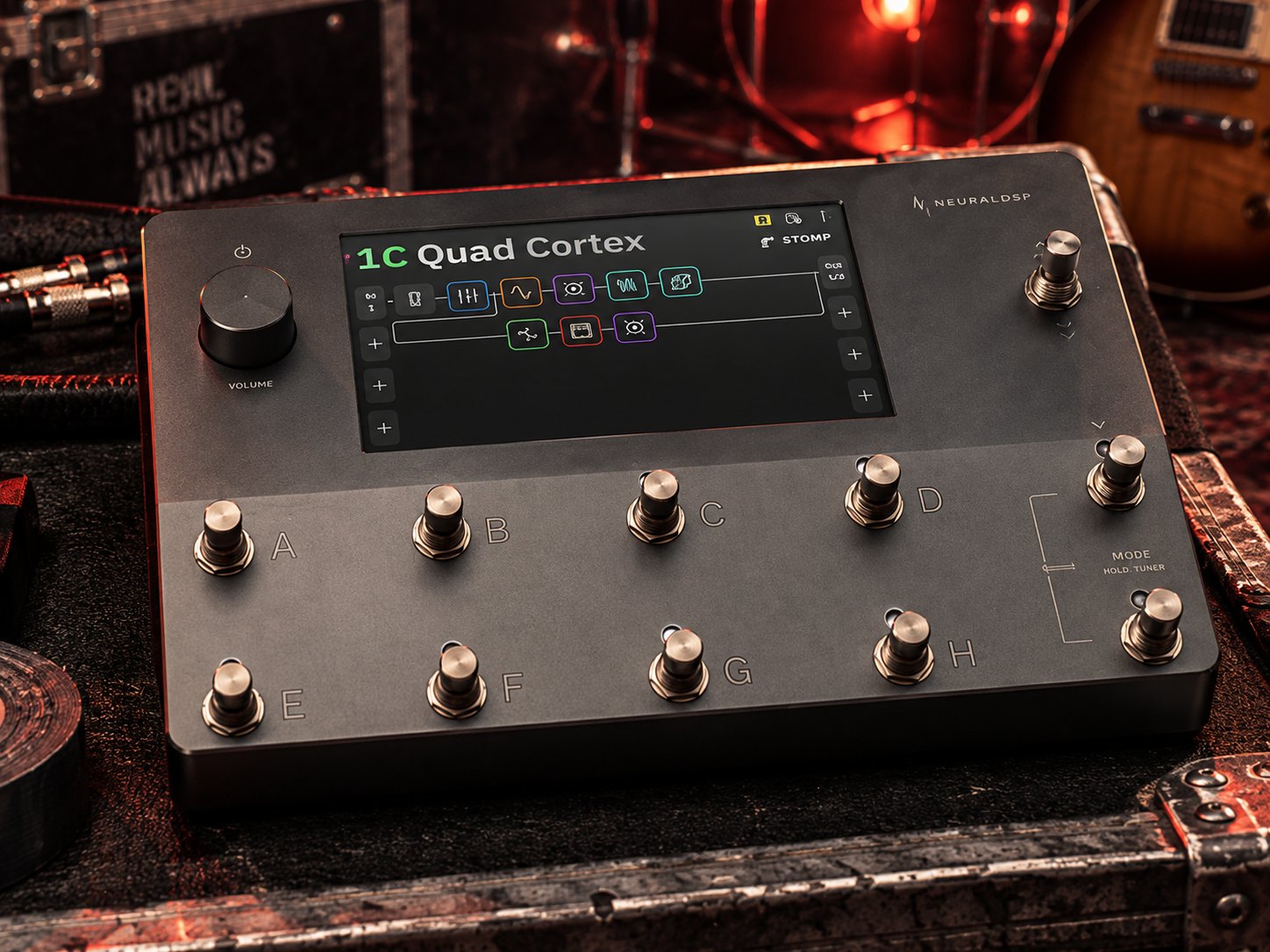
Neural DSP Quad Cortex Floor Modeler. AI-generated reference illustration, not a photograph.
The Neural DSP Quad Cortex redefined floor amp modeling: 6-core power, 7" touchscreen, Neural Capture, and an ever-expanding plugin ecosystem.
In January 2020, a Finnish software company with a reputation for boutique guitar amp plugins stepped onto the NAMM floor in Anaheim with a slab of black aluminium the size of a large book. Neural DSP had spent three years building what they called “the most powerful floorboard amp modeler on the planet,” and the claim, for once, was not marketing hyperbole. The Quad Cortex had six processor cores, a 7-inch touchscreen, a proprietary AI-powered amp capture system, and a weight of less than two kilograms. The guitar world leaned in.
By the time units shipped in 2021, the waiting list stretched to thousands. By 2023, it had won MusicRadar’s Best Amp Modeller award three years running. By 2026, it had accumulated the kind of critical and commercial consensus that makes competitors revise their roadmaps: Guitar World’s Best Multi-Effects Pedal, Guitar Player’s Best Amp Modeler, and a live-rig presence from Polyphia to Animals as Leaders to the ArcTanGent festival stage. This is how a software company with no hardware history wrote the new rulebook for floor modelers.
From Helsinki Plugins to Anaheim Hardware
Neural DSP Technologies Oy was founded in Helsinki, Finland, by Mikko Koskinen and a small team of digital signal processing engineers and guitarists. Their first products were software plugins: the Darkglass Ultra, the Fortin Nameless Suite, the Archetype: Plini. Each one was built around the same core philosophy — use machine learning and advanced DSP not to approximate the sound of a real amp, but to model its physics so precisely that the difference becomes academic. The plugins earned a cult following in the progressive metal, fusion, and djent communities where players valued accuracy over nostalgia.
The Quad Cortex extended that philosophy into hardware. Neural DSP’s in-house technology, called Neural Capture, uses a biomimetic neural network algorithm to learn the sonic behaviour of a physical amplifier, overdrive, or cabinet by feeding it a precisely calibrated test signal and analysing the response. The result is a capture that responds to pick attack, volume-knob rollback, and playing dynamics in ways that static impulse response matching cannot replicate. When the Quad Cortex launched in 2021, it was the first commercially available floor unit to put this class of capture technology in a pedalboard format.
That combination — unprecedented processing headroom, a genuine AI capture engine, and a touchscreen interface lifted directly from consumer electronics — created something the market had not quite seen before: a modeler that serious touring guitarists would actually consider as a first-choice rig, not a backup or a fly-date compromise.
Specifications
Neural Capture: Two Speeds, One Engine
The Quad Cortex has two distinct capture modes, and understanding the difference matters when you are deciding whether to capture your own amps or rely on the Cortex Cloud library.
Neural Capture V1 runs entirely on-device, with no internet connection required. It sends a sweep signal through your amp, analyses the response, and builds a model in a few minutes. It handles most transparent gain stages, clean amps, overdrive pedals, and medium-gain preamps with excellent accuracy. This is the mode you use at a rehearsal studio before a gig, or when you need to capture a backline amp between soundcheck and showtime. It runs in the background without any processing overhead on your signal chain.
Neural Capture V2, introduced in CorOS 3.3.0, offloads the analysis step to Cortex Cloud and processes captures with a significantly more advanced algorithm. The trade-off is an internet connection and some waiting time; the benefit is dramatically higher accuracy on touch-sensitive gear — fuzzes, compressors, highly dynamic tube amps, and any unit where subtle behaviour like volume-knob cleanup, amp sag, bloom, and fast transients makes the difference between “sounds similar” and “sounds like the thing itself.” If you are capturing a vintage Marshall Plexi, a vintage Fender Bassman, or a germanium fuzz that changes personality with battery voltage, V2 is the one to use.
The public Cortex Cloud library now holds thousands of community-created captures, many from professional producers and sound designers collaborating directly with Neural DSP. The practical effect is that a player who never captures their own amp still has access to a continuously growing library of documented real-world rigs.
The CorOS Platform: A Modeler That Gets Better Over Time
One of the structural advantages the Quad Cortex holds over fixed-architecture competitors is that the processing headroom built into the six-core design has allowed Neural DSP to ship meaningful new functionality for years after launch, with no hardware revision required.
CorOS 3.0.0 added plugin compatibility — the ability to run Neural DSP’s own Archetype software plugins directly on the hardware. This transformed the Quad Cortex from a standalone modeler into a node in a broader ecosystem: a preset built in Archetype: Plini X or Archetype: Tim Henson X on a desktop computer could be loaded directly onto the floor unit for stage use. The first plugin shipped was a free update to Archetype: Plini X, which Guitar World described as “an evolutionary and revolutionary extension” of the platform.
CorOS 3.3.0 followed with Neural Capture V2, 29 new virtual devices, and a monophonic synth engine. CorOS 4.0.0, released January 21, 2026, added four new virtual devices (the Nordic Concert Hall reverb, the Studio Plate 70 reverb, the Blossom modulation effect, and the Phase Doctor), Gig View footswitch access, a custom device naming feature for multi-unit rigs, a Scenes Dropdown for faster navigation, and boot tooltips. The firmware update cycle has been consistent enough that buyers in 2021 now have a materially more capable unit than the one they originally purchased.
Famous Players
Tim Henson (Polyphia) — Verified
Tim Henson is Neural DSP’s most visible artist relationship and one of the most thoroughly documented Quad Cortex users in professional touring. He is an official Neural DSP artist (tim-henson.html), and he has two dedicated signature plugins: the original Archetype: Tim Henson (2022) and the updated Archetype: Tim Henson X (2025), both of which are Quad Cortex compatible. CIOKS, whose products power his rig, lists Polyphia on their artist roster and specifically documents the CIOKS SOL powering his Quad Cortex setup. The depth of the collaboration — signature plugin, hardware power supply documentation, and official Neural DSP artist status — puts Henson’s Quad Cortex use beyond any reasonable doubt. His tones on Polyphia’s Remember That You Will Die and subsequent live sets have made the clean-with-shimmer-and-compression Quad Cortex sound one of the most recognisable tones in modern progressive guitar.
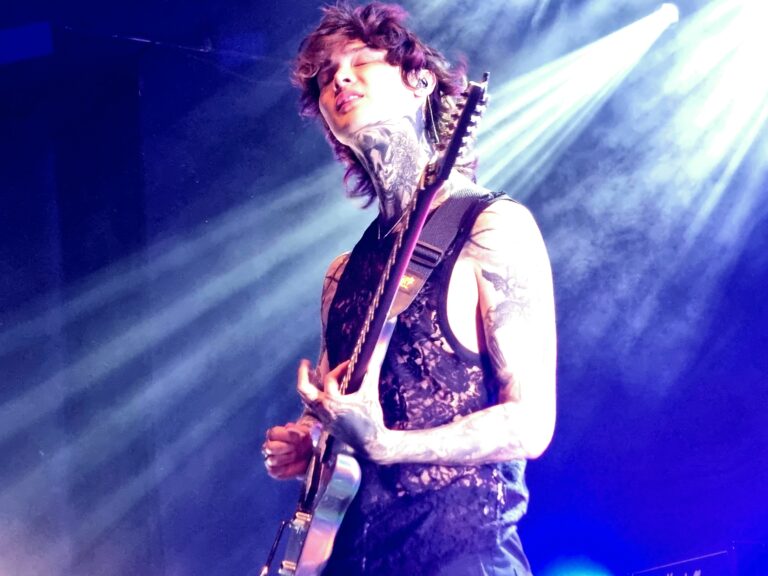
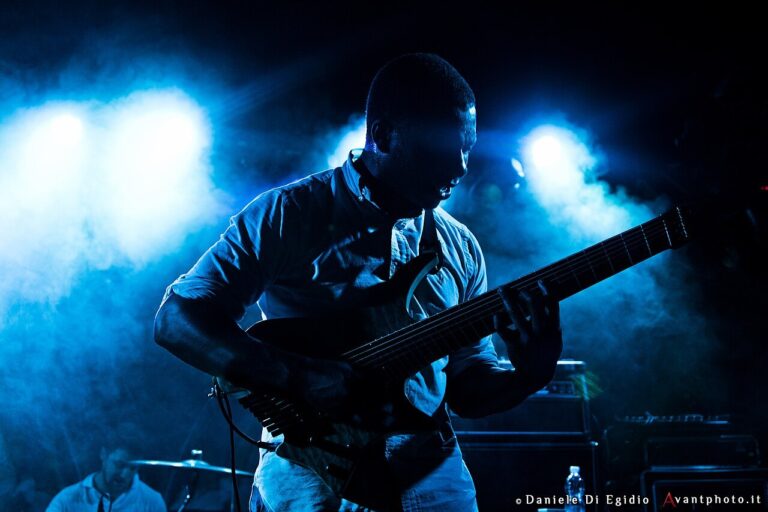
Tosin Abasi (Animals as Leaders) — Verified
Tosin Abasi’s Quad Cortex use is documented on Equipboard, where he states directly that he uses it because “it sounds great and the UI is super intuitive.” He is also an official Neural DSP artist (tosin-abasi.html) and has a signature plugin — Archetype: Abasi — that covers the clean, crunch, and extreme high-gain tones Animals as Leaders requires across a single preset. Abasi’s rig is technically demanding by any measure: eight-string and nine-string guitars, extensive use of tapping and whammy techniques, and the need for consistent gain response across the full extended-range frequency spectrum. His endorsement is a meaningful stress test, not a casual association.
Rabea Massaad — Verified
Rabea Massaad provided some of the most specific live-rig documentation for the Quad Cortex when, in an interview with MusicRadar tied to the 2024 ArcTanGent Festival, he and bandmate Joe Gosney (Vower) described the Quad Cortex as the “main brain” of their stage setups. Massaad used a Quad Cortex and a single expression pedal — the kind of stripped-back architecture that only works when you genuinely trust the unit under stage conditions. He also has a signature plugin, Archetype: Rabea X, Quad Cortex compatible as of a forthcoming CorOS update. His earlier “Neural DSP Quad Cortex | Unboxing & Presets” video on YouTube was one of the first high-visibility professional reviews of the unit.
Plini — Officially Documented
Plini’s relationship with Neural DSP is the longest and most architecturally integrated of any artist on the platform. His Archetype: Plini plugin was one of the company’s earliest signature releases and the first plugin to receive Quad Cortex compatibility when CorOS 3.0.0 launched. He is an official Neural DSP artist (s5-091-plini-gear-guide.html). A dedicated desktop Quad Cortex editor from Neural DSP — Cortex Control — allows Plini X presets to be dragged and dropped directly onto the hardware. While a formal rig rundown specifically documenting his touring Quad Cortex use was not available at publication, the depth of integration between his signature plugin and the hardware platform makes his association with the unit unambiguous in the Neural DSP ecosystem.
Cory Wong — Plugin-Level Association
Cory Wong has a signature plugin, Archetype: Cory Wong X, which is Quad Cortex compatible. He is a Neural DSP artist. No primary source — rig rundown, stage photo, or direct quote — was found at publication specifically documenting the hardware unit in a live or studio context. The article names him in the context of his Neural DSP collaboration rather than as a confirmed touring Quad Cortex user.

Tone Recipes
Start with a clean amp model with the master volume low and preamp gain at zero. Stack a subtle chorus (rate slow, depth 20–30%), a shimmer reverb (pitch set to a perfect fifth, mix around 25%), and a long plate or hall reverb after it. A transparent compressor before the amp block with a fast attack tames pick transients. The goal is glassy, sustaining, and harmonically rich without any grit. Pan the shimmer reverb slightly off-centre. Use a high-pass on the reverb return to keep the shimmer out of the low mids.
Use a high-gain amp capture or model with the gain at about 60–65% — enough harmonic density for chord clusters but controlled enough that an eight-string low B chord does not dissolve into mud. A tight gate before the amp (threshold set precisely to your attack floor) is non-negotiable. A low-shelf EQ cut at 80–100Hz in the cab block keeps the sub frequencies from masking the mid-range definition. Add a medium-length room reverb at 10–15% mix for depth without wash.
A mid-gain amp capture (UK-voiced, Class A/B feel) with the presence pushed slightly above noon. A parametric scoop at 400Hz by about 3dB firms up palm mutes and gives chord stabs definition. A parallel reverb path at very low mix (5–8%) creates air without blurring attack. For stereo output: hard-pan left dry, right with a 12ms delay and a 7% mix — instant width without any comb-filtering on a mono PA.
Moderate gain, single-coil-friendly amp model (bright American clean into a transparent overdrive block in front). A long, pitch-modulated delay at dotted-eighth note timing — mix around 20% — and a cavernous hall reverb at 15% mix. The key is maintaining note clarity under sustained bends: set the gate to follow the delay tail rather than cutting it, which means the threshold should be below your pick attack floor but above the room noise. This requires a precise gate; the Quad Cortex’s per-block routing makes this achievable without a compromise.
The Quad Cortex’s USB audio interface function makes it a viable direct-recording tool. Use a captured amp (V2 capture of your own tube amp works exceptionally well here), bypass the cab block, and use a high-quality third-party IR instead — a well-recorded 4×12 open-back or 2×12 closed-back at multiple microphone positions, blended to taste. Add a plate reverb at 5% mix for the small ambience a real room provides. Record both the direct Quad Cortex signal (post-amp, pre-cab) and the full wet signal simultaneously — the Quad Cortex’s dual outputs make this simple — so you have a re-amp option in the DAW without losing a take.
How It Compares
The Quad Cortex sits at the top tier of the floor modeler market alongside three direct competitors and one conceptually different alternative, all of which it is frequently compared to.
The Line 6 Helix Floor is the most mature platform in this comparison, with a larger preset library built over more years and a wider selection of amp and effects models in absolute terms. The Helix Floor is also the most established choice for guitarists crossing over from traditional pedalboards: its routing flexibility and dual-signal-path architecture are well-documented and have a deep community of content around them. The Quad Cortex’s advantage is Neural Capture — no equivalent technology exists in the Helix ecosystem — plus a processing headroom that allows more simultaneous blocks at high sample rates. The Helix Floor costs less at current street prices.
The Kemper Profiler Head is the older profiling standard and is still the reference point for capture accuracy in the studio community. Kemper’s profile library is larger by virtue of being available for longer, and the Kemper Stage (floor format) has a following among players who prioritised profiling before the Quad Cortex existed. The Quad Cortex challenges it on UI (the touchscreen versus Kemper’s button-and-knob matrix is a genuine ergonomic difference), on processing flexibility (the Kemper is a profiler-first device, not a multi-effects platform in the same sense), and on the V2 capture’s accuracy with dynamic and touch-sensitive gear.
The Fractal Audio Axe-FX III Mk II remains the professional recording benchmark. It is not a floor unit — it is a 2U rack processor requiring a separate floor controller — which makes it a different category for touring logistics. On raw modelling accuracy and tone library depth, the Axe-FX III competes at the same level as the Quad Cortex. The Axe-FX III Mk II costs more. Players who record in the same studio consistently and need the deepest possible library of algorithm-modelled amps typically land here; players who tour and need a self-contained floor unit with an intuitive touchscreen typically land on the Quad Cortex.
The Fender Deluxe Reverb is not a competitor — it is the thing many Quad Cortex users are trying to replicate. The Deluxe Reverb is the canonical American clean amp, a 22-watt 1×12 with a tremolo and a spring reverb that has appeared on more studio recordings than almost any other guitar amplifier. It appears in this comparison because a significant proportion of Quad Cortex presets begin with a Deluxe Reverb capture or algorithm model. If your primary tone is a clean or lightly broken-up Fender voice and you play venues with a full PA, the Quad Cortex running a Deluxe Reverb capture is a legitimate and well-documented alternative to owning and transporting the real thing.
Buying Guide
The standard Quad Cortex retails for $1,799 USD at Sweetwater and equivalent authorised dealers globally as of 2026. This is a significant investment, and the used market offers a realistic alternative. Used units appear regularly on Reverb and Guitar Center’s used listings in the $1,200–$1,400 range, and because CorOS updates apply equally to all hardware generations, a unit bought used in 2023 runs the same CorOS 4.0.0 as a unit bought new today. The hardware itself has no meaningful revision history in the original Quad Cortex line — there is only one version of the unit, and all firmware improvements are software-only.
The Quad Cortex Mini, released in 2025 at $1,399, retains the 7-inch touchscreen and the full CorOS platform — including Neural Capture, the plugin ecosystem, and Cortex Cloud — in a smaller chassis with four rotary footswitches instead of eleven. The Mini is the more logical choice for fly-date rigs, desktop studio use, or players who run a traditional pedalboard with the Quad Cortex as the amp and cab section only. The full-size unit makes more sense for players who need the eleven footswitches for live preset and scene management without additional MIDI controllers.
Several bundle configurations exist: a Sweetwater exclusive pairs the Quad Cortex with a CIOKS power supply at $2,099, and an expression pedal bundle is available at $1,899. Neither is necessary out of the box — the Quad Cortex is USB bus-powered for studio use and includes its own power supply for live use — but both reflect how the unit is commonly deployed in professional rigs.
One honest caveat for buyers new to modelers: the Quad Cortex’s touchscreen interface is genuinely faster to navigate than any button-and-knob system, but the depth of the routing engine — parallel chains, stereo splitting, per-block IR loading — has a learning curve. Neural DSP’s Cortex Control desktop software and the substantial YouTube tutorial ecosystem from both Neural DSP and the user community substantially flatten that curve. Budget time for this, particularly if you are transitioning from a traditional amp-and-pedalboard setup.
Ownership Notes
The Quad Cortex’s power supply situation is worth understanding before you buy. The unit ships with its own power adapter, but the internal power architecture is not isolated in the same way as a dedicated boutique power supply. Players running noise-sensitive single-coils in environments with poor electrical infrastructure may want to add a CIOKS or Strymon power supply to the chain if they encounter interference on the outputs.
Firmware updates are delivered over Wi-Fi via Cortex Cloud, which is straightforward, but a reliable internet connection at the rehearsal studio or on the road is a genuine dependency. The Cortex Control desktop editor allows offline backup of every preset, so the correct workflow before any gig is a full backup to the computer, keeping the touring rig as a standalone unit with no internet dependency on the night.
The eleven combination footswitches — each one serving as both a stomp switch and a rotary encoder — are genuinely unbreakable under normal stage use. They are stainless steel, and the rotary mechanism is industrial-grade. The 7-inch touchscreen is the component that requires more care: it is not hardened glass in the same way as a phone screen, and a dropped unit that lands on the display has a real risk of cracking it. A quality flight case (SKB or Mono) is worth budgeting for if the unit will be gigged regularly.
The built-in looper — up to four minutes and forty-four seconds with half-speed and reverse — is functional for practice and simple performance looping, but players building complex real-time loop compositions will likely supplement it with a dedicated looper in one of the effects loops.
The two combo input jacks include variable impedance and level controls, built-in microphone preamps, and phantom power. The phantom power option makes the Quad Cortex a viable dual-input for acoustic-electric setups using a condenser pickup system, or for direct DI of a bass into one input while routing guitar through the other. This is an underused feature that the specifications document but the marketing rarely emphasises.
FAQ
What is the Neural DSP Quad Cortex?
The Neural DSP Quad Cortex is a floor-format amp modeler, multi-effects processor, and amp capture device. It uses six processor cores (four SHARC+ DSP, two ARM) to run amp and effects algorithms, and it includes a proprietary AI capture technology called Neural Capture that can learn and replicate the behaviour of a physical amplifier, overdrive, or cabinet. It runs the CorOS firmware platform, which receives regular free updates, and supports Neural DSP’s own Archetype software plugins directly on the hardware.
How does Neural Capture compare to Kemper profiling?
Both systems capture the response of a real amp to a test signal and build a model from it. Kemper’s profiling is well-established and has a large existing library. Neural Capture V2, introduced in CorOS 3.3.0, processes captures via cloud computing with a more advanced algorithm and claims superior accuracy for touch-sensitive gear — fuzzes, compressors, and highly dynamic tube amps where subtle behaviours like amp sag, volume-knob cleanup, and fast transients matter. V1 runs on-device for rapid offline captures. The practical difference depends heavily on which amps you are capturing and how critical the touch-response fidelity is to your playing style.
What is the difference between the Quad Cortex and the Quad Cortex Mini?
The Mini (released 2025, $1,399) keeps the 7-inch touchscreen, the full CorOS platform, and Neural Capture, but in a smaller chassis with four rotary footswitches instead of eleven. Both run identical firmware and have access to the same plugin ecosystem and Cortex Cloud. The full-size unit is better for live use where you need direct foot access to multiple presets or scenes without a MIDI controller; the Mini suits studio, fly-date, or hybrid pedalboard use.
Can the Quad Cortex replace a real amp for live use?
It has done so for touring professionals including Tim Henson, Tosin Abasi, and Rabea Massaad. Whether it replaces a real amp for any specific player depends on the venue’s PA quality, the monitoring situation, and whether the player requires the physical interaction with a speaker cabinet that modelers cannot replicate. Into a full-range flat-response PA with good monitors, the Quad Cortex is a direct replacement for an amp-and-cab rig in a live context. Into a backline cab without a PA, it requires additional amplification through the ¼” outputs into a power amp, or the optional PowerCab or FRFR speaker.
Does the Quad Cortex work as a USB audio interface?
Yes. Connected via USB to a computer, the Quad Cortex operates as a multi-channel audio interface with ultra-low latency — a significant secondary function for studio players. You can record the full processed signal and the dry signal simultaneously, and the Cortex Control desktop editor allows deep preset editing from the computer while the unit is connected.
What plugins are compatible with the Quad Cortex?
Neural DSP’s own Archetype series plugins, when purchased, can be loaded onto the Quad Cortex hardware via CorOS 3.0 and later. Confirmed compatible titles include Archetype: Plini X, Archetype: Tim Henson X, Archetype: Cory Wong X, Fortin Nameless Suite X, Soldano SLO-100 X, and Archetype: Gojira X. Neural DSP adds compatibility to new and existing plugins on an ongoing basis. Third-party VST plugins are not currently supported — the ecosystem is Neural DSP’s own catalogue only.
What are the main criticisms of the Quad Cortex?
Recurring criticisms at launch centred on the smaller initial library of amp models compared to Line 6 Helix and Fractal Audio Axe-FX III. This gap has narrowed substantially with successive CorOS updates. Some players find the touchscreen more prone to fingerprint accumulation than they would like, and the learning curve on the routing engine — particularly parallel chains and stereo splitting — is steeper than a traditional multi-effects pedal. The $1,799 price point is significant, though the continuous free updates and the plugin ecosystem partially justify the premium over time.
Is the Quad Cortex good for bass as well as guitar?
Yes. The combo inputs include variable impedance appropriate for both guitar and bass, and the amp model library includes dedicated bass amp simulations. The phantom power on the inputs supports active bass pickups and condenser-based bass systems. A meaningful portion of the Cortex Cloud capture library consists of bass amp captures. Neural DSP’s own catalogue began with a bass plugin (the Darkglass Ultra), so the architecture has supported bass tone design from the company’s founding.
Image credits
- A guitarist on stage with an amp behind: Bex.Walton, Wikimedia Commons, CC BY 2.0.
- Top image: GuitarGangsters AI-generated reference illustration, not a photograph.
- Tim Henson: by Drew de F Fawkes from Guildford, Wikimedia Commons, CC BY 2.0.
- Tosin Abasi: Daniele di Egidio, Wikimedia Commons, CC BY 2.0.
- Cory Wong: Jazzman, Wikimedia Commons, CC BY-SA 4.0.
Latest News
Related
On This Day
Monday 9 November
From this week: