The Delay That Rewrote Rock Songwriting: Electro-Harmonix Deluxe Memory Man
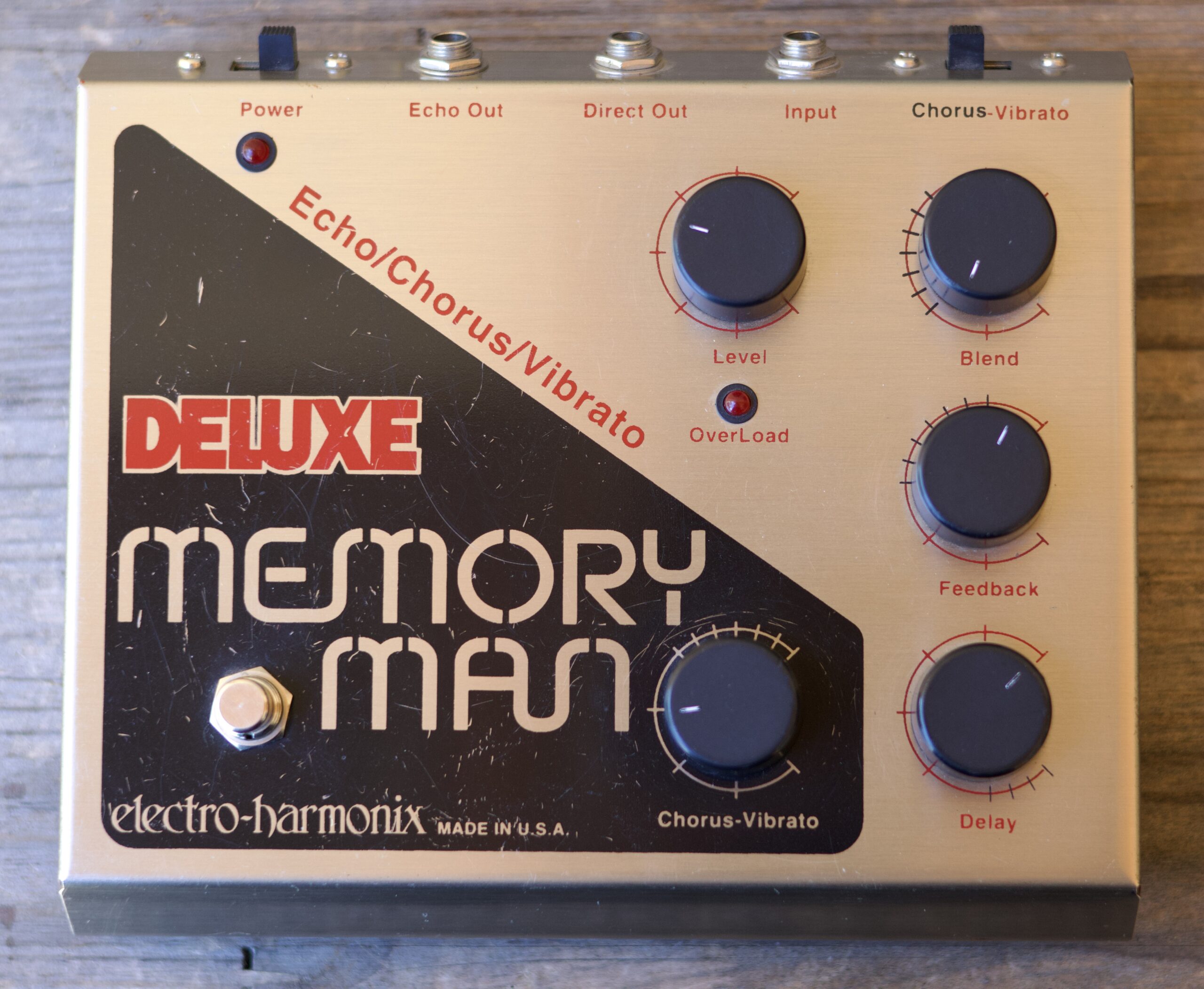
Electro-Harmonix Deluxe Memory Man, photographed 29 April 2025. Photo: Bontempi1953. CC BY-SA 4.0 (https://creativecommons.org/licenses/by-sa/4.0/). Full source frame retained; resized web versions are licensed under CC BY-SA 4.0. No crop or retouching. Source: https://commons.wikimedia.org/wiki/File:Deluxe_Memory_Man.jpg
The Deluxe Memory Man put analog echo at the feet of The Edge and Ed O'Brien. Here's the history, BBD circuit breakdown, player settings, and buying guide.
There is a moment in the early history of U2 when everything shifts. The band is young, barely out of Dublin, and The Edge is standing in a local music shop staring at a battered grey box with five knobs. He plugs in. He plays a note. The note repeats, warmly, darkly, with a slight swirling modulation that makes it feel alive. Then it repeats again. And again. He sets the delay to pulse in time with his picking, and suddenly a single-note guitar line turns into a cascading rhythmic architecture. He buys the Electro-Harmonix Deluxe Memory Man that day. What follows is forty years of some of the most recognizable guitar tones in rock history.
That story is not unique to The Edge. Ed O’Brien of Radiohead calls the Deluxe Memory Man his “god pedal.” Jim Jarmusch, the filmmaker who has spent decades obsessing over sonic texture, sat down with EHX for a dedicated live interview about his relationship with the box. For a pedal that does nothing more complicated than delay a signal and optionally wobble it, the Deluxe Memory Man has inspired a level of devotion that most gear rarely earns.
This guide covers everything: the history of the Memory Man from its 1976 origins through its bucket-brigade circuit evolution, the confirmed player connections and the honest corrections, practical tone settings, and a complete breakdown of the current model family. Whether you own one, want one, or simply want to understand why it has occupied a legendary position for nearly fifty years, this is your starting point.
Where the Echo Begins: Memory Man History
Electro-Harmonix was founded by Mike Matthews in New York City in 1968. By the mid-1970s, the company had already established itself with the Big Muff Pi fuzz pedal — a connection worth noting because the Big Muff and the Memory Man would later share pedalboards across countless landmark recordings. But while the Big Muff traded in sustained saturation, the Memory Man represented EHX’s entry into a completely different sonic territory: time.
The original Memory Man debuted in 1976, arriving at a moment when the dominant delay technology for guitarists was tape-based. Units like the Maestro Echoplex and the Roland RE-201 Space Echo were the professional standard, delivering warm, degraded repeats by physically recording audio to a moving tape loop. They sounded extraordinary. They also broke down constantly, required regular maintenance, and were large enough to fill a road case. The Memory Man offered something those units could not: compact analog delay without a single moving part.
The technology that made this possible was the bucket brigade device, or BBD — a chain of capacitors that pass a stored electrical charge from one stage to the next, much like the human chain that gave the technology its name. Each handoff introduces a tiny amount of signal loss and filtering, and it is precisely this imperfection that defines the Memory Man’s character. Audio does not emerge from a BBD delay pristine; it emerges slightly darker, slightly softer, with a warmth that digital precision would later struggle to replicate.
The earliest Memory Man pedals used Reticon SAD1024 chips as their BBD element. Around 1978, EHX transitioned to the Panasonic MN3005 — a 4096-stage BBD chip that became one of the most celebrated components in analog delay history. The MN3005’s longer chain of capacitors allowed for longer delay times with better frequency response than its predecessor, and its sonic character became inseparable from what players describe as the “Memory Man sound.” When Panasonic discontinued the MN3005 chip in the late 1980s as digital technology took over, its scarcity became one of the primary drivers of the vintage Memory Man’s collector value.
The pedal went through several configurations over its original production run: three-knob versions, four-knob versions with the Reticon chips, and the five-knob Deluxe variant that is the subject of this article. The Deluxe designation refers specifically to the addition of an internal LFO — a low-frequency oscillator that modulates the delay time, creating a subtle pitch fluctuation that translates as chorus or vibrato depending on how the delay and depth controls are set. This single addition transformed the Memory Man from a capable delay into a multi-function modulation engine.
After Electro-Harmonix went through a period of dormancy in the mid-1980s, Mike Matthews relaunched the company in the 1990s and resumed production of the Deluxe Memory Man. Modern versions use the Xvive MN3005, a high-quality recreation of the original Panasonic chip designed with input from Howard Davis, who was involved in the original circuit design. The current non-tap-tempo model requires a 24VDC power supply rather than the standard 9V used by most compact pedals — a reflection of the voltage requirements of the MN3005 chip family — and includes separate direct and effect outputs that enable creative studio and live routing options unavailable on most delay pedals.
Inside the Machine: BBD Circuit Deep Dive
Understanding what the Deluxe Memory Man actually does at the circuit level helps explain both its sonic character and its limitations — and why players who understand those limitations tend to love it more, not less.
The signal path begins at an input buffer and preamp stage, which includes a Level control allowing the player to drive the BBD chips slightly harder or softer. This preamp stage is one reason the vintage Deluxe Memory Man had a reputation as a signal enhancer even when the delay effect itself was subtle: the preamp contributes a gentle push and coloration that brightens and thickens the guitar signal before the delay processing begins. In vintage units without true bypass, this preamp remained active even when the effect was “off,” functioning as a permanent tone enhancement. Current true-bypass models bypass the entire circuit, which means the preamp can no longer serve as an always-on boost.
After the preamp, the signal enters the BBD chip chain. The two MN3005 chips — each containing 4096 stages — pass the signal through a total of 8192 capacitor stages, with each stage briefly storing a snapshot of the incoming voltage. The clock rate that drives these transfers determines the delay time: a faster clock produces shorter delays, a slower clock produces longer delays. At maximum delay time (550ms on the current model), the clock runs slowly enough that the signal passes through all 8192 stages with maximum attenuation and bandwidth reduction. At shorter delay times, the faster clock preserves more treble response, making the repeats somewhat brighter and clearer.
This means the Deluxe Memory Man is not a neutral, transparent delay. The repeats are characteristically darker than the dry signal, with a natural high-frequency rolloff that increases with delay time. At longer settings, the repeats become progressively murkier and warmer. This is not a flaw; it is the defining quality that separates the Memory Man from both digital delays and from the cleaner-sounding BBD pedals that use higher-resolution chips. Players who hear this character as desirable — and many do — find that it occupies frequency space in a mix without competing with the dry signal.
The LFO modulation in the Deluxe version wobbles the BBD clock rate slightly, which shifts the pitch of the delayed signal up and down. When the Delay control is set to minimum and only the Depth and modulation mode are active, the Memory Man functions as a chorus or vibrato effect with no audible delay. With delay time increased, the modulation rides on top of the echo, giving the repeats a liquid, animated quality that is difficult to replicate with digital processing. The Chorus mode uses a slower, subtle modulation; the Vibrato mode uses a faster, more pronounced sweep. The Edge, notably, preferred the Vibrato setting rather than Chorus on many of his early recordings — a detail often overlooked in attempts to replicate his sound.
Specifications
| Specification | Deluxe Memory Man (current) | DMM 550-TT | DMM 1100-TT |
|---|---|---|---|
| BBD chip | 2× Xvive MN3005 clone | 2× Xvive MN3005 clone | 4× Xvive MN3005 clone |
| Max delay time | 550ms | 550ms | 1100ms |
| Tap tempo | No | Yes (6 subdivisions) | Yes (6 subdivisions) |
| Modulation modes | Chorus / Vibrato | Chorus / Vibrato | Chorus / Vibrato |
| Controls | Blend, Level, Feedback, Depth, Delay + mode switch | Blend, Level, Feedback, Depth, Delay, Rate, Tap | Blend, Level, Feedback, Depth, Delay, Rate, Tap |
| Bypass | True bypass | True bypass | True bypass |
| Outputs | Separate Dry + Effect | Standard mono | Standard mono |
| Power | 24VDC (included) | 9VDC | 9VDC |
| Expression input | No | Yes | Yes |
| FX loop | No | Yes | Yes |
| Price (new/approximate) | ~$199–249 USD | Discontinued (2024); used ~$150–250 | ~$420–450 USD |
| Vintage MN3005 original | $300–800+ USD depending on version and condition | ||
Famous Players
The Edge (U2) — DB: The Edge Gear Guide
No discussion of the Electro-Harmonix Deluxe Memory Man is complete without spending serious time on The Edge, because the relationship between this guitarist and this pedal is one of the most thoroughly documented and musically consequential gear pairings in rock history. The Edge found the Deluxe Memory Man in a Dublin music shop in the earliest days of U2, and it became, by his own account, the pedal that changed everything.
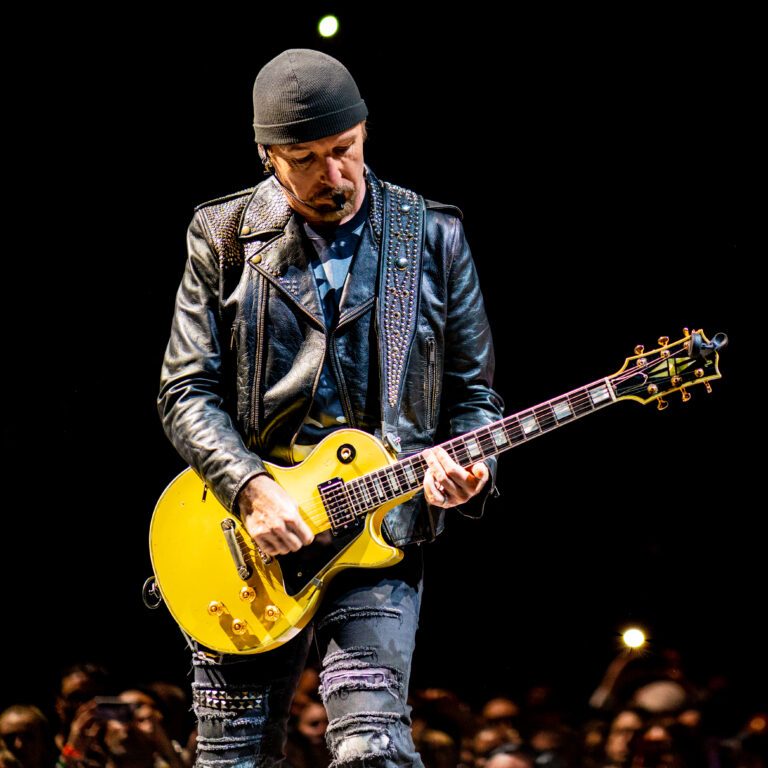
His approach was immediately distinctive. Where most guitarists treat delay as an effect added after the fact — a spaciousness enhancement, a repeat that trails behind a phrase — The Edge treated the DMM as a compositional instrument. He set the delay time to pulse in rhythmic relationship with the song’s tempo, so that his single-note lines would cascade and multiply into interlocking patterns. A simple ascending arpeggio became a shimmering wall of sound. A three-note motif became an eight-note phrase when the delay was factored in. The Memory Man was not decorating the guitar part; the guitar part was designed around what the Memory Man would do to it.
This approach is audible across virtually every major U2 recording from 1980 to 1987. On Boy (1980), tracks like “I Will Follow” and “Out of Control” demonstrate the technique in its earliest, most energetic form — delay times tuned to the song’s pulse, clean chord attacks multiplied into rhythmic textures. On War (1983), “Sunday Bloody Sunday” opens with a delay pattern locked to the military snare pattern beneath it, The Edge’s delay repeats reinforcing rather than competing with the rhythmic pulse. On The Unforgettable Fire (1984) and The Joshua Tree (1987), the approach reaches its peak sophistication: “Where the Streets Have No Name” opens with a delay pattern around 365ms, Feedback at roughly 11 o’clock, creating a harmonic shimmer that is now one of the most immediately recognizable guitar sounds in popular music.
The Edge’s preferred modulation setting on the Deluxe Memory Man was Vibrato rather than Chorus — the faster, more pronounced sweep that gives the repeats a slightly unstable, liquid quality. His early live rig used two DMMs running in parallel with two Vox AC30 amplifiers, allowing him to blend two different delay times and textures simultaneously. He has confirmed the pedal as the unit that established his core approach and tone, describing the moment he first played through it as the kind of discovery where “suddenly, everything changed.”
The Edge has continued to use various iterations of the DMM concept throughout his career, moving progressively toward rack-based systems for reliability on large tours. But his connection to the original Deluxe Memory Man is foundational — it is not one tool among many but the specific piece of equipment that revealed what his guitar voice could be. For any serious student of The Edge’s approach, understanding the DMM is prerequisite to understanding the player.
Ed O’Brien (Radiohead) — DB: Ed O’Brien Gear Guide
Ed O’Brien’s relationship with the Deluxe Memory Man is the most enthusiastically expressed of any guitarist associated with the pedal. He has called it his “god pedal,” and in a live interview hosted by Electro-Harmonix in January 2021, alongside filmmaker Jim Jarmusch — himself a devoted Memory Man user — O’Brien described the prospect of removing the pedal from his board as like “taking your soul away.” This is not casual endorsement language; it reflects a genuine dependency that runs through his playing and Radiohead’s textural approach to guitar.
O’Brien’s use of the DMM differs significantly from The Edge’s. Where The Edge uses delay as rhythmic structure, O’Brien deploys it as atmospheric depth — long, slowly decaying repeats that extend guitar phrases into sustained, evolving clouds of sound. His approach is more about texture and ambience than pulse and rhythm, using the Memory Man’s naturally warm, bandwidth-limited repeats to create the sense of space and distance that characterizes Radiohead’s studio and live guitar work. He uses the DMM alongside digital delay and reverb units, typically reserving the Memory Man specifically for the organic warmth that only a BBD circuit produces.
His board has included the Deluxe Memory Man across multiple Radiohead eras, and it appears consistently in rig rundown documentation from touring periods spanning the 2000s through the present. For O’Brien, the DMM is not a vintage novelty or an A/B comparison against digital alternatives — it is simply the right tool for the job, year after year.
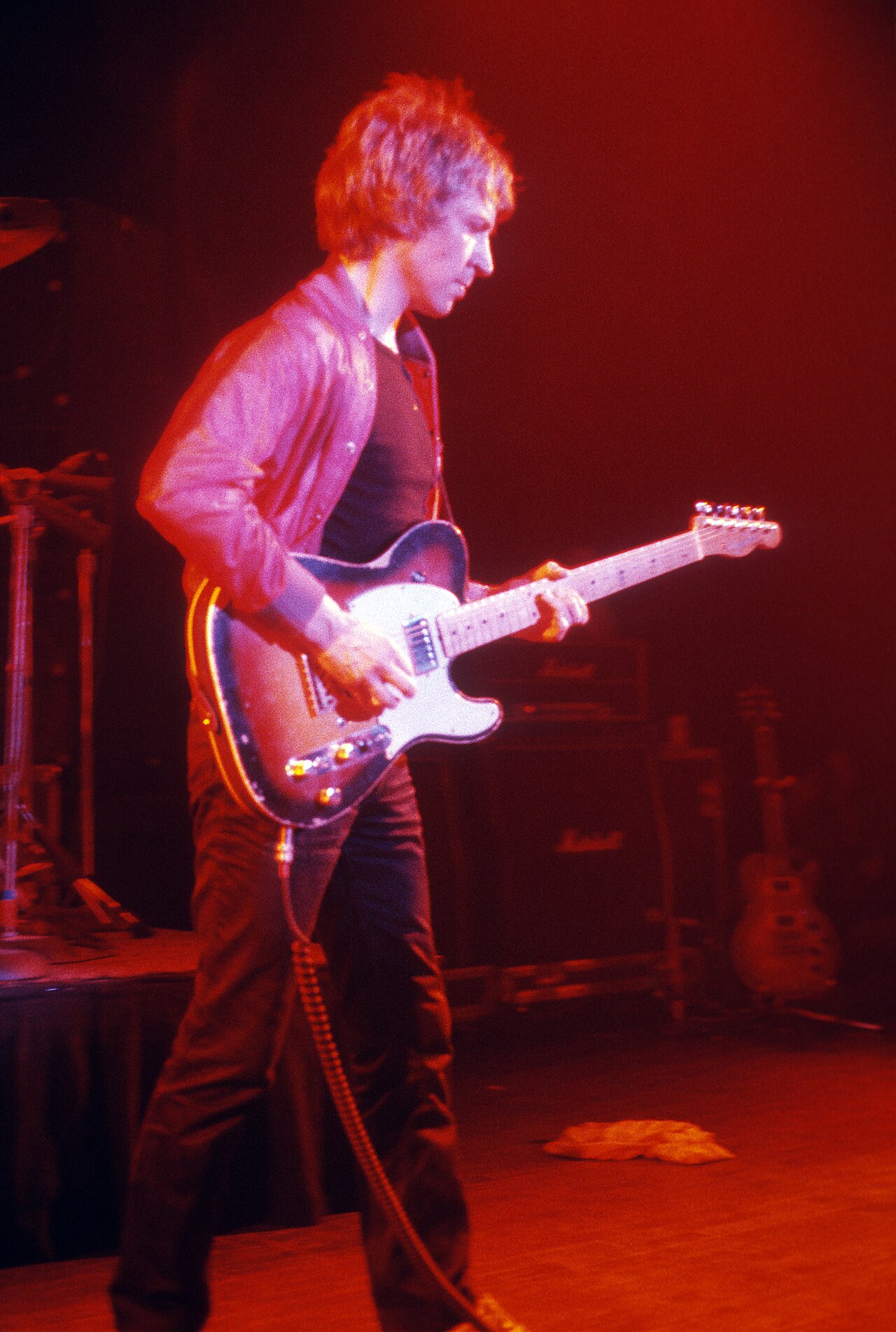
Andy Summers (The Police) — DB: Andy Summers Gear Guide — Honest Clarification
Andy Summers is a name that appears in many Deluxe Memory Man discussions, and the connection has a real basis — the Memory Man and the Pete Cornish-built boards Summers used are documented together in various sources. However, a careful examination of primary sources reveals that Summers’ central delay unit was not the Deluxe Memory Man but the Maestro Echoplex tape delay. The two effects that defined his Police-era sound are well-documented: the Maestro Echoplex for delay and the Electro-Harmonix Electric Mistress for flanger. His Pete Cornish board included multiple EHX units — the Muff Fuzz, an MXR Dyna Comp — but the Echoplex was his primary time-based effect rather than the BBD-based Memory Man.
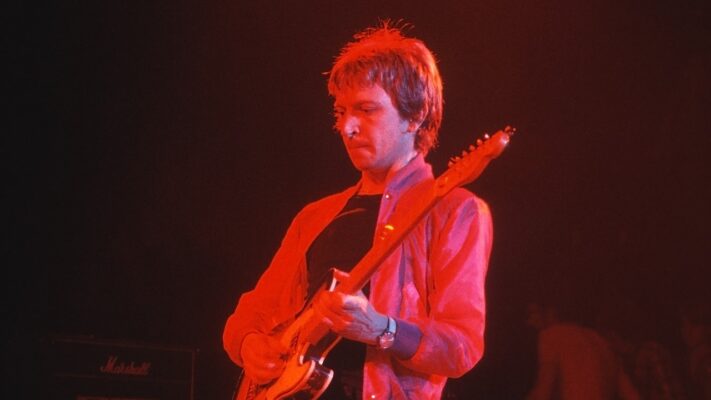
This does not diminish Summers as a point of reference for delay-driven guitar playing, and his textural approach to the guitar is deeply worth studying. But the specific pedal attribution matters: players seeking to replicate his sound on “Every Breath You Take,” “Every Little Thing She Does Is Magic,” or “Message in a Bottle” should look toward tape echo simulation rather than the Memory Man’s BBD character. Where the two units share common ground is in their warmth and the way their repeats naturally darken and degrade — but the tape mechanism of the Echoplex and the BBD chain of the DMM produce this character through different means, and the results are audibly distinct on careful listening.
John Frusciante — DB: John Frusciante Gear Guide — Not Confirmed
John Frusciante is associated with the Deluxe Memory Man in some online gear discussions, and given his well-documented love of Electro-Harmonix pedals — he has praised Mike Matthews and EHX publicly, appearing in Guitar World’s birthday tribute alongside Jack White and Peter Frampton — the connection seems intuitive. His confirmed delay unit on the 2022 Unlimited Love tour was the MXR M299 Carbon Copy Mini, documented via Instagram soundcheck photographs published by Ground Guitar. A confirmed Deluxe Memory Man connection via primary source has not been located in researching this article. His EHX relationship is genuine and well-documented; the specific DMM attribution is not confirmed. His gear guide covers what is verified.

J Mascis (Dinosaur Jr.) and Other Notable Users
J Mascis is one of the guitarists most commonly cited alongside the Deluxe Memory Man in the indie rock context. His approach — massive guitar walls with long, wash-style reverb and delay, high feedback settings that push toward self-oscillation — makes the DMM a natural fit for his sound. The pedal is documented in his rig and is consistent with the warm, saturated ambient character of Dinosaur Jr.’s studio recordings from You’re Living All Over Me (1987) through Bug (1988) onward. Jim Jarmusch, whose musical sensibility draws heavily from American post-punk and noise rock, has also confirmed his use of the Memory Man across his film score and solo music work.
Tone Recipes and Settings
The Edge Classic Rhythmic Delay
This is the foundational DMM setting: tempo-synced delay that becomes part of the composition rather than decoration. Start with Delay at approximately noon (around 330–380ms depending on song tempo), Feedback at 10–11 o’clock (3–5 repeats), Blend at noon, Level at noon, Depth at zero or minimum. The critical detail: your picking attack determines the density. Sparse, clean attacks create shimmering halos; busy playing creates congestion. Set the Delay knob so the first repeat falls on the beat or a rhythmic subdivision of the beat — tap your foot and adjust until the repeats slot in rather than fight the rhythm. The Edge used Vibrato mode rather than Chorus for this application.
Ed O’Brien Atmospheric Wash
Long delay, high Feedback, Blend favoring the wet signal. Delay at 2–3 o’clock (400–500ms), Feedback at 2 o’clock (8–12 repeats, approaching self-oscillation), Blend at 1 o’clock (wet-heavy mix), Depth at 9–10 o’clock for subtle Chorus modulation. This setting works best with a clean or lightly overdriven amp. Play single notes or simple intervals and let the Memory Man build the texture. Combine with reverb after in the signal chain for maximum atmospheric depth.
Slapback Country/Rockabilly
Short delay, single repeat, low mix. Delay at 7–8 o’clock (80–120ms), Feedback at minimum, Blend at 9 o’clock, Depth at zero, Level at noon. The BBD’s natural warmth works exceptionally well for rockabilly slapback — it has the same organic character as tape-based slapback but in a smaller, more reliable package. This setting works on any clean-voiced amp.
Modulated Chorus (No Delay)
The DMM makes an excellent chorus unit when the Delay control is set to minimum. With Delay at minimum and Depth at 10 o’clock, the LFO shifts the BBD timing just enough to create a chorus effect. Set to Vibrato mode for a more intense pitch wobble; Chorus mode for a subtle, shimmering thickness. This application works beautifully for clean guitar chord work where a traditional chorus pedal might add too much high-frequency artificiality.
Self-Oscillation Ambient Texture
With Feedback above 3 o’clock and Blend high, the Deluxe Memory Man will enter feedback runaway — the delayed signal feeds back into the BBD chain faster than it decays, building into a sustained, evolving drone. Push Feedback to maximum, Delay at noon, Blend high. The resulting sound is not a controlled delay but a living ambient texture that responds to input. Play a note to seed the oscillation, then back off and let the Memory Man evolve on its own. This is a technique used by drone and ambient guitarists, and the BBD’s natural bandwidth rolloff gives the resulting sound a warmth that digital feedback simulators rarely achieve.
The Memory Man Family — Which Version Is Right for You?
The current Deluxe Memory Man lineup spans four distinct products, each with a different target use case.
The standard Deluxe Memory Man (non-tap-tempo) is the closest analog to the original vintage circuit, using two Xvive MN3005 chips and a 24VDC power supply. It requires the included power adapter — it will not work with standard 9V supplies or daisy-chain boards without a dedicated 24V output. Its defining feature over the tap-tempo models is the separate direct and effect outputs, which allow players to split their signal and run dry to one amp and wet to another — a configuration worth serious consideration for studio and large-stage live work. True bypass means the preamp cannot serve as a permanent boost, unlike vintage units.
The DMM 550-TT added tap tempo and six tap subdivisions, an expression input, and an FX loop in the feedback path — allowing EQ, pitch, or other effects to be inserted into the repeat chain. This was the most feature-complete version at the 550ms delay time. It was discontinued by EHX in 2024, but used units are widely available and represent excellent value for players who want tap tempo and the broader feature set without the cost of the 1100-TT.
The DMM 1100-TT doubles the BBD chip count to four Xvive MN3005 units, extending maximum delay time to 1100ms — over a full second of pure analog echo. The additional chips also produce cleaner, brighter repeats at longer delay times because the clock rate doesn’t need to run as slow to achieve the same duration. This is the current flagship of the Memory Man line and carries a corresponding price. It runs on standard 9VDC unlike the non-TT model.
The Nano Deluxe Memory Man packages the core non-TT circuit into a smaller enclosure with standard 9V power compatibility, sacrificing the separate direct and effect outputs. It is the most practical choice for players who want the original DMM character in a pedalboard-friendly format without the 24V power requirement.
Vintage vs. Modern: An Honest Comparison
The vintage Deluxe Memory Man with original Panasonic MN3005 chips has acquired near-mythological status among delay enthusiasts. Prices for well-maintained vintage units range from $300 to over $800 USD depending on the version (the five-knob MN3005 Deluxe variants command the highest prices), and the Analogman-modded versions — which typically include buffer upgrades, LED additions, and AC power conversion for units that were originally battery-only — can exceed that range.
Is the vintage premium justified on sonic grounds? The honest answer is: somewhat, but not dramatically. Analog Man himself has acknowledged that the Xvive MN3005 chip used in current production is a well-executed recreation, and the sonic difference between a carefully maintained vintage unit and a current Deluxe Memory Man is audible only on direct, controlled comparison. Players who buy vintage units primarily for historical connection or collector value know what they are paying for. Players seeking the Memory Man sound for practical musical use are better served by the modern versions, which are more consistent, include the correct power supply, and can be serviced without hunting for scarce period-correct components.
The one functional difference worth noting: vintage true-bypass units (and some reissues) that include the preamp in the signal path even when bypassed offer the always-on tone enhancement that many players appreciated as part of the Memory Man’s character. If this application interests you, research the specific bypass type of the vintage version you are considering before purchasing.
Buying Guide
For players new to the Deluxe Memory Man family, the Nano Deluxe Memory Man represents the most practical entry point: it runs on standard 9V power, fits on any pedalboard, and captures the core BBD character without the infrastructure requirements of the larger models. Street price runs approximately $149–179 USD new.
Players who want the definitive vintage character in a modern, reliable package should look at the full-size non-tap-tempo Deluxe Memory Man. Budget for the dedicated 24VDC power supply slot on your board. The separate direct/effect outputs are a genuine advantage in studio and dual-amp live contexts. Street price is approximately $199–249 USD new.
For tap tempo and maximum features at 550ms, the discontinued DMM 550-TT offers excellent used value. Expect to pay $150–250 USD on the used market. All production runs are functionally identical; there is no vintage premium for earlier 550-TT units.
For the ultimate analog delay — maximum delay time, maximum feature set — the DMM 1100-TT at approximately $420–450 USD is the current production flagship. The added clarity from the additional chips makes it particularly useful for longer delay times where the 550ms models begin to sound congested.
For vintage original units: a well-maintained five-knob MN3005 Deluxe Memory Man is a legitimate collector piece as well as a functioning tool. Pay attention to chip health — the BBD chips degrade over time, and units with oxidized or intermittent chips are expensive to restore. Budget $300–500 USD for solid examples; expect to pay more for documented Analogman-modded units. The MN3005 chip itself is now a collector item: genuine Panasonic originals are available on the component market but command a significant premium over the Xvive recreations used in current production.
Ownership Notes
The 24VDC power requirement of the non-tap-tempo Deluxe Memory Man is the most common source of confusion for first-time buyers. The included EHX power supply handles this correctly; most third-party pedalboard power supplies require a dedicated 24V output or a step-up converter. Do not attempt to run the unit on 9V or 12V; the BBD chips require the higher voltage to operate at full specification, and under-voltage typically manifests as audible noise or degraded frequency response before the pedal stops working entirely.
The separate direct and effect outputs on the non-TT model unlock a routing approach worth exploring: the direct output passes the guitar signal without effect, while the effect output carries only the wet delay signal. Running these to separate amplifiers — dry guitar to a clean Vox or Fender, wet delay to a more ambient-voiced amp — creates a dimensional separation between the fundamental guitar tone and the delay texture that cannot be achieved with a single stereo output. This is a technique used by professional players who want their core tone to remain completely unaffected while the delay occupies its own sonic space.
True bypass switching means the DMM exits the signal path completely when bypassed. Unlike vintage non-true-bypass units whose preamp remained active in the chain, the current model provides no signal coloration when bypassed. Players who valued the vintage always-on preamp character should consider whether the Nano (which uses a different power approach) addresses this or whether they specifically want a vintage unit with the preamp always active.
The Memory Man handles high-feedback settings particularly well. Pushing Feedback toward maximum creates self-oscillation territory, and the BBD’s natural bandwidth rolloff prevents the runaway feedback from becoming harsh or painful at high volumes. This makes feedback experimentation safer and more musical than equivalent digital settings, where feedback runaway often produces harsh, high-frequency tones before decay.
Pair the Deluxe Memory Man with the Electro-Harmonix Big Muff Pi for the classic EHX dual-pedal combination that has appeared on countless recordings: Big Muff fuzz before the DMM in the chain, with the Memory Man’s delay trailing behind the saturated sustain. Alternatively, compare the DMM’s BBD warmth against the MXR M169 Carbon Copy Analog Delay — both are high-quality BBD delays at different price points, with the Carbon Copy offering a simpler feature set and standard 9V power at a lower cost, and the Memory Man offering greater control depth and the character of the MN3005 circuit.
Frequently Asked Questions
What makes the Deluxe Memory Man different from other analog delays?
Three things separate it from most BBD competitors: the MN3005 chip circuit, which uses a 4096-stage BBD with a particular combination of warmth and bandwidth; the integrated LFO that enables chorus and vibrato modulation in addition to standard echo; and the separate direct/effect outputs on the non-TT model that enable dual-amp routing not available on most comparable pedals. The combination of these three elements in one box is what has sustained the Memory Man’s reputation across five decades.
Do I need the vintage version with original Panasonic MN3005 chips to get “the sound”?
No. The Xvive MN3005 used in current production is a well-regarded recreation of the original chip, developed with input from Howard Davis who worked on the original EHX circuit design. The sonic difference between a well-maintained vintage unit and a current production model is real but modest, and audible only on careful direct comparison. For practical music-making, current production versions are more consistent, better supported, and easier to power and maintain.
Why does the non-tap-tempo Deluxe Memory Man require 24VDC instead of 9V?
The MN3005 BBD chip family was designed to operate at higher voltages than the 9V standard that became common in guitar effects pedals. The higher rail voltage allows the chips to handle a wider dynamic range and maintain their characteristic frequency response. The tap-tempo models (550-TT and 1100-TT) use a different internal power topology that allows them to run on standard 9V while still powering the chips at the correct voltage internally.
The Edge used two Deluxe Memory Mans at once — why?
In his early live rig, The Edge ran two DMMs into two Vox AC30 amplifiers. Running two delays simultaneously allowed him to blend two different delay times and decay characteristics — one unit might be set for a precise rhythmic repeat, the other for a looser, more ambient trail. The interaction between two BBD circuits, each with their own modulation, creates a more complex and layered texture than a single unit can produce. It was also a practical redundancy measure: if one unit failed live, the second could carry the essential delay function alone.
Is the DMM 550-TT’s 2024 discontinuation a concern for buying used?
Not significantly. The 550-TT is a well-built, robust pedal with no proprietary components that would be difficult to service. The Xvive MN3005 chip is currently available as a replacement component. Used units are widely available and represent one of the best value propositions in the current analog delay market. The discontinuation simply reflects EHX’s decision to consolidate the lineup around the non-TT model and the 1100-TT, not any functional issue with the 550-TT itself.
Can the Deluxe Memory Man function as a chorus/vibrato pedal without any delay?
Yes, and this is one of the pedal’s most underappreciated applications. With the Delay control set to minimum, the BBD chain is running at maximum clock speed, producing pitch modulation without any audible time-offset repeat. In Chorus mode, the LFO produces a gentle, analog-warm chorus character. In Vibrato mode, the modulation is more pronounced, creating a clear pitch wobble. Both modes sound distinctly different from the bright, digital chorus effects that proliferated in the 1980s, with the BBD’s natural bandwidth rolloff giving the modulation a more organic, less artificial character.
How does the Deluxe Memory Man interact with overdrive and fuzz pedals?
The standard placement question for any delay. Most players run the DMM after drive pedals in the signal chain: drive into Memory Man means the repeats are clean echoes of the distorted signal, which produces cleaner, more distinct repeat definition. Running drive after the DMM — or into the FX loop on the TT models — means the repeats are distorted along with the dry signal, creating a more congested but atmospheric effect. For fuzz specifically, true bypass on the Memory Man means there is no input impedance concern at the fuzz’s output when the DMM is engaged — the input impedance of the bypassed unit does not affect the fuzz response as it would with a vintage buffered-bypass unit in the chain.
What amps pair best with the Deluxe Memory Man?
The Deluxe Memory Man was effectively designed to be used with a Vox AC30 — the combination of The Edge’s early rig is so well-documented that the pairing represents a starting point for the classic DMM sound. The AC30’s chiming, complex high-frequency response complements the Memory Man’s natural warmth and bandwidth rolloff: the amp provides the brightness, the Memory Man provides the dark, cascading repeats, and the combination occupies a wide sonic spectrum. Beyond the AC30, clean Fender amplifiers — a Twin Reverb, a Deluxe Reverb — provide a neutral canvas that lets the Memory Man’s character define itself. High-gain modern amps with already-processed low and high end can struggle with the additional frequency coloration of the BBD circuit.
Image credits
- John Frusciante: Hel Davies, Wikimedia Commons, CC BY-SA 2.0.
- Andy Summers: Acroterion, Wikimedia Commons, CC BY-SA 4.0.
- Top image: Electro-Harmonix Deluxe Memory Man, photographed 29 April 2025. Photo: Bontempi1953 · Source photograph · CC BY-SA 4.0. Full source frame retained; resized web versions are licensed under CC BY-SA 4.0. No crop or retouching.
- The Edge: by Joe Ahorro, Wikimedia Commons, CC BY-SA 4.0.
- Andy Summers: Andy Summers Atlanta 1, Wikimedia Commons, CC BY-SA 4.0.
Latest News
Related
On This Day
Monday 9 November
From this week: