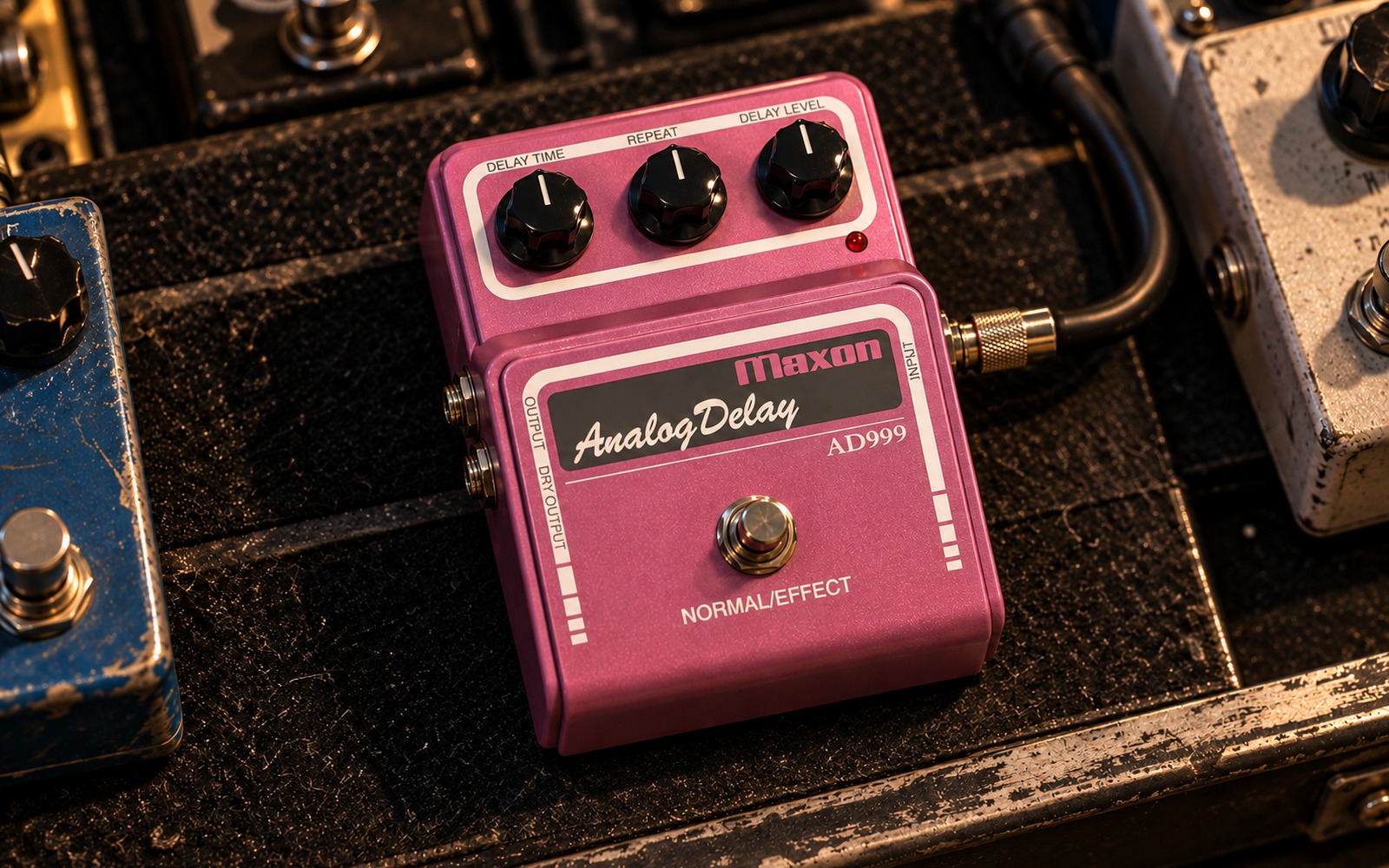
Nine Hundred Milliseconds of Pure Analog Heaven: The Maxon AD999 Analog Delay
Maxon AD999 Analog Delay: 900ms of bucket brigade warmth, stereo outputs, and true bypass. Specs, tone recipes, and confirmed players.
There is a moment, somewhere around 350 milliseconds and two repeats, where analog delay stops being an effect and becomes a texture. Where the echo is not a copy of what you played but something else entirely — warmer, slightly overdriven at the attack, rolling off into the dark. The Maxon AD999 Analog Delay lives in that moment and refuses to leave.
This is not a pedal that announces itself. It doesn’t glow or shimmer or promise cosmic modulation. It is a large, off-pink box with three knobs, and it does one thing extraordinarily well: it makes your guitar sound like it was recorded in a room that existed before digital audio was invented. Eight custom bucket brigade delay chips clocked at a deliberately slow rate produce a delay tone that is rich, warm, and slightly imprecise in exactly the way that sounds right. Not accurate. Not clean. Right.
The AD999 is the modern evolution of the Ibanez/Maxon AD-9 — an early 1980s analog delay that guitarists still hunt down and pay collector prices to own. Where the AD-9 topped out at around 500 milliseconds, the AD999 pushes to 900ms, putting genuine competition-class delay time in a bucket brigade circuit. It is one of the few pedals that can claim a legitimate analog heritage and still function at the delay times modern players expect.
The Bucket Brigade Legacy: From AD-9 to AD999
The story of the Maxon AD999 begins in the early 1980s, when Maxon (then known as Nisshin Onpa) developed the Ibanez AD-9 Analog Delay as part of their collaboration with Ibanez’s parent company Hoshino Gakki. The AD-9 used the MN3205 bucket brigade device chip — the same chip found in the Boss DM-2 — and became one of the most coveted analog delays of the era, praised for its warmth, musicality, and the way its repeats sat in a mix without competing with the dry signal.
The problem with bucket brigade technology, as it was understood in the 1980s, was delay time. The laws of physics limited how long you could delay a signal through a chain of capacitors before the audio quality degraded to unusable. Most analog delays of the era topped out at around 300–500 milliseconds. Anything beyond that required digital technology — and digital, in the late 1980s and early 1990s, became the standard. Rack-mounted digital delays with 1000ms or more of precise, clean, accurate repeats took over professional rigs. The warmth of the bucket brigade was filed under “vintage charm” and largely forgotten.
When the pendulum swung back — when players began re-examining older signal chains and discovering that many of the iconic delay tones of classic recordings came from tape delays and analog pedals — the demand for quality analog delay returned. Maxon’s response was the AD999 Vintage Series, a modern engineering solution to the delay time problem. Instead of using a single BBD chip, the AD999 uses eight custom Maxon MC4107D bucket brigade ICs in series, clocked at an extremely low rate to achieve 900 milliseconds of delay time. The compromise, as Maxon’s own technical documentation acknowledges, is a rolloff of high frequencies — particularly at longer delay times. The result of this rolloff is not a flaw but a feature: the warm, rounded, slightly dark character that makes the AD999’s repeats sit so naturally in a mix.
The AD999 was introduced as part of Maxon’s Vintage Series and has remained in production as one of the brand’s flagship pedals. A companion model, the AD999Pro, adds a secondary delay circuit for cascaded or parallel delay tones, but the standard AD999’s single-circuit purity remains its core appeal.
Specifications: What’s Under the Hood
| Parameter | Specification |
|---|---|
| Delay Circuit | 100% Analog — 8× Maxon MC4107D Bucket Brigade ICs |
| Delay Time Range | 40ms – 900ms |
| Controls | Delay Time, Repeat (Feedback), Delay Level |
| Bypass | True Bypass — Fujisoku 4PDT mechanical switch |
| Outputs | Mix Output (wet + dry) + Dry Output (dry only) |
| Input Impedance | 500K Ohms |
| Output Impedance | 10K Ohms or less |
| Residual Noise | -95 dB (input shorted, IHF-A weighted) |
| Current Draw | 46mA @ 9VDC / 48mA @ 10VDC |
| Power | 9V DC center-negative adapter (no battery) |
| Dimensions | 117mm (W) × 150mm (D) × 60mm (H) |
| Weight | 600g |
| Price (New, 2026) | ~$240–$280 USD |
| Price (Used, Excellent) | ~$140–$200 USD |
The stereo output configuration deserves particular attention. The standard output jack carries a blended wet-plus-dry signal — your typical mono pedalboard connection. The secondary Dry Output sends a clean, completely unprocessed signal. This opens up genuine stereo amp configurations: one amp receives the full delayed blend, the other receives the pristine dry signal. The result, in a live setting, is a stereo depth that makes most digital stereo delays sound thin by comparison. It also makes the AD999 useful in recording scenarios where keeping the dry signal separate from the effected signal is essential for mixing flexibility.
The Compander circuit — a compressor/expander stage — processes the signal before and after the BBD chips. This serves two functions: it brings the input signal to an optimal level for the delay chips to process cleanly, and it manages the signal-to-noise ratio across the delay chain. Without this stage, the eight BBD chips in series would accumulate noise with each pass. The Compander is why the AD999’s -95dB noise floor is acceptable despite the extended BBD chain. It is also part of why the repeats have that slightly dynamic, almost overdriven quality at the attack — the Compander is reacting to your pick attack, not just processing a flat signal.
The technical description of the repeat character, from Maxon’s own product documentation, is precise: “The repeats feature a slight EQ spike at around 1.5 kHz, preventing them from getting muddy or non-descript.” This 1.5kHz presence lift means the AD999’s repeats maintain articulation even as they decay, rather than collapsing into a warm muffle. Combined with the high-frequency rolloff from the low-clocked BBDs, the net result is a repeat that is warm but present — audible in a mix without competing for space.
The 46mA Power Reality
One practical note that surprises many first-time buyers: the AD999 draws 46mA at 9VDC. For context, this is roughly twice the draw of a typical overdrive pedal and more than a Boss DD-3 digital delay. On a power supply where you are managing multiple isolated outputs, the AD999 needs a 100mA or higher output. Any quality modern supply handles this easily — the Strymon Zuma, Cioks DC7, Voodoo Lab Pedal Power 2 Plus all work without issue. But if you are running a small four-output budget supply with 100mA total, you need to account for the AD999 first and plan around it. The pedal will not function on a 9V battery for any practical duration — 46mA will drain a standard alkaline within an hour of use.
Famous Players: The Honest Account
The artists most commonly associated with the Maxon AD999 are The Edge, David Gilmour, John Frusciante, Andy Summers, and Steve Vai. These are among the most celebrated delay users in rock history, and each of them has a deep connection to Maxon’s analog delay heritage — but that connection is to the AD-9, the AD999’s ancestor, not to the AD999 itself.

The Edge (U2) built his signature dotted-eighth delay sound around the Electro-Harmonix Deluxe Memory Man in the early period and later moved to Korg SDD-2000 and SDD-3000 digital delays, which remain core to his live rig. The LegendaryTones comparative review of the AD999 explicitly identifies The Edge as a Deluxe Memory Man user, not an AD999 user. The Ibanez AD-9 (Maxon-manufactured) appears in some documentation of his earlier rig, but the AD999 is a modern product that postdates the era when The Edge established his sound. No primary-source rig rundown confirms The Edge using the AD999 specifically. His connection to this pedal is one of ancestry, not ownership.
David Gilmour’s delay toolkit is legendary and includes Binson Echorec tape echo, the MXR Carbon Copy (which we covered at MXR M169 Carbon Copy Analog Delay), Boss DD-20, and various custom rack setups. No primary-source documentation — Premier Guitar rig rundown, Guitar World interview, or manufacturer page — confirms Gilmour using the Maxon AD999.
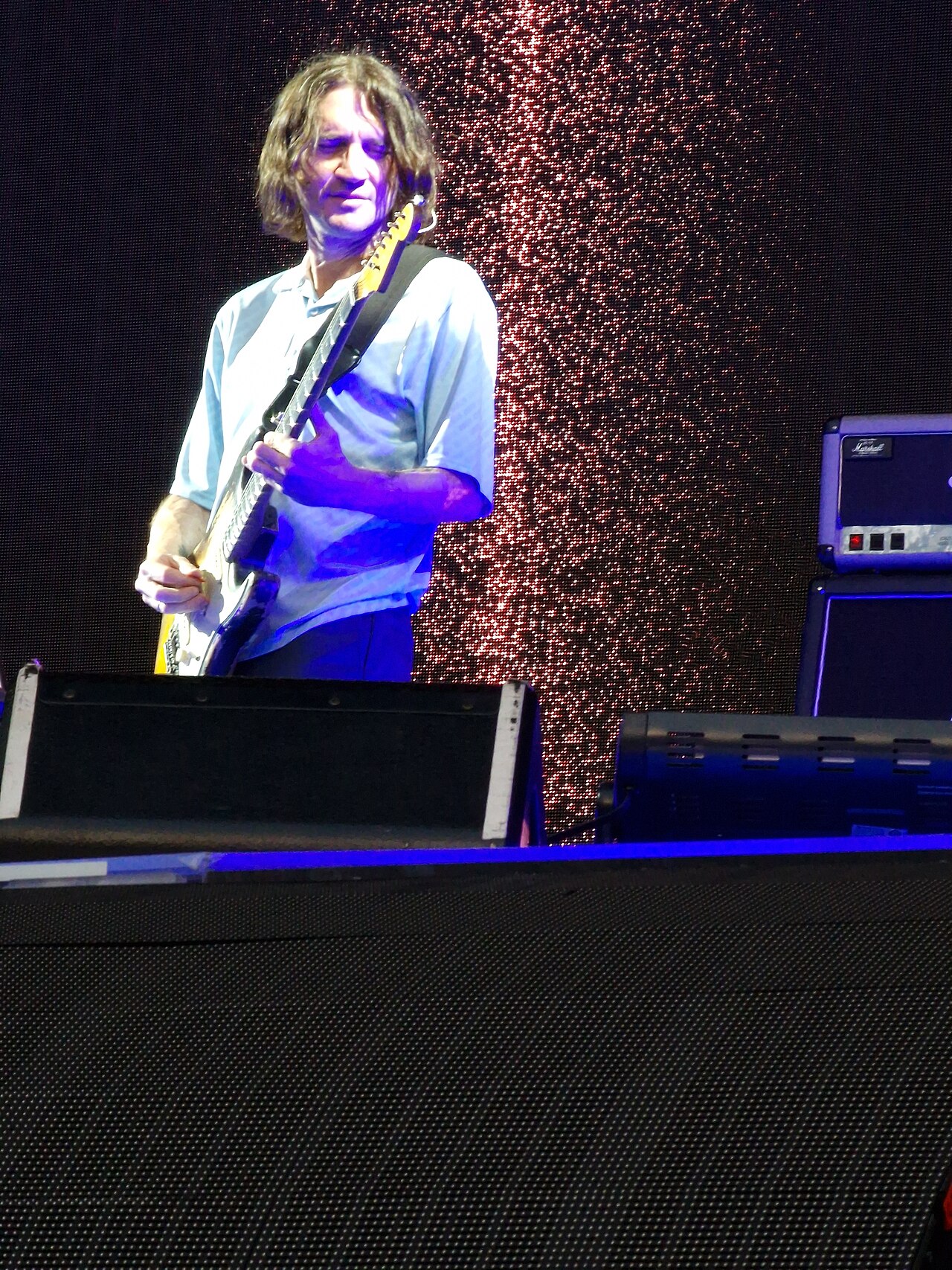
John Frusciante’s delay use across his Red Hot Chili Peppers and solo work spans the Electro-Harmonix Memory Man, Boss DD-series, and various vintage units. No primary source links him to the AD999.
Andy Summers’ documented rig for the 2007–2008 Police reunion tour included a Lexicon PCM 70, Eventide Eclipse, and Moogerfooger Analog Delay — not the Maxon AD999. He does use Maxon pedals (the Maxon SD9 Sonic Distortion is his documented drive pedal, as covered in earlier Guitar Gangsters gear guides), but the AD999 is not confirmed in his delay chain. His connection to Maxon analog delay heritage is real; his use of this specific pedal is not documented.
Steve Vai’s extensive rig documentation through Premier Guitar and his own gear catalogues does not specifically confirm the AD999. His delay setup tends toward rack-mounted units and multi-effects systems for live performance.
All five artists have genuine connections to the analog delay sound this pedal represents. Three of them specifically used the Ibanez AD-9 that Maxon manufactured — The Edge, Andy Summers, and David Gilmour all have documented history with AD-9-type delays. The AD999 carries that circuit heritage directly forward. But honest reporting requires distinguishing between “uses this pedal” and “uses something that inspired this pedal.” The former is what matters for a gear guide, and none of the five are confirmed AD999 users.
Confirmed Equipboard Users
Equipboard documents 11 professional artists using the Maxon AD999, with community-sourced evidence at varying confidence levels.
Zane Carney is the most directly confirmed, sourced from a GuitarPlayer.com article (“Zane Carney Takes Over Hollywood’s Hotel Cafe”) in which he is photographed using the Maxon AD-999 Analog Delay during his performance at The Troubadour in Los Angeles on August 27, 2018. Carney is known as a session and touring guitarist who has worked with John Legend, among others.
Blake Mills — collaborator with Haim, Fiona Apple, and Alabama Shakes, and one of the most critically respected session and production guitarists of the past fifteen years — appears at the top of Equipboard’s AD999 listing. Mills is known for meticulously curated, sonically specific gear choices, and the AD999’s warm, non-clinical character fits the layered, textural production style he brings to projects. His is an Equipboard community documentation rather than a primary-source rig rundown, but given his reputation for analog precision, the association is entirely credible.
David Bryant (Godspeed You! Black Emperor) uses the AD999 according to Equipboard documentation. Bryant’s post-rock orchestral guitar work — building from sparse clean tones to dense walls of sound — is precisely the context in which the AD999’s long decay and textural repeat character excels. For post-rock guitarists who need a delay that does not sound like a clock, the AD999’s organic repeats are a significant advantage over digital units.
Isaiah Mitchell (Earthless) is documented on Equipboard using the AD999. Mitchell’s psychedelic rock guitar work — long-form improvisation, heavily effected clean tones, extended instrumental passages — benefits from exactly the kind of warm, self-oscillation-capable analog delay the AD999 provides. Earthless’s music is built on the kind of layered, ambient repetition that pushes delay pedals to their maximum delay times and self-oscillation limits.
Tone Recipes: Seven Settings Worth Having
1. Classic Slapback (Rockabilly / Twang)
Delay Time at 7–8 o’clock (40–80ms), Repeat at minimum (1 repeat), Delay Level at noon. Strat bridge pickup, clean amp. The AD999’s dynamic distortion on the repeat gives the slapback a slightly saturated character that sounds more like a tape echo than a digital slapback. Classic American roots tone.
2. Edge-Style Dotted-Eighth Feel (Atmospheric Clean)
Delay Time at roughly 2 o’clock (350–400ms), Repeat at 9–10 o’clock (2–3 repeats), Delay Level at 9–10 o’clock. Tune the delay time by feel against your tempo — unlike digital delays, the AD999 does not lock to a tap-tempo grid, which means you adjust by ear. This approach forces you to set delay time musically rather than mathematically, often yielding a slightly “wrong” setting that sits better in a live context than a mathematically correct one.
3. Gilmour-Style Space (Long, Dark, Ambient)
Delay Time at 3 o’clock or above (600–800ms), Repeat at 10–11 o’clock (3–4 repeats), Delay Level at 8–9 o’clock. The high-frequency rolloff at long delay times gives the repeats a depth and distance that recalls Binson Echorec — the reference Maxon themselves invoke in their product description. Set the Delay Level below noon so repeats blend rather than compete. Neck pickup on a Stratocaster. Any clean tube amp with natural reverb.
4. Rhythm Fill (Always-On Low-Level)
Delay Time at 10 o’clock (100–150ms), Repeat at minimum, Delay Level at 8 o’clock. At this setting the delay is almost imperceptible as a discrete echo — it adds dimension and space to rhythm playing without doubling the notes. Leave it on for the whole set. Works with humbuckers and into slightly crunchy amps.
5. Self-Oscillation (Controlled Chaos)
Delay Time at noon (300–400ms), Repeat above 3 o’clock and approaching maximum, Delay Level at noon. As the Repeat control approaches maximum the AD999 self-oscillates — the repeats feed back into each other, building in volume and intensity. At max Repeat the oscillation becomes infinite and uncontrolled. Used as a textural effect: activate, let it build for a measure, disengage, use dry signal for a while. Isaiah Mitchell’s Earthless context exactly.
6. Van Halen-Style Rock Rhythm Depth
Delay Time at 11 o’clock (200–250ms), Repeat at minimum, Delay Level at 8 o’clock. The single quiet repeat adds the same “width” to rhythm chords that Eddie Van Halen achieved with a small amount of delay — not an echo, just a slight thickness. Les Paul into a Marshall-style amp. This is not a distinctive delay sound; it is a subtle supporting character that makes a dry-sounding amp feel larger.
7. Stereo Amp Spread
Connect the Mix Output to one amp, the Dry Output to a second amp. Delay Time at noon, Repeat at 9–10 o’clock, Delay Level at noon. The spatial separation between the pristine dry amp and the delayed wet amp creates a stereo width that is physically felt in the room, not just heard through headphones. The AD999’s stereo configuration is one of the most transparent implementations of this approach available in a pedalboard format.
Comparisons: How It Fits the Field
vs. Electro-Harmonix Deluxe Memory Man
The Deluxe Memory Man (EHX Deluxe Memory Man) is the AD999’s most famous analog delay competitor and the pedal most strongly associated with The Edge, Eric Johnson, and the canonical analog delay tone of the late 1970s and 1980s. The DMM adds chorus and vibrato modulation to its delay repeats — a feature the AD999 completely lacks. The DMM’s maximum delay time is shorter than the AD999’s 900ms. The AD999 wins on delay time, signal transparency, pedalboard footprint, and noise floor; the DMM wins on tonal complexity and modulation options. They are different tools pursuing the same general aesthetic: players who want modulated ambient delay choose the DMM, players who want pure, dry analog delay at maximum time choose the AD999.
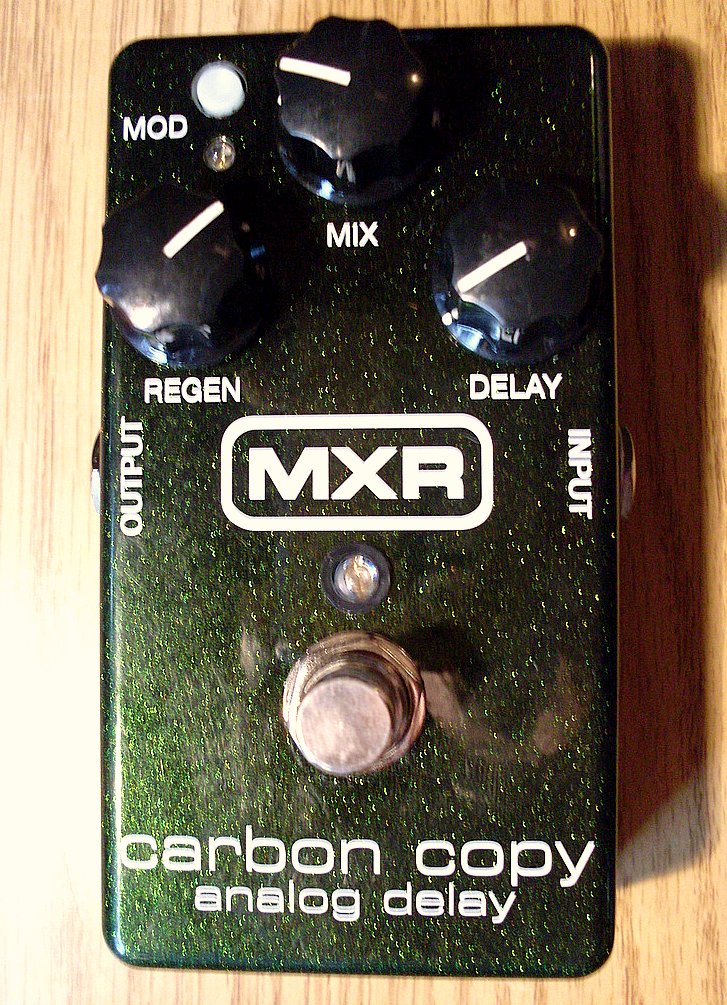
vs. MXR Carbon Copy (M169)
The MXR M169 Carbon Copy is the accessible entry point to serious analog delay — smaller, less expensive (around $130 new), and offering 600ms of delay time. The Carbon Copy has an optional internal modulation trimmer, a simpler circuit, and a much smaller footprint. The AD999 wins on maximum delay time (900ms vs 600ms), stereo output, dynamic repeat character, and the tonal depth of eight BBD chips vs the Carbon Copy’s single-chip design. The Carbon Copy wins on price, size, and pedalboard efficiency. For most working guitarists the Carbon Copy covers the analog delay ground at half the cost; the AD999 is for players for whom that extra 300ms and the specific character of eight Maxon BBDs matters.
vs. Maxon AD9 Reissue
The AD9 Reissue is the direct ancestor model — same three-knob layout, single BBD chip (the MN3205), 500ms maximum delay time, and the warmer, slightly compressed character of the original design. The AD9 Reissue costs significantly less than the AD999 and occupies a standard-size enclosure. The AD999 wins on delay time (900ms vs 500ms), stereo output capability, and the dynamic repeat distortion from the eight-chip design. The AD9 Reissue wins on price, enclosure size, and the “vintage original” argument — its single MN3205 chip is closer to what the famous players of the early 1980s actually used. Both are legitimate; they are different implementations of the same heritage.
vs. Boss DD-3
The Boss DD-3 is the digital control group — 800ms of delay, precise repeats, compact enclosure, significantly lower cost. The DD-3’s repeats are accurate recreations of the input signal: each repeat sounds like a precise copy that decays cleanly. The AD999’s repeats are not accurate — they are warmer, darker, slightly overdriven at the attack, and less precise as they decay. Which is better depends entirely on what you want from delay. For applications where accuracy matters (recording, tight rhythmic delay effects, tap-tempo matching), digital wins. For applications where texture and feel matter (atmospheric clean tones, blues lead, ambient post-rock), the AD999’s imprecision is its value.
Buying Guide: New, Used, or Pro?
The AD999 has been in production for several years and is available new from authorized Maxon retailers at around $240–$280 USD as of 2026. Note that Godlyke, the longtime US distributor for Maxon (and the operator of the maxonfx.com storefront), has indicated they are no longer actively receiving inventory from Maxon Japan — the same distributor situation noted across recent Maxon product releases. Other US retailers including Guitar Center and Sweetwater continue to stock the AD999, and it remains readily available at normal prices.
Used examples in excellent condition appear on Reverb in the $140–$200 range, with condition being the primary price driver. The AD999 is a durable pedal — its heavy die-cast construction and mechanical switching are designed for long-term use — and a used example in excellent condition represents the same sonic performance as a new one at significantly lower cost.
The AD999Pro adds a secondary delay circuit for cascaded or parallel delay configurations. It costs more and occupies slightly more space. For most guitarists the standard AD999’s single-circuit purity is preferable — the Pro version is for players who specifically need two delay times from a single analog pedal, a relatively narrow use case that could also be served by two separate delay pedals with more individual flexibility.
Ownership Notes: Living with the AD999
The AD999’s three knobs are recessed slightly into the enclosure, making them difficult to adjust with your foot mid-set. This is by design for protection, but it means you set your delay time before you play and commit to it. Players who need to switch between radically different delay times mid-song should use two delay pedals or add a more flexible unit. The AD999 rewards players who find a delay time they love and leave it there.
The mechanical true bypass switch — the Fujisoku 4PDT — produces an audible click when engaged or disengaged. This is standard for quality mechanical bypass switches and has no impact on tone, but it is noticeable in quiet recording environments. If silent switching is a requirement for your recording setup, the AD999 is not the right tool.
Self-oscillation is available and deliberate — pushing the Repeat control past 3 o’clock begins the feedback loop that leads to self-oscillation. Used intentionally, this is a powerful textural tool. Reached accidentally during a performance, it is loud and potentially embarrassing. Knowing where your Repeat sweet spot is and staying below the oscillation threshold is essential setup homework.
The -95dB noise floor is acceptable for an eight-BBD-chip design but is noisier than a digital delay or a single-chip analog design like the Carbon Copy. In a quiet studio environment with a clean signal chain, the AD999’s floor noise is audible at high Delay Level settings. In a live performance context it is completely irrelevant. Plan your recording gain staging accordingly.
Frequently Asked Questions
What is the difference between the Maxon AD999 and the Ibanez AD9?
The Ibanez AD9 was designed and manufactured by Maxon in the early 1980s and used the MN3205 bucket brigade chip for up to 500ms of analog delay. Maxon continued manufacturing the AD9 under their own brand as the AD9 Reissue. The AD999 is a modern evolution of the same concept: eight custom Maxon MC4107D BBD chips in series for 900ms of delay time, plus stereo outputs and true bypass. The AD9 Reissue is warmer and simpler; the AD999 is more capable and more complex.
Does the AD999 have tap tempo?
No. The AD999 is a purely analog pedal with no digital circuitry, and tap tempo requires digital processing to function. You set the delay time manually by ear using the Delay Time knob. This is actually one of the AD999’s defining characteristics — the slightly imprecise, feel-based delay time adjustment is part of what makes the pedal sound musical rather than mechanical.
Can I use the AD999 with a standard pedalboard power supply?
Yes, as long as your power supply can provide 9VDC center-negative with at least 50mA of current on that output. The AD999 draws 46mA — significantly more than typical overdrive pedals — so check your power supply’s per-output ratings. Any quality isolated power supply (Strymon Zuma, Cioks, Voodoo Lab Pedal Power 2 Plus) handles it without issue. Do not try to run it on a 9V battery for any serious playing time.
What is the self-oscillation point on the AD999?
Self-oscillation begins when the Repeat (feedback) control is pushed above roughly 3 o’clock. As you approach maximum, the repeats feed back into each other with increasing intensity until they become continuous and grow in volume. Max Repeat produces uncontrolled oscillation that requires turning the Delay Level down or bypassing the pedal to stop. Many players use the point just below full oscillation — edge-of-chaos — as a sustained pad effect.
How does the AD999’s stereo output work?
The AD999 has two output jacks: the standard Mix Output (which carries both the dry signal and the delayed signal blended together) and a Dry Output (which carries the unprocessed dry signal only). In a stereo setup, you route the Mix Output to one amplifier and the Dry Output to another. The result is a natural stereo spread: one amp is clean and dry, the other carries the delay effect. This is not a simulated stereo — the physical separation of wet and dry signals produces a genuine spatial depth.
Is the AD999 true bypass?
Yes. Bypassing is handled by a Fujisoku 4PDT mechanical switch, one of the most reliable bypass switching mechanisms available in a compact pedal format. When bypassed, the pedal’s circuitry is completely removed from your signal path. The bypass is fully transparent — indistinguishable from a direct cable connection in A/B testing.
What makes the AD999’s delay repeats sound different from a digital delay?
Three things: First, the eight BBDs clocked at a low rate roll off high frequencies progressively across the delay chain, so each repeat is slightly darker and warmer than the one before. Second, the Compander circuit reacts dynamically to pick attack, giving the initial repeat a slightly overdriven quality that softens as the repeat decays. Third, an EQ presence boost at approximately 1.5kHz in the repeat chain keeps the echoes articulate without shrill brightness. The net effect is a repeat that sounds like it was recorded in a room, not calculated by a processor.
Who actually uses the Maxon AD999?
Confirmed users include Blake Mills (producer/session guitarist), David Bryant (Godspeed You! Black Emperor), Isaiah Mitchell (Earthless), and Zane Carney, among the 11 documented artists on Equipboard. The pedal is particularly strong in the hands of guitarists who prioritize texture over precision — post-rock, psychedelic, atmospheric, and session work where the feel of the delay matters more than its mathematical accuracy. The Ibanez AD-9 (the AD999’s ancestor, also Maxon-manufactured) was used by The Edge, Andy Summers, and others during the early 1980s, giving the AD999 a genuine circuit lineage connecting it to some of the most important delay tones ever recorded — but that lineage is heritage, not direct user endorsement of this specific model.
Image credits
- Top image: GuitarGangsters AI-generated reference illustration, not a photograph.
- John Frusciante: Hel Davies, Wikimedia Commons, CC BY-SA 2.0.
- Andy Summers: Drussel1, Wikimedia Commons, CC BY-SA 4.0.
- MXR Carbon Copy: MXR Carbon Copy by Roadside Guitars, Flickr, CC BY-SA 2.0.
Latest News
Related
On This Day
Monday 9 November
From this week: