Coiled Tape, Digital Ghosts: The Boss RE-2 Space Echo Brings Roland’s Iconic Echo Back to Earth
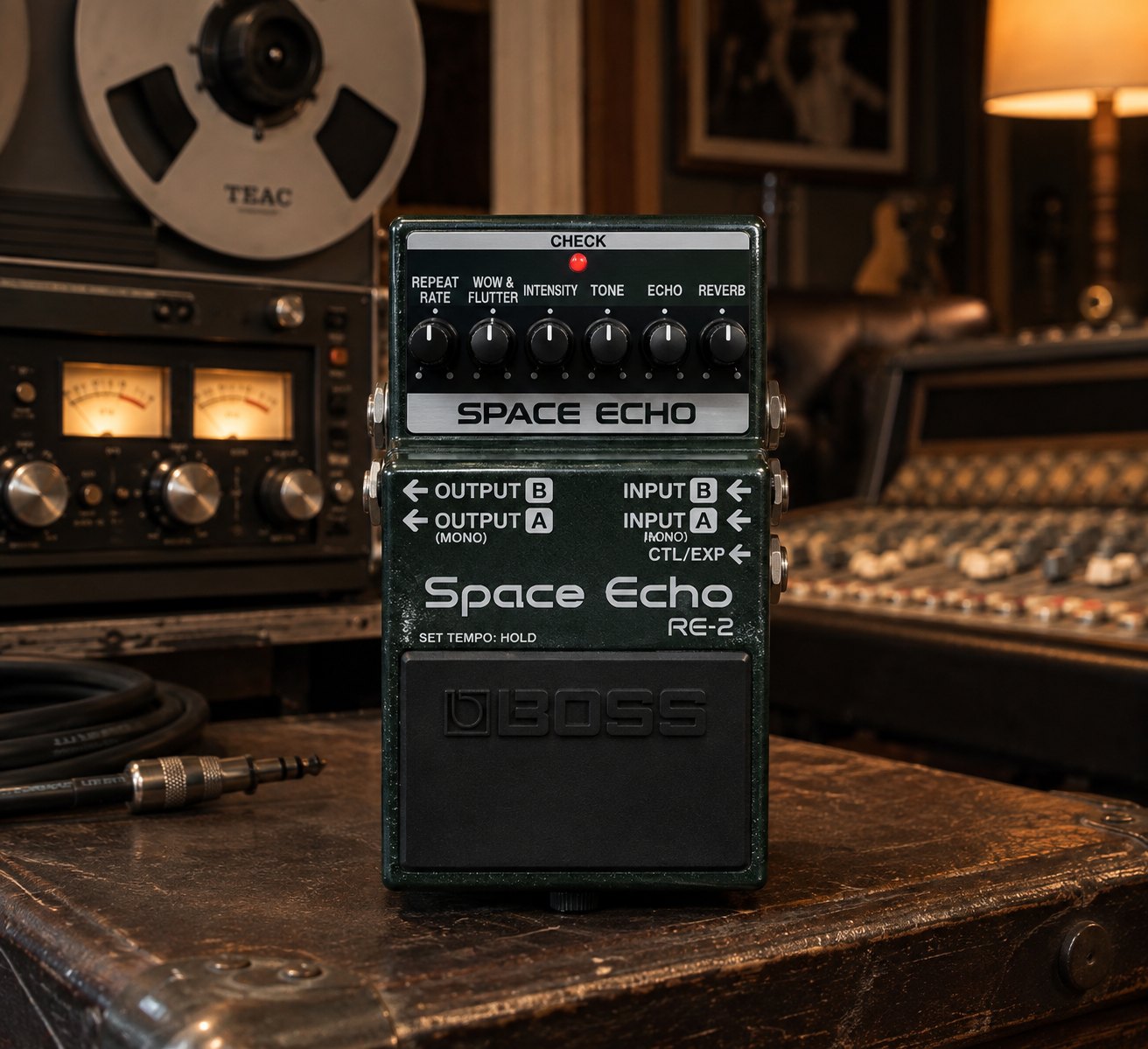
BOSS RE-2 Space Echo Delay/Reverb Pedal. AI-generated reference illustration, not a photograph.
The Boss RE-2 Space Echo packs the legendary Roland RE-201 tape echo into a standard compact pedal. Specs, tone recipes, players, and buying advice.
There is a reason the Roland RE-201 Space Echo appears in the origin story of practically every genre of electric music made between 1974 and 1990. Reggae dub masters used it to sculpt cathedrals of sound out of a single guitar chord. Surf guitarists cranked it until it sang feedback harmonics. Post-punk architects built entire sonic identities around its organic repeats and spring reverb rattle. The Edge wove texture. Andy Summers made the space between notes as important as the notes themselves. Brian Setzer turned it into a rockabilly time machine. When Roland discontinued the tape-based unit in the early 1990s, the used market responded by sending prices to the stratosphere, where vintage RE-201 units still trade for $600 to $1,500 or more depending on condition.
The problem with tape echo is that it is simultaneously one of the most musical and most temperamental technologies ever pressed into guitar service. Tape stretches, breaks, degrades. Capstans wear. Pinch rollers harden. The mechanism that makes the RE-201 sound the way it does — actual magnetic tape moving at controlled speed past three playback heads — is also the mechanism that guarantees the unit will eventually need a technician, a bag of replacement parts, and possibly a spiritual advisor. Boss and Roland have spent decades trying to solve this problem in compact form, from the RE-20 Boss pedal of 2006 to the current dual-release of the RE-2 and RE-202 in 2022. The RE-2 is the more ambitious of the two solutions: all the essential Space Echo functionality, crammed into a standard-sized Boss compact chassis.
This is a story about what that ambition actually sounds like, what it costs, who plays one, and whether the RE-2 belongs on your pedalboard.
From Magnetics to Modeling: The Space Echo Timeline
Roland launched the RE-201 Space Echo in 1974 as a studio-grade tape echo unit for professional use. The design centered on a continuous loop of recording tape that passed over an erase head, a record head, and three playback heads at fixed positions along the tape path. By combining different playback heads through an 11-position mode selector, players could generate single echoes, dual-head polyrhythms, and triple-head cascades, each with a different timing relationship derived from the physical distance between heads. The spring reverb tank ran in parallel, fed by a separate send, and the two wet signals could be blended independently. The result was an instrument within an instrument: a device so interactive that small adjustments to the Intensity knob (which controlled the feedback level, and therefore the number of repeats) could push the unit from tasteful ambient wash to self-oscillating chaos without any additional pedals involved.
Roland discontinued the tape-based Space Echo line in the early 1990s when digital delay technology had advanced to the point where tape became commercially impractical. For the next fifteen years, the RE-201 became the province of dub producers, studio engineers, and committed vintage collectors. Boss addressed the gap in 2006 with the RE-20 pedal, a twin-footswitch, wide-format pedal that modeled the RE-201 closely enough to become a mainstay of pedalboards for musicians who wanted the Space Echo character without the mechanical uncertainty. The RE-20 was a solid pedal, but by 2022 its modeling algorithms were a decade and a half old and its format did not suit players with space-constrained boards.
Boss retired the RE-20 and simultaneously released the RE-2 and RE-202 in 2022. The RE-202 is the larger, more feature-complete unit with dedicated knobs for each parameter, selectable bypass modes, and expanded stereo options. The RE-2 applies all the same new modeling algorithms to a standard Boss compact enclosure, accepting the tradeoffs that come with the smaller chassis in exchange for maximum pedalboard compatibility. Both units benefited from modeling work developed specifically for the 2022 release, representing a significant improvement over the RE-20’s original algorithms.
Boss RE-2 Space Echo: Full Specifications
Inside the RE-2: How the Controls Work
The RE-2 packs a genuinely complex control system into a compact pedal through the use of three concentric dual-knob pairs. Each pair puts two separate functions on the same shaft: the outer ring and the inner knob operate independently. This means the RE-2 has six effective control points across those three knob sets, plus the 11-position mode selector and the footswitch. For players new to Space Echo designs, there is a learning curve. For players who grew up on RE-201s, the layout maps to familiar territory immediately.
The Mode knob is the most critical control on the pedal and also the most problematic in practice. All eleven positions correspond to different combinations of the RE-201’s three playback heads, determining not just the number of delay repeats but the timing relationships between them. Head 1 alone gives you a single short echo. Heads 1 and 2 together create two echo lines at different rates. All three heads produce a dense, polyrhythmic cascade. Mode 11 adds the reverb tank into the head combination, producing the drenched, reverb-soaked wash that defines certain classic RE-201 applications. The problem Premier Guitar’s Charles Saufley identified in his November 2022 review is real: the mode positions are difficult to read in low light, and navigating to a specific mode on stage requires either memorization or a printed reference. This is a consequence of the compact format’s size constraints and is the RE-2’s most significant usability limitation.
The Intensity knob controls feedback — the number of repeats — and functions exactly as it does on the original RE-201. At low settings you get one or two clean echoes. As you increase intensity, the echoes multiply and compress into each other. At the upper extreme, the RE-2 enters self-oscillation: an escalating feedback loop that produces the modulating, spiraling madness the RE-201 is famous for when pushed past its design envelope. This self-oscillation is a feature, not a malfunction, and many players specifically choose the RE-2 to access it safely without risking damage to vintage hardware.
The Wow & Flutter knob adds analog character by simulating the speed fluctuations of aging tape transport mechanisms. Low settings give the delay a subtle organic warmth. High settings introduce an obvious pitch wobble that pushes the RE-2 toward explicit vintage character — almost vibrato-like on the repeats. Combined with high Intensity, maximum Wow & Flutter produces the kind of deteriorated, unstable echo texture that spent decades being available only to players willing to maintain original tape hardware.
The Twist function is activated by pressing down on the footswitch while the pedal is already engaged. It ramps the pitch of the delay signal upward while held, then ramps back down when released, creating a whooshing, pitch-warped sweep effect. It is a performance tool with specific applications: extended ambient passages, dramatic musical punctuation, experimental texture work. Some players find it gimmicky. Others build entire sections of songs around it.
Famous Players: Who Actually Uses the RE-2
Because the RE-2 is a 2022 pedal, any association with players who built their signature sounds in earlier decades is historically impossible. The Edge’s Korg SDD-3000 delay tones predate the RE-2 by four decades. David Gilmour’s Binson Echorec work, Andy Summers’ iconic Police-era echo, Brian Setzer’s rockabilly tape delay — all of these were developed on original Roland RE-201 units or other vintage tape machines. The relevant question for the RE-2 is who has specifically adopted the pedal since its 2022 release, not who has historically used tape echo in general. The distinction matters, and honest gear journalism requires making it explicitly.
The highest-profile confirmed RE-2 user currently documented is Dan Auerbach of The Black Keys. Auerbach’s RE-2 is confirmed via a pedalboard photograph on Equipboard that clearly shows the unit in his signal chain. Auerbach has long been associated with vintage-influenced, lo-fi-adjacent guitar tones, and the Space Echo character fits naturally into his recorded and live sound. See Dan Auerbach’s Gear Guide.
Josh Klinghoffer, formerly of the Red Hot Chili Peppers and currently the guitarist for Jane’s Addiction, has been documented using the RE-2 on his pedalboard during Jane’s Addiction performances. The documentation is via a Twitter/social media post by a user photographing his setup, captured on Equipboard. Klinghoffer’s guitar voice — deeply textural, effects-dense, rooted in the alternative and post-punk tradition — makes Space Echo-style delay a natural fit.
Viktor Krauss, the bassist who performs with Robert Plant and Alison Krauss, is documented as an RE-2 user in a pedalboard description that lists his full setup including Strymon Blue Sky, Klon KTR, Boss RE-2, Nobels Overdrive, LS-2, EHX Pitch Fork, Hologram Microcosm, and others. Krauss is a bassist rather than a guitarist, and his RE-2 usage reflects the pedal’s cross-instrument versatility — it works as naturally on bass as on guitar.
Beyond these documented users, Equipboard records 11 pro artists using the RE-2 as of mid-2026, reflecting the pedal’s position as a relatively recent release with a growing professional user base. Players who historically used the Roland RE-201 — Brian Setzer (Brian Setzer’s Gear Guide), Andy Summers (Andy Summers’ Gear Guide), David Gilmour (David Gilmour’s Gear Guide) — are not confirmed RE-2 users. Their associations are with the original RE-201 tape unit and its particular analog character, and attributing their tone to the RE-2 would misrepresent both the history and the technology.
Tone Recipes: Seven Essential RE-2 Settings
1. Classic Single-Head Slap (MODE: Position 1)
Set MODE to position 1 (head 1 only). Repeat Rate at 10 o’clock for a short slap between 100-150ms. Intensity at 9 o’clock for 1-2 clean repeats. Echo Volume to taste, Reverb Volume at zero. Wow & Flutter at minimum. This is the cleaner, more disciplined Space Echo sound — tight enough for country, roots, and rockabilly without the texture bleeding into the next beat. With a bright single-coil into a clean amp, this setting produces the foundational Space Echo character without any ambient wash.
2. Multi-Head Polyrhythm (MODE: Position 7 or 8)
Set MODE to a position using heads 1, 2, and 3 simultaneously. Repeat Rate at noon for a medium delay time. Intensity at 10-11 o’clock. Wow & Flutter at 9-10 o’clock. Echo Volume slightly above unity, Reverb Volume at zero. The three playback heads create echoes at three different time values simultaneously, producing rhythmic complexity that shifts depending on what tempo you play. The interlocking echo patterns reward playing that leaves space — strummed chords and melodic phrases become rhythmically entwined with their own delay trails.
3. Andy Summers Ambient Wash (MODE: Position 5 or 6)
Use a two-head mode. Repeat Rate at noon to 1 o’clock for a longer delay. Intensity at 12-1 o’clock for multiple repeats. Echo Volume at noon. Reverb Volume at 9 o’clock. Tone slightly bright. Wow & Flutter at 10 o’clock for subtle organic movement. This is the setting territory where clean, arpeggiated chord voicings take on a halo of delay and reverb, each note staying present long enough to overlap with what follows. Summers never used the RE-2 specifically — his RE-201 tones are well documented — but this is the configuration space where the RE-2 approaches those sonic textures most closely. Reference: Andy Summers’ Gear Guide.
4. Dub Echo (Intensity Maxed, Controlled)
MODE at a multi-head position. Repeat Rate at 1-2 o’clock for a longer delay time that lands behind the beat. Intensity at 2-3 o’clock — not quite self-oscillating but dense and repeating. Echo Volume at noon. Reverb Volume at 10 o’clock. Tone slightly dark. Wow & Flutter at noon. This is the reggae dub application that made the original RE-201 canonical in Kingston studios. The long, dense repeats trail behind the source material, creating a sense of vast space and elastic time. Pull back the guitar’s tone control to roll off treble, and the effect becomes more cavernous.
5. Self-Oscillation Dive (Performance Technique)
Set Intensity just below self-oscillation threshold — approximately 2-3 o’clock, depending on mode. Play a note or chord, then slowly advance the Intensity knob past the threshold while the note sustains. The delay feedback escalates, the repeats stack, and the unit enters controlled self-oscillation that climbs in density and pitch. Back the Intensity off to return to stability. This technique requires practice and familiarity with the specific Intensity taper on your unit, but it is one of the most powerful sonic tools available on any delay pedal and a direct inheritance from the original RE-201’s interactive nature.
6. Spring Reverb Only (No Echo)
Set MODE to position 0 (no echo heads engaged, if available) or use a head-only position with Echo Volume at zero. Reverb Volume at noon. Intensity at minimum. This isolates the RE-2’s spring reverb emulation as a standalone effect. Premier Guitar noted the spring sounds cool on its own, if not quite matching the character of the original RE-201’s tank. It works as a light room reverb for clean-amp applications, particularly with Tone rolled back to reduce the spring’s characteristic brightness. Better spring reverb options exist — the Boss RV-6 (covered at Boss RV-6 Reverb Guide) has a more convincing spring emulation as a primary function — but the RE-2’s spring is usable and convenient when you want reverb from the same pedal that’s providing your delay.
7. Twist Performance Sweep
Configure any echo mode with medium Repeat Rate and medium Intensity. Play a sustained chord or long note. Engage the footswitch to activate the RE-2. While the note sustains with echoes trailing, press and hold the footswitch to activate Twist. The delay pitch sweeps upward as long as you hold, then descends back as you release. This works best at the end of a phrase or song section, where the pitch sweep can build and release without conflicting with subsequent notes. Combined with high Wow & Flutter and high Intensity, the Twist function generates the kind of spatially warped sound that demands listener attention.

How the RE-2 Compares to Its Alternatives
The Boss RE-202, released simultaneously with the RE-2 in 2022, is the most direct comparison point. The RE-202 uses the same modeling algorithms in a larger chassis with fully separated control knobs (no concentric doubling), selectable true bypass or buffered bypass modes, and expanded stereo options. The RE-202 is more ergonomically comfortable to operate, particularly in live situations where finding a specific mode quickly matters. The RE-2 wins on pedalboard real estate — it occupies the same footprint as any Boss compact while the RE-202 requires a larger dedicated area. For players who prioritize space and already own the standard Boss power and switching setup, the RE-2 is the practical choice. For players who will work the controls extensively, the RE-202 justifies its size and higher cost. Both share the same underlying sonic engine, so the tonal difference is minimal.
The Boss RV-500 Reverb contains a dedicated Space Echo emulation mode (Roland RE-201 algorithm, referred to internally as the Space Echo mode). For players who already own an RV-500 and are debating whether to add the RE-2, the RV-500’s Space Echo algorithm is capable and convenient. The RE-2 offers a more focused, more tweakable, and more interactive emulation of the original RE-201 experience, particularly for players who use Twist, tap tempo, and the Wow & Flutter control as performance tools rather than set-and-forget parameters.
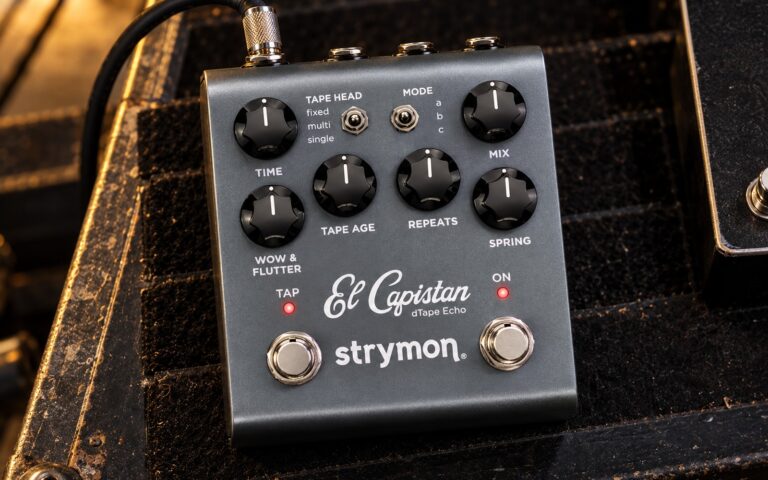
The Electro-Harmonix Deluxe Memory Man is frequently mentioned alongside the RE-2 in discussions of delay with organic character. The Memory Man is an analog BBD-based delay with integrated modulation — a fundamentally different technology from the RE-2’s digital modeling. The Memory Man produces analog warmth from actual bucket-brigade circuit behavior; the RE-2 models the tape-echo character digitally. Both can produce ambient, textured delay, but they do it through different mechanisms and achieve different tonal signatures. The Memory Man cannot replicate the specific multi-head echo combinations of the RE-2. The RE-2 cannot replicate the pure BBD analog behavior of the Memory Man. They are more complementary than competitive.
The MXR Carbon Copy operates in a different category entirely: a single-mode analog delay focused on warm, dark repeats rather than the complex multi-head character of the Space Echo family. The Carbon Copy is simpler, cheaper, and purer in its analog character. The RE-2 is more versatile, more complex, and offers sounds the Carbon Copy cannot approach. They address different needs.
The Boss DD-500 contains a Space Echo emulation within its Tape mode selection. The DD-500’s Roland SDE-3000 emulation covers the rack-mount Roland digital territory, while its Tape mode can approximate Space Echo character. For players who already run a DD-500 as their primary delay, the overlap with a dedicated RE-2 is real. Players who specifically want Space Echo as their primary sonic tool — rather than one of many delay options — will find the RE-2’s more focused, interactive design more satisfying to work with.
Buying Guide: New, Used, and What to Expect
The RE-2 sells new for approximately $259 to $289 USD depending on retailer. Used examples in excellent condition typically trade between $160 and $220 USD, reflecting the pedal’s 2022 release date and consequent limited used-market depth. Unlike a vintage Boss pedal where manufacturing date significantly affects collector interest, all RE-2 units are sonically identical — there are no manufacturing variants, no PCB revisions that affect tone, and no chip-sourcing changes to research before purchasing used. Any RE-2 in good working condition is equivalent to any other.
The 75mA current draw is higher than a typical analog compact pedal (Boss DS-1 draws around 10mA; a CE-2W draws 40mA) but well within the range of most power supplies designed for digital pedals. A standard isolated 9V supply with a 100mA or greater output per circuit will handle the RE-2 without issue. Daisy-chaining with other digital pedals is not recommended due to noise interaction risk; isolated power is the reliable approach. Boss does not recommend battery use for live performance given the 4.5-hour alkaline life, though the battery slot is a useful backup option.
The RE-2’s buffered bypass maintains signal level through the output stage when the effect is off, which can be beneficial for long cable runs or passive effects chains. The effect carryover function allows delay trails to continue decaying naturally when you bypass the pedal, eliminating the abrupt cutoff that bufferless true-bypass units produce when disengaged mid-phrase. For live performance, this makes the RE-2 more musically natural to operate than a hard-bypassing delay when you need to cut the effect cleanly at a phrase boundary.
Living With the RE-2: Practical Ownership Notes
The RE-2’s biggest real-world limitation is the 11-position mode knob’s low-light legibility. In a rehearsal room or studio with overhead lighting, it is manageable. On a dimly lit stage, the mode positions become difficult to read mid-performance without a pedalboard light or tape markers added by the player. Many RE-2 owners solve this by marking their two or three primary mode positions with a paint pen or nail polish dot on the pedal enclosure. This is not elegant but it is practical and widely documented in player communities.
The concentric knob system rewards slow, deliberate dialing rather than fast on-stage adjustments. The outer ring (which controls Reverb Volume, Tone, and Wow & Flutter depending on which knob pair) is narrower and requires more precision to adjust than a standalone knob. For players who set the RE-2 and leave it as a single-setting always-on or scene pedal, this is not an issue. For players who need to make multiple parameter adjustments quickly between songs, the RE-2 requires more practice than its larger sibling the RE-202.
The Wow & Flutter control warrants particular attention during initial setup. At noon and above, the pitch modulation on the repeats becomes obviously audible — noticeable not just as warmth but as actual pitch movement. For players accustomed to digitally pristine modern delays, this can be disconcerting initially. It is not a defect; it is exactly what the control is designed to do. Setting Wow & Flutter between 7 and 9 o’clock adds organic warmth without overt pitch wobble, and that range is where most players settle for standard use. Above noon is for deliberate vintage texture or experimental work.
The spring reverb element works best when used in combination with the echo rather than as a solo reverb effect. Its primary role in the RE-201 was always to complement the tape echo character rather than stand alone, and the RE-2’s spring emulation follows that heritage. Players looking for a dedicated spring reverb sound should consider the Boss RV-6 Reverb, which has a dedicated Spring mode developed as a primary reverb type rather than a supporting character for a delay pedal.
The RE-2 in the Signal Chain
Traditional signal chain placement puts the RE-2 after gain stages (overdrive, distortion, fuzz) and before reverb if running a separate reverb. This produces echoes of the driven guitar signal, which then wash into ambient reverb. Because the RE-2 has a built-in spring reverb, many players use it as the final stereo stage, combining echo and reverb within the unit and routing both outputs to a stereo power amp or two separate amplifiers. The RE-2’s true stereo path means the two outputs carry genuinely independent signal processing, with the multi-head echo combinations spreading across the stereo field in ways that a mono delay running into a stereo splitter cannot replicate.
For use with a Fender Stratocaster into a clean amp, the RE-2 is particularly effective in multi-head modes at medium delay times, where the staggered echo pattern complements the guitar’s natural articulation and the single-coil brightness gives each repeat a distinctive transient character. The Tone control’s ability to roll off the high-frequency content of the repeats — simulating the high-frequency loss that actual magnetic tape imposes on recorded material — pairs especially well with bright single-coil guitars, creating a sense of the repeats receding into distance as they multiply. With a Fender Telecaster, the same approach works equally well, and the Telecaster’s harder attack translates to slightly more defined echo transients than the Stratocaster’s softer response.
Running the RE-2 in front of a Vox AC30 is a combination with deep historical precedent — the AC30 and tape echo machines were standard studio and live tools in the same era and were frequently used together. The AC30’s natural compression and harmonic richness works with the RE-2’s echo character to produce a sound that sits in the middle distance rather than at the front of the mix, particularly at lower master volume settings.
Frequently Asked Questions
What is the difference between the Boss RE-2 and RE-202?
The RE-2 uses the same modeling algorithms as the RE-202 but in a standard Boss compact enclosure with concentric dual-knob controls. The RE-202 is a larger pedal with separate dedicated controls for each parameter, selectable bypass modes (including true bypass), and slightly more ergonomic control access. Sonically they are very close. The choice is primarily about pedalboard space and workflow preference: RE-2 for compact boards, RE-202 for players who will adjust parameters frequently.
Does the Boss RE-2 have true bypass?
No. The RE-2 uses Boss’s standard buffered bypass with effect carryover. This means your dry signal runs through the buffer when the pedal is engaged and bypassed, and delay trails continue to decay naturally when you bypass mid-phrase rather than cutting off abruptly. Players who require true bypass should look at the RE-202, which offers selectable bypass modes. The RE-2’s buffer is clean and transparent and does not color the dry signal in a way most players will find objectionable.
What does the Twist function do?
Twist is activated by pressing down on the footswitch while the RE-2 is already engaged. It sweeps the pitch of the delay signal upward as long as you hold the footswitch, then ramps back down when you release. The effect is a dramatic, swooping pitch modulation on the echo trails — useful for dramatic musical punctuation, ambient performance passages, or experimental texture. It is a direct nod to the kind of accidental or deliberate manipulation that tape echo users would perform on original RE-201 units by touching or slowing the tape transport mechanism.
Can the Boss RE-2 self-oscillate?
Yes. As you raise the Intensity control toward its upper range, the RE-2 enters self-oscillation: the echo feedback loop escalates until the repeats stack and compress into a continuous, climbing drone. This is identical in concept to what happens on an original RE-201 when Intensity is pushed past the stable threshold. Managed carefully, it is a powerful performance tool. Pushed to extremes and held, it requires you to reduce Intensity or bypass the pedal to return to normal operation.
How much power does the RE-2 draw?
The RE-2 draws 75mA at 9V DC. This is higher than most analog compact pedals but lower than the Boss DD-500 (200mA) or RV-500 (225mA). Most power supplies rated at 100mA or more per isolated output will handle the RE-2 without issue. Daisy-chaining with other digital pedals is not recommended. Battery life is approximately 4.5 hours with a fresh alkaline, making batteries impractical for regular gigging but useful as emergency backup.
Is the RE-2 good for bass guitar?
Yes. The RE-2 works across instruments including bass, keyboards, and drum machines. Viktor Krauss uses one in his touring bass rig with Robert Plant and Alison Krauss. The Tone control can be adjusted to preserve low-end character in the echo repeats, and the multi-head combinations translate directly to bass without any specific configuration required. The stereo output is particularly useful for bass players who run two amplifiers or a DI split.
How does the RE-2 compare to the original Roland RE-201?
The RE-2 models the RE-201’s multi-head echo and spring reverb digitally. It cannot replicate the tactile, mechanical experience of interacting with the original unit’s knobs, nor the specific sonic character that comes from actual magnetic tape aging and degrading in unique ways. What it does provide is a consistent, reliable, maintenance-free approximation of the RE-201’s sonic character in a pedal that costs $259 new rather than $600 to $1,500 used. For players who need the Space Echo character without the mechanical uncertainty, the RE-2 is the practical answer. For players who specifically need the irreproducible character of the original tape mechanism, the RE-201 remains its own instrument.
Does the RE-2 work with expression pedals?
Yes. The CTL/EXP jack accepts either an external footswitch (for additional hands-free control, including tap tempo from a secondary switch) or an expression pedal. The expression pedal can control parameters including Repeat Rate (for real-time delay time sweeps), Echo Volume (for swells in and out of the effect), and other assignable functions. Real-time expression control of the Repeat Rate produces a pitch-shifting effect on the existing echoes as the delay time changes, one of the most expressive tools available on the RE-2.
Image credits
- A Boss ODB-3 bass overdrive pedal seen from the rear: Roadside guitars, Wikimedia Commons, CC BY-SA 2.0.
- Boss OD-2 Turbo Overdrive and OD-2R pedals side by side: Kuriosatempel, Wikimedia Commons, CC BY-SA 4.0.
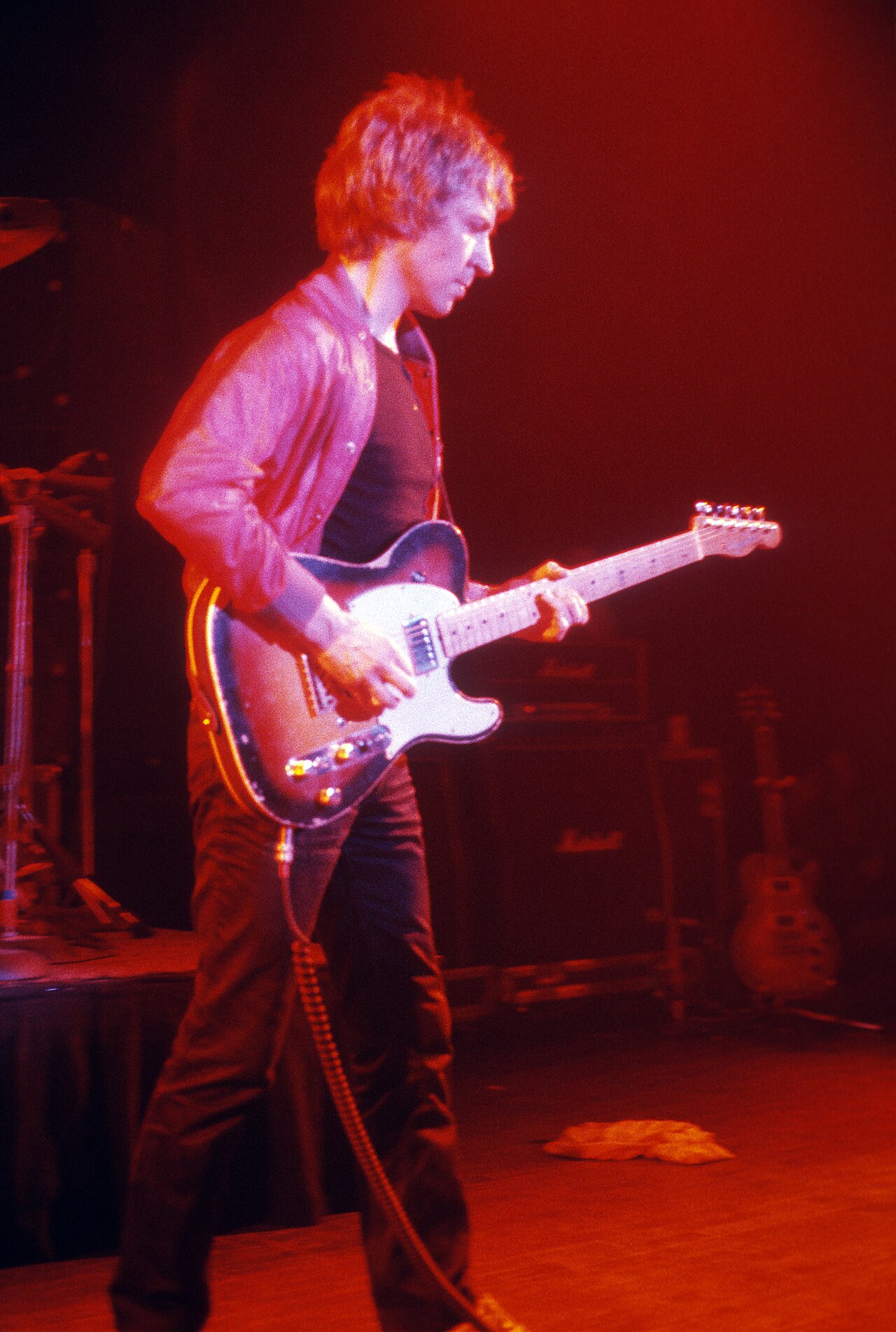
- Andy Summers: Acroterion, Wikimedia Commons, CC BY-SA 4.0.
- Top image: GuitarGangsters AI-generated reference illustration, not a photograph.
Latest News
Related
On This Day
Monday 9 November
From this week: