Five Knobs, One Bucket Brigade, and Every Classic Chorus Tone You’ve Ever Wanted
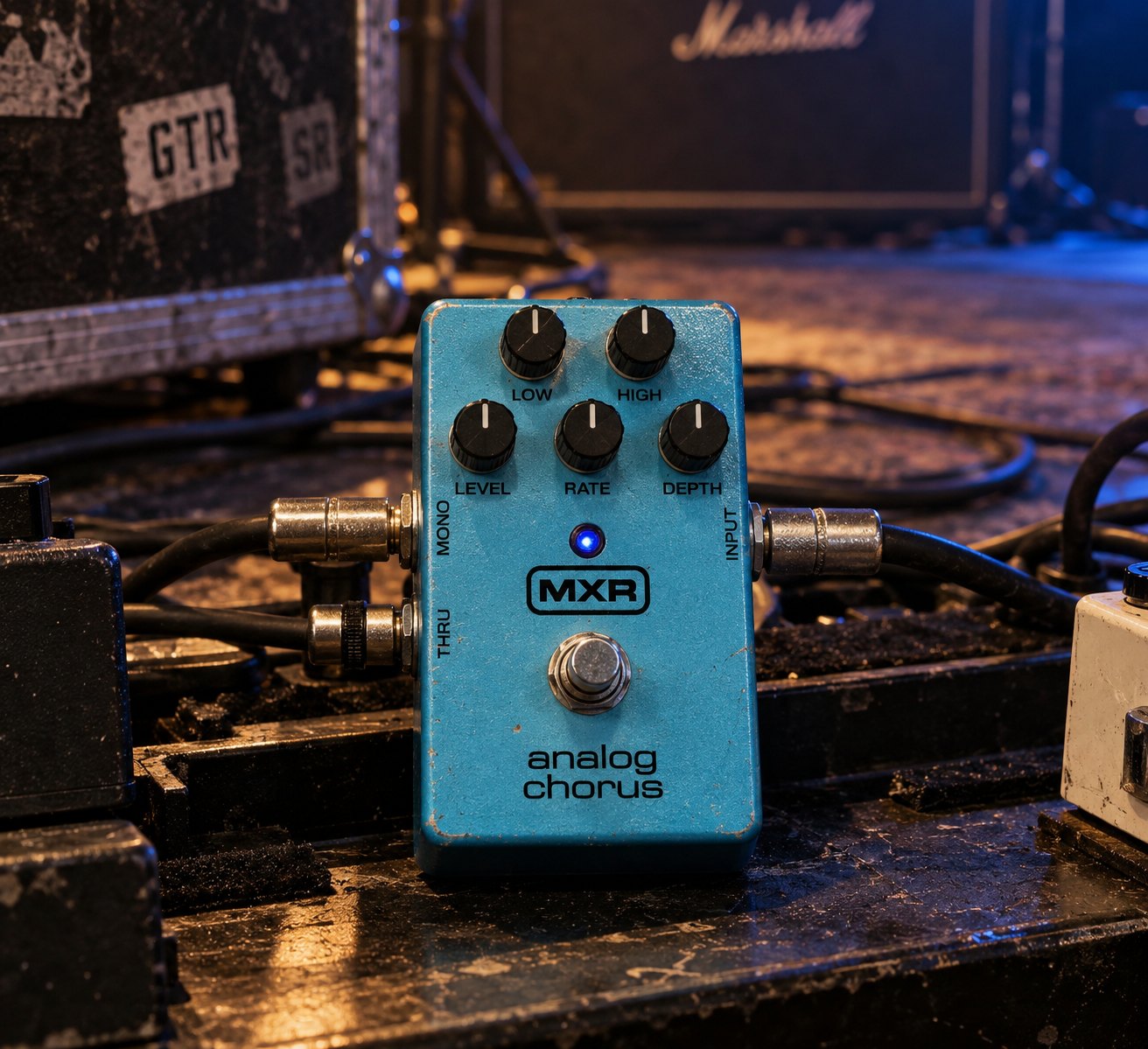
MXR M234 Analog Chorus Pedal. AI-generated reference illustration, not a photograph.
MXR M234 Analog Chorus deep dive: BBD specs, honest artist connections (Slash confirmed), tone settings, stereo setup, and buying guide.
There’s a moment on the intro to “Paradise City” — before the kick drum drops, before Axl’s voice enters, before any of it — where Slash’s clean guitar shimmers with something that sounds like it’s breathing. Not vibrato, not flanger, not reverb. Chorus. Warm, wide, liquid analog chorus from a bucket-brigade circuit that’s been reproducing those tones for guitarists since Jim Dunlop relaunched the MXR brand in the late 1980s. On the GN’R Not in This Lifetime reunion tour, the pedal producing that specific shimmer on Slash’s pedalboard was the MXR M234 Analog Chorus. His guitar tech Ace confirmed it directly on video, describing the effect as “that shimmery sound… the only place we’re using it, in the very beginning where the guitars have that shimmery, open, cowboy kind of chords, but like ’80s cowboy.” That endorsement captures the M234 better than any spec sheet: it sounds like the ’80s never left.
The M234 Analog Chorus is MXR’s compact successor to the M134 Stereo Chorus, stripped to essentials and given a two-band EQ that makes it far more practical for modern pedalboards than its bulkier predecessor. At $139.99 MSRP and street prices often pushing below that, it represents the most affordable all-analog, bucket-brigade chorus pedal in MXR’s catalog — and one of the most practical on the market. Ninety-four professional artists appear on its Equipboard page. It has 212 user reviews averaging 4.6 out of 5. It has been on pedalboards from stadium punk tours to indie folk sessions to recording studios across five decades of rock music. This is what it does, how it works, and when it’s the right choice.
Where Bucket Brigade Chorus Comes From
Analog chorus is older than most people realize. The concept of splitting a signal, delaying one path slightly, modulating that delay with a low-frequency oscillator, and recombining the result with the original dates to 1976, when Boss introduced the CE-1 Chorus Ensemble — the first standalone chorus pedal ever made. The CE-1 used a bucket-brigade device (BBD) chip, a form of analog delay line where signal samples pass sequentially through a chain of capacitors like water moving from bucket to bucket. The slight imperfections of this analog transfer process — the mild noise floor, the subtle filtering, the warmth from the capacitor charge-discharge cycle — are exactly what defines the sound. It’s not clean. It’s alive.
MXR has been making BBD-based chorus since the company’s Dunlop-era revival in the late 1980s. The M134 Stereo Chorus was the predecessor to the M234 — a larger format pedal aimed at players who wanted stereo outputs and EQ control but could tolerate the extra real estate. The M234 consolidates that feature set into a standard MXR die-cast housing, adding the High and Low cut knobs (which were absent from earlier compact chorus designs) while keeping the stereo output configuration. It’s not a radical departure from anything that came before it; it’s a refinement of a well-understood circuit philosophy.
Dunlop’s official description of the M234 is precise: “All-analog bucket-brigade circuitry creates classically lush, liquid textures that you just can’t get with digital circuitry.” That’s a marketing line, but it’s also technically accurate. Digital chorus can approximate BBD behavior, but the discrete analog signal path — with its inherent frequency response characteristics and the mild compression the BBD chain imposes on the signal — produces a texture that digital algorithms continue to simulate rather than replicate.
Controls and Signal Architecture
The MXR M234 Analog Chorus has five knobs: Rate, Depth, Level, High, and Low. Understanding what each one actually does under the hood makes the pedal significantly easier to dial in.
Rate controls the speed of the low-frequency oscillator (LFO) that modulates the delay time in the BBD chip. Slower Rate settings produce wide, slow pitch sweep — the “breathing” shimmer heard on Slash’s clean intro. Faster Rate settings push toward vibrato or, at extremes, a Leslie-cabinet flutter. For most rock and pop applications, Rate lives in the first third of its travel: slow enough to be musical, fast enough to be audible.
Depth controls how much the LFO modulates the delay time — essentially how wide the pitch sweep becomes. Low Depth settings produce subtle thickening, the kind where you only notice the chorus is on when you turn it off. High Depth settings produce overt, obvious modulation. The interaction between Rate and Depth is the core sound-shaping territory on any chorus: slow Rate with high Depth = seasick warble; fast Rate with low Depth = shimmer; both at noon = the “classic” analog chorus sound.
Level controls the wet-to-dry ratio. This is the M234’s most useful differentiation from older, simpler chorus designs. Because you can independently set how much wet chorus signal blends with your dry signal, you have precise control over effect intensity without having to sacrifice Depth settings. Pull Level down to barely audible for subtle always-on thickening; push it to blend for an even mix; note that at maximum Level you’re hearing primarily the wet signal, which loses the spatial quality that comes from the contrast between wet and dry.
High is a cut knob for the high frequencies — turning it clockwise rolls off the treble content in the effect signal. This is essential for darker-voiced guitars, heavier amp settings, or any situation where the chorus effect is adding unwanted brightness to an otherwise warm tone. It’s also the fix for the M234’s one commonly mentioned criticism: at maximum Depth with a bright single-coil guitar, the modulation can feel slightly harsh. A modest High cut resolves it immediately.
Low is a cut knob for the low frequencies — turning it clockwise removes low-end from the effect signal. This is the other essential control for live use. Running chorus through a large amp or a bass-heavy signal chain can result in the low-frequency modulation muddying up the bottom end. Cutting the Low from the chorus signal preserves your guitar’s fundamental while letting the modulation work on the upper harmonics where it’s most perceptible. Many professional players — particularly those running into high-gain amp settings — use M234 with Low cut to keep the low end stable while chorusing only the mid and high content.
The output section offers a standard output jack and a second thru jack. Both carry the full mixed signal when the pedal is active, allowing true stereo separation between two amplifiers. When run in stereo — one amp wet, one amp dry, using the output routing from your switching system — the M234 produces a spatial separation that no single-amp setup can replicate.
One important technical note: the M234 is not true bypass. It uses buffered bypass, meaning the signal path runs through the pedal’s circuitry even when the effect is disengaged. Some players notice a slight hum or tone change in certain signal chain configurations. For most pedalboard setups, this is a non-issue — the buffer actually helps drive long cable runs and impedance-sensitive effects downstream. But if your rig includes vintage fuzz pedals or components that are sensitive to buffering, position the M234 after those pedals rather than before them.
Famous Players: Honest Assessment
Andy Summers, John Frusciante, Prince, Kurt Cobain, and Robert Smith are the artist connections listed for the MXR M234 Analog Chorus. That reflects a legitimate problem that affects this entire category of gear: the most iconic chorus sounds in rock history were made with specific pedals that are not the M234. The M234 is the modern analog chorus pedal that approximates and extends that legacy. Those are related but different things, and they deserve honest treatment.
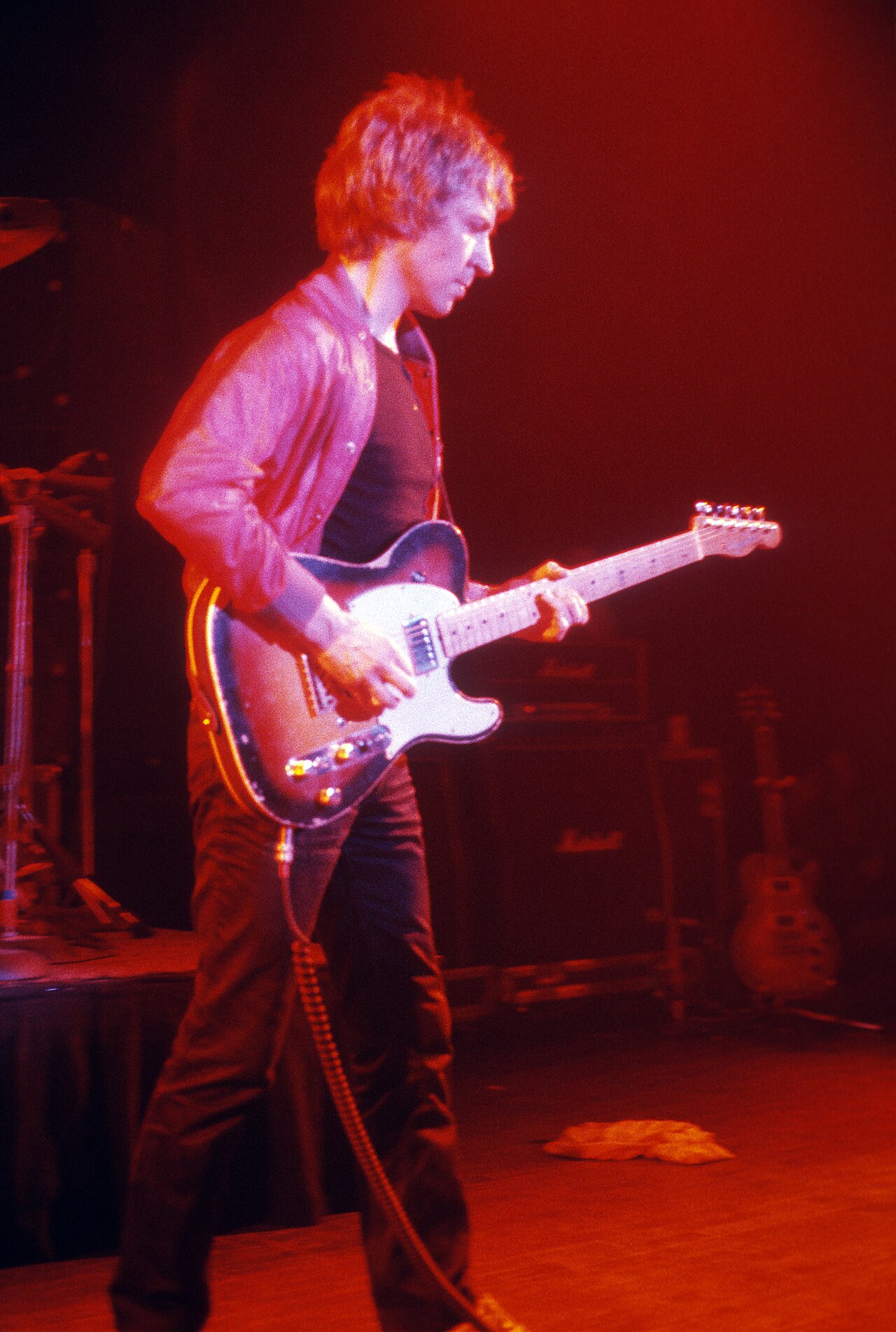
Andy Summers
Andy Summers defined the sound of analog chorus for an entire generation of guitarists through his work with The Police. “Walking on the Moon,” “Message in a Bottle,” “Don’t Stand So Close to Me” — those shimmering, wide-interval Telecaster tones shaped what players still mean when they say “chorus guitar.” His primary chorus tools were the Boss CE-1 and CE-2, along with a Roland Dimension D chorus/enhancer in the rack. In interviews, Summers has explicitly credited the CE-1: “The CE-1 and CE-2 were BOSS pedals, and there was a rackmount Roland chorus called the Dimension D.” His Pete Cornish pedalboard during the Police years included MXR gear — a DynaComp, a Distortion+, a Phase 90, an Analog Delay — but not the M234 Analog Chorus.
What Summers proves for M234 buyers is this: the analog chorus character his CE-1 and CE-2 created is the same BBD-circuit territory the M234 inhabits. The M234’s Rate and Depth controls can reach every texture Summers used — from the subtle shimmer underneath clean chords to the more pronounced modulation on “Don’t Stand So Close to Me.” His tone is the destination the M234 is pointing toward, even if he took a different road to get there.
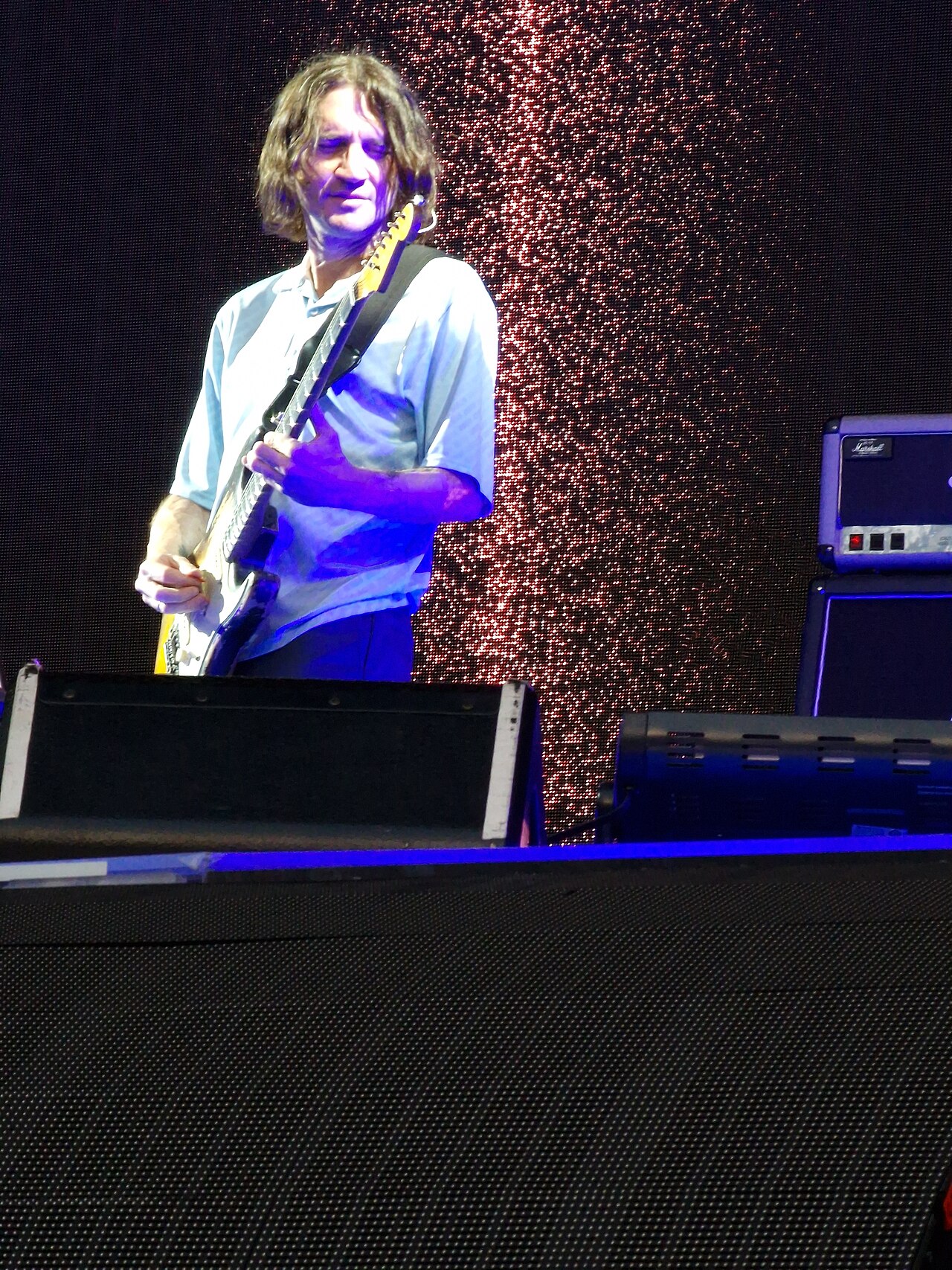
John Frusciante
John Frusciante‘s chorus tone is defined by the Boss CE-1 — the same pedal Andy Summers used, and for similar reasons: the CE-1’s wide, slow modulation and distinctive low-frequency character create a warmth that no compact pedal has ever perfectly duplicated. Frusciante has used the CE-1 from his early RHCP years through the Unlimited Love reunion tour in 2022. There are YouTube tutorials showing how to approximate his chorus sound with the MXR M234, and the approximation is genuinely close. But Frusciante himself plays the CE-1, not the M234.
What Frusciante demonstrates for M234 context is the universality of BBD-circuit chorus tone: the same fundamental technology, applied at different price points and form factors, produces a family of related sounds. The M234, set with moderate Rate and Depth and Level at about halfway, gets into CE-1 territory convincingly enough that the YouTube comparison video exists and has views. That’s a real capability of the pedal.
Kurt Cobain
Kurt Cobain‘s chorus pedal was the Electro-Harmonix Small Clone — heard most famously on “Come as You Are” and responsible for the swirling, slightly seasick quality of Nirvana’s clean tones. The Small Clone is a simpler, fixed-character chorus with two controls and a personality distinct from the MXR analog chorus family. There is no confirmed connection between Cobain and the MXR M234. His spirit in the chorus section of this article is tonal inspiration, not product history: the M234’s Depth knob cranked into Small Clone territory produces a similar effect character, though the M234’s added EQ control gives you more sculpting ability than the Small Clone ever offered.
Robert Smith
Robert Smith of The Cure is another guitarist whose chorus tone shaped an era without the MXR M234 being the vehicle. Smith used the Boss CE-1 and the Electro-Harmonix Electric Mistress through the band’s classic period, and his atmospheric, layered guitar textures were built from those specific circuits. Like Summers and Frusciante, Smith is a BBD-chorus architect whose sounds the M234 can reference — but who did not play the M234 himself.

Prince
Prince used an enormous range of guitar effects across his career, and chorus was a regular tool in his tonal vocabulary. His rigs varied significantly by era and often included custom or non-standard effects chains. No specific primary-source documentation confirms the MXR M234 on any Prince pedalboard. His guitar tones demonstrate the breadth of what analog chorus can do — from the clean, sophisticated shimmer of his jazz-inflected playing to the more overt modulation effects on certain funk recordings — and the M234 can serve all of those applications. But listing Prince as a confirmed M234 user would go beyond what the evidence supports.
Slash
Slash is the confirmed MXR M234 user in this article. Guitar tech Ace documented the M234 on Slash’s GN’R reunion tour pedalboard specifically for the clean intro of “Paradise City,” describing the M234’s function as producing the “shimmery, open, cowboy kind of chords” that open that song. Before the reunion tour, Slash used the MXR M134 Stereo Chorus for the same passage — the M234 replaced the larger M134 when it became available, maintaining the same stereo-capable analog chorus character in a more compact form. The specific sonic requirement — a warm, wide shimmer that doesn’t distort or overload the clean signal at stadium volume — is exactly what the M234’s BBD circuit is built for.
Billie Joe Armstrong
Billie Joe Armstrong has been documented with the MXR M234 on his pedalboard during performances with The Coverups, his covers band side project. The documentation comes from Equipboard’s community photo archives rather than a Premier Guitar Rig Rundown. Armstrong’s main Green Day rig — covered by PG in both 2013 and 2024 — uses an MXR Carbon Copy Delay as his primary MXR effect, with no M234 mentioned. The Coverups connection is real but secondary-sourced. What it demonstrates is that when Armstrong sets up a more stripped-down rig for a side project, the M234 makes the shortlist. That’s a meaningful endorsement even if it’s not his primary production rig.
Tone Recipes and Settings
1. “Paradise City” Clean Shimmer (Slash approach)
Rate at 9 o’clock (slow), Depth at 10 o’clock (subtle), Level at 1 o’clock (significant wet signal), High at 10 o’clock (mild brightness cut), Low at 10 o’clock (mild low cut). Run into a clean Fender-style amp or the clean channel of a Marshall set below breakup. This setting produces the wide, breathing shimmer that opens the song — present enough to be obviously modulated, controlled enough not to warble. Works best with a humbucker-equipped guitar through a high-headroom amp.
2. Andy Summers / Police-Style Shimmer (Telecaster through clean amp)
Rate at 8 o’clock (very slow), Depth at 9 o’clock (very subtle), Level at 11 o’clock (moderate), High at noon (flat), Low at noon (flat). This setting on a single-coil Telecaster through a clean Fender Twin reissue or similar amp produces the shimmering, almost-vibrato-but-not-quite character of the CE-1/CE-2 territory that Summers explored. The Telecaster’s natural brightness combined with the M234’s slightly warm BBD filtering creates the spatial quality. Always-on setting: leave it engaged for your entire clean/light-drive section.
3. Classic ’80s Mid-Rate Pop Chorus
Rate at 10-11 o’clock (moderate), Depth at 11 o’clock (moderate), Level at noon (even blend), High at 11 o’clock (slight brightness cut), Low at 11 o’clock (slight low cut). This is the textbook chorus setting — the sound that defined thousands of ’80s ballads and clean-guitar moments. Works across most guitar and amp combinations. The slight High and Low cuts keep the effect from becoming excessive. This setting turns the M234 into the utility chorus voice — use it every time you want chorus without committing to a specific character.
4. Subtle Always-On Thickener
Rate at 8 o’clock, Depth at 8 o’clock, Level at 9 o’clock. Everything very subtle. The goal is to make a single guitar sound like two players — just barely. Listeners shouldn’t notice the effect; they should only notice when it’s off that something changed. Works brilliantly in a recording context where you want the guitars to sit wider in the stereo field without obviously announcing “this is chorused.” The M234’s Level control is what makes this setting possible; older chorus designs without a wet/dry mix knob couldn’t reach this level of restraint.
5. Frusciante-Approach Mid-Range Warmth
Rate at 9 o’clock (slow), Depth at 1 o’clock (significant), Level at 11 o’clock (moderate wet), High at 10 o’clock (cut brightness), Low at noon (flat). This setting pushes the modulation further than the Summers setting, reaching the warmer, more pronounced CE-1 territory. The High cut is essential here — with Depth this high, bright single-coils can produce a slightly harsh effect edge; cutting the highs smooths it out. Use on neck or middle pickup position for maximum warmth. The result is liquid rather than sparkly.
6. Kurt Cobain Small Clone Reference
Rate at 1 o’clock (faster), Depth at 2 o’clock (deep), Level at noon (even). This is intentionally exaggerated — overt, woozy modulation that announces itself. The M234 reaches Small Clone territory here, though with the added ability to EQ the effect via the High and Low cuts. Run it into a slightly dirty amp (not high gain — clean to low crunch) for the “Come as You Are” adjacent quality. Not a setting for subtlety; save it for the specific moments that call for overt chorus character.
7. Stereo Wide-Field Split
Rate at 10 o’clock, Depth at noon, Level at 1 o’clock, High and Low to taste. Run one output to Amp A (wet/dry mix) and the second output to Amp B. Pan Amp A to the left and Amp B to the right in the mix or in the room. The M234’s two outputs allow full stereo chorus separation — one amp hears the modulated signal, the other hears the dry signal. The spatial result is significantly wider than any single-amp setup. This is the setting Slash’s tech referenced indirectly: the “open” quality of “Paradise City”‘s intro comes partly from stereo amp separation, which the M234’s two-output architecture enables directly.
The M234’s five-knob layout gives it more tonal range than most players initially expect. These settings work as starting points for real musical contexts; adjust by ear at performance volume.
Comparison with Competing Pedals
The analog chorus category is crowded, and understanding where the M234 sits helps clarify who it’s for.
vs. Boss CE-2 Waza Craft: The CE-2 Waza is the modern Boss reissue of the classic CE-2, with a switch between CE-1 and CE-2 circuit modes. It has a distinctive, vintage-voiced character that many players find irreplaceable — the specific warmth of the original circuit. But it offers only Rate and Depth controls: no Level knob, no EQ. The M234 beats the CE-2 Waza on practical control flexibility and street price; the CE-2 Waza beats the M234 on vintage-specific character for players chasing the exact Boss circuit sound. They’re both BBD-based and both excellent, but they serve different priorities. Reference: players who favor vintage-voiced simplicity tend toward the CE-2 Waza; players who want practical modern usability tend toward the M234.
vs. MXR M134 Stereo Chorus: The M134 is the M234’s larger predecessor. It has the same fundamental analog chorus circuit and stereo outputs but in a larger housing. The M234 replaced the M134 on Slash’s board for a reason: same sound in less space. If you already own an M134, the M234 is a lateral move in tone with a footprint benefit. If you’re buying new, the M234 is the current production answer to the same tonal need.
vs. EHX Small Clone: The Small Clone is Kurt Cobain’s pedal and a classic in its own right, but it’s a simpler machine: Rate knob and a chorus depth switch, nothing else. It has a specific, slightly pronounced character that works brilliantly in the applications where it’s famous but doesn’t adapt as widely. The M234 offers more adjustment range, a proper Level control for wet/dry mixing, and the two-band EQ. The Small Clone is the right answer when you specifically want the Small Clone sound; the M234 is the right answer when you need to dial in a range of analog chorus applications from subtle to overt. Reference: anyone building a pedalboard that needs to cover multiple chorus roles should prefer the M234’s flexibility.
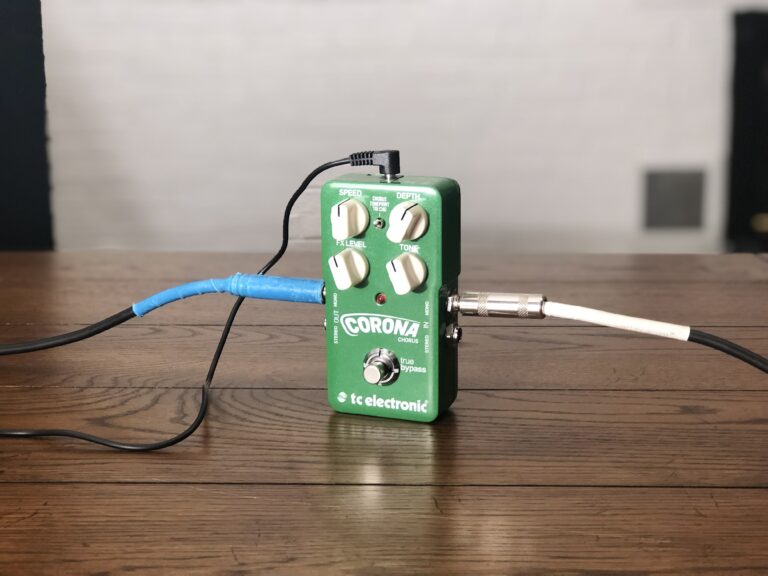
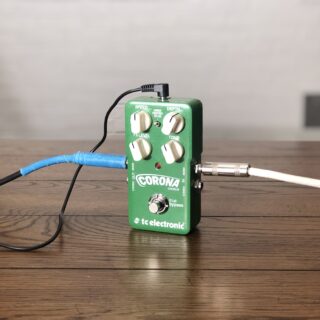
vs. TC Electronic Corona Chorus: The Corona is a digital chorus with TC’s TonePrint technology, allowing impulse-response-style chorus presets. It’s extremely versatile, sounds excellent, and is true bypass. But it’s digital — and the specific warmth of BBD circuitry, with its inherent compression and mild high-frequency rolloff, is not what the Corona produces. Players who specifically want the analog texture should consider the M234; players who want maximum versatility including digital chorus emulations of vintage pedals should consider the Corona. The two pedals serve different parts of the chorus buyer spectrum.
vs. Strymon Ola: The Ola is a premium digital modulation platform with chorus among its modes. It sounds superb in a studio context, offers tap tempo, and has MIDI control capability. But it’s significantly more expensive and primarily digital. The M234 wins on price and analog authenticity; the Ola wins on features and control depth. For the majority of live pedalboard applications, the M234’s simplicity and analog character are advantages, not limitations.
Buying Guide and Ownership Notes
The MXR M234 Analog Chorus retails at $139.99 MSRP, with street prices typically ranging from $99 to $130 new depending on the retailer and any promotional pricing. Used units in excellent condition typically trade in the $60 to $90 range, making the M234 one of the most accessible analog chorus options in its quality tier. The used market is healthy — 94 confirmed pro artist users means these units circulate frequently — and older units show no known reliability issues associated with age.
Power: 9V DC center-negative (standard pedal power supply) or 9V battery. Current draw is standard for MXR compact effects: use any quality isolated output from your power supply. The pedal does not require premium isolated power, but isolation is always a good practice for hum-free operation. The non-true-bypass buffered circuit is a mild consideration: if you’re running germanium fuzz pedals or other buffer-sensitive effects, run them before the M234 in your chain rather than after.
The MXR die-cast housing is road-tested by decades of professional touring. The jacks are durable, the footswitch is reliable, and the knobs are substantial. The M234 is not going to be the weakest link in your pedalboard’s structural integrity. Dunlop’s warranty covers manufacturing defects, and MXR pedals have an established service and repair network.
Chain placement: chorus typically goes after drive pedals and before time-based effects (delay, reverb). Running chorus after delay produces a warbled, modulating delay repeat that can be interesting in specific contexts but is generally considered unconventional. Running chorus before delay produces the more musical result where the dry+wet chorus signal enters the delay with full character. The M234’s Level control gives you enough wet/dry flexibility to manage placement in complex chains: if the chorus is too overt in one position, pulling back Level often resolves the issue before you need to reorder the chain.
Stereo use: the M234 is genuinely one of the most affordable stereo-capable analog chorus pedals available. If you run two amplifiers — even two small amps for home recording — the output-to-thru stereo configuration delivers a spatial depth that justifies the pedal at its price point alone. The stereo field produced by a dry amp and a wet-mix amp is qualitatively different from any mono simulation of stereo, and the M234’s architecture makes it accessible without requiring a routing switcher or additional hardware.
FAQ
Is the MXR M234 Analog Chorus true bypass?
No. The M234 uses buffered bypass, meaning the signal runs through the pedal’s input buffer even when the effect is disengaged. This is a standard design in many professional pedals and is typically harmless in most signal chains. The buffer can actually benefit long cable runs. The caveat: position buffer-sensitive effects (vintage germanium fuzz, some vintage phasers) before the M234 in your chain to avoid any impedance interaction.
Can I use the MXR M234 to get Andy Summers’ chorus sound?
You can get close. Summers used Boss CE-1 and CE-2 pedals, which are BBD-circuit analog chorus units of the same fundamental family as the M234. Set the M234 with slow Rate, subtle Depth, moderate Level, and flat EQ on a single-coil guitar through a clean amp, and you’re in the same territory. The character won’t be identical — different BBD chips produce slightly different filtering and noise characteristics — but the family resemblance is genuine and the M234’s additional EQ control gives you more sculpting ability than the CE-1 or CE-2 provided.
What chorus pedal did Andy Summers actually play?
Summers’ primary chorus pedals were the Boss CE-1 Chorus Ensemble and Boss CE-2, along with a Roland Dimension D in the rack. He has confirmed these in multiple interviews. His MXR gear during The Police years included the DynaComp, Distortion+, Phase 90, and Analog Delay — but not the M234, which came later.
Did John Frusciante use the MXR M234?
No confirmed primary source places the M234 on Frusciante’s pedalboard. His chorus pedal of choice is the Boss CE-1, which he has used from his early RHCP career through the Unlimited Love reunion tour. YouTube demonstrations of how to approximate his chorus sound using the M234 exist and are useful, but they demonstrate the M234’s capability to reference that territory rather than Frusciante using the pedal himself.
What’s the difference between the MXR M234 and the M134 Stereo Chorus?
The M134 Stereo Chorus is the M234’s larger predecessor. Both use analog BBD circuitry and offer stereo outputs. The M234 is significantly more compact, fitting a standard MXR housing, and adds the two-band High/Low EQ that the M134 lacked. Slash switched from M134 to M234 on his reunion tour, confirming that the M234 achieves the same tonal goal in a more practical package. The M134 is no longer in production; the M234 is the current answer.
Is the MXR M234 good for metal?
Chorus and metal are not an obvious pairing, but there are applications. The M234 with significant Low cut on the effect signal can add dimension to a clean intro or a clean channel without muddying the low-frequency content that defines heavy rhythm playing. For high-gain leads where the amp already provides harmonic complexity, chorus can actually reduce clarity — in those contexts, modulation effects (flanger, phaser) or no modulation at all is typically more appropriate. The M234 is best understood as a rock and clean-tone tool rather than a high-gain specialist.
Does the MXR M234 work in stereo?
Yes — and it’s one of the M234’s most practical advantages at its price point. The Output jack carries the wet/dry mix; the Thru jack carries the dry signal only. Running one amp from Output and another from Thru produces a true stereo chorus separation — one amp has the effect, the other stays clean. The spatial result is substantially wider than any mono chorus simulation. You need two amplifiers or a stereo effects loop to use it, but the capability is built in at no additional cost.
Can the MXR M234 go before or after drive pedals?
Either position is valid depending on the desired result. Chorus after drive pedals (the more common placement) applies the modulation to the distorted signal, which creates the shimmering quality where the distorted harmonics themselves are pitch-modulated. Chorus before drive pedals applies modulation to the clean signal first, then distorts the result — this can create a slightly more subtle, blended effect. Most players who use the M234 as a standalone effect place it after their drive pedals and before delay and reverb, following the conventional modulation placement in a standard effects chain.
Image credits
- Robert Smith: Bill Ebbesen, Wikimedia Commons, CC BY-SA 3.0.
- John Frusciante: Hel Davies, Wikimedia Commons, CC BY-SA 2.0.
- Andy Summers: Acroterion, Wikimedia Commons, CC BY-SA 4.0.
- Top image: GuitarGangsters AI-generated reference illustration, not a photograph.
Latest News
Related
On This Day
Monday 9 November
From this week: