Time Machine in a Box: The Electro-Harmonix Mel9 Brings the Mellotron to Your Pedalboard
EHX Mel9 Tape Replay Machine: nine Mellotron voices for guitar — no MIDI needed. Used by Josh Klinghoffer and Johnny Marr. Specs, sounds, and settings inside.
There are guitar pedals that make you sound better, and then there are guitar pedals that make you sound like a completely different instrument. The Electro-Harmonix Mel9 Tape Replay Machine belongs firmly in the second category. Plug it in, dial the preset knob to Flute, pick a single note slowly, and the thing breathes like a Mellotron from 1967. It’s uncanny, it’s beautiful, and for a certain kind of player it opens up an entire sonic universe that previously required either a vintage keyboard worth thousands of dollars or a very tolerant bandmate willing to haul one around.
The Mellotron itself was one of the great weird inventions of 20th-century music — a keyboard that played pre-recorded magnetic tape strips when you pressed its keys. No synthesis, no sampling in the modern sense, just individual lengths of tape physically dragged across a playback head at the speed your finger controlled. The result was a sound that was simultaneously majestic and decayed, lush and unstable, orchestral and unmistakably artificial in all the most compelling ways. The Beatles used it on “Strawberry Fields Forever.” King Crimson built cathedrals out of it on “In the Court of the Crimson King.” The Moody Blues practically lived inside it. Led Zeppelin, Genesis, Yes, Radiohead — everyone eventually found a reason to want that sound.
The Mel9 doesn’t replace a Mellotron. But in 2016 it did something arguably more useful: it put nine of the most sought-after Mellotron voices onto a guitar pedal the size of a large notebook, with no MIDI pickups required, no special wiring, and no tape to maintain. Plug in, twist a knob, and your guitar starts channeling something from four decades back.
The Mellotron’s Long Strange History
The Mellotron story begins in Birmingham, England, in the early 1960s, when the Bradley brothers developed an instrument based partly on the American Chamberlin Music Master — itself an eccentric contraption that used recorded tape loops to simulate orchestra sounds. The Mellotron Mark I appeared in 1963, followed by the Mark II, designed for pub entertainment rather than rock and roll. What nobody anticipated was how perfectly wrong the Mellotron sounded in the hands of progressive rock musicians who valued texture over precision.
Each key on a Mellotron is connected to its own individual tape strip approximately six feet long, running across a playback head at 15 inches per second. Press a key and you get roughly eight seconds of audio before the tape runs out — at which point it springs back to the start. That eight-second ceiling gave Mellotron players a discipline that synthesists never faced: you had to keep moving. The tape playback also meant that the instrument’s pitch, tone, and volume fluctuated in ways that no electronic synth could replicate organically. Tapes stretched. The flutter of the mechanism colored the tone. The result was an imperfection that became a signature.
By the mid-1970s the Mellotron was synonymous with progressive rock excess. It was also a logistical nightmare — roadies hated the things, and many recordings of the era are full of Mellotrons that are slightly out of tune because the tapes had aged or the instruments had been transported carelessly. When synthesizers arrived en masse in the late 1970s, the Mellotron was largely abandoned. Bands that had previously carted them around simply stopped. The sounds lived on as reference recordings in samplers and later as plug-ins, but the physical instruments became expensive curiosities.
The revival came slowly, driven by nostalgia and a hunger for authentic imperfection. The Swedish company Mellotron AB began reissuing and restoring instruments. Bands like Radiohead, Tame Impala, and Sigur Rós made the Mellotron’s voice central to records that introduced it to new generations. And then Electro-Harmonix, the New York pedal company that has never met a sonic territory it wasn’t willing to invade, looked at all that history and asked a simple question: what if you could get those sounds from a footswitch?
Nine Voices, One Knob: The Mel9 Up Close
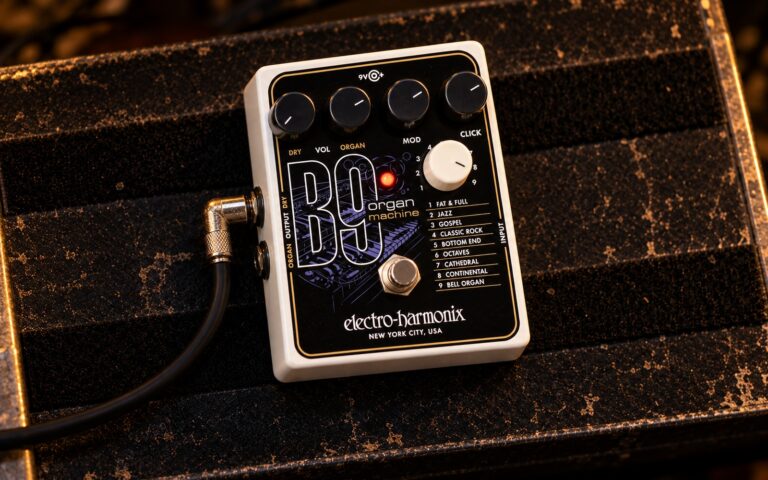
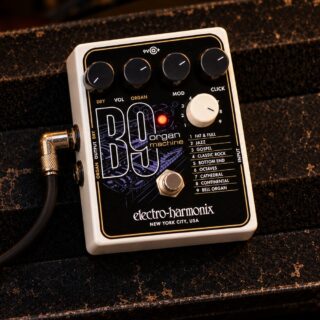
The Mel9 launched in 2016 as part of EHX’s expanding “9 Series” of instrument-emulation pedals — a family that includes the B9 Organ Machine, C9 Organ Machine, Key9 Electric Piano Machine, Synth9 Synthesizer Machine, String9 String Ensemble, and Bass9 Bass Machine. Each pedal in the family targets a different vintage keyboard archetype. The Mel9’s focus is the Mellotron specifically, and its nine voice presets are the sounds that made that instrument legendary.
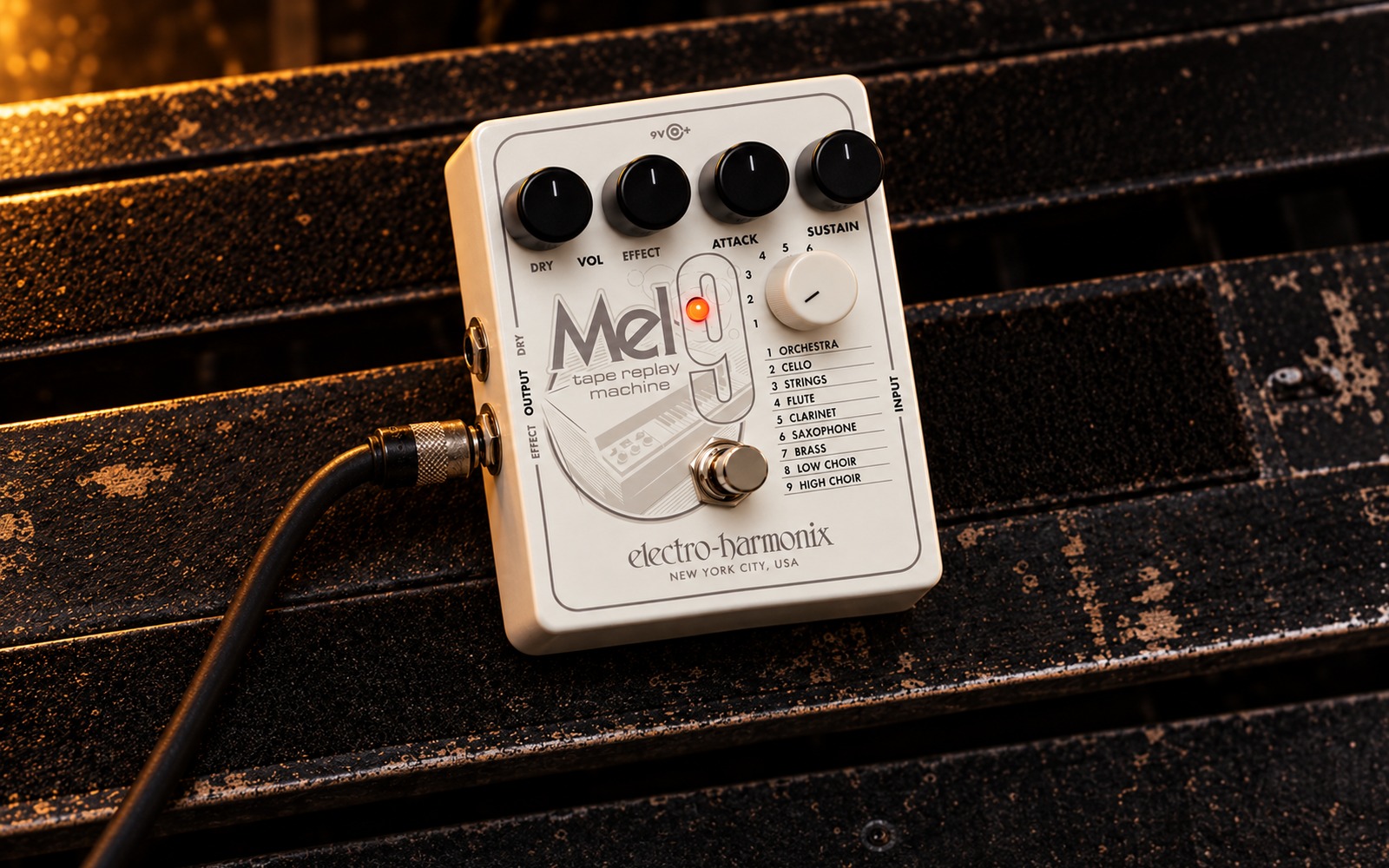
The preset knob selects between Orchestra, Cello, Strings, Flute, Clarinet, Saxophone, Brass, Low Choir, and High Choir. There is no digital menu, no screen, no hidden bank switching — you turn one rotary knob and you get one of nine sounds. The layout is simple enough that you can make changes in the dark or while moving on a stage, which is either a deliberate design virtue or a happy accident. Given EHX’s engineering philosophy, probably both.
The control layout pairs that preset selector with four knobs: Dry Vol (the level of your clean guitar signal at the Effect Output), Effect Vol (the level of the Mellotron voice at the Effect Output), Attack (how quickly the effect responds after you pick a note), and Sustain (how long the sound continues after you stop playing). The Attack knob does something subtle but important: turned clockwise, it slows the onset of the effect, creating a volume swell that sounds like a musician with a tremendous bow arm easing into a phrase. Turned counterclockwise to maximum speed, notes respond almost immediately. The Sustain knob’s action is equally musical — maximum sustain lets chords hang in the air after your fingers lift, building layers of harmonic mist.

There are three jacks on the back: Input, Effect Output, and a separate Dry Output. The Dry Output sends your clean guitar signal at unity gain regardless of where the knobs are set — it is always live, always clean, and entirely independent of the Effect Output’s wet/dry blend. This means you can run two simultaneous signal paths: your guitar through a normal guitar amp from the Dry Output, and the Mellotron voice through a keyboard amplifier, PA channel, or studio mixer from the Effect Output. In studio contexts this is a genuine creative tool, letting you balance the two sources with precision at the mixing desk rather than wrestling with blend knobs at the pedal.
Specs and Practical Considerations
The 100mA current draw is a meaningful practical advantage. Several of the Mel9’s EHX siblings — the Canyon Delay and Oceans 11 Reverb, for instance — draw 150mA, which exceeds the output of many budget isolated power supplies. The Mel9’s 100mA sits within the range of nearly all standard isolated outputs. If your supply has 100mA isolated ports, the Mel9 will work without issue. No upgrade required.
That said, Josh Klinghoffer’s guitar tech Ian Sheppard has noted publicly that the Mel9 “has trouble with certain power supplies,” and there is user consensus that a clean, regulated, isolated 9V source produces the most consistent results. Dirty power from wall-wart daisy chains can cause instability in the effect volume. The included 9.6VDC adapter works, but an isolated supply port is the better long-term solution for live performance.
The pedal uses buffered bypass. This is standard for a circuit that needs to process your input signal at all times to track pitch and dynamics accurately. Practically speaking, buffered bypass is a non-issue for most guitarists — it keeps your signal clean and stable regardless of cable length. The only players who need to think about it are those running germanium fuzz pedals earlier in their chain, since germanium fuzzes can be sensitive to buffered signals ahead of them. Place any germanium fuzz before the Mel9 if this applies to your rig.
There is no battery option. The 100mA draw makes battery use impractical, so the included adapter is your power source. One jack for input, one for effect output, one for dry output — no expression input, no MIDI, no secondary parameter mode. The Mel9 is unusual among EHX digital pedals for its straightforwardness: what you see on the panel is everything the pedal does.
Famous Players: Confirmed Users
Josh Klinghoffer (Red Hot Chili Peppers, Pluralone)
Josh Klinghoffer’s relationship with the Mel9 is both well-documented and genuinely instructive about how the pedal fits into a working musician’s creative process. During his years with the Red Hot Chili Peppers, Klinghoffer maintained two separate pedalboards — one for the standard Peppers set, and a sprawling secondary “ambient mega-board” dedicated to textural, non-guitar-like sounds. It was in this second context that the Mel9 found its home.
He has described the purchase as “a sort of impulse buy based on seeing one of my favorite guitarists, Mr. John Dwyer, use it.” That attribution to John Dwyer is telling — Dwyer is one of the most respected and uncommercial sonic experimenters in indie rock, the man behind Oh Sees/Osees, and a player who has consistently used the Mel9 as a textural tool in a context that has nothing to do with imitation or nostalgia. When a player like Klinghoffer sees someone like Dwyer using something, the takeaway is creative credibility rather than commercial endorsement.
His tech Sheppard has noted that the Mel9 has “no built-in compression,” which means the effect output responds directly to your picking dynamics — pick hard and the Mellotron voice blooms dramatically, pick softly and it whispers. This lack of compression is a feature for sensitive playing and a challenge for high-energy live performance, where consistent output is valued. Klinghoffer’s solution was to use a compressor before or after the pedal depending on the application. And despite the pedal’s “jankiness” with certain power supplies, Sheppard reported that “it hasn’t left a setup since he bought it” — which is as strong an endorsement as any professional musician can give a piece of gear.
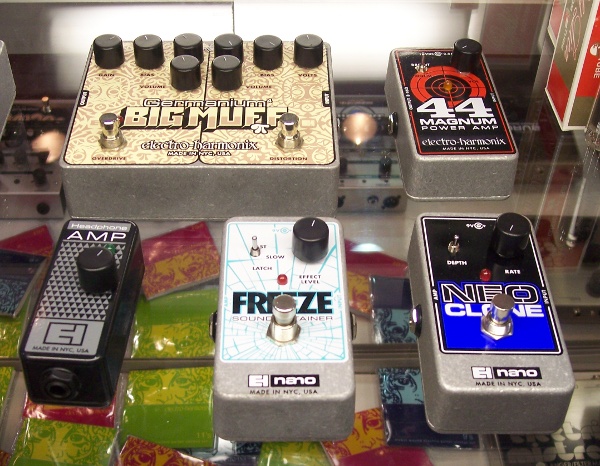
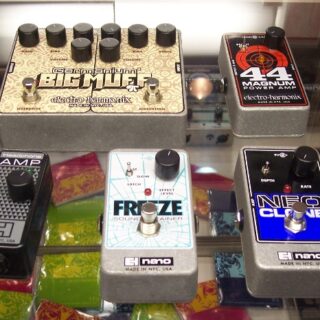
His ambient pedalboard included the Mel9 alongside the EHX Freeze Sound Retainer, Canyon Delay, and Key9 Electric Piano Machine — what he called “the cornerstones” of the ambient setup. The four pedals together create a complete language for non-guitaristic guitar playing: a keyboard texture from the Key9, a Mellotron voice from the Mel9, infinite sustain from the Freeze, and time-based context from the Canyon. It is one of the most clearly articulated ambient guitar setups in recent rock history.
Johnny Marr (The Smiths, solo career)
Johnny Marr confirmed his Mel9 use in November 2022 when MusicRadar documented his dedicated all-Electro-Harmonix studio pedalboard at his Crazy Face Factory studio. The board — entirely separate from his Carl Martin live board — is a monument to EHX’s keyboard-emulation and modulation range, including the Stereo Memory Man with Hazarai, Cathedral Reverb, EHX Tortion, C9 Organ Machine, B9 Organ Machine, Synth9, Mel9, Mod Rex Polyrhythmic Modulator, and Superego+.

The context matters enormously. Marr is not a guitarist who plays guitar pedals as guitar pedals. He has stated explicitly that he feels “almost like I have a duty to keep the guitar as modern in context as I can,” and that the threat of reverting to “old tropes” is something he actively resists. An all-EHX keyboard-emulation board is entirely consistent with that philosophy: each pedal on it is a tool for making a guitar sound like something that is not a guitar. The Mel9, on Marr’s board, is not a novelty — it is an instrument in itself.
His studio work on albums like Call the Comet (2018) engaged deeply with synthetic textures and orchestral layers. The Mel9’s Strings, Orchestra, and Choir presets would have been directly applicable in that context. See Johnny Marr Gear Guide.
John Dwyer (Oh Sees / Osees)
John Dwyer’s use of the Mel9 is confirmed not only by his Equipboard documentation but by Josh Klinghoffer’s own account — the rare case where one artist’s explanation of why they bought a pedal provides primary-source documentation for another artist’s use of it. Dwyer’s interest in the Mel9 aligns with his broader approach to guitar: he treats the instrument as a sound-making device rather than a guitar-specific tool, and the Mellotron’s orchestral and choir voices fit naturally into Oh Sees’ psychedelic and experimental contexts.
Tone Recipes: Working with the Nine Voices
The “Strawberry Fields” Flute
Preset: Flute. Attack: approximately 9 o’clock (moderate, leaning toward slow). Sustain: 12 o’clock. Effect Vol: 60-70%. Dry Vol: 30-40%. Play single-note lines in the upper register of your guitar with a medium-soft pick attack. The Flute preset does its most convincing work in this register — lower notes tend toward a slightly hollow woody quality that reads less as flute. Pair with a gentle reverb at the end of the chain for spatial depth. The combination of a Strat neck pickup, the Mel9 Flute setting, and a hall reverb produces something very close to the opening of “Strawberry Fields.” Add a light vibrato from a Univibe-style pedal and you have the entire texture.
Orchestral Swells (King Crimson style)
Preset: Orchestra. Attack: maximum CCW (slowest possible onset). Sustain: maximum CW. Effect Vol: 70-80%. Dry Vol: 20-30%. Pair with a volume pedal before the Mel9. Pick a chord and let the volume swell bring it in gradually while the Mel9’s slow attack adds another layer of controlled bloom. The result — two separate envelope controls, one from the volume pedal and one from the Attack knob — creates an evolving texture that sounds like a string section warming up. Release the chord slowly, let the Sustain ring out, then build the next one. This is meditative, compositional playing, not reactive guitar work.
Cello as Rhythm Voice
Preset: Cello. Attack: 11 o’clock (slightly slower than immediate). Sustain: 10 o’clock (moderate). Effect Vol: 50%. Dry Vol: 50%. Play the low E and A strings in rhythmic patterns. The Cello preset, in the lower register, has a genuine bowed-instrument quality that is significantly different from the smoother Strings preset — there’s a slight swell to each note onset that mimics a bow change. In this application the Mel9 can function as a bass-register texture under a lead player, giving the impression of a cello section doing rhythmic pizzicato. Mono output means the Effect Output feeds one amp, Dry Output feeds a second — useful for maintaining separation between the “guitar” and “cello” sounds in a live context.
Choir Pad for Atmospheric Passages
Preset: High Choir or Low Choir (depending on register). Attack: slow. Sustain: maximum. Effect Vol: 40-50%. Dry Vol: 30-40%. Apply a stereo reverb after the Mel9 (from your Effect Output path) and route the wet signal to a keyboard amp or PA channel with some additional reverb on that channel. Play slowly resolving chord shapes — open voicings with suspended seconds and fourths work particularly well. The choir presets have a breathiness that benefits from spatial processing, and the long sustain means harmonic layers accumulate over time. This is the setting Johnny Marr’s approach points toward: guitar as texture generator, not lead instrument.
Aggressive Brass for Punctuation
Preset: Brass. Attack: fast (fully CW). Sustain: moderate. Effect Vol: 70%. Dry Vol: 30%. Pair with a compressor before the Mel9 to even out your picking dynamics, since the Brass preset’s immediate response at fast Attack settings means inconsistent picking translates directly into inconsistent output volume. Hit chord stabs on beats two and four in a rock context and the result is unmistakably horn-like. The Brass setting also responds interestingly to a light overdrive placed after the Mel9’s Effect Output — the clipping adds harmonic complexity that brings the tone closer to a brass section playing through a slightly overloaded PA.
The 9 Series Family: How the Mel9 Fits
The Mel9 sits in a growing family of EHX instrument-emulation pedals that share a design philosophy: one input, one Effect Output, one Dry Output, buffered bypass, individual voice presets on a rotary knob, Attack and Sustain controls. Once you understand how one 9 Series pedal works, you understand them all. The Mel9’s nine Mellotron presets occupy a specific sonic territory within that family.
The Key9 Electric Piano Machine covers Rhodes, Wurlitzer, electric piano, and vibraphone textures — the percussive, harmonic keyboard sounds that underpin soul, funk, and classic rock. Josh Klinghoffer explicitly paired the two on his ambient board because they address complementary sound palettes. The Mel9 handles sustaining orchestral/wind/choir textures; the Key9 handles rhythmic/percussive keyboard textures. Together they give a guitarist access to nearly the full range of vintage keyboard sounds without duplication.
The String9 String Ensemble is the closest sibling to the Mel9’s Strings and Cello presets, but the String9 is a dedicated string-emulation pedal with multiple string-specific voicings that go deeper than the two string options the Mel9 provides. If strings are specifically your interest, the String9 delivers more focused tools. If you want the full Mellotron experience — choir, wind, and orchestral sounds in one pedal — the Mel9 is the right tool.
The B9 and C9 cover Hammond and combo organ territory. The Synth9 handles classic synthesizer emulation — Minimoog, Moog Taurus, Prophet-5 territory. None of these overlap meaningfully with the Mel9. A pedalboard containing the Mel9, Key9, B9, and Synth9 is essentially a complete vintage keyboard collection that fits in a laptop bag.
Signal Chain Placement and Practical Setup
The standard placement for the Mel9 is after your compressor and before your time-based effects (delay, reverb). A compressor placed before the Mel9 evens out your picking dynamics, which matters because the pedal’s output responds directly to input amplitude — the “no built-in compression” characteristic that Klinghoffer’s tech noted means that what you put in is directly reflected in what comes out. Consistent picking dynamics in equals consistent Mellotron voice out.
Delay and reverb after the Mel9 add the spatial dimension the Mellotron voices expect. The original Mellotron sounds were always captured in rooms — churches, studios, concert halls. A touch of room reverb anchors the Mel9’s digital output in physical space and makes the emulation significantly more convincing. The EHX Oceans 11 Reverb in Hall or Plate mode is a natural complement; so is any quality reverb pedal with a medium decay time.
For dual-amp users: run the Dry Output to your normal guitar amplifier and the Effect Output to a keyboard amplifier or clean PA channel. This allows the Mellotron voice to be EQ’d and mixed independently of your guitar tone — a significant workflow advantage when the two sounds need to sit in different frequency ranges of a mix.
The Mel9 does not have an expression input, which means the Attack and Sustain parameters cannot be swept in real time via expression pedal. For players who want dynamic control over the onset speed — slower for ballads, faster for rock passages — the Attack knob has to be preset before the song rather than adjusted mid-phrase. This is a design limitation worth knowing before you buy.
Buying Guide: New, Used, and Alternatives
As of 2026, the Mel9 is listed as NOT AVAILABLE at EHX direct — the same status as several of its 9 Series siblings. Whether this represents a temporary stock issue or a longer-term production situation is unclear. The used market is the reliable avenue.
Street used excellent condition runs approximately $130–$175. At that price point the Mel9 represents strong value for a polyphonic Mellotron emulator that requires no modification to your guitar and works immediately out of the box. Condition variations are primarily cosmetic — the digital circuit either works or it doesn’t, and there are no tubes, no capacitors likely to need replacement, and no moving parts to wear out.
New units priced at approximately $220–$260 appear through third-party retailers when available. The included 9.6VDC adapter is a useful accessory to retain even if you switch to an isolated power supply — it serves as a known-good backup for troubleshooting.
If the Mel9 is unavailable and the Mellotron sounds are specifically what you need, the Electro-Harmonix String9 covers the string portion and is currently in production. For broader orchestral needs, a software-based solution via an audio interface is the alternative, though that introduces significant setup complexity compared to a single pedal with a preset knob.
Ownership Notes: Living with the Mel9
A few things become clear once you spend time with the Mel9. First: the Attack knob interacts with your Sustain setting in ways that require experimentation per preset. What works for Flute — a moderate attack that lets the breath of the sound develop — may be too slow or too fast for Orchestra or Brass. Each of the nine voices has its own optimal range, and finding those ranges takes time with the pedal rather than shortcuts from a settings guide.
Second: the Mel9 performs best with single-note lines and open chord voicings in the middle register. Five-note polyphony is adequate for most musical situations, but dense jazz voicings with extensions can expose the tracking limits. The sound remains musical rather than glitchy when tracking is stressed — the pedal fails gracefully — but it is not a 10-note polyphonic instrument.
Third: the no-compression design means your Mel9’s behavior is a direct function of your technique. Players with a consistent, controlled picking technique will find the pedal highly responsive. Players with a looser, more dynamic attack may find themselves working with a compressor more than they expected. This is not a complaint — it is a characteristic that rewards the kind of deliberate, controlled playing that Mellotron sounds invite anyway.
Fourth: the Dry Output is genuinely useful and worth using. Many players set up the Mel9 in a simple mono chain and never engage the Dry Output, missing the most flexible thing about the pedal’s design. If you have any means of routing two signals — a stereo amp setup, a small mixer, a two-channel interface — the Dry Output transforms the Mel9 from an effect pedal into a layering instrument.
Finally: the Mel9 currently unavailable at EHX direct. Buy from the used market without hesitation. The digital circuit does not age or drift like analog components, and a used Mel9 in excellent condition is functionally identical to a new one from 2016.
Frequently Asked Questions
Does the Mel9 work polyphonically?
Yes. The Mel9 handles up to five simultaneous notes across the range A1 to A5. Chords, double-stops, and chord melody approaches all work. Dense voicings with six strings may show limitations with certain presets, but open-position and partial chord shapes track cleanly.
Can I use the Mel9 with a keyboard or bass?
Yes. EHX explicitly states the pedal works with any instrument producing an electrical output, including keyboards and bass down to the open A string (55Hz). Bassists have used the Mel9 to add orchestral texture to bass lines. Keyboards can trigger it provided they output a standard line-level signal.
What does the Dry Output do exactly?
The Dry Output sends your input signal at unity gain — clean, unaffected, and always active regardless of whether the pedal is engaged or bypassed. It is independent of the Effect Output’s blend. You can use it simultaneously with the Effect Output to route your guitar signal and the Mellotron signal to separate destinations.
Is the Attack knob the same as a volume swell?
It shares the concept but works differently. A volume swell pedal controls the volume of your entire signal. The Mel9’s Attack knob controls only how quickly the effect voice responds after you pick a note — the dry signal is unaffected. At maximum slowness, the Mellotron voice fades in gradually while your dry guitar signal (via Dry Output) plays at full volume. For a pure Mellotron swell with no audible dry attack, route your signal entirely through the Effect Output with the Dry Vol at zero.
Does the Mel9 track guitar bends accurately?
Premier Guitar’s review specifically confirmed this: “Mel9 tracks pitch bends without sounding glitchy or collapsing into a crumble of digital artifacts.” The tracking is polyphonic and maintains pitch accuracy through vibrato, bends, and slides.
What is the difference between the Mel9 and the String9?
The Mel9 is a broad-spectrum Mellotron emulator with nine voices spanning orchestra, winds, and choir. The String9 is a dedicated string ensemble emulator with multiple string-specific voicings. The Mel9 includes two string-related presets (Cello and Strings); the String9 goes deeper into that territory exclusively. If strings are your only interest, String9 is more focused. If you want the full Mellotron range including flute, clarinet, brass, and choir, the Mel9 is the appropriate tool.
Why does the Mel9 have trouble with some power supplies?
Josh Klinghoffer’s guitar tech Ian Sheppard has noted this publicly. The most likely cause is that certain power supplies — particularly unregulated wall-warts or lower-quality daisy chains — produce noisy or slightly off-voltage DC that the Mel9’s circuit is sensitive to. An isolated, regulated 9V supply from a quality pedalboard power unit (Cioks DC7, Strymon Zuma, Truetone CS12, Voodoo Lab Pedal Power 2+) resolves this reliably. The included 9.6VDC adapter is a guaranteed-clean power source to test against if you experience issues.
Can I use the Mel9 with a fuzz pedal?
You can, but placement matters. The Mel9 uses buffered bypass, which means it outputs a low-impedance signal even when bypassed. Germanium fuzz pedals are sensitive to low-impedance inputs and can lose their character when placed after a buffer. Place any germanium fuzz before the Mel9 in your chain, or use the Dry Output to keep the fuzz and the Mel9 on separate parallel paths.
Image credits
- Top image: GuitarGangsters AI-generated reference illustration, not a photograph.
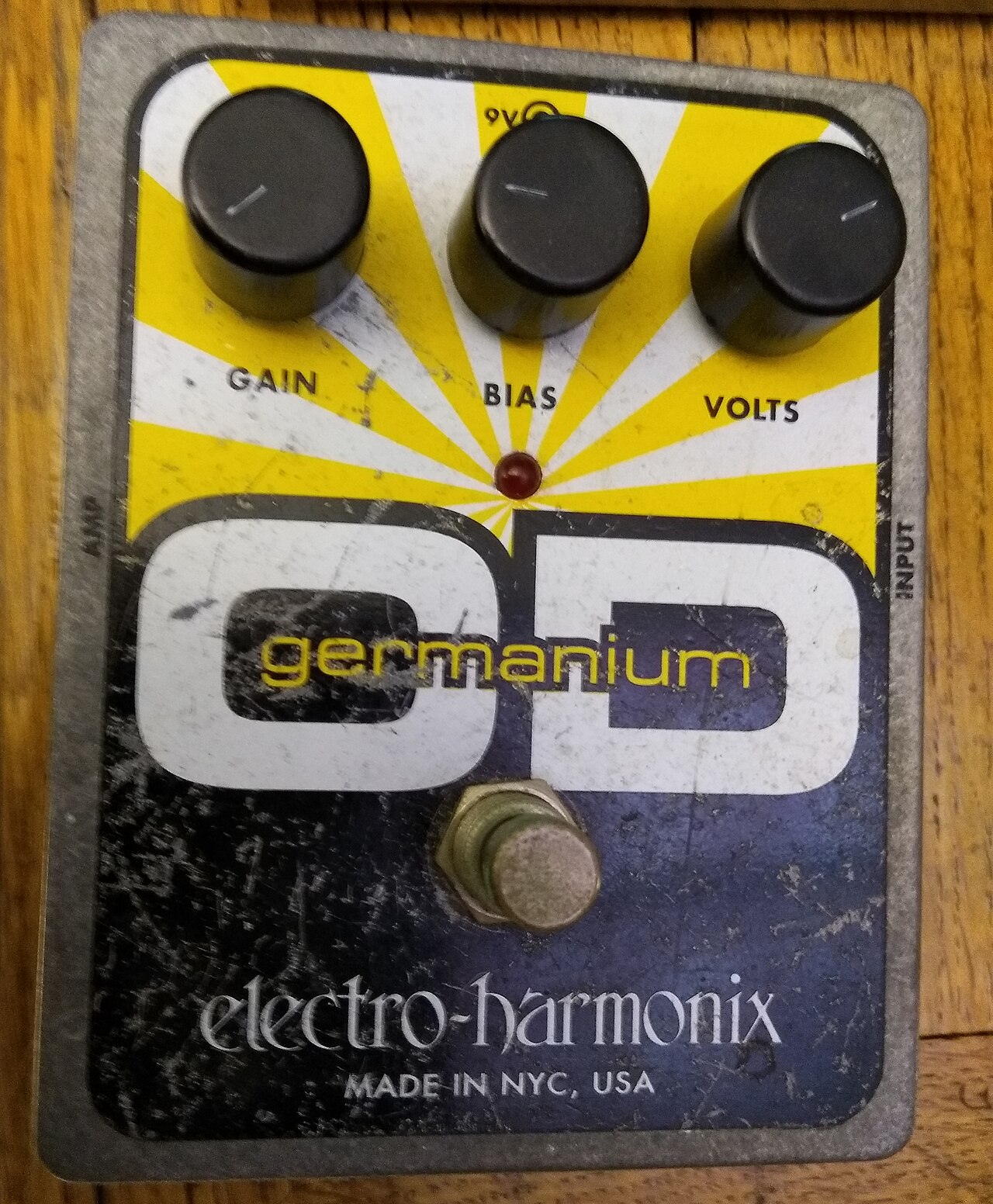
- An Electro-Harmonix Germanium OD pedal: Skimel, Wikimedia Commons, CC BY-SA 4.0.
- Johnny Marr: Liliane Callegari from São Paulo, Wikimedia Commons, CC BY 2.0.
- John Dwyer: friedoxygen, Wikimedia Commons, CC BY-SA 4.0.
Latest News
Related

On This Day
Monday 9 November
From this week: