Every Organ You Ever Loved, Crammed Into a Stompbox: The Electro-Harmonix B9 Organ Machine
Transform your guitar into a vintage organ with the EHX B9 Organ Machine — 9 presets, dual outputs, 100mA, and no tracking headaches.
There is a moment in Deep Purple’s “A Whiter Shade of Pale” — or rather, in the thousand bar-room covers of it — where the guitarist stops, looks at the keyboard player, and wishes. Not for talent. Not for fingers. For the drawbars. For that fat, churning wall of tonewheel harmonics that no amount of guitar processing had ever properly replicated. That moment lasted roughly from 1967 until 2014, when Electro-Harmonix shipped the B9 Organ Machine and quietly ended fifty years of guitar-player envy.
The B9 doesn’t work like a traditional guitar synth. There is no hex pickup to install, no MIDI cable to route, no laptop running samples in the corner. You plug in your guitar, select one of nine carefully voiced organ presets, and what comes out of the Organ Output sounds, in most contexts, exactly like a keyboard player you hired and don’t have to pay. It won a MIPA Award shortly after launch, and it has earned a devoted cult following among guitarists who want to expand their sonic vocabulary without building a secondary keyboard rig. The Edge uses one on tour. Johnny Marr keeps one in his studio. This is that pedal.
How a Stompbox Became an Organ — The Technology Behind the B9
Understanding why the B9 works so well starts with understanding what it doesn’t do. It does not pitch-track your guitar in the traditional sense and fire organ samples at the detected notes. That approach — the basis of every MIDI guitar synth from the Roland GR-300 forward — introduces latency and tracking artifacts that feel unmusical. Instead, the B9 uses the same polyphonic pitch-shifting and wave-shaping technology that EHX developed for their HOG (Harmonic Octave Generator) pedal. It processes the guitar string signal directly, reshaping the waveforms and adding harmonic layers in real time.
Sound on Sound’s Paul White, writing in October 2014, captured this distinction precisely: the B9 “makes you feel as though you’re playing through an effect — and I mean that in a positive way; you don’t get that detached feeling that comes from working with a pitch-tracking guitar-synth type of device.” The playing feels immediate. Strike a pinched harmonic and the organ follows it. Bend a string and the organ bends with it. The sound stays connected to the guitar player, not to a DSP algorithm trying to guess what note was played.
The technology has real-world limits. Tracking is consistent up to the 23rd fret of the high E string. Beyond that, the algorithm struggles. Major seventh chords — where two notes are only a semitone apart — can produce occasional tonal warble, particularly on exposed passages. White noted this in his review and it is worth knowing before a gig: dense chord voicings with semitone intervals are the B9’s one genuine weakness. For everything else — single notes, power chords, triads, arpeggios, partial chords — it is essentially flawless.
Specifications at a Glance
Layout and Controls — Five Knobs, Two Outputs, Zero Complexity
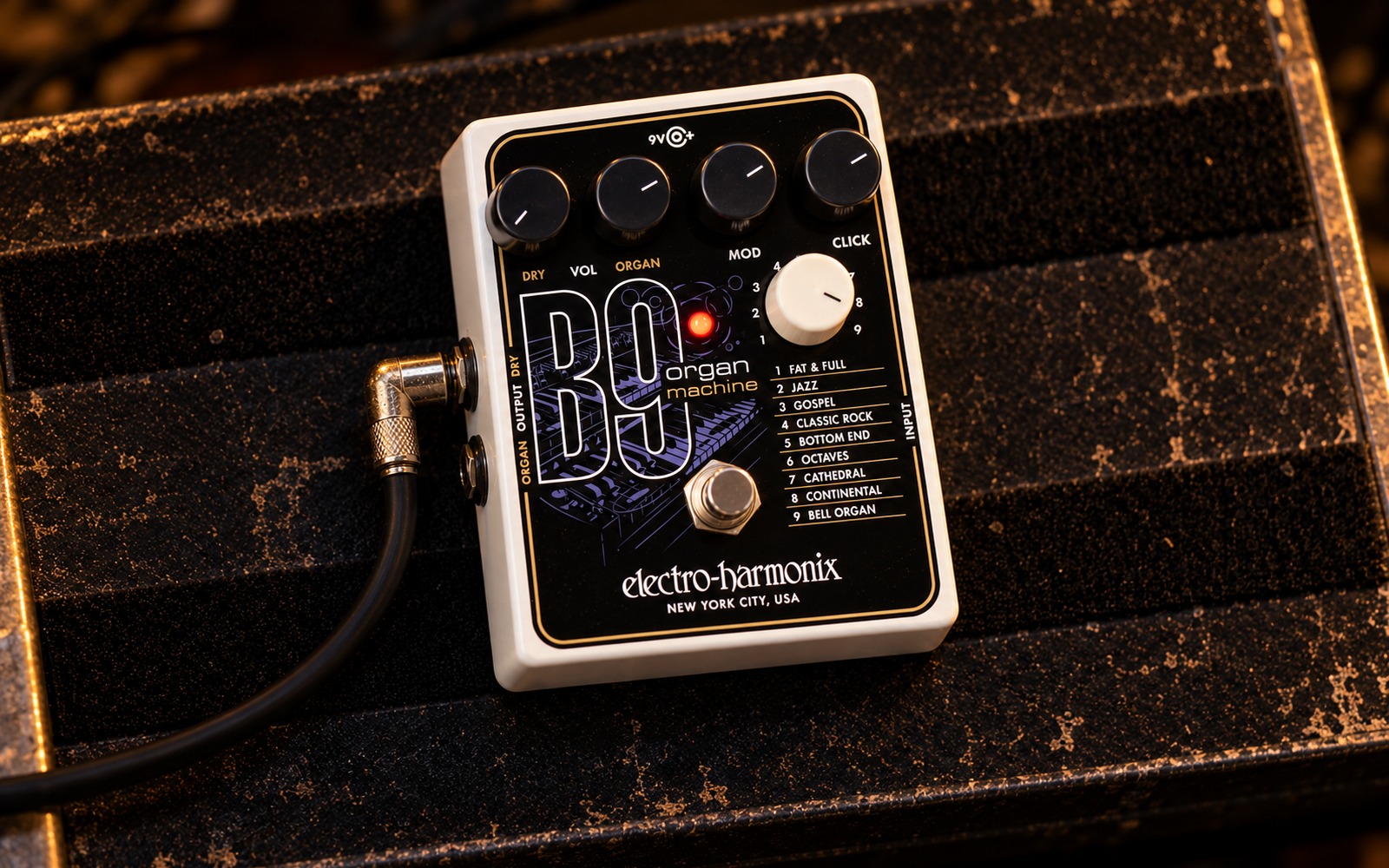
The B9’s front panel is as uncluttered as a Hammond drawbar console after someone pulled out seven drawbars. Five knobs run across the top. On the left side are the dual outputs that will change how you think about your entire signal chain.
The Dry Volume knob controls how much of your unprocessed guitar signal appears at the Organ Output jack. The Organ Volume knob sets the level of the organ effect at that same output. Together, these two controls define the wet/dry blend — push Dry down and Organ up for a full organ-only sound; balance them evenly for a guitar-organ blend that sounds like a duo. The Mod knob controls the speed of whatever modulation is available on the selected preset — chorus, vibrato, or tremolo depending on which voice is active. The Click knob adds percussive key-click, a detail unique to tonewheel organs like the Hammond B3 and C3. On presets where key click is not the relevant parameter, the Click knob instead adjusts modulation depth. The large Preset knob selects among the nine voices. The bypass footswitch toggles between effect and bypass.
The two output jacks deserve special attention. The Organ Output carries the wet/dry blend set by the knobs. The Dry Output is always active — buffered, at unity gain, regardless of whether the B9 is in effect or bypass mode. This means you can split your signal: clean guitar into your regular amp chain from the Dry Output, organ signal into a separate amp or PA from the Organ Output. Premier Guitar’s Jason Shadrick tested this configuration with a Tech 21 Trademark 60 and a Route 66 compressor, and the results opened “a wealth of different recording and effect loop options.” For studio work, it means you can record dry guitar and organ simultaneously on separate tracks.
The power situation is clean: 100mA from the included adapter. Unlike the EHX Canyon or Oceans 11 — both of which draw 150mA and require upgraded power supplies — the B9 fits comfortably on any standard isolated power supply output rated at 100mA or higher. This puts it in the same pedalboard-friendly tier as the Synth9 and Mel9. There is no battery option, which makes sense — at 100mA, a 9V alkaline battery would drain in minutes. Power from the included adapter or your board’s power supply, and you are set.
The Nine Presets — What Each One Actually Sounds Like
The nine presets on the B9 are not generic “organ type A through J.” They are voiced to evoke specific historical instruments and playing traditions. Here is what each one does and where each one belongs.
Fat & Full is the most versatile all-rounder — a big, rich Hammond-style tonewheel sound with upper and lower drawbars dialed in for maximum body. Use the Mod knob for slow rotary-like movement. This is the setting you reach for when a song needs organ without a specific stylistic reference.
Jazz chases the sound of organists like Jack McDuff and Mel Rhyne — smoky, late-night organ trio tone. Shadrick noted it runs slightly brighter than expected and stops short of the dark, cellar-like presence of a fully loaded Hammond B3, but it puts you convincingly in the neighborhood. The Mod knob on this preset gives a rotating speaker simulation. For live situations, dial back your amp’s high frequencies slightly to make it sit in a mix.
Gospel was where Paul White and Jason Shadrick both agreed the B9 truly delivers. The upper drawbars bloom in a way that sounds genuinely musical rather than digital. White’s verdict: “For example, if you choose the Gospel setting and ‘arpeggio’ your way through Dylan’s ‘Like A Rolling Stone’ with an equal mix of guitar and organ, the result is uncannily realistic.” Shadrick put it through Jimmy Herring’s gospel-influenced “Bilgewater Blues” and found the click knob indispensable — he kept it around 10 o’clock. Climb higher on Click for more percussive attack definition.
Classic Rock is the Jon Lord / Keith Emerson setting — the organ sound of Smoke on the Water, of Tarkus, of every organ-guitar face-off in hard rock history. Pair it with a compressor and your amp’s top-end presence, and Shadrick found it capturing “the more progressive sounds of Yes and Deep Purple.” The Click knob adds definition to the attack without losing the sustained body.
Bottom End goes deep — this is the Booker T. “Green Onions” register, the bass-register tonewheel sound that anchors a soul band. White described it as “useful for adding a sub-octave with a bit more character than a typical octave divider or pitch-shifter would give you.” With the Dry output feeding your guitar amp and the Organ output going to a bass amp, Bottom End can genuinely simulate what it would be like to have a bass player who moonlights on organ.
Octaves layers high harmonic content — upper register shimmer that sits above the fundamental. The Click knob becomes a harmonic presence control on this setting. Shadrick found it “fun to experiment with.” This is the most experimental voice on the B9, less anchored to a specific historical organ sound.
Cathedral was Paul White’s personal favorite, and for good reason. It uses tremolo modulation (the Mod knob controls tremolo speed) and has an upper midrange quality that turns guitar arpeggios into something that sounds genuinely liturgical. White wrote that it is “very psychedelic.” Shadrick found that combined with a compressor it suggested “the more progressive sounds of Yes.” This preset rewards slow, deliberate playing — sustained chord tones rather than rapid single-note lines.
Continental is the Vox Continental / Farfisa sound of the 1960s — the preset that puts Ray Manzarek’s “Light My Fire” intro or the keyboard riff from Iron Butterfly’s “In-A-Gadda-Da-Vida” within reach. Shadrick called it “admirably” done, and noted that even Iron Butterfly’s classic sits in its wheelhouse. It uses vibrato modulation. While not the most tonally serious of the nine settings, it delivers an immediately recognizable sonic era that is extraordinarily difficult to reproduce convincingly any other way without actual vintage hardware.
Bell Organ is a hybrid — the percussive attack of an electric piano married to an organ sustain. The Click knob here controls how much of the bell-like attack component is present. Shadrick’s sweet spot was around noon, with adjustments toward 2 o’clock if the guitar/amp combination was darker. This is the B9’s most unusual voice, and also its most versatile for session work: it adds texture that sits between keyboard departments and can make a guitar part sound like a different instrument entirely without committing to a full organ sound.
Famous Players — Who Actually Uses a B9
The Edge of U2 is the most prominent confirmed user. In a Premier Guitar Rig Rundown of U2’s 2018 touring rig — conducted with longtime guitar tech Dallas Schoo — the Electro-Harmonix B9 appears alongside an extraordinarily complex rack that includes Fractal Audio Axe-Fx II XL units, Korg SDD-3000 delays, Boss SD-1 overdrives, and an Ibanez TS-9 Tube Screamer. For a guitarist defined by textural complexity and the guitar-as-orchestral-instrument philosophy, the B9 makes perfect sense: it is another color on a palette that was already painting with more hues than any other guitarist’s rig in rock.
Johnny Marr keeps a B9 in his Crazy Face Factory studio — a dedicated all-EHX board that also includes the C9 Organ Machine, Synth9, Mel9, Stereo Memory Man with Hazarai, Cathedral Reverb, EHX Tortion, Mod Rex Polyrhythmic Modulator, and Superego+. MusicRadar’s Rob Laing documented the board in November 2022 with explicit naming of the B9. This is studio use rather than live touring: Marr uses the board to generate keyboard textures from guitar, treating the EHX 9-series pedals as a polyphonic keyboard substitute for compositional work. The fact that he keeps both the B9 and C9 on the same board is instructive — he wants access to both tonewheel and combo organ families without firing up an actual keyboard rig.
Gary Clark Jr. has been photographed with a B9 on his pedalboard in an image shared by Jim Dunlop USA on Instagram. Clark’s music sits at the intersection of blues, rock, and soul — exactly the tonal territory the B9 was designed to explore. His use of the Bottom End and Gospel presets would be consistent with his approach to songwriting, though the specific application has not been documented in interview detail.
Nels Cline of Wilco appears on Equipboard as a B9 user. Cline is one of the more adventurous pedalboard architects in rock guitar, and the B9 fits comfortably within his experimental approach to texture and orchestration from the guitar position. His use is documented secondarily through Equipboard without specific primary-source quote confirmation.
The connections above are real, but they reflect a pattern common across the EHX 9-series — the pedals are used by serious players for texture and studio work, not as centerpiece live-rig effects. The Edge and Johnny Marr do not deploy the B9 as a lead sound; they use it as one component in a much larger sonic architecture. That is precisely the right approach.
Tone Recipes — Six Settings Worth Dialing In
These settings assume the B9 is placed before any drive or modulation in your chain, with a compressor immediately before the B9 to even out picking dynamics.
Gospel Organ (Worship Hall / Motown Soul): Preset → Gospel. Organ Vol: 12 o’clock. Dry Vol: 8 o’clock (mostly organ). Mod: 9 o’clock (slow rotation). Click: 10 o’clock (subtle percussion). Feed into a clean amp with moderate reverb. Play chord arpeggios rather than strumming.
Hammond B3 Jazz Trio: Preset → Jazz. Organ Vol: 11 o’clock. Dry Vol: 11 o’clock (even blend). Mod: 12 o’clock (medium rotation). Click: 9 o’clock (very subtle). Guitar amp rolled back on treble to sit darker in the mix. Works best with bridge pickup. Single-note lines and chord stabs.
Deep Purple / Classic Rock Organ: Preset → Classic Rock. Organ Vol: 1 o’clock. Dry Vol: 12 o’clock. Mod: 9-10 o’clock (slow). Click: 12-1 o’clock (prominent). Add a compressor before the B9, then a touch of drive after the Organ Output. Sustain through chord tones.
Ray Manzarek “Light My Fire” (Continental): Preset → Continental. Organ Vol: 1 o’clock. Dry Vol: very low (mostly organ). Mod: 12 o’clock. Click: off or minimal. Clean tone, no drive. Works best when playing the actual keyboard part voicings rather than strumming guitar chords — use single-note melodic runs and two-note intervals.
Psychedelic Cathedral: Preset → Cathedral. Organ Vol: max. Dry Vol: off. Mod: 1-2 o’clock (faster tremolo). Click: minimal. Add reverb after the Organ Output — a long room or hall. This setting, layered under psychedelic guitar passages, can make a two-piece sound like a five-piece.
Dual-Amp Split Rig: Guitar → Compressor → B9. Dry Output → guitar amp (full pedalboard chain). Organ Output → separate clean combo or PA channel. Organ Vol and Dry Vol set independently. This mode lets you blend organic guitar and organ to taste in real time, from pure guitar to pure organ, using the two output knobs as a crossfader.
Signal Chain — Where the B9 Lives and Why
EHX recommends placing the B9 early in the signal chain, and Sound on Sound’s Paul White found that it “doesn’t take too kindly to being fed ‘dirty’ signals, or ones with echo or reverb added.” The practical sequence is: guitar → tuner → compressor → B9 → [split into Dry and Organ paths]. A compressor before the B9 is not optional for live use if your picking dynamics are variable — White specifically noted that “players with wayward picking dynamics might produce a more even and organ-like result by putting a compressor before the B9.”
There is one exception documented by Shadrick: if your guitar has low-output pickups (like a MIM Strat with factory single-coils), placing a clean boost before the B9 gives the algorithm a healthier signal to process. He ran a Fulltone Full-Drive 2 MOSFET before the B9 in clean-boost mode to help his Strat’s low-output pickups and found “a distinct advantage.” This is not drive — it is clean amplification of the raw signal. The B9 needs adequate signal level to process accurately.
After the B9, the Organ Output can go through reverb, delay, and modulation without issue. The Cathedral preset’s tremolo benefits from a long reverb after the pedal. The Jazz preset sits better through a plate or room reverb than a spring. The Continental and Continental-adjacent presets work beautifully through a subtle chorus or vibrato pedal placed after — they already have vibrato in the preset, but a second mild modulation layer adds authenticity.
The Dry Output feeds a completely clean, buffered version of your guitar signal directly from the input. Because the bypass is buffered, the Dry Output is always active — even when the B9 is bypassed, the Dry Output carries signal. This means you can use the B9 as a signal splitter independently of its organ function. It also means that if you are running a germanium fuzz anywhere in your chain, that fuzz must come before the B9 (as with all buffered pedals), not after.
B9 vs. C9 vs. Mel9 — Knowing Which EHX 9-Series You Need
The B9 covers tonewheel and gospel organ — the Hammond B3 and C3 family, the instrument that defined soul, jazz organ trio, classic rock, and gospel music from the late 1950s forward. Its nine presets are all rooted in this tradition, even where they branch into psychedelic cathedral or hybrid bell-organ territory.
The C9 Organ Machine covers combo organs — the Vox Continental, Farfisa Compact, and their 1960s British Invasion siblings. Where the B9 is about drawbars and gospel heat, the C9 is about the thin, reedy brightness of “House of the Rising Sun” and the buzzing treble of 1960s garage rock. They are genuinely complementary: Johnny Marr keeps both on his studio board for exactly this reason.
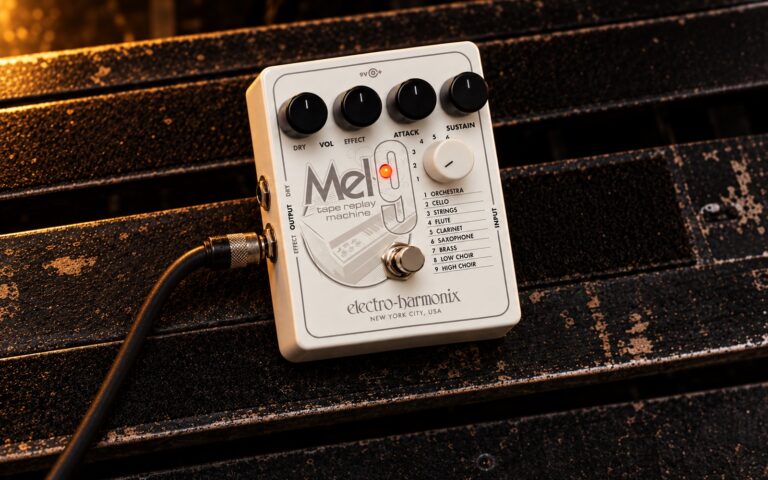
The Mel9 does not do organ at all — it emulates Mellotron tape playback: flute, strings, choir, cello, brass, saxophone. Where the B9 gives you a keyboard player in an organ trio, the Mel9 gives you an orchestra in a pedal. The two sit naturally together in a signal chain or an A/B arrangement, covering organ and orchestral texture from one corner of the pedalboard.
And the Synth9 goes further still into synthesizer territory — Oberheim OB-X, Prophet-5, Moog, Roland GR-500. If you need an organ, you want the B9 or C9. If you need a synth pad, you want the Synth9. The four together — B9, C9, Mel9, Synth9 — form a complete keyboard/orchestral expansion system for guitarists who want to play everything on a six-string.
Buying Guide — New vs. Used in 2026
The B9 is currently listed as NOT AVAILABLE at EHX direct (ehx.com), which has been its status for some time. The used market is therefore the primary acquisition channel for most players.
Street new runs approximately $185–$220 through dealers and online retailers with remaining stock. Used excellent-condition units come in at roughly $115–$155 on the major resale platforms. Unlike some EHX products that degrade meaningfully with use (capacitor-based analog circuits), the B9 is digital with no moving parts beyond the knobs and footswitch — a well-cared-for used unit is essentially identical to new.
When buying used, check: footswitch action (should click cleanly with no sticking), all five knobs (smooth rotation, no crackle), both output jacks (insert a cable and wiggle slightly — no intermittent connection), power adapter compatibility (the included adapter is 9.6VDC center-negative at 200mA; a Boss-compatible 9VDC at 100mA+ isolated output works fine). The B9 is a robust unit and used examples rarely arrive with serious issues beyond cosmetic wear.
There is no announced successor or V2. EHX released the B9 in 2014 and has not significantly revised it. The basic architecture was also applied to the C9 (2015), Key9 (2016), Mel9 (2016), Synth9 (2017), String9, and Bass9 — the algorithm is mature and proven. If you want this specific tonewheel organ territory in a stompbox, the B9 is the reference product, and likely to remain so.
Ownership Notes — What Nobody Tells You Before You Buy
A few practical realities become apparent after extended use that reviews do not always surface clearly.
The EQ relationship between the B9 and your amp matters more than with most pedals. Because the B9 processes your guitar signal rather than replacing it entirely, some fundamental guitar character still bleeds through the organ sound. This is generally positive — the B9 sounds warm and organic in part because of this — but it means that a bright, scooped guitar amp will make the B9 sound thin, while a warm, thick amp will complement it. Shadrick found he needed to adjust his amp’s EQ more than usual on some presets when playing live. If the B9 isn’t cutting through a mix, try adding low-mids at the amp before chasing the B9’s knobs.
The picking dynamics threshold is real. Premier Guitar noted “a threshold that once crossed boosts the output considerably.” If you dig in hard on a chord, there is a jump in volume. This is where the compressor before the B9 pays its admission — smooth out your attack before the B9 sees it, and the output will remain consistent. Live players who play with varying intensity across a set should build this into their chain from day one.
The MOD knob does not speed-switch during performance. Sound on Sound’s Paul White called this a missed opportunity: “I think the designers have missed a trick here, as rotary effects always sound best when you’re able to switch speeds during performance, ideally with the speed change lag built in.” He was right, and there is no workaround within the B9 itself. If you need Leslie-style slow/fast switching, the solution is a dedicated rotary emulator pedal placed after the Organ Output — a Strymon Lex, a Neo Ventilator, or any rotary simulator. Yes, a good one costs more than the B9 itself. Yes, it is worth it if real-time rotary speed control matters to your music.
The Continental and Jazz presets specifically reward clean, sparse playing. Full strumming produces reasonable results, but sophisticated single-note lines and two-note voicings sound dramatically more convincing. Paul White’s rule of thumb: “Clean and even playing is always rewarded. Choosing suitable organ chord voicings, playing partial chords or arpeggios sounds far better than just strumming.” This is less a limitation than a creative constraint that will improve your musical vocabulary.
Finally: the B9 also works with bass guitar, “though not quite so well below the instrument’s D-string,” per Sound on Sound. Bass players who want to add organ texture to a two-piece setup will find the Bottom End and Fat & Full presets particularly useful with a bass guitar input.
Frequently Asked Questions
Does the B9 need a special pickup or MIDI system to work?
No. The B9 works with any standard electric guitar or bass through a regular 1/4″ instrument cable. No hex pickup, no MIDI interface, no special installation. Plug in and play.
Does it track chords, or only single notes?
It tracks chords — that is one of the B9’s primary advantages over older guitar synth technology. Polyphonic pitch-shifting and wave-shaping processes all played strings simultaneously. Major seventh chords (with semitone intervals between voices) can occasionally produce slight tonal warble on complex voicings, but standard major, minor, and power chord voicings track without issue.
What is the difference between the B9 and the C9?
The B9 covers tonewheel organ (Hammond B3, C3, and related instruments) — the organ of gospel, jazz, soul, and classic rock. The C9 covers combo organs (Vox Continental, Farfisa Compact) — the organ of 1960s British Invasion and garage rock. The B9 is fuller and warmer; the C9 is brighter and thinner. They are complementary rather than redundant.
Can I use the B9 with a bass guitar?
Yes, with some limitations. It tracks bass guitar reasonably well down to the D-string. Notes below the D-string (A and E strings, open position) produce less consistent results. The Bottom End and Fat & Full presets work best with bass input.
Should I put the B9 before or after my overdrive?
Before. The B9 processes a clean guitar signal. Feed it a distorted signal and the polyphonic tracking becomes less reliable and the tonal character changes in unpredictable ways. EHX, Sound on Sound, and Premier Guitar all agree on this: B9 goes early in the chain, before drive pedals. Add drive after the Organ Output if you want a driven organ sound.
Is there a battery option?
No. At 100mA, a 9V battery would drain extremely quickly and is not a practical option. The B9 uses the included 9.6VDC-200mA adapter or any compatible isolated power supply output rated for 100mA at 9VDC (center-negative). Standard Boss-compatible supplies work fine.
The B9 is showing as Not Available at EHX. Is it discontinued?
EHX has listed the B9 as NOT AVAILABLE for an extended period. Used units are widely available on the secondary market at $115–$155 in excellent condition. No replacement or V2 has been announced. The used market is the primary acquisition path as of 2026.
Does the Dry Output go silent when the B9 is bypassed?
No — and this is important. The Dry Output is always active, always buffered, regardless of bypass state. Even when the B9 footswitch is in bypass mode, clean guitar signal flows continuously from the Dry Output. This enables using the B9 as a permanent signal splitter even when the organ effect is not in use.
Image credits
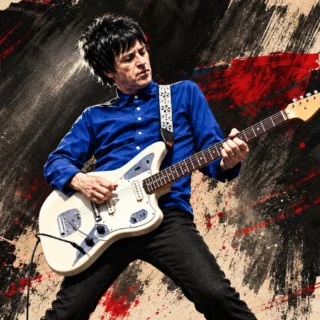
- Top image: GuitarGangsters AI-generated reference illustration, not a photograph.
- A guitarist using an effects pedal on stage: Shixart1985, Wikimedia Commons, CC BY 2.0.
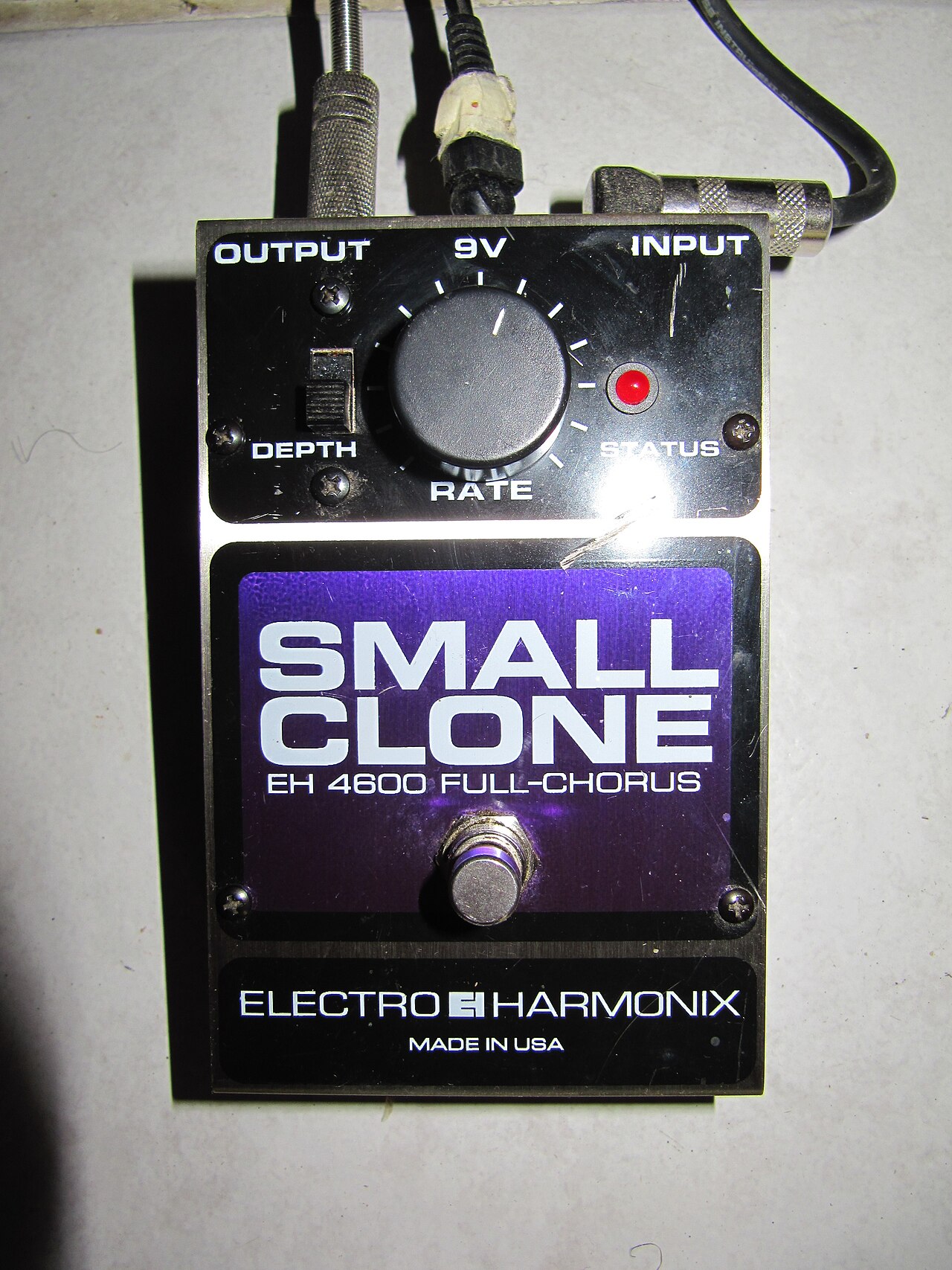
- An Electro-Harmonix Small Clone chorus pedal: Sky99, Wikimedia Commons, CC BY-SA 3.0.
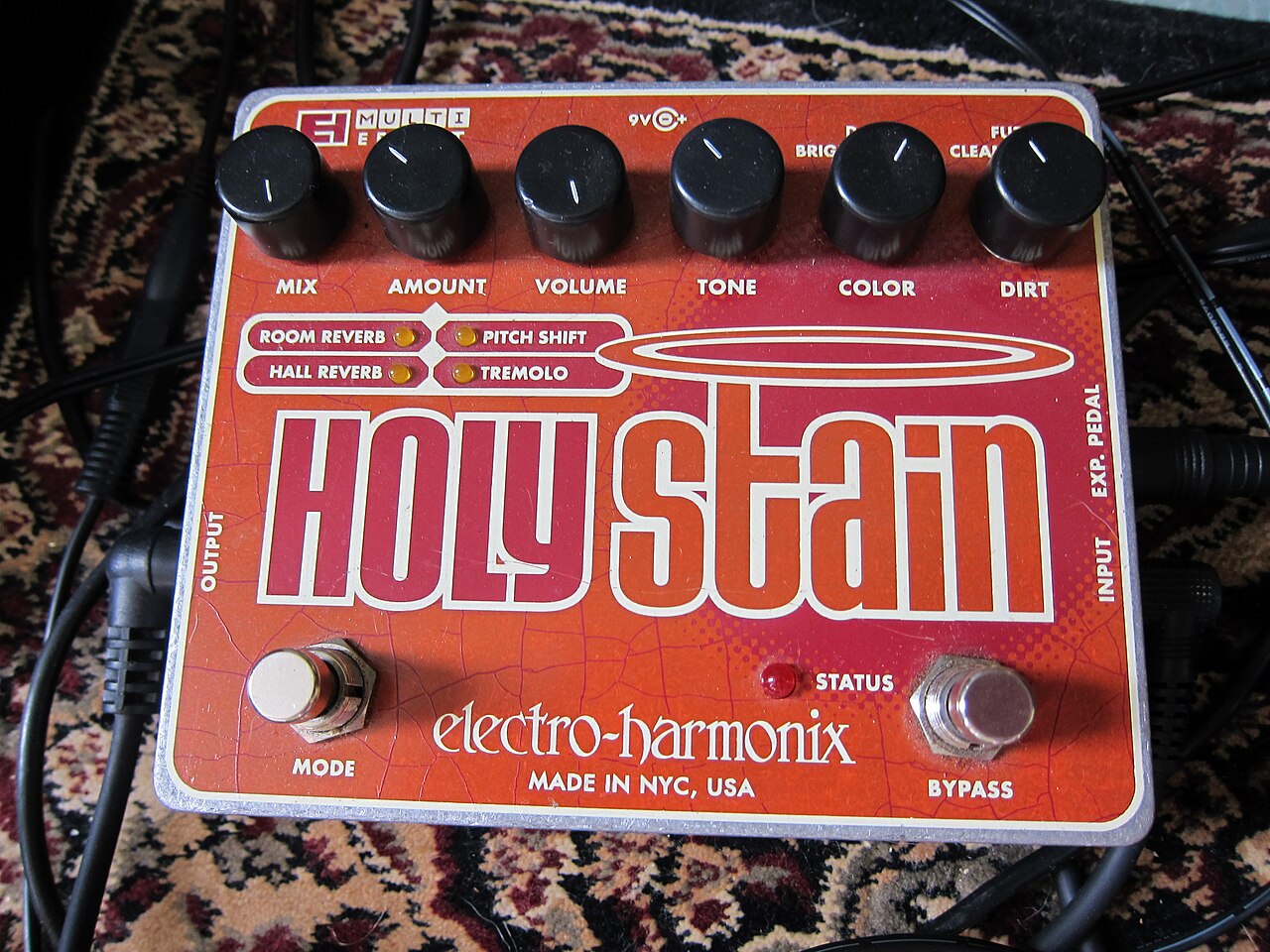
- An Electro-Harmonix Holy Stain pedal: Oldangelmidnight from Northampton, MA, Wikimedia Commons, CC BY-SA 2.0.
Latest News
Related
On This Day
Monday 9 November
From this week: