Eleven Tricks Up Its Sleeve: The Electro-Harmonix Oceans 11 Reverb
11 reverb algorithms in one nano pedal. Discover the EHX Oceans 11's Spring, Hall, Shimmer, DYNA, and Poly modes, verified players, and settings.
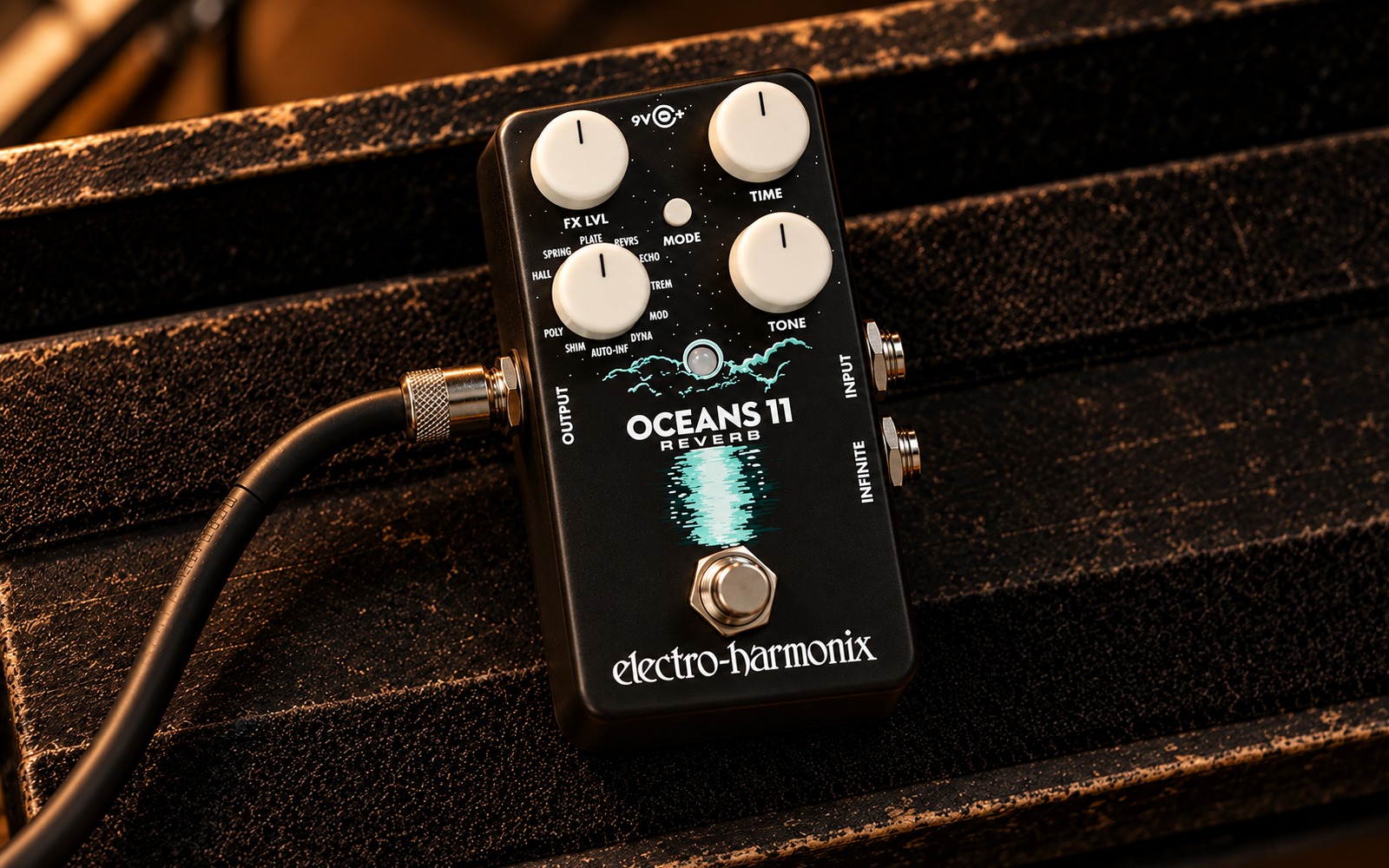
Everything a pedalboard needed in the reverb department used to require either a rack unit the size of a refrigerator or a willingness to carry three separate pedals. Then, on May 29, 2018, Electro-Harmonix dropped the Oceans 11 — eleven reverb algorithms crammed into the same compact nano enclosure that houses the Canyon delay — and the reverb game changed. Not because the Oceans 11 is the most sophisticated reverb pedal money can buy. But because it puts Hall, Spring, Plate, Reverse, Echo, Tremolo, Modulated, Dynamic, Auto-Infinite, Shimmer, and Polyphonic reverb on your board for the MAP price of a hundred and seventy-six dollars. The casino heist metaphor in the name is cheeky, but accurate: you are robbing the boutique market blind.
Premier Guitar, which gave the Oceans 11 a Gear Award in 2018, called it “a killer reverb solution for a small fly-date board and recording sessions that require spatial sounds.” That summary is as accurate now in 2026 as it was at launch — which tells you something about how well EHX designed this thing.
The EHX Reverb Family: From Holy Grail to Eleven
Before the Oceans 11 existed, EHX’s reverb story was simpler and, frankly, more limited. The original Holy Grail (1999) gave players three algorithms — Hall, Spring, and Flerb (a flanger/reverb hybrid) — in a small format at an approachable price. The Holy Grail Nano stripped it to three on a rotary knob. The Holy Grail Neo updated the DSP without dramatically expanding the algorithm set. Each iteration refined the approach without breaking out of the three-mode structure.
The 2017 Canyon delay changed the philosophy. Here was an EHX nano pedal that didn’t just do delay — it did eleven delay modes with Secondary Knob Mode hidden parameters, tap tempo, and a built-in looper. When the Canyon landed with rave reviews, the template was established. The Oceans 11 applied the same architecture to reverb, launching in 2018 and picking up the Premier Guitar Gear Award that year. Both pedals share the same nano enclosure, the same Secondary Knob Mode approach, and — importantly for pedalboard planning — the same 150mA current draw.
The timing was deliberate. The multi-algorithm digital reverb category had been heating up: the TC Electronic Hall of Fame 2 offered TonePrint connectivity, the Boss RV-6 covered eight modes, and the MXR M300 had been staking out the mid-range since 2016. EHX’s answer was: eleven modes, nano footprint, power adapter included, and a price point well below the competition.
Specifications
Controls: FX LVL knob (wet signal output level), TIME knob (reverb decay time), TONE knob (EQ of wet signal), Reverb Type rotary switch (11 positions), MODE button (sub-modes per reverb type), Footswitch (bypass / infinite hold).
Jacks: Input, Output, INFINITE (1/4″ TS for external momentary footswitch).
Internal Tails switch: determines whether the reverb tail fades naturally after bypass or stops immediately. Requires accessing the bottom plate to adjust.
Secondary Knob Mode: press and hold the footswitch to access hidden parameters stored per reverb type, adjustable via the TIME and TONE knobs. LED changes color to indicate the mode is active.
The Eleven Reverbs, Explained
Each of the eleven reverb types has up to three sub-modes accessible via the MODE button, indicated by a green, red, or orange LED. That gives the Oceans 11 a theoretical maximum of thirty-three distinct reverb configurations from eleven knob positions — far more than the front panel suggests at first glance.
HALL covers the classic large-room concert hall reverb essential to studio recordings since the early 1970s. Three modes adjust the character from smaller, rounder spaces to larger, more diffuse ambiences. Secondary parameters include pre-delay time — the gap between the dry signal and the reverb onset — and pre-delay feedback. Getting the pre-delay right on hall reverb is the difference between a reverb that adds dimension and one that muddles a chord progression.
SPRING pays direct homage to the Fender 6G15 tube spring reverb unit — the external tank that Fender players used before reverb was built into their amplifiers. MusicRadar’s Trevor Curwen, reviewing the Oceans 11 in September 2018, noted that “its authentic sound will not disappoint surf guitarists in any way — it has that ‘drip’ that you hear when palm muting.” Secondary parameters include Spring Length (simulating the physical length of the spring coil) and preamp Drive (a gentle saturation approximating the warm breakup of the original hardware). The Drive secondary parameter is worth knowing: cranked up, it adds a subtle grit to the reverb signal that makes the whole thing feel more analog and lived-in.
PLATE renders the lush, even reverb tail of the large metal plate hardware historically used in recording studios. Plate reverb is the go-to for anything that needs space without the particular character of a real room. Secondary controls include pre-delay.
REVRS emulates reverse reverb — the backwards swell that appears to approach the note rather than trail it. EHX notes, with appropriate skepticism, that “Jimmy Page claims to have invented it.” Regardless of origin, reverse reverb has remained a staple of ambient, psychedelic, and post-rock production. The Oceans 11 implementation lets you adjust the sensitivity and tail length across three sub-modes.
ECHO combines plate reverb with a recirculating echo. The delays are smudged by the plate reverb into something warmer and more diffuse than a clean digital repeat — closer to the way a tape echo sounds in a room than to a pristine digital delay. This is the only reverb mode on the Oceans 11 that supports tap tempo via the footswitch. If you’re using the Oceans 11 as your sole time-based effect, ECHO with tap tempo covers both reverb and delay in a single algorithm.
TREM applies tremolo to both the wet and dry signal within a Hall reverb context. Three sub-modes offer smooth sine, squarish, and intermediate waveshapes. Crucially, you can reduce the FX LVL to near-zero and use TREM as a standalone tremolo — an unexpected secondary capability that makes the Oceans 11 even more useful on a minimal fly-date board.
MOD is the modulated reverb mode. Three sub-modes apply different modulation flavors: Chorus laced onto the reverb tails, Flanger wrapping through the reverb tails, and a combined Chorus plus Flanger. The MOD flanger mode at medium FX LVL and moderate TIME produces exactly the kind of spatial, slightly-haunted atmospheric sound associated with ’80s new wave and post-punk production. EHX’s own context explicitly references an “eighties Andy Summers sound” as achievable from the MOD section.

DYNA is the dynamic reverb mode and arguably the most musically intelligent collection of algorithms on the Oceans 11. Three sub-modes: Swell (suppresses the initial note attack before blooming the reverb into the soundscape — a volume pedal swell without the pedal), Gate (passes the reverb tail through a noise gate that opens when it detects playing — this is the Phil Collins gated reverb effect applied to guitar), and Duck (compresses the reverb tail while playing and fades it back in during rests, keeping space out of the way of busy passages while filling silence with air).
AUTO-INF triggers a reverb wash for each new note or chord. When a new note is struck, the previously sounding reverb crossfades smoothly to the new one. The result is a constant, self-updating shimmer that follows your playing — somewhere between an ambient pad and a reverb freeze, and genuinely useful for textural playing.
SHIM is Shimmer reverb: octave-shifted reverb that modulates and blooms behind the dry signal. Shimmer produces the choir-of-angels effect associated with Brian Eno’s ambient work, U2’s early atmospheric explorations, and broadly every ambient guitarist who has picked up a reverb pedal since 2010. Three sub-modes adjust the shimmer character, and Secondary Knob Mode gives control over the octave blend and modulation rate.
POLY is the Oceans 11’s most radical algorithm. Two configurable bi-directional pitch shifts operate on the pre-reverb signal. Choose dissonant intervals with near-infinite decay for disorienting soundscape textures, or choose perfect and major intervals to generate harmonies that drift through a key. POLY is not something you’d engage mid-song in a rock club — it is a compositional tool for ambient work, post-rock, and experimental guitar, and it is excellent at what it does.
Famous Players
The Edge, John Mayer, Mark Lettieri, and Mateus Asato are credible reverb users in general — but independent research does not confirm any of them as documented Oceans 11 users specifically. The Edge’s reverb rigs operate through dedicated rack processors and Korg SDD-3000 units at the technical heart of U2’s setup; no Oceans 11 has appeared in documented rig rundowns. John Mayer’s Fender Vibro-King provides built-in spring reverb, and his pedalboards don’t show the Oceans 11 in published sources. Mark Lettieri’s documented Fall 2023 Snarky Puppy rig uses the TC Electronic Hall of Fame Reverb. Mateus Asato’s documented gear similarly points toward the TC Electronic HOF rather than the EHX unit. None of these connections survived primary-source checking.
Andy Summers (The Police): Equipboard documents Andy Summers with an EHX Oceans 11 on his pedalboard, consistent with his decades-long relationship with Electro-Harmonix — a relationship that began with the original Electric Mistress and Small Clone during The Police’s peak years. His engagement with the MOD section makes particular sense: modulated reverb sat at the heart of his defining tone on records like “Synchronicity” and “Ghost in the Machine.” The Oceans 11’s MOD Flanger mode is what EHX’s own context identifies as capable of producing that specific ’80s atmospheric sound. Andy Summers is the most credibly documented Oceans 11 connection this article can offer.
Kim Gordon (Sonic Youth): Kim Gordon appears on Equipboard’s documented list of Oceans 11 users. Her experimental approach to guitar and bass throughout Sonic Youth’s catalog — using feedback, extended technique, and space as compositional elements — makes her a natural Oceans 11 player. The REVRS and POLY modes fit her sonic vocabulary directly.
Sammy Duet (Goatwhore): Also listed on Equipboard’s documented users. Duet’s use of the Oceans 11 in a black metal context is instructive — the DYNA Gate mode, specifically, is useful for creating short, explosive reverb bombs that sit behind heavy riffs without accumulating wash into the next note.
The Oceans 11 is genuinely embedded in that world. Players working in the traditions of Stars of the Lid, Grouper, and post-rock atmospheric guitar embraced the SHIM, AUTO-INF, and POLY modes quickly following the 2018 release. The Oceans 11 became the default multi-algorithm reverb recommendation in several ambient guitar forums precisely because it delivers boutique-adjacent functionality at a non-boutique price.
Signal Chain Guide
The classic reverb question — does reverb come before or after delay? — is partially answered by the Oceans 11’s built-in ECHO mode, which already provides a delay-into-reverb architecture. If you pair the Oceans 11 with the EHX Canyon as companion pedals, try both arrangements: Canyon → Oceans 11 (reverb applied to echoes, creating larger ambience) and Oceans 11 → Canyon (echoes applied to the reverberant signal, creating a cascading swell effect).
In a standard chain, the Oceans 11 lives at the end: drives and modulation pedals before it, amplifier after it. This applies the reverb to the full processed signal and is how most players run it.
The 150mA current draw is the critical pedalboard planning point. It matches the Canyon, and both exceed the 100mA per-output maximum of most budget isolated power supplies. If your supply tops out at 100mA per output, the Oceans 11 will either not function correctly or will generate audible noise. The included 9.6VDC-200mA adapter is the proper starting point. For players building a serious isolated supply, the Cioks DC7, Strymon Zuma, and Truetone CS12 all offer high-current outputs capable of running the Oceans 11 cleanly.
Buffered bypass means the Oceans 11’s buffer circuit is always active — even in bypass mode, it maintains a consistent low-impedance output. For most players this is a non-issue and contributes to clean signal integrity down a long cable run. For vintage germanium fuzz players: place fuzzes before the Oceans 11 in the chain, not after, to preserve the fuzz circuit’s expected high input impedance.
Tone Recipes and Settings
Classic Hall with Pre-Delay (Recording / Live Room): Reverb Type: HALL, Mode 1 (green LED). FX LVL: 9 o’clock (light wash). TIME: noon. TONE: noon. Enter Secondary Knob Mode and set the TIME secondary to approximately 50ms pre-delay, TONE secondary to low feedback. The pre-delay separates the attack from the reverb onset and prevents muddiness on chord passages. This is a versatile starting point for any clean or lightly driven guitar tone in a live or studio setting.
Fender Tube Spring (Surf / Twang): Reverb Type: SPRING, Mode 1 (green LED). FX LVL: 8 o’clock. TIME: 10 o’clock. TONE: 11 o’clock. Secondary: Spring Length at noon, Drive at 9 o’clock for subtle vintage warmth. Palm-mute a low E string and listen for the characteristic spring “drip” — the satisfying mechanical plunge that defines surf guitar reverb. Increase Drive slightly for a more saturated, pre-CBS Fender character.
Gated Reverb (Alternative / Post-Grunge): Reverb Type: DYNA, Mode 2 (Gate, red LED). FX LVL: maximum. TIME: 8 o’clock (short decay). TONE: 1 o’clock (brighter). The result is an explosive reverb bloom that fires on each note and cuts cleanly — the Phil Collins effect relocated to guitar. Works well on snare-cracking power chords and isolated single notes. Combine with a volume swell pick attack for maximum drama.
Shimmer Pad (Ambient / Post-Rock): Reverb Type: SHIM. FX LVL: 2 o’clock. TIME: near maximum. TONE: noon. Secondary: shimmer level elevated, modulation rate slow. Play a sustained chord, then hold the footswitch to freeze the shimmer into an infinite pad. Play single-note lines over the top. Set the internal Tails switch to ON for natural decay when bypassing. This is the recipe for the ambient guitar passages that have defined the genre since Talk Talk’s late albums.
Attack-Free Volume Swell (DYNA Swell): Reverb Type: DYNA, Mode 1 (Swell, green LED). FX LVL: 2 o’clock. TIME: 10–11 o’clock. TONE: noon. Note attacks are suppressed; the reverb bloom swells up behind each note as if played through a volume pedal. Works particularly well on a clean Stratocaster into a clean amp — the swell is organic and musical rather than artificial. No volume pedal required.
Andy Summers MOD Atmosphere: Reverb Type: MOD, Mode 2 (Flanger, red LED). FX LVL: 10 o’clock. TIME: noon. TONE: 10 o’clock (darker). Secondary: flanger rate slow. This is the spatial, slightly-haunted sound of early-’80s new wave production translated to a nano pedal. Play sparse, arpeggiated chord voicings with the Tone rolled back on a Stratocaster for maximum authenticity.
Polyphonic Harmony Reverb (Compositional): Reverb Type: POLY. Set the two pitch shifts to a major third and a perfect fifth above your root. TIME near maximum. FX LVL at noon. Play slow chord movements and let the POLY algorithm generate harmonics above each note. The effect is closer to a twelve-string guitar through a cathedral than anything a standard reverb does. Experiment with TIME and the pitch interval Secondary parameters until something clicks.
How It Compares
The Oceans 11 occupies a specific position in a competitive category. Here’s how it sits against reverb pedals already covered on GuitarGangsters:
The TC Electronic Hall of Fame 2 has stereo I/O and TonePrint connectivity — downloadable artist presets via smartphone. Its nine algorithms include Shimmer and Hall but no DYNA or POLY equivalents. The HOF 2 wins for stereo rigs and preset flexibility; the Oceans 11 wins on algorithm depth, DYNA versatility, and cost per mode.
The Boss RV-6 offers eight modes, stereo I/O, and Boss’s legendary build quality. Its shimmer and modulated modes are excellent. The Oceans 11 has more algorithms and significantly more hidden parameters via Secondary Knob Mode; the RV-6 is simpler to operate in real time and built to withstand considerably more physical abuse.
The MXR M300 has stereo I/O, six reverb modes, and a dedicated Wet output useful for parallel reverb rigs. It is larger than the Oceans 11 nano enclosure but provides more immediate real-time control without entering Secondary Knob Mode. The Oceans 11 wins on footprint and algorithm count; the M300 wins on stereo operation and direct parameter access.
The EHX Canyon is the natural companion — same enclosure, same Secondary Knob Mode architecture, same 150mA current draw. Canyon for delay plus Oceans 11 for reverb covers enormous sonic territory in two nano spaces. They share architectural logic, which makes operating both simultaneously intuitive once you know one.
Against boutique competitors: the Oceans 11 cannot match the Strymon BigSky on algorithm sophistication, stereo operation, preset storage, or expression connectivity. It was never designed to. It competes on price and footprint — and wins decisively on both.
Buying Guide
New at $144–176: the Oceans 11 is one of the best-value multi-algorithm reverb pedals in its class. The only caveat before purchase is the 150mA current draw — confirm your power supply has a compatible output before ordering. If your supply only has 100mA outputs, budget for the included adapter or a power supply upgrade alongside the pedal.
Used at $100–130: the Oceans 11’s digital DSP circuit has no mechanical components that degrade. A used unit in excellent condition performs identically to a new one. When evaluating a used Oceans 11: click through all eleven rotary switch positions confirming each reverb type engages cleanly, hold the footswitch to verify Infinite Reverb works, enter Secondary Knob Mode to confirm hidden parameters are accessible. Check the nano enclosure for physical damage — the aluminum casing is reasonably robust but the corners can dent.
Who should look elsewhere: players who need stereo operation need the TC Electronic HOF 2, Boss RV-6, or Strymon BigSky. Players who need preset storage for mid-set switching need the HOF 2’s TonePrint system or the Strymon. Players who want an expression pedal input for real-time reverb swells need EHX’s own Oceans Abyss or the Strymon.
The Oceans Abyss: EHX’s larger sibling to the Oceans 11, released in 2021. Adds expression pedal input, preset storage, stereo I/O, and expanded secondary parameter control. Street price runs roughly $250–280. If your budget reaches the Abyss, it is a genuine upgrade. If not, the Oceans 11 covers the same reverb territory for considerably less.
Ownership Notes
The internal Tails switch is the most overlooked setup step. It lives inside the bottom plate — not on the exterior of the pedal — and requires removing four screws to access. Tails ON means the reverb decay continues naturally after you engage bypass; the tail fades rather than cutting. Tails OFF means the reverb stops immediately on bypass — useful for switching to a completely dry tone mid-song without a reverb tail bleeding into the next passage. Set this before gig day. If you buy used, confirm which position the seller left it in and adjust to your preference before the first rehearsal.
Secondary Knob Mode is the Oceans 11’s learning curve. Each of the eleven reverb types has its own unique hidden parameters, and the TIME and TONE knobs map to different parameters depending on which reverb is active. The manual — downloadable in PDF from EHX’s website — lists every parameter per reverb type. After a few focused practice sessions with the manual, the patterns become intuitive. The payoff is meaningful: pre-delay on Hall and Plate, Spring Length and Drive on Spring, shimmer blend on SHIM, pitch interval selection on POLY. These secondary parameters are what separate the Oceans 11 from a simpler reverb pedal in real-world use.
No stereo operation: there is one input and one output jack. If you are building a stereo rig, the Oceans 11 processes only one channel. The Oceans Abyss addresses this directly.
The ECHO reverb’s tap tempo implementation deserves specific attention. The footswitch doubles as a tap tempo input when ECHO is selected — it does not engage bypass. This allows live tempo adjustment without switching off the reverb effect. In all other reverb modes, pressing and holding the footswitch triggers Infinite Reverb rather than tap. The external INFINITE jack accepts a separate momentary footswitch that can trigger infinite reverb independently of the main footswitch — useful for hands-free ambient playing.
One workflow note on Secondary Knob Mode exit: parameters adjusted in Secondary Knob Mode are stored per reverb type but reset when the unit loses power. There is no persistent memory — the Oceans 11 powers up with its default secondary parameters each time. If you rely on specific secondary settings, note them down and re-enter them at the start of each session until they become muscle memory.
Frequently Asked Questions
Does the Oceans 11 work with bass guitar?
Yes. The digital circuit and buffered bypass handle bass fundamentals without rolling off low end. The DYNA Duck mode is particularly useful for bass — it compresses the reverb while you’re playing and fades it back in during pauses, keeping the reverb spatially present without accumulating wash under fast bass lines.
Can I store presets on the Oceans 11?
No. The Oceans 11 has no preset storage. Knob positions are read in real time. If you need preset-based switching for live performance, the TC Electronic Hall of Fame 2 with TonePrint presets or EHX’s Oceans Abyss with dedicated preset slots are the alternatives.
What is the difference between the Oceans 11 and the Oceans Abyss?
The Oceans Abyss is a larger-format EHX reverb with stereo I/O, expression pedal input, preset storage, and expanded parameter control for each algorithm. The Oceans 11 covers similar reverb territory in a nano footprint at roughly half the street price. For pedalboard-real-estate-sensitive players who don’t need stereo or presets, the Oceans 11 is the right choice.
Can I use an expression pedal with the Oceans 11?
No. The INFINITE jack accepts a 1/4″ TS momentary footswitch only — press and hold for infinite reverb. Expression pedal connectivity requires the Oceans Abyss.
How does Infinite Reverb work in practice?
In most reverb modes, holding the footswitch creates a reverb wash that sustains indefinitely. You can play over it with a fresh reverb effect running simultaneously — the infinite wash freezes while normal reverb continues from your playing. Release the footswitch to let the frozen wash decay. An external momentary footswitch connected to the INFINITE jack lets you trigger this without engaging the main bypass footswitch. Particularly effective with the SHIM mode for ambient pad work.
Is the buffered bypass audible?
For most players in most signal chains: no. The Oceans 11’s buffer is clean and transparent. It maintains signal integrity over long cable runs and provides a stable, low-impedance output throughout the chain. The only players who might notice interaction are those with vintage germanium fuzz pedals, which are impedance-sensitive. Solution: place the fuzz before the Oceans 11 in the chain.
What does the Secondary Knob Mode actually unlock?
Each reverb type has unique secondary parameters accessible via TIME and TONE knobs in Secondary mode. HALL: pre-delay time and pre-delay feedback. SPRING: spring length and preamp drive. PLATE: pre-delay time and pre-delay feedback. REVRS: several reversal behavior parameters. ECHO: echo level and echo feedback. TREM: tremolo depth and tremolo shape fine-tuning. MOD: modulation rate. DYNA: gate/duck threshold and sensitivity. AUTO-INF: crossfade speed. SHIM: shimmer level and modulation rate. POLY: pitch interval selection for both shifters. These secondary parameters are not cosmetic — they substantially alter the character of each reverb.
Is 150mA current draw a problem for most pedalboards?
It can be. Most budget isolated power supplies offer 100mA per output, which is insufficient. The included 9.6VDC-200mA adapter is the safe starting point. For integration into a pedalboard power solution, look for isolated outputs rated at 200mA or higher — the Cioks DC7, Strymon Zuma, and Truetone CS12 all offer compatible outputs. If you pair the Oceans 11 with the Canyon on the same board, note that both units draw 150mA — two high-current outputs are required.
For reverb context from the players who shaped the sound: see Andy Summers’ gear guide for the atmospheric reverb approach that defined The Police’s production, and The Edge’s gear guide for how long digital decay times built the sonic architecture of U2’s defining records. For the delay side of the time-based equation, the EHX Canyon is the Oceans 11’s natural pedalboard partner.
Image credits
- Top image: GuitarGangsters AI-generated reference illustration, not a photograph.
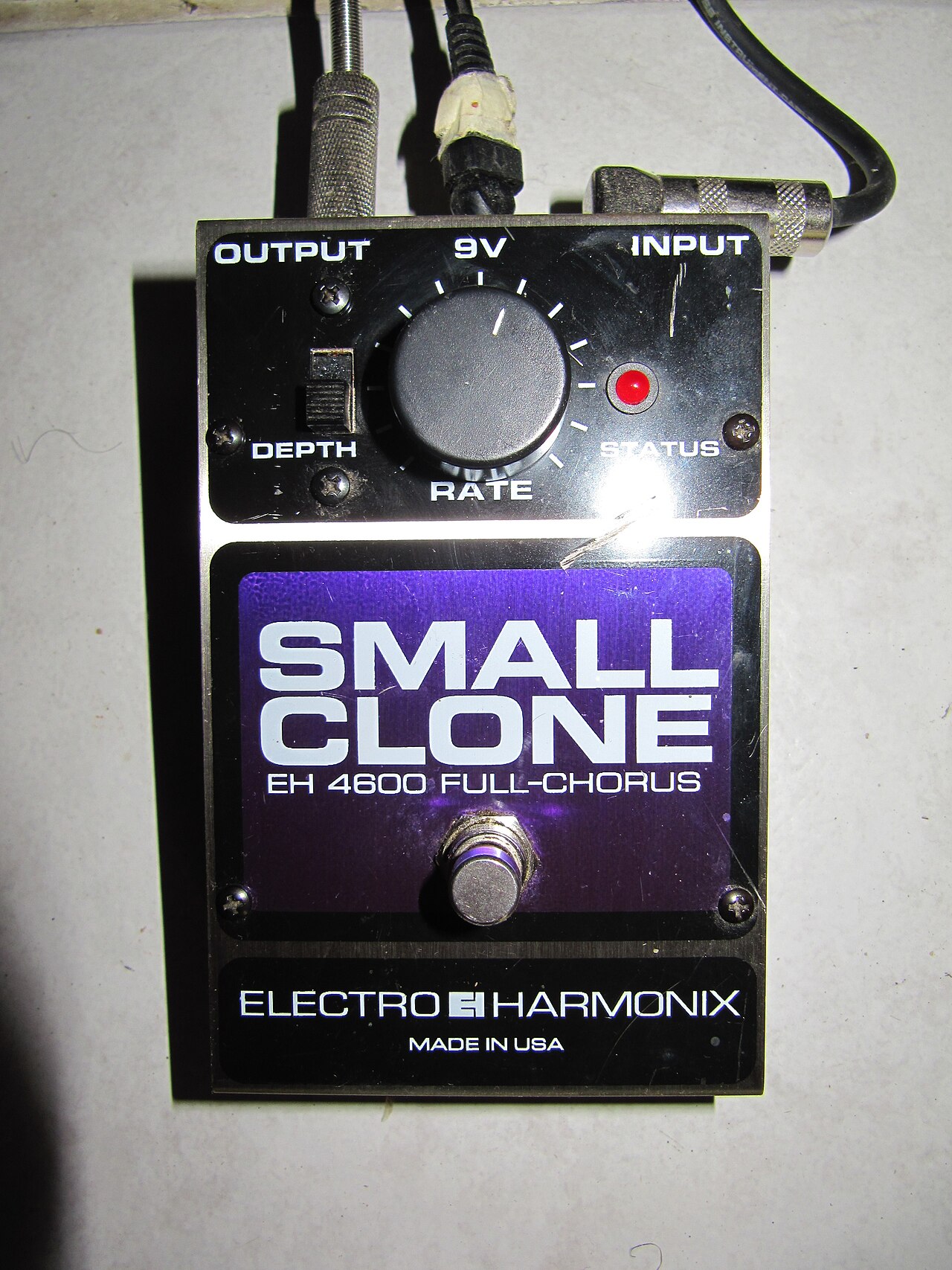
- An Electro-Harmonix Small Clone chorus pedal: Sky99, Wikimedia Commons, CC BY-SA 3.0.
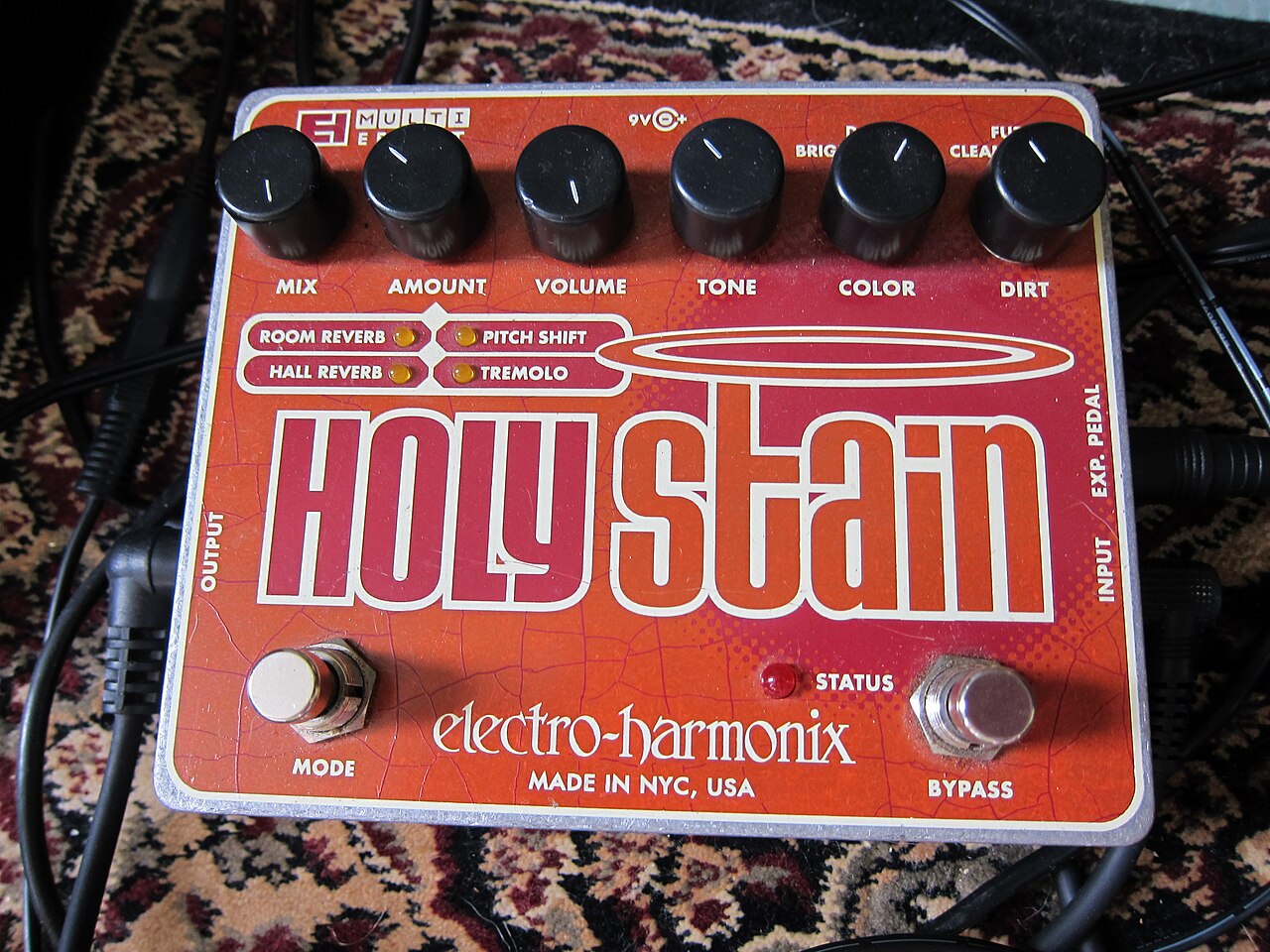
- An Electro-Harmonix Holy Stain pedal: Oldangelmidnight from Northampton, MA, Wikimedia Commons, CC BY-SA 2.0.
- Andy Summers: Drussel1, Wikimedia Commons, CC BY-SA 4.0.
Latest News
Related
On This Day
Tuesday 10 November
From this week: