Old Blood Noise Endeavors Visitor: The Modulation Pedal That Refuses to Stand in Line
Inside the Old Blood Noise Endeavors Visitor parallel multi-modulator: how its two modulations interact, verified players, settings, specs and buying advice.
Almost every multi-effect ever built asks you the same boring question: which one first? Chorus into phaser, or phaser into chorus? Tremolo before the vibrato, or after? Signal chains are queues, and queues are the least interesting thing about electricity.
The Old Blood Noise Endeavors Visitor doesn’t ask. It takes your signal, splits it, sends it down two modulation circuits at the same time, lets those two circuits talk to each other, and hands the result back as a single, slightly unstable thing that has no obvious name. Old Blood calls it a “Parallel Multi-Modulator,” which sounds like marketing until you sit with the pedal for twenty minutes and realise it is simply the most accurate description available.
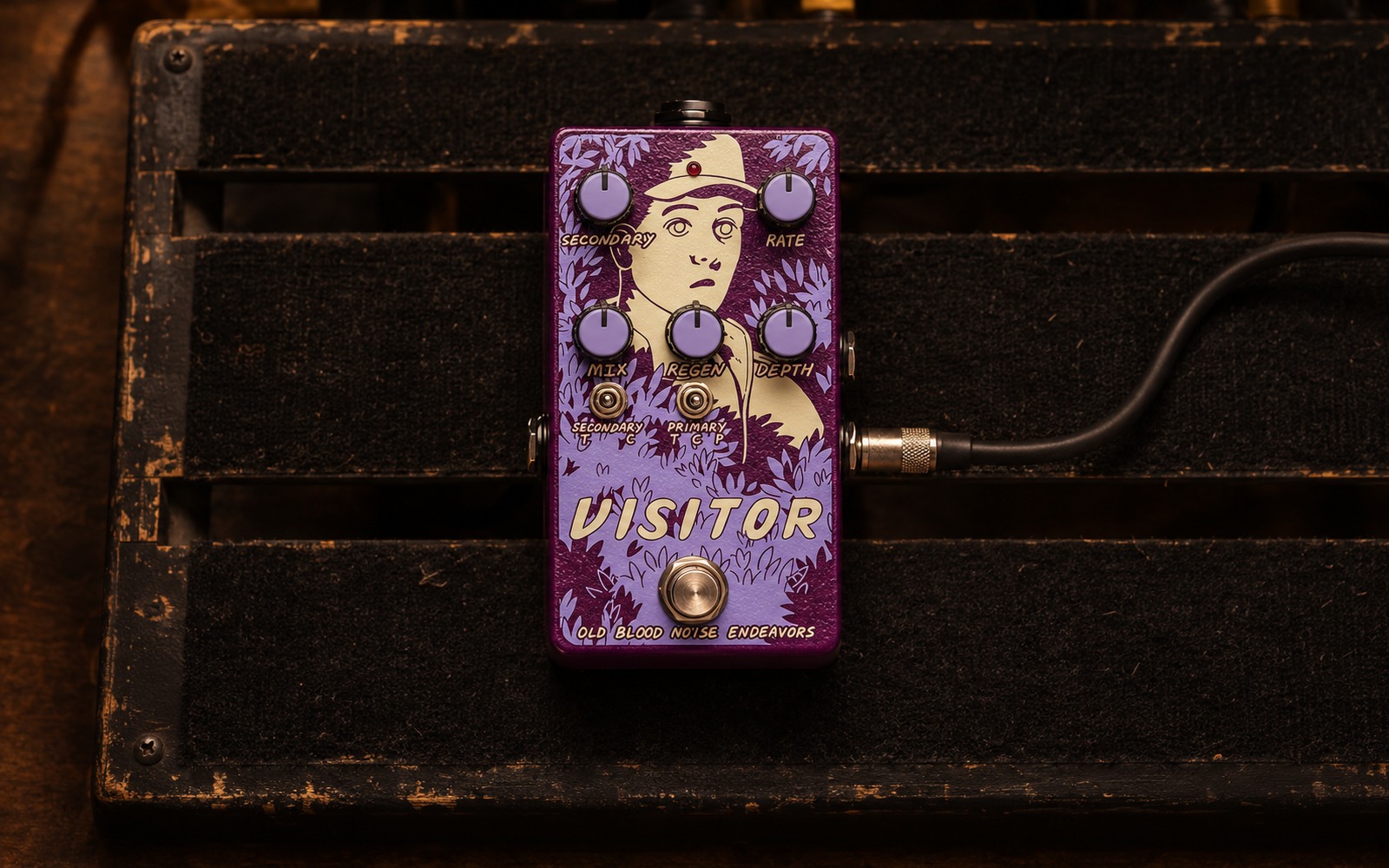
Here is what that actually means in practice. A primary modulation — tremolo, chorus or phaser, chosen with a toggle — runs the way you would expect, with its own Rate and Depth knobs. Alongside it, in parallel rather than in series, a secondary modulation — tremolo or chorus — runs off a single knob that moves four parameters at once. The two are not stacked. They are superimposed. And because the secondary’s rate is influenced by the primary’s LFO, and because both are fed back into both by a Regen control, the pedal never quite settles into a loop you can predict.
It is a $209 box with five knobs, two toggles and one footswitch, and it makes sounds that a $700 stereo modulation workstation with a colour screen cannot make, because the workstation is still, deep down, running effects in order.
Oklahoma City, and a Company That Names Its Artists
Old Blood Noise Endeavors is the work of Brady Smith and Seth McCarroll, who met at the University of Oklahoma. In a Q&A with Chicago Music Exchange, Smith traced the company’s origin to late-night conversations early in 2014 about how the two of them would run a pedal business, and dated its actual existence to August 2014, when they released the Black Fountain delay. Smith’s own route in was through a couple of BYOC build-it-yourself kits, put together specifically to get his soldering good enough to apply for a job at Keeley Electronics.
That origin explains something about how OBNE pedals feel in the hand. They are not vintage-worship devices and they are not attempts to out-spec Strymon. They are pedals built by people who came up through the modern boutique scene rather than the repair bench, and whose instinct is to ask “what if this were wired differently” rather than “how close can we get to a 1976 unit.”
The company also does something almost no other pedal builder bothers with: it credits the illustrator on the product page. The Visitor’s enclosure art — a lurching, tentacled thing that looks like it wandered in from a cheap paperback — is by Garrett Young. It matters more than you would think. The name and the artwork are doing the same job as the circuit: telling you this is not a chorus pedal, it is a chorus pedal with something else living inside it.
NAMM 2020: The Pedal Nobody Asked For
The Visitor was unveiled at NAMM 2020 in Anaheim, in January of that year — Delicious Audio’s coverage image sits in a January 2020 upload folder, which pins the announcement date precisely even where the manufacturer gives no launch statement. Old Blood’s own press copy framed it plainly: “Inspired by the unique complexities of running modulations in parallel.”
The timing is worth pausing on. January 2020 was the last normal NAMM. Within eight weeks the industry the Visitor was launched into had effectively shut down, and the pedal spent its first year of life being sold almost entirely on the strength of demo videos to players stuck at home. That is arguably the ideal audience for it. The Visitor is a pedal you discover by fiddling, not by trying in a shop for four minutes.
Guitar World’s Trevor Curwen reviewed it on 3 December 2020, at a launch price of $199 / £189, and delivered a verdict that has aged well: the pedal has its own unique take on textural modulation, and is aimed at players looking to take their tone off-piste. His only real complaint was the price. Six years on, the pedal is still in Old Blood’s active catalogue at $209 — it has never been retired, never been given a V2, and never been given a stereo sibling.
Specifications
A Note on the Power Spec, Because the Numbers Disagree
This is worth flagging before anything else, because it is the single most common source of confusion with this pedal. Old Blood’s product page states that the Visitor requires a 9V DC centre-negative 2.1 mm supply “capable of 110mA.” Guitar World’s review, working from the review sample and its documentation, lists the current draw as 46 mA. Both figures are first-party or first-party-derived, and they are a factor of 2.4 apart.
They are not actually contradictory once you read them carefully. 46 mA is what the pedal draws. 110 mA is what Old Blood wants your supply to be able to deliver, with headroom, because relay bypass circuits pull a brief inrush at switching and because undersized supplies are the number one cause of “my pedal makes a ticking noise” support emails.
The practical advice is unambiguous: feed it from an isolated output rated at 100 mA or more. Do not daisy-chain it off the tail end of a chain that is already close to its ceiling. And check the connector: 2.1 mm, centre negative. This is the same standard as most of the modern boutique world, but it is emphatically not the same as the centre-positive 5.5/2.5 mm supplies used by the Eventide Factor series, and plugging the wrong thing into the wrong hole is how boutique pedals die.
What Every Knob Actually Does
The Primary toggle: tremolo, chorus, phaser
This is the familiar half of the pedal, and all three are good on their own terms. The tremolo has genuine range, from a gentle amplitude wobble to hard on/off choppiness at the extremes. The chorus shimmers rather than swirls — closer to a Boss CE-2 lineage than to a lush eighties rack chorus — and it goes far deeper than you will ever need. The phaser is the surprise: rich, resonant, and capable of a convincingly metallic flanger sweep once you bring the Regen up.
Rate and Depth
These belong to the primary modulation only. Nothing complicated here — Rate sets speed, Depth sets intensity. The one thing to know is that the primary’s LFO does not stay in its lane. It influences the secondary’s rate too, which is why turning Rate up does not simply speed up one thing; it changes the relationship between two things.
Secondary: the four-parameters-on-one-knob knob
This is the pedal. Everything interesting about the Visitor is downstream of this control, and it is worth understanding exactly what it is doing as you sweep it, because it is not a simple blend.
At minimum, the secondary modulation is silent and you have an ordinary — very good, but ordinary — tremolo, chorus or phaser. As you advance the knob, four things happen at once, and Curwen’s Guitar World review is the clearest published account of them:
- Volume ramps up to unity early in the sweep and then stays there for the rest of the travel, so the secondary does not keep getting louder and swamp the primary.
- Depth increases similarly, and is deliberately curved so it does not run away from you at the top of the sweep.
- Rate increases — but is also influenced by the primary LFO, which is where the “to and fro” quality comes from. The secondary is not running at a fixed speed. It is breathing in time with something else.
- Delay offset increases, pushing the secondary voice progressively later relative to the primary. This is the parameter that turns the far end of the sweep ambient rather than merely fast.
That last one is the hidden feature. At high Secondary settings with two tremolos selected, the offset is long enough to read as a slapback — a rhythmic ghost of your playing arriving behind the beat. It is the closest a modulation pedal gets to being a delay without containing one.
Regen
Master feedback, and unusually, it feeds the sum of both modulations back into both. On the phaser setting it is the fastest route to a flanger — that hard, metallic, jet-sweep resonance. On chorus it thickens into something closer to a resonant filter sweep. Past about three o’clock on any setting it starts to head into territory that is more sound-design than accompaniment, which is either the point or a warning depending on your band.
Mix
Standard wet/dry blend, with one important consequence: set it fully wet on the chorus setting and you have a vibrato. No dry signal means no beating against the unmodulated tone, which means genuine pitch wobble rather than chorus. This is the same trick that turns a Boss CE-2W into something like a VB-2W, and it is free here.
The expression jack
An expression pedal takes over the Secondary knob entirely. Given that the Secondary knob is a four-parameter macro, this means one treadle sweeps you from clean primary modulation to full parallel chaos, with the volume, depth, rate and delay offset all moving together on a curve someone actually designed. It is the single best argument for buying an expression pedal you were not planning to buy — Old Blood’s own Dark Star owners will recognise the house habit of putting the most interesting parameter behind an external jack.
The internal trimmer
There is an output trim pot inside the enclosure. It is there because the modulation circuits can be pushed into a mild drive, and because unity gain means different things on a Jazzmaster and an active bass. Most owners never touch it. The ones who do are usually chasing either a cleaner blend at high Regen or a deliberately hotter, flanger-ish grind. Consult the manual before you go in there.
The Six Combinations, and What Each One Is Actually For
Three primaries times two secondaries gives six pairings. It is a small enough number to work through methodically, and unusually for a multi-mode pedal, all six are genuinely usable rather than three good ones and three novelties.
- Chorus + chorus — the swimmiest setting on the pedal. Two chorus voices at different rates and offsets stop sounding like chorus and start sounding like a detuned twelve-string played underwater. This is the shoegaze setting.
- Phaser + chorus — the other great “swimmy” pairing, and the more musical of the two because the phaser’s notches move against the chorus’s pitch drift rather than with it. Excellent under arpeggios.
- Tremolo + tremolo — rhythmic complexity rather than texture. Two amplitude modulations at related-but-not-locked rates create genuine polyrhythm, and at the top of the Secondary sweep the delay offset gives you that slapback ghost.
- Tremolo + chorus — a chopped signal with a pitch-drifting shadow behind it. Sounds like a broken Leslie in the best possible way.
- Chorus + tremolo — the inverse, and the subtler of the two. The tremolo acts as a textural overlay on the chorus rather than a rhythmic event, adding a flutter that reads as tape wobble.
- Phaser + tremolo — the most aggressive pairing. With Regen up, this is where the Visitor stops being a modulation pedal and becomes something closer to a filter effect.
One structural limitation, and it is worth being straight about it: the phaser is only available as a primary. You cannot run two phasers, and you cannot put a phaser in the secondary slot. Owners on the guitar-pedal forums have noted this as the one place the pedal’s flexibility stops short. Whether it bothers you depends entirely on whether you wanted a dual phaser, which, in fairness, most people did not.
Famous Players: A Short and Honest Section
This is where an article about a 2020 boutique modulation pedal has to be careful, and where a lot of gear writing quietly cheats. So here is the situation as it actually stands.
Taylor York (Paramore) is the one artist with documented Visitor usage. The evidence is an Instagram photograph of his recording pedalboard with a Visitor on it, catalogued on Equipboard. That is photograph-grade evidence, not an interview and not a filmed rundown — it establishes that the pedal was on a working board, not what he tracked with it or which record it is on. We are not going to claim more than that.
What makes it a credible rather than incidental data point is York’s documented history. In EarthQuaker Devices’ Board to Death episode published 3 January 2018, during the After Laughter cycle, his modulation section alone contained two Boss DC-2s, a Boss CE-2W, an EarthQuaker Rainbow Machine and an EarthQuaker Grand Orbiter, all triggered from an RJM Mastermind switcher inside a rack, feeding a pair of Supro Statesman heads and a Top Hat Emplexador through three Supro cabinets. He described the Rainbow Machine as a pedal he bought for the weirdness and kept for a modulated slapback he now uses “all over the place,” and he was candid about phasers being “really tricky” to get past a front-of-house engineer.
That is a player whose entire relationship with the guitar runs through modulation, who owns duplicate Dimension C units — the circuit reissued as the Boss DC-2W — because one was not enough, and who buys pedals for the strange settings and then finds the useful ones. A parallel multi-modulator turning up on his studio board two years later is exactly what you would predict. His own summary of why, from the same piece: pedals “inspire me to do things differently. It’s such a big part of what I do and how I create.”
Beyond York, there is nothing that clears the bar. Equipboard lists exactly one artist. Premier Guitar’s Rig Rundown archive has plenty of Old Blood Noise sightings — a Black Fountain on Jesse Lacey’s board with Brand New, a Minim with Idles’ Mark Bowen, a Beam Splitter in Rhett Shull’s rig — but no Visitor. There are social-media board photographs circulating, as there always are, and we are not counting them, because a photograph on an aggregator with no date, no venue and no account of use proves nothing except that a pedal and a person were once in the same room.
The honest framing is this: the Visitor is a studio pedal that has not yet accumulated a live-rig paper trail. That is not a criticism of the pedal. It is a consequence of launching a mono, preset-less, one-footswitch modulation box in January 2020 into an industry that promptly stopped touring for two years. Equipboard’s genre distribution for it — Rock 20, Alternative Rock 10, Indie Rock 10, Pop 8, Punk 4 — tells you where it has landed rather than who is carrying it.
For the lineage rather than the ownership: the sound the Visitor is chasing has ancestors, and none of them owns one. The interlocking, non-repeating modulation textures on Kevin Shields‘ records, the chorus-as-architecture approach of Robert Smith and Johnny Marr, the treated-guitar-as-synthesizer instinct of Jonny Greenwood and The Edge, and the smeared, un-pinnable modulation of Neil Halstead’s Slowdive work are all doing, with multiple pedals and a great deal of patience, what this one box does in a single sweep of a knob.
Nine Settings Worth Stealing
All positions given clock-face. Start with everything at noon and the Secondary knob at zero, get the primary sounding right on its own, and only then bring the Secondary in.
1. Underwater Cathedral (chorus + chorus)
Primary: chorus. Secondary: chorus. Rate 10 o’clock, Depth 2 o’clock, Secondary 1 o’clock, Regen 11 o’clock, Mix 1 o’clock. The signature Visitor sound. Big chords bloom and drift apart. Play it slow.
2. True Vibrato (chorus, full wet)
Primary: chorus. Secondary at zero. Rate 1 o’clock, Depth 2 o’clock, Regen off, Mix fully clockwise. No dry signal, so no chorus beating — just pitch. Add Secondary to about 9 o’clock for a slight seasick quality.
3. Broken Leslie (tremolo + chorus)
Primary: tremolo. Secondary: chorus. Rate 2 o’clock, Depth 3 o’clock, Secondary noon, Regen 10 o’clock, Mix noon. Chopped and pitch-drifting at once. Works startlingly well on a clean semi-hollow.
4. Polyrhythm Machine (tremolo + tremolo)
Primary: tremolo. Secondary: tremolo. Rate 3 o’clock, Depth maximum, Secondary 11 o’clock, Regen off, Mix 1 o’clock. Two choppers at unrelated speeds. Hold one chord and let the pedal write the part.
5. Ghost Slapback (tremolo + tremolo, extreme)
Same as above but push Secondary to maximum. The delay offset stretches far enough to read as a short slapback echo behind the chop. The single most surprising sound in the box, and the one nobody expects from a modulation pedal.
6. Metallic Flanger (phaser, high Regen)
Primary: phaser. Secondary at zero. Rate 9 o’clock, Depth 3 o’clock, Regen 3 o’clock, Mix 1 o’clock. Hard, resonant, jet-sweep territory that competes directly with an Electric Mistress — from a pedal that does not contain a flanger.
7. Ambient Bed (phaser + chorus)
Primary: phaser. Secondary: chorus. Rate 8 o’clock, Depth 1 o’clock, Secondary 3 o’clock, Regen noon, Mix 2 o’clock. Slow, wide and deeply unstable. Put a reverb after it and stop playing for a while.
8. Expression Sweep (any pairing)
Set your favourite primary. Plug an expression pedal into the Secondary jack. Heel down is a clean, gigging modulation; toe down is full parallel weirdness with maximum offset. One song, one treadle, two entirely different guitar sounds. This is the setting that justifies the pedal live.
9. Bass Wobble (chorus + tremolo, low Mix)
Primary: chorus. Secondary: tremolo. Rate 10 o’clock, Depth noon, Secondary 10 o’clock, Regen off, Mix 10 o’clock. Keep the dry signal dominant so the fundamental survives, and let the wet path add flutter above it. Same principle that makes Old Blood’s other parallel-wet designs work on bass.
How It Compares
Versus a great single-effect pedal. If what you want is the chorus or the phaser, buy the specialist. A CE-2W, an MXR Phase 90 or a Small Clone will do its one job with more authority and less thinking. The Visitor’s three primaries are good; they are not category-defining. What is category-defining is what happens when you turn the fourth knob.
Versus a Strymon Mobius. The Mobius has a dozen modulation machines, presets, MIDI, stereo and a screen — and it runs one at a time. It is a modulation library. The Visitor is a modulation interaction. Different products entirely, and a working board could reasonably hold both.
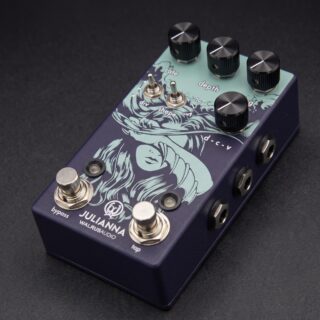
Versus a Walrus Julianna or Julia V2. The Julia line offers a beautifully engineered lag-and-blend chorus/vibrato with a genuinely useful LFO shape control. It is the better pedal if you want a chorus that goes deep. The Visitor is the better pedal if you want two modulations arguing.
Versus a Chase Bliss Warped Vinyl HiFi. Both are modulation pedals that reward obsessives. The Warped Vinyl is a bucket-brigade vibrato with waveform-splitting and dip-switch depth that is essentially bottomless; the Visitor is simpler to operate and stranger in result. The Chase Bliss is the connoisseur’s single modulation. The Visitor is the one that surprises you. The Visitor also has the significant practical advantage of still being manufactured.
Versus a Strymon Flint. The Flint is two effects in one box in series, done impeccably, aimed squarely at people who want a great tremolo and a great reverb without thinking about it. It is the opposite design philosophy: refinement in series versus instability in parallel.
Versus a Walrus Monument V2. The Monument is the better tremolo, full stop — harmonic mode, tap tempo, subdivisions, proper live control. The Visitor’s tremolo is good but has no tap. If tremolo is your primary effect and you play to a click, this comparison ends quickly.
Versus its own stablemates. Old Blood’s modulation catalogue includes the Flat Light flange shifter and the Reflector chorus, both of which are more conventional in shape. The Visitor is the outlier in the range: the one that is more interested in a routing idea than in an effect type. If you already own an OBNE Dark Star and liked the way its wet path behaves as a parallel voice rather than a room, the Visitor is the same philosophy applied to modulation.
Buying Guide
It is still made. Unlike most of the pedals in this price bracket that get written about six years after launch, the Visitor has not been discontinued, superseded or given a V2. Old Blood lists it new at $209. That means you are not paying a scarcity tax and you are not hunting a used market — a genuine advantage over, say, the Chase Bliss pedals killed by the cadmium-sulphide RoHS deadline in August 2024.
Used prices are soft. Aggregated listings have shown units from around $178. For a hand-built American pedal that has never had a price rise beyond ten dollars, that is a reasonable entry point. There is no version confusion to navigate.
One cosmetic caveat. Owners have noted that the knobs changed at some point during the production run for supply-chain reasons. This is cosmetic only, affects nothing electrically, and is worth knowing solely so you do not assume a listing is a fake because the knobs look different from the press photos.
Buy it if: you want modulation that does something you have not heard before; you already own a good chorus and a good phaser and are bored of both; you play ambient, shoegaze, indie or anything where the guitar is allowed to be a texture; you own or will buy an expression pedal; you record more than you tour.
Don’t buy it if: you need stereo; you need presets or MIDI; you need tap tempo; you need one perfect chorus for a covers set; you want a pedal you can set and forget. The Visitor is not a set-and-forget pedal. It is barely a set-and-remember pedal.
Living With One
Placement. Standard modulation position — after dirt, before delay and reverb — works and is where most owners land. But the Visitor rewards experiment more than most: in front of a dirt pedal, the tremolo-plus-tremolo setting produces amplitude variation that the drive then compresses into something rhythmic and strange, and the phaser-plus-Regen setting pushed into overdrive gets genuinely filthy.
The mono question. This is the pedal’s real limitation in 2026. A parallel modulator is exactly the kind of circuit that would benefit enormously from splitting its two voices left and right, and the Visitor does not. Everything sums to one output. It remains the most common owner complaint, and it is a fair one.
Relay bypass housekeeping. Soft-touch relay switching means the footswitch is a quiet momentary button rather than a clunky mechanical stomp, which is lovely, and it also means the pedal needs power to bypass properly. Kill the power mid-set and you lose signal, not just effect. Plan your supply accordingly.
Noise floor. With Regen high and the internal trimmer untouched, the Visitor is a reasonably quiet pedal by boutique standards, but stacking it after high-gain drive into a bright amp will show up hiss like any modulation circuit with feedback. The fix is the usual one — put it in a loop, or pull Regen back to eleven o’clock and let the Secondary knob do the work instead.
Bass and synth. There is no manufacturer claim here, so treat this as a technique note rather than a spec: because Mix is a genuine parallel blend, keeping it below noon preserves the dry fundamental completely while the wet path does whatever it likes. That is the same structural reason Old Blood’s other parallel designs translate to bass, and it is the setting to start from.
Frequently Asked Questions
What does “parallel multi-modulator” actually mean?
It means the two modulation circuits run side by side on split copies of your signal rather than one feeding into the other. In a series pedal, the second effect processes the output of the first. In the Visitor, both process the original signal and are then summed, which is why they interact rather than compound — and why the result does not sound like a chorus into a tremolo.
Can I run two phasers, or a phaser as the secondary?
No. The phaser exists only in the primary slot. Secondary is limited to tremolo or chorus. This is a hard limitation of the design and the most frequently raised owner complaint after the lack of stereo.
Is the Visitor stereo?
No. One mono input, one mono output, one expression input. Given that the pedal is built around two parallel voices, a stereo version is the most obvious thing Old Blood could build next, and as of 2026 they have not.
How much current does it draw, and why do I see two different numbers?
Roughly 46 mA in normal operation, but Old Blood specifies a supply “capable of 110mA.” The first number is consumption, the second is the recommended supply rating with headroom for the relay bypass. Use an isolated 9V DC output rated at 100 mA or more, centre negative, 2.1 mm. There is no battery compartment.
Can I get a true vibrato out of it?
Yes. Select chorus as the primary and turn Mix fully clockwise so there is no dry signal left. With no unmodulated tone to beat against, the chorus circuit’s pitch modulation is exposed on its own, which is the definition of vibrato. Adding a little Secondary makes it wobblier and less regular.
What is the internal trim pot for?
Output level. It lets you adjust the pedal’s gain to suit your instrument and the rest of your chain — useful if you run active pickups, or if you want a slightly hotter, drivier character at high Regen settings. Read the manual before adjusting it; it is not a tone control.
Does an expression pedal do anything worthwhile?
More than on most pedals. The expression jack takes over the Secondary knob, which is a macro controlling four parameters simultaneously — depth, rate, delay offset and level of the secondary modulation. One treadle sweep therefore moves you continuously from a conventional modulation sound to a full parallel texture. If you play live and buy only one accessory for this pedal, buy that.
Who actually uses one?
Documented: Taylor York of Paramore, on the strength of a photograph of his recording pedalboard. That is the honest answer. The Visitor launched at NAMM in January 2020 and spent its formative years in a period when almost nobody was touring or filming rig rundowns, so its paper trail is thin in a way that reflects its timing rather than its quality.
Is it worth $209 in 2026?
If you are buying a modulation effect, no — there are cheaper and better single-purpose pedals. If you are buying a sound you cannot get any other way, yes. The Visitor’s value is entirely in the interaction between its two voices, and nothing else at this price does it. Guitar World’s only real criticism at launch was the price, and that was six years and one round of global inflation ago; at $209 today it is arguably better value than it was at $199 then.
Image credits
- Top image: GuitarGangsters AI-generated reference illustration, not a photograph.
Latest News
Related
On This Day
Monday 9 November
From this week: