Two Knobs, One Chip, a Decade of Chorused Greatness: The Boss CE-2 Chorus
From Gilmour to Johnny Marr, the Boss CE-2 Chorus defined the '80s guitar sound with two knobs and one MN3007 BBD chip. History, specs and famous players.
In October 1979, Boss shipped a small blue pedal with exactly two knobs — Rate and Depth — and an analog BBD circuit that cost less than most guitar straps. Within two years it was on David Gilmour’s stereo pedalboard. Within five it was on Johnny Marr’s BCB-6 pedalboard case at every Smiths gig. Within ten it had become the default setting for chorus guitar sound across new wave, post-punk, classic rock, funk, and country. The Boss CE-2 Chorus didn’t merely participate in the guitar sound of the 1980s. It largely created it.
As Guitar World’s Chris Gill wrote in August 2025: “Pretty much everyone who used chorus during the ’80s had a Boss CE-2 at some point or another.” That isn’t hyperbole. It’s a documented historical fact. And the reason it happened has everything to do with the intersection of timing, simplicity, engineering, and a Matsushita BBD chip called the MN3007.
From Ensemble to Compact: The CE-2’s Origin Story
The story of the CE-2 begins three years earlier with a different Boss pedal — the CE-1 Chorus Ensemble, released in 1976. The CE-1 was large, heavy, and expensive, more like a floor-mounted effects unit than a compact stompbox. It ran on AC power, not battery, and featured the internal chorus and vibrato circuit from Roland’s legendary Jazz Chorus JC-120 amplifier. That circuit — BBD-based analog modulation of a delayed signal mixed with the dry signal — was genuinely new-sounding and immediately attractive to guitarists who wanted the lush shimmer of a Roland JC-120 without committing to that specific amplifier.
The CE-1’s sound was undeniably excellent. Andy Summers of The Police had one on his Pete Cornish pedalboard during the band’s early years, and it contributed substantially to the airy, chromatic quality of his playing on tracks like “Message in a Bottle” and “Walking on the Moon.” But the CE-1 was unwieldy on a compact pedalboard, expensive, and required an AC outlet — real limitations for gigging musicians. Boss had already revolutionized the compact pedal market with the 1977 OD-1/PH-1/SP-1 trio, and the logical next step was packaging the CE-1’s essential character into a single compact stompbox.
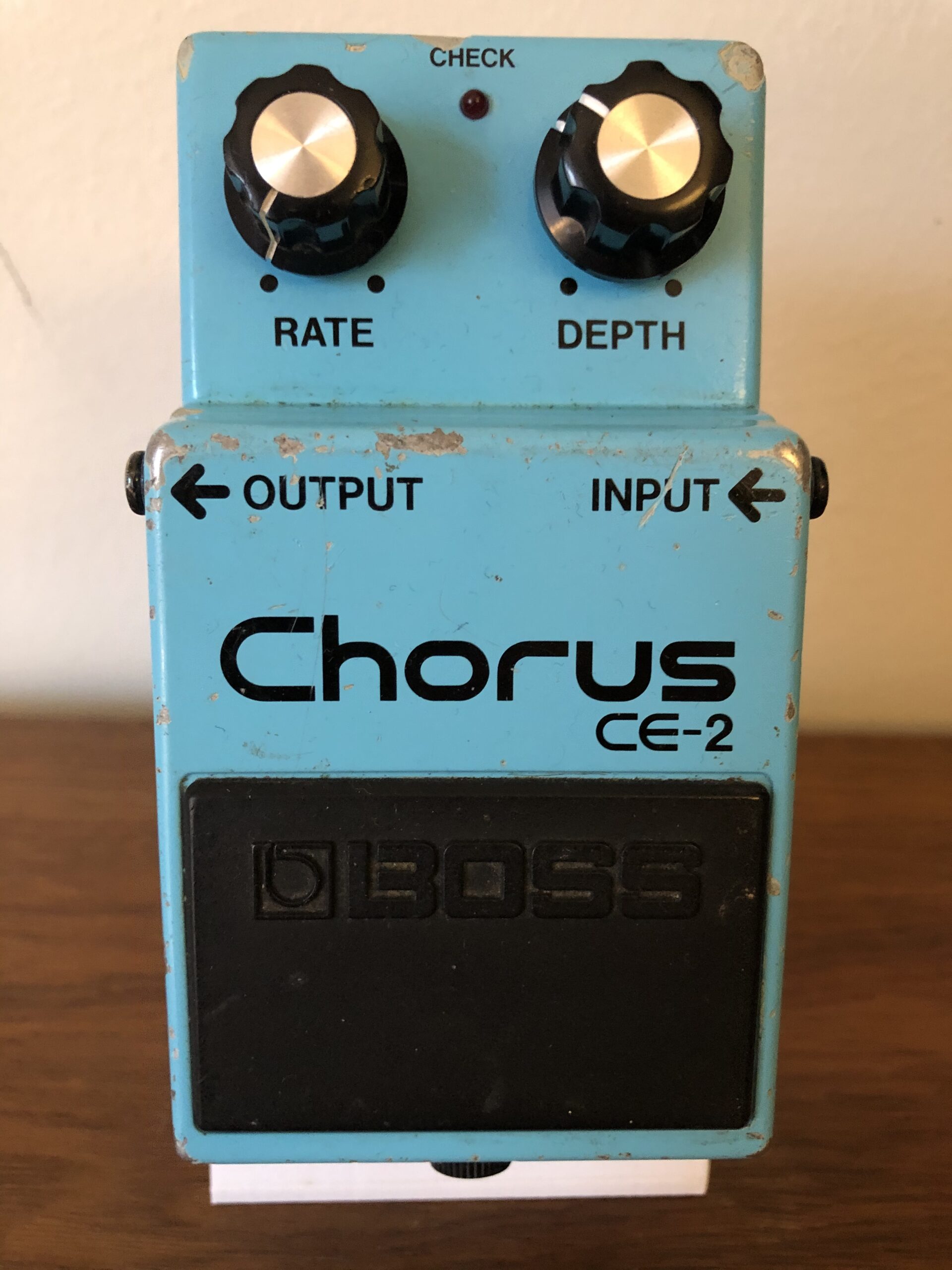
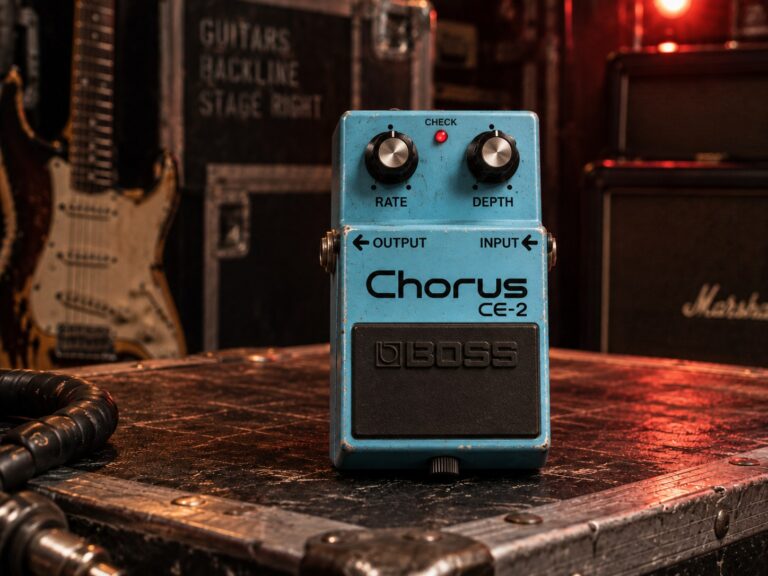
That became the CE-2, released October 1979. Where the CE-1 had multiple modes, individual level controls, and a bulky chassis, the CE-2 stripped the concept down to its essentials: Rate controls the LFO speed, Depth controls how much modulation is applied to the delayed signal. Two knobs. That’s it. The engineering team at Boss made the brave — and correct — decision not to add any more controls. The result was a pedal so intuitive it’s effectively impossible to dial in a bad sound. Even with Rate and Depth both maxed, the CE-2 produces a gently warbling vibrato effect that’s warm and musical rather than seasick and weird.
Critically, the CE-2’s sound wasn’t a pale imitation of the CE-1. The MN3007 BBD chip at the heart of the circuit — a 1024-stage bucket brigade device manufactured by Matsushita — delivered exceptionally low noise and clean headroom by the standards of 1979. The clock driver (MN3101), paired with a uPC4558C op-amp for the input and output stages and a TL022LP for the LFO, created a modulation circuit with a distinctive warmth and midrange presence that became the pedal’s sonic signature.
That midrange quality is worth emphasizing. Most chorus effects of the era tended to scoop the midrange, producing a brilliant shimmering effect that could get lost in denser mixes. The CE-2, by contrast, maintained a slight level boost and a distinctive midrange character that helped chorused tones push to the front of a mix rather than disappearing into the high-frequency wash. It sounded equally effective with both clean and overdriven tones — something competitors couldn’t always claim.
Production History: Japan, Taiwan, and the MN3007 Question
Boss manufactured the CE-2 in Japan from its 1979 introduction through 1988. In 1988 production shifted to Taiwan, and the pedal continued in production in that configuration until it was eventually discontinued — estimates vary, but roughly around 2001 to 2003.
For used buyers, the Japan vs. Taiwan distinction matters, but the chip question matters more. The MN3007 BBD chip is what defines the CE-2 sound — it offers lower noise and improved clean headroom compared to substitute chips used in some later production runs. A CE-2 with an MN3007 is the version most collectors and tone-chasers seek. Early Made-in-Japan units are most likely to have it, but the MN3007 was also used in some Taiwanese units. The practical advice: if buying vintage, verify the chip rather than just relying on the country of manufacture marking. Open the back panel and look — MN3007 stamped on the BBD chip is the confirmation you’re after.
Vintage CE-2 prices on the used market reflect the pedal’s reputation. Made-in-Japan examples in good condition typically fetch $150–$350 depending on condition and whether original packaging is present. Taiwanese examples are generally $80–$150. Given the CE-2W Waza Craft reissue’s current street price of approximately $200–$220, the vintage premium for MIJ examples is real but modest — most players interested in the authentic circuit are better served by the CE-2W, which replicates the original circuit faithfully while adding a bonus CE-1 mode.
Specifications
Famous Players: The CE-2’s Verified Six-String Hall of Fame
The CE-2’s famous-player list is genuine and well-documented — which makes it all the more important to draw a precise line between players of the original CE-2 and players primarily associated with its predecessor, the CE-1. The distinction matters both historically and practically. The CE-1 and CE-2 share DNA but have different characters; a CE-1’s vibrato mode and stereo CE-1 chorus sound differ meaningfully from the CE-2’s compact circuit. Where the record is clear, this article states it clearly.
David Gilmour — Two CE-2s in Stereo on the Wall Pedalboard
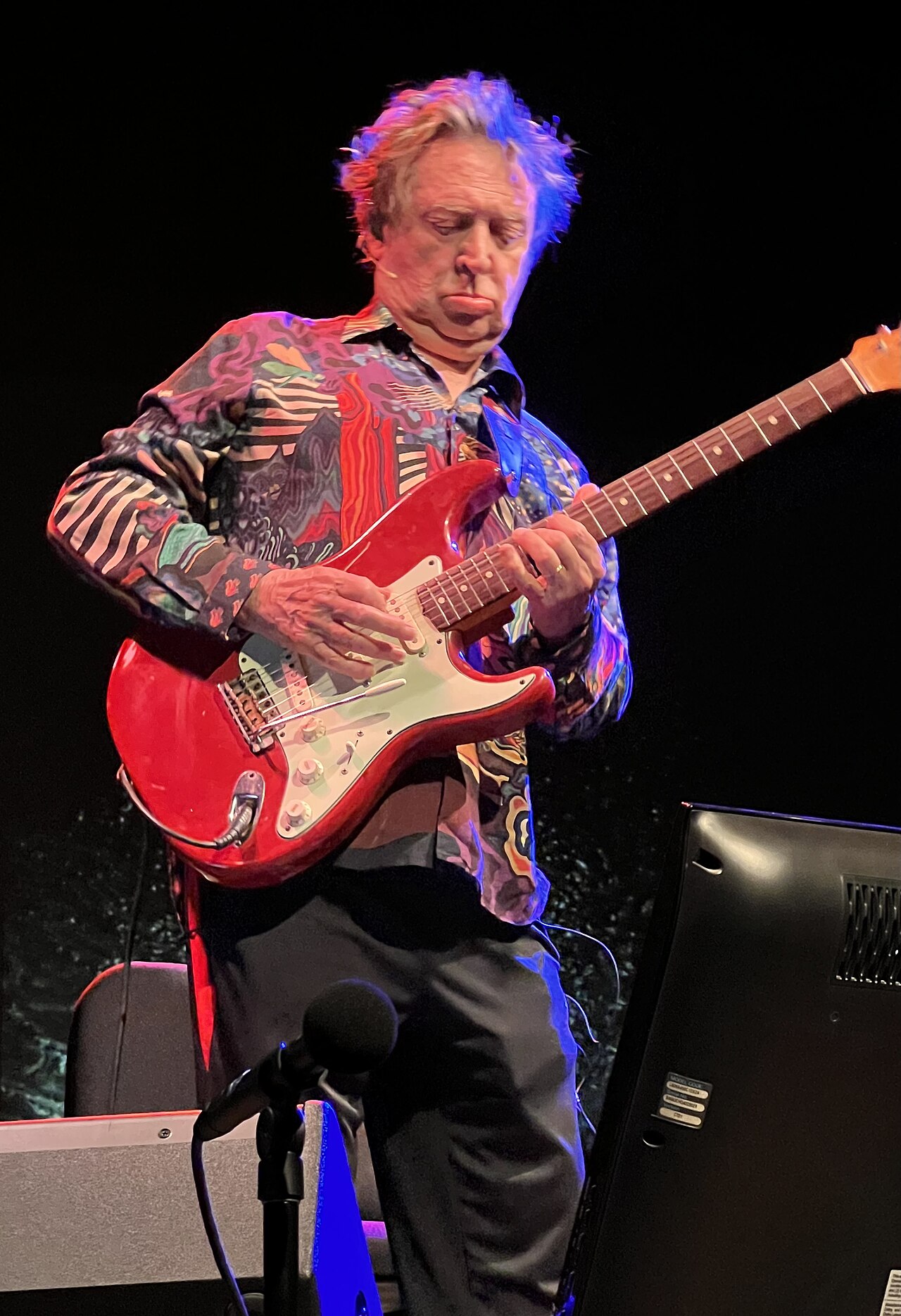
David Gilmour had relied on Uni-Vibes and phase shifters for modulation during Pink Floyd’s early years. By the time the Animals sessions and subsequent tour came around in 1976–1977, he’d shifted his modulation approach toward chorus, using the CE-1 Ensemble. By The Wall (1979–1980), his enormous live tone relied on splitting his pedalboard signal and feeding each output through a separate Boss CE-2 chorus pedal, creating a true stereo chorused signal that became one of the most distinctive guitar sounds in rock history. The gilmourish.com archive — the most authoritative Gilmour gear research resource online — documents his Wall-era board’s two CE-2 units explicitly as part of the signal chain’s stereo split configuration.
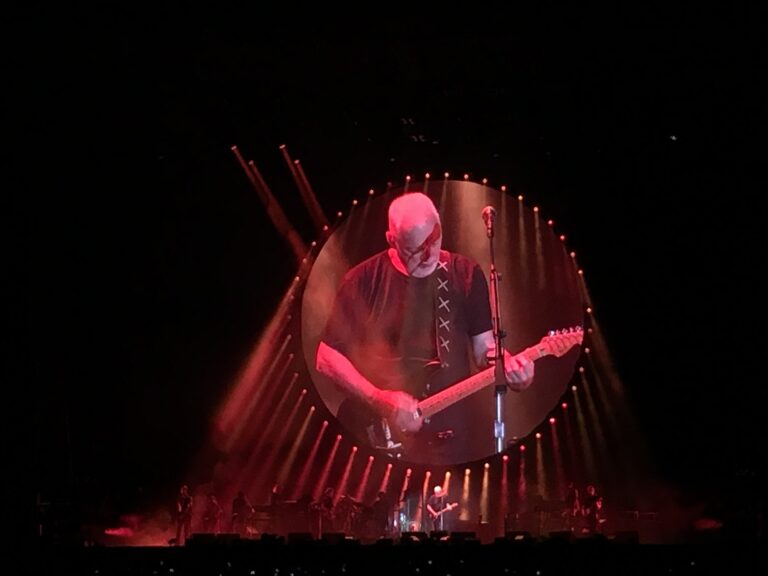
Gilmour’s CE-2 approach was less about obvious warble and more about stereo width — using two pedals with slightly different Rate settings to create a natural, breathing dimension to his leads. This is the CE-2 at its most sophisticated: Rate set conservatively, Depth moderate, the effect providing width and warmth rather than announcing itself as a chorus pedal.
Johnny Marr — “I Had the CE-2 Chorus Pedal”
If Gilmour’s CE-2 use was refined and background, Johnny Marr‘s was central to his entire guitar identity. The CE-2 was a feature of The Smiths’ live rig throughout the band’s existence. A documented photograph of Marr’s Boss BCB-6 pedalboard case from the 1986 Nottingham gig shows the chain: PSM-5 power supply, GE-6 graphic EQ, OD-2 Overdrive, TW-1 Touch Wah, HM-2 Heavy Metal, and the CE-2 at the end of the chain. In his own words from a Guitar World interview, Marr enumerated his Boss pedal chain explicitly: “I had the yellow OS-2 overdrive/distortion pedal, the OD-2 Overdrive pedal… I had the CE-2 chorus pedal, the white GE-6 EQ, the BF-2 purple Flanger and when the very first grey reverb pedal came out, the RV-2, I got that.”
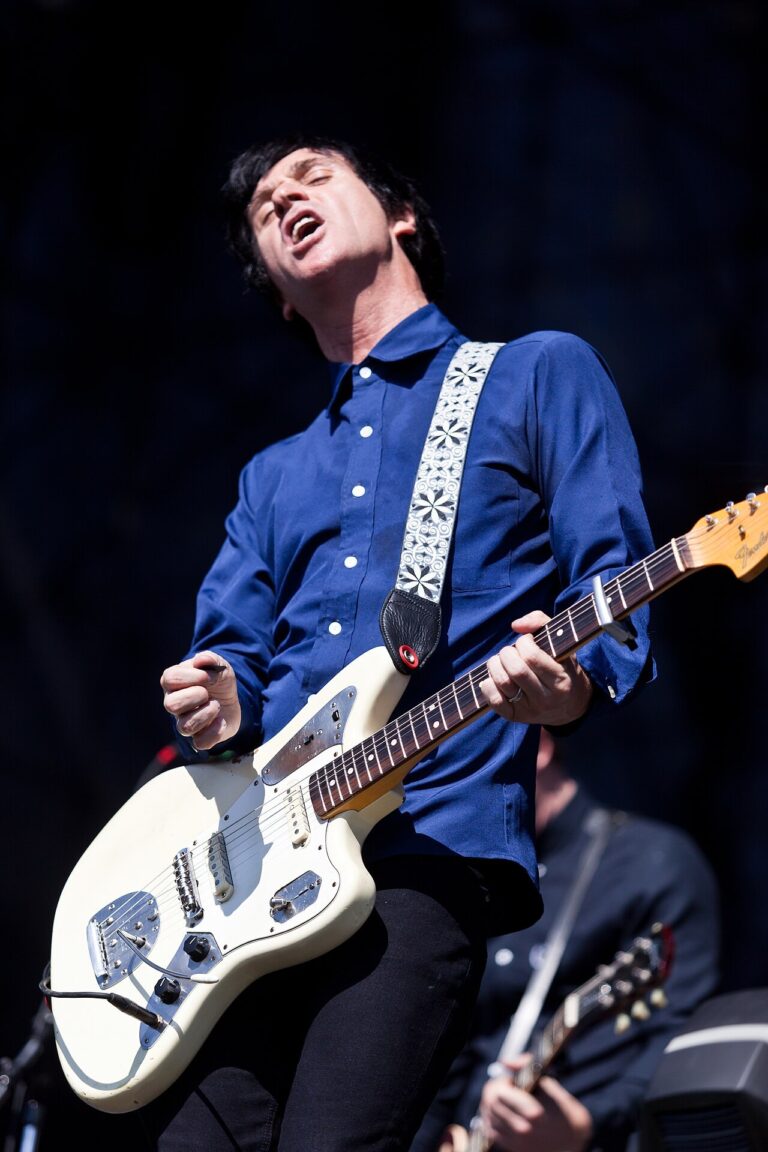
Marr’s CE-2 use was typically at moderate Depth with varied Rate — his chorus is rich but never garish, part of the reason The Smiths’ guitar textures sound distinctly of their era without feeling dated. On tracks like “This Charming Man,” “There Is a Light That Never Goes Out,” and “The Boy with the Thorn in His Side,” that CE-2 shimmer is baked into the record. It’s not an effect; it’s a component of the guitar’s fundamental tone.
Prince — CE-2 in the Early 1980s Funkadelic Signal Chain
Prince used the Boss CE-2 during the early 1980s, a period when his guitar work was becoming increasingly central to his recordings. The Guitarcloud Prince Equipment Archive — the primary documentation resource for Prince’s gear, drawing on verified instrument and equipment records — confirms the CE-2 in his signal chain. For a player whose guitar tone ranged from single-note staccato funk to soaring stadium leads, the CE-2’s ability to add dimension and movement without overwhelming the dry signal made it a natural fit. Prince’s playing rarely called for obvious chorus wash; the CE-2 at subtle Depth settings gave his guitar the slight three-dimensional quality audible throughout this period without sounding like he was playing through a flanger at full tilt.
James Honeyman-Scott — From Clone Theory to CE-2
James Honeyman-Scott of The Pretenders had used an Electro-Harmonix Clone Theory for the band’s debut album — one of the CE-2’s main competitors in the late ’70s compact chorus market. By the time The Pretenders moved into live touring mode, he had swapped to a CE-2 for his live rig, a switch documented in Guitar World’s August 2025 CE-2 history by Chris Gill. Honeyman-Scott’s rhythm guitar work with The Pretenders — lush, mid-forward, with that particular ’80s shimmer — is one of the clearest illustrations of what the CE-2 sounds like through a Vox AC30 at moderate gain. His tragic death in 1982 cut short a career, but his CE-2 association remains one of the most documented of any player from that first wave of compact chorus adopters.
Billy Duffy — CE-2 and the Cult’s Cathedral of Guitar
Billy Duffy of The Cult built guitar sounds in the mid-1980s that were cathedral-large — long reverbs, dramatic chorusing, gated reverb drums, the whole High Gothic production aesthetic of that period. The CE-2 was part of that toolkit. Guitar World’s Chris Gill names Duffy explicitly as a notable ’80s CE-2 aficionado, and the sonic evidence is in The Cult’s records: “She Sells Sanctuary,” “Rain,” “Love Removal Machine” all feature the kind of dense, shimmering guitar that only an analog BBD chorus handles with that particular warmth. Duffy’s use was heavier on the Depth than Gilmour’s — more presence, more movement, the effect pulling the guitar texture toward something almost atmospheric.
Robert Fripp — CE-2 and the Art Guitar Experiments
Robert Fripp is an unlikely member of any “famous players of the Boss CE-2” list, but his inclusion in Guitar World’s 2025 Chris Gill article is accurate. Fripp’s 1980s solo and collaborative work — including his Guitar Craft workshops and the Frippertronics loop experiments — drew on a range of effects that included the CE-2. For a player whose approach to the electric guitar was already highly unconventional, the CE-2’s character as a purely analog, non-oscillating modulator with no additional processing noise made it compatible with the kind of sustained, loop-based playing Fripp developed during this period. He is, as always with Fripp, a special case — his CE-2 application was nothing like any other player’s, which is what makes noting his use interesting rather than redundant.
Rory Gallagher — The Blues Master’s Analog Shimmer
Rory Gallagher used the CE-2 during the later portion of his career — the early-to-mid 1980s period when his recording and live approach incorporated effects more consciously than his stripped-down early ’70s style. Guitar World’s 2025 CE-2 history includes him among the notable ’80s users. For a player as rooted in authentic blues and Celtic rock as Gallagher, the CE-2’s warm, mid-rich character was a better fit than the brighter, more hi-fi chorus effects of the era. His CE-2 use added movement and texture to his tone without fighting the natural character of his battered Stratocaster.
The CE-1 Players: Andy Summers and John Frusciante — Honest Notes
Two guitarists appear frequently in CE-2 discussions who deserve an honest clarification: Andy Summers and John Frusciante.
Summers’ chorus sound is inseparable from The Police’s identity, and his association with Boss chorus is real and documented. His primary instrument, however, was the CE-1 Chorus Ensemble — the CE-2’s larger predecessor. Boss interviews confirm he used the “big box version for a long time” before eventually incorporating compact Boss pedals into his rig. Whether he specifically used a CE-2 alongside or after the CE-1 in his live signal chain is less clearly documented than his CE-1 connection. If you’re chasing Andy Summers’ tone, the CE-1 mode on the Boss CE-2W Waza Craft is your primary reference, not the CE-2 mode — though the difference is subtle enough that the CE-2 setting gets you into the same sonic neighborhood.
Frusciante’s relationship with Boss chorus is similarly often framed around the CE-2 but is in practice centered on the CE-1. Documentations of his Californication-era pedalboard show two Boss CE-1 Chorus Ensemble units in series — a full-dual-CE-1 chorus rig. The CE-1 mode on the CE-2W is the most direct path to Frusciante’s chorus sound. This isn’t a pedantic distinction: the CE-1’s internal preamp and separate vibrato mode contribute meaningfully to its character. The CE-2 shares the essential BBD modulation approach but has a somewhat brighter, more direct quality than the CE-1’s warmer, fuller sound.
Kurt Cobain is sometimes listed as a CE-2 user. He was not. Cobain’s chorus pedal on Nevermind — specifically on “Come As You Are,” the track most directly associated with his chorus use — was an Electro-Harmonix Small Clone. The Small Clone has a distinctly different character: thicker, slightly more compressed, with a particular warble that’s inseparable from Nirvana’s early ’90s sound. Attributing Cobain’s chorus to the CE-2 is a common and understandable error, but it’s an error.
Tone Recipes: Five CE-2 Settings That Actually Work
1. Gilmour Stereo Width — Wall/Animals era
Rate: 9 o’clock (slow). Depth: 11 o’clock (moderate-low). Into a clean or slightly broken-up amp with reverb. The effect should be almost subliminal — widening the guitar’s stereo image rather than introducing obvious pitch modulation. If you have two amps or a stereo effects loop, run two CE-2s in parallel (or use the CE-2W stereo output) at slightly different Rate settings. This is what stereo chorus was designed to do, and the CE-2’s midrange character keeps the tone from going thin in stereo.
2. Marr Shimmer — Smiths Clean Lead
Rate: 10–11 o’clock. Depth: 1–2 o’clock. Into a Fender Twin or similar clean amp with spring reverb. This is the CE-2 used as a foreground effect — the chorus is present and audible, giving arpeggiated figures and lead lines a distinctive moving quality. Marr typically paired this with a GE-6 EQ boosting upper-mids slightly. Bridge pickup on a Rickenbacker or Telecaster gives you the right starting point timbrally.
3. Subtle Funk Enhancement — Prince approach
Rate: 10 o’clock. Depth: 9–10 o’clock. The CE-2 used at low Depth adds a slight three-dimensional quality to single-note funk lines without making them sound washed out. The goal here is movement rather than obvious modulation — the effect should widen the note’s presence without blurring its attack. Works well after light compression (an Ibanez TS9 at low Drive and high Level also functions as a clean boost that pairs naturally before the CE-2 here).
4. Duffy Cathedral — Heavy Chorus for Atmospheric Rock
Rate: 1 o’clock. Depth: 2–3 o’clock. This is the CE-2 pushed toward the limit of what it does well before tipping into vibrato territory. At these settings the modulation is clearly present and produces the kind of churning, atmospheric quality that defined mid-’80s post-punk and alternative guitar textures. Into a clean amp with long plate reverb. Neck pickup on a hollowbody or single-coil-equipped guitar gives the most dramatic result.
5. Country Clean — Keith Urban approach
Rate: 9 o’clock. Depth: 12 o’clock (noon). The CE-2 is surprisingly effective for country guitar applications where its midrange warmth adds sparkle without washing out Telecaster twang. Pair with a clean Fender Deluxe Reverb or similar tweed-voiced amp and keep the Rate slow enough that the modulation reads as shimmer rather than warble. The CE-2’s character through a TS9 into a Fender clean is a remarkably flexible combination across genres.
Signal Chain Placement: Before or After Drive?
The CE-2’s buffered bypass output means it behaves consistently regardless of where it sits in a signal chain. That said, placement matters tonally:
CE-2 after drive pedals: The standard approach for most players. A Boss DS-1, ProCo RAT 2, or similar drive pedal before the CE-2 sends a stabilized, clipped signal into the chorus. The result is a chorused distortion — the modulation affects the already-driven tone, producing the effect most players associate with ’80s rock chorus use. This works well for lead tones and atmospheric rhythm playing.
CE-2 before drive pedals: Less common but used by some players who want the chorus to interact directly with the amplifier’s input stage or a tubescreamer-style soft-clipper. The modulation hits the drive pedal’s input, creating a more complex interaction between the pitch variation and the clipping circuit. At extreme drive levels this can get chaotic; at moderate levels it produces a warmer, more organic chorus-into-overdrive quality.
CE-2 in an effects loop: For players with amp effects loops, placing the CE-2 in the serial loop post-preamp is the most electrically correct approach for avoiding preamp stage coloration. Gilmour’s stereo rig effectively achieved this via his pedalboard splitting circuit. In a simple serial loop setup, the CE-2’s buffered bypass and 9mA current draw make it a hassle-free effects loop resident.
Wah pedal before CE-2: A Cry Baby GCB95 before the CE-2 works cleanly given the Cry Baby’s buffered output and the CE-2’s 470kΩ input impedance. There are no significant impedance interaction issues here, unlike the Fuzz Face situation. The wah’s bandpass sweep interacts with the CE-2’s modulation to produce an animated, vowel-like quality on rhythm parts.
CE-2 vs. The Competition: How It Stands Up
CE-2 vs. Electro-Harmonix Small Clone: The Small Clone (Kurt Cobain’s actual chorus pedal) is thicker and more compressed than the CE-2, with a heavier modulation character that becomes part of the tone rather than adding to it. The CE-2 is more transparent and midrange-forward; the Small Clone is warmer and more submerged. Neither is better — they’re different tools for different sounds. The Small Clone’s character works best with single-coils into clean amps; the CE-2 works across more amp types and pickup configurations.
CE-2 vs. Boss CE-1: The CE-1 has a warmer, fuller character attributed to its onboard preamp section and the lower clock frequency of its BBD delay. The CE-1’s vibrato mode (wet-only, no dry blend) is also significantly different from anything the CE-2 can do. For Frusciante and Summers sounds, the CE-1 (or the CE-2W’s CE-1 mode) is the correct reference. For everything else — the vast majority of ’80s rock and pop chorus applications — the CE-2’s character is what you actually hear on the records.
CE-2 vs. Electro-Harmonix Clone Theory: The Clone Theory, Honeyman-Scott’s pre-CE-2 chorus, has a more pronounced depth and a slightly different modulation sweep. James Honeyman-Scott’s own migration from Clone Theory to CE-2 is illustrative: the CE-2 was easier to dial in consistently and more reliable for live use. The Clone Theory’s unique character is appealing precisely because it’s harder to control — it tends toward more extreme modulation effects than the CE-2’s predictably musical behavior.
CE-2 vs. Boss CE-2W Waza Craft: For players who want the CE-2 sound new, the CE-2W is the current answer. It offers a CE-2 mode that Boss describes as a faithful recreation of the original circuit, and an additional CE-1 mode that activates the CE-1’s different BBD chorus and vibrato characteristics via a mode switch. The CE-2W also supports stereo output in CE-1 mode. At approximately $200–$220, it costs what a decent vintage Taiwanese CE-2 costs and eliminates concerns about aging BBD chips and pots. The one thing it doesn’t replicate is the specific MN3007 chip’s sonic contribution, which vintage purists maintain is audibly different from any modern replacement — a point that remains genuinely debated.
Buying Guide: Vintage or CE-2W?
For most players, the Boss CE-2W Waza Craft at approximately $200–$220 is the practical answer. It captures the CE-2’s essential character in a new unit with modern build quality, adds the CE-1 mode as a significant bonus, and includes stereo output. It’s a complete chorus platform rather than just a vintage reissue.
If you specifically want an original vintage unit, here’s what to look for: Made-in-Japan examples are identifiable by the “Made in Japan” marking on the bottom plate, typically from 1979 through 1988. MIJ examples with an MN3007 BBD chip are the most desirable and typically sell for $150–$350 depending on condition. Taiwanese examples (1988 onward) are generally $80–$150 in good condition. Both can sound excellent — the MIJ/MN3007 advantage is real but modest under most playing conditions.
Inspect the Rate and Depth potentiometers carefully on used units — these are the most common failure points on aging CE-2s. Scratchy or inconsistent pot behavior (audible as crackling when you turn a knob) is repairable but represents an additional cost to factor into the used purchase price. Boss’s compact series pedals are generally well-built, but units that have been used heavily on pedalboards for decades will show it.
Ownership Notes: What the CE-2 Does That Specs Don’t Capture
The CE-2’s 9mA current draw is low by modern standards and plays well with any standard pedalboard power supply. Its buffered bypass — Boss’s electronic bypass system rather than true-bypass — is actually beneficial in most rigs. The CE-2’s output buffer helps maintain signal integrity down the rest of the pedal chain, particularly useful when the CE-2 feeds into longer cable runs or multiple subsequent pedals.
Rate and Depth interact in a way that isn’t immediately obvious from their names. Rate controls LFO speed but also affects the perceived intensity of the effect: a higher Rate setting at moderate Depth will sound more prominent than the same Depth setting at low Rate. When dialing in subtle chorus for a clean platform sound, start with both Rate and Depth at 9 o’clock and adjust from there. The sweet spot for most players is somewhere in the 9–12 o’clock range on both controls — the “beautiful” zone where the CE-2 adds movement without becoming the dominant element of the sound.
The CE-2 sounds excellent with bass guitar, particularly fretless bass. The MN3007 chip’s low noise floor means the bottom end stays clean and defined even when the modulation is prominent. If you’re running a bass through the CE-2, be aware that the 470kΩ input impedance is optimized for guitar-level signals — it works fine with bass passive pickups but may not interact ideally with active bass preamps that expect lower-impedance inputs.
For direct recording without a cabinet, the CE-2 needs to be followed by an amp/cab simulator — its output is instrument-level, not a balanced line signal. Into a cab simulator or audio interface instrument input, the CE-2 translates its analog warmth faithfully to tape. This is how many of the ’80s records were made: chorus pedal directly into the recording path, often with the CE-2 feeding a mixing desk input rather than a physical amplifier.
Frequently Asked Questions
What is the Boss CE-2 Chorus?
The Boss CE-2 is an analog bucket brigade device (BBD) chorus pedal released in October 1979. It was the first compact chorus pedal Boss produced, derived from the circuit architecture of the larger CE-1 Chorus Ensemble (1976), which was itself based on the Roland Jazz Chorus amplifier’s internal chorus effect. The CE-2 features only two controls — Rate and Depth — making it one of the simplest and most intuitive chorus pedals ever built.
What chip does the Boss CE-2 use?
The original Boss CE-2 uses a Matsushita MN3007 bucket brigade device (BBD) — a 1024-stage analog delay chip — paired with an MN3101 clock driver IC. The input and output stages use a uPC4558C op-amp; the LFO uses a TL022LP op-amp. The MN3007 chip is widely considered responsible for the CE-2’s distinctive warmth and low noise floor, and it’s the component most sought by vintage CE-2 buyers.
Is the Boss CE-2 still made?
The original Boss CE-2 was discontinued around 2001–2003. Boss currently produces the CE-2W Waza Craft, which replicates the original CE-2 circuit in CE-2 mode and adds a CE-1 chorus/vibrato mode. The CE-2W is generally regarded as the best way to access the CE-2 sound in a new, reliable unit at approximately $200–$220.
Did Andy Summers use the Boss CE-2 or CE-1?
Andy Summers is primarily documented as a user of the Boss CE-1 Chorus Ensemble — the large, floor-mounted predecessor to the CE-2. Boss interviews confirm he used “the big box version for a long time.” Whether he subsequently used CE-2 compact pedals specifically in his live rig is less clearly documented than his CE-1 connection. For Andy Summers tones, the CE-1 mode on the Boss CE-2W is the most accurate reference.
Did Kurt Cobain use the Boss CE-2?
No. Kurt Cobain’s chorus pedal — most prominently heard on “Come As You Are” from Nevermind — was an Electro-Harmonix Small Clone. The Small Clone has a distinctly different character from the CE-2: thicker, more compressed modulation with a heavier bottom end. Cobain did not use a CE-2. This is a common and understandable misattribution but factually incorrect.
What’s the difference between CE-2 mode and CE-1 mode on the CE-2W?
The CE-2 mode on the Boss CE-2W replicates the original compact CE-2 circuit — Rate and Depth controls, BBD chorus in mono. The CE-1 mode activates a different circuit architecture based on the 1976 CE-1 Chorus Ensemble, which has a warmer, fuller character and includes a separate vibrato mode (wet-only, no dry signal blend). In CE-1 mode, the CE-2W also supports stereo output. The CE-1 mode is the correct reference for Andy Summers and John Frusciante sounds; the CE-2 mode covers the majority of ’80s rock and pop chorus applications.
How do you get the Smiths guitar sound with a CE-2?
Johnny Marr’s Smiths tone involves the CE-2 with Rate around 10–11 o’clock and Depth around 1–2 o’clock, typically after an OD-2 or similar Boss overdrive set to low gain, into a Fender Twin Reverb with the amp’s own spring reverb engaged. Marr used a GE-6 graphic EQ to shape his upper-mid frequencies. A Rickenbacker 330 or a Telecaster into this chain gets you closest to his recorded sound. The CE-2’s midrange character is essential — a brighter chorus pedal won’t produce the same result.
What are common problems with vintage Boss CE-2 units?
The most common issues on aging CE-2 units are scratchy or intermittent potentiometers (the Rate and Depth pots) and dried-out electrolytic capacitors that can affect the depth of the modulation effect and overall signal quality. Both are straightforward repairs for any competent pedal technician. The MN3007 BBD chip is durable and rarely fails. The 9V battery contact can also corrode on heavily used units — check this before assuming a more serious fault. Budget approximately $30–$60 for a professional pot replacement or recap service if buying a used unit that shows signs of these issues.
Image credits
- Andy Summers: Drussel1, Wikimedia Commons, CC BY-SA 4.0.
- Top image: Johan Rosén, Wikimedia Commons, CC BY-SA 4.0.
- David Gilmour: Jan Hagelskamp, Wikimedia Commons, CC BY 4.0.
- Johnny Marr: Liliane Callegari from São Paulo, Wikimedia Commons, CC BY 2.0.
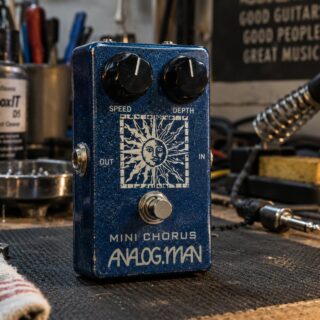
- Boss CE-2 Chorus: GuitarGangsters AI-generated reference illustration, not a photograph.
Latest News
Related
On This Day
Tuesday 10 November
From this week: