The Pedal That Made Chorus Sound Boring: Boss VB-2W Vibrato
Boss VB-2W Vibrato: specs, true bypass, Graham Coxon, Prince & Mac DeMarco, tone recipes, Standard vs Custom mode. The rare analog wobbler is back.
There is a moment on Prince’s Purple Rain recordings where the guitar does something that doesn’t quite sound like chorus, doesn’t quite sound like a Leslie cabinet, and doesn’t quite sound like anything else in the effects lexicon of 1984. It wobbles. It breathes. It makes the note feel unstable in a way that pulls you toward it rather than pushing you away. That effect came from the Boss VB-2 Vibrato, a pedal so short-lived that it disappeared from the market only four years after it launched, and so coveted that its used prices ballooned to collectors’ territory for the next three decades.
In 2016, Boss brought it back as the VB-2W, a Waza Craft reissue with the same all-analog bucket-brigade circuit as the original, a new Custom mode, and an expression pedal input for real-time Depth control. For players who’d spent years hunting down a working original or settling for digital software approximations, the VB-2W’s arrival was the kind of event that actually makes gear news meaningful. This is not a chorus pedal. It’s not a tremolo. It is one of the few stomp boxes ever made that delivers true pitch vibrato — full modulation of the note itself — in a format you can actually buy new, at a price that doesn’t require selling gear to afford.
Understanding why the VB-2W matters requires understanding what vibrato actually is, why so few pedals do it right, and why the specific character of the Boss circuit has made it a recurring presence on the boards of players as different as Prince, Blur’s Graham Coxon, and indie lo-fi icon Mac DeMarco. The sounds it produces are idiosyncratic. They are not universally loved. But for the players who love them, nothing else will do.
The Brief, Brilliant Life of the Original VB-2 (1982–1986)
Boss released the original VB-2 Vibrato in April 1982, during the same era that produced the CE-2 Chorus, the BF-2 Flanger, and the PH-2 Phase Shifter — the golden age of Boss analog modulation. The VB-2 was built around the MN3207 bucket-brigade device chip (the same BBD chip used in the CE-2 and many other analog modulation classics of the era) paired with a MN3102 clock driver, a combination that defined the tonal character of early-1980s analog effects.
Where the CE-2 mixed a pitch-modulated copy of your signal with the dry original to create the characteristic “shimmer” of chorus, the VB-2 took a different approach: it removed the dry signal entirely and modulated the pitch of the full guitar signal. True vibrato, in other words. The result was a more dramatic, more destabilizing, more uniquely itself effect — with none of the comfortable wash of chorus holding it in place.
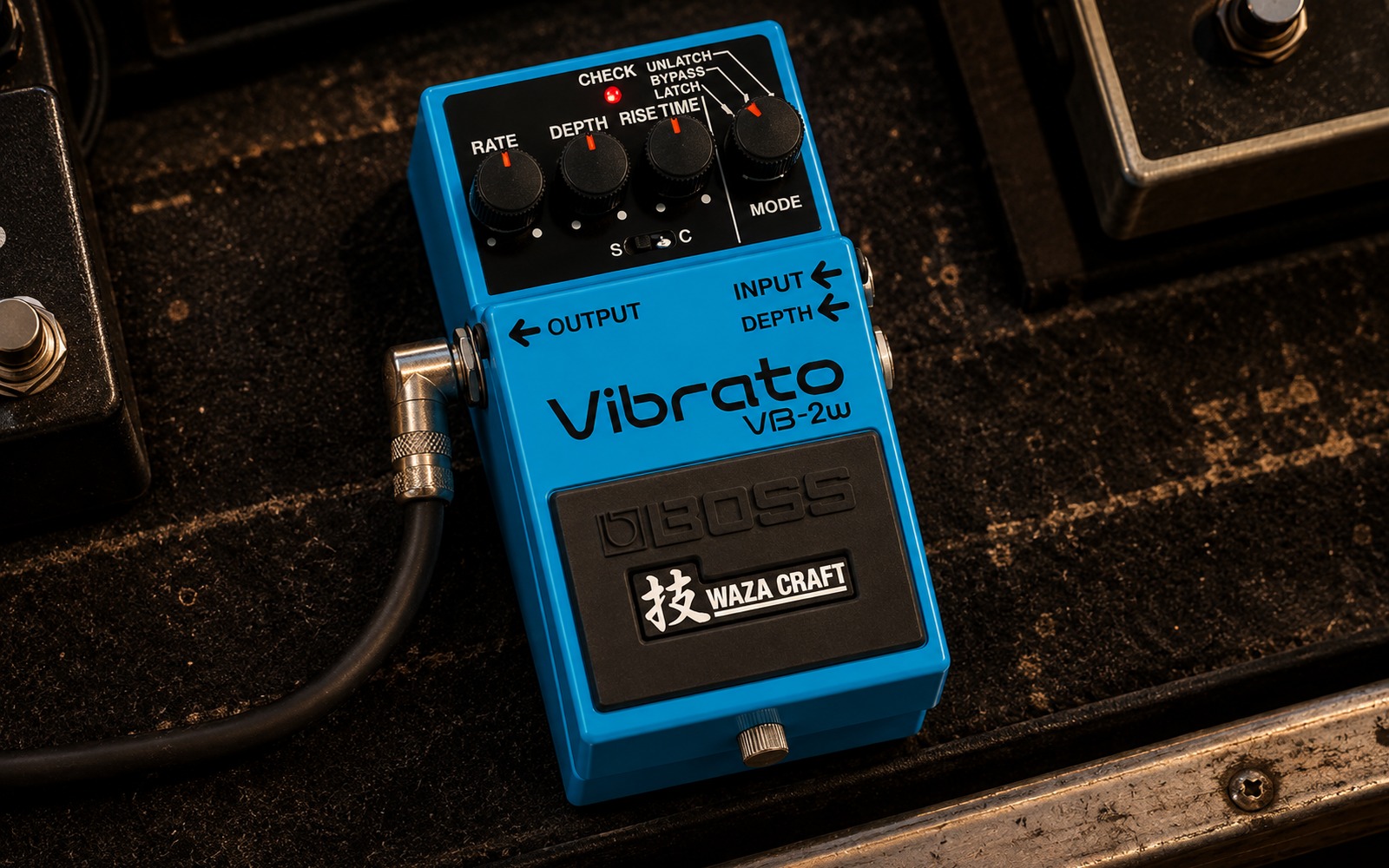
The original VB-2 had three controls on its top panel: Rate (speed of modulation), Depth (intensity of pitch shift), and Rise Time (how quickly the modulation builds to full intensity in Latch mode). A three-position Mode switch chose between Latch (standard toggle-on/off), Bypass (effect bypassed when pedal off, normal circuit behavior), and Unlatch (effect active only while footswitch held down — releases when you release). Current draw was a modest 14mA.
The VB-2 was discontinued in April 1986, having been in production for exactly four years — one of the shortest production runs of any Boss compact pedal. Boss’s stated reason was market performance: the effect was unusual enough that mainstream players didn’t gravitate to it, while the players who loved it weren’t numerous enough to justify continued production. What followed was three decades of steady appreciation, a rising used-market price that put pristine originals in the $200–400+ range, and constant discussion in effects forums about whether digital alternatives could capture what the original did. (General verdict: close, but not quite.)
Boss VB-2W Waza Craft: The Return (2016)
The VB-2W launched in April 2016 as part of Boss’s Waza Craft series, the premium Japanese-made line that has also produced the CE-2W, DC-2W, DM-2W, and a handful of other analog reissues of classic Boss circuits. Like other Waza units, the VB-2W is manufactured in Japan rather than Taiwan, uses selected components, and represents Boss’s best-quality build rather than its mass-market price point.
Structurally, the VB-2W maintains the footprint and four-knob layout of the original VB-2 — Rate, Depth, Rise Time, and Mode — while adding two new features. The first is a small slider switch below the knobs that selects between Standard mode (which replicates the original VB-2 circuit character) and Custom mode (a deeper, darker, more intensely modulated voice that extends the effect’s range beyond what the original could achieve). The second addition is a 1/4-inch expression pedal input on the right side of the pedal that allows real-time control of the Depth parameter, enabling sweeps from barely-there modulation to full seasick pitch oscillation with a single foot motion.
One specification deserves emphasis because it distinguishes the VB-2W from virtually every other Boss compact pedal: it features true bypass rather than Boss’s standard buffered bypass. This is unusual in the Boss lineup, where buffered bypass has been the consistent design choice across decades. For players who prefer true bypass on their signal chain — particularly important for those running long cable runs or germanium fuzz pedals that can interact poorly with input buffers — the VB-2W’s true bypass implementation removes a potential concern. The signal when the pedal is off is completely unaffected by the pedal’s circuitry.
Technical Specifications
Vibrato vs. Chorus vs. Tremolo: Why the Distinction Matters
Because the terms get conflated constantly — even in professional contexts — it’s worth being precise about what the VB-2W actually does and how it differs from the effects players more commonly reach for.
Tremolo is modulation of volume: the signal gets louder and quieter at a set rate. Classic examples are the built-in tremolo circuits on vintage Fender amps, and pedals like the Boss TR-2. The pitch stays constant; only the amplitude changes.
Chorus mixes a pitch-modulated copy of your signal with the original dry signal. Because the original is always present and in tune, chorus sounds relatively stable — the detuned copy adds shimmer and width, but the unmodulated dry signal grounds it. This is why chorus feels lush rather than disorienting. The CE-2, CH-1, and CE-2W all work on this principle.
Vibrato — true vibrato — modulates the pitch of the entire signal with no dry blend. There is no stable reference frequency. When the effect is on, every note is being continuously raised and lowered in pitch. This is what the VB-2W does. It sounds organic, unpredictable, slightly unsettling, and — in the right musical context — hypnotic in a way that neither chorus nor tremolo can achieve. Premier Guitar described the VB-2W’s modulation waves as “neither as smooth nor as phase-shifty as a chorus, nor as organic as a rotating speaker,” settling on “a kind of throbbing — at times tremolo-like — sci-fi undulation that suggests the otherworldly and unnatural.”
The Rise Time knob is unique to the VB-2 lineage and has no equivalent on most other vibrato or chorus pedals. In Latch mode, it controls how quickly the vibrato effect builds to full intensity after you activate the pedal. Fully counterclockwise, the modulation kicks in at full depth immediately. Clockwise, the effect swells in gradually over a period of several seconds, creating a build from dry-ish to fully wobbly that can be used as an intentional dynamic device — engage the pedal at the start of a phrase and let it arrive at full pitch modulation by the phrase’s peak.
The Mode switch’s three positions serve distinct performance functions. Latch is standard toggle: step on, effect is on; step on again, effect is off. Bypass routes the signal around the BBD chips entirely when the pedal is off — distinct from standard Latch, which keeps the circuit active but blended (note: with true bypass, both modes disconnect the circuit when off). Unlatch turns the VB-2W into a momentary device: effect is active only while your foot presses and holds the switch, releasing immediately when you lift. This transforms the pedal from a consistent texture into a performance gesture — press for a wobble on a held note, release, and you’re back to unaffected signal instantly.
Famous Players: Who Actually Used This Pedal
Jeff Beck, Kurt Cobain, Graham Coxon, James Hetfield, and Nuno Bettencourt are commonly listed as VB-2W associations. Research verifies only one of these connections directly. Of the remaining players, some are connected to the original VB-2 (not the VB-2W), and some cannot be confirmed via primary sources at all. The honest breakdown follows.
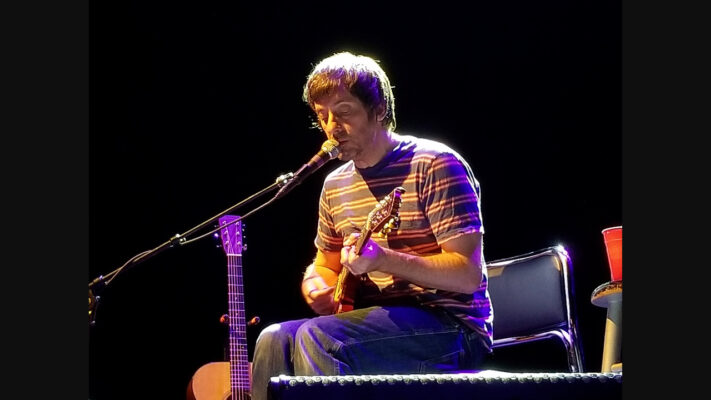
Graham Coxon (Blur) — CONFIRMED VB-2 User
Graham Coxon’s use of the Boss VB-2 is the most frequently cited and best-documented connection in the pedal’s history. The Premier Guitar review of the VB-2W at launch (April 2016) specifically named Coxon as a player who “found favor” with the original VB-2, and his custom-built Mike Hill pedalboard has been documented with the VB-2 across multiple sources over multiple years. In the context of Blur’s discography — particularly the more abrasive, noise-influenced work on albums like Blur (1997) and Think Tank (2003) — the VB-2’s queasy, destabilizing pitch shift is a logical tool for a guitarist who has always used effects to introduce intentional unease rather than smooth beautification. Coxon is featured in the Graham Coxon gear guide.
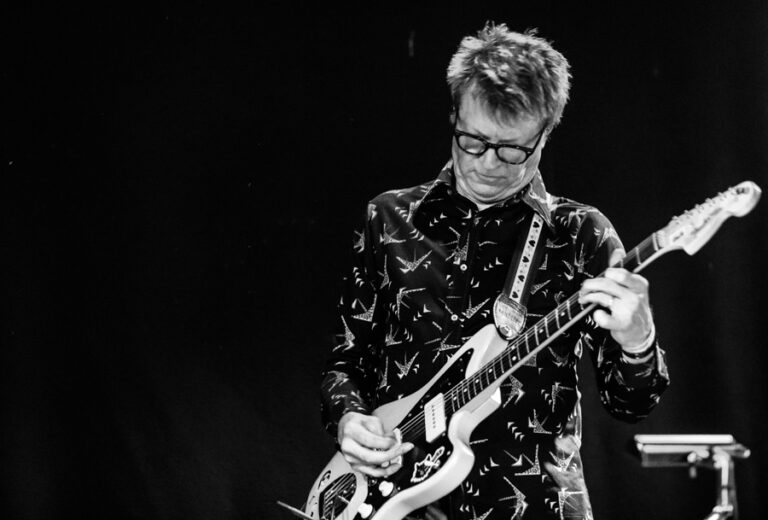
Nels Cline (Wilco) — CONFIRMED VB-2 User
The same 2016 Premier Guitar VB-2W review that named Coxon also cited Nels Cline in the same sentence — “sonic anarchists like Nels Cline and Blur’s Graham Coxon” — as documented VB-2 users. Cline’s approach to his instrument with Wilco, and in his more experimental solo work, makes the VB-2 a natural fit: he has always operated in the space between conventional guitar tone and texture-for-its-own-sake, and the VB-2’s willingness to make notes feel genuinely unstable serves that aesthetic directly. Nels Cline is featured in the Nels Cline gear guide.
Prince — CONFIRMED VB-2 User (Original)
The Guitarcloud Prince Equipment Archive, a comprehensive primary-source documentation project for Prince’s gear, confirms the Boss VB-2 Vibrato as part of Prince’s pedalboard from the mid-1980s Purple Rain era onward. Multiple sources — including gear documentation and pedalboard photographs from that period — place the VB-2 on Prince’s board alongside other Boss effects including the OC-2 Octave, BF-2 Flanger, and DD-3 Digital Delay. Guitar Reviewed notes that “sounds you would identify as ‘chorus’ on the Purple Rain album are actually coming from this thing,” which is an important sonic clarification: much of what sounds like Prince’s shimmering modulation tone on that record is true pitch vibrato, not conventional chorus, which partly explains why attempts to recreate the Purple Rain guitar tone with a chorus pedal often fall slightly short. Prince is featured in the Prince gear guide.
Mac DeMarco — CONFIRMED VB-2W User
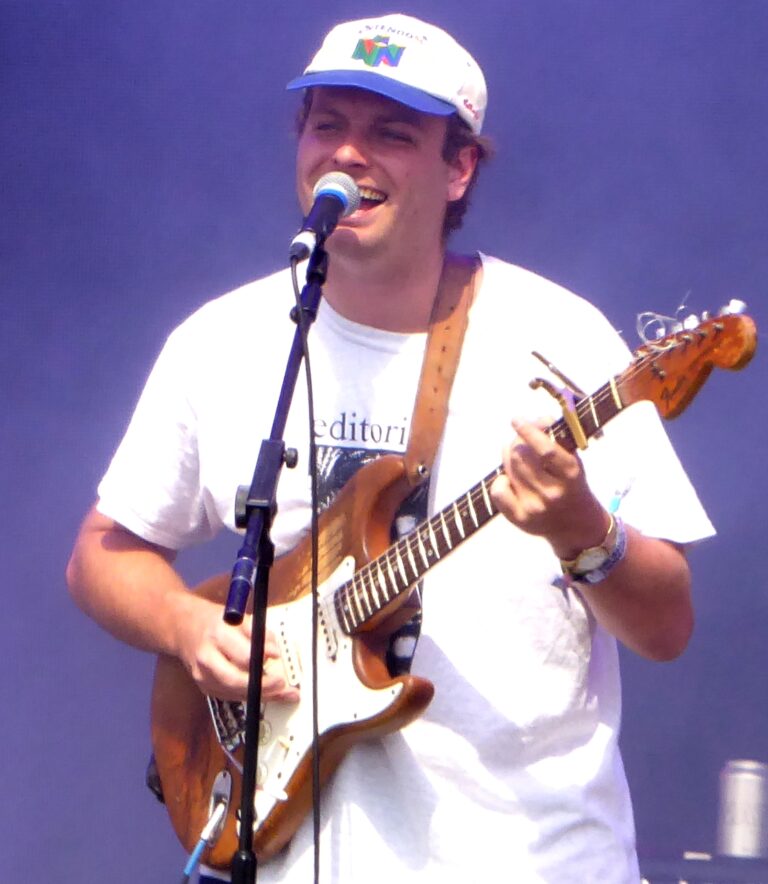
Mac DeMarco’s VB-2W use during the “This Old Dog” tour cycle (2017–2018) is documented via Ground Guitar with a primary-source pedalboard photograph showing the pedal in situ on his board. DeMarco’s tone — the slow, detuned, almost seasick quality that critics and fans have identified as his signature — owes a significant debt to low-depth, moderate-rate vibrato from the VB-2W. By 2019, he had replaced it with a TC Electronics Shaker Vibrato, but the VB-2W era coincided with some of his most recognized recorded and live work. His documented use is among the most photographically confirmed VB-2W connections available.
Not Confirmed: Kurt Cobain, Jeff Beck, James Hetfield, Nuno Bettencourt
Research found no primary-source documentation connecting Kurt Cobain, Jeff Beck, James Hetfield, or Nuno Bettencourt to the Boss VB-2 or VB-2W. Cobain’s documented pedalboard effects are well-catalogued and include the Small Clone chorus, EHX Big Muff, ProCo Rat, Boss DS-1, and Tech 21 SansAmp — no vibrato pedal appears. Jeff Beck’s documented rigs across multiple eras show no Boss vibrato connection via any primary source. Hetfield’s Metallica-era pedalboard is metal-focused with no modulation of this type documented. Nuno Bettencourt’s confirmed gear list (Boss OC-2, Boss DD-3) shows no VB-2 connection. These are omitted here in keeping with the project’s commitment to verified connections only.
Tone Recipes and Settings
1. The Classic VB-2W Wobble (Standard Mode)
Start in Standard mode with Rate and Depth both at noon, Rise Time fully counterclockwise. This is the most immediate, identifiable VB-2 sound — the pitch oscillates at a steady, moderate speed with enough depth to be clearly present but not so much that it becomes comedic. Latch mode, engaged and left on for chord voicings, reveals why players describe this effect as “chewy.” Best with single-coil pickups into a clean or lightly-driven amp. This setting is a good starting point for anyone new to the pedal.
2. The Mac DeMarco Jangle (Standard Mode, Subtle)
Standard mode. Rate at 10 o’clock, Depth at 8–9 o’clock (low but present), Rise Time counterclockwise. This is low-intensity, persistent vibrato as texture rather than effect — the kind of setting where you’re not sure if you’re hearing the pedal or if the guitar is just breathing. DeMarco runs his Strat or Squier through this kind of setting to give his clean, reverby tones a slightly unstable, lo-fi quality that distinguishes them from sterile Tele clean sounds. Into a clean amp with some room reverb, this produces the essential indie jangle-with-seasickness character.
3. Graham Coxon Queasy Blur (Standard Mode, Medium-High Depth)
Standard mode. Rate at 1 o’clock, Depth at 2–3 o’clock, Rise Time noon. More aggressive than the DeMarco setting — the pitch modulation is clearly intentional and slightly unsettling. Unlatch mode for this setting turns it into a performance gesture: engage for moments of harmonic instability, release for conventional tone. This kind of intermittent application suits the Blur approach, where the VB-2’s queasy quality is introduced as punctuation rather than constant atmosphere. Fuzz or overdrive before the VB-2W adds texture without defeating the pitch modulation’s clarity.
4. Prince-Style Chorus Substitute (Standard Mode)
Standard mode. Rate at 10 o’clock, Depth at 9–10 o’clock, Mode at Latch. Prince used the VB-2 in situations where a conventional chorus pedal would create too much of a stereotypical “1980s chorus” sound. At low depth settings, the VB-2’s modulation reads as an unusually liquid, uncommonly dimensional “chorus-adjacent” effect — it adds width and movement without the obvious chorus sweep. Running this setting into a clean amp, as Prince did with his combination of Boss effects and Mesa Boogie, gives you modulation that sounds expensive rather than synthetic.
5. Custom Mode Maximum Drama
Custom mode. Rate at 1 o’clock, Depth at 2 o’clock, Rise Time counterclockwise. The Custom mode’s deeper, darker character makes everything more theatrical. This is not a subtle setting. The pitch excursions are wider, the modulation feels more insistent, and the overall effect is closer to the “seasick” descriptor that comes up constantly in descriptions of the VB-2W at full intensity. Expression pedal connected to the Depth input makes this setting interactive: start a phrase with Depth pedal at minimum (barely noticeable wobble), sweep to maximum as the phrase develops. The sonic result is a genuine climax structure built into the modulation itself.
6. Rotary Speaker Approximation (Standard Mode)
Rate at 1–2 o’clock, Depth at 9 o’clock. Premier Guitar specifically identifies this as the VB-2W’s version of a fast-rotary sound — the combination of moderate-to-fast rate and low depth creates a dimensionality that approximates some of the Leslie cabinet’s character without actually being a rotary simulation. It won’t fool an engineer who has heard a real Leslie, but in a live mix it adds the kind of movement and air that makes solos feel less static. The Custom mode version adds extra “whooshing authenticity” (Premier Guitar’s term) to this setting, particularly when you roll back your guitar’s tone knob slightly.

How the VB-2W Fits in Your Signal Chain
Because the VB-2W has true bypass rather than Boss’s standard buffered bypass, placement relative to buffered pedals requires different thinking than most Boss units. Standard practice: place the VB-2W after any true-bypass overdrive and fuzz pedals, before delay and reverb (so the modulation is captured in the time-based effects’ wet signal). If you’re running a Boss DS-1 Distortion or similar buffered-bypass overdrive, the DS-1’s output buffer will drive the VB-2W’s input correctly regardless of placement; the VB-2W’s true bypass won’t affect the DS-1’s circuit behavior.
For ambient and shoegaze applications — the genre that arguably claims the VB-2/VB-2W most enthusiastically in the current era — the typical placement is: tuner → fuzz/overdrive → VB-2W → modulation (if other modulation is present) → delay → reverb. The VB-2W before delay means the pitch-modulated signal gets smeared and multiplied by the delay’s repeats, which creates layered complexity rather than clean oscillation. VB-2W after delay keeps the modulation clean but detaches it from the reverb tail’s decay character.
One specific consideration: germanium fuzz pedals prefer to see a high-impedance input immediately after the guitar. If you run a germanium fuzz (Tone Bender, Fuzz Face, etc.) and you also run other true-bypass pedals, the VB-2W’s true bypass means it won’t affect the germanium fuzz’s input impedance when bypassed — which is generally preferable to a buffered-bypass pedal that would reduce the fuzz’s input impedance even when the buffer’s pedal is off.
VB-2W vs. Alternatives: How It Compares
The vibrato effect category is genuinely smaller than chorus, overdrive, or delay. Options that compete directly with the VB-2W include the TC Electronic Shaker Vibrato (Mac DeMarco’s replacement choice), the Strymon Zelzah, the EHX Wiggler, and digital-mode vibrato channels in multi-effects units. The differences are meaningful.
The TC Electronic Shaker Vibrato is a digital pedal at roughly half the VB-2W’s price point. Its TonePrint functionality allows custom vibrato characters loaded via smartphone, making it more flexible in some respects. What it lacks is the analog BBD’s particular sonic character — digital vibrato tends toward cleaner, more precise pitch modulation, while the VB-2W’s BBD circuit adds harmonic interaction and a subtle darkening of the signal that Premier Guitar described as “a very pretty, liquid — even vaporous — fade to the modulations as the waves dissipate in volume.” For players who prioritize the organic feel of analog processing over digital precision, the VB-2W’s premium price reflects a genuine difference.
The Strymon Zelzah offers digital simulation of multiple vintage vibrato types, including the Uni-Vibe-derived univibe effect that is related to vibrato but not identical to it. The Zelzah is more versatile. The VB-2W is more specific — it does its particular version of BBD vibrato, and that specificity is the point.
The vintage original VB-2, for players who find one in working condition, represents the same circuit without the Custom mode or expression input. Prices for clean originals start around $200 and run significantly higher for pristine examples. At the VB-2W’s price point (~$199–270 new), the Waza reissue is currently competitive with mid-grade used originals, and offers the additional features. Unless collector value or originality is the priority, the VB-2W is the practical choice for players who actually want to use the sound.
Compared to the Boss TR-2 Tremolo — another Boss modulation compact with a devoted following — the VB-2W occupies completely different sonic territory. The TR-2 modulates volume; the VB-2W modulates pitch. Both have their place, and some players run both, using the TR-2 for rhythmic amplitude patterns and the VB-2W for pitch-destabilizing texture. They don’t overlap.
Buying Guide: Original VB-2 vs. VB-2W
If you’re in the market for the Boss vibrato sound, the practical choice is the VB-2W. It’s in current production, carries a five-year Boss warranty, includes the Custom mode and expression input that the original lacks, and can be found new at authorized dealers. The analog BBD circuit is genuine, the Made-in-Japan construction is Boss’s highest build standard, and the true bypass implementation removes a potential concern for players who care about signal path purity.
The original VB-2 is for collectors, for players who specifically prefer the classic circuit without the additional features, or for players who find a working example priced below the VB-2W’s new price point. Original units have two manufacturing variants (the ACA power requirement of very early units vs. later PSA-compatible versions), so confirm power compatibility before purchase. MIJ vs. later production differences exist but are less sonically significant than the power supply compatibility issue.
Used VB-2W units in excellent condition typically appear in the $130–180 range. This represents reasonable value given the pedal’s analog circuit and Japanese manufacture. Inspection on a used VB-2W: test all three Mode positions, confirm expression input works with a TRS cable, test the Standard/Custom slider switch (confirm it clicks cleanly between positions and the Custom mode sounds noticeably different). Any noise or oscillation in Normal operation at extreme Rate + Depth settings is expected behavior; noise at low settings in bypass mode suggests a circuit issue.
Ownership Notes
The VB-2W’s true bypass implementation means it won’t contribute to your signal chain’s noise floor when bypassed — a practical advantage for players who run long pedalboards where multiple buffered pedals accumulate noise. The expression pedal input accepts a standard TRS 1/4-inch expression pedal; the Boss EV-30 or any TRS expression pedal with a compatible polarity setting will work. Confirm polarity before purchase if buying a third-party expression pedal, as different manufacturers use different TRS pin assignments.
The pedal’s all-analog BBD circuit is temperature-sensitive in the same way as other analog BBD-based effects: very cold environments can cause the circuit to run slightly out of spec until it warms to operating temperature. This is not a defect but a characteristic of BBD circuits generally. Practical implication: if you’re playing in cold venues, give the pedal a few minutes at operating temperature before critical tuning-sensitive passages.
Battery life of approximately 22 hours on alkaline is better than most analog pedals of similar complexity, which is a practical benefit for fly dates or gigs where power supplies can be inconvenient. Boss’s standard PSA adaptor powers the VB-2W; the Waza Craft units don’t require the higher-current isolated supplies that some complex digital pedals demand.
Frequently Asked Questions
Is the Boss VB-2W a chorus pedal?
No. It is a true vibrato pedal, meaning it modulates the pitch of the entire signal without blending in a dry signal. Chorus pedals (like the Boss CE-2W or CH-1) mix a pitch-modulated copy with the original dry signal, creating shimmer while maintaining a stable pitch reference. The VB-2W removes the dry signal entirely, which creates a more destabilizing, less comfortable, more characterful effect. Some of Prince’s recordings that sound like chorus are actually VB-2 vibrato.
What’s the difference between Standard and Custom mode?
Standard mode replicates the original 1982 VB-2 circuit character: the vibrato is rich, deep, and idiosyncratic, but there’s a ceiling on how extreme it gets. Custom mode extends the circuit’s range, producing deeper, darker, and more intensely modulated pitch shifts. The Premier Guitar review describes Custom mode as having “extra fatness” and recommends it for Leslie-adjacent settings with the tone rolled back on your guitar.
What does the Rise Time knob do?
Rise Time controls how quickly the vibrato effect builds to full intensity after the pedal is activated in Latch mode. Fully counterclockwise, the modulation hits at full depth immediately. Fully clockwise, the effect swells in gradually over several seconds. This creates a dynamic option where the vibrato arrives rather than strikes — useful for sustained notes where the wobble should develop as the note evolves rather than starting at full intensity.
Does the VB-2W have true bypass?
Yes. This is unusual for Boss compact pedals, which historically use buffered bypass. The VB-2W’s true bypass means the signal is completely disconnected from the circuit when the pedal is off — no loading of your guitar’s pickup, no contribution to the buffer chain. This matters most for players running germanium fuzz pedals or very long cable runs where they specifically want no additional buffering.
Can I use an expression pedal with the VB-2W?
Yes. The right side of the pedal has a 1/4-inch TRS expression pedal input that controls the Depth parameter in real time. This allows sweeping from barely-there modulation to extreme pitch oscillation with a foot rocker, which transforms the VB-2W’s expressive range significantly. Boss’s EV-30 or compatible TRS expression pedals work; confirm TRS polarity compatibility with third-party pedals before purchase.
Why was the original VB-2 discontinued after only four years?
Boss discontinued the VB-2 in April 1986 because it didn’t sell well enough to justify continued production. True vibrato was an unusual effect in a market dominated by chorus, flanger, and delay, and the VB-2’s sounds were not immediately accessible to mainstream players. The players who loved it were enthusiastic but few. Post-discontinuation, the used-market price rose steadily as those enthusiasts competed for a finite supply, which ultimately created enough demand justification for the 2016 Waza Craft reissue.
How does the VB-2W compare to the TC Electronic Shaker Vibrato?
The TC Electronic Shaker Vibrato is a digital vibrato pedal at roughly half the VB-2W’s price, with TonePrint flexibility for loading custom vibrato characters. Its digital circuit produces cleaner, more precise pitch modulation. The VB-2W’s all-analog BBD circuit adds a soft, organic quality to the pitch modulation — what Premier Guitar calls “a beautiful darkening effect” as the modulation waves dissipate — that digital processing doesn’t naturally replicate. Mac DeMarco used the VB-2W and later switched to the Shaker; players who’ve used both consistently describe the VB-2W as the more characterful of the two, and the Shaker as the more practical one.
Does the VB-2W work with bass guitar?
Yes. The VB-2W’s analog circuit handles low-frequency content well, and the pitch modulation on bass creates an effect that is unusual and interesting in bass contexts — somewhere between a chorus and something harder to name. It won’t cause the low-end smearing that flangers can introduce on bass (that’s a different circuit type). Used conservatively with a slow Rate and low Depth, it adds a quality of organic movement to bass tones that is genuinely distinctive.
Image credits
- Top image: GuitarGangsters AI-generated reference illustration, not a photograph.
- Graham Coxon: XoxoHell, Wikimedia Commons, CC BY 2.0.
- Graham Coxon: Graham Coxon North American Tour 2018 by Udenjan /, Wikimedia Commons, CC BY-SA 4.0.
- Nels Cline: Tore Sætre / Wikimedia, Wikimedia Commons, CC BY-SA 4.0.
- Mac DeMarco: Paul Carless from St Albans, UK, Wikimedia Commons, CC BY 2.0.
Latest News
Related
On This Day
Monday 9 November
From this week: