Old Blood Noise Endeavors Screen Violence: The Pedal That Turned a Synth-Pop Album Into a Circuit
Inside the Old Blood Noise Screen Violence: the CHVRCHES collaboration, how the Screen macro works, tone recipes, specs and used-buying advice.
Most signature pedals are a lie of omission. A guitarist has a favourite overdrive, a builder puts the guitarist’s face on it, everyone pretends the two things are connected. The Screen Violence is not that. It is a pedal that exists because two members of a Scottish synth-pop band got tired of switching on five stompboxes to make one sound, and asked the people who built four of them to put the whole thing in a single box.
The band is CHVRCHES. The album is Screen Violence, released in 2021 — dark, widescreen, deliberately cinematic, and full of guitars that don’t sound much like guitars. The builder is Old Blood Noise Endeavors of Oklahoma City, whose pedals were already all over the record. The result, announced on 26 May 2022 at $279, is a stereo box with two footswitches, six knobs and three toggles that Old Blood filed under a category nobody had heard of before: Stereo Saturated Modulated Reverb.
That name is doing real work, and it is worth flagging a housekeeping point up front. Our own ranking data files the Screen Violence as a distortion pedal, and plenty of retail listings do the same. Old Blood’s own product page does not. Their words are “stereo saturated modulated reverb,” and Guitar.com’s review — which scored it 9/10 — leads with “a magnificent mashup of reverb and overdrive.” Calling this a distortion box is like calling a Swiss Army knife a corkscrew. It has one, it works, and it is not why the thing exists.
Two Sides, One Idea
The Screen Violence is split down the middle, and the split is the design.
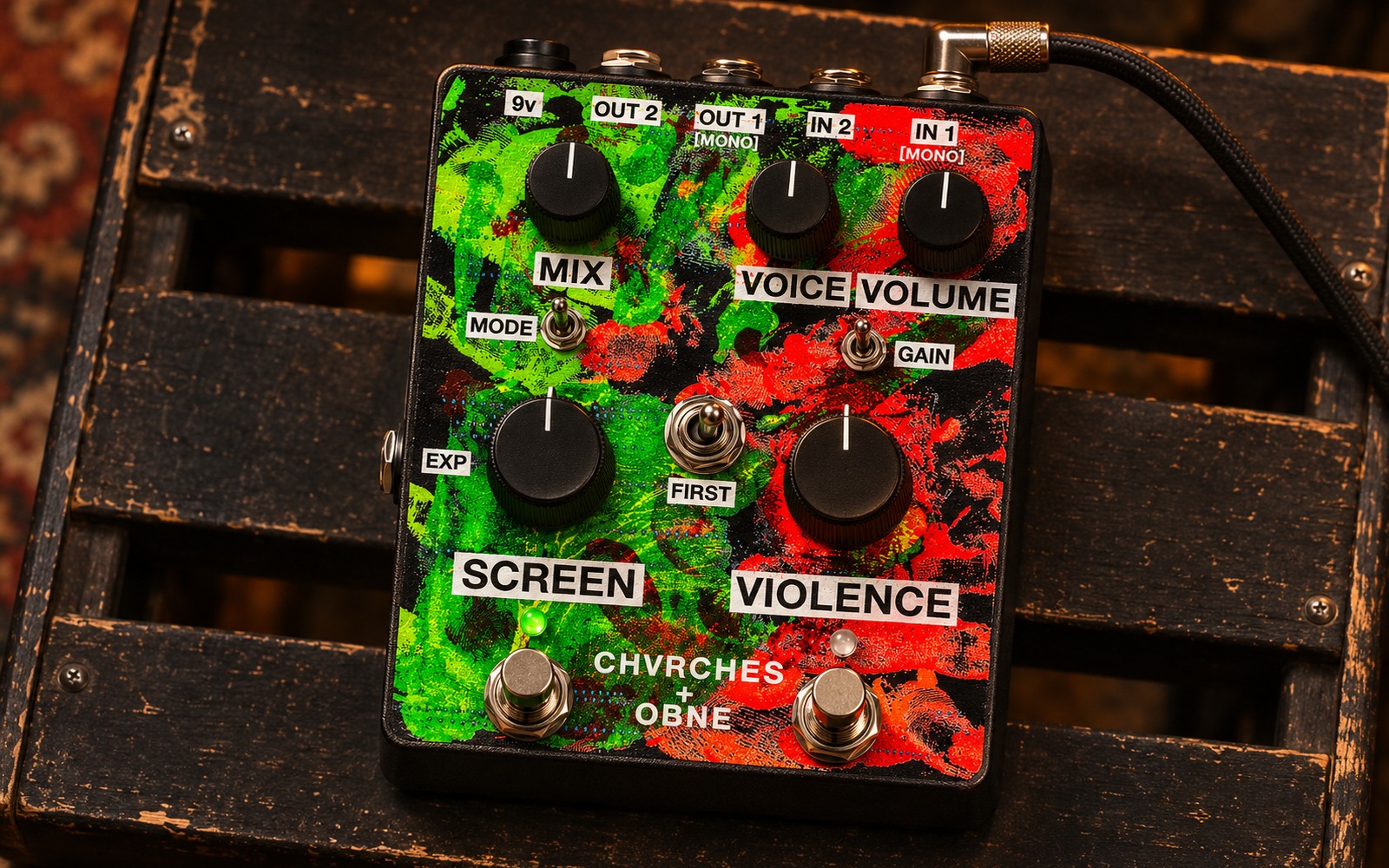
On the right is Violence: a tube-inspired overdrive with four controls — Violence (input gain), Gain (a toggle for the first transistor stage), Voice (tone) and Volume (output). On the left is Screen: an ambient section with just two knobs, Mix and Screen, plus a two-position Mode toggle. Between them sits the First toggle, which decides which section the signal hits first.
The Screen knob is the whole trick. Old Blood describe it as “a magic knob controlling many parameters at once,” and Martin Doherty of CHVRCHES explained the intent bluntly to MusicRadar: “The modulation in this pedal, I guess it starts with a simple chorus, and then expands. By the time it gets to the maximum it’s complete chaos. But it’s controlled chaos, chaos you can use.”
The reason it exists is even more direct. “The reason I wanted to do a pedal like this is I was using four or five pedals to achieve this particular sound,” Doherty said. “This sound that became a big, crucial backbone of the album, so to speak.”
That is the honest origin story of the Screen Violence, and it is a better one than most signature pedals can offer: it is a macro. It is one knob standing in for a chain that a band actually built, used on a record you can go and listen to, and then got sick of patching together on tour.
Oklahoma City, and the Company That Says Yes
Old Blood Noise Endeavors is the work of Brady Smith and Seth McCarroll, who met at the University of Oklahoma and started the company in 2014 with the Black Fountain delay. Their catalogue runs from the ferociously simple to the borderline unclassifiable, and the Screen Violence sits firmly at the second end — alongside the parallel-modulation Visitor and the stereo pad-reverb Dark Star, both of which share the Screen Violence’s willingness to hand you a control that does five things and refuse to tell you which five.
OBNE’s collaboration habit is worth noting because it is unusual. Most builders do a signature pedal as a marketing exercise. Old Blood treat it as a design brief — the Emily Hopkins collaboration (Parting) and the CHVRCHES collaboration were both driven by what the artist actually needed rather than what would sell. Iain Cook of CHVRCHES described the goal in Old Blood’s own press material: “Our aim with the collaboration was to distill the sound of the record into a pedal that would be versatile enough to use with guitars, synths, bass or whatever we wanted to throw at it. A lofty goal but I am proud to say that we achieved it together.”
Note that phrasing carefully. Guitars, synths, bass or whatever. This pedal was not designed for a guitar first. That is unusual, and it explains several design decisions further down.
Specifications
A power-draw discrepancy worth knowing about
Three first- and second-party sources give three different figures. Old Blood’s own current product page specifies a supply “capable of 110mA.” Their original press release said “at least 100mA 9VDC center negative power.” Guitar.com’s review lists 100 mA. None of these contradict each other in spirit — the press release says at least — but if you are budgeting outputs on a crowded supply, plan for 110 mA and give yourself headroom on top of that. A stereo pedal with two independent relay-bypassed analogue drive sections and a digital ambient engine is not a pedal to run off a daisy chain. Isolated output, please.
The connector spec is the ordinary one: 2.1 mm barrel, centre negative. That is worth stating explicitly because we have covered pedals that break the rule — the Eventide Factor units use a centre-positive 5.5/2.5 mm plug, and swapping the two will end badly for somebody.
What the Screen Knob Actually Does
Turning one knob and getting “many parameters at once” is the kind of claim that usually means the builder ran out of front-panel space. Here it is a genuine architecture, and the two Mode positions behave quite differently.
Mode 1 (toggle up) feeds multiple delay stages into a chorus. It does not accept a stereo input. As you advance the Screen knob you move from a slow chorus, through a doubling effect, into slapback delay territory. This is the “modulation and short echo” half of the pedal, and it is the setting that most resembles a conventional board of separate boxes.
Mode 2 (toggle down) is true stereo and blends three different reverbs — short, medium and long. Advancing the Screen knob sweeps you through the blend until you arrive at what Old Blood’s demo describes as a “not quite infinite decay, long trail thing.” This is the CHVRCHES setting. This is what the album sounds like.
The Mix knob then re-integrates the dry signal, and it has a subtlety that catches people out. Fully counter-clockwise you get dry only. Around noon, with Screen dialled in, you get the classic dry-plus-wet chorus interaction. Fully clockwise — wet only — a slow pitch vibrato emerges, because there is no dry signal left to anchor the pitch. Push the Screen knob from there and, as MusicRadar’s coverage puts it, things get queasier. If you have read our Chase Bliss Warped Vinyl HiFi piece, this will be a familiar mechanism: chorus and vibrato are the same effect at different mix settings, and always have been.
The Violence Side Is Not a Throwaway
It would be easy to assume the drive circuit is there to justify the pedal’s name. It isn’t. Guitar.com’s Jason Mays, reviewing it through a Matchless Nighthawk 15, described a drive that “sits somewhere between the light crunch of the 1981 Inventions DRV and the roar of an overdriven Sunn Model T amp,” and singled out the fact that it manages that range “without ever sounding harsh or fizzy.” Highs stay transparent, lows stay defined, and — his words — the amount of gain on tap is “more than enough to justify its name.”
The control layout rewards understanding. Violence is input gain: turning it up pushes more signal into the gain stages. Gain is a toggle governing how much gain the first transistor stage runs — down for less, up for more. Volume is output, so you compensate there. Voice is tone: darker anti-clockwise, brighter clockwise, and as it opens up it drives the mids and highs into a mid-forward overdrive rather than a scooped one.
Two things follow from that. First, the pedal is genuinely usable as a boost with Violence low and Volume high. Second, because the drive was inspired by outboard studio gear that was itself modelled on guitar amps, it does not behave like a Tube Screamer derivative. It is closer in spirit to something like the Strymon Riverside in that its clean-to-filthy range is wide enough to be the only drive on a small board — although the Riverside is a far more surgical, precise tool and the Violence side is happy to be ugly.
The First Toggle: The Feature That Justifies the Price
This is where the Screen Violence separates itself from every “reverb plus drive” pedal on the market. The central toggle reverses the internal order of the two sections, and the two results are not variations on a theme. They are different pedals.
Violence into Screen — drive first — gives you a clean, sheeny reverb sitting on top of a distorted signal. The ambience stays legible because it is being generated from an already-saturated source rather than being smeared afterwards. Guitar.com’s tester found that with dirt at four o’clock and everything else at noon, this produces “a gain-soaked modulated ‘verb similar to the dense textures of the CHVRCHES song How Not To Drown.”
Screen into Violence — reverb first — pushes the wet signal itself through the drive circuit. Everything mushes together into a single distorted bath. Guitar.com reached for post-rock reference points here: This Will Destroy You, and the more subdued textures of Daughter.
Reverb-into-drive is the rarer and more valuable of the two, because it is difficult to achieve on a normal board without a loop switcher. Pedals that offer it as a built-in option are a small club — the EarthQuaker Avalanche Run and various dual-engine boxes get near it in different ways, but a single enclosure that flips the order of its own drive and its own reverb with one toggle is genuinely uncommon.
Stacked Violence Mode — and a Documented Disagreement
When the pedal is running in stereo, the two channels each have their own distortion section. In mono, that second section would simply go unused. Old Blood’s answer was Stacked Violence: channel one’s drive running into channel two’s drive, for considerably more gain than either alone.
Doherty explained the origin of it to MusicRadar: “With a good stacked distortion you can get all sorts of crazy feedback, that I like to record into the computer. Then I’ll grab little sections of it and loop it, manipulate it and take it to a whole other place. So when we were messing around and testing the first version of the pedal we thought it would be a good idea if we had two distortion modules and when we were using the pedal in mono, the option to stack them would be super f***ing cool.”
Iain Cook’s response, per the same piece: “Because sometimes one distortion isn’t enough.”
Here is the honest complication. Sources disagree on how Stacked mode is engaged. MusicRadar’s launch coverage says you stack the two sections by holding down both footswitches at the same time. Delicious Audio’s write-up says the pedal automatically activates Stacked Violence Mode whenever it is operating mono-to-mono or mono-to-stereo. Both are describing the same feature, but they are not describing the same activation method, and we have not been able to resolve the disagreement from the manual — Old Blood publish the Screen Violence instruction manual as a PNG image poster rather than as text, which is charming as an object and unhelpful as documentation. If you own one, the manual you have in the box is the authority; if you are buying secondhand and the manual is missing, request it from Old Blood before you assume.
Famous Players: The Rare Case Where the Answer Is Simple
This series spends a great deal of its time being sceptical about artist claims. Brands recycle rosters. Aggregators repeat one another. A pedal turns up on a “used by” list and the trail leads nowhere. The Screen Violence is the pleasant exception: the artist connection is not a marketing claim bolted on afterwards, it is the reason the pedal was designed, and it is documented in first-party statements from the band members themselves.
CHVRCHES — Martin Doherty and Iain Cook
Doherty and Cook are named collaborators on the design, quoted at length in Old Blood’s own press release and in MusicRadar’s launch coverage, and both appear in Old Blood’s own eighteen-minute walkthrough video alongside Lauren Mayberry and a member of the OBNE team. Doherty is described as a musician who has OBNE pedals in both his synth rig and his guitar rig. Cook’s stated design goal was a pedal that would work with “guitars, synths, bass or whatever.”
Doherty also stated the pedal replaced a specific four-to-five-pedal chain that formed “a big, crucial backbone” of the Screen Violence album. So the correct framing is not “CHVRCHES use this pedal.” It is: the sound came first, on the record, and the pedal is a compression of it. That is the strongest form of signature-pedal provenance there is.
For context on the band’s wider gear history: Iain Cook’s early rig ran a Doepfer sequencer through guitar pedals, and on The Bones of What You Believe their Moog Voyager was frequently routed through his pedals, including an Electro-Harmonix Memory Man delay and a Holy Grail reverb. That last detail is a straight line to the pedal we are discussing — a synth through a guitar reverb is exactly what the Screen side’s stereo Mode 2 is for.
A connection worth naming: Robert Smith
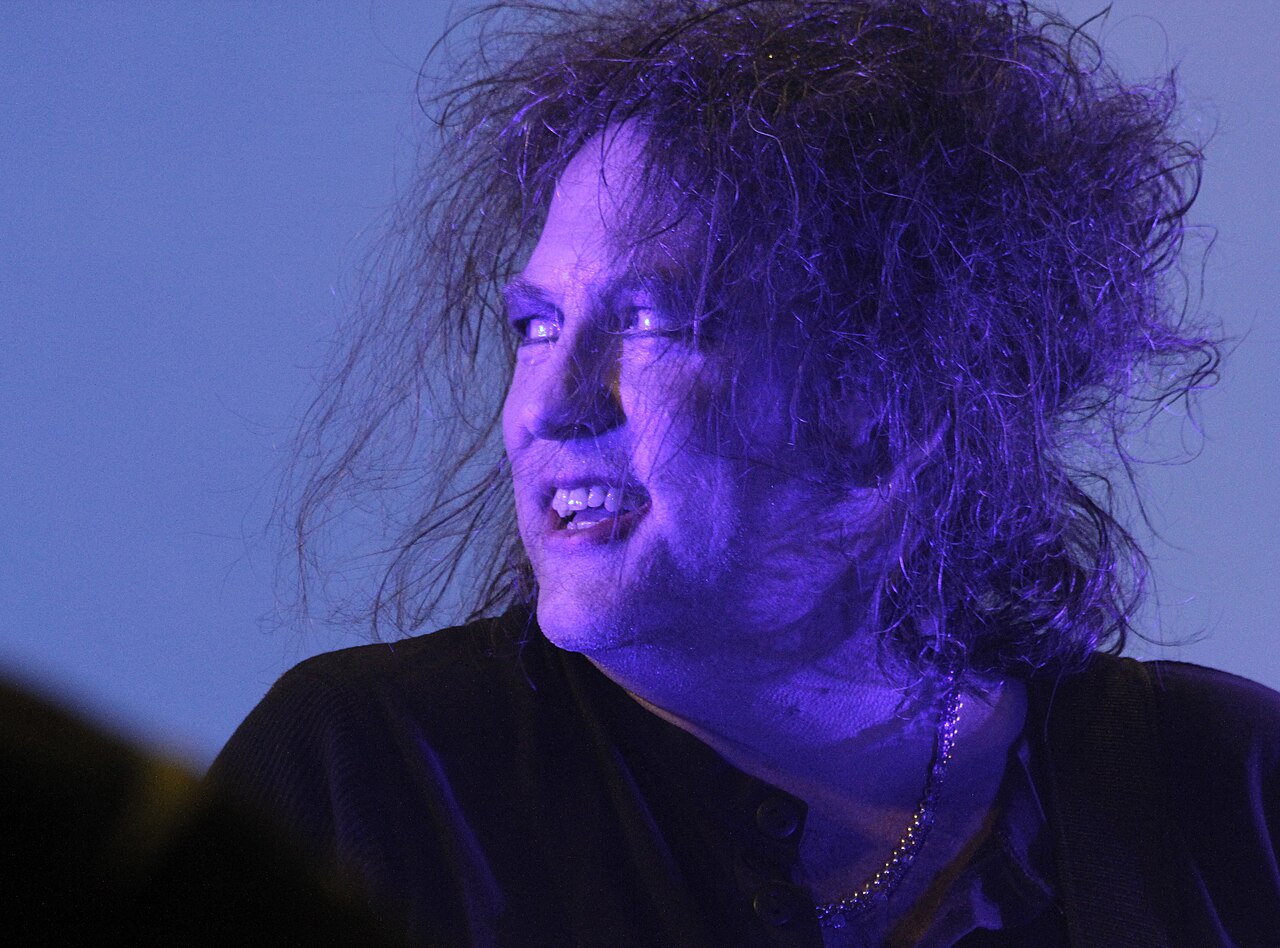
“How Not To Drown” — the album track Guitar.com used as its reference point for the drive-into-reverb setting — is a collaboration with Robert Smith of The Cure, whom the band’s own press material describes as one of their musical heroes. This is not a claim that Smith uses a Screen Violence; we have no evidence that he does, and we are not implying otherwise. It is simply worth understanding that the specific song most often cited when describing this pedal’s flagship sound has The Cure’s frontman on it, and that the aesthetic lineage runs directly through the chorus-drenched, reverb-soaked guitar language he spent forty years building.

The wider lineage, explicitly not a user list
Guitar.com’s review reached for two other reference points to describe what the pedal does: “lush shoegazing ambiences that would be right at home on a new Slowdive or Team Sleep album,” and “a powerful drive section that could easily take you into My Bloody Valentine territory.” Those are descriptions of a sonic tradition, not of ownership. Bilinda Butcher, The Edge, Jonny Greenwood, Thurston Moore and Lee Ranaldo all built parts of the vocabulary the Screen Violence draws on. None of them, as far as we can establish, owns one.
Our standard of evidence remains what it has been throughout this series: a dated, photographed board in a published rig rundown, a manufacturer artist page, or a direct quote from the player. For the Screen Violence, CHVRCHES clear that bar comprehensively and nobody else we have looked at clears it at all. Given that the pedal launched in mid-2022, was sold in limited quantity direct from OBNE and at CHVRCHES gigs, and sold out, that thin field is a function of scarcity rather than of quality.
Tone Recipes
“How Not To Drown” — the flagship
First toggle: Violence first. Violence 4 o’clock, Gain toggle up, Voice noon, Volume to unity. Mode 2 (reverbs), Screen noon, Mix noon. This is the setting Guitar.com identified by name — a gain-soaked modulated reverb that stays legible because the ambience is generated after the dirt. Play sustained fifths high on the neck.
Post-rock bath
First toggle: Screen first. Mode 2, Screen 3 o’clock, Mix 2 o’clock. Violence 11 o’clock, Gain toggle down, Voice 1 o’clock. The reverb tail itself gets driven, so decays bloom and compress rather than fade cleanly. Guitar.com’s reference points were This Will Destroy You and Daughter; add volume swells and it is straightforwardly a Walrus SLÖ substitute with teeth.
Synth widener (the pedal’s actual design purpose)
Mono in, stereo out. Mode 2, Screen 1 o’clock, Mix 1 o’clock, Violence off entirely. Feed it a mono synth output and take two lines to the desk. This is the use case Cook described, and the one that most owners never try because they plug a guitar in and never unplug it.
Chorus and slapback, no drive
Mode 1, Screen 10 o’clock, Mix noon, Violence bypassed. A slow, wide chorus with a hint of doubling. Push Screen to 1 o’clock and the delay stages come forward into slapback. Directly comparable in role to a Walrus Julia V2, though the Julia is far more controllable and the Screen Violence is far more likely to surprise you.
Pitch-vibrato queasiness
Mode 1, Mix fully clockwise (wet only), Screen 11 o’clock. With no dry signal to anchor it, the chorus becomes a slow pitch vibrato. Advance Screen from there for progressively more unstable results. Best with an expression pedal on the Screen jack so you can walk into and out of it.
Stacked filth
Mono operation, both drive sections stacked (see the activation caveat above). Violence 2 o’clock, Gain up, Voice 11 o’clock. Screen off. Feedback becomes a playable instrument at stage volume; this is the setting Doherty records and then chops up.
All settings assume clock positions with the pedal in front of a clean-ish amp. Adjust Volume to taste; the drive section has more output than you expect.
Where It Sits Against the Alternatives
The Screen Violence has an awkward relationship with the rest of the market, because almost nothing does the same job.
If you want a great stereo reverb and nothing else, you are better served elsewhere and for less money. The Strymon blueSky V2 is more refined, the Source Audio Ventris is far more flexible, the Meris Mercury7 is more distinctive, and the EHX Oceans 11 does eleven algorithms for a fraction of the price. None of them will drive your reverb tails, and none of them has a macro knob.
If you want reverb plus drive in one box, the closest relatives are the EarthQuaker Avalanche Run (delay/reverb with a very different flavour of chaos) and the ambient-machine end of the market that Guitar.com itself flagged as alternatives: Catalinbread Cloak, Collision Devices Black Hole Symmetry, AC Noises Ama v2. The Black Hole Symmetry is the only one of those that also gives you order-switching, and it is a considerably larger and more expensive proposition.
If you want one knob that does everything, the philosophical siblings are elsewhere in the boutique world: the Chase Bliss Habit, the Generation Loss MkII, and OBNE’s own Visitor, whose Secondary knob is exactly the same design idea applied to modulation. The Screen Violence’s macro is less deep than Chase Bliss’s and considerably more immediate.
And if you want the CHVRCHES sound, there is no alternative, because this is the only pedal that contains it.
Buying Guide and Ownership Notes
Availability. Old Blood’s product page currently lists the Screen Violence as sold out, and it does not appear in their live catalogue as a standing item. This was always a limited proposition — sold direct from OBNE and, per the launch materials, “wherever you find CHVRCHES playing live.” That means the secondhand market is the realistic route, and pricing there is a function of scarcity rather than of function.
What to check on a used unit. Ask whether it is one of the first 200 with the signed card of authenticity, which carries a collector premium independent of the pedal’s sound. Check both footswitches individually — these are soft-touch switches driving bypass relays, which are more reliable than mechanical 3PDTs but not immune. Confirm the First toggle actually changes the sound in both positions. Test both output jacks; a stereo pedal that has spent its life in mono may have a right-channel jack nobody has ever used, and faults hide there.
The manual. Get it. Old Blood supply it as a PNG that doubles as a small poster — Guitar.com’s reviewer specifically praised the attention paid to it, and it contains suggested presets that are genuinely useful on a pedal this opaque. If the seller doesn’t have it, the file is linked from Old Blood’s own product page.
Board planning. 140 × 102 mm is a wide pedal, and its jacks are top-mounted, which helps. Budget an isolated 9V output at 110 mA or more. There is no battery option. If you intend to use the expression jack — and you should — allow room for the cable and treadle.
Signal-chain placement. Old Blood’s own copy says it is “equally happy at many points in a signal chain,” which is unusually honest hedging. In practice: guitar → pedal → amp works fine; so does putting it in an effects loop, feeding it a synth, or running it as the last box before a stereo pair. Because both sections are independently bypassable, it survives being placed anywhere.
Frequently Asked Questions
Is the Screen Violence a distortion pedal or a reverb pedal?
Neither, exactly, which is why Old Blood invented a category for it: “Stereo Saturated Modulated Reverb.” It contains a genuinely good overdrive and a genuinely good stereo ambient engine, and its point is what happens when you change the order they run in. Retail listings that file it under “distortion” are following a database category, not the manufacturer.
Do I need to be a CHVRCHES fan to want one?
No, though it helps to know what the album sounds like, because the pedal is a compression of that record. If you play shoegaze, post-rock, ambient or anything where guitars are meant to sound like weather rather than like guitars, it works regardless of your feelings about synth-pop.
What does the Screen knob actually control?
Multiple parameters at once, and the specific parameters depend on the Mode toggle. In Mode 1 you sweep from slow chorus through doubling into slapback delay via a chain of delay stages feeding a chorus. In Mode 2 — true stereo — you sweep through a blend of three reverbs, short to medium to long, ending at a near-infinite trail. It is a macro, not a single parameter, and that is deliberate.
Can I use it with a synth or bass?
Yes, and that was an explicit design goal. Iain Cook’s stated aim was a pedal versatile enough for “guitars, synths, bass or whatever we wanted to throw at it,” and Martin Doherty runs OBNE pedals in his synth rig as well as his guitar rig. The stereo Mode 2 fed from a mono synth output is arguably the pedal’s best trick.
Does it work in mono?
Yes. It runs mono-to-mono, mono-to-stereo and stereo-to-stereo via top-mounted jacks. Note that Mode 1 on the Screen side does not accept a stereo input — only Mode 2 is true stereo. In mono operation the second drive channel becomes available for stacking.
How do I engage Stacked Violence mode?
Sources disagree, and we would rather say so than guess. MusicRadar’s launch coverage describes holding both footswitches down simultaneously. Delicious Audio describes it as automatic whenever the pedal is running mono-to-mono or mono-to-stereo. Check your own manual, which Old Blood supply as a PNG on the product page.
What power supply does it need?
9V DC, centre negative, 2.1 mm barrel, mains only — no battery. On current draw, Old Blood’s product page says 110 mA, their press release said “at least 100mA,” and Guitar.com’s spec box lists 100 mA. Use an isolated output rated comfortably above 110 mA and you will be fine. Do not daisy-chain it.
Is it worth chasing on the used market?
If you want the specific interaction of a wide-range overdrive with a stereo modulated reverb and the ability to reverse their order with a toggle, then yes — because that combination is close to unique and the pedal is out of production. If you mainly want a good reverb or a good drive, there are better and cheaper single-purpose options in this series, several of which are still on shop shelves. Buy it for the architecture, not for either half.
Image credits
- Top image: GuitarGangsters AI-generated reference illustration, not a photograph.
- Robert Smith: Christopher Johnson, Wikimedia Commons, CC BY-SA 2.0.
- Robert Smith: Bill Ebbesen, Wikimedia Commons, CC BY-SA 3.0.
Latest News
Related
On This Day
Wednesday 11 November
From this week: