Strymon blueSky Reverberator V2: The Pedal That Taught Guitarists To Care About Reverb
Strymon blueSky Reverberator V2 guide: plate, room and spring explained, verified famous players, tone recipes, V1 vs V2, buying advice and full FAQ.
For most of the electric guitar’s history, reverb was not a decision. It was a tank of springs bolted into the bottom of an amplifier, and you had one knob, and the knob went from “dry” to “surf.” Nobody chose it. It was simply the sound of the room the amp pretended to be in.
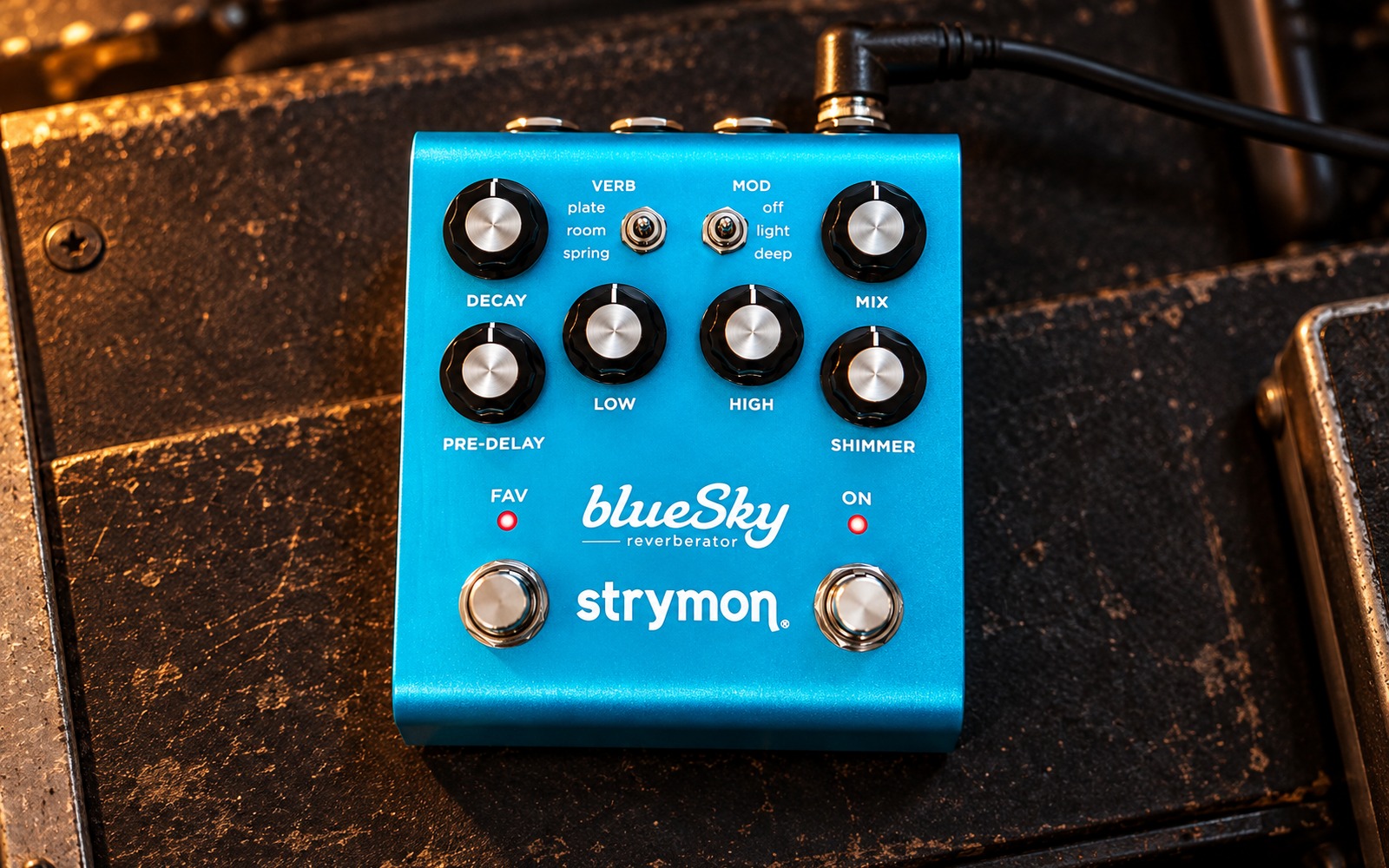
Then in 2010 a small company in Westlake Village, California put a compact blue enclosure on the market that treated reverb the way a mastering engineer treats reverb — as an instrument in its own right, with a decay envelope you shape, a pre-delay you set deliberately, and a tonal character you damp at both ends. The Strymon blueSky Reverberator did not invent the ambient guitar pedal. What it did was make studio-grade reverb small enough, cheap enough and reliable enough that a working guitarist could put one on a pedalboard and stop apologising for the amp’s spring tank.
Twelve years later Strymon rebuilt it. The blueSky V2, which went on sale on 28 June 2022 as part of a six-pedal “next generation” refresh, keeps the original voicings intact and adds the things a decade of working players kept asking for: a dedicated Shimmer knob, separate Low and High damping controls, a properly re-engineered spring algorithm, an analogue JFET front end, stereo input, USB-C, and full MIDI with 300 preset slots.
This is a gear guide, not a review. What follows is what the blueSky V2 actually does, what its three algorithms are actually modelling, which famous players are actually documented using one — and, importantly, which of the names attached to this pedal in circulation do not survive five minutes of checking.
The Artist List Attached To This Pedal Is Partly Wrong, And One Name Is Impossible
Five players are listed for the blueSky: Jeff Beck, Kurt Cobain, Graham Coxon, James Hetfield and Nuno Bettencourt. Two of those hold up under scrutiny. One of them is chronologically impossible. Two are unsupported.
Kurt Cobain died in April 1994. The blueSky Reverberator was released in 2010. There is no version of this pedal that Cobain could have touched, and the claim should never have been made. It is a useful reminder of how gear rosters degrade: a famous name attaches itself to a brand, then to a category, then to a specific product it predates by sixteen years, and nobody checks the dates. Cobain’s actual reverb was whatever was in the amp, plus, on occasion, an Electro-Harmonix Small Clone doing modulation duty — a different effect entirely.
James Hetfield and Nuno Bettencourt likewise turn up nowhere in the documented usage record for this pedal — not in manufacturer material, not in photographed pedalboards, not in rig features. Both are high-gain players whose signal chains are built around amplifiers and channel switching; neither has a reverb pedal at the centre of his sound. Their inclusion appears to be roster padding.

What is documented is genuinely impressive, and the Famous Players section below tiers every name by how strong the evidence actually is.
Origins: Damage Control, Westlake Village, And A Company That Started With DSP
Strymon is a division of Damage Control Engineering, and the company’s history explains a great deal about why its reverbs sound the way they do. Damage Control’s earlier products were tube-driven effects; when the team pivoted to the Strymon brand around 2008, they brought with them a set of engineers whose instincts were pointed at digital signal processing rather than at cloning circuits. That distinction matters. A boutique overdrive company argues about capacitor types. Strymon argues about algorithms.
The original blueSky arrived in 2010 alongside the company’s early wave and did something that, at the time, was rare in a pedal-sized box: it ran genuinely high-resolution conversion — 24-bit at 96 kHz, with a full 20 Hz to 20 kHz frequency response — and it committed enough processing headroom to the reverb tail that the decay did not turn grainy or metallic when you pushed it into ambient territory. Compact reverb pedals in 2010 mostly sounded fine at short settings and fell apart when you asked for eight seconds of decay. The blueSky did not fall apart.
The other thing it did was give you three algorithms rather than eleven. Where the later Strymon BigSky offers a full library of reverb machines, the blueSky offers plate, room and spring — and then hands you real control over each. It is a philosophical choice, and it is the reason the blueSky has survived on professional boards for a decade and a half while flashier pedals came and went. Three good sounds you can shape beat twelve you cannot.
What Changed In V2
Strymon’s own line on the V2 is that they “preserved the original sound and functions while updating the user interface for expanded I/O and control.” That is honest but undersells it slightly, because one algorithm was genuinely rewritten.
The controls that are new
The V1 had a single Tone knob and a hidden secondary parameter layer. The V2 splits tone into Low and High damping, each running from heavily damped at minimum to no damping at maximum. This is the single biggest usability change: you can now roll the low end out of a long plate tail so it does not mud up a busy mix, while leaving the top end wide open — a thing that took menu-diving on the V1.
Shimmer gets its own knob and, more interestingly, its own behaviour per algorithm rather than one global pitch effect. On plate, Shimmer adds regenerative octave-up pitch shifting — the classic ascending-cathedral sound. On room, it adds an octave plus a fifth, which stacks into something closer to a synthetic string pad. On spring, and this is the genuinely novel one, it adds an octave-down pitch effect with an adjustable LFO speed, producing a queasy, sub-octave drone underneath the spring splash that has no obvious precedent in any other reverb pedal.
The Mod control was re-engineered as a three-position toggle: off, light, or deep, selectable per reverb type. On the V1, modulation was essentially a fixed flavour.
The hardware that is new
A discrete Class A JFET preamp input replaces the old front end — high impedance, ultra low noise, and the practical result is that the pedal responds to pick attack and volume-knob rolls more like an analogue circuit than a converter. A rear-panel switch selects mono or TRS stereo input; the outputs are stereo either way. A new ARM DSP chip supplies more processing power while drawing less current. And there is now an externally mounted USB-C jack for firmware updates, which anyone who ever tried to update a V1 will appreciate.
The control that is new
Full MIDI implementation over the EXP/MIDI jack (1/4″ TRS) or over USB, with 300 onboard preset locations. Practically every knob, switch and setting is remotely addressable. The V2 also accepts a standard TRS expression pedal for continuous control over any knob, or a Strymon MultiSwitch Plus / MiniSwitch for extra footswitching. New power-up modes let you choose true or buffered bypass, line or instrument level, and — the one that matters live — spillover, so the tail keeps decaying after you stomp the pedal off instead of being guillotined.
Specifications
The Three Algorithms, In Plain Language
Plate
A model of a vintage studio plate — the EMT-style suspended steel sheet that gave 1960s and 1970s records their sheen. Plate reverb has no early reflections in the way a room does; it goes straight to a dense, smooth wash. That makes it the most forgiving algorithm on the pedal and the reason most players who own a blueSky leave it on plate. It sits behind a clean chord without arguing, and it takes long decay settings better than either of the other two. With Shimmer up, plate is where the octave-up cathedral sound lives.
Room
Strymon’s description — “a versatile room ranging in size from a bedroom to an arena” — is not marketing fluff; the decay control genuinely rescales the space rather than just extending the tail. Short room settings are the most useful thing on this pedal for anyone playing in a band, because they add dimension without adding audible reverb. Long room settings get you something closer to a hall. Shimmer on room adds an octave and a fifth, which is a much more chordal, pad-like effect than the plate’s pure octave.
Spring
This is the algorithm Strymon rewrote for V2, and it is a substantial improvement. The original blueSky’s spring was competent; the V2’s is convincing — you get the drip, the clang on hard attacks, and the slightly uneven decay that makes real tanks sound alive. It is not a replacement for the tank in a Supro Black Magick Reverb or a blackface Fender, but it is close enough that most listeners will not separate them in a mix. And with Shimmer engaged, spring does the octave-down thing, which is unlike anything else in the category.
Famous Players: Who Actually Uses One
Every name below is tiered by evidence strength. Where a source is a crowd-sourced photograph rather than a first-party statement, that is stated.
Tier 1 — first-party statements or professional-press documentation
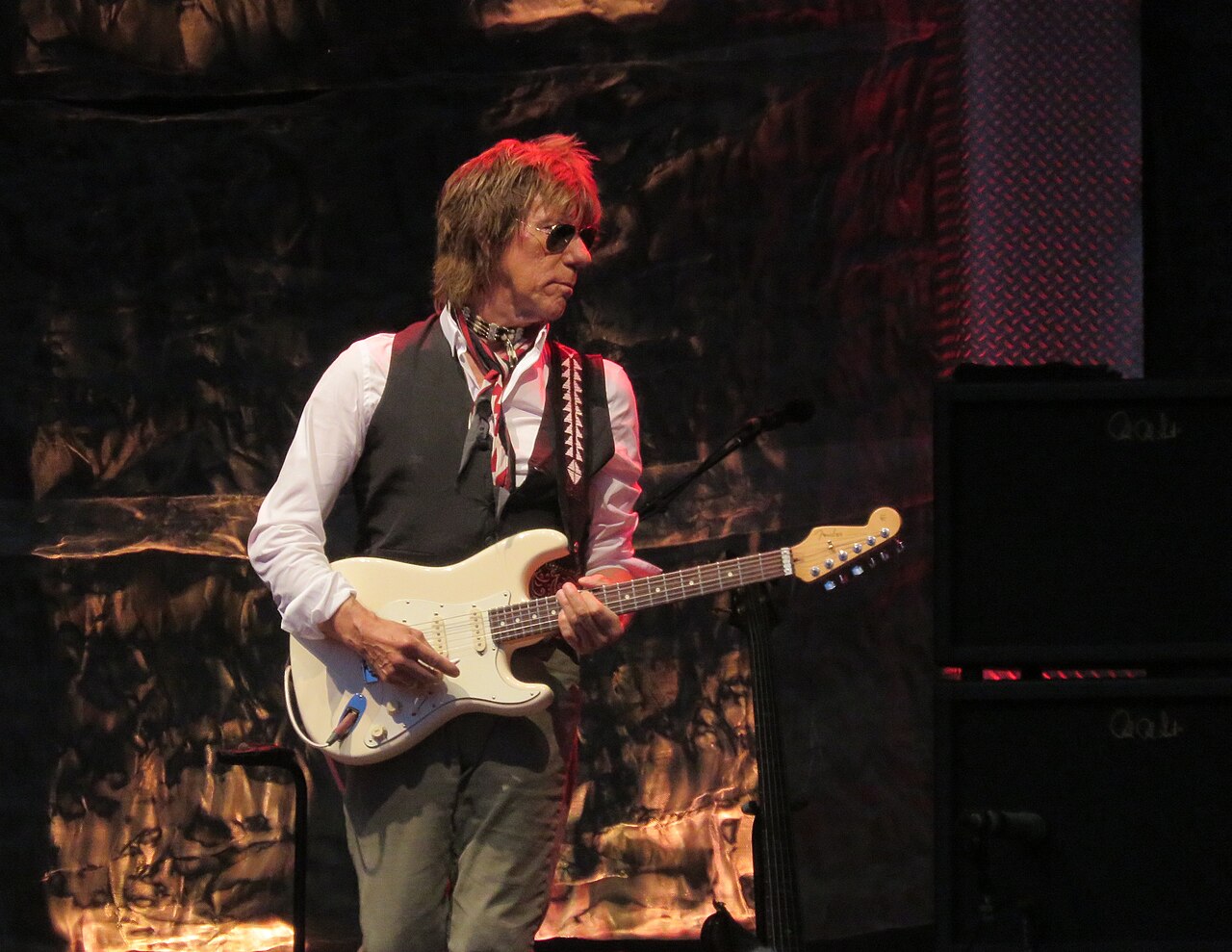
Jeff Beck . Beck’s tech Stevie Prior confirmed to Vintage Guitar magazine that Beck used the blueSky on his solo shows. For a player whose entire vocabulary was built on volume swells, whammy-bar vibrato and sustained notes bending in and out of pitch, a high-resolution reverb with a long, clean tail is not decoration — it is the thing that lets a swelled note keep existing after the pick is gone. Beck died in January 2023; the reference is historical, not current.
Jessica Dobson (Deep Sea Diver, formerly The Shins) — documented by Chris Kies for Premier Guitar, whose Rig Rundown identifies the specific pedal on her board as the V2, distinguishable from the original by its extra knobs. Dobson is one of the clearest V2 sightings in the professional press.
Leo Wyndham (Palace) — the most explicit endorsement on record. In Gear Masters episode 460 he walks through his board and, at 6:03, describes the blueSky as his standard reverb, on every song. That is about as unambiguous as a documented usage claim gets.
Steve Lukather — pictured with the blueSky on his current live board via Ernie Ball’s Instagram, with the pedal also appearing in the rig documentation on his official site. Lukather is an interesting inclusion because his session-era sound was built on rack reverbs; putting a compact pedal in that role is a meaningful vote of confidence.
Stu Mackenzie (King Gizzard and the Lizard Wizard) — credited with a blueSky in the liner notes for The Silver Cord on Bandcamp. Liner-note credits are first-party documentation and rank above photographs.
Mateus Asato — posted about his pedalboard on Instagram in September 2016 and singled the blueSky out, saying he keeps it separate because he uses it every time he records. A recording-specific endorsement from a player whose entire sound is built on clean-tone sustain.
Taylor Hawkins — discussed his blueSky on camera in a Sotheby’s feature on collecting and rock and roll style. Hawkins was a drummer, which makes the mention a nice illustration of how far this pedal travelled outside its category.
Tier 2 — photographic and rig-build documentation
Graham Coxon . Dan Steinhardt of That Pedal Show posted a photograph of a completed pedalboard including the blueSky, describing it as built and delivered for Coxon with help from Joe at The GigRig. That is a rig-builder attribution rather than a quote from Coxon himself, so it sits in Tier 2 — but it is solid.

Matthew Bellamy (Muse) — Bellamy’s guitar tech Chris Whitemyer described the rig’s RJM loop switcher as bringing in, among other things, a Korg SDD delay, a Whammy, a Strymon blueSky reverb and a ZVEX Fuzz Factory. Tech testimony on a specific pedal in a specific loop is strong evidence.
Eric Johnson — spotted on his pedalboard in a Facebook photograph from June 2017. Johnson is famously particular about signal path and battery type, so a digital reverb making his board is notable in itself.
Chris Shiflett (Foo Fighters) — visible second from the left in the bottom row of a pedalboard photograph posted by Heptode in October 2014.
Justin Vernon (Bon Iver) — XAct Tone Solutions published photographs of the rack gear they built for Bon Iver, and a blueSky appears in one of the trays. Given how central processed, pitch-shifted ambience is to Bon Iver’s guitar sound, this one fits the music.
Taylor York (Paramore) — photographed with a blueSky on his board.
William Tyler — confirmed with a V2 on his 2024 pedalboard. Tyler’s instrumental, Americana-adjacent work is exactly the use case the plate algorithm was built for.
John Osborne (Brothers Osborne) — shown demonstrating a V2 on a Pedaltrain Nano+ in a 2024 home-studio tour video.
Sebastian Danzig (Palaye Royale) — a V2 identified in a June 2023 Instagram post from Graspop Festival.
Novo Amor — a V2 photographed on his pedalboard during a Spanish tour.
Four Tet — not a guitarist, but Kieran Hebden walks through the sends on his live DJ setup in a video and the blueSky is part of it. Worth including because it tells you something real about the pedal: at line level, into a mixer send, it works as a studio effect and not just a guitar pedal.
The pattern
Equipboard’s genre breakdown for the blueSky is dominated by rock, alternative rock and indie rock, with pop, folk and dream pop close behind. That is the honest picture: this is a pedal for players who want their clean and lightly-driven tones to have depth. It is not a metal pedal.
Tone Recipes And Settings
“Always on” band reverb
Type: room. Decay 9 o’clock. Mix 10 o’clock. Pre-Delay minimum. Low 11 o’clock. High 1 o’clock. Mod off. Shimmer off. This is the setting that makes a guitar sound recorded rather than DI’d, without anyone in the room being able to point at reverb. Pull the Low back further if you play in a band with an active bass player.
Vintage surf spring
Type: spring. Decay 11 o’clock. Mix 12 o’clock. Pre-Delay minimum. Low 2 o’clock. High 2 o’clock. Mod off. Shimmer off. Hard picking will produce the clang; that is correct behaviour. If you want the amp-tank sound specifically, keep Pre-Delay at zero — real tanks have essentially none.
Studio plate for solos
Type: plate. Decay 1 o’clock. Mix 11 o’clock. Pre-Delay 10 o’clock. Low 10 o’clock. High 2 o’clock. Mod light. Shimmer off. The pre-delay is doing the work here: it keeps the attack of each note clear of the wash, so lines stay articulate at higher mix settings. This is the classic mastering-desk trick applied to a pedalboard.
Ambient cathedral
Type: plate. Decay 4 o’clock. Mix 2 o’clock. Pre-Delay 12 o’clock. Low 9 o’clock. High 3 o’clock. Mod deep. Shimmer 1 o’clock. Roll the low damping well down or the octave-up regeneration will pile up into mud. Play sparse — one chord every four bars — and let the pedal do the arranging. Put a volume pedal in front of it for swells.
The octave-down spring drone
Type: spring. Decay 3 o’clock. Mix 1 o’clock. Pre-Delay 9 o’clock. Low 12 o’clock. High 11 o’clock. Mod light. Shimmer 2 o’clock. This is the V2-exclusive sound and it has no equivalent elsewhere. The sub-octave sits underneath the spring splash like a detuned organ. It is unsettling on purpose and it is superb for anything cinematic or doom-adjacent.
Synthetic pad
Type: room. Decay 3 o’clock. Mix 3 o’clock. Pre-Delay 11 o’clock. Low 10 o’clock. High 12 o’clock. Mod deep. Shimmer 12 o’clock. The octave-plus-fifth Shimmer on the room algorithm stacks into something genuinely keyboard-like. Hold a fifth on the bottom two strings and let it bloom.
Chain placement
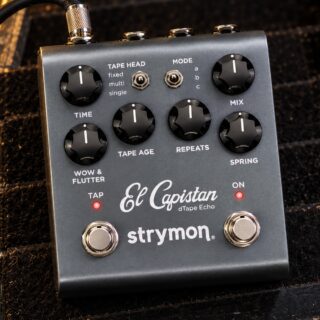
Standard practice puts the blueSky last in the chain, after delay — so El Capistan or TimeLine into blueSky, not the other way round. Reverbing your delay repeats sounds like a room; delaying your reverb tail sounds like a mistake. If you run an amp modeller such as the Strymon Iridium, put the blueSky after it and switch the pedal to line level. In a four-cable-method rig, blueSky belongs in the effects loop.
Knob positions are given as clock positions. Remember that Mix is 50/50 at 3 o’clock, not at noon — this is the single most common thing new owners get wrong, and it is why so many first-time settings sound too dry.
How It Compares
blueSky V2 vs Strymon BigSky
The obvious first question, and the answer is not “more is better.” The BigSky gives you twelve reverb machines, a larger enclosure, and a screen. The blueSky gives you three, in a fraction of the footprint, at roughly half the price. If you know that plate, room and spring cover your needs, the blueSky is not a compromised BigSky — it is a more focused instrument with deeper per-algorithm control than the BigSky offers on any single machine. Buy the BigSky if you want nonlinear, reverse, cloud and chorale textures. Buy the blueSky if you want three great sounds and a board you can carry.
blueSky V2 vs Strymon Flint
Flint combines tremolo with three vintage-amp reverbs — ’60s spring, ’70s plate, ’80s hall — and is aimed squarely at recreating amplifier ambience. The blueSky is aimed at studio ambience. Flint’s reverbs are shorter, darker and more period-correct; the blueSky’s are longer, cleaner and more shapeable. Players chasing a blackface amp sound in a pedal want Flint. Players chasing a mix engineer’s reverb want blueSky.
blueSky V2 vs Strymon NightSky and Cloudburst
Strymon’s own reverb line has diverged usefully. NightSky is an experimental, sequenceable texture synthesiser that happens to be a reverb; Cloudburst is a compact, ensemble-flavoured ambient pedal with an “Ensemble” voice-like layer. The blueSky sits between them as the conventional, professional, do-the-job reverb. If your reaction to the phrase “reverb pedal” is that you want the sound of a room and a plate done extremely well, the blueSky is still the one.
blueSky V2 vs Boss RV-6 and RV-500
The Boss RV-6 is roughly a fifth of the price and covers a wider spread of modes with less depth in each. It is a superb value pedal and genuinely good; the blueSky beats it on tail quality, converter resolution, front-end feel and control depth, and costs accordingly. The RV-500 is a closer fight — deep editing, presets, MIDI — but is a menu-driven flagship rather than a knob-per-function pedal. If you edit at home and recall live, the RV-500 makes sense. If you turn knobs on stage, the blueSky does.
blueSky V2 vs TC Electronic Hall of Fame 2 and EHX Oceans 11
The Hall of Fame 2 brings MASH pressure-sensitive footswitching and TonePrint, at well under half the price. The EHX Oceans 11 is arguably the best value in reverb full stop, with eleven modes in a small box. Both are excellent. Neither has the blueSky’s headroom on very long decays or its analogue front end, and neither offers per-algorithm damping control. The gap is real but it is a gap of degree, and for a player who uses reverb as seasoning rather than as an instrument, the cheaper pedals are the sensible purchase.
blueSky V2 vs Walrus Audio SLÖ and Fathom
The Walrus SLÖ is the blueSky’s most direct boutique rival in the ambient space and is a more overtly characterful, less neutral pedal — SLÖ wants to be heard. Fathom undercuts the blueSky substantially and covers hall, plate, lo-fi and sonar with a modulation depth control. The Strymon wins on transparency and on MIDI; the Walrus pedals win on personality and price.
Other useful reference points
The EHX Holy Grail Neo remains the fastest way to get one good spring sound. The MXR M300 packs six studio-grade algorithms into a compact box with genuine quality. The Keeley Caverns V2 and the JHS 3 Series Reverb come at the problem from opposite ends — combined delay-and-reverb versus radical simplicity.

Buying Guide
Is the V2 worth it over a used V1?
The core plate and room voicings are the same, so if you already own a V1 and use it on plate at moderate settings, the upgrade is optional. Buy the V2 if you want any of the following: separate Low and High damping, Shimmer as a real-time knob, the rewritten spring algorithm, stereo input, MIDI presets, or spillover. The rewritten spring alone justifies it for anyone who bought a blueSky for surf or country work and quietly went back to using the amp.
What it costs
The blueSky V2 sells for $379 new direct from Strymon as of September 2026, and it is in stock and in current production — there is no discontinuation notice on the product page. Used V2s appear on the secondary market in the region of $260 to $310 depending on box and condition. Original V1s have settled around $230 to $280, which makes them a strong buy for a player who wants the Strymon plate sound and does not need MIDI.
Who should buy one
Buy a blueSky V2 if reverb is a compositional element in your playing rather than a garnish — if you write with sustain, if you use volume swells, if your clean tone is the main event, or if you play in a stereo rig. Buy it if you need MIDI recall in a preset-driven live setup. Buy it if you are building a Strymon-based board and want everything on one control protocol.
Who should not
If you play high-gain rhythm and use reverb only for solos, a Boss RV-6 will do the job for a fraction of the money. If you want reverb to be a strange, unpredictable instrument, NightSky or the Walrus SLÖ will get you further. And if your amp already has a good tank in it, be honest about whether you are solving a problem or shopping.
Ownership Notes
Power is not negotiable. 9 VDC, centre negative, 300 mA minimum. There is no battery compartment and there is no battery operation. A cheap daisy chain will not supply this reliably alongside other digital pedals; use an isolated supply with a properly rated output. Under-powering a Strymon is the most common cause of “my new pedal sounds wrong.”
Stereo requires the right cable. The input is a single jack. To feed it a stereo signal you need a TRS adapter cable and you must flip the rear-panel switch to STEREO. Outputs are stereo regardless; use Out L alone for mono.
Set the bypass mode deliberately. The V2 lets you pick true bypass or buffered bypass at power-up. Buffered with spillover is almost always the better choice for a reverb — true bypass will cut your tail dead the instant you disengage, which sounds abrupt at the end of a passage.
The Favorite footswitch is one preset, not a bank. Press and hold until the LED flashes blue, then press to save. The 300 preset locations are MIDI-addressable, not accessible from the pedal’s own footswitches — you need an external MIDI controller, a Strymon Conduit, or a MultiSwitch Plus to use them live.
Line level exists for a reason. If you are running the blueSky after a modeller, in a mixer send, or in a studio patchbay, switch it to line level. Leaving it at instrument level in a line-level chain will cost you headroom.
Firmware updates go over USB-C, which on the V2 is externally mounted. This is a real improvement over the V1 and worth checking after purchase — a used pedal may be several revisions behind.
Frequently Asked Questions
Did Kurt Cobain use a Strymon blueSky?
No, and he could not have. Cobain died in April 1994; the blueSky was released in 2010. Any list that attaches his name to this pedal is repeating an error. His actual modulation and ambience came from the amp and from an Electro-Harmonix Small Clone chorus.
Did Jeff Beck use a blueSky?
Yes. Beck’s tech Stevie Prior confirmed to Vintage Guitar magazine that Beck used the blueSky for his solo shows. It is one of the better-documented associations the pedal has, and it makes musical sense given how much of Beck’s playing depended on sustained, swelled notes.
What is the difference between the blueSky and the BigSky?
The BigSky has twelve reverb machines, a display and a larger enclosure. The blueSky has three algorithms — plate, room and spring — in a compact box, with deeper per-algorithm shaping than the BigSky gives any single machine, at roughly half the price. Neither replaces the other; they answer different questions.
Is the blueSky V2 worth upgrading from the V1?
If you use spring, or want Shimmer on a knob, or need separate low and high damping, or need MIDI presets and stereo input — yes. If you use the plate algorithm at moderate settings and nothing else, the V1 still sounds the same and the upgrade is optional.
Can the blueSky V2 run on a battery?
No. It requires 9 VDC centre negative at 300 mA minimum from an external supply. There is no battery compartment.
Where should the blueSky go in my signal chain?
Last, after delay. Drives and modulation first, then delay, then reverb. In an amp with an effects loop, put it in the loop. After a modeller such as the Iridium, put it last and switch it to line level.
Why does my blueSky sound too dry at noon on the Mix knob?
Because the 50/50 point on this pedal is at 3 o’clock, not at noon. The Mix control runs from 100% dry at minimum to 100% wet at maximum with an intentionally non-linear taper that gives you fine control in the useful range. Turn it further than instinct suggests.
What does Shimmer actually do on each algorithm?
On plate, regenerative octave-up pitch shifting — the ascending cathedral sound. On room, an octave plus a fifth, which behaves more like a synth pad. On spring, an octave down with an adjustable LFO speed, which is unique to this pedal and unlike anything else on the market.
The Verdict That Isn’t A Verdict
The blueSky’s real achievement was never a spec on a sheet. It was that in 2010 it made a certain kind of guitarist possible — the one whose sound is built from sustain and space rather than from gain and attack — and made that sound portable, repeatable and roadworthy. Everything that came after it in the ambient pedal market, from Walrus to EHX to Strymon’s own NightSky, is arguing with a case the blueSky made first.
Sixteen years on, the V2 is still $379, still in production, still built in California, and still the pedal most working guitarists reach for when they want reverb that sounds like a decision rather than an accident. The famous-player list attached to it is half fiction, but the half that survives — Beck, Bellamy’s rig, Lukather, Coxon’s board, Dobson’s V2, Asato’s recording chain — describes exactly the kind of player it was built for.
Image credits
- Top image: GuitarGangsters AI-generated reference illustration, not a photograph.
- Jeff Beck: Shannon Kringen from USA, Wikimedia Commons, CC BY-SA 2.0.
- Graham Coxon: XoxoHell, Wikimedia Commons, CC BY 2.0.
- Nuno Bettencourt: SebastyneNet, Wikimedia Commons, CC BY-SA 4.0.
- Jeff Beck: Shannon Kringen, Wikimedia Commons, CC BY-SA 2.0.
Latest News
Related
On This Day
Tuesday 10 November
From this week: