Caroline Guitar Company Shigeharu: The Fuzz Named After a Waiter, Built to Survive the Mix
Inside the Caroline Guitar Company Shigeharu octave fuzz: the Havoc switch, hidden bias trimpot, specs, tone recipes and buying advice.
Every fuzz pedal makes the same promise and most of them break it in the same place. Alone in a bedroom, through headphones, at midnight, a Big Muff sounds like the end of the world. Then the bass player plugs in, the drummer hits a ride cymbal, and the world-ending fuzz turns into a warm grey blanket sitting somewhere underneath everything. The frequencies you were relying on belong to somebody else now. You have been scooped out of your own band.
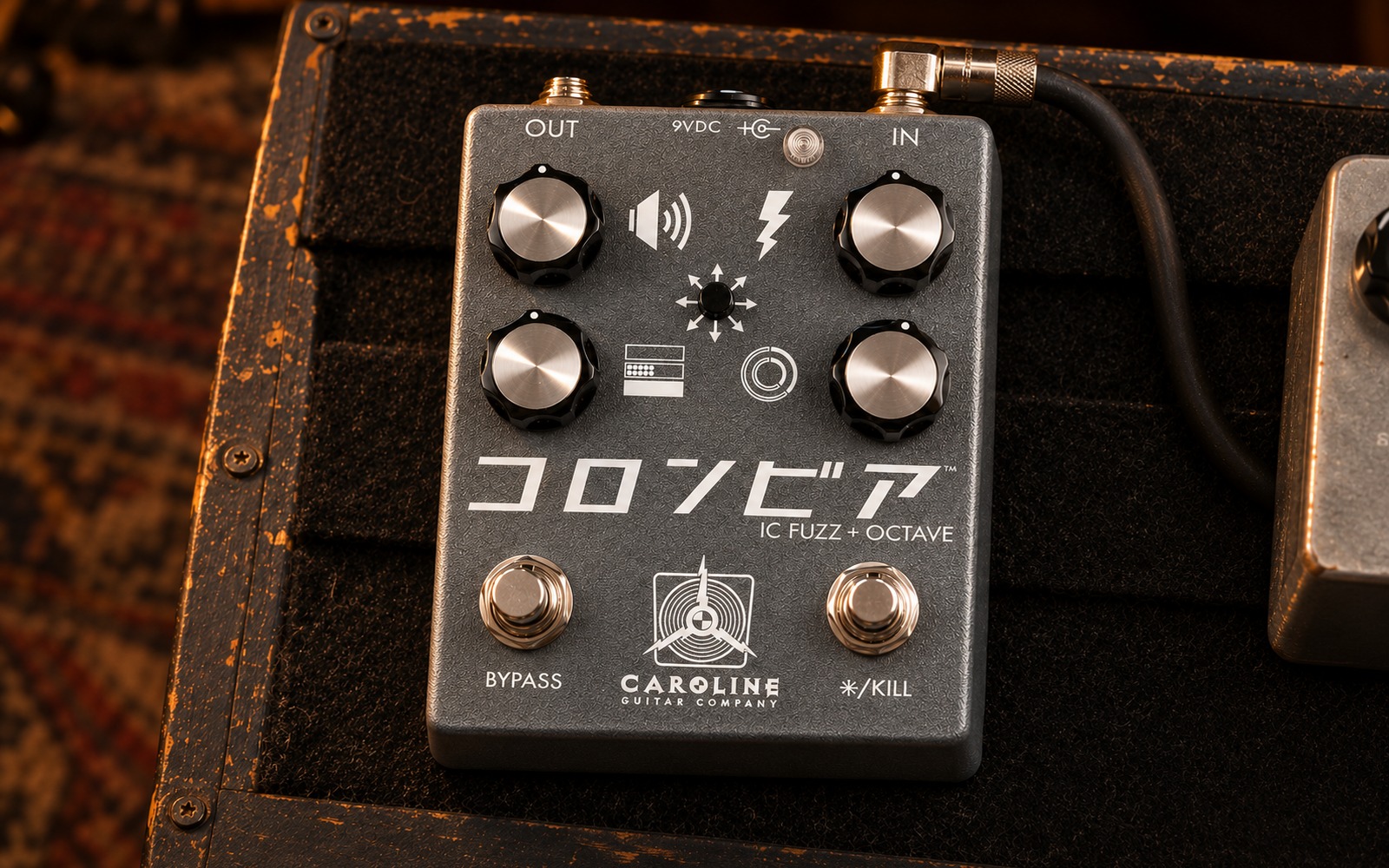
Caroline Guitar Company’s answer to that problem is a big grey-and-black box with Japanese script on it, five knobs, two footswitches, two secret controls under the lid, and a name borrowed from a waiter at a sushi restaurant in South Carolina. It is called the Shigeharu, it costs $219.99 from the factory, and its entire design brief was: make a Muff that does not disappear.
This is a feature on that pedal — what is inside it, where it came from, how to set it, and where it sits relative to the rest of the fuzz world. It is not a review. We have not scored it out of ten and we are not going to.
The Name, Because Everyone Asks
Caroline’s product names run to the surreal — Wave Cannon, Hawaiian Pizza, Kilobyte, Météore, Somersault, Icarus — so it is reasonable to assume Shigeharu is a reference to something. A samurai. A film. A synthesizer engineer.
It is a waiter. When Delicious Audio covered the pedal’s launch in April 2017, Christopher Scapelliti noted that the pedal was named “(for some reason, after the name of a waiter currently employed at a sushi restaurant in SC).” That is the whole story. A small pedal company in Columbia, South Carolina named its most aggressive fuzz after someone who had brought them dinner.
The Japanese script on the enclosure follows from the name rather than the other way round, and it is worth knowing because it is also the fastest way to identify a first-run unit: later special editions dropped the script, and the hammer-and-sickle motif on one prototype was replaced by a red star on the production run of that edition. More on the variants further down.
Columbia, South Carolina, and the Small Batch Distortery
Caroline Guitar Company was launched in 2010 by Philippe Herndon, and the company’s own About page tells the origin story with a shrug rather than a mission statement: it started “after Philippe Herndon unsuccessfully failed to sell his soul to any corporate devils still reeling from the financial collapse.” The plan was to make a handful of pedals to prove they could. People wanted more. They kept going.
Two details from that page matter for anyone weighing up a purchase. First, Herndon is “a former full-time touring and recording player,” which shows in the Shigeharu’s priorities — mix placement, buffer tolerance, output level — rather than in vintage-part fetishism. Second, Caroline claim to have been “the first guitar pedal company to crowdfund a pedal,” and have used pre-order specials to raise money for local charities. The Shigeharu’s manual signs off from “our small batch distortery™ in Columbia, S.C.” with a thank-you. It is a very small company that talks like one.
Caroline’s most famous moment in the wider gear press was not the Shigeharu. In his Premier Guitar Rig Rundown filmed at the Tivoli Theatre in Chattanooga and published on 8 December 2015 — at 65 minutes, the longest Rundown the magazine had made at that point — Jason Isbell discussed using a Caroline Wave Cannon in the studio on the solo of “Flying Over Water,” describing the pedal’s Havoc switch as making weird, glitchy, still-melodic noises with notes jumping octaves. Demand from viewers led Caroline to build a run of limited-edition custom-shop Cannonballs.
To be explicit, because this is the kind of thing that gets garbled into a fake endorsement: that is the Wave Cannon, not the Shigeharu, and it is a different circuit doing a different job. We flag it here as brand context and nothing else.
Designed With Electronic Audio Experiments
The Shigeharu was not developed inside Caroline alone. It was designed in collaboration with John Snyder of Electronic Audio Experiments, a builder then based in Boston, Massachusetts, and Caroline’s own explanation of why is the best line on their product page: the pedal “was fearsome enough to compel us to seek a second opinion.”
That is a joke, but there is a real point behind it. EAE’s work — the Model Feral, the Longsword, the Halberd — is characterised by very high headroom and very deliberate gain staging, which is precisely the axis on which the Shigeharu differs from a stock Muff. Two builders working on the same circuit means two sets of ears deciding when “loud and nasty” tipped over into “unusable,” and the Shigeharu lands considerably further out than most factory fuzzes without becoming a novelty.
What Is Actually Inside It
Caroline describe the Shigeharu as “a cascading hybrid of op-amp and BC184 transistor gain stages.” Unpacked, that means the front end of the pedal is an integrated-circuit gain stage rather than the discrete transistor input a classic four-transistor Muff uses, and the clipping happens downstream in transistor networks.
This is why the pedal behaves the way it does. An IC input stage presents a stable, high-headroom load that does not care much what is in front of it. A classic Fuzz Face-style germanium input, by contrast, is famously interactive with your guitar’s volume pot and famously miserable after a buffer. Caroline make the consequence explicit in the manual: the Shigeharu is built “to deliver high performance wherever you place it in your chain, even after buffers.” That is a design decision with a cost — you lose some of the touch-sensitivity purists chase — and a benefit: the thing works after a tuner, after a wireless unit, after three buffered Boss pedals, in the loop, wherever.
Guitar Pedal X’s Stefan Karlsson, who bought a Germanium Edition in January 2025, published a component-level description that goes further than the manufacturer’s copy: two BC184B transistors, two IC chips — an LF353P and an RC4558P — an audio transformer, and three diodes, of which two Schottkys serve the main hybrid fuzz. That RC4558 is the same op-amp family found in the original Ibanez TS808 Tube Screamer, which is not an accident: Caroline’s own shorthand for the circuit is “Screamer-ish punch and Muff-y hairiness.”
The octave section is a separate circuit sitting on top of the main fuzz, running in parallel rather than in series, with its own diode. That parallel topology is the single most important architectural fact about this pedal, and we will come back to it in the settings section.
Specifications
| Item | Detail |
|---|---|
| Model | Caroline Guitar Company Shigeharu (IC Fuzz + Octave) |
| Type | Hybrid op-amp/transistor fuzz with parallel octave-up circuit |
| Introduced | April 2017 (Delicious Audio launch coverage, 12 April 2017) |
| Origin | Handmade in Columbia, South Carolina, USA |
| Designed with | John Snyder, Electronic Audio Experiments |
| External controls | Drive, Body, Tone, Level, Havoc Level (small centre knob) |
| Footswitches | Bypass; Havoc (momentary by default) |
| Internal controls | Bias/gate trimpot; slide switch (octave always-on / footswitch becomes mute-kill) |
| Gain stages | IC drive stage feeding BC184 transistor clipping networks |
| Reported components | 2 × BC184B, LF353P + RC4558P ICs, audio transformer, 2 × Schottky diodes (Germanium Edition adds a vintage Soviet germanium diode in the octave path) |
| Bypass | True bypass |
| I/O | 6.35 mm (1/4″) mono in and out |
| Power | 9V DC, centre-negative, 2.1 mm barrel — Boss PSA or equivalent |
| Dimensions | 94 × 119 × 43 mm (W × D × H), per Thomann |
| Weight | 450 g, per Thomann |
| Price | $219.99 direct (standard); $249 for the Germanium Edition |
| Availability | Listed out of stock direct at time of writing; widely available via dealers |
A Note on the Battery Question
Sources disagree here and we would rather show the disagreement than pick a side. Thomann’s listing states flatly: “Battery operation is not supported.” Caroline’s own printed manual (version 3, hosted on carolineguitar.com and dated 2018 in the file path) ends with the instruction to “unplug cable from input when not in use to save battery life” — which only makes sense if a battery snap is present. Both are first-party or near-enough.
The safe reading is the one that costs you nothing: power it from a proper isolated 9V DC supply, centre negative, and do not plan a gig around a nine-volt block. Caroline’s manual is unambiguous on the supply side and worth quoting in full because pedal warranties die on this exact rock: “if you use a power supply, use only a 9V DC center negative tip power supply, BOSS PSA or equivalent industry standard units.” Caroline’s warranty covers component failure and manufacturing defects. It does not cover you plugging in the wrong wall wart.
The Controls, and What Each One Actually Does
Caroline’s manual is admirably terse, so here it is expanded.
Drive
Per the manual, Drive “controls the force from the IC gain stage to the transistor clipping networks.” Note the phrasing — it is not a master gain, it is how hard the op-amp slams the transistors. At low settings you get a surprisingly civilised, almost overdrive-like grind with note separation intact. Past about two o’clock the transistors are being buried and the pedal goes fully Muff.
Body
Body “shapes the bass and midrange content available to the EQ section” — critically, before the tone stage, which is why it does something a Muff’s single Tone knob cannot. This is the control that solves the disappearing-fuzz problem. A stock Big Muff has a fixed mid-scoop baked into its tone stack; Body lets you decide how much low-mid content even reaches that stage. A Thomann customer review from August 2025 makes exactly this point in German, from a player who had tried several four-transistor Muffs and never got on with them: the Body control is what makes both classic scooped Muff sounds and mid-forward voicings available from the same box.
Tone
Tone “tilts the overall voicing brighter or darker.” Tilt is the operative word — this is a broad shelving action rather than the see-saw scoop of a Muff tone stack, so the middle of the sweep is usable rather than being a null point you have to steer around.
Level
Output. There is a lot of it. The Shigeharu can drive the front of an amp hard on its own, which is part of the “survives the mix” design goal.
Havoc, and the Havoc Level knob
This is the pedal’s signature and it is shared across Caroline’s line — the Wave Cannon has a Havoc switch too, doing something completely different (oscillation). On the Shigeharu, holding down the Havoc footswitch activates a parallel fuzz circuit with octave-up overtones. The small centre knob, Havoc Level, sets the volume of that parallel fuzz relative to the main fuzz.
Two things follow from “parallel.” First, the octave fuzz is added to the main fuzz rather than replacing it, so you keep your fundamental — this is not a Roger Mayer Octavia-style ring-modulated shriek where the original note vanishes. Second, Havoc Level at zero gives you a stomp that does nothing, and Havoc Level at maximum gives you what Karlsson calls “maximum impact and sear.” His recommendation, after a week with the Germanium Edition, was blunt: keep it at max.
By default the switch is momentary. You hold it, you get octaves; you let go, they stop. That is the whole appeal — it is a gesture, not a mode.
The two things under the lid
Open the pedal and there are two more controls.
The slide switch converts the Havoc effect to always-on, and converts the footswitch to a mute/kill switch. This is a genuine two-pedals-in-one moment. In always-on mode the octave fuzz is permanently blended in — Caroline’s own description is “metallic, fizzy grind” — and the Havoc stomp becomes a kill switch for stutter effects and hard stops.
The bias/gate trimpot is the fun one. Manual, verbatim: “Turn it fully clockwise for fun, gated, spitty sounds, or fully counter-clockwise for normal operation.” Fully clockwise gets you into starved-battery, velcro-fuzz, note-dies-abruptly territory — the same broad family of behaviours as the Gate control on a ZVEX Fuzz Factory, though far less unstable and without the Fuzz Factory’s willingness to oscillate on its own.
Famous Players: What We Could and Could Not Verify
Here is where we have to be straight with you, because the alternative is padding this section with names scraped off aggregator sites.
We could not verify a single named professional player using a Shigeharu. We searched Premier Guitar’s Rig Rundown archive — which is where dated, photographed, on-the-record pedalboards live — and found nothing. We searched for interviews and found nothing. The Shigeharu is a low-volume boutique octave fuzz from a company that makes pedals in small batches, and the honest conclusion is that it has not yet turned up on a documented touring board that anybody filmed.
Our standard of evidence for this series is deliberately high: a dated photograph of a board in a published rig feature, a manufacturer artist page, or a direct quote from the player in an interview. Message-board hearsay, Instagram screenshots and gear-database “users” lists do not clear that bar, because those lists are notoriously seeded with guesses and never corrected.
What we can verify is brand-level, and we have already stated it precisely: Jason Isbell used a Caroline Wave Cannon on the studio solo for “Flying Over Water,” and said so on camera to Premier Guitar in December 2015. Isbell is not a Shigeharu user on any evidence we have found, and we are not going to imply otherwise by putting his name in a list headed “famous players.”
The lineage, which is a different claim
What the Shigeharu descends from is well documented, and that is a legitimately interesting story even without a celebrity roster.
Octave-up fuzz as an idea belongs to Jimi Hendrix and Roger Mayer, whose Octavia put a doubled ghost note on top of a fuzz and made “Purple Haze” and “Fire” sound like nothing else in 1967. The Muff half of the Shigeharu’s personality runs through the Big Muff Pi and everyone who leaned on it: David Gilmour‘s sustained singing leads, J Mascis‘s wall of Dinosaur Jr saturation, Billy Corgan’s stacked op-amp Big Muff layers on Siamese Dream, Kevin Shields‘s smeared textures. The specific trick of a momentary octave stab — hold it for one phrase, release — is the one Matt Bellamy and Josh Homme have both built riffs around with various boxes.
None of those players used a Shigeharu. They are named here as ancestors of the sound, not as owners of the pedal, and the distinction matters.
Tone Recipes
1. The Mix-Survivor (the reason the pedal exists)
Drive 1 o’clock · Body 2 o’clock · Tone 12 o’clock · Level 1 o’clock · Havoc Level 12 o’clock (unused)
Body pushed past noon puts low-mid weight back into the signal that a scooped Muff throws away. Tone at noon, thanks to the tilt design, is genuinely neutral. This is the setting to A/B against your existing fuzz with the whole band playing, which is the only test that matters.
2. Full Doom
Drive 3 o’clock · Body 3–4 o’clock · Tone 10 o’clock · Level 12 o’clock
The manual’s phrasing for this region is “scoop more doom than Cthulhu with a front loader.” Roll Tone back, wind Body up, and let the transistor networks compress into sustain. Pairs naturally with a dark amp; pairs disastrously with a bright single-coil bridge pickup and a Tone knob past two o’clock.
3. Karlsson’s Germanium Setting
Level 2 o’clock · Drive 3 o’clock · Havoc Level max · Tone 2 o’clock · Body 3 o’clock
Published by Guitar Pedal X for the Germanium Edition, and the one settings recommendation from a named source we could find in print. Everything hot, everything forward, octave at maximum. Works on the standard version too, though the germanium diode gives the octave a rougher, more textured edge.
4. Fake Overdrive
Drive 9 o’clock · Body 11 o’clock · Tone 1 o’clock · Level 2 o’clock
The manual’s own joke setting, and a real one. Low Drive plus high Level uses the IC front end as a loud, slightly hairy boost. Useful for rhythm parts where you want grit without the fuzz’s compression.
5. The Havoc Stab
Any of the above, plus Havoc Level 3 o’clock, held for one bar
Hold the switch on the last note of a phrase and release. Because the octave circuit is parallel, the fundamental stays put and the octave appears above it — a sudden ceiling on the note rather than a pitch change. This is the pedal’s best trick and the one that justifies the second footswitch.
6. Broken Radio
Internal bias trimpot fully clockwise · Drive 12 o’clock · Body 10 o’clock · Tone 2 o’clock · Level 1 o’clock
Requires opening the pedal. Gated, spitty, notes cut off before they decay. Best on staccato single notes and small chord shapes; full chords turn to mud. Set it, play with it for an evening, and decide whether you want to live there — this is not a setting you change mid-set.
7. Always-On Grind
Internal slide switch set to octave always-on · Havoc Level 10 o’clock · Drive 2 o’clock · Body 1 o’clock · Tone 11 o’clock
With a low Havoc Level the octave becomes a permanent upper-harmonic sheen rather than a lead effect, and the footswitch becomes a kill switch. Caroline’s own phrase for this is “metallic, fizzy grind.” Good for parts that need to sit above a second guitar.
Knob positions are given as clock faces. Caroline’s own manual offers sample settings under captions rather than numbers — the printed ones read like overheard band-room dialogue, including “I like setting my fuzzes as overdrives to confuse the people who check out my board” and “My last fuzz would always get buried in the mix between the SVT and the ride cymbal.” That second one is effectively the pedal’s mission statement.
How It Compares
The Shigeharu is competing in two categories at once, which is both its selling point and the reason it is hard to shop for.
Against Muffs. The straightforward comparison is the Big Muff Pi itself and its variants — the Green Russian, the op-amp version, the Metal Muff. All of them are cheaper. None of them has a Body control that acts before the tone stage, and none has an octave circuit. The closest philosophical relatives are the mid-controllable Muff derivatives: the Way Huge Swollen Pickle MkII with its internal scoop and filter trimmers, the EarthQuaker Devices Hoof with its germanium/silicon hybrid and Shift knob, and the EQD Hizumitas. The Shigeharu is louder and more IC-forward than any of them.
Against octave fuzzes. The Keeley Monterey stacks octave, vibe and modulation into a Hendrix-flavoured multi-effect. The Keeley Fuzz Bender takes the Tone Bender route with a bias control. The Dunlop JH-F1 Fuzz Face is the germanium-input opposite of everything the Shigeharu does — glorious, interactive, and useless after a buffer. The Shigeharu’s differentiator against all of them is the parallel-and-momentary architecture: the octave is a thing you do rather than a thing you set.
Against pitch pedals. If what you want is a clean, tracked, polyphonic octave, this is the wrong tool and you want the EHX POG2, the EHX Pitch Fork or a DigiTech Whammy. The Shigeharu’s octave is analogue, dirty, harmonically derived and gloriously unreliable on low strings — that is the point.
Against other Caroline dirt. Within the house line, the RAT-descended Wave Cannon covers distortion with an oscillation-flavoured Havoc, and the Hawaiian Pizza handles the two-transistor fuzz-drive territory. The Shigeharu is the loud one.
Worth noting for context: the closest thing in the broader market to the Shigeharu’s “IC-driven fuzz with a mid control” idea at a fraction of the price is the JHS 3 Series Fuzz, and the closest thing to its “clipping architecture as a variable” idea is the JHS PackRat. Neither octaves. Both are worth hearing before you spend $220.
Buying Guide
Which version?
There are two you are likely to encounter.
The standard Shigeharu is the 2017 production pedal, $219.99 direct, with the Japanese script on the enclosure and Caroline’s original knob set. This is the one most reviews and demos refer to.
The Germanium Edition arrived later at $249, and Guitar Pedal X’s first-hand account is the most detailed public description of what changed: a vintage Soviet germanium diode replaces the diode in the octave path, and the two ICs are “tuned slightly differently — for a more textured output.” Cosmetically the Japanese script is gone and the original knobs are replaced; Karlsson, who owns both, preferred the standard version’s looks. A limited army-green run exists. Stock of the Germanium Edition sold out at Caroline directly and moved to dealers.
Neither is a straight upgrade. If you want the textbook version of the circuit and the nicer enclosure art, buy standard. If you want a slightly rougher octave and do not mind paying $30 more for a diode with a passport, buy germanium.
Where it goes on the board
Anywhere, and that is unusual enough to be a selling point. Because the input stage is an op-amp rather than a low-impedance-sensitive transistor front end, the Shigeharu does not need to be first in line. It will work after a buffered tuner, after a wireless receiver, after a compressor, after a wah — all placements that make a germanium fuzz sound thin and choked. Caroline say so explicitly and it is the single most practical advantage the pedal has over the vintage-style competition.
What to check on a used unit
Open it before you commit, or ask the seller to. The internal bias trimpot may have been left fully clockwise by a previous owner, in which case the pedal will sound broken and gated straight out of the box — that is not a fault, it is a setting, and turning it counter-clockwise restores normal operation. Likewise check the slide switch: if the octave is stuck on and the Havoc stomp mutes the signal, the previous owner set it that way on purpose.
Is it worth the money?
Judged strictly as a fuzz, $219.99 buys you something two or three times the price of a very good mass-market Muff derivative. Judged as a fuzz plus a footswitchable parallel octave circuit plus two internal voicing controls plus buffer-proof placement, it is priced about where boutique two-footswitch pedals sit. The honest test is whether you will actually use the Havoc switch. If you will, the maths works. If the octave is going to sit unused at zero, buy a Hoof and spend the difference on strings.
Living With It
A few practical notes from the documentation and from owner reports.
It is big. 94 × 119 mm is a large footprint by modern standards — wider than a Boss compact and considerably deeper. At 450 g it is also heavy. Budget the board space before you order.
The momentary switch is divisive. The most substantial owner review in public — a four-star Thomann rating from August 2025 — praises the Body control as the thing that finally made Muff-style fuzz usable for that player, but names the Havoc switch as the pedal’s one weak point: they did not want a kill switch, they wanted the octave latching, and they did not want to stand on the footswitch to hold it. Their workaround was to set the internal slide switch to permanent octave and ignore the kill function, with a plan to eventually swap the momentary switch for a latching one. If that is your use case, know it going in. There is no soft-switch smart momentary/latching behaviour here.
Power it properly. 9V DC, centre negative, 2.1 mm, isolated output. Caroline name the Boss PSA standard in the manual. The warranty covers defects, not wrong adapters.
Support is a phone number. The manual prints carolineguitar.com and 803.250.1972. That is what buying from a small company in South Carolina looks like.
Frequently Asked Questions
What does “Shigeharu” mean?
Nothing technical. Delicious Audio’s launch coverage reports that the pedal is named after a waiter working at a sushi restaurant in South Carolina. The Japanese script on the enclosure follows from the name.
Is the Shigeharu a Big Muff clone?
No. It shares the Muff’s cascaded-gain-into-clipping philosophy and its sustain, but the front end is an integrated circuit rather than a discrete transistor stage, and the pre-EQ Body control gives it midrange behaviour that no stock Muff has. Caroline’s own description is “Screamer-ish punch and Muff-y hairiness.”
Does the octave circuit replace the fuzz or add to it?
It adds. The Havoc circuit runs in parallel with the main fuzz, so your fundamental stays audible underneath the octave-up overtones. The Havoc Level trimpot sets how loud the parallel circuit is relative to the main one.
Can I make the octave stay on without holding the switch?
Yes. There is a slide switch inside the enclosure that locks the Havoc effect on permanently and converts the footswitch into a mute/kill switch. You need a screwdriver, not a soldering iron.
Why does my Shigeharu sound gated and broken?
Almost certainly the internal bias trimpot, which is fully clockwise. That position is a deliberate feature — Caroline call it “fun, gated, spitty sounds” — and turning it fully counter-clockwise returns the pedal to normal operation. Check this first on any used unit before assuming a fault.
Will it work after a buffer or a wireless system?
Yes, and this is one of its main design goals. Caroline state that the IC gain stage delivers “high performance wherever you place it in your chain, even after buffers.” This is the practical difference between the Shigeharu and a vintage-style germanium fuzz, which typically wants to be first in the chain and directly after the guitar.
What power supply does it need, and can it run on a battery?
9V DC, centre negative, 2.1 mm barrel, Boss PSA standard. On batteries the sources conflict: Thomann’s listing says battery operation is not supported, while Caroline’s own manual advises unplugging the input cable “to save battery life.” Treat mains as the only reliable answer and use an isolated supply output.
What is the difference between the standard and Germanium editions?
Per Guitar Pedal X’s first-hand account, the Germanium Edition ($249) uses a vintage Soviet germanium diode in the octave path and has its two ICs tuned differently for a more textured output. It also drops the Japanese script and changes the knobs. It is a variation, not an upgrade — the standard version ($219.99) is the canonical circuit.
Who else makes something similar?
Nothing lines up exactly, which is the point. For mid-controllable Muff territory look at the Way Huge Swollen Pickle MkII and the EarthQuaker Hoof. For octave fuzz look at the Keeley Monterey or Fuzz Bender. For clean tracked octaves look at the EHX POG2 or Pitch Fork. The Shigeharu’s specific combination — parallel momentary octave on a buffer-proof IC Muff with a pre-EQ body control — does not have a direct rival at the time of writing.
Image credits
- Top image: GuitarGangsters AI-generated reference illustration, not a photograph.
Latest News
Related
On This Day
Tuesday 10 November
From this week: