
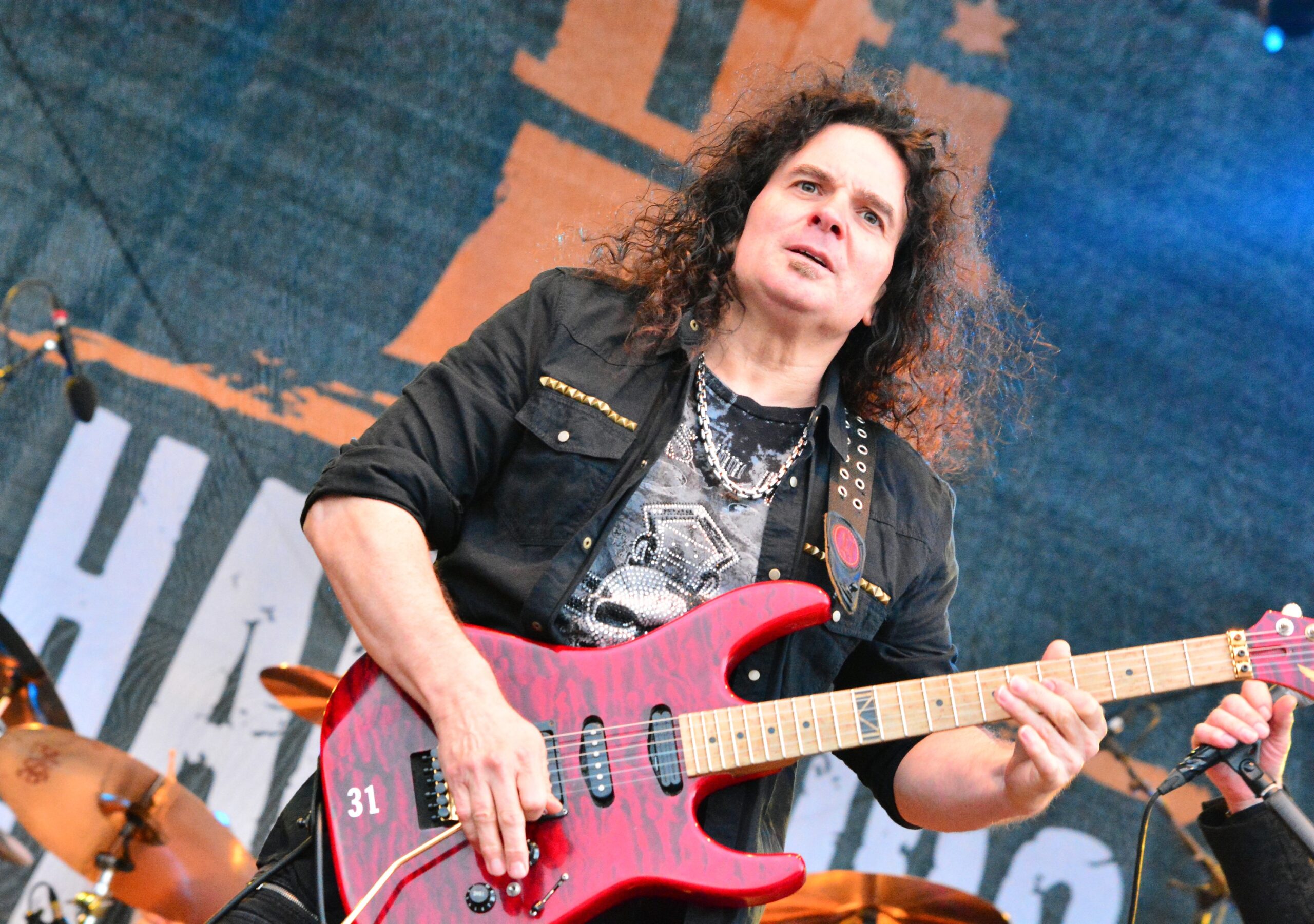
Vinnie Moore guitars gear is the subject of one of the shred era’s most musically complete stories — a guitarist who arrived in the late 1980s with a debut album of such melodic intelligence and technical sophistication that it stood apart from the speed-for-speed’s-sake approach that dominated the genre, and who has sustained that level of musical seriousness across four decades of recording and performing. His work with UFO — the British hard rock institution he joined in 2004 — gave his playing a larger stage and a different musical context, one that required him to serve the band’s classic hard rock aesthetic rather than showcase his own virtuosity, and his ability to do that while maintaining his musical identity is itself a demonstration of genuine musicianship.
The Journey
His solo career — albums including Mind’s Eye (1987), Time Odyssey (1988), Meltdown (1991), The Maze (1999), and Soul Shifter (2012) — demonstrates a player who has developed over time rather than plateauing at his technical peak. The early records showcase extraordinary technique in service of composed, melodically focused instrumental music; the later records show a player who has deepened harmonically and emotionally while retaining the technical command established in the beginning. Vinnie Moore guitars gear, approach, and tonal philosophy are the subject of this complete breakdown.
Background
Vinnie Moore was born on April 14, 1964, in Newark, Delaware — a university town in the mid-Atlantic region of the United States with no particular heavy metal heritage but with the general musical culture of late-1970s America that gave aspiring rock guitarists access to the full range of influences from blues through hard rock through the emerging fusion and shred traditions. He began playing guitar in his early teens, developing rapidly and discovering the neoclassical and jazz-fusion influences that would shape his mature playing style.
His career break came through Mike Varney’s Shrapnel Records — the San Francisco label that was the primary commercial home of American shred guitar in the 1980s, releasing debut albums by Yngwie Malmsteen, Tony MacAlpine, Jason Becker, Marty Friedman, and many others who defined the genre. Varney heard a demo recording that Moore had made and signed him immediately, releasing Mind’s Eye in 1987. The album’s combination of neoclassical vocabulary, blues-influenced expressiveness, and genuine melodic composition gave it an immediate and lasting impact — it was technically sophisticated in ways that placed it in the shred tradition while being more musically complete than many of the genre’s purely technical exercises.
Time Odyssey (1988) continued the approach with additional harmonic sophistication; Meltdown (1991) moved toward a more hard-rock-influenced direction with vocals and song-oriented structures alongside the instrumental tracks. His parallel career as a session and live guitarist — he toured with Alice Cooper in the early 1990s and contributed to various other artists’ projects — demonstrated the versatility that would eventually make him an appropriate choice for the UFO position.
When he joined UFO in 2004, replacing the band’s previous guitarist, he entered one of the most storied positions in British hard rock — a band whose legacy included guitarist Michael Schenker’s foundational work on the classic albums of the 1970s and Pete Way’s legendary bass playing, and whose fanbase had very specific expectations about the guitar position. Moore has navigated this context with the intelligence of a musician who understands that serving the music is more important than demonstrating personal virtuosity, and his UFO tenure — including albums You Are Here (2004), The Monkey Puzzle (2006), The Visitor (2009), and A Conspiracy of Stars (2015) — has been musically successful and well-received by the band’s audience.
Vinnie Moore Guitars Gear: The Complete Rig
Guitars
The ESP Horizon — ESP’s high-performance double-cutaway guitar in the Super-Strat tradition but with set-neck or neck-through construction, making it a slightly different species from the bolt-on Charvel and Jackson instruments that dominated the shred scene — has been Vinnie Moore’s primary instrument across much of his solo career and UFO work. His specific ESP Horizon instruments feature neck-through construction (the neck wood running continuously through the body, providing maximum resonant coupling and sustain), typically a mahogany or alder body, a rosewood or ebony fretboard, Floyd Rose Original or fixed bridge depending on the specific instrument and application, and a pickup configuration tailored to his tonal requirements. The Horizon’s body shape — a double-cutaway design with more conventional proportions than the extreme Super-Strat designs of the Jackson and Charvel platforms — gives slightly different physical balance and resonant characteristics from the pure Super-Strat, with the mahogany body option providing additional warmth and the neck-through construction’s enhanced sustain character giving lead lines a longer, more even decay than bolt-on instruments typically produce.
ESP has produced Vinnie Moore signature instruments that capture his specific preferences in production form. The signature models typically feature the Horizon body shape in Vinnie Moore-specific configurations, with his preferred neck profile, pickup choice, and aesthetic features. These instruments have been available in ESP USA Custom Shop and LTD production series versions, with the Custom Shop examples most closely matching the specifications of his personal instruments.
Vinnie Moore’s primary pickup configuration in his ESP instruments uses DiMarzio passive humbuckers — specifically the DiMarzio Air Norton (DP193) in the neck position and the DiMarzio Tone Zone (DP155) in the bridge position. The DiMarzio Air Norton is one of DiMarzio’s most distinctive passive humbucker designs: it uses an Alnico 5 magnet but with a specific winding that produces a warmer, more open sound than most high-output humbuckers. The “Air” in the name refers to the pickup’s design characteristic — a slightly lower-than-typical coil impedance relative to its output level that gives a more open, less compressed sound. The Air Norton’s DC resistance is approximately 12.7k ohms with an Alnico 5 magnet, giving higher output than a vintage PAF while maintaining a more open, dynamic character than ceramic-magnet high-output designs. In the neck position, the Air Norton gives warm, full lead tones with excellent sustain and good note definition — suited to the singing, sustained quality of Moore’s melodic lead work. The Tone Zone (bridge, DC resistance approximately 16.4k ohms, Alnico 5 with a slightly different magnetic structure than the Air Norton) gives high output with a warm, mid-forward character specifically designed for neck-position-like warmth in the bridge position — unusual for a bridge pickup but consistent with Moore’s preference for warmth and musicality over pure aggression in his bridge pickup tone.
Gibson Les Paul guitars — both vintage examples with PAF or Patent Number humbuckers and modern production instruments — appeared in Moore’s studio documentation for specific applications. In the UFO context particularly, where the band’s classic hard rock sound has Les Paul associations through the Michael Schenker era’s humbucker-heavy tone, the Les Paul gave a more appropriate reference tonal character for certain recording passages. The warm, sustaining PAF or PAF-spec humbucker tone through a cranked Marshall or Bogner gave a vintage British hard rock quality that the more modern ESP/DiMarzio combination approached but could not precisely replicate.
Fender Stratocasters — both vintage and current production examples — appeared in Moore’s documented setup for clean and blues-influenced passages where the Stratocaster’s transparent, dynamically responsive single-coil character gave a different tonal quality from the humbucker-equipped ESP. His Strat use was selective — deployed when the specific application required the single-coil’s transparency and dynamic response rather than the humbucker’s warmth and sustain.
Steel-string acoustic flat-tops — both dreadnoughts and smaller-body instruments — appeared in Moore’s setup for the acoustic passages and ambient textures that occasionally appeared in his more compositionally diverse solo recordings. His acoustic playing demonstrated a player with genuine technique and musical understanding of the acoustic instrument’s specific characteristics rather than merely an electric guitarist using an acoustic as a substitute.
Moore uses GHS Boomers electric strings — specifically GHS Boomers in medium-light gauge (.010–.046) for most applications. GHS Boomers use a hex core with nickel-plated steel outer winding — the hexagonal core (rather than the round core of some premium string designs) gives a slightly stiffer feel and a brighter, more articulate tone than round-core strings. The nickel-plated steel outer winding gives the strings a bright, articulate character with good attack definition — useful for the precise, technically demanding playing that Moore’s technique requires.
Amps
The Marshall JCM800 Model 2203 was Moore’s primary amplification during his early solo career — the debut period of Mind’s Eye and Time Odyssey — consistent with its status as the defining high-gain amplifier of late-1980s American shred metal. His JCM800 settings for melodic lead playing: moderate-to-high preamp gain (7–8) for sustained lead tones, middle and treble set for presence without harshness, and master volume pushed to give the EL34 output stage natural compression. The JCM800’s cascaded gain topology gave sufficient saturation for his technically demanding lead passages while the EL34’s natural harmonic complexity gave the sustained notes the specific quality that distinguished his playing from purely technical shred.
The Bogner Ecstasy has become Moore’s primary amplification in more recent years, both for UFO and his solo work. The Ecstasy’s three-channel design (Clean, Crunch, Lead), four EL34 output tubes producing 100 watts, and the specific voicing of Bogner’s Lead channel — smoother, more harmonically complex than the JCM800, with better note definition at high gain and a more three-dimensional tonal character — suited the development of Moore’s playing toward greater musical sophistication and away from the pure technical approach of the early career. The Ecstasy’s Clean channel is also exceptional — warm, detailed, with the EL34’s characteristic harmonics adding complexity to clean tones that solid-state alternatives don’t replicate. Moore uses the Ecstasy’s Clean channel for the UFO material’s cleaner passages and the Lead channel for the heavier passages, with the Crunch channel serving specific mid-gain applications.
The Mesa/Boogie Mark IV — three channels (Clean, Rhythm 1, Lead), 6L6GC or EL34 output options, five-band graphic EQ — appeared in Moore’s studio setup for specific tonal applications. The Mark IV’s lead channel gave the characteristic Mesa/Boogie smooth, singing lead tone that complemented the more aggressive Marshall and Bogner options for passages requiring a warmer, more vocal quality. His use of the Mark IV’s five-band graphic EQ for precise tonal shaping reflected a sophisticated understanding of frequency relationships and their musical implications.
The Marshall JVM410H — a modern Marshall amplifier with four channels (Clean, Crunch, OD1, OD2), switchable via MIDI, and a wide range of gain and tonal options across the channels — appeared in Moore’s UFO live setup. The JVM’s channel switching capability via MIDI gave him the ability to recall specific channel and gain settings for specific songs in UFO’s set without manual amplifier adjustments between songs — a practical necessity for a live show that covers a wide range of the band’s catalogue with different tonal requirements across the setlist.
Moore runs his amplifiers into Marshall 1960A or 1960B 4×12 cabinets, typically loaded with Celestion Vintage 30 speakers. The V30’s upper-midrange emphasis and tight bass response complemented the Bogner Ecstasy’s specific tonal character — adding presence and definition to the Ecstasy’s smooth high-gain character without excessive harshness.
Effects
The Boss GT-10 and its successor the GT-100 — professional floor-based guitar processors providing comprehensive amplifier modelling, effects, and signal chain management — appeared in Moore’s live rig for effects management and tonal organisation. His use of the Boss GT series reflects a pragmatic approach to effects management: the GT’s comprehensive preset system allowing complete signal chain configurations to be recalled instantly for different songs, and its modelling capabilities giving tonal options that supplement his physical amplifier setup. The GT-10/100’s effects algorithms — including reverb, delay, modulation, and dynamics — provided high-quality processing for the spatial and textural enhancements his playing requires.
The Boss NS-2 in muting loop configuration gave noise management for Moore’s high-gain signal chain. The DiMarzio passive pickups’ susceptibility to electromagnetic interference in high-gain contexts required effective gating, and the NS-2’s threshold was set to eliminate background noise in silent passages while allowing the natural decay of sustained lead notes to complete naturally.
The Tube Screamer — in either TS808 or TS9 configuration — provided the standard low-drive, level-boosted midrange emphasis that pushed the Marshall or Bogner’s input harder for lead passages. Moore’s TS application was conventional: Drive at 2–4, Level at 6–7, using the pedal’s midrange character to give his lead tone additional presence and sustain without additional distortion.
The TC Electronic Chorus+ — one of TC Electronic’s early and highly regarded analog chorus pedals, using BBD (bucket brigade device) chips for warm, organic chorus modulation — appeared in Moore’s setup for specific atmospheric and textural applications. His chorus use was restrained — light, slow modulation for specific passages requiring dimensional width rather than obvious chorus effect — consistent with the musical sophistication that characterised his approach to effects throughout his career.
The MXR Phase 90 appeared in Moore’s setup for atmospheric phase effects. His Phase 90 use — at slow speed settings for specific passages — added dimensional movement to sustained chord work and specific lead passages without the more obvious rotary-speaker character of faster settings.
Eventide processors — both the rack-mount H3000 and the more recent compact H9 pedal — appeared in Moore’s setup for pitch-shifting and harmonizing applications. The diatonic harmonizer algorithm gave him the ability to add key-correct harmonized guitar lines to specific passages in both his solo recordings and the UFO live context, approximating the layered guitar texture of studio recordings in real time.
TC Electronic delay units — the G-System’s delay processing and the compact Flashback delay pedal — provided the spatial dimension for Moore’s lead playing. His typical delay settings: 200–350ms, one to two repeats, 15–20% mix level for subtle spatial depth without obvious echo. The G-System’s MIDI-based control capability gave comprehensive rig management for the UFO touring context.
The Dunlop Cry Baby 535Q — with adjustable Q control and frequency range control — appeared in Moore’s setup for expressive wah-filtered lead passages in both the blues-influenced and UFO hard rock contexts. The 535Q’s adjustable parameters allowed him to configure the wah’s vocal character for different applications — wider Q for subtle, atmospheric filter effects; narrower Q for more dramatic, focused wah-wah expression.
Playing Style & Tone Philosophy
Vinnie Moore is a player whose career trajectory has been one of consistent musical development — not the rapid technical peak followed by plateau that characterises some virtuoso careers, but a gradual deepening of harmonic knowledge, compositional sophistication, and emotional expressiveness that has made each decade of his output distinctly more mature than the preceding one. The Mind’s Eye recordings were already extraordinary for a twenty-three-year-old, but the playing on his later albums and his UFO work shows a musician who has continued to grow rather than settling for the accomplishment already achieved.
His technical foundation is clean alternate picking of the kind that his genre demands — strict down-up execution at high tempos with exceptional consistency of attack. But his technique was always subordinate to musical expression rather than an end in itself, and this hierarchy — music first, technique in service of music — is audible in the specific ways he deployed his vocabulary. The fast runs in his solos serve the compositions they inhabit; they have beginnings, build toward points of intensity, and resolve in ways that reflect musical thinking rather than technical display.
His vibrato is wide, expressive, and blues-derived — a wrist-rotated approach that produces a rich, emotionally communicative modulation on sustained notes. This blues vibrato is one of the most distinctive elements of his playing and one of the clearest demonstrations of the blues influence that runs through his work alongside the neoclassical and jazz vocabulary. The combination of technically demanding neoclassical scalar runs and the emotionally direct blues vibrato creates a specific tonal and expressive character — intellectually sophisticated harmonically but physically direct and emotionally immediate in its sustained note quality.
His chord voicing in the UFO context demonstrates a player who understands the hard rock tradition and can work within it with genuine authority. The specific voicings he chooses for UFO’s material — the inversions, the voice-leading between chord changes, the specific harmonic choices in the lead fills — reflect a musician applying real harmonic knowledge to a genre that doesn’t always demand it, elevating the material while remaining completely faithful to its essential character.
Tonally, Vinnie Moore guitars gear philosophy reflects the evolution of his musical approach. The early Marshall JCM800-based setup — aggressive, tightly compressed, optimised for technical articulation and speed — gave way to the Bogner Ecstasy’s more refined, harmonically complex character as his playing became more harmonically sophisticated. The DiMarzio Air Norton and Tone Zone’s specific warmth-with-clarity character reflects a player who values musicality over pure power output, and the ESP Horizon’s neck-through warmth and sustain give his lead lines the singing, sustained quality that his melodic approach requires. Every element of his current rig is in service of a musical vision that has deepened across decades of serious engagement with the instrument.
The DiMarzio Air Norton’s design philosophy — warmth and openness in a high-output passive humbucker — represents a specific response to a genuine problem in the pickup world: the tendency of high-output humbuckers to compress the guitar signal’s dynamic range in ways that reduce the responsiveness and expressiveness that sensitive playing requires. The standard high-output humbucker approach — increasing output by using more windings (higher DC resistance) or stronger magnets — increases the pickup’s sensitivity to string vibration but also increases the magnetic “pull” on the strings (the attraction of the pickup’s magnetic field holding the string’s vibration) and the pickup’s electrical loading on the string resonance. Too much magnetic pull dampens the string’s natural sustain and changes its vibration characteristics; too much electrical loading reduces the pickup’s high-frequency response. The Air Norton addresses these issues by using Alnico 5 magnets (which have a softer, more gradual magnetic field than ceramic magnets) at a lower height than typical high-output humbuckers, and by using a specific winding approach that gives higher-than-vintage output without the excessively high DC resistance of more aggressive designs. The result — a pickup that delivers strong output with the dynamic responsiveness of a lower-output design — was specifically suited to Moore’s playing style, where the variation in pick attack from gentle melodic passages to aggressive picked runs needed to produce corresponding variation in the amplified tone rather than being compressed into uniform loudness by a high-output pickup’s limiting effect.
The transition from Marshall JCM800 to Bogner Ecstasy in Moore’s amplification setup — roughly corresponding to his musical development from the early shred virtuosity of Mind’s Eye to the more harmonically sophisticated approach of his UFO and later solo work — reflects a genuine relationship between tonal choice and musical maturity. The JCM800’s cascaded gain topology produces a hard-clipping distortion that is specifically suited to the kind of playing where each note must be clearly articulated at high speed: the hard clipping compresses transients consistently, giving each note a similar attack profile regardless of the velocity of the pick stroke. This consistency is practically valuable for shred playing where the priority is clarity and evenness of individual note articulation. The Bogner Ecstasy’s smoother, more harmonically complex high-gain character — the result of its different gain staging topology and the EL34’s more gradual, harmonically rich saturation — gives a different relationship between pick attack and tonal response: more dynamic, more variable with pick attack variation, with each note’s character more directly reflecting the force and angle of the pick contact. For Moore’s more mature playing — where dynamic variation, expressive vibrato, and harmonic sophistication are as important as technical articulation — the Bogner’s greater expressiveness under different levels of pick attack gave a more musically complete result than the JCM800’s more uniform, consistent clipping. This evolution of amplifier choice is itself a document of musical development: the Vinnie Moore guitars gear setup at forty-five reflects more completely developed artistic priorities than the setup at twenty-three, because the player himself is more completely developed.
The UFO context deserves specific expansion in the Vinnie Moore guitars gear analysis because the demands of the UFO position — playing the catalogue of a band whose classic recordings were made by a guitarist (Michael Schenker) with a completely different tonal identity and approach — required Moore to balance fidelity to the established sound with his own musical personality. Schenker’s UFO-era tone — Marshall amplification, Gibson Flying V, a specifically raw and emotionally intense lead guitar style — was quite different from Moore’s refined, technically polished approach. The challenge for Moore was to serve the classic material faithfully (which the audience expected) while bringing his own musical identity to the new recordings (which gave the band creative reasons to continue). His solution — using his own equipment and approach for the new studio recordings while accommodating the tonal expectations of the classic live material within his ESP/Bogner setup — reflected the same musical intelligence that characterised his broader career. The ESP Horizon’s mahogany warmth and neck-through sustain gave his UFO tones enough weight and body to work within the classic hard rock context even without the Flying V’s specific tonal character, and the Bogner Ecstasy’s EL34 harmonic complexity gave sufficient “British” character to connect with the Marshall-derived tonal heritage of the classic UFO recordings.
How to Sound Like Vinnie Moore
Guitar Approach
An ESP Horizon (or ESP LTD H-1001 for a more accessible price point) with DiMarzio Air Norton (neck) and Tone Zone (bridge) humbuckers is the foundation for Vinnie Moore guitars gear tone. Alternative instruments: a Gibson Les Paul Standard or Custom with aftermarket DiMarzio Air Norton and Tone Zone installation, or a PRS Custom 24 with similar pickup configuration. Use GHS Boomers .010–.046 strings for the bright, articulate tonal character that Moore’s technically demanding playing rewards.
Alternate picking technique is non-negotiable — develop strict down-up-down-up execution at high tempos using a metronome. Study the harmonic minor and Phrygian Dominant modes as primary improvisation vocabulary alongside the blues pentatonic and natural minor scales that give Moore’s playing its emotional directness alongside its technical sophistication. Use a medium-heavy pick (Dunlop Tortex 1.0mm or similar) for the controlled, precise attack that both fast runs and expressive bends require.
Amp Approach
The Bogner Ecstasy (or alternatives: Bogner Shiva for more accessible pricing, Friedman BE-100, Two-Rock Classic Reverb Signature) into a 4×12 with Celestion Vintage 30 speakers is the current Vinnie Moore tone foundation. The Marshall JCM800 2203 (or reissue, or DSL100H) for the earlier, more aggressive shred tones of the Mind’s Eye period.
| Control | Setting (0–10) | Notes |
|---|---|---|
| Bogner Ecstasy Lead Gain | 6–8 | Moderate-high — Bogner’s smooth high-gain suits melodic lead singing quality |
| Bass | 5 | Neutral — Air Norton neck pickup has warmth; avoid bass accumulation |
| Mid | 6–7 | Forward — melodic lead presence and harmonic definition |
| Treble | 6 | Present — note articulation through V30 speakers |
| Presence | 5 | Moderate — adds definition without aggression |
| Master Volume | 6–7 | EL34 output compression contributes to lead sustain character |
| TS808 Drive (lead boost) | 3 | Minimal — midrange focus function, not additional distortion |
| TS808 Level | 6–7 | Above unity — drives Bogner input harder for lead presence |
| Phase 90 Speed | 2 (very slow) | Barely perceptible sweep — dimensional depth on specific chord passages |
| TC Flashback Delay | 250ms, 1 repeat, 15% mix | Subtle lead spatial depth — musical dimension without clutter |
The TS808 (or Maxon OD808) at minimum drive as lead boost into the Bogner. Boss NS-2 in muting loop for noise control. TC Electronic Chorus+ (or TC Electronic June-60 using MN3007 BBD chips) at slow, light settings for atmospheric chord passages. Phase 90 at very slow speed for barely perceptible dimensional movement. Eventide H9 for harmonized guitar passages. The Boss GT-100 or TC Electronic G-System for comprehensive live rig management with MIDI preset recall.
Influence & Legacy
Vinnie Moore’s influence on the shred guitar tradition is substantial and specifically musical — he was among the first players to demonstrate conclusively that the technical vocabulary of neoclassical metal could be deployed in service of genuine compositional and melodic ambition rather than purely technical display. The Mind’s Eye album, arriving at the height of the late-1980s shred craze, stood apart from its contemporaries precisely because it sounded like music rather than an instrument demonstration, and that distinction has made it a lasting reference point rather than a period piece.
His UFO tenure has given him a different kind of influence — the influence of a player who has successfully navigated the transition from solo artist to band member within a major hard rock institution, demonstrating that genuine musicianship is transferable across contexts and that the specific skills of a virtuoso solo guitarist translate into effective band playing when the player has the musical intelligence to prioritise the ensemble over individual display.
The comparison with Tony MacAlpine — his direct contemporary in the Shrapnel Records shred scene and another player who combined neoclassical vocabulary with genuine compositional depth — illuminates the specific strand of the shred tradition that valued musical substance over pure technical demonstration. The parallel with Michael Schenker — his predecessor in the UFO guitar position and the player whose classic recordings defined the band’s guitar-playing standards — shows the musical heritage Moore was engaging with when he joined UFO and the standard he was expected to meet. And the broader connection to John Norum — another European hard rock guitarist of comparable technical and melodic accomplishment who has navigated the balance between solo work and band membership with similar intelligence — places Vinnie Moore guitars gear and musical philosophy in the tradition of technically accomplished hard rock guitarists who prioritise musical depth over career strategy.
Frequently Asked Questions: Vinnie Moore Guitars & Gear
What guitar does Vinnie Moore play?
Vinnie Moore’s primary guitar is the ESP Horizon — ESP’s double-cutaway high-performance instrument in neck-through configuration, typically with mahogany or alder body, rosewood or ebony fretboard, and DiMarzio Air Norton (neck) and Tone Zone (bridge) humbucking pickups. ESP has produced Vinnie Moore signature models capturing his specific neck profile, pickup configuration, and aesthetic preferences. He also uses Gibson Les Pauls for specific studio applications requiring vintage humbucker warmth, and Fender Stratocasters for clean and blues-influenced passages where single-coil transparency is preferable.
What amplifier does Vinnie Moore use?
Moore’s current primary amplification is the Bogner Ecstasy — Reinhold Bogner’s three-channel, four-EL34, hand-built boutique amplifier whose smooth, harmonically complex high-gain character suits his mature melodic lead approach better than the more aggressive Marshall JCM800 that was his primary amplifier during the early solo career. He uses the Ecstasy’s Lead channel for high-gain passages and Clean channel for clean tones, running into Marshall 1960A or 1960B 4×12 cabinets loaded with Celestion Vintage 30 speakers. The Marshall JVM410H has also appeared in his UFO live rig for its MIDI-controlled channel switching capability.
What pickups does Vinnie Moore use?
Moore uses DiMarzio passive humbuckers — the DiMarzio Air Norton (DP193, approximately 12.7k ohms DC resistance, Alnico 5, warm and open character) in the neck position and the DiMarzio Tone Zone (DP155, approximately 16.4k ohms, Alnico 5, warm mid-forward character designed for both neck and bridge positions) in the bridge position. Both are passive designs, giving more dynamic, touch-responsive character than EMG active humbuckers — the pickups respond to pick attack variation and guitar volume changes in ways that active pickups’ buffered output buffers against. The Air Norton’s specific “open” character in the neck position is central to the warm, singing quality of his melodic lead tone.
How did Vinnie Moore join UFO?
Vinnie Moore joined UFO in 2004, becoming the band’s lead guitarist after the departure of the previous guitarist. His combination of hard rock credibility, technical accomplishment, and musical sophistication — demonstrated across his solo career and various session and touring work — made him an appropriate choice for a band whose guitar position requires both technical ability and the musical maturity to serve the band’s classic hard rock catalogue faithfully. He has been UFO’s primary guitarist since joining, appearing on multiple studio albums and extensive touring through the subsequent decades.
What is Vinnie Moore’s picking technique?
Moore uses strict alternate picking — consistent down-up-down-up execution across string changes — as his primary right-hand technique for fast passages. His picking mechanics show the refinement of decades of dedicated development: consistent attack weight across different string-crossing movements, controlled pick angle giving a clean, defined attack transient, and the physical economy of motion that maximises speed and accuracy while minimising fatigue. He supplements alternate picking with legato technique (hammer-ons and pull-offs) for specific passages requiring a smoother, more fluid line quality than pure picking allows. He uses medium-heavy picks (Dunlop Tortex 1.0mm equivalent) for the controlled precision that his technical playing requires.
What records best showcase Vinnie Moore’s guitar playing?
For the early shred period: Mind’s Eye (1987, Shrapnel) is the essential document — a compositionally serious instrumental album that demonstrates how technical neoclassical vocabulary can be deployed in genuinely musical compositions. Time Odyssey (1988) continues and develops the approach. For his more recent development: Soul Shifter (2012) shows how his playing has deepened harmonically and emotionally across two decades of further development. For UFO work: The Visitor (2009) contains some of his finest playing in the classic hard rock ensemble context, demonstrating the adaptability and musical intelligence that makes him effective in a band as well as a solo context.
How does Vinnie Moore balance his solo work with UFO commitments?
Moore has maintained both his solo career and his UFO commitment across his tenure with the band — releasing solo albums, performing solo shows, and continuing his own compositional development while fulfilling UFO’s touring and recording schedule. This dual commitment has been possible because both contexts are musically rewarding in different ways: UFO’s classic hard rock provides a different musical challenge from his solo instrumental work, requiring different skills and a different relationship with the guitar’s role in an ensemble. The two contexts have reinforced rather than competed with each other, with the UFO work giving him broader exposure and commercial reach while his solo work gives him the creative freedom that an ensemble context cannot provide.
The GHS Boomers string choice — and the specific hex core construction that distinguishes them from round-core alternatives — connects to a broader point about Vinnie Moore guitars gear and the interaction between string construction and tonal character. The hex core (a hexagonal cross-section wire at the string’s centre) and the round-core alternative (a circular cross-section centre wire) give different tonal characteristics because of how the outer winding wire contacts the core. On a hex core string, the outer winding’s contact with the flat sides of the hexagonal core produces a stiffer, more secure winding that resists slipping and gives a brighter, more articulate tone with more high-frequency content. On a round core string, the outer winding contacts the smooth circular surface with a looser grip, giving a more flexible, warmer tone with more of the fundamental frequency and less of the upper harmonics. The GHS Boomers’ hex core gives Moore the bright, articulate attack character that his technically demanding alternate picking requires — each downstroke and upstroke of the pick producing a clear, defined transient that carries through the Air Norton’s warm character and the Bogner Ecstasy’s smooth high-gain without losing the pick attack’s precision. For fast alternate-picked runs, this attack clarity is functionally essential: without it, the individual notes within a rapid run blur together and the technical content becomes aurally indistinguishable despite being physically executed correctly.
One dimension of Moore’s playing that distinguishes him from many in the shred tradition is his use of space — the deliberate inclusion of rhythmic pauses, dynamic reductions, and phrase-ending resolution within technically demanding passages. Many shred guitarists fill every available rhythmic space with notes, using density as the primary measure of technical sophistication. Moore’s playing, from Mind’s Eye onward, showed a player who understood that musical space — the deliberate absence of notes at specific moments — can be as expressive as the notes themselves. A phrase that builds through a technically demanding run, pauses on a sustained note with wide vibrato, and then resolves through a simpler, more direct melodic figure has a narrative arc that continuous note-density cannot achieve. This use of space reflects the influence of his blues listening — the blues tradition’s understanding of the dramatic power of a single, well-chosen bend held with vibrato over a backing that continues — applied to the neoclassical metal context where the technical vocabulary demands more notes but the musical intelligence demands selective deployment. Vinnie Moore guitars gear, in this sense, serves a musical approach that values what is not played as much as what is played — an unusual quality in a genre that typically measures achievement by speed and density.
The Shrapnel Records context that launched Moore’s career is worth examining because it shaped the environment in which his specific musical identity was developed and recognised. Mike Varney’s San Francisco label operated as the primary commercial and artistic home of American neoclassical and shred metal in the 1980s, producing a roster that included virtually every significant player in the genre. The label’s marketing approach — emphasising technical accomplishment in its promotional materials and finding an audience of serious guitarists who valued technical sophistication — gave players like Moore, Jason Becker, Tony MacAlpine, and Marty Friedman a commercial infrastructure for a genre that mainstream record labels had no framework for evaluating or promoting. In this context, Vinnie Moore guitars gear and musical approach — technically accomplished enough to satisfy the label’s technical audience, musically serious enough to be more than mere technique demonstration — gave him a specific identity within the Shrapnel roster that distinguished him from his label-mates while working within the same general aesthetic framework. The early Shrapnel albums’ direct-order sales model (the label sold directly to its guitar enthusiast audience, bypassing the mainstream retail infrastructure) also gave Moore’s recordings immediate access to the most technically sophisticated and musically discerning segment of the guitar-playing audience — listeners who were equipped to appreciate both the technical content and the musical substance of his recordings.
The TC Electronic Chorus+ pedal’s BBD-based analog chorus character — discussed briefly in the effects section — deserves specific mention as a reflection of Vinnie Moore guitars gear’s consistent preference for warmth and organic quality over technical perfection. The TC Electronic Chorus+ was one of the finest analog chorus pedals of its era, using BBD (bucket brigade device) chips to produce a warm, slightly imperfect chorus modulation that integrates with the guitar signal more naturally than digital chorus alternatives. The BBD’s characteristic noise floor and frequency roll-off at higher frequencies gives the chorus effect a warmth that digital alternatives don’t replicate, and the organic, slightly imprecise modulation of an LFO-driven BBD circuit has a living quality that mathematically perfect digital modulation lacks. Moore’s consistent preference for this kind of organically imperfect, warm-sounding processing — the BBD chorus rather than the digital alternative, the Air Norton’s open warmth rather than the active pickup’s clinical precision, the Bogner’s harmonically complex saturation rather than the more precisely engineered alternatives — reflects a consistent aesthetic preference for musicality over technical superiority, for warmth over precision, for the humanly expressive over the mechanically perfect. This preference, consistent across every element of Vinnie Moore guitars gear, is itself a statement of musical values that distinguishes his approach from the purely technical orientation of some contemporaries.
Related stories
Wayne Kramer Guitars & Gear: The Complete Guide to MC5’s Proto-Punk Guitar Insurrectionist’s Rig
Wayne Kramer guitars & gear: MC5's proto-punk guitar insurrectionist. Star-spangled Strat, Big Muff Triangle, Marshall stacks, MXR Jail Guitar Doors Drive — the complete rig.
Wes Montgomery Guitars & Gear: The Complete Guide to the Jazz Master’s Rig
Wes Montgomery's guitars, amps, and effects — the complete guide. Gibson L-5 CES, Standel amps, thumb picking technique, flatwound strings, and how to nail that warm jazz tone.

Yngwie Malmsteen Guitars & Gear: The Complete Guide to the Shred Master’s Rig
Yngwie Malmsteen's guitars, amps, and effects — the complete guide. The Duck Stratocaster, scalloped fretboard, Marshall wall, DiMarzio HS3, and how to nail that neoclassical metal tone.