
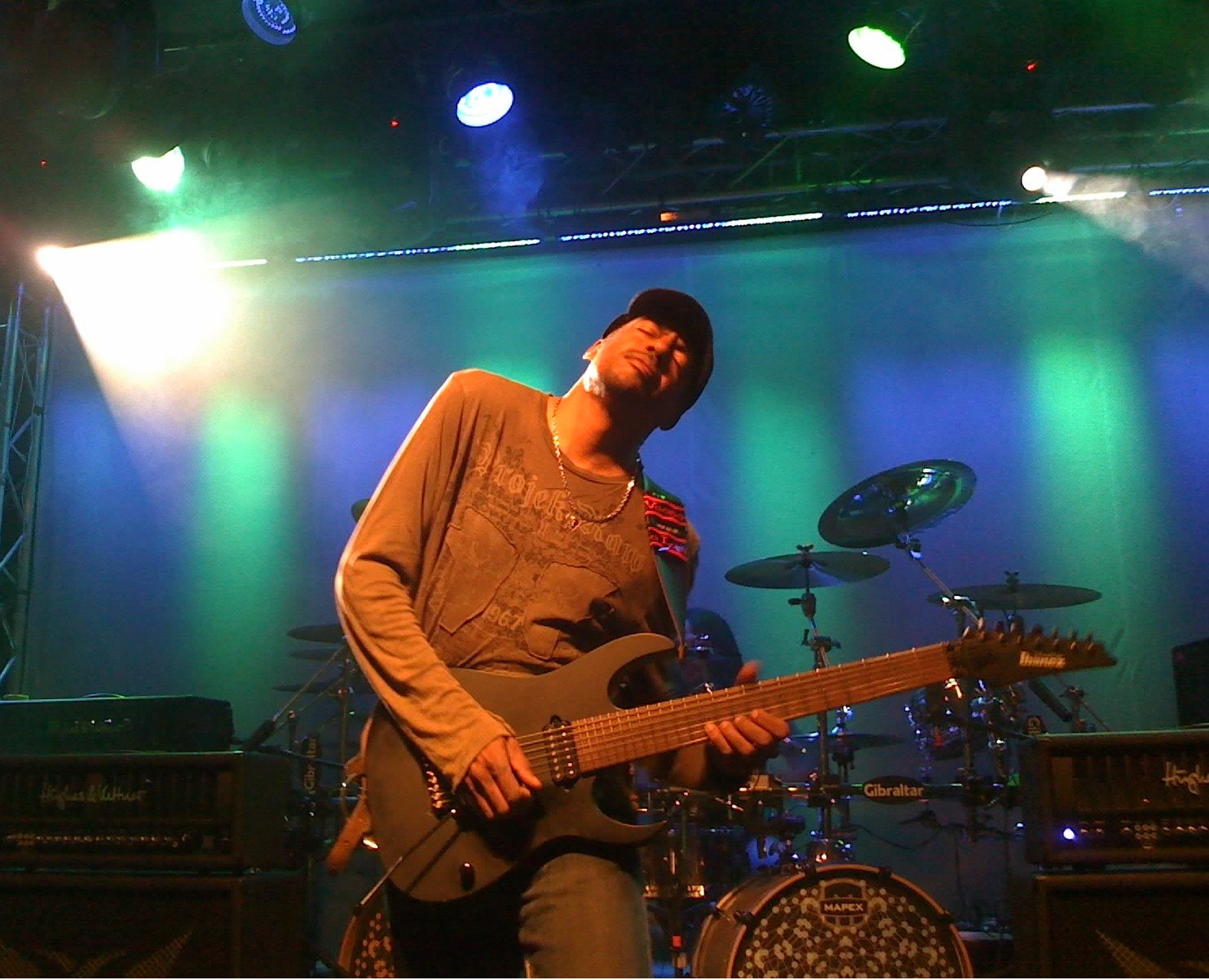
Tony MacAlpine guitars gear is the story of the most academically prepared mind to ever arrive at the intersection of Baroque counterpoint and heavy metal guitar — a player who completed a classical piano degree at the Hartt School of Music, studied classical guitar seriously, and then took the full weight of that formal education into the late-1980s American shred scene and produced some of the most technically accomplished and musically complete instrumental guitar albums the genre has ever seen. MacAlpine is not merely a guitarist who was influenced by classical music; he is a trained classical musician who happened to choose the electric guitar as his primary performance vehicle. The difference is audible, and it matters enormously.
His debut album Edge of Insanity (1986), released on Mike Varney’s Shrapnel Records at age twenty-three, announced a player of extraordinary breadth — technically demanding enough to satisfy the shred audience, harmonically sophisticated enough to challenge jazz listeners, and compositionally serious enough to be evaluated as art music rather than guitar demonstration. The subsequent solo career, the M.A.R.S. supergroup project, and his ongoing presence in the fusion and progressive metal communities have maintained that level across four decades. This is the complete breakdown of Tony MacAlpine guitars gear, technique, and tonal philosophy.
Background
Anthony MacAlpine was born on August 29, 1960, in Springfield, Massachusetts — a New England city with a strong cultural and educational tradition that gave him access to the serious music education that would shape his career. He studied classical piano at the Hartt School of Music at the University of Hartford, earning a degree in classical piano performance — a formal academic credential in a challenging performance discipline that is genuinely unusual among rock and metal guitarists. Alongside his piano studies he developed as a classical guitarist, absorbing the technique and repertoire of the classical guitar tradition before eventually combining both influences with the electric guitar and heavy metal.
This specific educational background gave MacAlpine something most shred guitarists lacked: a deep understanding of Western classical music’s harmonic language from the inside rather than from the outside. He understood counterpoint not as an abstract concept but as a practical compositional technique he had applied; he understood voice-leading not as something to approximate but as something to execute correctly; he understood the structural logic of Baroque and Classical period music as living musical knowledge rather than historical reference. When he brought this understanding to the electric guitar and the metal context, the result was something genuinely different from players who used classical-sounding scales and arpeggios without the theoretical framework to deploy them with compositional intelligence.
His debut Edge of Insanity (1986) was followed by Maximum Security (1987), Eyes of the World (1990), Freedom to Fly (1992), and numerous subsequent albums that demonstrated his continued development. The M.A.R.S. project (1986, alongside bassist Rudy Sarzo, drummer Tommy Aldridge, and vocalist Rob Rock) gave him a mainstream hard rock context that demonstrated his ability to work within commercial song structures while maintaining his musical identity. His later career has included collaborations with Steve Vai, Steve Lukather, and various other guitarists in live performance and recording contexts, as well as continued solo recording and touring.
His battle with non-Hodgkin’s lymphoma — diagnosed in 2012 and treated over several years — interrupted his career and gave his continued musical engagement a context of personal commitment similar to Jason Becker’s, if in less severe circumstances. He has returned to full activity following his recovery and continues to record and perform.
Tony MacAlpine Guitars Gear: The Complete Rig
Guitars
In the earliest period of MacAlpine’s professional career — the Edge of Insanity and Maximum Security era — Ibanez guitars appeared in his documented setup. The Ibanez JEM (Steve Vai’s signature model, introduced 1987) and similar high-performance Ibanez instruments — featuring Ibanez’s proprietary Edge tremolo system (a Floyd Rose-inspired double-locking tremolo with specific improvements including a pop-in arm socket and more stable locking saddles), DiMarzio or Ibanez proprietary pickups, and the five-piece maple/walnut or basswood/maple neck-through construction of Ibanez’s premium range — gave the technical performance platform that late-1980s shred playing required.
ESP M-II guitars — ESP’s double-cutaway Super-Strat in bolt-on or neck-through configuration, with maple neck, rosewood or ebony fretboard, Floyd Rose Original, and high-output humbucker pickups — appeared prominently in MacAlpine’s documented setup and became one of his primary instruments through much of his career. The ESP M-II’s construction gave the technical performance specifications he required — Floyd Rose stability, neck profile suited to fast position shifting, compound-radius fretboard for bending ease in the upper positions — while ESP’s custom shop capability allowed specific modifications to pickup configuration, neck profile, and hardware to match his exact requirements. His ESP M-II instruments were typically configured with high-output passive or active humbuckers in the bridge and neck positions for the high-gain contexts his playing inhabited.
Caparison Guitars — a Japanese high-end guitar manufacturer whose instruments are built to extraordinarily precise specifications and whose customer base includes some of the most technically demanding guitarists in the world — became central to MacAlpine’s setup in more recent years. The Caparison AP series — an asymmetric body shape with a deep upper horn cutaway, neck-through construction using multiple wood laminations for the neck-through unit, ebony fretboard, and Schaller Floyd Rose or similar high-performance tremolo — gives exceptional build quality, precise fret level and edge work, and a specific tonal character from the multi-laminate neck-through construction that Caparison’s craftspeople refine obsessively. The AP’s ebony fretboard gives the bright, articulate attack character that MacAlpine’s technically demanding alternate picking rewards — each note’s fundamental is clearly defined without the softer, warmer response of rosewood. His Caparison instruments have been configured with various pickup combinations over the years as his tonal preferences have evolved.
DiMarzio passive humbuckers have been central to MacAlpine’s pickup setup across multiple instruments and periods. His configurations have included the DiMarzio D Activator (a passive pickup designed to approximate the output level and tonal character of EMG active pickups without requiring a battery — using neodymium magnets rather than Alnico or ceramic, giving a bright, focused, tight-sounding high-output character), the DiMarzio Breed (DP165, approximately 14.0k ohms, Alnico 5, warm and rounded), and the DiMarzio PAF Pro (DP151, 8.3k ohms, Alnico 5, vintage-voiced) in various combinations depending on the specific instrument and the recording or performance context. His pickup choices across instruments reflect the same systematic tonal intelligence that characterises his approach to amplification — each pickup chosen for the specific tonal contribution it makes to the complete signal chain rather than for adherence to a single brand or design philosophy.
Gibson Les Paul Customs — ebony fretboard, gold hardware, multi-binding, PAF or Patent Number humbuckers — appeared in MacAlpine’s studio documentation for specific applications requiring the Les Paul’s warm, sustaining vintage humbucker tone. The Les Paul Custom’s combination of ebony fretboard brightness and PAF humbucker warmth gives a specifically articulate yet warm tonal character that suited certain passages in his compositionally diverse recordings better than the more modern, high-gain-optimised ESP or Caparison instruments.
MacAlpine’s classical guitar background — developed alongside his piano studies and maintained as a compositional and performance tool — gave him access to the nylon-string classical guitar’s specific vocabulary as a compositional and recording resource. His classical guitar playing appears on certain recordings where the instrument’s specific tonal character, articulation, and harmonic possibilities suited the composition, and his formal classical training gave this playing a depth of technique and musical understanding that casual acoustic-electric use could not replicate.
MacAlpine has used various string brands and gauges across his career, with a general preference for medium-light or light gauges (.009–.042 or .010–.046) on his electric instruments. His classical piano training gave him a sophisticated understanding of how string tension and gauge affect tonal character — the physical relationship between string mass, tension, and the resulting fundamental-to-harmonic ratio in the string’s vibration — that informs his string choices with more technical awareness than most guitarists bring to this decision.
Amps
The Marshall JCM800 Model 2203 — the dominant high-gain amplifier of the late-1980s shred scene — served as MacAlpine’s primary live and studio amplification through the early solo albums. The JCM800’s cascaded high-gain preamp and hard-clipping distortion character gave the technical precision and high-gain saturation that the demanding compositional content of albums like Edge of Insanity required, and the EL34 output tubes’ harmonic complexity gave the sustained lead passages their specific tonal character. His JCM800 settings: high preamp gain (7–8) for maximum lead sustain and definition, forward mids for presence, and moderate master volume for natural EL34 output compression.
Mesa/Boogie amplifiers — both the Mark IV (three channels, 6L6GC output, five-band graphic EQ, smooth Mark-series lead tone) and the Dual Rectifier (two channels, 6L6GC or EL34, rectifier-tube sag, tight low-end character) — appeared in MacAlpine’s studio setup across various albums. The Mesa/Boogie’s 6L6GC-based American character gave a different tonal quality from the Marshall’s EL34 British character — warmer in the fundamental, with less upper-midrange aggression and more low-end authority. For the more orchestral, compositionally dense passages in MacAlpine’s recordings, the Mark IV’s smooth lead channel gave a musical quality appropriate to the sophisticated harmonic content.
The Bogner Ecstasy has become MacAlpine’s primary amplification in more recent years, consistent with the amplifier’s adoption by technically and musically sophisticated players who have found its combination of high gain and tonal refinement superior to the alternatives. The Ecstasy’s smooth, harmonically complex high-gain character suits the compositionally sophisticated material of MacAlpine’s more recent recordings — the lead tones have a three-dimensional quality that the more aggressive JCM800 or tighter Rectifier cannot quite achieve, and the clean channel’s exceptional warmth and detail gives the quieter, more atmospheric passages their appropriate tonal character.
The Peavey 6505+ — successor to the 5150, four EL34 output tubes, high-gain Lead channel — appeared in MacAlpine’s live rig as a backup amplifier. The 6505+’s reliability and the consistency of its high-gain character made it a practical touring backup that gave similar tonal territory to his primary Bogner without the service demands of the boutique instrument.
The Fractal Audio Axe-Fx — specifically the Axe-Fx II and III, using Fractal’s Quantum modelling engine — has appeared in MacAlpine’s current documented live setup as either a supplementary or primary tone source. The Axe-Fx’s models of his specific amplifiers (Bogner Ecstasy, Mesa/Boogie Mark series) give consistent, repeatable tone at every performance, and the comprehensive effects processing gives him complete signal chain management from a single digital unit. For touring, the practical advantages of the Axe-Fx — no tube maintenance, consistent operation regardless of local power supply quality, complete setup in a single unit — outweigh the marginal tonal differences between the modelled and physical amplifiers in live performance contexts.
MacAlpine runs his amplifiers into 4×12 cabinets — either Mesa/Boogie standard 4×12 (loaded with Celestion Vintage 30 speakers as factory standard) or Marshall 1960 cabinets (loaded with various Celestion variants including Vintage 30 and G12T-75). The Vintage 30’s upper-midrange character complements the Bogner’s smooth high-gain character with appropriate presence and definition.
Effects
The Boss GT series — professional floor-based multi-effects processors providing comprehensive amplifier modelling, effects, and signal chain management — appeared consistently in MacAlpine’s live rig across multiple generations of the product line. The GT’s preset-based operation gave him complete, repeatable signal chain configurations for different songs in his set, and the quality of the GT’s effects processing (reverb, delay, modulation) was sufficient for professional live use. His GT configuration typically loaded his physical amplifier’s input through the GT’s effects, using the physical amplifier as the primary gain and tonal source while the GT managed the spatial and modulation effects and provided comprehensive preset-based control.
The Boss NS-2 in muting loop configuration gave essential noise management for MacAlpine’s high-gain signal chain. His specific DiMarzio passive pickup configurations, while quieter than some higher-output passive designs, still produced audible background noise through the high-gain amplifier stages, and the NS-2’s threshold setting was calibrated to eliminate this noise without affecting the natural sustain of his lead playing.
The Tube Screamer — in TS9 or TS808 configuration — provided the standard midrange boost and level enhancement for lead passages into MacAlpine’s Marshall or Bogner amplifiers. His TS application was consistent with the established approach: low drive (2–3), level boosted above unity (6–7), using the pedal’s midrange emphasis to give lead tones additional presence over the rhythm section backing.
The MXR Phase 90 appeared in MacAlpine’s setup for atmospheric phase modulation effects on specific passages. His Phase 90 use was selective and musically purposeful — applied for the specific textural quality that phase modulation gave to chord voicings and sustained lead notes in the more compositionally elaborate passages of his recordings and live performances.
TC Electronic delay units — the professional rack-mount 2290 Dynamic Digital Delay and the more recent compact Nova Delay pedal — provided MacAlpine with high-quality digital delay for lead spatial enhancement. His delay settings were consistent with the genre’s standard approach: 200–400ms, one to two repeats, 15–20% mix level for depth without clutter.
The Eventide H9 appeared in MacAlpine’s more recent setup for pitch-shifting and harmonizing applications. His classical training gave him more precise understanding of the diatonic interval relationships that the H9’s harmonizer algorithm required — correctly setting the harmonizer for each specific song’s key and the precise diatonic interval needed for each harmonic passage reflected the music theory knowledge that his formal education had developed.
The DigiTech Whammy appeared in MacAlpine’s setup for dramatic real-time pitch effects. His Whammy use was more musically controlled than the pure dive-bomb approach common in metal — he used the expression-pedal control for specific, predetermined pitch transitions rather than wild, uncontrolled pitch excursions, reflecting the same compositional deliberateness that characterised his approach to every element of his playing.
Playing Style & Tone Philosophy
Tony MacAlpine is the guitarist who most completely proved that a classical music education translates directly into electric guitar excellence when applied with genuine musical intelligence — that counterpoint, voice-leading, harmonic analysis, and the structural thinking of Western classical composition are not academic abstractions irrelevant to metal guitar but living, practical musical tools that enrich and deepen every aspect of the playing. His solos don’t just sound like classical music; they are built on classical compositional principles applied to the electric guitar context, and the result is an internal logic and coherence that purely intuitive improvisation, however technically accomplished, rarely achieves.
His alternate picking technique is among the most consistently precise and musically controlled in the shred tradition — developed through the same rigorous practice discipline that his piano training demanded, applied to the guitar with the technical specificity of a conservatory-trained instrumentalist. His pick attack shows a consistency of force and angle that comes from treating the picking motion with the same systematic attention as a pianist treats finger technique — identifying the mechanical requirements, practising them in isolation, and integrating them into musical performance through years of dedicated refinement.
His use of counterpoint — the simultaneous movement of two or more independent melodic lines — in his compositions is one of the most distinctive elements of his work. Most rock and metal guitar compositions organise around a single melodic line with harmonic support; MacAlpine’s compositions frequently feature two simultaneously moving lines that interact and resolve according to classical counterpoint principles. This gives his music a textural complexity and a harmonic completeness that single-line compositions cannot achieve, and it demonstrates the practical application of his formal training in ways that purely technical shred playing cannot.
His keyboard playing — retained from his piano studies and applied both in live performance (he plays keyboard in his live shows alongside guitar) and in composition — gives his musical arrangements an orchestral completeness. Unlike guitarists who add keyboard parts as an afterthought or hire a keyboardist for specific parts, MacAlpine writes and performs keyboard arrangements with the fluency of a trained pianist, giving his live shows and studio recordings a complete harmonic and tonal environment that reflects his complete musical education.
Tonally, Tony MacAlpine guitars gear philosophy has evolved from the early Marshall JCM800 aggression of the debut period toward the more refined, harmonically complex character of the Bogner Ecstasy that serves his current compositional approach better. The shift from the JCM800’s hard-clipping, technically precise character to the Bogner’s more harmonically rich, expressively responsive character mirrors the musical development documented across his career — from the technical demonstration of Edge of Insanity (remarkable as it is) to the compositionally mature work of his later albums. His string, pickup, and instrument choices have followed the same trajectory: the early period’s high-output, technically optimised setups giving way to more balanced, musically expressive configurations that serve the compositional ambitions of his mature work more completely.
The DiMarzio D Activator’s neodymium magnet technology deserves expanded technical discussion because neodymium represents a fundamentally different approach to magnetic pickup design that has important implications for tonal character. Neodymium (Nd) is a rare-earth element that produces the strongest permanent magnetic field per unit mass of any known material — a neodymium magnet of a given physical size produces a significantly stronger magnetic field than an Alnico or ceramic magnet of equivalent size. In a guitar pickup, this means that the D Activator can achieve the high output levels of a ceramic-magnet high-output passive pickup (which achieves high output through strong magnetic field and high winding turns) while using a physically smaller magnet with a more focused, more precise field geometry. The consequence is a pickup that delivers EMG-like output levels with passive dynamic responsiveness — the smaller, more focused magnetic field creates less “magnetic damping” of the string vibration (the tendency of a strong magnetic field to slow the string’s vibration, reducing sustain and changing the harmonic envelope of the vibrating string). Less magnetic damping means the string vibrates more freely, giving a more open, sustained tonal quality that MacAlpine’s compositional approach benefits from: long, singing lead lines need every possible assistance with sustain, and a pickup that allows the string to vibrate freely contributes meaningfully to the sustain duration and quality that high-gain amplification alone cannot fully provide.
Caparison Guitars’ production methods deserve examination because they represent a different level of manufacturing precision from most production guitar companies and give specific tonal advantages that cheaper production methods cannot replicate. Caparison builds their instruments in Japan using computer-controlled manufacturing for the body routing and neck shaping, combined with extensive hand-fitting and finishing by skilled craftspeople who bring decades of instrument-building experience to the final assembly and setup. The specific quality advantage this gives: the fret installation is typically outstanding — each fret is seated fully, with no visible gaps between the fret crown and the fretboard, and the fret ends are perfectly dressed so there are no sharp edges under any playing position. The nut is cut precisely for the specific string gauge and the instrument’s specific action requirements, not to a generic pattern that may or may not suit the individual guitar’s specific characteristics. The neck relief — the intentional slight forward bow in the neck, set by the truss rod — is adjusted to the specific combination of neck wood, string gauge, and tuning of the individual instrument rather than to a factory standard that assumes all necks behave identically. These precision setup standards give Caparison instruments a playing feel and intonation accuracy that directly translates into technical playing performance: a guitar that is set up correctly plays in tune across the full fretboard range (critical for compositions that use the full range of the instrument), allows clean fretting with minimal pressure (critical for fast position shifts that become impossible if the action is even slightly too high), and has no sharp fret ends that cause the player to slow their position shifts out of pain avoidance. Tony MacAlpine guitars gear reflects this attention to precision at every level, from the instrument construction to the amplifier quality to the signal chain design.
His live keyboard playing — performing both guitar and keyboards in his solo shows — gives the live experience of his music a completeness that the guitar-only format cannot provide. The specific challenge of simultaneously conceiving music for both instruments and maintaining the technical standard he sets for each is itself an extraordinary demonstration of musical breadth. When MacAlpine sits at a keyboard and plays an accompaniment figure while mentally planning his next guitar passage, he is drawing on the same comprehensive musical training that his formal education provided — the ability to think in multiple simultaneous musical voices, to understand the relationship between them, and to execute each with precision while maintaining awareness of the overall musical structure. This multi-instrumental facility gives his live shows a self-contained, complete quality — the impression that a single musician is providing a complete musical experience rather than a feature guitar performance supported by accompanying musicians. Few rock or metal guitarists have developed this level of dual-instrument facility at the professional performance level, and MacAlpine’s training and practice made it possible in ways that are directly relevant to the Tony MacAlpine guitars gear analysis: the keyboard playing is not separate from the guitar approach but continuous with it, both expressions of the same comprehensive musical intelligence applied through different physical instruments.
The Hartt School of Music context — where MacAlpine received his classical piano training — is worth examining in terms of the specific musical skills that conservatory piano pedagogy develops. Classical piano training at the conservatory level involves, among other things: the physical development of independent finger control across ten digits performing different rhythmic, dynamic, and articulative functions simultaneously; the theoretical understanding of counterpoint, voice-leading, and harmonic analysis through practical application rather than abstract description; the comprehensive exposure to the Western classical repertoire from the Baroque through the Romantic periods, developing stylistic awareness and historical understanding of how musical languages evolved; and the development of musical memory capable of retaining and reproducing extended works of great complexity. Each of these specific skills translates directly into electric guitar performance and composition. Independent finger control becomes the fretting hand’s independence and picking hand’s control. Counterpoint knowledge becomes compositional structure. Repertoire exposure becomes harmonic vocabulary. Musical memory becomes the internalized musical library from which improvisational choices are drawn. MacAlpine’s pianistic training was not a detour from guitar playing but a direct preparation for the kind of guitar playing he subsequently developed.
How to Sound Like Tony MacAlpine
Guitar Approach
An ESP M-II or Caparison AP series guitar — neck-through construction, ebony fretboard, Floyd Rose Original, DiMarzio passive humbuckers (D Activator bridge, Breed or PAF Pro neck) — is the foundation of Tony MacAlpine guitars gear tone. Alternative: a Jackson Soloist with similar specifications, or an Ibanez RG with neck-through construction and DiMarzio pickup upgrade. Use medium-light strings (.010–.046) for the balance of bending ease and tonal authority that his compositionally diverse playing requires.
The compositional development is the most significant musical challenge for players who want to genuinely engage with MacAlpine’s approach rather than merely approximate his technique. Study classical counterpoint — at minimum, the species counterpoint exercises of the traditional pedagogy; ideally, the analyses of specific Bach two-part inventions and three-part sinfonias — to develop the understanding of how simultaneous melodic lines interact and resolve. Apply this understanding to guitar composition: write two-voice passages in which each voice follows correct counterpoint principles rather than merely sounding pleasing. This compositional practice is as important as the technical development for understanding what MacAlpine actually does.
Amp Approach
The Bogner Ecstasy (or alternatives: Bogner Shiva, Friedman BE-100, Two-Rock Classic Reverb Signature) into a 4×12 with Celestion Vintage 30 speakers for the mature MacAlpine sound. The Marshall JCM800 2203 for the early shred tone of Edge of Insanity and Maximum Security. The Fractal Axe-Fx (loaded with Bogner Ecstasy and Mesa/Boogie Mark profiles) for live touring with the practical consistency advantages of digital modelling.
| Control | Setting (0–10) | Notes |
|---|---|---|
| Bogner Ecstasy Lead Gain | 7–8 | Smooth high-gain — harmonically complex EL34 saturation for melodic leads |
| Bass | 5 | Neutral — ebony fretboard has brightness; avoid excessive bass accumulation |
| Mid | 6–7 | Forward — classical-influenced lead lines need midrange presence |
| Treble | 6 | Present for note articulation within contrapuntal passages |
| Presence | 5 | Moderate — definition without harshness through V30 speakers |
| Master Volume | 6–7 | EL34 output compression contributes to sustained lead quality |
| TS9 Drive | 2–3 | Minimal — midrange boost into Bogner input, not additional distortion |
| TS9 Level | 6–7 | Above unity — drives Bogner harder for lead presence and sustain |
| Phase 90 Speed | 2–3 | Very slow — atmospheric sweep for specific contrapuntal chord passages |
| TC Nova Delay | 250ms, 1 repeat, 15% mix | Subtle lead spatial depth — enhances the orchestral quality of lead passages |
The TS9 or TS808 at minimal drive as lead boost. Boss NS-2 in muting loop for noise management. Boss GT-100 or Fractal Axe-Fx for comprehensive live rig management and effects preset recall. The Eventide H9 for diatonic harmonizing on arranged passages — MacAlpine’s theory training means he’ll know exactly which interval and which key to specify for each song and passage. Phase 90 at very slow speed for specific atmospheric textures. Keep the signal chain organised and purposeful; the compositional complexity of his playing provides sufficient interest without excessive effects processing.
Influence & Legacy
Tony MacAlpine’s influence on guitar music is twofold: his technical influence on shred and instrumental metal guitarists who absorbed his approach to fast alternate picking, counterpoint application, and harmonic sophistication; and his broader musical influence on the idea of what guitar music can aspire to when a formally trained composer uses the electric guitar as his primary creative vehicle. The specific demonstration that classical compositional training and metal guitar virtuosity are not merely compatible but mutually enriching has been one of his most lasting contributions to how guitarists think about their instrument’s potential.
His influence within the Shrapnel Records generation was specific: alongside Jason Becker and Vinnie Moore, he formed the most musically serious strand of the shred movement — players who understood that technical accomplishment was a means rather than an end and who used their technique in service of genuine compositional ambition. The recordings he made in the late 1980s and early 1990s remain among the most complete documents of what instrumental guitar virtuosity can achieve when directed by a fully developed musical intelligence.
The comparison with Steve Vai — the other most compositionally sophisticated figure of the 1980s shred scene, whose classical training (with Joe Satriani and later at Berklee) similarly distinguished his approach from purely technical contemporaries — illuminates both the tradition MacAlpine was working within and the originality of his specific contribution. The connection to Al Di Meola — whose jazz-fusion approach to technically demanding guitar work shared MacAlpine’s commitment to musical substance over technical demonstration and whose formal music education similarly distinguished him from purely intuitive players — places Tony MacAlpine guitars gear and musical philosophy in the broader tradition of seriously educated guitarists who have enriched the instrument’s possibilities by bringing formal musical knowledge to informal popular music contexts. And the parallel with Jason Becker — his direct contemporary in the Shrapnel era, whose similar combination of technical accomplishment and musical seriousness made him the other most significant figure of the classically-influenced shred generation — shows how two players working from different but related classical vocabularies (Becker’s violin-influenced harmonic minor approach versus MacAlpine’s keyboard-influenced contrapuntal approach) produced equally valid but distinctly different results.
Frequently Asked Questions: Tony MacAlpine Guitars & Gear
What guitar does Tony MacAlpine play?
Tony MacAlpine’s primary instrument in more recent years is the Caparison AP series — a Japanese high-end guitar with asymmetric body, neck-through multi-laminate construction, ebony fretboard, and Schaller Floyd Rose tremolo, built to exceptional precision standards. Earlier instruments included ESP M-II guitars (Super-Strat, Floyd Rose, various humbucker configurations) and Ibanez JEM and RG series instruments. His pickup configurations have used DiMarzio passive humbuckers in various combinations — D Activator, Breed, PAF Pro — depending on the specific instrument and recording context. Gibson Les Paul Customs have appeared in studio documentation for specific vintage humbucker applications.
What amplifier does Tony MacAlpine use?
MacAlpine’s current primary amplification is the Bogner Ecstasy — EL34 output tubes, three channels, smooth harmonically complex high-gain character — run into 4×12 cabinets with Celestion Vintage 30 speakers. Earlier career amplification was the Marshall JCM800 2203, which defined the aggressive shred tone of Edge of Insanity and Maximum Security. Mesa/Boogie Mark IV and Dual Rectifier appeared in studio recordings for specific tonal applications. The Fractal Audio Axe-Fx (loaded with modelled profiles of his physical amplifiers) has been adopted for live touring for its consistency and practical advantages.
What is Tony MacAlpine’s classical music background?
MacAlpine graduated with a degree in classical piano performance from the Hartt School of Music at the University of Hartford — a serious academic music credential involving rigorous performance standards, music theory, ear training, harmony, counterpoint, and musical history studied at university level. He also studied classical guitar seriously, adding the specific instrumental technique and repertoire of the classical guitar tradition to his piano-derived harmonic knowledge. This formal education gave him access to Western classical music’s compositional vocabulary as a practical, applied knowledge rather than merely as an external influence — and this practical knowledge is audible in the counterpoint, voice-leading, and harmonic sophistication of his compositions.
What is the DiMarzio D Activator and why does MacAlpine use it?
The DiMarzio D Activator is a passive humbucker using neodymium magnets (rather than Alnico or ceramic) to achieve an output level and tonal character that approximates EMG active pickups without requiring a battery. Neodymium is the strongest permanent magnet material available — giving the D Activator a stronger magnetic field per unit of magnet mass than any other passive pickup design. The result is a tight, focused, bright-sounding high-output passive pickup with excellent note definition and minimal compression — qualities that suit technically demanding playing where individual note clarity within fast passages is critical. MacAlpine uses the D Activator for its combination of active-like output and passive dynamic responsiveness — the pickup responds to pick attack variation more faithfully than true active designs, giving his technically demanding playing the expressiveness that the passive design allows.
How does MacAlpine incorporate counterpoint in his guitar playing?
MacAlpine’s counterpoint application on guitar typically appears in composed rather than improvised passages — specifically designed two-voice passages where each voice follows classical counterpoint’s principles of independent melodic motion, avoiding parallel fifths and octaves, and resolving dissonances according to the voice-leading conventions of the Baroque and Classical periods. On guitar, two-voice counterpoint is executed by playing alternating notes on adjacent strings, with each string representing a different voice. This requires both the theoretical knowledge to write correctly-behaved counterpoint and the technical ability to execute the resulting guitar parts cleanly and at performance speed. The classical piano background gave him the theoretical knowledge; the guitar technique he developed provided the execution capability.
What is M.A.R.S. and what was MacAlpine’s role?
M.A.R.S. (MacAlpine, Aldridge, Rock, Sarzo) was a hard rock supergroup formed in 1986, featuring MacAlpine on guitar and keyboards, Tommy Aldridge on drums, Rob Rock on vocals, and Rudy Sarzo on bass. The project produced one album — Project: Driver (1986) — that demonstrated MacAlpine’s ability to work within commercial hard rock structures while maintaining his musical identity. His role was lead guitarist and co-composer, with his keyboard playing also contributing to the arrangements. The project’s commercial hard rock context was notably different from his solo instrumental work, requiring him to serve song structures and vocal arrangements rather than showcase extended instrumental passages.
What happened to Tony MacAlpine after his cancer diagnosis?
MacAlpine was diagnosed with non-Hodgkin’s lymphoma in 2012 and underwent chemotherapy treatment over the following years. He has spoken about the diagnosis and treatment in interviews, describing both the physical challenges of the treatment period and the experience’s effect on his perspective on music and life. He returned to full professional activity following his recovery, recording and touring with renewed commitment. His cancer recovery — unlike Jason Becker’s ALS, which remains progressive and incapacitating — allowed a full return to playing, and his post-recovery recordings demonstrate musical abilities fully intact and in some respects deepened by the experience.
One final dimension of Tony MacAlpine guitars gear that illuminates the complete picture of his musical approach: his attitude toward musical development in the post-cancer recovery period. MacAlpine has spoken in interviews about how the cancer diagnosis and treatment period changed his relationship with music — not toward playing less but toward playing with more awareness of music’s value and with less anxiety about technical perfection. The illness gave him a perspective on creative engagement that he has described as liberating: the technical standards he maintained were always in service of musical expression, and the recovery reinforced his understanding that the music itself matters more than the technical accomplishment. His post-recovery recordings and performances reflect this perspective — the technical facility remains fully intact, but the musical priority is even more clearly in service of genuine expression rather than demonstration. This evolution — from the technical prodigy of the debut period to the musically mature artist of the recovery era — is itself a demonstration of the complete musical life that Tony MacAlpine guitars gear and career represent: technique developed to serve music, music understood as serving something beyond technique, and the whole enterprise sustained through adversity by a commitment to the music itself that neither cancer nor commercial indifference could diminish.
The Boss GT series’ longevity in Tony MacAlpine guitars gear — appearing across the GT-6, GT-8, and GT-10 generations spanning roughly two decades of professional use — reflects a practical evaluation of what professional multi-effects management requires. The GT’s preset system gives complete, repeatable signal chain configurations that can be recalled instantly with a single footswitch press; its effects processing quality improved substantially across generations; and its interface familiarity (once learned, the fundamental operational logic of the GT series remains consistent across hardware generations) reduced the learning curve for each new unit. For a touring musician who uses the system for comprehensive live rig management across many different songs with different tonal requirements, the GT’s combination of comprehensive capability, operational familiarity, and professional reliability gave practical advantages that more feature-rich but less operationally stable alternatives could not match. MacAlpine’s continued use of the GT platform through multiple hardware generations reflects the same pragmatic tonal intelligence that characterises all his gear choices: evaluating equipment by what it actually contributes to the musical result in professional conditions rather than by specifications or genre fashion.
Related stories
Wayne Kramer Guitars & Gear: The Complete Guide to MC5’s Proto-Punk Guitar Insurrectionist’s Rig
Wayne Kramer guitars & gear: MC5's proto-punk guitar insurrectionist. Star-spangled Strat, Big Muff Triangle, Marshall stacks, MXR Jail Guitar Doors Drive — the complete rig.
Wes Montgomery Guitars & Gear: The Complete Guide to the Jazz Master’s Rig
Wes Montgomery's guitars, amps, and effects — the complete guide. Gibson L-5 CES, Standel amps, thumb picking technique, flatwound strings, and how to nail that warm jazz tone.
Yngwie Malmsteen Guitars & Gear: The Complete Guide to the Shred Master’s Rig
Yngwie Malmsteen's guitars, amps, and effects — the complete guide. The Duck Stratocaster, scalloped fretboard, Marshall wall, DiMarzio HS3, and how to nail that neoclassical metal tone.