Frank Marino Guitars & Gear: The Mahogany Rush Shaman’s Complete Rig
Frank Marino guitars gear — vintage Les Pauls and Marshall Super Leads explored for the Mahogany Rush legend's raw tone, Univibe technique, and complete effects chain.
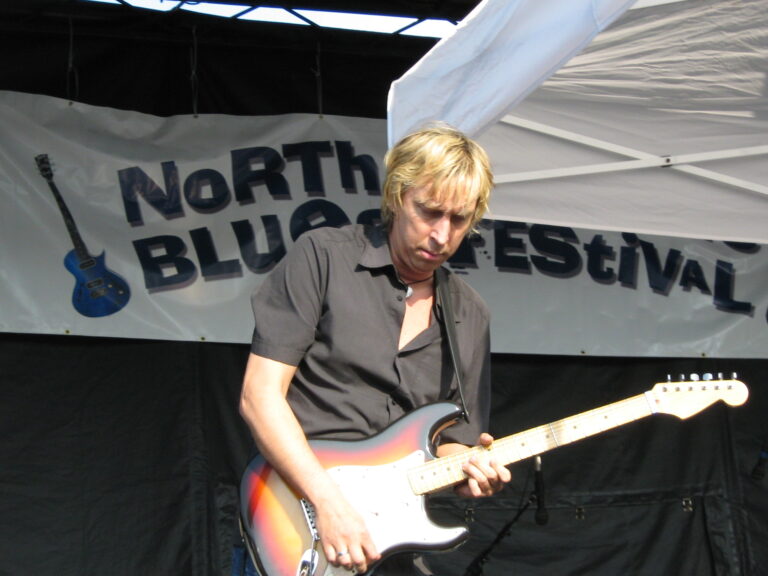
Frank Marino performing with Mahogany Rush in Birmingham, 1983. Photo: Steve Knight. Work: Frank Marino & Mahogany Rush, live in Birmingham 1983. Source: https://www.flickr.com/photos/kitmasterbloke/50048141976/ CC BY 2.0: https://creativecommons.org/licenses/by/2.0/ Resized; full source frame retained.
When you dig into Frank Marino guitars gear, you run headlong into one of rock’s most fascinating and controversial origin stories — a teenager hospitalised after a bad drug experience who claimed to wake up playing guitar with the instincts of Jimi Hendrix, despite having virtually no prior experience. Whether you take that story literally, metaphorically, or with a large grain of salt, the musical reality is undeniable: Frank Marino emerged in the early 1970s as one of the most technically accomplished and tonally sophisticated guitarists in hard rock, leading Mahogany Rush through a decade of searing live performances and studio records that earned him a devoted cult following and the respect of virtually every serious guitarist who heard him.
This guide covers everything in Marino’s rig: the Les Pauls he played with almost religious devotion, the Marshall stacks he ran at volumes that altered the chemistry of concert halls, the effects chain that added dimension without diluting directness, and the specific technical approaches that made him sound simultaneously like a Hendrix disciple and something entirely his own. If you want to understand why a guitarist from Montreal became a touchstone for blues rock tone and technique across multiple generations, this is where the story is told properly.
Background
Frank Marino was born on November 20, 1954, in Montreal, Quebec, Canada. His early teenage years were largely unremarkable from a musical standpoint — he was not, by most accounts, a serious guitar student before the incident that would define his public narrative. In 1968, at around thirteen years old, Marino was hospitalised following a bad experience with LSD. The story he has told, with varying degrees of literalness over the years, is that he woke from this experience able to play guitar — specifically, able to play with the intuitive command and emotional depth of someone who had been practising for years. He claimed at various points that the spirit of Jimi Hendrix had somehow transmitted musical knowledge to him during the experience.
Hendrix himself was alive at the time — he died in September 1970 — and would later hear a Mahogany Rush recording that Marino had made, reportedly responding with genuine interest. The supernatural framing of Marino’s origin became a marketing hook that both helped and hindered his career: it drew attention early on, but also invited dismissal from critics who saw it as a gimmick rather than engaging with the music on its own terms. Those who actually listened heard something more complex: a player whose Hendrix influence was clear and acknowledged, but who had developed a technique and tonal vocabulary that went well beyond imitation.
Mahogany Rush — the band Marino formed in Montreal in the early 1970s with bassist Jimmy Ayoub and drummer Paul Harwood — released their debut album Maxoom in 1971 on a small Canadian label. The record found its way to Columbia Records, who signed the band and gave them North American distribution. Over the next several years, Mahogany Rush released a string of albums — Child of the Novelty (1974), Strange Universe (1975), World Anthem (1977), Tales of the Unexpected (1979) — that built a substantial touring following even as they remained somewhat outside the mainstream rock conversation. The band was a relentless live act, and Marino’s guitar playing in concert was consistently rated by audience members as among the most powerful they had witnessed.
By the late 1970s, Marino had begun recording and touring under his own name — Frank Marino & Mahogany Rush — and then simply as a solo artist. He continued releasing albums through the 1980s and maintained an active touring and recording career into the 2000s and beyond, developing an increasingly loyal international following particularly in Europe and among the guitar community. He became known not only for his playing but for his outspoken commentary on the music industry, his refusal to compromise for commercial concerns, and his willingness to engage directly and at length with fans on online forums, discussing his technique, gear, and philosophy with unusual openness.
Throughout all of it, Marino remained based in Canada, working largely outside the Los Angeles and Nashville industry ecosystems that shaped most of his contemporaries, and maintaining an independence — financial, artistic, and personal — that coloured everything he produced. He built his own recording studio, controlled his masters, and kept his operation small enough to remain genuinely free. That independence is inseparable from understanding his gear choices: Marino used what worked for him, not what was fashionable or endorsed, and he was willing to talk in unusual technical depth about why specific pieces of equipment produced specific results.
Frank Marino Guitars Gear: The Complete Rig
Guitars
Frank Marino is fundamentally a Les Paul player, and has been since the earliest days of Mahogany Rush. His relationship with the Gibson Les Paul Standard — specifically vintage examples from the late 1950s and the early 1970s reissues — is as central to his identity as Hendrix’s relationship with the Stratocaster or Page’s with the Les Paul. The difference is that Marino’s approach to the instrument was defined by a particular obsession with the pre-CBS Fender sound channelled through a Gibson platform, which required careful pickup selection and modification to achieve.
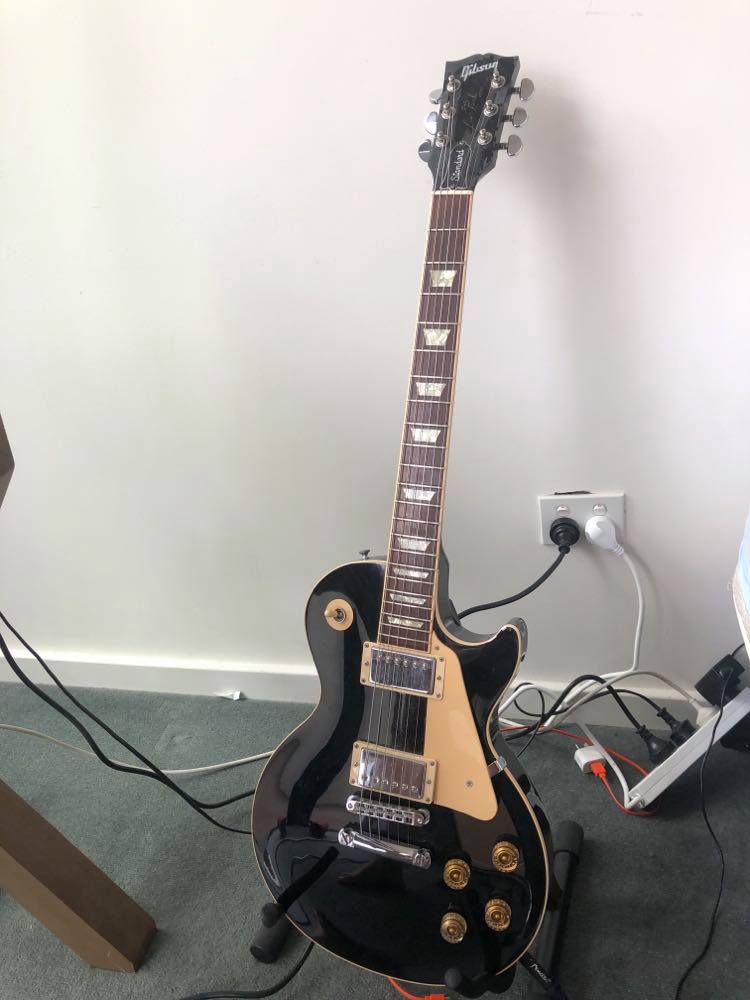
His primary instruments for much of his classic period were 1957 and 1958 Gibson Les Paul Standards — or high-quality replicas and refinished examples of the same era. The late-1950s Les Paul Standard, with its mahogany body, carved maple top, mahogany neck with rosewood fingerboard, and original PAF humbucker pickups, produces a tone that sits at the intersection of warmth and clarity that Marino required. The mahogany body and neck contribute a fundamental warmth and sustain, while the maple top adds upper harmonic content and prevents the instrument from becoming muddy at high gain. This combination — which is essentially why the late-1950s Les Paul became the most coveted electric guitar in history — suited Marino’s approach perfectly.
The PAF humbuckers in these instruments are critical to understanding his tone. Original Patent Applied For humbuckers from this era typically measure between 7.5k and 8.5k ohms DC resistance, wound with plain enamel wire on Alnico II or Alnico V rod magnets depending on the specific example. The relatively low output of these pickups — compared to later high-output replacements — means they hit the amplifier’s input stage with a signal that retains significant dynamic range, allowing the amp to respond to pick attack rather than saturating uniformly regardless of how hard you play. Marino’s technique is deeply dependent on this dynamic response: his ability to go from clean warmth to searing overdrive within a single phrase without adjusting any controls is a function of the low-to-medium output PAF interacting with a valve amp running at the edge of its headroom.
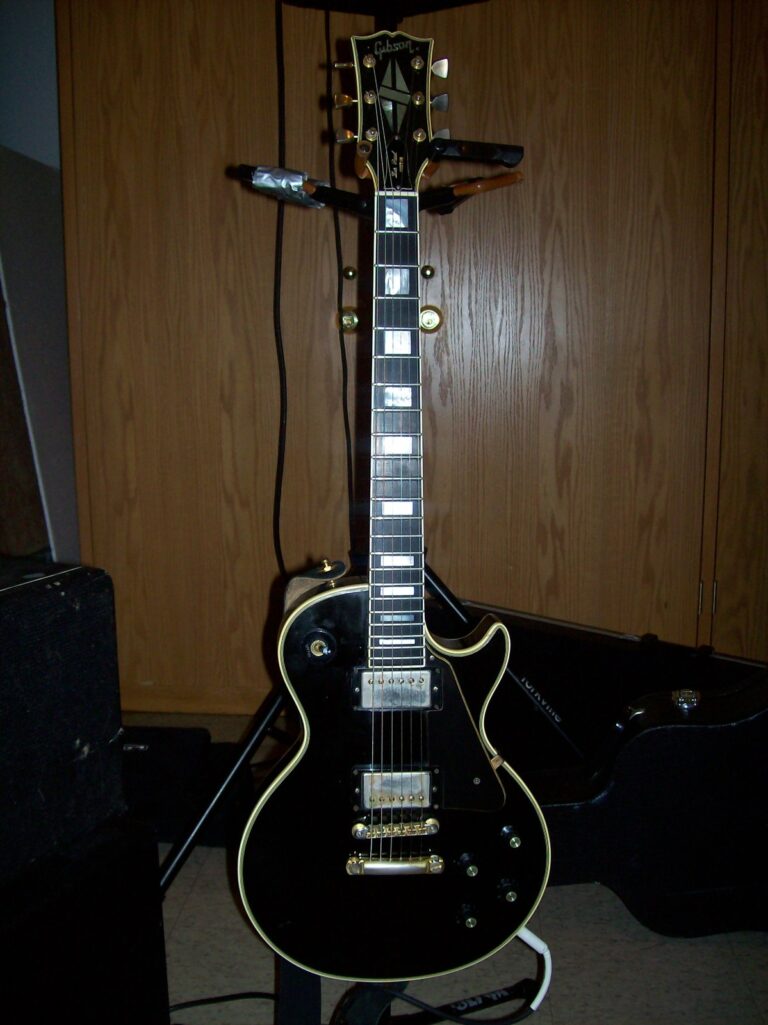
Marino also played Gibson Les Paul Customs — the black beauty configuration with ebony fingerboard and multi-ply binding — at various points, particularly in live settings where the visual impact of the instrument suited the theatrical intensity of Mahogany Rush’s performances. The Custom’s ebony board gives the instrument a slightly tighter, more focused attack compared to the rosewood-board Standard, which affected his tone in subtle but audible ways.
In later years, Marino worked with luthiers to create custom instruments built to his specifications, maintaining the mahogany/maple construction and PAF-style pickup configuration of his preferred vintage examples while incorporating specific neck profiles and fret sizes suited to his technique. He has been notably vocal about the importance of neck feel and the relationship between neck profile, fret size, and the ability to execute the wide, aggressive string bends that are central to his playing style. A thick neck profile — closer to the chunky ’59 Les Paul specification than the slim-taper profile of early-1960s instruments — gives the fretting hand more contact with the wood, which affects both intonation accuracy during bends and the overall resonance transfer from string to body.
String gauges are relevant here: Marino typically used relatively heavy strings — .010–.046 minimum, often heavier — which contribute to the physical authority of his tone. Heavy strings on a long-scale Les Paul (24.75-inch scale length compared to Fender’s 25.5-inch) produce a particular combination of tension and warmth that lighter gauges don’t replicate, and the interaction between heavy strings and PAF humbuckers gives the picked note a density that allows the amplifier to work with a genuinely full signal.
Amps
Frank Marino is a Marshall player, specifically a vintage Marshall player, and his amplifier preferences were established early and maintained with the kind of obstinate consistency that only comes from having found the right tool and refusing to let fashion move you away from it. His primary amplifiers throughout his classic period were Marshall Super Lead 100-watt heads — specifically the late-1960s and early-1970s Plexi and aluminium-panel variants — run at full power into large speaker cabinets.
The Marshall Super Lead 100-watt head in its classic configuration uses four EL34 pentode output valves in a push-pull configuration, producing approximately 100 watts of output power. The preamp uses ECC83 (12AX7) valves in a high-gain cascade configuration that was, at the time of its introduction in the mid-1960s, significantly more aggressive than most American amplifier designs. The Plexi-panel versions (named for the clear Plexiglas front panel used through approximately 1969) have a particular quality of overdrive — a complex, multi-harmonic saturation with a particular emphasis on even-order harmonics — that the later aluminium-panel and then JMP variants approach but don’t quite replicate. Marino was aware of these distinctions and specifically sought out pre-1970 examples when possible.
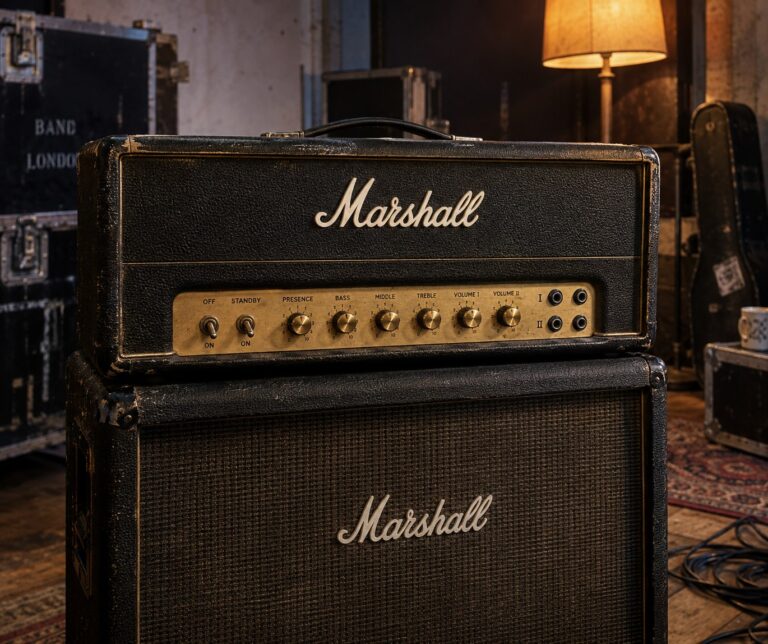
Critically, Marino ran his Marshalls loud — not attenuated, not at bedroom levels through a load box, but at the kind of stage volume that pushes the output transformer into saturation and causes the EL34s to compress and bloom in ways that only happen when the amp is genuinely stressed. The interaction between a fully-driven Marshall output section and a Les Paul with PAF humbuckers produces a specific complex harmonic texture that has been endlessly pursued by players and boutique amp builders since, and Marino understood this intuitively from his earliest playing.
He used multiple Marshall heads simultaneously — a common approach for players who wanted both volume and redundancy — running them into Marshall 4×12 cabinets loaded with Celestion G12M Greenback speakers. The Greenback, rated at 25 watts with a ceramic magnet, a resonant frequency around 75Hz, and a sensitivity of approximately 98dB/1W/1m, produces a characteristic midrange bark and top-end sizzle when pushed that became the defining sound of British hard rock. The combination of Greenbacks with driven EL34s and a Les Paul with PAFs is essentially the blueprint for hard rock guitar tone as the genre defined itself in the late 1960s and early 1970s, and Marino was working within that tradition while pushing his own technical vocabulary through it.
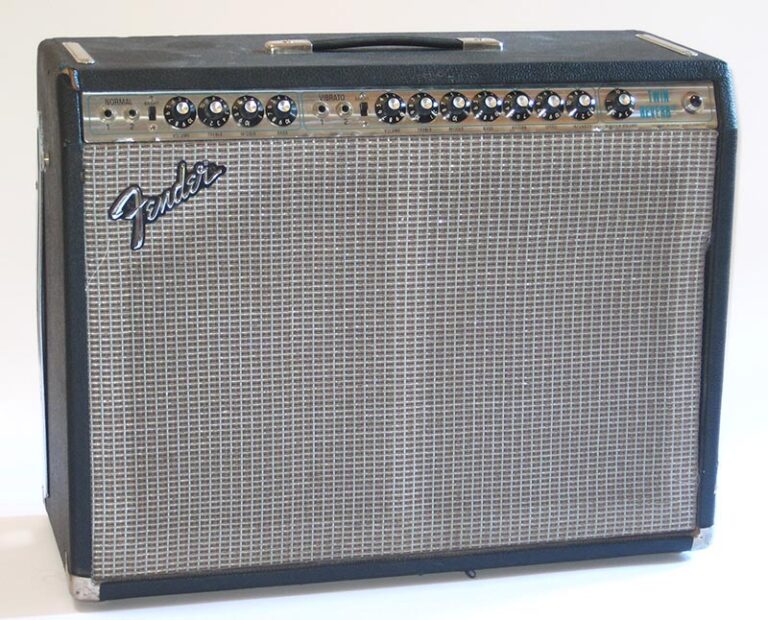
In the studio, Marino occasionally used Fender amplifiers — particularly tweed-era Fender Bassmans and blackface Twin Reverbs — for specific sounds that required a cleaner, American character. The Fender 6L6-based designs produce a fundamentally different harmonic structure from the EL34 Marshalls: warmer, with a more rounded low end and a different top-end character. Used for clean passages or as a contrast to the Marshall’s dominant voice, the Fender added dimension to his recorded work that pure Marshall setups wouldn’t achieve. But the Marshall was always the foundation — the thing his entire playing approach was calibrated to.
Effects
Frank Marino’s approach to effects was rooted in the same philosophy as his approach to equipment generally: use what genuinely serves the music, understand why it works, and resist the temptation to add complexity for its own sake. His signal chain was not minimal, but every element in it was there because it contributed something specific and irreplaceable to his sound.
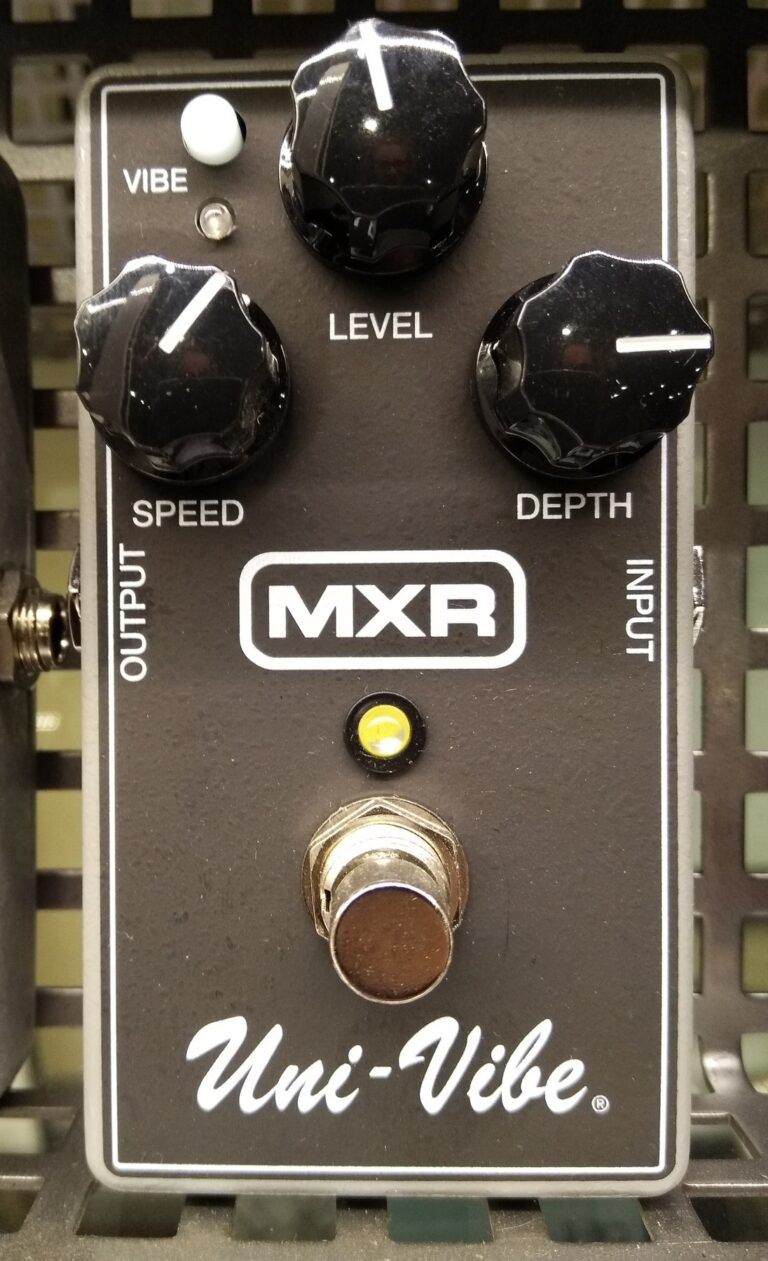
The Univibe was central to his early rig — practically obligatory for any guitarist working in the Hendrix tradition in the early 1970s, and in Marino’s case genuinely deployed for musical reasons rather than mere tribute. The Univibe, developed by Shin-ei in Japan, uses a light bulb and four photocells (LDRs) to create a chorus and vibrato effect that simulates the frequency sweep of a rotating Leslie speaker. The result is a liquid, pulsing modulation with a slight pitch wobble and a complex phase relationship between the dry and wet signals that no digital recreation has fully captured. Marino used the Univibe extensively on slower, more introspective passages, where its atmospheric quality opened up space in the music.
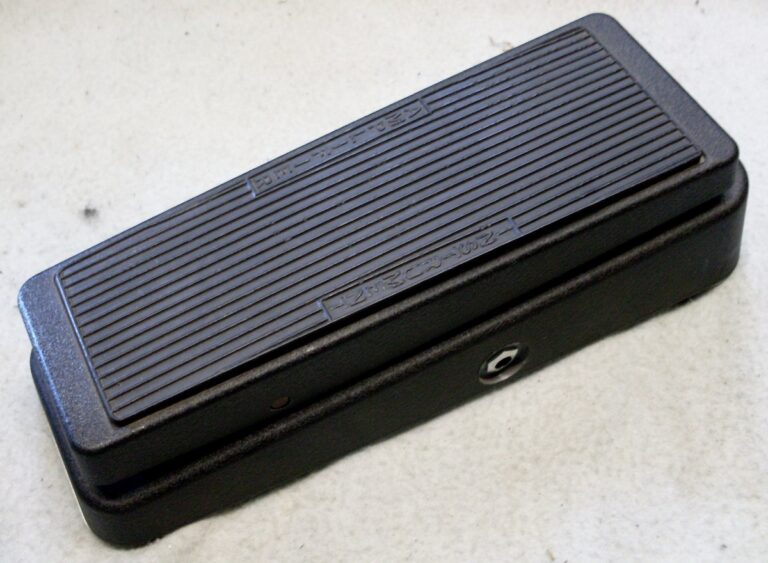
A Dunlop Cry Baby wah pedal was another essential component — both as a conventional swept wah effect in solos and as a fixed filter left at a specific position to emphasise midrange frequencies. The Cry Baby in its classic configuration uses an inductor and variable capacitor circuit driven by the rocker pedal, with a Q factor and centre frequency that give it the characteristic vocal character. Marino’s wah work is fluid and expressive, used to shape individual notes within phrases rather than simply as a lead guitar colour.
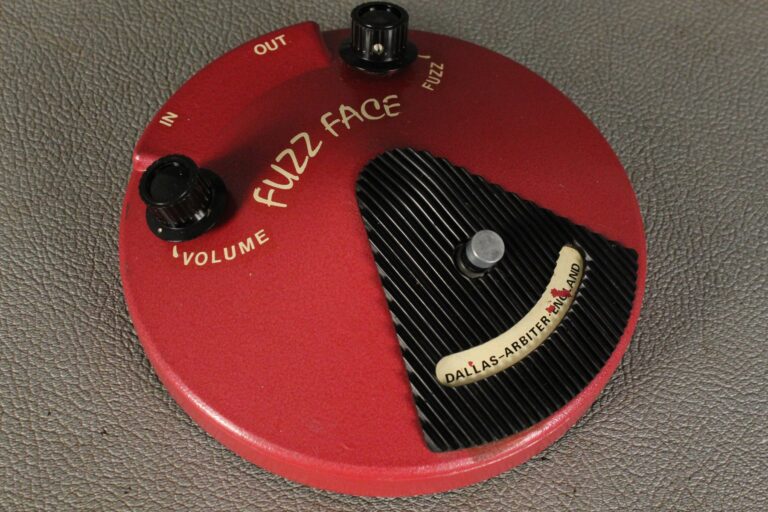
A fuzz pedal — specifically germanium-transistor-based units similar to the Dallas Arbiter Fuzz Face and its variants — appeared in his chain for specific textural applications. The germanium fuzz, with its characteristic warmth, asymmetric clipping, and sensitivity to input level and picking dynamics, adds a velvet texture to the tone that silicon-based fuzzes don’t replicate. Marino understood the interplay between fuzz units and amplifier gain stages: running a germanium fuzz into an already-driven Marshall produces a layered saturation rather than simple addition of gain, with the two stages of clipping interacting to produce complex harmonic content.
An Octavia — the octave-up fuzz circuit originally built by Roger Mayer for Hendrix — also featured in his rig, particularly for solos in the upper register where the octave-doubling effect adds a distinctive synthetic quality to the top end. The Octavia circuit uses a transformer to invert part of the signal and blend it with the original, creating the characteristic octave-up effect that gives specific notes an almost violin-like quality when played high on the neck near the bridge pickup.
Marino used relatively little reverb — preferring the natural ambience of large rooms and the slight room reverb that emerged from running loud Marshall stacks in concert spaces — but employed tape echo units (the Maestro Echoplex and similar) for specific studio applications where spatial depth was required. His overall effects philosophy was consistent with his broader approach: transparency and directness, with effects used to expand the palette rather than to construct or replace the fundamental tone.
Playing Style & Tone Philosophy
Frank Marino’s playing is built on a paradox: he is simultaneously the most overtly Hendrix-influenced major guitarist of his generation and one of the most technically distinctive players the guitar has produced. The Hendrix influence is not subtle — you can hear it in the chord voicings, the use of the thumb over the neck, the rhythmic choppiness, the approach to pentatonic melody, and the overall attitude of the playing. But Marino took those elements and drove them through his own technical and musical intelligence, producing something that transcends the source material while remaining identifiably connected to it.
His right-hand technique is particularly distinctive. Marino uses a heavy pick — typically a thick Dunlop or similar — and attacks the strings with extraordinary authority, often playing with a downward angle that produces a sharp, percussive transient at the beginning of each note. This attack is followed by the sustain of the heavy string and the amplifier’s natural compression, creating a note shape — sharp attack, compressed body, long sustain — that is immediately recognisable. The alternative picking technique he uses for faster passages is highly developed, allowing him to execute runs at tempo that would challenge many players trained primarily in jazz or classical contexts.
His vibrato is wide and fast by conventional standards — a lateral push-and-pull vibrato applied with considerable tension that gives long notes an almost operatic quality. Unlike the controlled, narrow vibrato favoured in jazz or the gentle classical vibrato, Marino’s approach pushes the pitch significantly above and below the target note in a way that communicates raw emotion directly. It is technique in service of expression, and the expression is always primary.
His approach to the neck — specifically his use of the thumb over the top edge to fret bass strings while the fingers reach the treble strings — allows him to execute chord shapes and single-note passages that conventional grip doesn’t accommodate. This is a technique associated with Hendrix, Jimi Page, and several jazz players, and it fundamentally changes what’s harmonically accessible at any given position on the neck. Marino integrated this approach so completely into his technique that it became natural rather than affected.
Tonally, Marino’s philosophy was straightforwardly anti-fashion. He repeatedly emphasised in interviews and forum discussions that tone comes from the hands first, the guitar second, the amplifier third, and effects last — and that the pursuit of tone through equipment substitution, rather than through the development of touch and technique, was fundamentally misguided. This philosophy is easy to state and hard to embody, and Marino embodied it more fully than most. His tone on a borrowed guitar through an unfamiliar amplifier retained his essential character in a way that reveals how deeply physical and technique-driven his sound actually was.
How to Sound Like Frank Marino
Guitar Approach
A late-1950s-spec Les Paul Standard — or a well-built replica with PAF-style humbuckers measuring in the 7.5k–8.5k ohm range — is the starting point. Alnico II magnets in the neck pickup will give you the warm, slightly spongy response that characterises his clean-to-crunch neck pickup passages; Alnico V in the bridge provides more focus and cut for lead work. Use heavy strings — .010s at minimum, .011s if your technique can handle the tension — and set the action slightly higher than the absolute minimum to allow the strings to vibrate fully without choking on bends.
Develop your pick attack. This sounds elementary but it’s the most important instruction: Marino’s tone is generated primarily by how hard and at what angle he strikes the string, not by the settings on his amplifier. Practice attacking with authority, varying your pick angle to shift between a rounder, warmer attack and a sharper, more percussive one. Work on your vibrato — wide, committed, emotional — because his vibrato is as important to his sound as any piece of equipment he uses.
Amp Approach
A vintage Marshall Super Lead or a quality clone (Friedman BE-100, Plexi-style boutique heads) is the correct amplifier. Run it loud — not brutally loud, but loud enough that the output valves are starting to compress and the speakers are working. The sweet spot for a genuine 100-watt Marshall with Greenback-loaded 4x12s is at a volume level that requires ear protection; if it doesn’t, you’re not getting the full character of the circuit.
Set the amplifier fairly clean on the input — let the Les Paul’s pickup output drive the front end rather than using the preamp’s full gain range — and push with pick attack. The Marshall’s natural overdrive character should emerge from the combination of the guitar, the picking force, and the amplifier’s volume rather than from heavy preamp distortion. Add a germanium fuzz or treble booster if you want more saturation, but start from an amplifier that’s already working hard before you add anything in front of it.
| Control | Setting | Notes |
|---|---|---|
| Presence | 6–7 | Presence adds top-end air; too high becomes harsh |
| Bass | 4–5 | Moderate bass — Les Paul adds low end naturally |
| Middle | 7–8 | High mids give the Marino honk and cut |
| Treble | 6 | Moderate — the Les Paul/Greenback combo is naturally warm |
| Volume (Input 1) | 7–8 | High volume drives output stage into natural compression |
| Fuzz (optional) | Low-medium | Germanium unit before amp for added harmonic density |
| Univibe (optional) | Slow–medium speed | For atmospheric passages and slow bluesy material |
Influence & Legacy
Frank Marino’s legacy operates on two levels that rarely intersect in mainstream music commentary: there is the legacy documented in guitar magazines and musician interviews, which is considerable, and there is the legacy of actual influence on playing guitarists, which is arguably even larger. He is the kind of musician whom other musicians know and venerate even when casual listeners have never encountered his name — the guitarist’s guitarist in the fullest sense of the term.
Within the Canadian rock tradition, Marino is a foundational figure. He demonstrated in the early 1970s that technically extraordinary rock guitar playing could emerge from outside the American and British centres of the industry, and that a player working from a base in Montreal could develop a global following through the sheer quality of the music without relocating to Los Angeles or London. This precedent mattered to subsequent generations of Canadian musicians in ways that are hard to quantify but easy to observe in the reverence with which he is discussed in that community.
His influence on the approach to Les Paul tone — specifically the combination of vintage PAF humbuckers, Marshall stacks running at significant volume, and the dynamic picking technique that allows a single setup to cover the full range from clean warmth to raging overdrive — has been enormous among players who studied his recordings seriously. The tonal ideal he embodied, arrived at through consistent application of a specific philosophy rather than through fashionable equipment changes, became a reference point for the boutique amplifier movement of the 1990s and 2000s, when builders began specifically trying to recreate the sonic conditions that players like Marino had found in vintage equipment.
His forum presence in the early internet era — his willingness to discuss his technique, his gear philosophy, and his musical thinking in genuine depth in public forums — created a direct transmission of knowledge to a generation of players who otherwise would have had no access to that kind of specific technical information. In an era before YouTube tutorials and professional instruction videos, Marino sitting at a keyboard and explaining in meticulous detail why a particular amplifier circuit produced a particular sound was genuinely educational in ways that shaped how many players thought about tone.
For players interested in the broader blues rock tradition that Marino inhabited and extended, the rigs of Michael Bloomfield — whose own approach to the Les Paul through Marshall combination predated Marino’s and formed part of the tradition he drew on — and Mick Abrahams, whose work with Jethro Tull and Blodwyn Pig explored similar territory from a British perspective, offer essential context. And for the specifically Hendrix-inflected strand of Marino’s playing, Rory Gallagher‘s approach — another player who took the American blues rock tradition and made something distinctly personal from it — provides a parallel case study in how deep influence can coexist with genuine originality.
The Live Animal: Mahogany Rush on Stage
Any serious accounting of Frank Marino’s gear has to grapple with the fact that he was, first and most essentially, a live musician. Mahogany Rush in the 1970s was a concert band in the deepest sense — the albums served partly as advertisements for an experience that could only be fully delivered on a stage. Marino’s setup was calibrated to performance conditions: the volume levels he required to get his Marshalls into their sweet spot, the physical feedback between a loud amplifier and the guitar he was playing, and the specific way the room’s acoustic response became part of the instrument chain at serious stage volumes were all part of the sonic picture that his equipment was designed to create.
Running a pair of Marshall Super Lead 100-watt heads into multiple 4×12 cabinets at working volume creates a physical phenomenon that no bedroom or studio approximation reproduces. The air pressure generated by sixteen Greenback speakers pushing simultaneously is not merely loud — it interacts with the guitar’s strings and pickups through a process called acoustic feedback that adds sustain, harmonic complexity, and the ability to coax notes out of the guitar that don’t exist at lower volumes. Marino understood this interaction intuitively and built his technique around it. The singing sustain on his slower passages, the harmonic blooms that appear spontaneously at the end of bent notes, the way his vibrato seems to energise rather than simply modulate a note — these are all partly products of playing loud enough that the amplifier and guitar are in genuine acoustic communication.
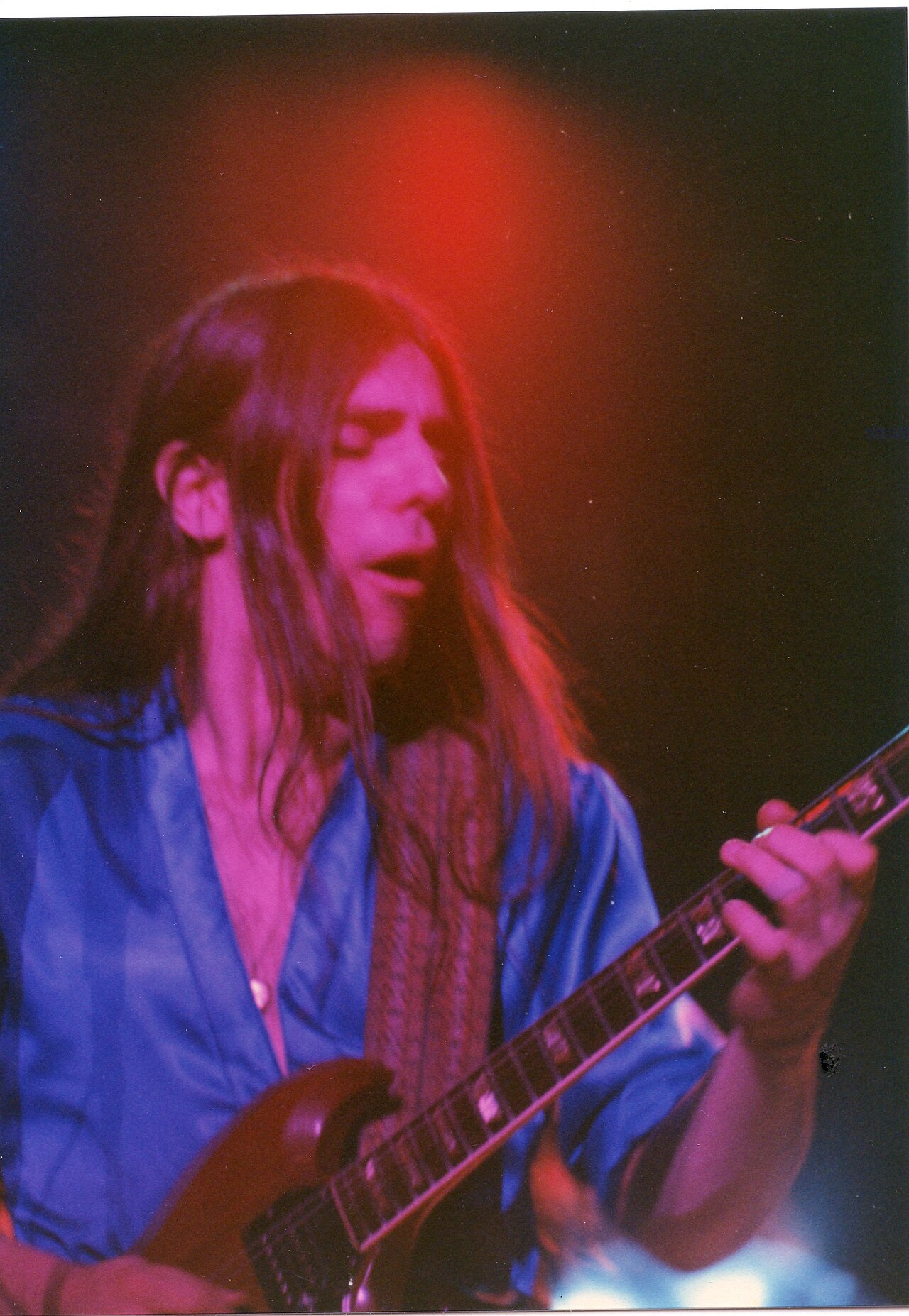
His live performances were also defined by duration and intensity. Mahogany Rush shows regularly ran well past two hours, with Marino soloing for extended periods that tested both his technique and his physical endurance. Unlike players who conserved energy for specific peak moments, Marino tended to perform at full commitment throughout — the long, exploratory solos that he was known for were not technically spectacular in a showy sense but emotionally relentless, covering emotional ground from gentle lyricism to full-volume attack within single extended improvisations. This approach demanded equipment that could sustain those dynamics over long periods without degrading, which is one reason his fidelity to proven vintage gear was practical as well as aesthetic.
The theatrical dimension of Mahogany Rush performances — the band’s image drew on the supernatural narrative of Marino’s origin story — also shaped the gear choices in indirect ways. A guitarist who presented himself as the vessel for a musical spirit required an instrument and amplifier combination that sounded genuinely extraordinary, not merely competent. The vintage Les Paul through vintage Marshall combination, at volume, in a large room with good acoustics, produces a sound that justifies theatrical presentation — it’s one of the few guitar tones that can fill an arena without sounding thin or anonymous.
The Recording Philosophy: Studio Versus Stage
Marino’s studio work presents an interesting case study in the negotiation between the live sound that defined him and the controlled environment of the recording studio. His approach to recording was consistently oriented toward capturing performance energy rather than achieving sonic perfection, which put him at odds with the production trends of the late 1970s and 1980s, when the industry was moving toward increasingly processed and layered guitar sounds. Marino found this development philosophically objectionable and practically limiting, and his resistance to it coloured his relationship with his record labels and shaped the reception of his studio work.
The early Mahogany Rush albums — particularly Maxoom and Child of the Novelty — were recorded with a directness that captured something close to the live performance energy, even if the technical limitations of the recording process compressed and modified what the players actually sounded like on stage. The guitar tones on these records are raw in a productive way: you can hear the amplifier working, the room adding some character, the pick attack giving each note a physical presence. These records still sound vital because they were captured with a primary concern for the energy of the performance rather than the polish of the production.
Later albums, recorded with more sophisticated production budgets and in more technically accomplished studios, show Marino navigating the tension between his natural instincts and the requirements of commercial record-making with varying success. Tales of the Unexpected (1979) and the material from the early 1980s represent his best-produced work, with enough sonic clarity to serve the music without the antiseptic quality that affected much rock recording of the era. When Marino eventually built and controlled his own recording facility, the compromise pressure largely disappeared, and his later self-produced work reflects a return to the directness of the early records.
His views on studio guitar tone — expressed at length and with characteristic directness in online forums over the years — consistently emphasised that the fundamental relationship between hands, guitar, and amplifier should be established first, and that everything else in the production process should serve rather than replace that foundation. He was deeply sceptical of direct-injection recording, effects-heavy production, and the practice of recording guitar at low volumes and then applying software processing to simulate the character of a driven amplifier at stage volume. These techniques, he argued, removed the physical component of guitar tone in ways that degraded the musical result even when the technical outcome sounded impressive on technical grounds. His own recording practice consistently prioritised microphone placement in front of a real amplifier running at meaningful levels, even at the cost of bleed into adjacent microphones and other studio inconveniences.
The combination of these aesthetic priorities — live performance as the primary context, direct capture as the studio method, vintage equipment as the tool — produced a body of recorded work that has aged better than most of its contemporaries. The Mahogany Rush catalogue sounds like a specific time and a specific musician in a way that more heavily produced records from the same era don’t, because the decisions made about recording reflected genuine artistic priorities rather than simply following the fashions of the moment.
One dimension of Marino’s recording approach that deserves specific attention is his use of guitar volume and tone controls as active performance tools during recording. Unlike players who set their controls once and leave them, Marino — consistent with his Hendrix influence — used the volume knob to clean up the tone during rhythm passages without changing amplifier settings, then rolled it back up for lead work to restore the full-drive character. This technique, which requires a guitar with a volume pot that cleans up gracefully rather than simply cutting level, works best with low-to-medium-output pickups like PAFs: high-output humbuckers tend to remain saturated even at reduced volume settings, negating the dynamic range the technique depends on. His choice of PAF-era instruments was therefore not merely tonal preference but practical necessity for the playing approach he had developed.
Marino’s consistency across decades — the same guitar platform, the same amplifier philosophy, the same effects approach — is itself a statement about tone and music that contrasts sharply with the gear churn that characterises much of the guitar industry’s relationship with players. He found what worked, understood why it worked, and stayed with it. The result is a catalogue of recordings in which the guitar sounds recognisably like the same musician across thirty-plus years of work, which is rarer than it sounds and represents a kind of artistic integrity that has inspired the players who followed him as much as the technique itself.
It is also worth noting the specific contribution Marino made to the understanding of how a Les Paul interacts with Marshall amplification at high volume — a relationship that had been explored by Clapton on the Beano album, by Page throughout Led Zeppelin, and by countless others, but which Marino articulated with particular clarity both in his playing and in his subsequent commentary. The key insight, which he stated explicitly and demonstrated practically, is that the vintage PAF humbucker’s moderate output level creates a dynamic relationship with the amplifier’s input that high-output replacement pickups destroy: the amplifier can hear the difference between a softly plucked note and a hard-picked one, and responds differently to each, producing a range of tones from a single guitar-amp combination that would otherwise require separate clean and drive channels. This is not a subtle point — it is the fundamental mechanism by which the classic British blues rock tone works — but Marino’s ability to demonstrate and explain it contributed meaningfully to its wider understanding among players who came after him.
Frank Marino’s place in the guitar pantheon remains somewhat undervalued in mainstream music criticism, which has never quite known what to do with a player who is simultaneously derivative in his influences and exceptional in his execution. The tendency to dismiss him as a Hendrix imitator says more about the limitations of that critical framework than about the actual quality of the music. What he achieved — taking a set of influences absorbed in extraordinary circumstances and transforming them through technical development and personal obsession into a distinctive voice — is precisely what every serious guitarist does, and he did it with more honesty and less artifice than most. The gear was in service of the music. The music was in service of the feeling. And the feeling, at its best, justified every watt of every Marshall he ever pointed at an audience.
Frequently Asked Questions: Frank Marino Guitars & Gear
What guitar did Frank Marino play?
Frank Marino’s primary guitars throughout his career with Mahogany Rush were Gibson Les Paul Standards from the late 1950s and early 1960s, valued for their PAF humbucker pickups, mahogany bodies, and carved maple tops. He also played Les Paul Customs and, later in his career, custom-built instruments made to his specifications. The late-1950s Les Paul’s combination of low-output PAF pickups and resonant construction was central to his tone.
What amp did Frank Marino use?
Marino’s primary amplifiers were vintage Marshall Super Lead 100-watt heads, specifically Plexi-panel and early aluminium-panel variants from the late 1960s and early 1970s. He ran these into Marshall 4×12 cabinets loaded with Celestion G12M Greenback speakers. He typically used multiple heads simultaneously, run at high volume to drive the EL34 output valves into natural compression and saturation.
Did Frank Marino really learn to play guitar like Jimi Hendrix overnight?
Marino has told this story — that he woke from a hospitalisation following a bad drug experience in 1968 able to play guitar with instinctive command — consistently throughout his career, though he has at various times been more or less literal about the supernatural element. What is undeniable is that his musical development was extraordinarily rapid and that his mature playing reflects deep absorption of Hendrix’s techniques, combined with substantial original technical development. The story is best understood as a significant part of Marino’s mythology rather than a literal account that demands verification.
What effects did Frank Marino use?
Marino’s key effects included a Univibe (for the characteristic rotating-speaker simulation central to his atmospheric passages), a Dunlop Cry Baby wah pedal, germanium-transistor fuzz pedals (particularly Dallas Arbiter Fuzz Face variants), and an Octavia for octave-up effects in the upper register. He used tape echo — particularly the Maestro Echoplex — for studio work. His overall effects philosophy emphasised musical purpose over complexity.
Is Frank Marino just a Hendrix imitator?
This is the most common reductive characterisation of Marino’s playing, and it doesn’t survive serious listening. The Hendrix influence is real, acknowledged, and clearly audible — but Marino’s technical development, particularly his alternate picking technique, his approach to rhythm playing, and his tonal philosophy, goes well beyond what Hendrix himself achieved. Players and critics who have engaged seriously with his catalogue consistently find a distinct musical personality operating within the tradition rather than simply replicating it.
What strings did Frank Marino use?
Marino typically used heavier gauges than most rock players of his generation — .010–.046 minimum, with .011 sets used regularly. The heavier gauge on a Les Paul’s 24.75-inch scale length produces the combination of tension and resonance that contributed significantly to the physical density of his tone, particularly in combination with PAF humbuckers and a driven Marshall amplifier.
How did Frank Marino influence modern guitarists?
Beyond his direct musical influence on players who studied his recordings, Marino’s legacy includes an early and significant internet presence in which he discussed tone, technique, and gear philosophy in unusual depth. This technical openness, at a time when such conversations were rare, educated a generation of players who otherwise would have had no access to that knowledge. His insistence on the primacy of touch and technique over equipment — backed by the demonstrable quality of his playing — became an influential position in discussions of guitar tone.
Genre:
Blues Rock
Decades:
1970s | 1980s | 1990s
Image credits
- Frank Marino: kitmasterbloke, Wikimedia Commons, CC BY 2.0.
- Top image: Steve Knight, Flickr, CC BY 2.0.
- Gibson Les Paul Standard: DonnyBurger1974, Wikimedia Commons, CC BY-SA 4.0.
- Marshall 1959 Super Lead Plexi: GuitarGangsters AI-generated reference illustration, not a photograph.
- Fender Twin Reverb: Micahmedia, Wikimedia Commons, CC BY 3.0.
- MXR Uni-Vibe: Skimel, Wikimedia Commons, CC BY-SA 4.0.
- Dunlop Cry Baby: Roadside Guitars, Flickr, CC BY-SA 2.0.
- Dallas Arbiter Fuzz Face: sploshette, Wikimedia Commons, CC BY 2.0.
- Gibson Les Paul Custom: Ibanez Guy, Wikimedia Commons, CC BY-SA 3.0.