
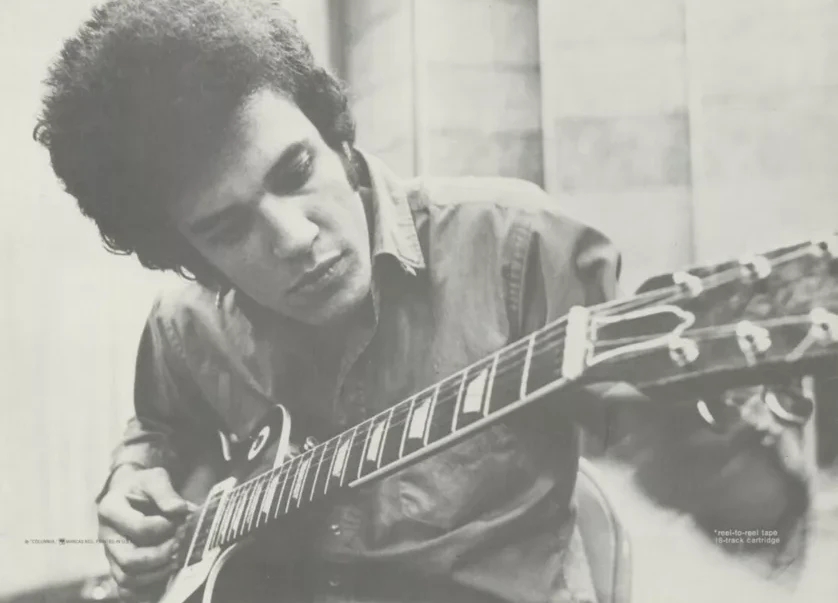
Research Michael Bloomfield guitars gear and you’re digging into the equipment of arguably the most important American electric blues guitarist of the 1960s — the player who turned Bob Dylan electric at Newport, who defined the sound of the Paul Butterfield Blues Band, who assembled the Electric Flag, and who produced a body of recorded work that influenced virtually every serious rock and blues guitarist who came after him. Bloomfield was the link between the Chicago electric blues tradition and the rock world, the translator who made B.B. King and Muddy Waters legible to a generation of young white Americans who might otherwise have missed the music entirely.
This guide covers the full picture of Bloomfield’s equipment: the specific Gibson and Fender guitars he used at different points in his career and why, the amplifiers he favoured and the tonal logic behind those choices, his relatively spare effects chain, and the playing approach that made him one of the most emotionally direct and technically accomplished guitarists of his era. Bloomfield’s gear choices were never accidental — he was a serious student of the instruments and the tradition they represented — and understanding those choices illuminates both the music and the man.
Background
Michael Bernard Bloomfield was born on July 28, 1943, in Chicago, Illinois, into a prosperous Jewish family with no particular musical background. His early exposure to blues came through the South Side Chicago clubs that were, in the early 1960s, still operating as genuine community music venues rather than tourist attractions — places where Muddy Waters, Howlin Wolf, Little Walter, and Buddy Guy played regularly to audiences who considered the music theirs rather than a cultural artefact to be preserved. The young Bloomfield, making his way to these clubs from his comfortable North Shore background, absorbed the music at its source, and the directness of that absorption — the music experienced as living tradition rather than historical document — shaped everything he subsequently played.
He began playing guitar seriously in his early teens and developed rapidly, partly through natural talent and partly through the specific educational context of Chicago in the early 1960s, where he could hear the great blues players in person and, occasionally, play alongside them. By his late teens he was established enough in the local scene to be working with various folk and blues acts, and in 1965 he joined the Paul Butterfield Blues Band — the integrated Chicago blues band led by harmonica player Paul Butterfield that became the vehicle through which the Chicago blues tradition reached the young white rock audience.
The Butterfield Blues Band’s debut album in 1965 and the follow-up East-West in 1966 established Bloomfield as one of the most gifted young guitarists in America. The title track of East-West — a thirteen-minute improvisation that blended blues vocabulary with modal jazz influences drawn from John Coltrane’s “My Favorite Things” period — was a defining moment in the development of extended improvisational rock guitar, predating the Grateful Dead’s similar experiments and influencing a generation of players who heard it as a map of where the electric guitar could go.
His appearance at the 1965 Newport Folk Festival, playing lead guitar for Bob Dylan’s electric set — the famous “going electric” moment that divided the folk community — gave Bloomfield a cultural significance beyond his musical achievements. The sound of his guitar on those Newport recordings, and on the subsequent Highway 61 Revisited album, is the sound of American popular music’s most significant tonal shift, and Bloomfield was at the centre of it.
After leaving Butterfield in 1967, Bloomfield formed the Electric Flag — a large-ensemble band that incorporated brass, rhythm and blues, and psychedelic rock influences — and then pursued a series of collaborative projects and solo records through the early 1970s. His collaboration with Al Kooper on Super Session (1968) produced another landmark recording, and his work on The Live Adventures of Mike Bloomfield and Al Kooper (1969) captured his live playing at its peak.
Personal struggles — with drug addiction and the various psychological and social consequences of early fame — limited his output through the mid-1970s, but he continued to record and perform, producing solo albums that maintained the quality of his best work even when the commercial context was diminished. He died on February 15, 1981, found in his car in San Francisco at the age of 37 — a loss that removed from the music one of its most distinctive and irreplaceable voices precisely at the point when his late-career work was suggesting a renewed creative engagement.
Michael Bloomfield Guitars Gear: The Complete Rig
Guitars
Michael Bloomfield’s guitar history is one of the most interesting and well-documented in rock, not least because he changed his primary instrument significantly at a crucial point in his career and was unusually articulate about why. Understanding his guitar choices requires understanding two distinct periods: the Fender Telecaster period of his early career, and the Gibson Les Paul period that defined his classic sound.
In his earliest professional work, Bloomfield played a Fender Telecaster — specifically a mid-1950s blonde Telecaster with a single-coil bridge pickup and the characteristic bright, cutting tone that the instrument produces. The Telecaster’s attack was well-suited to the Chicago blues style he was absorbing, where the cutting single-coil bridge pickup could replicate the sharp, aggressive tone of Chicago electric blues players like Elmore James. On early recordings from this period, the Telecaster’s brightness and attack are audible in his playing.
The critical transition came around 1964–1965, when Bloomfield acquired a 1959 Gibson Les Paul Standard — one of the sunburst flame-top instruments produced in Gibson’s finest year, featuring original Patent Applied For humbuckers and the specific construction details that made the late-1950s Les Paul the most valuable and sought-after electric guitar in history. Bloomfield has described this acquisition as a revelation — the Les Paul’s warmth, sustain, and midrange character were fundamentally different from the Telecaster’s cutting brightness, and they suited the more lyrical, singing lead style he was developing under the influence of B.B. King and the Chicago blues players he had been studying.
The 1959 Les Paul Standard’s original PAF humbuckers — typically measuring 7.5k to 8.5k ohms DC resistance, wound with plain enamel wire on Alnico II or Alnico V rod magnets depending on the specific example — have a dynamic responsiveness and harmonic complexity that later higher-output humbuckers don’t replicate. The neck pickup in particular, with its warmth and vocal quality, produced the singing tone that Bloomfield used for his most expressive lead work — long, sustained lines that bent and vibrated with the emotional content of the phrases. The bridge pickup, slightly brighter and more aggressive, provided the cutting authority for rhythm work and more assertive lead passages.
The specific 1959 Les Paul that Bloomfield used for his most famous recordings — including the Butterfield Blues Band’s East-West and the Dylan sessions — has become one of the most discussed guitars in rock history. Its flame maple top, cherry sunburst finish, and original PAF humbuckers have been extensively documented by guitar historians, and reproductions of its specific tonal characteristics have been attempted by numerous luthiers and manufacturers. The guitar was eventually stolen — a loss that prompted a famous classified advertisement in which Bloomfield described the instrument in loving detail and offered a reward — and never recovered.
Throughout the 1970s, Bloomfield used various other instruments, including other vintage Les Paul Standards and Customs, as well as Telecasters for specific applications. He was notably practical about instruments — he cared about the tone they produced rather than their collectibility — and his willingness to play whatever was available and sounded right, rather than treating his instruments as untouchable museum pieces, reflects a musician’s rather than a collector’s relationship with equipment.
String gauges were medium-heavy — .010–.046 or slightly heavier — consistent with the need for sustain and string tension that his technique required. His pick was a medium-thickness celluloid type, the standard choice for blues players of his generation, used with a warm, direct attack that gave his notes their characteristic authority without the percussive harshness of harder picks.
Amps
Michael Bloomfield’s amplifier choices reflected a consistent preference for American valve designs that could deliver clean headroom and natural, musical breakup — a different approach from the British players of his generation who favoured Marshall’s more aggressive character, and consistent with his formation in the Chicago blues tradition where Fender amplifiers were the standard tool.
His primary amplifier throughout most of his career was a Fender Super Reverb — the 4×10 combo that Fender introduced in 1963, running two 6L6 output valves at approximately 40–45 watts into four 10-inch Jensen speakers. The Super Reverb’s character — clean at lower volumes, naturally breaking up with a particular warmth and sweetness at higher volumes, with the onboard spring reverb adding spatial dimension — was perfectly matched to his Les Paul and his playing style. The 6L6 output valves produce a fundamentally different tonal character from the EL34s in Marshall amplifiers: warmer in the low end, with a different compression character and a different quality of saturation when pushed. For blues playing, particularly the lyrical, singing lead style that Bloomfield favoured, the 6L6’s character is arguably more appropriate than the EL34’s more aggressive midrange emphasis.
The four Jensen C10N speakers in the Super Reverb — 10-inch ceramic-magnet speakers with a sensitivity of approximately 97dB/1W/1m and a resonant frequency around 65Hz — add a specific character to the amplified sound: slightly brighter and more detailed in the upper midrange than 12-inch Celestion Greenbacks, with a more forward top end that suited Bloomfield’s lead playing. The four-speaker configuration meant each speaker was handling a quarter of the amplifier’s output, which kept the individual cones working in a sweet spot rather than being pushed to their limits.
He also used Fender Twin Reverb amplifiers — the 2×12 combo that ran two 6L6 valves at 85 watts into a pair of 12-inch Jensen C12N speakers. The Twin’s higher power rating gave it more clean headroom than the Super Reverb, useful in large venues where the 40-watt combo’s natural breakup threshold occurred at too low a volume for the room. The Jensen C12N speakers in the Twin — 12-inch, ceramic magnet, with a sensitivity around 100dB/1W/1m — produced a cleaner, more articulate character than the Celestion Greenbacks of British amplifiers, consistent with the brighter, more detailed American tonal aesthetic.
For specific recordings and live applications, Bloomfield used Fender Vibroverb amplifiers — the blackface 1×15 or 2×10 combo that offered a slightly different tonal character from the Twin and Super Reverb, with the single 15-inch speaker version providing particularly full low-end response that suited certain blues contexts. The Vibroverb’s onboard vibrato circuit — a genuine pitch-modulation tremolo rather than simple amplitude modulation — also added a rhythmic dimension to specific passages when engaged.
Effects
Michael Bloomfield’s effects use was notably spare — consistent with the Chicago blues tradition he was working within, where the emphasis was on the guitar-amplifier relationship as the primary sound-shaping tool. He used effects as accents rather than as foundations, which kept his playing connected and direct in a way that heavier effects use rarely achieves.
The most significant effect in his chain was a Vox wah pedal — the original Vox Clyde McCoy wah, introduced in 1966 and using an inductor-based circuit to create the swept vowel filter effect that became one of the defining sounds of late-1960s rock guitar. Bloomfield used the wah both as a conventional swept lead effect and as a fixed filter — rocking the pedal to a specific position and leaving it there to emphasise a particular frequency range. His wah technique was musical and integrated rather than decorative, used to shape individual notes within phrases rather than applied uniformly to solo sections.
A Maestro Fuzz-Tone — the original American fuzz pedal, designed by Gibson and released in 1962, using germanium transistors in a circuit that created the now-classic fuzz distortion — appeared in his chain for specific tonal applications. The Fuzz-Tone’s germanium transistors produce a particular soft, warm clipping character that differs from silicon-transistor fuzzes, and its interaction with Bloomfield’s Les Paul and Fender amplifiers created a layered saturation with a complex harmonic content. He used the Fuzz-Tone selectively rather than as a constant setting, engaging it for specific passages where its character added something that the amplifier’s natural drive didn’t provide.
Beyond these two effects, Bloomfield’s chain was essentially direct — guitar into amplifier, with the amplifier’s onboard spring reverb providing whatever spatial dimension the music required. This austerity was not a limitation but a philosophy, consistent with his understanding of where guitar tone actually comes from and his commitment to keeping the direct line between his playing and the listener’s ears as short and unmediated as possible.
Playing Style & Tone Philosophy
Michael Bloomfield’s playing is best understood as the direct transmission of the Chicago electric blues tradition through a technically accomplished young musician who absorbed it from its source. Unlike many of his contemporaries who learned blues from records — which inevitably introduces a layer of mediation between the player and the tradition — Bloomfield learned from the players themselves, in the clubs where they played, in the specific social and musical context where the music made its original sense. This direct absorption gave his playing an authenticity that record-derived approaches rarely match.
His B.B. King influence is immediately audible and deeply absorbed. The specific technique of playing fewer notes, bending them further, and holding them longer — of making each note carry more emotional weight rather than impressing through quantity — is the central lesson Bloomfield took from King, and it became the foundation of his mature playing style. His vibrato, wide and emotionally committed, extended from this influence: not a mechanical ornament but a genuine expression of the phrase’s emotional content, varying in speed and width according to the feeling rather than being applied uniformly.
His left-hand technique was particularly sophisticated — the ability to execute wide bends accurately while maintaining intonation, to use position shifts to access specific notes at specific tonal moments in the scale, and to employ vibrato of varying character at appropriate musical moments required years of specific practice and a developed musical intelligence about what each technique could communicate. This sophistication was not showy — Bloomfield was not a technically demonstrative player — but it produced music of consistent emotional depth that players with greater technical facility often fail to achieve.
His rhythm playing — often overlooked in accounts of his work — was equally developed. The Chicago blues rhythm guitar tradition, rooted in the interlocking rhythmic patterns of the Chess Records recordings, requires a sophisticated understanding of how to create rhythmic interest within a limited harmonic vocabulary, and Bloomfield had absorbed this understanding thoroughly. His chord work was rhythmically inventive and harmonically informed, providing a foundation for Butterfield’s harmonica and vocals that was more sophisticated than the simple backing-track function it might appear to serve on casual listening.
Tonally, Bloomfield believed in the guitar-amplifier relationship as the primary tone-shaping tool, and his equipment choices — warm Les Paul, warm Fender amplifier, minimal effects — reflected that belief. He was not interested in the pursuit of tone through equipment; he was interested in using equipment to get as directly as possible to the sound he heard in his head, which was the sound of the great Chicago blues players he had studied. That sound — warm, sustaining, emotionally direct — required specific equipment, and Bloomfield chose that equipment with care and clarity of purpose.
How to Sound Like Michael Bloomfield
Guitar Approach
A late-1950s-spec Les Paul Standard with original or reproduction PAF humbuckers is the starting point — Alnico II in the neck for the warm, vocal quality of his lead tone, Alnico V in the bridge for the slightly more assertive character of rhythm work. The mahogany construction is essential: maple-body instruments don’t have the warmth that his tone requires. Use .010–.046 strings and develop your bending technique specifically — wide bends, accurately intonated, held until the vibrato has fully expressed the phrase. This is the most important technical element of his playing and the one most difficult to develop through practice alone.
Listen to B.B. King before you listen to Bloomfield. Understand where the vocabulary comes from, how it functions emotionally within the blues form, and what makes the difference between a note that says something and one that merely fills space. Bloomfield’s playing is dense with meaning at a level that rewards deep listening, and that meaning comes from the tradition he absorbed as well as from his personal gifts.
Amp Approach
A Fender Super Reverb or Twin Reverb is the correct amplifier — the 6L6-based American designs that produce the warm, clean-to-natural-breakup character that his playing required. Run the Super Reverb at a volume where it starts to breathe and compress naturally — typically volume 5–6 on a vintage unit — and keep the EQ settings relatively neutral, with the treble and bass in the middle range and the middle boosted slightly for presence. The onboard spring reverb at a modest level adds the spatial dimension that his playing required without overwhelming the natural character of the amplified tone.
| Control | Setting | Notes |
|---|---|---|
| Volume | 5–6 | Push 6L6s into natural warmth and slight compression |
| Treble | 5–6 | Moderate — Les Paul adds warmth, Jensen 10s add brightness |
| Middle | 6–7 | Boosted middle for blues presence in band mix |
| Bass | 4–5 | Controlled — Les Paul provides natural low-end weight |
| Reverb | 2–3 | Modest spring reverb — spatial dimension without wash |
| Tremolo speed | Off | Tremolo off for most material — use sparingly if at all |
| Wah (optional) | As needed | Vox-type wah for specific lead lines — use expressively |
Influence & Legacy
Michael Bloomfield’s legacy is substantial and layered. At the most direct level, he was the primary conduit through which the Chicago electric blues tradition entered the broader American rock consciousness in the mid-1960s — the player who made it possible for young white Americans to hear and understand music that had previously circulated primarily within the Black community that created it. This cultural bridging function was musically important and socially significant, and it had consequences that extended far beyond his own recordings.
His direct influence on other guitarists was enormous. Carlos Santana, Duane Allman, Jerry Garcia, and countless other players of his generation cited Bloomfield as a formative influence — not just on their technique but on their understanding of what the electric guitar could do and what it was for. The specific combination of technical accomplishment and emotional directness that he embodied became a model for serious rock guitar playing, and its influence can be traced through the entire tradition of blues-influenced rock guitar that followed.
The East-West title track, in particular, had a specific and documentable influence on the development of extended improvisational guitar music — the tradition that would encompass the Grateful Dead, the Allman Brothers Band, and the entire genre of jam-band guitar that descended from both. Bloomfield’s willingness to follow a musical idea wherever it led, within a blues framework but without the formal constraints of the blues form, was a revelation to players who had previously understood improvisation as either strictly blues-based or strictly jazz-based, and the possibility of a synthesis that was both technically demanding and emotionally grounded opened creative possibilities that are still being explored.
His early death at 37 removed from the music a player who was, by the testimony of those who knew and worked with him, still developing and still capable of work that would have surprised and challenged his contemporaries. The recordings he left are sufficient to establish his importance, but they represent a partial picture of what he might have achieved with another two or three decades of creative work. That incompleteness is one of the genuine losses in the history of American music.
For players exploring the tradition Bloomfield inhabited and extended, the rigs of Mick Abrahams — who absorbed similar American blues influences through the British blues scene and developed a parallel approach with different equipment — and Doyle Bramhall II, whose more recent blues rock work carries many of the same values into a contemporary context, offer illuminating comparison. The Chicago blues tradition that Bloomfield transmitted is further explored through Frank Marino‘s rig, which shows how that tradition was absorbed and transformed by the next generation of rock guitarists.
Newport 1965 and Highway 61: The Equipment at the Turning Point
The most culturally significant moment in Bloomfield’s career — his appearance at the 1965 Newport Folk Festival backing Bob Dylan’s electric set — was also, in retrospect, one of the most important single deployments of a Les Paul and Fender amplifier combination in the history of American popular music. Understanding what he was playing and why illuminates both the event and the music that followed it.
At Newport, Bloomfield used his recently acquired 1959 Les Paul Standard through a Fender Super Reverb — the same combination he had been developing his sound around for the previous year and that he would use on the subsequent Highway 61 Revisited sessions. The choice of the Super Reverb for these sessions was deliberate: its 6L6-based circuit, running at 40-something watts into four Jensen 10-inch speakers, produced the clean-to-natural-breakup character that the blues tradition required, with enough power to project in a live performance setting and enough warmth to complement rather than compete with Dylan’s voice and acoustic sensibility.
The Highway 61 Revisited recordings, captured at Columbia Studios in New York with producer Bob Johnston, show Bloomfield’s playing adapted to a session context that was very different from the live blues performance environment where his playing had been developed. The challenge of serving Dylan’s songs — which required rhythmic precision, harmonic sensitivity, and the ability to complement a very specific vocal and lyrical vision — was different from the challenge of holding a twelve-minute blues improvisation together, and Bloomfield met it with an adaptability that demonstrated the range of his musicianship beyond the blues context in which he was primarily known.
The guitar tone on Highway 61 Revisited — particularly on “Tombstone Blues” and “Highway 61 Revisited” itself — is the sound of Bloomfield’s Les Paul pushing a Fender Super Reverb into the early stages of natural breakup, with just enough drive to give the rhythm parts authority and the leads sustain, but not so much that the overall sound becomes heavy or muddy. It is a perfectly calibrated tone for the musical context, and it represents Bloomfield at his most disciplined and most collaborative — qualities that were as genuinely part of his musicianship as the more overtly impressive aspects of his lead playing.
East-West: The Improvisation Blueprint
If the Newport and Dylan sessions represent Bloomfield at his most culturally significant, the East-West album title track represents him at his most musically ambitious — a thirteen-minute improvised piece that drew on blues, modal jazz, Indian classical music, and the specific energy of a group of young musicians pushing at the boundaries of what they thought electric guitar music could be. The piece is a landmark not just in Bloomfield’s career but in the history of rock improvisation, and the guitar tone and technique it documents deserve detailed examination.
The tone on “East-West” is the Super Reverb at a volume where the 6L6 output valves are beginning to compress and the Jensen speakers are starting to work — not at full breakup, but in the zone where the amplifier is responsive in the specific way that valve amplification is, with the compression and saturation varying according to the playing dynamic rather than being uniformly applied. This responsive quality is essential to the improvisation: Bloomfield’s ability to go from a whispered, barely audible passage to full-force attack within a single phrase is partly a function of his technique and partly a function of equipment that responds to that dynamic range rather than compressing it out.
The modal passages in “East-West” — the Coltrane-influenced sections that move away from blues pentatonic vocabulary into a freer, more openly modal improvisational approach — show Bloomfield’s harmonic breadth extending beyond his blues roots without losing the emotional directness of the tradition. His guitar tone through these passages is the same warm, Fender-driven Les Paul sound as the blues sections, but the vocabulary changes significantly: longer, more intervallic lines, less vibrato and bending (those being specifically blues techniques), more note-to-note movement through the mode. The equipment serves all of these approaches equally because it is fundamentally transparent — it amplifies and enhances what the player does rather than imposing a character of its own that would have made the modal sections sound different from the blues ones in a way that broke the musical coherence of the piece.
That transparency — the ability of good equipment choices to serve a wide range of musical approaches without imposing a limiting character of their own — is the deepest lesson in Bloomfield’s rig, and it is one that becomes clearer with repeated listening to the range of material he recorded over his career. The same Les Paul and Fender combination that delivered the raw, physical blues of the early Butterfield recordings also worked for the more sophisticated harmonic language of “East-West” and the session-musician precision of the Dylan recordings. That versatility is a property of the equipment only in the sense that the equipment was correctly chosen for the player and the tradition; the versatility itself came from Bloomfield’s musicianship, and the equipment was simply adequate to transmit it.
Later Career and the Mature Sound
Bloomfield’s later career — the period from the early 1970s through his death in 1981 — produced a series of recordings that have been somewhat overshadowed by the canonical status of the mid-1960s work but that contain playing of genuine quality and reveal a musician who continued to develop throughout a period marked by personal difficulty. The solo albums from this period — Try It Before You Buy It (1973), If You Love These Blues, Play ‘Em as You Please (1976), Analine (1977) — are uneven in execution but consistently revealing of his musical intelligence and the depth of his blues understanding.
The guitar tones on the later recordings are generally similar to the classic period — Les Paul Standards and Customs through Fender amplifiers, with the same minimal effects philosophy — but there are variations that reflect both the evolution of his playing and the different musical contexts of the later work. The solo acoustic playing that appears on several later recordings shows a dimension of his musicianship that the electric work obscured: a fingerstyle guitar approach rooted in the Delta blues tradition, with specific influences from Robert Johnson and Son House audible in the right-hand technique and the vocal, bardic quality of the performance. This acoustic work reveals the depth of his blues absorption more completely than the electric recordings, because acoustic guitar leaves nothing hidden — every aspect of the player’s technique and musical understanding is exposed without the mediation of amplification.
His final recording sessions, captured in the year before his death, show a player whose technique had been somewhat affected by the health consequences of his personal struggles but whose musical intelligence and blues feeling remained fully intact. The specific quality of understanding — knowing exactly which note to play, when to play it, and how to play it to achieve the intended emotional effect — is not a physical skill that deteriorates with age or health; it is a musical understanding that, once genuinely acquired, remains available even when the physical execution becomes more effortful. Bloomfield’s later recordings document that understanding continuing to operate even as the physical circumstances of his life became increasingly difficult, and they stand as evidence that the musical depth he had developed over two decades of serious playing was genuine rather than circumstantial.
The equipment Bloomfield used throughout his career was never exotic or particularly unusual — these were the standard tools of working American musicians in his era, available in guitar stores and widely used by players at every level of the profession. What distinguished his use of this equipment from that of players with similar rigs was entirely a function of what he brought to it: the depth of his blues education, the specific quality of his listening, the physical technique he had developed through thousands of hours of playing in challenging live contexts, and the musical intelligence that determined which note to play and when to play it. These qualities cannot be purchased or specified in a piece of equipment. They can only be developed through the kind of sustained, serious engagement with the music that Bloomfield undertook from his teenage years in Chicago through the end of his short life. The equipment was right. The playing was what made it matter.
Bloomfield remains, more than four decades after his death, a touchstone for guitarists who care about the intersection of technical accomplishment and emotional directness. His name appears in discussions of the greatest electric guitarists with a regularity that reflects genuine consensus among players who have listened carefully — not the casual consensus of those who know his name from rock history accounts, but the considered assessment of musicians who have spent time with the recordings and understand what they are hearing. That assessment, consistently and independently reached by serious players across multiple generations, is the most reliable measure of his legacy and the most accurate testimony to the depth of what he achieved with a Les Paul, a Fender amplifier, and the musical tradition he absorbed from the source.
One technical element of Bloomfield’s playing that deserves specific attention in the context of his equipment choices is his use of the guitar’s neck pickup as his primary lead voice. While many rock guitarists of his era and since have favoured the bridge pickup for lead work — its brighter, more cutting character projecting through a band mix more aggressively — Bloomfield consistently returned to the neck pickup for his most expressive lead passages. The neck pickup on a 1959 Les Paul with original PAF humbuckers — typically measuring around 7.5k to 8.0k ohms, with Alnico II magnets and a somewhat lower winding than the bridge unit — has a warmth and vocal quality that the bridge pickup’s brighter, more compressed character doesn’t provide. Through a Fender Super Reverb at working volume, the neck PAF produces a tone that is simultaneously warm and present, sustaining and defined — the tone that most closely approximates the human voice among the available options on the instrument, and the tone that B.B. King and the Chicago blues players Bloomfield had studied used for their most emotionally intense lead work. This choice — neck pickup, moderate volume, natural amplifier compression — is not the obvious choice for a player trying to project in a loud rock band context, and the fact that Bloomfield made it and made it work reflects both the depth of his blues understanding and the adaptability of his technique.
The specific tonal consequence of this neck-pickup preference, combined with the Fender Super Reverb’s American 6L6 character, was a lead tone that was warmer and rounder than the British Les Paul-through-Marshall combination that his contemporaries often favoured. This warmth is audible throughout the Butterfield Blues Band and Electric Flag recordings as a defining quality — notes that sing rather than cut, sustain that feels organic rather than forced, and a midrange character that speaks clearly in the mix without the upper-midrange aggression of bridgepickup-and-Marshall combinations. It is a specifically American sound, rooted in the specific tradition Bloomfield had absorbed, and it remains as distinctive and recognisable today as it was when those recordings were first released.
Frequently Asked Questions: Michael Bloomfield Guitars & Gear
What guitar did Michael Bloomfield play?
Bloomfield’s most famous instrument was a 1959 Gibson Les Paul Standard with original PAF humbuckers — one of the most revered vintage guitars in rock history. He began his career on a mid-1950s Fender Telecaster but switched to the Les Paul around 1964–65 when he discovered that its warmth, sustain, and midrange character suited his developing style better than the Telecaster’s brightness. His 1959 Les Paul was eventually stolen and never recovered.
What amp did Michael Bloomfield use?
His primary amplifiers were Fender designs — specifically the Fender Super Reverb 4×10 combo and the Fender Twin Reverb 2×12 combo, both using 6L6 output valves that produced the warm, American-character clean-to-breakup tone that suited his blues playing. He also used Fender Vibroverb amplifiers for specific applications. His preference for American Fender amplifiers distinguished him from contemporaries like Clapton who favoured British Marshall designs.
What is Michael Bloomfield’s most important recording?
Several recordings make a claim: the Paul Butterfield Blues Band’s East-West (1966) for its musical ambition and influence on extended improvisation; the Dylan Highway 61 Revisited sessions (1965) for their cultural significance; and Super Session (1968) with Al Kooper for its combination of accessibility and musical quality. The East-West title track remains the single most musically ambitious document of his playing, while the Dylan sessions represent his greatest cultural impact.
What effects did Michael Bloomfield use?
Bloomfield’s effects chain was minimal: a Vox Clyde McCoy wah pedal and a Maestro Fuzz-Tone germanium fuzz were the primary elements, with the Fender amplifier’s onboard spring reverb providing spatial dimension. He was philosophically committed to minimising the signal chain between his guitar and the amplifier, preferring to derive tonal variety from picking dynamics and guitar controls rather than from effects processing.
Why is Michael Bloomfield important to blues rock history?
Bloomfield was the primary conduit through which the Chicago electric blues tradition entered the broader American rock consciousness in the 1960s. He learned directly from the great Chicago blues players — Muddy Waters, Howlin Wolf, B.B. King — at a time when this was still possible, and he transmitted that tradition with both technical accuracy and genuine emotional understanding. His influence on contemporaries including Carlos Santana, Duane Allman, Jerry Garcia, and many others was direct and substantial.
What happened to Michael Bloomfield’s 1959 Les Paul?
Bloomfield’s famous 1959 Gibson Les Paul Standard was stolen, prompting him to place a classified advertisement in which he described the guitar in loving detail and offered a reward for its return. The guitar was never recovered. He subsequently used various other vintage Les Paul Standards and Customs, but none achieved the mythological status of the stolen 1959 instrument, which has become one of the most searched-for lost guitars in rock history.
How did Bloomfield’s playing influence British guitarists?
Bloomfield’s recordings with the Paul Butterfield Blues Band — particularly the East-West album — were enormously influential in Britain, where they arrived as part of the broader American blues import that fuelled the British blues boom of the mid-to-late 1960s. Players like Eric Clapton, Peter Green, and Mick Abrahams absorbed Bloomfield’s synthesis of Chicago blues and rock improvisation and translated it back through British equipment and sensibility, creating the British blues rock tradition that defined a generation of guitarists.
Genre:
Blues Rock
Decades:
1960s | 1970s
Related stories
Wes Montgomery Guitars & Gear: The Complete Guide to the Jazz Master’s Rig
Wes Montgomery's guitars, amps, and effects — the complete guide. Gibson L-5 CES, Standel amps, thumb picking technique, flatwound strings, and how to nail that warm jazz tone.
Yngwie Malmsteen Guitars & Gear: The Complete Guide to the Shred Master’s Rig
Yngwie Malmsteen's guitars, amps, and effects — the complete guide. The Duck Stratocaster, scalloped fretboard, Marshall wall, DiMarzio HS3, and how to nail that neoclassical metal tone.
Sylvain Sylvain Guitars & Gear: The Complete Guide to the New York Dolls’ Gretsch, Les Paul Junior & Automatic Guitar Proto-Punk Rig
Sylvain Sylvain guitars & gear: New York Dolls guitarist. Les Paul Junior 'automatics', Gretsch Golden Anniversary, white Les Paul Custom stolen by Steve Jones — proto-punk tone.