Leigh Stephens Guitars & Gear: Blue Cheer’s Proto-Metal Pioneer Complete Rig
Leigh Stephens guitars gear — Gibson SG and Marshall Super Lead deep-dive for the Blue Cheer proto-metal pioneer's extreme volume tone and complete rig explored.
Investigate Leigh Stephens guitars gear and you find yourself at one of the most important and least discussed origin points in the history of heavy music — the San Francisco guitarist who turned up his Gibson SG through a wall of Marshalls in 1967 and accidentally invented something that would take another decade to be named. Blue Cheer’s debut album Vincebus Eruptum, recorded in late 1967 and released in January 1968, is one of the most sonically extreme records ever made up to that point: louder, heavier, more distorted, and more deliberately abrasive than anything that preceded it, a record that simultaneously drew on the psychedelic blues tradition and obliterated it by pushing every element past its intended limits.
This guide covers everything in Stephens’ rig: the Gibson instruments he used to generate that catastrophic volume, the Marshall amplification he ran in configurations that made the walls bleed, the specific technical choices that produced the Blue Cheer sound, and the playing philosophy — if you can call it that — of a guitarist who understood intuitively that volume and distortion were not merely louder versions of existing guitar sounds but something qualitatively different, a new kind of music that required new approaches to playing and listening. Blue Cheer didn’t invent heavy metal — the term didn’t exist yet — but they invented the conditions that made heavy metal possible.
Background
Leigh Stephens was born in 1947 in the San Francisco Bay Area — the precise location and date are somewhat obscure in available biographical sources, which is itself characteristic of the Blue Cheer era, when the counterculture’s suspicion of documentation and the general chaos of the late-1960s San Francisco scene meant that factual records of who was where and when are frequently incomplete. He came up in the Bay Area music scene of the mid-1960s, absorbing the psychedelic rock and blues influences that were circulating through that particular cultural moment, and formed Blue Cheer with vocalist and bassist Dickie Peterson and drummer Paul Whaley in 1966.
Blue Cheer took their name from a particularly potent strain of LSD that was circulating in the San Francisco scene at the time — a naming choice that announced their relationship to the era’s psychedelic culture while also, inadvertently, describing the effect of their music on anyone who experienced it at close range. The band was managed by Gut, a motorcycle club associate with connections to the Hell’s Angels, and their early performances in San Francisco were characterised by the kind of volume that made venues physically uncomfortable for audience members unaccustomed to the experience.
Their debut album Vincebus Eruptum, recorded at RCA Studios in Los Angeles in late 1967 and produced by Abe Kesh and Bob Shad, captured the band at their most primally powerful. The record contained their version of Eddie Cochran’s “Summertime Blues” — which reached number 14 on the US Billboard Hot 100 in 1968, giving Blue Cheer their only significant chart success — alongside a collection of original material and blues covers rendered in the band’s characteristically overwhelming style. The guitar tone on the record, particularly on the heavier tracks, was unlike anything that had been commercially released up to that point: not just louder than previous guitar records but texturally different, with a quality of distortion and physical weight that suggested the amplification system was being pushed past its design parameters.
Stephens left Blue Cheer after their second album Outsideinside (1968), reportedly due to creative tensions and health issues, and was replaced by guitarist Randy Holden for the band’s subsequent recordings. His post-Blue Cheer career was relatively low-profile — he recorded a solo album, Red Weather, in 1969 and participated in various projects — but his influence, carried through the recordings he made with Blue Cheer, was enormous and disproportionate to the brevity of his major-label career.
The historical assessment of Stephens’ contribution has grown substantially over the decades since his Blue Cheer work. As the lineage of heavy music has been traced backward from its various 1970s and 1980s manifestations to its 1960s roots, Blue Cheer has increasingly been recognised as a crucial missing link — the band that took the blues rock of Cream and Hendrix and pushed it past the point of rock music into something harder, heavier, and more deliberately confrontational. Stephens, as the guitarist who generated that sound, deserves recognition as one of the progenitors of an entire wing of popular music.
Leigh Stephens Guitars Gear: The Complete Rig
Guitars
Leigh Stephens’ primary guitar during the Blue Cheer period was a Gibson SG Standard — the double-cutaway solid body guitar that Gibson had produced since 1961, originally as the “new Les Paul” before reverting to the SG designation. The SG Standard in its late-1960s configuration featured a mahogany body and neck, a rosewood fingerboard, and two humbucking pickups — typically the Gibson Patent Applied For or early patent-number humbuckers that were winding down production but still appearing in instruments during this period.
The choice of the SG over the Les Paul is significant for understanding Stephens’ sound. The SG’s body is thinner and lighter than the Les Paul’s — approximately 1.5 inches at the rim compared to the Les Paul’s more substantial carved-top construction — and this thinner body produces a different resonance character: slightly brighter, with more upper-mid presence and a faster attack than the Les Paul’s denser, warmer construction. Through extremely high levels of amplification and distortion, these differences become somewhat academic — everything gets compressed and saturated — but at the edge of feedback and breakup where Stephens operated, the SG’s faster attack and brighter character contributed to the specific quality of the Blue Cheer sound.
The SG’s double-cutaway design also allowed access to the upper register of the neck in ways that the Les Paul’s single cutaway limited, and for the extended, feedback-prone lead work that characterised Blue Cheer’s live performances, this access to the upper frets was practically useful. The neck join angle — more acute than the Les Paul’s, giving the SG its characteristic tendency toward neck dive — also placed the instrument slightly differently in the playing position, which affected pick attack angle and the relationship between the right hand and the strings.
The humbucking pickups in Stephens’ SG — whatever specific variant was fitted to his particular instrument — operated in extreme conditions that pushed them well beyond their designed operating range. At the volume levels Blue Cheer used, with the amplifiers saturated and the speakers working at their limits, the pickups were not simply transducers converting string vibration to electrical signal; they were participants in a complex electromagnetic feedback loop that involved the room’s acoustic energy, the amplifiers’ magnetic fields, and the guitar’s own resonant frequencies. The result was a constantly shifting, unpredictable interaction between instrument and amplification that required the player to manage — or at least respond to — phenomena that conventionally-played guitars never encounter.
He also used a Gibson ES-335 at various points — the semi-hollow thinline that provided a different resonance character with its hollow wing construction and solid centre block. The semi-hollow construction added acoustic resonance to the amplified sound, which at normal volumes produces a warm, slightly airy quality, and at the volumes Stephens used contributed to the feedback characteristics of the instrument in complex ways. The ES-335’s feedback behaviour was different from the SG’s solid-body characteristics — more unpredictable, with the hollow chambers adding resonant frequencies that the solid body didn’t generate — which could be either a musical resource or a management challenge depending on the performance context.
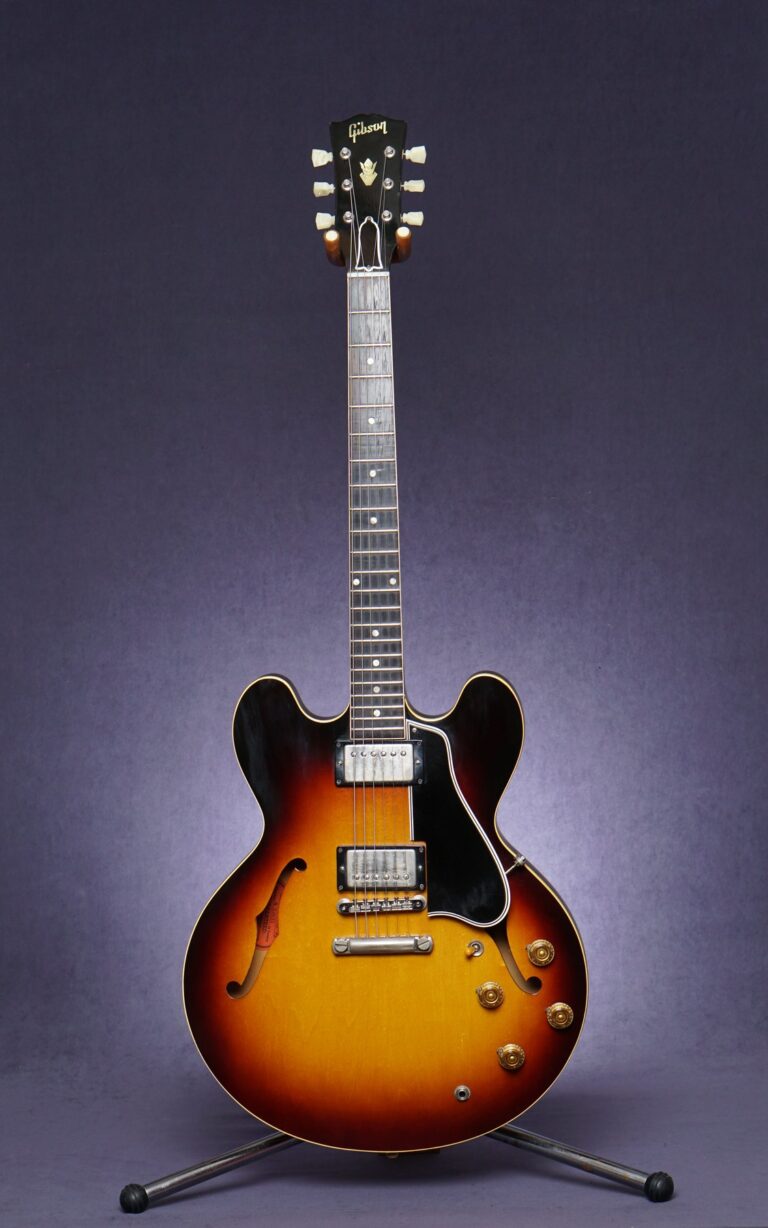
String gauges ran medium-to-heavy — .010–.046 or heavier — which provided the mass and tension that sustained notes required at the volumes and with the distortion levels Stephens used. Lighter strings would have lacked the physical authority to produce the sustained, feedback-prone tones that characterised his playing; heavier strings provided enough mass that individual notes retained their identity even when the amplification system was contributing its own harmonic content to the signal.
Amps
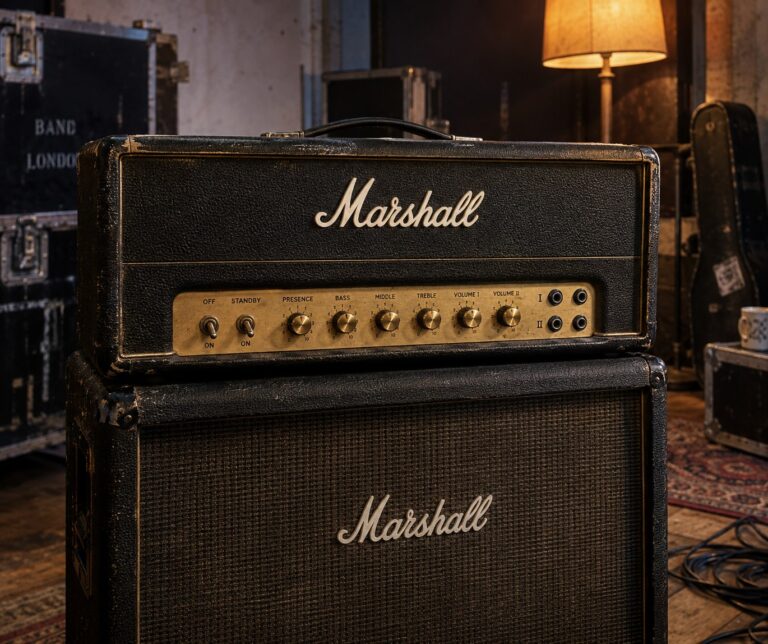
The amplification side of Leigh Stephens’ rig is where the Blue Cheer story becomes truly remarkable — and where the specific combination of equipment and approach produced something that had not existed before in commercial music. Blue Cheer used Marshall amplification — specifically multiple Marshall Super Lead 100-watt heads — in configurations and at volume levels that pushed the equipment far beyond its intended operating parameters.
The Marshall Super Lead 100-watt head in its late-1960s Plexi configuration uses four EL34 pentode output valves producing approximately 100 watts of audio power. This is significant wattage for a guitar amplifier, particularly in an era before the widespread use of PA reinforcement for guitar — Blue Cheer expected the amplifiers themselves to fill venues with guitar sound rather than using the PA system as an extension of the instrument. Multiple Super Lead heads running simultaneously meant that the total amplifier output was several hundred watts, all contributing to the acoustic energy in the performance space.
The Marshall 4×12 cabinets loaded with Celestion G12M Greenback speakers — each rated at 25 watts, so a standard 4×12 cabinet handling 100 watts total — were being driven at power levels that exceeded their rated capacity when multiple heads were feeding them. The Greenback’s behaviour when pushed past its rated power is characteristic: the cone breaks up, the voice coil temperature increases, and the speaker’s effective response changes in ways that add their own distortion and compression to the signal. At the power levels Blue Cheer used, the speakers were not merely passive radiators of the amplifiers’ output; they were active participants in the distortion generation, adding mechanical and acoustic distortion to the electronic distortion already present in the amplifier output stage.
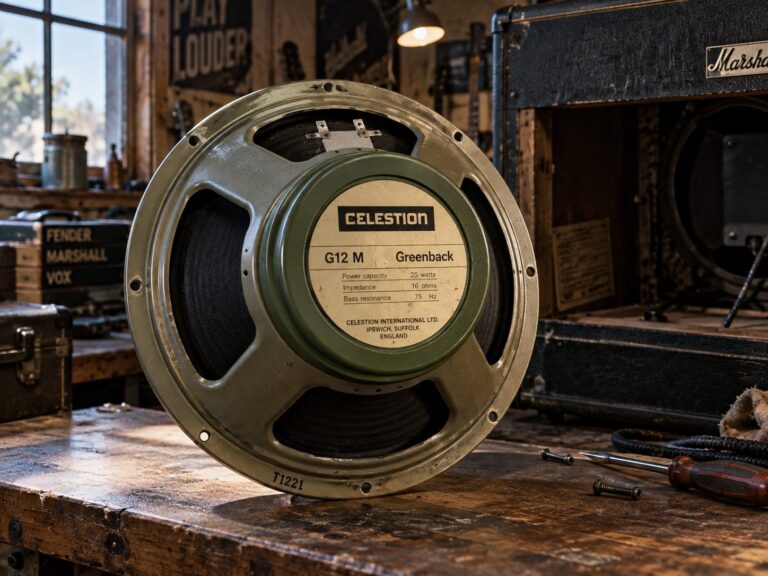
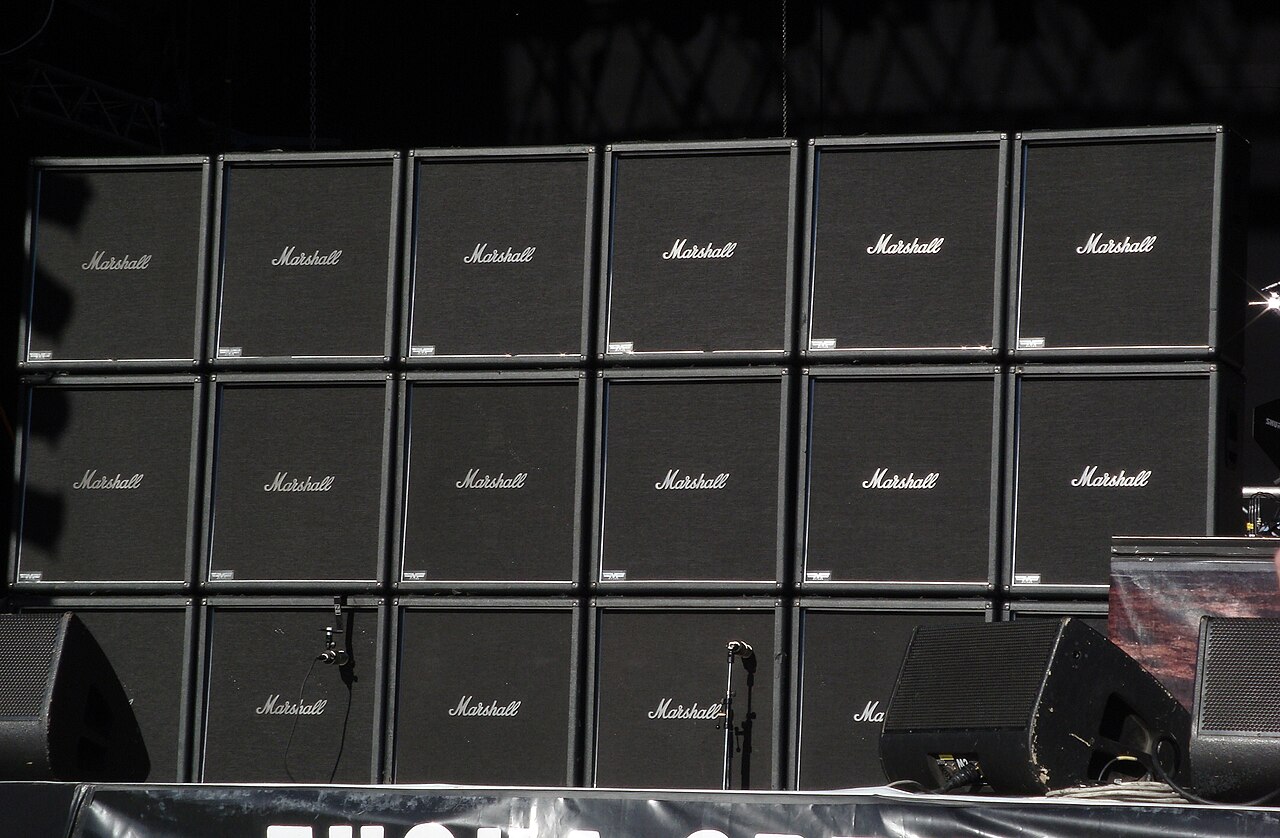
This multi-amplifier, multi-cabinet configuration — several hundred watts pushing multiple stacks of Greenback-loaded 4×12 cabinets — produced sound pressure levels in performance spaces that were physically oppressive. Accounts of Blue Cheer live performances consistently describe the volume as a physical experience — the low frequencies inducing vibration in the body, the high frequencies creating auditory fatigue — that was qualitatively different from the experience of merely loud music. This physical dimension of the Blue Cheer experience was not incidental to the music but fundamental to it: the volume was part of the content, the physical sensation part of the artistic intention.
The specific distortion character of this setup — multiple stages of saturation, from the preamplifier through the output valves through the speaker cones — produced a harmonic complexity that single-amplifier, conventional-volume setups don’t generate. Each stage of clipping adds its own harmonic content, and the interaction between multiple stages produces combination tones and intermodulation products that give heavily distorted guitar its characteristic density and texture. Stephens’ guitar tone on Vincebus Eruptum has this texture in extreme form — notes that are simultaneously distinct and surrounded by a halo of harmonically related distortion that gives the overall sound a physical weight no conventionally recorded guitar had previously achieved.
Effects
Leigh Stephens’ effects chain was, paradoxically, relatively simple — because at the volume levels he was working at, the amplification system itself was generating more sonic complexity than most effects chains could have added. The primary “effect” in his rig was the distortion produced by the multiple stages of valve saturation and speaker breakup that his amplifier configuration generated, and adding additional distortion boxes on top of this would have been gilding an already very comprehensive lily.
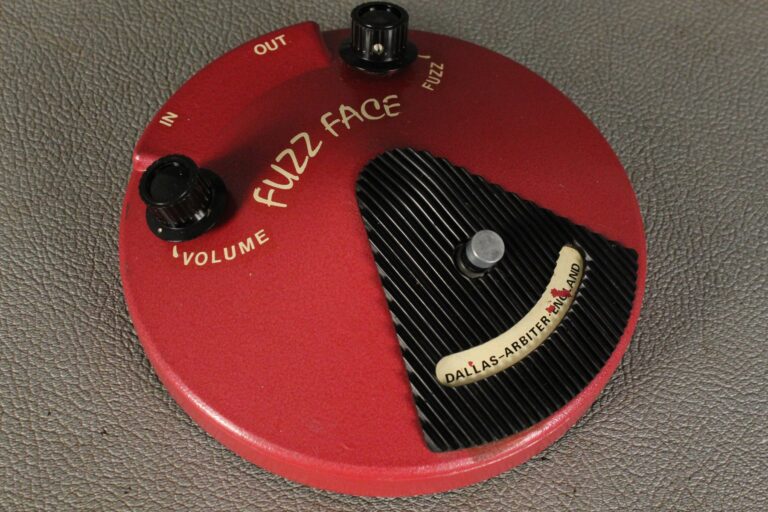
A fuzz pedal — the Dallas Arbiter Fuzz Face in its germanium OC75 transistor configuration — appeared in his chain for specific applications where additional fuzz texture was required before the signal hit the amplifier input stage. The Fuzz Face’s germanium circuit has a particular soft-clipping character that differs from the harder, more aggressive silicon fuzz sound — a warmer, more rounded saturation that, when combined with the multiple amplifier stages that followed it, produced a layered distortion with complex harmonic content rather than simply louder versions of the same clipping character.
A wah pedal — the Vox Clyde McCoy original or a Cry Baby variant — appeared in his rig for specific lead passages where the swept filter effect added a vocal quality to the heavily distorted guitar. Using a wah pedal in a heavily saturated signal chain produces a different effect from using it with a clean or lightly driven signal — the filter’s sweep interacts with the harmonics generated by the distortion rather than with the fundamental frequencies of a clean guitar note, producing a more complex, sometimes unpredictable result that experienced players learn to control.
The most unconventional “effect” in Stephens’ rig was controlled feedback — the deliberate use of the guitar-to-amplifier electromagnetic and acoustic feedback loop to sustain notes beyond their natural decay and generate specific harmonic overtones. Feedback at high volumes is not a single predictable phenomenon but a complex interaction between the guitar’s resonant frequencies, the amplifier’s frequency response, the room’s acoustic characteristics, and the player’s physical position relative to the speakers. Managing feedback as a musical resource requires developing an intuitive understanding of all these variables and the ability to move within them fluidly — to find the feedback sweet spots for specific notes, to encourage particular overtones, to break feedback cleanly without unwanted noise. Stephens developed this ability in the specific context of Blue Cheer’s extreme volume environment and used it as a central element of his lead playing.
Playing Style & Tone Philosophy
Leigh Stephens’ playing style is inseparable from the specific conditions of extreme volume and distortion in which it was developed. He was not a conventionally trained blues player deploying a learned vocabulary in a new context; he was a player who had found a new context — the Blue Cheer volume environment — and was developing techniques specific to it, some of which had no precedent in earlier guitar playing.
His blues influence is audible in the vocabulary — the pentatonic scales, the bends, the general approach to building and releasing tension within a solo — but the execution of this vocabulary at Blue Cheer’s volume levels transformed it into something quite different from the blues tradition it came from. Notes that bend and sustain at normal volume behave differently when surrounded by hundreds of watts of distorted amplification; the physical sensation of playing changes, the feedback interactions change, the relationship between picking attack and note response changes. Players who work at extreme volumes develop a different physical relationship with the instrument than players who work at normal volumes, and this different physical relationship produces different musical instincts.
Stephens’ approach to dynamics was paradoxically subtle within the overall context of extreme volume — he understood that variation in pick attack, pick position, and left-hand damping could produce significant dynamic variation even within the saturated, feedback-prone environment he was working in. The most interesting passages in his recorded and live work were not the loudest but the most dynamically controlled — moments where specific technique created contrast within the constant extreme of the volume level, where a slightly softer attack or a specific hand position produced a qualitatively different tone within the overall sonic assault.
His tone philosophy was fundamentally about pushing existing equipment past its design limits to find what existed beyond those limits. He was not pursuing the equipment’s intended sound — the clean, warm, controlled tone that Marshall and Gibson designed their instruments to produce — but the sound that emerged when the equipment was overloaded, when the valves were beyond saturation, when the speakers were beyond their rated power. This approach, which produced music of genuine historical significance, was enabled by a willingness to damage equipment in service of the music — a willingness that professional session musicians would never have shared and that gave Blue Cheer’s music its specific quality of controlled destruction.
How to Sound Like Leigh Stephens
Guitar Approach
A late-1960s Gibson SG Standard with period-correct humbucker pickups — or a well-built replica with similar specifications — is the correct starting point. The SG’s specific combination of thin mahogany body, set neck, and humbucker pickups produces the resonance character that Stephens’ tone required. Use medium-heavy strings (.010–.046 minimum) for the mass and tension needed to sustain notes at high gain levels. Set up the guitar for relatively high action to prevent buzz at the string tensions required by heavy amplification feedback.
The most important technique to develop for the Stephens approach is feedback management — the ability to find and hold specific feedback tones using body position relative to the amplifier, left-hand damping, and picking position. Start at moderate volume and gradually increase, learning how the feedback character changes as the amplifier is pushed harder. This is not a technique that can be learned quickly or safely at low volumes; it requires the specific conditions that only emerge when the amplification system is genuinely working hard.
Amp Approach
Multiple Marshall Super Lead or equivalent 100-watt heads running simultaneously into multiple 4×12 Greenback-loaded cabinets is the authentic configuration — and one that is impractical for most situations. A more manageable approach is a single Marshall-style head with an attenuator allowing the output valves to be driven into saturation at lower speaker volumes, combined with an appropriate level of preamp gain. The character of the saturation will not be identical — speaker breakup at full volume is acoustically different from attenuated output — but the harmonic complexity of the distortion will be closer to the original than a low-volume, high-gain-preamp approach.
| Control | Setting | Notes |
|---|---|---|
| Volume (Input 1) | 8–10 | Maximum — output stage saturation is the point |
| Presence | 6–7 | Moderate presence — controls feedback character |
| Treble | 6 | Moderate — extreme treble causes uncontrolled feedback |
| Middle | 7–8 | High mids for the Blue Cheer body and cut |
| Bass | 5–6 | Significant bass for the physical weight |
| Fuzz Face (optional) | Germanium, full fuzz | Before amp for additional harmonic layering |
Influence & Legacy
Leigh Stephens and Blue Cheer occupy a specific position in rock history as precursors whose importance was not fully recognised until well after the fact. At the time of their peak activity — 1967 to 1969 — they were regarded as an extreme novelty act, a band whose volume and distortion exceeded what most listeners could comfortably accommodate and whose commercial success was limited accordingly. The mainstream music press of the era was largely baffled or dismissive; only the heaviest of the underground critics understood what they were hearing.
The retrospective reassessment has been dramatic. As the lineage of heavy metal, stoner rock, and noise rock has been traced backward from its various manifestations, Blue Cheer appears at or near the origin point of each thread. The specific combination of volume, distortion, and blues-derived vocabulary that Stephens deployed on Vincebus Eruptum predates comparable developments in British heavy rock by one to two years, and its influence on the American hard rock scene of the early 1970s — through bands like MC5, Stooges, and the various proto-metal acts that emerged from the San Francisco and Midwest scenes — is traceable and direct.
The guitar community’s recognition of Stephens has grown substantially in the era of internet-enabled historical research, when players who grew up on later heavy music could trace its origins and discover his contribution. His specific guitar tone — the SG through saturated Marshalls with Greenback speakers pushed past their rated limits — has become a reference point for players seeking the specific texture of early, pre-production-smoothed heavy rock distortion. The boutique amplifier market has produced numerous designs specifically intended to recreate this kind of multi-stage, output-driven saturation, which is the clearest possible commercial acknowledgment of the enduring influence of the sound Stephens helped create.
For players exploring the proto-metal and early heavy rock tradition that Stephens helped found, the rigs of Uli Jon Roth — who took the heavy rock tradition into neo-classical territory a decade later — and Eric Bell, who was developing comparable heavy blues approaches in Ireland at roughly the same time, offer illuminating parallel cases. The broader psychedelic blues context from which Stephens emerged is explored through Michael Bloomfield‘s rig, whose East-West explorations were a crucial reference point for the San Francisco scene in which Blue Cheer formed.
Vincebus Eruptum: Documenting the Impossible
The recording of Vincebus Eruptum presented the production team with a challenge that few studios had encountered before: how to capture on magnetic tape a guitar sound that was generating noise floor and distortion levels that the recording equipment of the era was not designed to handle. The Ampex and Scully multitrack recorders used in major studios in 1967 had dynamic ranges and overload characteristics calibrated for the music of that era — rock bands at loud but manageable levels, orchestras, jazz ensembles. Blue Cheer’s guitar sound was several orders of magnitude beyond these calibrations.
Producers Abe Kesh and Bob Shad, working at RCA Studios in Los Angeles, reportedly struggled with microphone placement and recording levels throughout the sessions. The problem was not simply volume — it was the specific frequency content of the signal, which contained high levels of energy across a very wide frequency band, including sub-frequencies that taxed the low-frequency response of both the microphones and the tape machines. The solution involved multiple microphone positions, careful management of recording levels to avoid tape saturation, and a willingness to accept a certain amount of distortion in the recording itself as an inextricable part of the sound rather than a problem to be solved.
The resulting recordings have a specific character that reflects this production challenge: a certain roughness in the high-frequency response, a density in the midrange that comes from multiple distortion stages interacting, and an overall sense that the recording medium was pushed to its limits to capture the music — which was, in fact, exactly what happened. This roughness is not a flaw in the records; it is evidence of what the music actually was, and attempts to clean it up or smooth it would destroy the character that makes Vincebus Eruptum historically significant.
The guitar specifically was recorded using dynamic microphones — Shure SM57s and similar workhorses — placed at varying distances from the speaker cabinets. Closer mic placement captured more of the speaker’s direct output with less room reflection; further placement captured more of the room’s acoustic response to the speakers, which at the power levels involved was itself a form of distortion. Stephens’ guitar tone on the record is the product of all of these variables working simultaneously, and the specific quality of that tone — dense, heavy, with a particular texture of controlled chaos — reflects the specific conditions under which it was captured as much as the equipment that generated it.
The Physics of Extreme Volume: What Actually Happens
Understanding what Leigh Stephens was doing with his rig requires a brief excursion into the physics of what happens to guitar amplification systems at extreme volume levels — because the Blue Cheer sound was not simply a loud version of a conventional guitar sound. It was a qualitatively different phenomenon produced by specific physical processes that only occur when amplification systems are pushed far beyond their rated capacity.
The first stage is amplifier saturation. When a valve amplifier’s input stage receives more signal than it can handle in its linear operating range — which in the Marshall Super Lead occurs relatively quickly when the volume is turned high and a hot humbucker pickup is feeding it — the preamp valves begin clipping the signal, cutting off the peaks of the waveform. This clipping adds harmonic distortion to the signal: odd-order harmonics that give the characteristic fuzz quality to overdriven amplifiers. The more extreme the clipping, the richer the harmonic content — more distortion is not simply louder distortion but more harmonically complex distortion.
The second stage is output stage saturation. When the preamp signal drives the output valves hard, the EL34s begin clipping as well, adding a different character of saturation to the signal. Output stage saturation has a different harmonic character from preamp saturation — typically richer in even-order harmonics, which are musically consonant (octaves, fifths), giving the distortion a warmer, more musical quality than pure preamp saturation. The interaction between preamp and output stage saturation produces a complex harmonic environment that neither stage alone generates.
The third stage is speaker breakup. Celestion Greenback speakers rated at 25 watts, driven by amplifiers putting out several times their rated input power, produce their own mechanical distortion as the cone and voice coil operate beyond their linear range. Speaker distortion has its own characteristic — a specific kind of compression and frequency rolloff that changes the tonal character of the signal in ways that valve distortion doesn’t produce. The specific quality of the Blue Cheer guitar tone owes something to all three of these distortion stages operating simultaneously, and the harmonic interaction between them is what gives the sound its particular density and texture. No amount of fuzz pedals running into a clean amplifier recreates this — the effect requires the specific physical processes that only occur when the entire amplification chain is simultaneously and consistently overloaded.
Stephens’ achievement, in this context, was not merely turning everything up — it was managing the complex, partially unpredictable behaviour of a system in extreme overload and finding musical expression within it. The feedback interactions, the varying distortion character as the amplifiers heated up through a performance, the way specific notes in specific registers generated different feedback behaviour — all of these required a player who was genuinely attuned to what the system was doing and capable of responding musically to its behaviour. This is a form of technical mastery quite different from conventional guitar technique, and it is one that received no recognition in the era’s conventional understanding of what guitar playing was supposed to be.
The San Francisco Context: Blue Cheer Among the Psychedelic Bands
Blue Cheer existed within the San Francisco psychedelic scene of 1967–1968 but occupied a very different position from their scene contemporaries. The Grateful Dead, Jefferson Airplane, Quicksilver Messenger Service, and Big Brother and the Holding Company were all working with loud, electric, blues-influenced music — but they were also working with song structures, folk influences, and a relationship to their audience that involved shared experience rather than sonic assault. Blue Cheer’s approach was different in kind rather than degree: they were not a psychedelic band that played loudly but a band that used extreme volume as a primary artistic tool, in a way that prefigured the noise and industrial traditions more than the hippie rock of their immediate contemporaries.
Stephens’ guitar playing sat within this context in a way that was simultaneously typical of the era — pentatonic blues vocabulary, Hendrix-influenced approach to extended soloing, the psychedelic attitude toward time and structure — and radically atypical in its relationship to amplification and volume. The other San Francisco guitarists of the era were pursuing clarity and expression through their amplification; Stephens was pursuing something more like immersion and obliteration. The difference in approach produced a correspondingly different result, and the Blue Cheer albums sound nothing like the other San Francisco music of 1967–68 despite being products of the same scene and the same cultural moment.
The relationship between the psychedelic drug culture and the specific nature of the Blue Cheer sound has been noted by critics and historians — the idea that the band’s music was designed for or emerged from the experience of chemically altered consciousness, and that its extreme volume and disorienting distortion were aesthetic analogues to the perceptual alterations of psychedelic substances. Whether this is a useful or accurate framing is debatable, but it does help explain why the Blue Cheer approach made sense within the San Francisco scene even as it differed so radically from what other bands in that scene were doing. The psychedelic aesthetic was capacious enough to include both the gentle, melodic psychedelia of the Dead and the sonic assault of Blue Cheer, because the underlying attitude — the willingness to push experience past conventional limits to find what lay beyond them — was the same even when the specific manifestation was radically different.
Leigh Stephens embodied this attitude in his relationship with his guitar and amplification system: pushing past the conventional limits of what the equipment was designed to do, finding what emerged on the other side, and using that emergence as the basis of a music that had no clear precedent. The specific equipment he used — SG, Marshall Plexis, Greenback-loaded 4x12s — was conventional; the manner in which he used it was not. That combination of conventional tools and unconventional application is one of the more interesting paradoxes in the history of guitar tone, and it produced results that continue to influence heavy music more than fifty years after the fact.
The specific moment in rock history that Blue Cheer occupied — after Hendrix and Cream had established that heavily amplified blues-rock could be commercially viable, before Black Sabbath and Led Zeppelin had defined the specific parameters of what heavy rock would become — gave Stephens unusual freedom to explore without the constraint of genre definition. He was not trying to sound like heavy metal because heavy metal did not exist as a defined genre; he was simply pushing his equipment as far as it would go and seeing what music emerged from the interaction. This freedom from genre constraint, paradoxically, produced some of the most genre-defining music of the era — sounds that retrospectively became the templates for entire strands of subsequent music precisely because they were made without reference to an existing model. The specific quality of discovery that characterises the best moments of Vincebus Eruptum — the sense of a player encountering sounds that no one has produced before and responding to them with a combination of instinct and intelligence — is the quality that makes the record historically significant and musically alive beyond its immediate context. It is a record made by someone who was genuinely going somewhere new, with equipment that was not designed to take him there, and the equipment evidence of that journey is worth studying by anyone who cares about the relationship between gear, technique, and musical discovery.
Randy Holden, who replaced Stephens in Blue Cheer after the Outsideinside sessions, subsequently pursued an even more extreme volume-based approach in his own solo work — his 1970 album Population II, recorded with a PA system’s worth of amplification, represents perhaps the logical conclusion of the Blue Cheer approach taken to its furthest extreme. That Holden, who had absorbed Stephens’ approach from within the band, subsequently pushed it even further is itself testimony to the generative power of what Stephens had established. The lineage from Stephens to Holden to the various doom and stoner rock musicians who have cited both as influences is direct and traceable, running through the specific equipment choices and playing approaches that Blue Cheer developed in the brief but extraordinarily productive period between 1967 and 1969. In that context, Leigh Stephens’ SG and his wall of Marshalls were not merely instruments of destruction but instruments of creation — the tools with which a new kind of music was made possible.
The verdict of history on Leigh Stephens and Blue Cheer is still being written, but the direction is clear: increasingly recognised, increasingly studied, increasingly cited by musicians who have traced their own musical roots back far enough to find them. The equipment tells part of the story — SG, Plexis, Greenbacks, all pushed past their limits — and the music tells the rest.
Frequently Asked Questions: Leigh Stephens Guitars & Gear
What guitar did Leigh Stephens play?
Leigh Stephens’ primary guitar during the Blue Cheer period was a Gibson SG Standard with humbucking pickups. He also used a Gibson ES-335 semi-hollow at various points. The SG’s combination of thin mahogany body, double-cutaway design, and humbucker pickups suited the extreme volume and feedback environment in which he worked, providing enough upper-mid presence to cut through the saturation while the humbuckers handled the high-gain conditions without excessive noise.
What amp did Leigh Stephens use?
Stephens used multiple Marshall Super Lead 100-watt heads simultaneously, running into multiple 4×12 cabinets loaded with Celestion G12M Greenback speakers. The configuration — several hundred watts of Marshall amplification pushing multiple stacks — produced the extreme volume and multi-stage distortion that characterised Blue Cheer’s sound. At these power levels, the Greenback speakers were being driven past their rated capacity, adding their own mechanical distortion to the electronic saturation of the amplifier stages.
What made Blue Cheer’s guitar sound so distinctive and unprecedented?
The Blue Cheer guitar sound was the result of running conventional late-1960s equipment — SG, Marshall Plexi heads, Greenback speakers — at volume and gain levels that pushed every component well past its intended operating range. Each stage of the signal chain — preamp, output valves, speakers — was in saturation simultaneously, producing a layered, complex distortion with harmonic content that single-stage distortion doesn’t generate. The result was qualitatively different from the louder-but-controlled heavy playing of contemporaries, with a specific texture of controlled destruction that had not previously existed in commercial recordings.
What effects did Leigh Stephens use?
His effects use was relatively minimal given the extreme nature of the amplification. A Dallas Arbiter Fuzz Face with germanium OC75 transistors appeared in his chain for additional fuzz texture before the amplifier, and a wah pedal (Vox or Cry Baby) was used for specific lead passages. The most significant “effect” in his rig was controlled acoustic and electromagnetic feedback — deliberately managing the feedback loop between guitar and amplifier as a musical resource, which at Blue Cheer’s volume levels was a constant and complex presence rather than an occasional technique.
Is Blue Cheer the first heavy metal band?
The question of who played the first heavy metal is genuinely contested — Black Sabbath, Led Zeppelin, MC5, and Blue Cheer all have legitimate claims depending on how the genre is defined. What is clear is that Blue Cheer’s Vincebus Eruptum (1968) is among the earliest commercial recordings to deploy the specific combination of extreme distortion, high volume, and heavy blues vocabulary that defines heavy metal guitar, and it predates most of the British developments that are typically associated with the genre’s origin. Stephens’ contribution to whatever the correct answer is substantial and historically significant.
What happened to Leigh Stephens after Blue Cheer?
Stephens left Blue Cheer after their second album Outsideinside in 1968, reportedly due to creative tensions and health issues. He recorded a solo album, Red Weather, in 1969 that showed a more introspective, acoustic-influenced side of his musicianship than the Blue Cheer work. His subsequent career was relatively low-profile compared to his Blue Cheer period, though his historical reputation has grown substantially as the significance of that period has been more fully recognised.
How did Blue Cheer influence later heavy music?
Blue Cheer’s influence on subsequent heavy music is traceable through multiple lineages: the American hard rock and proto-metal scene of the early 1970s (MC5, Stooges, early Grand Funk Railroad); the development of stoner rock and doom metal in the 1980s and 1990s, where bands explicitly cited Blue Cheer as a primary influence; and the noise rock tradition, which drew on Blue Cheer’s willingness to use distortion and volume as primary musical elements rather than simply louder versions of conventional guitar sound. The specific combination of San Francisco psychedelic blues and extreme amplification that characterised their music was a unique synthesis that proved remarkably influential across a wide range of subsequent developments.
Genre:
Psychedelic Rock / Proto-Metal
Decades:
1960s
Image credits
- A wall of Marshall speaker cabinets: Jaakonam, Wikimedia Commons, CC BY-SA 3.0.
- Gibson SG Standard: Sonya, Wikimedia Commons, CC BY-SA 4.0.
- Gibson ES-335: Lightburst, Wikimedia Commons, CC BY-SA 4.0.
- Marshall 1959 Super Lead Plexi: GuitarGangsters AI-generated reference illustration, not a photograph.
- Dallas Arbiter Fuzz Face: sploshette, Wikimedia Commons, CC BY 2.0.
- Celestion G12M Greenback 12-inch Guitar Speaker: GuitarGangsters AI-generated reference illustration, not a photograph.
- Gibson SG Standard: Sonya, Wikimedia Commons, CC BY-SA 4.0.
- Gibson SG Standard: Sonya, Wikimedia Commons, CC BY-SA 4.0.