Chris Rea Guitars & Gear: The Road to Hell Slide Master’s Complete Rig
Chris Rea guitars gear — Stratocaster slide and Marshall deep-dive for the Road to Hell blues legend's atmospheric tone, glass bottleneck, and complete rig.
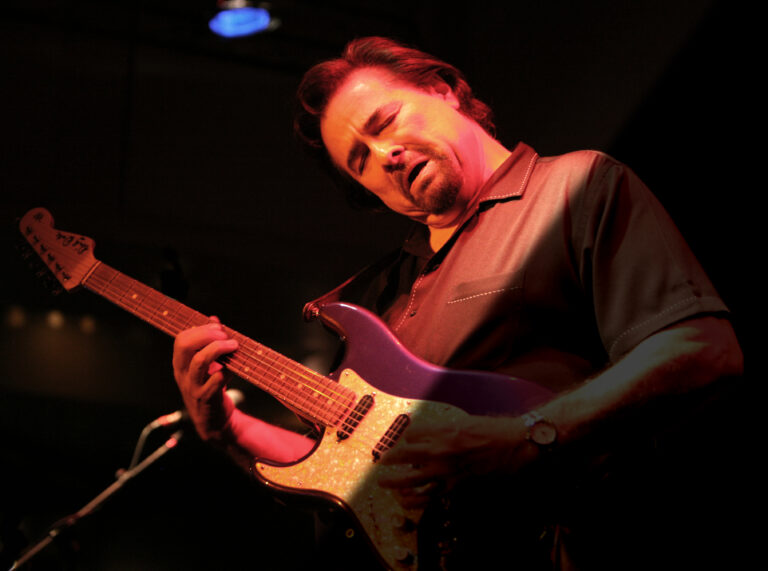
Photo by Andrzej Barabasz (Chepry), licensed under CC BY-SA 3.0 (https://commons.wikimedia.org/wiki/File:Chris_Rea_05_AB.jpg)
Dig into Chris Rea guitars gear and you find the equipment behind one of Britain’s most distinctive and chronically undervalued guitarists — a Middlesbrough-born musician whose commercial success as a singer-songwriter has consistently obscured his credentials as a genuine blues slide guitarist of the first order. Rea’s slide guitar work — which has become increasingly prominent as his career has moved away from the commercial mainstream toward the Delta blues recordings he always wanted to make — sits in the tradition of the great American slide players with an authenticity and depth that few British players have achieved. Behind the polished radio-friendly recordings that made him a household name across Europe in the 1980s lay a musician whose true passion was always the raw, physical blues of Robert Johnson and Elmore James.
This guide covers the full equipment picture of Chris Rea’s career: the Stratocasters and custom guitars he used, the amplification that gave him his warm, singing slide tone, the effects chain he employed, and the playing philosophy of a musician who spent decades making commercially successful music while yearning to play the blues he actually loved — and who eventually did exactly that.
Background
Christopher Anton Rea was born on March 4, 1951, in Middlesbrough, in the northeast of England — the same region that produced Micky Moody, and another example of the disproportionate musical output of industrial northeast England. His early musical formation was shaped primarily by American blues and rock and roll — he has spoken of hearing Ry Cooder’s bottleneck playing as a revelation that redirected his musical ambitions entirely, and the influence of Cooder’s approach to the blues tradition has been visible in his playing throughout his career.
He began his professional career in the mid-1970s with various bands before signing to Magnet Records as a solo artist in 1977. His debut album Whatever Happened to Benny Santini? (1978) contained “Fool (If You Think It’s Over)” — a song that reached the UK Top 40 and the American Top 10, establishing him as a commercially viable solo artist. A succession of albums through the 1980s — Tennis (1980), Chris Rea (1982), Water Sign (1983), Wired to the Moon (1984), Shamrock Diaries (1985), On the Beach (1986) — built a substantial European following while his guitar work remained somewhat subordinated to the pop production values of the era.
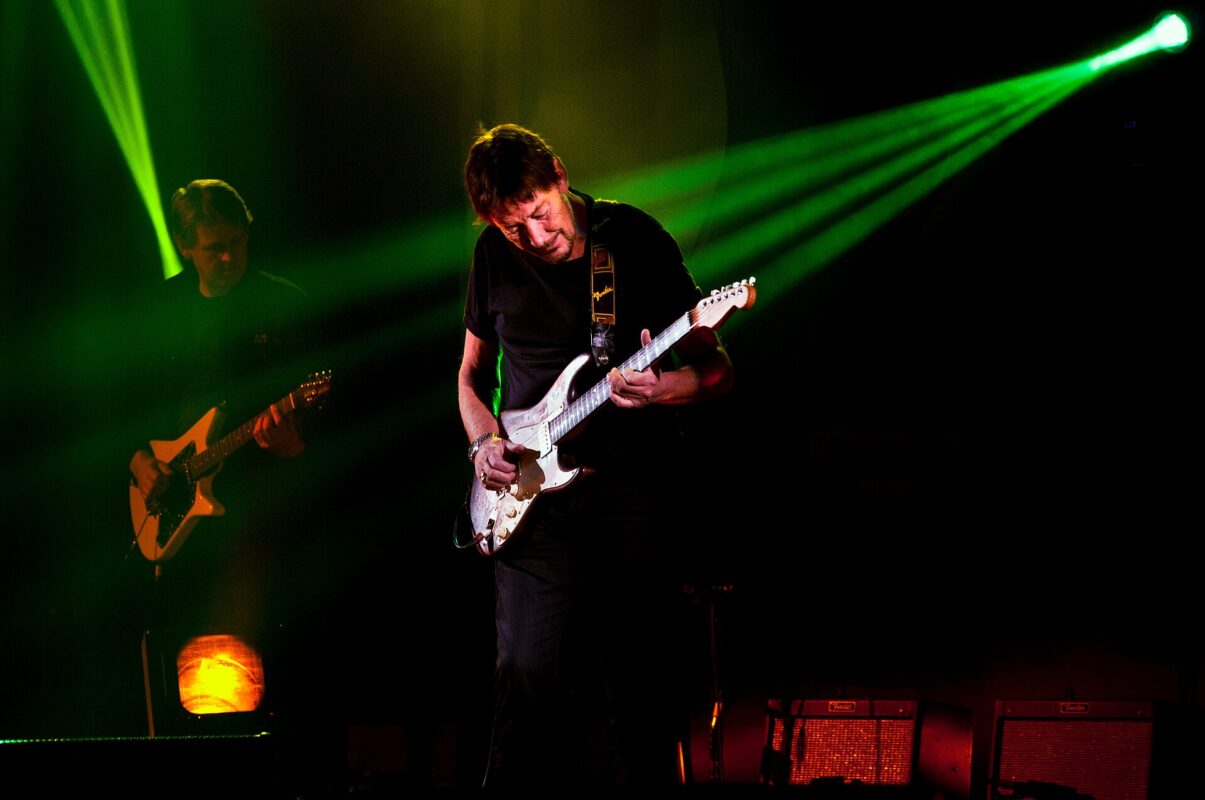
The commercial peak came with The Road to Hell (1989) — the album that spent 33 weeks in the UK Top 40 and whose title track became one of the most widely known British rock songs of the era. The guitar tone on the title track — a sustained, slightly distorted slide sound over a dark, minor-key progression — was immediately recognisable and represented the first time that many listeners heard his slide playing in its fully developed form.
As his commercial success peaked and then gradually declined through the 1990s, Rea used the financial security his earlier work had generated to pursue the Delta blues recordings he had always wanted to make. The project eventually emerged as The Blue Jukebox (2004) and The Return of the Fabulous Hofner Bluenotes (2008 and 2010) — recordings that showed his slide playing in its most authentic and developed form, free from the commercial production values that had constrained it through the successful years.
A serious health crisis — a near-fatal bout of pancreatitis in 1999 — temporarily interrupted his career and, by his account, reinvigorated his commitment to playing the music that genuinely mattered to him rather than the music that the market expected. His subsequent output has reflected this reinvigoration: more blues, more slide guitar, more of the raw musical truth that had always been his primary motivation.
Chris Rea Guitars Gear: The Complete Rig
Guitars
Chris Rea’s guitar history centres on the instruments that best served his slide playing — the technique that became the defining element of his musical identity as his career developed. His choices reflect both the practical requirements of slide guitar playing and the specific tonal character he was pursuing: the warm, singing quality that he associated with the great American Delta blues players.
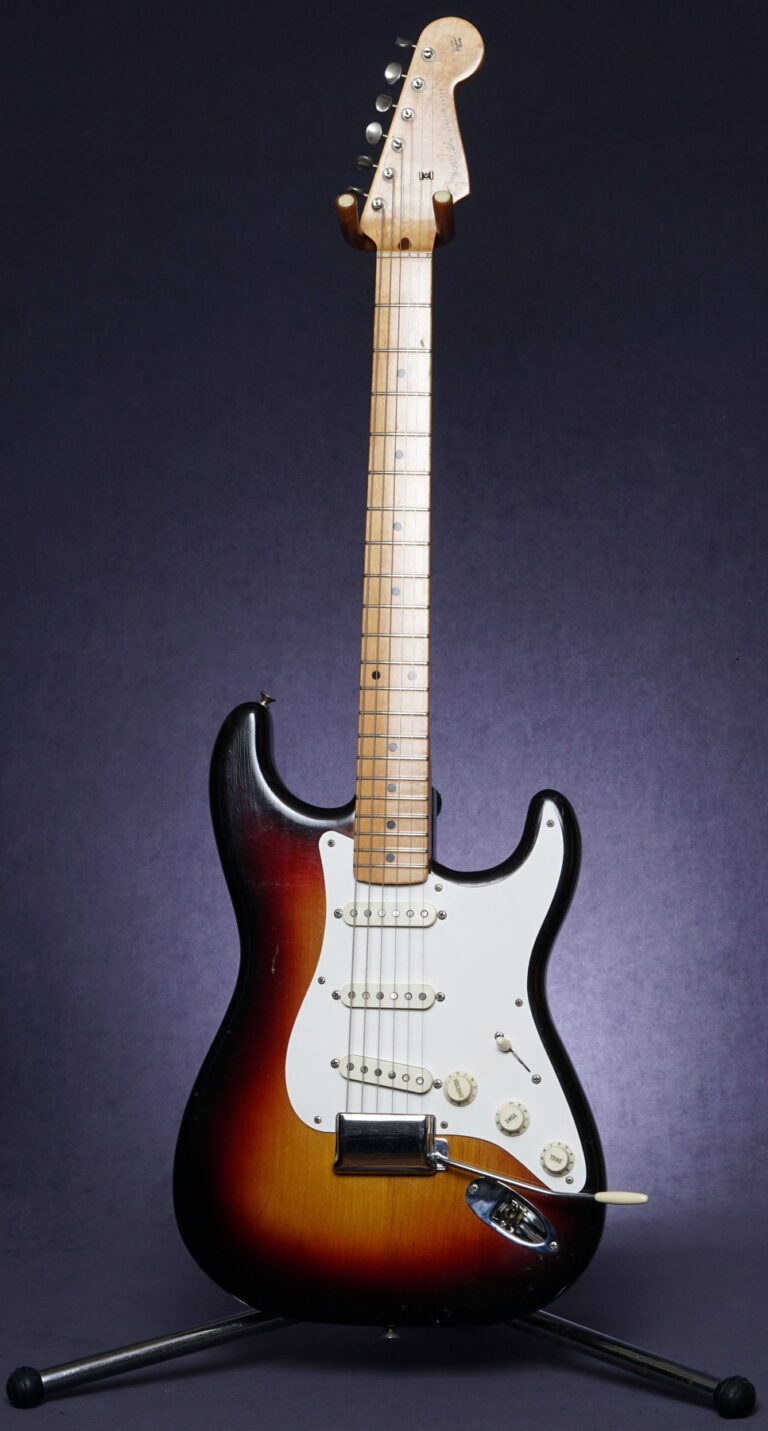
His primary guitar through much of his career has been a Fender Stratocaster — specifically vintage late-1960s and early-1970s examples that he played both for slide and conventional fretted work. The Stratocaster’s three-pickup configuration suited the dual requirements of his playing: the bridge pickup for the bright, cutting character suited to slide, and the neck pickup for the warmer, more sustained tone that conventional fretted passages required. The specific single-coil pickups in his Stratocasters — Alnico V magnets, approximately 5.8k to 6.2k ohms DC resistance — produced the specific combination of brightness and dynamic sensitivity that characterised his slide tone on the commercial recordings.
For slide work, Rea used a glass bottleneck on the ring finger of his left hand — following the tradition of the Delta blues players who used glass rather than metal for its warmer, smoother tone. Glass slides produce a different harmonic character from metal: softer attack, longer sustain, and a warmer tonal quality in the upper register that suits the specific emotional colour of blues slide playing. His choice of ring finger rather than little finger (the more common choice among some slide players) reflected his specific technique: the ring finger allows the middle finger to assist with muting adjacent strings, which is important for the clean, defined slide lines he favoured.
He also used a Hofner guitar — specifically a semi-hollow Hofner that appears on the blues recordings that represented his most personal and committed musical work. The Hofner’s specific character — warmer and more acoustically resonant than a solid-body instrument, with a different midrange voicing from the Stratocaster — suited the specific atmospheric quality he was pursuing in the Delta blues material. The hollow body construction added an acoustic dimension to the amplified sound that solid-body instruments don’t provide, giving the slide lines a more natural, earthy quality.
Various custom and modified guitars appeared throughout his career — instruments built or modified to his specific requirements, particularly for the slide work that demanded specific action heights and pickup configurations. Slide guitar requires higher action than conventional fretted playing — the string must be raised high enough that the slide can move over the frets without buzzing, while remaining low enough that the slide can produce clean, sustaining notes. This specific action requirement typically means maintaining a dedicated slide guitar rather than attempting to set up a single instrument for both conventional and slide playing.
String gauges for his slide work ran medium-heavy — .011–.052 or heavier — providing the string tension and mass that slide playing requires. Lighter strings produce less sustain and are more prone to unwanted vibration when the slide touches them; heavier strings sustain longer and produce a fuller, more even tone under the slide.
Amps
Chris Rea’s amplification has been rooted in British valve designs — primarily Marshalls and Voxes for the commercial recordings, and a more varied selection for the blues-focused work that represented his personal musical ambitions. His amplifier choices reflected the different tonal requirements of the commercial and personal strands of his career.
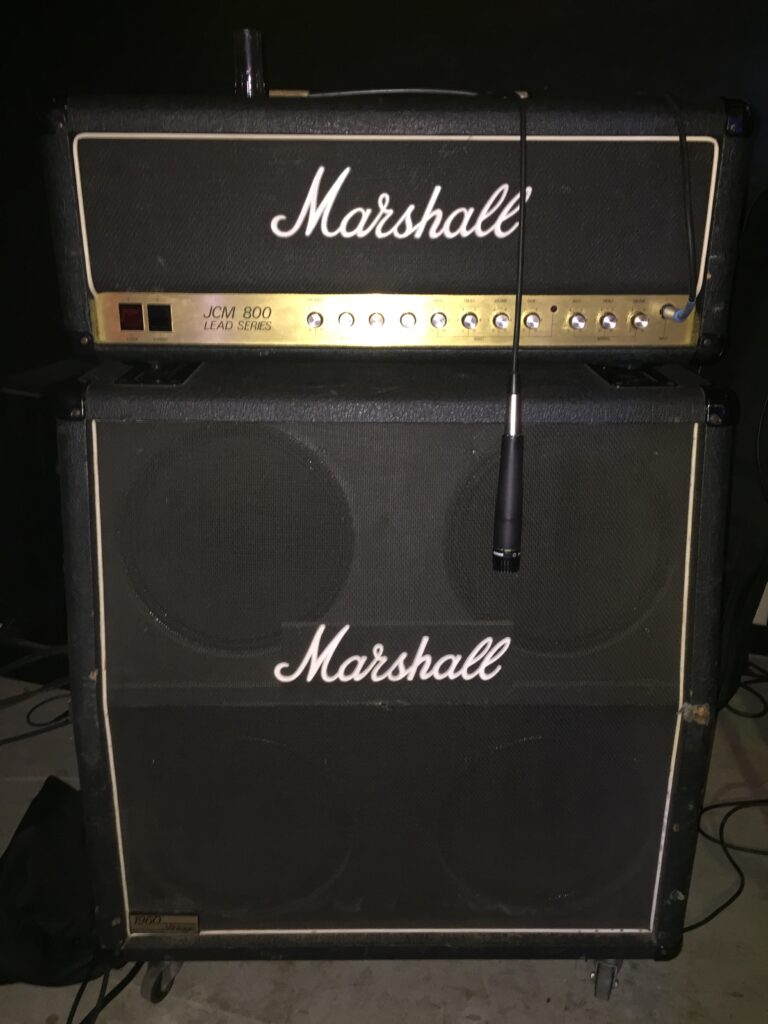
For the commercial recordings of the 1980s, his primary amplifier was a Marshall JMP or JCM800 — the British EL34-based designs that were standard for British rock recording of the period. The Marshall’s natural drive at working volume, its midrange emphasis, and its specific quality of sustain suited the polished rock production that characterised albums like The Road to Hell. The slide tone on the title track of that album — warm, singing, with a natural drive quality that complemented the dark minor-key atmosphere of the song — was produced through a combination of the Stratocaster’s single-coil bridge pickup and the Marshall’s working-volume overdrive character.
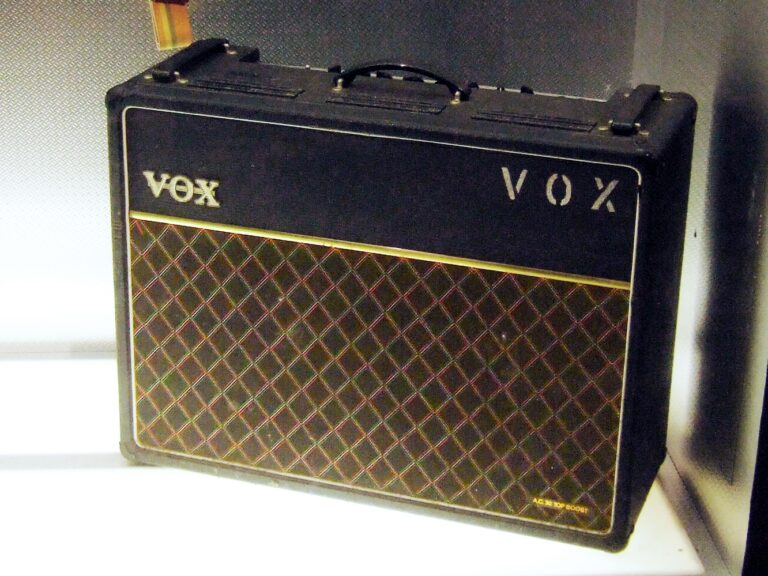
He also used Vox AC30 Top Boost amplifiers — the EL84-driven British combo whose natural compression and chimey midrange suited the more atmospheric, cleaner passages in his playing. The AC30’s specific tonal character — the natural compression of cathode-biased EL84 output valves, the warmth of the Top Boost channel — suited both conventional guitar playing and slide work in contexts where the Marshall’s more aggressive midrange emphasis was too heavy for the musical material.
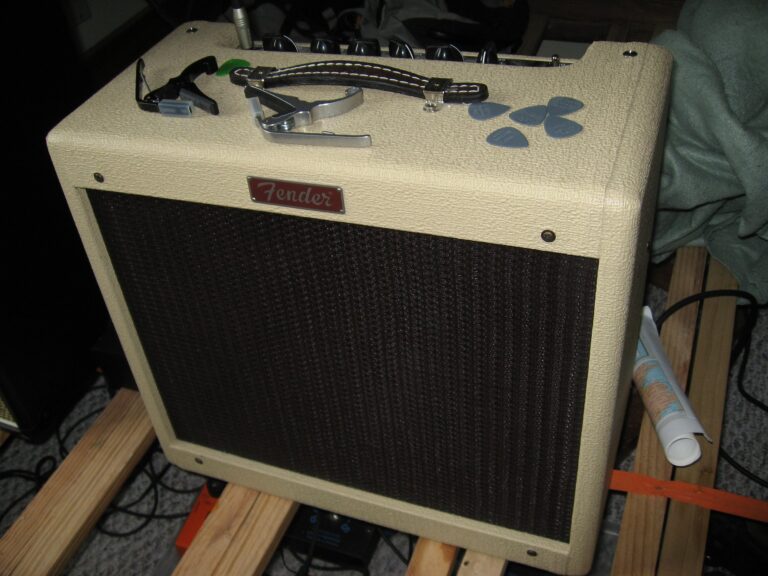
For the blues recordings, Rea used Fender amplifiers — particularly the Fender Tweed Deluxe and Fender Blues Junior variants — that provided the warmer, more American character he associated with the Delta blues tradition. The 6V6 output valve character of tweed-era Fender amplifiers — warmer, with earlier saturation and a different quality of harmonic distortion from the EL34 Marshall — suited the specifically American blues material that the Blue Jukebox projects represented. The direct connection between the tonal character of his amplifier and the specific musical tradition he was working within was a deliberate and musically intelligent choice.
Effects
Chris Rea’s effects chain was relatively straightforward — consistent with the blues tradition he most admired, where the instrument-amplifier relationship is the primary tonal tool and effects are used selectively and sparingly. His commercial recordings incorporated more production processing than his personal blues work, but even in the most produced context, his guitar parts maintained a directness that excessive effects chain complexity would have undermined.
A delay/echo unit — a Boss DD series digital delay and, in earlier work, tape-based echo units — was a consistent element of his chain, particularly for the atmospheric, sustaining slide passages that characterised the more cinematic moments in his commercial recordings. The delay added the spatial dimension and harmonic repetition that gave his slide lines their atmospheric, hypnotic quality. The specific delay time and feedback settings he used — moderate delays with limited regeneration — produced an echo effect that was atmospheric without being obviously processed.
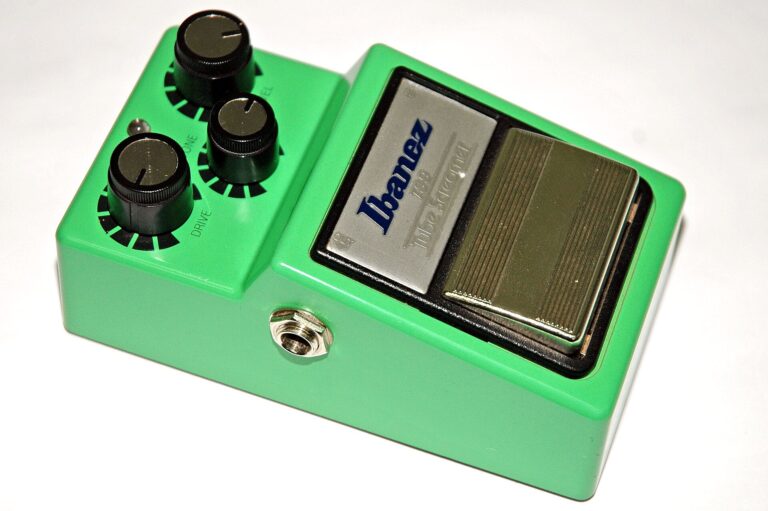
A mild overdrive pedal — typically an Ibanez Tube Screamer or similar smooth overdrive unit — appeared in his chain for specific applications where additional warmth and sustain were required before the amplifier. The Tube Screamer’s JRC4558 op-amp circuit produces a soft, mid-forward overdrive that added harmonic richness to slide lines without the harder clipping that would have obscured the slide’s natural tonal character.
The onboard reverb of his amplifiers — spring reverb in the case of Fender and some Vox models — contributed the spatial dimension that blues slide guitar traditionally employs. The spring reverb’s specific character — slightly metallic, with a natural drip on the decay — is part of the tonal identity of the blues tradition, and using it as an integral part of the signal chain rather than as a separate effect maintained the authenticity of the overall tone.
A volume pedal appeared for specific passages where swell effects or dynamic control were required — allowing him to manage the slide’s natural sustain in ways that served specific musical passages. His volume pedal use was subtle and musical rather than technically spectacular: a tool for specific tonal shaping rather than a performance technique in its own right.
Playing Style & Tone Philosophy
Chris Rea’s playing is defined by the tension between his natural identity as a blues musician and the commercial context in which much of his career was played out — a tension that produced some interesting musical compromises in the commercial work and was finally resolved when he stripped away the commercial context entirely in the blues projects of the 2000s and 2010s. The playing on those later recordings — slide guitar in the Delta tradition, with genuine emotional commitment and the specific tonal character of the American blues vocabulary — shows what he always was underneath the polished production values of the commercial releases.
His slide technique reflects the Delta blues tradition in its most essential elements: the bottleneck held loosely against the strings with just enough pressure to contact all of them without pressing them to the fretboard, the right-hand technique producing clear, sustaining notes from individual strings while muting adjacent strings to prevent sympathetic vibration, and the specific melodic vocabulary of the Delta blues — phrases that slide between notes rather than jumping, that use the natural resonance of the slide to extend specific pitches, and that speak in the specific emotional language of the tradition rather than in the more neutral language of technical facility.
His vibrato with the slide — a rapid oscillation of the bottleneck on the string that produces a pitch modulation similar to a singer’s vibrato — is particularly developed, giving sustained notes the expressive quality that distinguishes genuinely musical slide playing from technically accomplished but emotionally neutral slide work. The specific speed and width of his vibrato, developed over decades of performance, is immediately recognisable to listeners familiar with his playing.
His conventional (non-slide) guitar playing reflects the same blues roots — pentatonic vocabulary, blues bends, the specific rhythmic approach of Chicago electric blues — but is less distinctive than the slide work that became his primary musical identity. He was always more comfortable as a slide guitarist than as a conventional lead player, and the recording contexts in which his slide playing was most prominent produced his most musically convincing work.
Tonally, Rea’s philosophy evolved from the commercial compromise of the 1980s records — where the production values of the era shaped the guitar tone as much as his own preferences — toward the more authentic, blues-rooted sound of his later work. The warmer, more direct tone of the blues recordings — closer to the original American tradition he had always admired — reflects the tonal philosophy he would have pursued throughout his career if commercial considerations had been absent from the beginning.
How to Sound Like Chris Rea
Guitar Approach
A Fender Stratocaster with the bridge pickup as your primary slide voice — or a semi-hollow guitar for the warmer, earthier tone of his blues recordings — is the starting point. Medium-heavy strings (.011–.052 minimum) provide the sustain and tension that slide playing requires. A glass bottleneck on the ring finger, held loosely with enough contact pressure to produce clear notes without pressing to the fretboard. The right-hand muting technique — the palm resting lightly behind the slide to damp sympathetic string vibration — is essential for the clean, defined slide lines that characterise his playing.
Study the Delta blues vocabulary specifically: Robert Johnson, Elmore James, and Ry Cooder (Rea’s primary stated influence) all provide models for the specific melodic language he uses. The technique is learnable; the vocabulary requires deep listening and specific study of the tradition.
Amp Approach
A Marshall JCM800 or equivalent for the commercial rock material; a Fender Tweed Deluxe or Blues Junior for the Delta blues material. For the signature commercial tone, the Marshall at moderate gain — enough drive for sustain without obscuring the slide’s natural tonal character — with a mild Tube Screamer before it for additional warmth. For the blues material, the Fender running slightly driven, with spring reverb at a moderate setting for the spatial dimension the tradition requires.
| Control | Setting | Notes |
|---|---|---|
| Preamp Gain | 4–5 | Moderate — enough drive for slide sustain without harshness |
| Treble | 6 | Moderate — Stratocaster bridge adds natural brightness |
| Middle | 6–7 | High mids for slide projection in band context |
| Bass | 4–5 | Controlled bass for clarity in slide work |
| Master Volume | 5–6 | Working volume for natural EL34 compression |
| Delay (echo) | Short-medium, low feedback | Atmospheric dimension without obvious processing |
| Reverb | 3 | Moderate — spatial quality without wash |
Influence & Legacy
Chris Rea’s legacy within British music sits in an interesting position: he is widely known as a singer-songwriter rather than as a guitarist, which has obscured his genuine significance as a British exponent of the Delta blues slide tradition. Among players who have heard his blues recordings — the Blue Jukebox projects and similar — the assessment is very different: a genuine blues musician who spent decades making commercially successful pop-rock while harbouring a musical identity rooted in the American tradition.

His influence on subsequent British guitarists who play in the blues tradition is difficult to trace specifically, partly because his blues work became widely known relatively late in his career when his influence on a younger generation was less direct. But within the British blues guitar community, his commitment to the Delta tradition — his willingness to abandon commercial security in the later years of his career in favour of the music he genuinely believed in — has been noted and respected.
The specific commercial recordings that brought him to wide attention — “The Road to Hell,” “Auberge,” “Let’s Dance” — contain guitar work that was more blues-influenced than the mainstream radio audience recognised, and players who listened carefully to those recordings heard in them the specific quality of blues guitar sensibility that distinguished them from comparable commercial records. The slide tone on “The Road to Hell” in particular — atmospheric, sustained, emotionally direct — showed what serious guitar playing could contribute to a commercially successful pop-rock context without compromising either the commercial appeal or the musical authenticity.
For players exploring the British blues slide tradition that Rea inhabits, the rigs of Micky Moody — whose Whitesnake slide work explored similar blues-in-rock-context territory from a different perspective — and Rory Gallagher, whose Irish blues approach represents the deepest British Isles engagement with the American blues tradition, provide essential comparison. The American Delta tradition that Rea admired most directly is explored through Doyle Bramhall II‘s more recent slide work, which shows how the tradition continues to develop in contemporary hands.
The Road to Hell: Anatomy of a Guitar Tone
“The Road to Hell” (1989) is the recording that introduced Chris Rea’s slide guitar to the widest audience, and examining what specifically went into the guitar sound on that record illuminates both his equipment choices and his approach to deploying slide guitar in a commercially successful pop-rock context without compromising its blues authenticity.
The song opens with the slide guitar — Rea’s Stratocaster through the Marshall, with the specific delay setting that gives the notes their atmospheric, lingering quality — before the rhythm track enters. This opening is one of the most effective uses of slide guitar as a scene-setter in British rock: the specific tonal character of the slide line — slightly driven, warm in the midrange, with the delay adding spatial depth — creates the oppressive, threatening atmosphere that the lyric subsequently develops. The choice to open with slide guitar rather than with conventional guitar or keyboard was the correct musical choice, and it required both the technical ability to execute the slide line with the necessary atmosphere and the musical judgment to understand that this was the right voice for this specific moment.
The specific equipment that produced this sound was the Stratocaster’s bridge single-coil pickup feeding the Marshall JCM800 at moderate gain — enough drive that the slide notes sustained naturally and had harmonic richness, but not so much that the specific tonal character of the glass bottleneck on the string was obscured. The delay unit set to a short-to-medium delay time with minimal regeneration — echo rather than repeat — added the spatial dimension that the atmospheric quality of the slide line required without creating obvious repetition effects that would have made the processing too visible.
The right-hand muting technique that Rea employs — the palm resting against the strings behind the slide to damp unwanted sympathetic vibration — is particularly important for the specific quality of his slide sound on this recording. The individual notes are clearly defined rather than blurring into each other, which requires active muting of strings not being played by the slide. Without this muting discipline, the bridge pickup’s resonant frequency response and the Marshall’s gain would have produced a wash of sympathetic string noise rather than the clean, melodically distinct slide lines that give the recording its character. The technique is invisible in the finished record but fundamental to its musical quality.
The Delta Blues Projects: Coming Home
The series of Delta blues recordings that Rea produced from the early 2000s onwards — culminating in the Blue Jukebox project and the Hofner Bluenotes series — represents the most personally significant chapter of his musical career, and the equipment choices he made for these recordings are correspondingly more deliberate and more revealing of his actual musical values than the commercial recordings that preceded them.
The decision to use a Hofner semi-hollow guitar for much of this work — rather than the Stratocaster that had served his commercial recordings — was a specific tonal choice reflecting what he heard the music requiring. The Hofner’s semi-hollow construction, with its acoustic resonance contributing to the amplified sound, produced a warmer, more organic quality that suited the earthy, raw character of Delta blues more authentically than the clean, precise sound of a Stratocaster. The Hofner’s specific midrange character — slightly softer, less cutting than the Stratocaster’s bright single-coils — complemented the glass bottleneck’s own warmth, producing a slide tone with the specific atmospheric quality of early American blues recordings without requiring period-correct equipment that would have been technically impractical.
The amplification for these recordings — predominantly Fender rather than Marshall — reflected the same deliberate choice for American character over British character. The tweed Fender Deluxe’s 6V6 output valves and Jensen speaker, running slightly into natural saturation at working volume, produced the warm, slightly compressed clean tone that early American electric blues recordings had established as the sonic standard for the tradition. The specific character of 6V6 valve saturation — rounder, warmer, with a different quality of harmonic content from EL34 distortion — suited the blues tradition in ways that are acoustically specific rather than merely associative. Rea understood this distinction and made the equipment choice that served the music’s authentic character.

The recording approach for these projects was similarly oriented toward authenticity: relatively direct capture of the acoustic environment, minimal production processing, the natural room ambience of the recording space contributing to the overall sound rather than being suppressed in favour of close-miked directness. This approach — closer to how the original Delta blues recordings were made than to the controlled, multi-tracked, heavily processed approach of commercial rock recording — suited the specific music being recorded and reflected Rea’s understanding that the tonal character of the original tradition was partly a product of how the recordings were made as well as what instruments were played.
The Ry Cooder Influence: Understanding the Source
Rea’s acknowledgment of Ry Cooder as his primary slide guitar influence is musically significant and deserves examination, because Cooder’s approach to the American roots tradition is itself distinctive enough that understanding it illuminates what Rea was absorbing and why it shaped his playing in the specific direction it did.
Cooder’s approach to slide guitar is characterised by an unusually deep engagement with the musical traditions he draws on — not the surface vocabulary of the style but the actual historical tradition and the specific emotional and cultural contexts from which that vocabulary emerged. His recordings of Delta blues, gospel, calypso, Tex-Mex, Hawaiian slack-key, and other American roots traditions are not exercises in style imitation but genuine engagements with the musical substance of each tradition, and the guitar playing reflects this deep engagement in ways that technically accomplished but culturally superficial approaches don’t achieve.
For Rea, absorbing this approach meant understanding that the Delta blues tradition was not simply a set of licks and slide techniques to be learned and reproduced but a musical and cultural language whose emotional content had to be genuinely felt rather than simulated. The specific quality of Robert Johnson’s slide guitar — the urgency, the yearning, the specific physical energy of the playing — comes from Johnson playing in a state of genuine emotional investment, and no technical reproduction of his techniques without that emotional investment produces the same musical result. Cooder’s understanding of this, and his ability to communicate it in his own playing through genuine cultural study rather than surface imitation, was what Rea took from him as a model and tried to bring to his own work.
The equipment that Cooder characteristically uses — open-tuned acoustic and electric guitars, modest amplification, minimal electronic processing — reflects the same philosophy: the music’s emotional content is primary, and the equipment is the most direct possible path to communicating it. Rea’s equipment choices for his blues recordings — the Hofner’s acoustic warmth, the Fender’s clean American character, the minimal effects — reflect the same philosophy absorbed through his study of Cooder’s approach. The equipment served the tradition; the tradition shaped the equipment choices; and the result was music that, while not identical to the American originals, had a genuine relationship with their musical substance rather than merely their surface appearance.
The Commercial and Artistic Divide: Equipment Serving Two Masters
One of the more interesting aspects of Chris Rea’s equipment history is how clearly it divides between the commercial and the personal — with the Marshall and the Stratocaster serving the commercial recordings of the 1980s, and the Fender and the Hofner serving the personal blues recordings of the 2000s. This division reflects a career in which two different musical personalities coexisted for decades before the financial security generated by the commercial work allowed the more personal musical identity to emerge fully.
The commercial Rea — the singer-songwriter who made sophisticated pop-rock records for European audiences — needed equipment that could serve a specific kind of polished, professional rock production: the Stratocaster’s versatility, the Marshall’s reliable drive character, the signal chain appropriate for multi-tracked studio recording with significant post-production. The personal Rea — the blues obsessive who had been listening to Ry Cooder and Robert Johnson since his teens — needed equipment that connected as directly as possible to the American tradition he admired: the Hofner’s acoustic resonance, the Fender’s American warmth, the minimal processing that let the instrument’s natural character come through.
Most musicians who have these two sides to their musical personality never get to fully express the more personal one — the commercial pressures of a successful career leave insufficient time and creative energy for the deeper personal work, and the financial security required to pursue it on its own terms rather than on the market’s terms is hard to accumulate. Rea was fortunate in having built the commercial success that allowed him to step away from it for the blues projects, and the musical result — recordings that are genuinely blues rather than merely blues-influenced pop — reflects the value of that freedom.
The equipment choices for the blues work — the deliberate move away from the commercially successful Marshall-and-Stratocaster combination toward the more authentic Fender-and-Hofner combination — were themselves a statement about musical priorities. Choosing equipment for its connection to a specific musical tradition rather than for its connection to a commercially successful personal brand is an act of artistic integrity that costs something, and Rea made that choice deliberately when the music gave him the freedom to do so. The gear shifted when the music’s requirements shifted; the music’s requirements reflected a genuinely different artistic intention; and the artistic intention was the more authentic expression of who he actually was as a musician. That is the complete story of Chris Rea’s equipment, and it is a story worth knowing by any musician who has had to navigate the tension between commercial success and personal musical truth.

The pancreatitis that nearly killed him in 1999 — which he has described as the catalyst for his subsequent commitment to playing the music that genuinely mattered to him — is not a guitar gear story, but it provides essential context for understanding why the equipment changed in the 2000s. A musician who has confronted mortality and returned to performance with a clear understanding of what matters most to him musically will make different equipment choices from one who is still trying to satisfy commercial expectations alongside personal ones. The Hofner and the Fender in the blues recordings are partly a consequence of that confrontation — the equipment of a musician who has decided to spend whatever performing years remain on the music that is most true to his actual musical self.
The Stratocaster’s bridge pickup — the primary voice for Rea’s slide work in the commercial period — has specific acoustic properties that made it particularly well-suited to the atmospheric, cinematic quality of his best-known recordings. The bridge single-coil’s proximity to the bridge saddles means it picks up the string’s vibration at a point where the harmonic content is highest and the fundamental is relatively reduced compared to the neck pickup’s rounder, fuller response. This high harmonic content gives notes played with a slide — where the fundamental pitch is less precisely defined than in fretted playing — a clarity and definition that allows individual notes to be heard distinctly even in a dense harmonic context. The delay and slight drive from the Marshall then added warmth and spatial dimension to this inherently bright, defined signal, producing the specific combination of clarity and atmosphere that characterises the slide tone on “The Road to Hell” and the similar passages on subsequent albums. Understanding these acoustic relationships — the bridge pickup’s specific frequency response, the Marshall’s contribution at moderate gain, the delay’s spatial function — reveals the logic behind equipment choices that might appear casual but were in fact carefully calibrated to produce a specific and distinctive musical result. Rea’s slide tone was not an accident of available equipment but the outcome of specific choices made by a musician who understood precisely what he needed and how to get it.
Chris Rea’s sustained creative output across five decades — from the Magnet Records debut in 1977 through the blues projects of the 2010s — reflects a musician who found ways to remain productive and musically honest even when commercial and personal priorities pointed in different directions. The gear he used at each stage was appropriate to what he was doing at that stage: the Marshall for the commercial rock, the Fender for the personal blues, the Stratocaster’s versatility for both. The consistency through all of it was the glass bottleneck on the ring finger and the commitment to making the slide guitar speak with genuine blues feeling rather than technical approximation. That combination — the right instrument for the right music, played with the right emotional commitment — is the definition of a guitarist who understands what the guitar is for. His legacy within British blues guitar, however much it may be obscured by the commercial success that precedes it in most listeners’ awareness of his work, deserves to be assessed on the evidence of the blues recordings rather than on the evidence of the radio hits. The radio hits are fine; the blues recordings are something else.
One final technical observation about the glass bottleneck itself as a piece of “equipment” in the strictest sense: its specific material properties matter more than casual observers might assume. The glass slide’s smooth, hard surface allows it to glide across strings with minimal friction — producing the characteristic smooth, flowing movement between pitches that distinguishes glass slide from metal. Glass has a specific resonant frequency that contributes to the harmonic content of notes produced through it, adding a slight warmth to the upper register that metal slides, with their harder, brighter resonance, don’t provide. The thickness and weight of the glass slide also affect tone: thicker, heavier slides produce more sustain and a fuller, more authoritative tone; lighter, thinner slides are easier to control but produce less sustain. Rea’s specific slide preferences — developed through the decades of performance that refined every other aspect of his technique — reflected these acoustic considerations in the same way his amplifier and guitar choices did. The slide is part of the instrument chain, not merely an accessory, and choosing the right one for the specific tonal character required is as musically important as choosing the right amplifier or the right pickup configuration. That level of attention to the complete signal chain — from the glass slide through the strings through the pickups through the amplifier to the microphone and the recording medium — is what separates guitarists who get great tones from guitarists who aspire to them without quite achieving them.
Frequently Asked Questions: Chris Rea Guitars & Gear
What guitars does Chris Rea play?
Chris Rea’s primary electric guitar has been the Fender Stratocaster — vintage late-1960s and early-1970s examples with Alnico V single-coil pickups. He uses a glass bottleneck for slide work, worn on the ring finger of his left hand. For his Delta blues recordings, he also uses a Hofner semi-hollow guitar whose acoustic resonance suits the earthy character of the blues material. His slide guitars are set up with higher action than conventional fretted instruments to accommodate bottleneck playing without buzzing.
What amp does Chris Rea use?
His primary amplification has been Marshall JMP and JCM800 heads for the commercial rock recordings, and Fender amplifiers — particularly tweed-era Deluxes and Blues Junior combos — for the Delta blues recordings. He also used Vox AC30 amplifiers for specific tonal requirements. The amplifier choice varies according to the specific musical character he was pursuing: British EL34 warmth for the commercial material, American 6V6 warmth for the blues.
What is Chris Rea’s most famous guitar moment?
The slide guitar introduction and recurring motif on “The Road to Hell” (1989) is his most widely recognised guitar work — a sustained, slightly driven slide line that sets the atmospheric, threatening tone of the song before the vocal enters. The specific combination of Stratocaster bridge pickup, Marshall drive, and atmospheric delay that produced this tone became one of the most recognisable guitar sounds in British rock of the era and introduced his slide playing to an audience that might not have sought out dedicated blues recordings.
What kind of slide does Chris Rea use?
Rea uses a glass bottleneck — a cylindrical glass slide worn on the ring finger of his left hand. Glass produces a warmer, smoother tone than metal slides, with a softer attack and longer sustain that suits the specific emotional character of blues slide playing. His choice of ring finger (rather than the more common little finger) allows the middle finger to assist with muting adjacent strings, which is important for the clean, defined slide lines he favours.
What effects does Chris Rea use?
His effects chain is relatively concise: a delay unit (Boss DD series or tape echo in earlier periods) for atmospheric echo effects on slide passages; a mild overdrive pedal (Tube Screamer or similar) for additional warmth and sustain; the onboard spring reverb of his Fender amplifiers for spatial dimension; and a volume pedal for specific dynamic control. His effects philosophy is consistent with the blues tradition he admires: use what the music needs, nothing more.
What inspired Chris Rea’s slide guitar playing?
Rea has cited Ry Cooder as his primary slide guitar influence — specifically Cooder’s approach to the American roots tradition, his use of open tunings, and his ability to draw on Delta blues, gospel, and Tex-Mex traditions without losing the emotional authenticity of any of them. Robert Johnson and Elmore James are among the Delta blues players whose recordings shaped his understanding of what slide guitar could express emotionally, and their influence is audible in the specific melodic vocabulary and emotional character of his slide work.
What are Chris Rea’s best blues recordings?
The Blue Jukebox (2004) and the Return of the Fabulous Hofner Bluenotes series (2008, 2010) represent his most fully realised blues work — recordings made with the specific intention of playing the Delta blues tradition as directly and authentically as he could, without the commercial production values that had constrained his guitar work through the successful years. These recordings show his slide playing in its most developed form and are the best entry points for listeners interested in his blues work rather than his commercial recordings.
Genre:
Blues Rock
Decades:
1970s | 1980s | 1990s | 2000s | 2010s
Image credits
- Chris Rea: Andrzej Barabasz (Chepry), Wikimedia Commons, CC BY-SA 3.0.
- Chris Rea: Andrzej Barabasz (Chepry), Wikimedia Commons, CC BY-SA 3.0.
- Top image: by Andrzej Barabasz, Wikimedia Commons, CC BY-SA 3.0.
- Chris Rea: photo by Chepry (Andrzej Barabasz), via Wikimedia Commons, CC BY-SA 4.0.
- Fender Stratocaster: Lightburst, Wikimedia Commons, CC BY-SA 4.0.
- Marshall JCM800: John2112, Wikimedia Commons, CC BY-SA 4.0.
- Vox AC30 Top Boost: wetwebwork; existing crop and contrast/color adjustments: Clusternote, Wikimedia Commons, CC BY-SA 2.0.
- Fender Blues Junior: Fender blues junior blonde, Wikimedia Commons, CC BY-SA 3.0.
- Ibanez TS9 Tube Screamer: Mataresephotos, Wikimedia Commons, CC BY 3.0 US.
- Chris Rea live: Andrzej Barabasz (Chepry), Wikimedia Commons, CC BY-SA 4.0.
- Chris Rea live: Andrzej Barabasz (Chepry), Wikimedia Commons, CC BY-SA 4.0.