
Gear Timeline
The Fender Twin Reverb that Steve Jones used to record Never Mind the Bollocks, Here’s the Sex Pistols was stolen from a reggae band that was opening for Bob Marley at the Hammersmith Apollo. This is not a hypothetical reconstruction or a disputed historical claim; it is the specific, documented provenance of the amplifier with the Sex Pistols’ name scribbled on the front that appears in the “God Save the Queen” music video, and it is completely consistent with the biography of the man who used it. Steve Jones grew up in extreme poverty in Shepherd’s Bush, West London, and he built the Sex Pistols’ equipment base by stealing from other musicians — specifically from David Bowie, Rod Stewart, Ronnie Wood, and various others who had gear worth taking. The stolen Fender Twin from the Bob Marley show at Hammersmith — the amp that recorded “Anarchy in the UK” and “God Save the Queen” and “Pretty Vacant” and the rest of Never Mind the Bollocks — is the specific physical vessel through which one of the most culturally significant debut albums in rock history was produced, and it was stolen property. The guitar — the 1974 Gibson Les Paul Custom in Alpine White that had previously belonged to Syl Sylvain of the New York Dolls — was either stolen or purchased at below-market value from sources that Jones’s biography makes somewhat ambiguous. The studio engineer who recorded the sessions, Bill Price, said: “Steve Jones was, and still is, about the tightest lead guitarist I’ve ever heard in my life.” The tightest lead guitarist the engineer had ever heard, playing a guitar that used to belong to the New York Dolls, through an amplifier stolen from a Bob Marley support act, producing the most consequential debut album of the punk era. This is the Steve Jones gear story.
Stephen Philip Jones was born on May 3, 1955, in Shepherd’s Bush, London. His early life was one of genuine poverty and instability — his parents separated, his stepfather was abusive, he spent time in reform school, and his development as a musician occurred entirely outside any formal educational or institutional context. He taught himself guitar by listening to records and by developing the specific aggressive, power-chord-driven approach that suited both his limited formal training and the specific musical requirements of the Sex Pistols. He was not a technically accomplished guitarist in the conventional sense when the Pistols formed in 1975; he was an aggressive, energetic rhythm guitarist with the specific instinct for the riff and the specific commitment to the performance that punk required. The technical sophistication came later — the “tightest lead guitarist” that Bill Price had ever heard was a development of the self-taught approach, not a product of formal instruction.
The Sex Pistols’ formation — under Malcolm McLaren’s management, with the specific intention of creating the most provocative and commercially disruptive band possible — gave Jones the vehicle for the specific guitar approach he had developed. The power chord aggression, the palm-muted verse riffing, the Les Paul’s mid-forward character through the Fender Twin’s clean headroom — these produced the specific “buzzing, swarming mass of guitars, pushing and pulling against each other, shot through with the occasional gleaming sliver of a lead” that Guitar World identifies as the sonic character of Never Mind the Bollocks. Jones played all the guitars on the album — the rhythm parts, the leads, and, because Sid Vicious genuinely couldn’t play, the bass as well. “Owing to the absence of Matlock’s replacement, Sid Vicious, on the sessions, Jones also played bass on the album.” Sid Vicious was the bassist who famously couldn’t play bass. Steve Jones played the bass on the most celebrated punk rock album in history. Never Mind the Bollocks was, in significant musical measure, a Steve Jones solo record with John Lydon singing and Paul Cook drumming.
The Gibson Steve Jones Signature Les Paul — released by Gibson in 2008, “to celebrate his inextricable relationship with the brand and achievements” — arrived thirty-one years after the original album and confirmed the institutional recognition of the specific guitar identity he established with the stolen or Syl Sylvain-owned 1974 Les Paul Custom. The signature replicates the exact specs of the original 1974 model, including the stickers and the period-appropriate appointments. It is one of the more specific signature instruments in this series: not an idealized version of the primary guitar but an exact replica, stickers and all, of the specific instrument that recorded the most consequential punk album in history. The Alpine White finish yellowed from cigarette smoke. The Bigsby B5 removed by Jones shortly after he got the guitar. The tan lines where 1940s pinup girl decals were previously placed. The signature includes all of this.
His memoir Lonely Boy (2016) — the autobiography that covers the Shepherd’s Bush poverty, the reform school, the stealing from rock stars, the Sex Pistols, and the decades of subsequent musical activity — confirmed both the biography’s specific details and the specific character of a musician who built a career from a starting point of genuine deprivation through the specific combination of aggression, talent, and opportunism that the punk context required. He currently hosts “Jonesy’s Jukebox” on Indie 103.1 FM in Los Angeles — a radio show that has run since 2004 and that demonstrates the musical breadth and the specific enthusiasm for good music that underlies the punk identity he established in 1975.
Background: Shepherd’s Bush, Stolen Gear, and the Album That the Bassist Couldn’t Play On
The stolen equipment biography is the most specific and most revealing aspect of the Steve Jones pre-Pistols story. Before the Sex Pistols had any gear of their own, Jones built the equipment base by stealing from the rock stars who were using London’s rehearsal studios and venues — David Bowie, Rod Stewart, Ronnie Wood, and various others. This is not presented in the Sex Pistols’ mythology as particularly problematic; it is presented as the specific consequence of poverty and ambition in a context where formal access to professional equipment was economically impossible. You could not afford to buy professional rock equipment on the Shepherd’s Bush poverty budget. You could steal it if you were willing to take the risk. Jones was willing.
The New York Dolls connection — the 1974 Les Paul Custom that had previously belonged to Syl Sylvain — is the specific guitar genealogy that establishes Jones’s tonal identity in the most direct possible way: the same guitar tradition (the Les Paul with humbuckers through a clean-headroom amp) that Mick Jones of the Clash had absorbed from Johnny Thunders (another New York Dolls guitarist), Steve Jones absorbed through the actual guitar of another New York Dolls member. The New York Dolls were the proto-punk band whose specific combination of glam visual identity, Les Paul guitar sound, and aggressive rock performance shaped the London punk scene’s understanding of what a punk band looked and sounded like. Thunders gave Mick Jones his guitar inspiration; Sylvain’s actual Les Paul Custom gave Steve Jones his primary recording guitar. The New York Dolls are the missing link between glam rock and British punk, and the Gibson Les Paul Custom is the physical artifact of that connection.
The Never Mind the Bollocks recording sessions at Wessex Sound Studios — the same studio where the Clash would record London Calling two years later — are among the most precisely documented punk recording sessions because of the specific cultural significance of the album and the specific interest in how that specific sound was achieved. Working with producers Chris Thomas (who had previously worked on the Beatles’ White Album) and engineer Bill Price, Jones developed the specific layered guitar approach that produced the “buzzing, swarming” wall of guitars on the album: multiple passes of rhythm guitar, different guitars for different passes, the Fender Twin’s clean headroom providing the frequency space for each layer to be audible within the combined wall. The album was not a one-guitar-one-take recording; it was a carefully layered production that happened to sound like three minutes of anarchy.
His post-Pistols career includes the Professionals (with Paul Cook), the Neurotic Outsiders (with Duff McKagan, Matt Sorum, and John Taylor), solo work, film soundtracks, acting appearances in the Wayne’s World film, and the Radio show. The ongoing musical activity across different contexts confirms the specific musical capability that Bill Price recognized during the Never Mind the Bollocks sessions — a guitarist who was “the tightest lead guitarist” the engineer had encountered, working in a band context that was specifically designed to appear as though technical tightness was the least of anyone’s concerns.
The Rig: Steve Jones’s Guitars, Amps, and Effects
Guitars
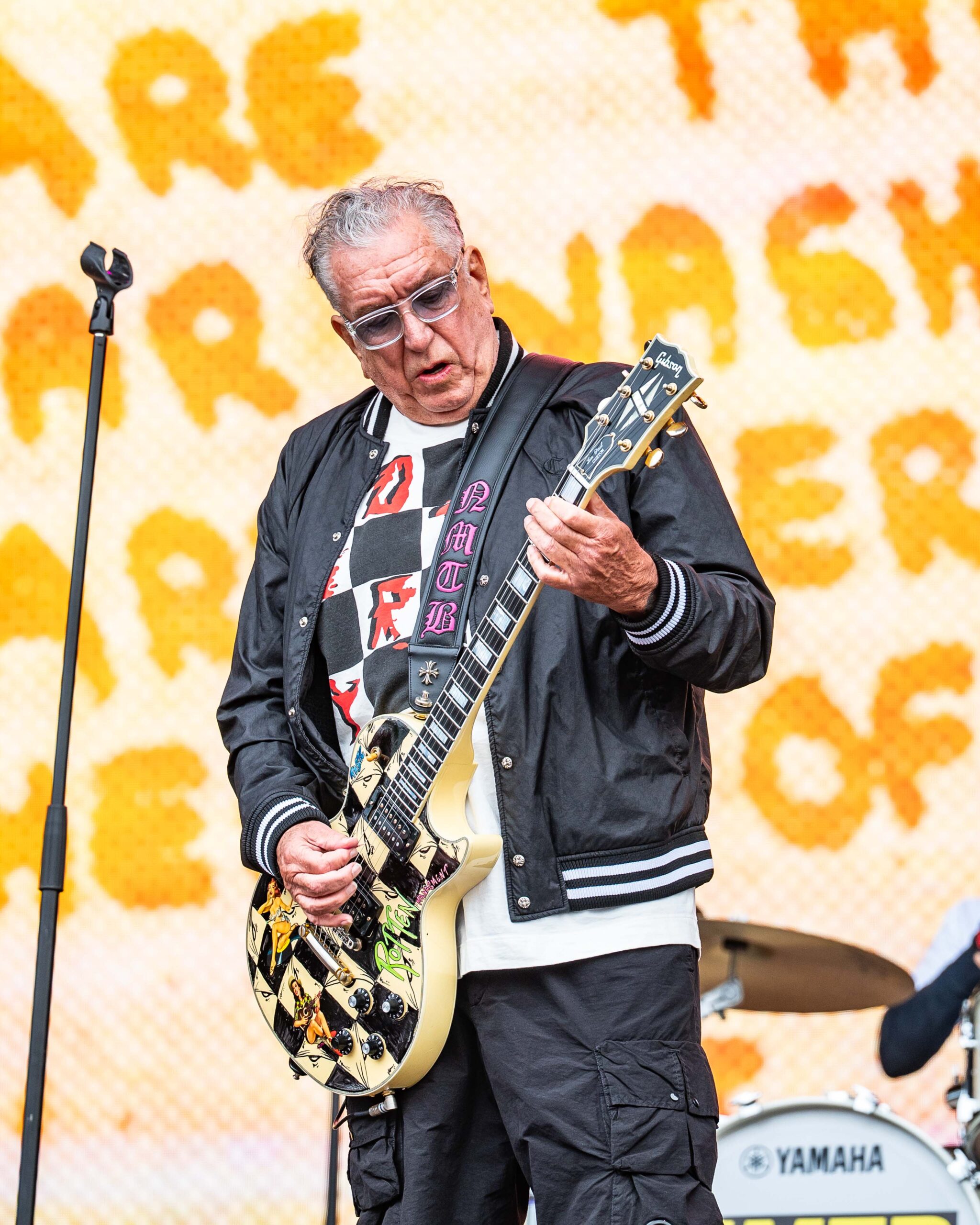
The foundational Steve Jones guitar — the instrument at the center of the Never Mind the Bollocks recording and the “God Save the Queen” music video — is the 1974 Gibson Les Paul Custom in Alpine White with serial number 145418, previously owned by Syl Sylvain of the New York Dolls. As Jones has indicated in interviews, many other white Les Paul Customs have been sold as his “original” Sex Pistols guitar, but Julien’s Auctions confirmed the specific guitar through extensive photo matching. The guitar shows the specific character of a working instrument: heavily worn, the finish yellowed from cigarette smoke, breaks, cracks, and repairs consistent with Sex Pistols touring. The tan lines on the body show where 1940s pinup girl decals were previously placed; four mounting holes show where the Bigsby B5 vibrato was installed before Jones removed it shortly after acquiring the guitar. Jones removed the bridge pickup covers to accentuate the guitar’s aggressive treble response — a modification that exposes the ceramic or alnico magnets and reduces the pickup cover’s slight treble-attenuating effect, giving the Les Paul Custom a brighter, more aggressive attack than the factory-covered version. The 1974 Les Paul Custom’s construction: the ebony fingerboard, three-pickup configuration with three humbucker pickups (unlike the Standard’s two), and the specific mid-1970s CBS-era Les Paul construction that differs from the more celebrated late-1950s Standards but produces its own specific tonal character.
For the Never Mind the Bollocks sessions, Jones used a Les Paul Custom Black Beauty alongside the white 1974 model. For the sessions, Jones used a white ’74 Gibson Les Paul Custom, a Les Paul Custom Black Beauty, a Fender Twin, and — for “Anarchy in the U.K.” only — an MXR phase pedal. The Black Beauty — the classic black Les Paul Custom with gold hardware — provides a slightly different tonal character from the white 1974 model, with the specific ebony fingerboard clarity of the Les Paul Custom combined with whatever specific humbucker configuration the Black Beauty example contained. The use of multiple Les Paul Customs for different passes of the layered guitar recording gave the wall of sound on Never Mind the Bollocks its specific combined tonal character.
The Equipboard community documents Steve Jones playing a Gibson Les Paul Special Doublecut with some inlay work done at the beginning of the neck in a 1977 Sex Pistols concert, and photographs confirm a TV Yellow Gibson Les Paul Junior Doublecut at the Paradiso Club in Amsterdam in January 1977. The P-90-equipped Les Paul Junior and Special provide a completely different tonal character from the humbucking Les Paul Customs of the studio recordings — the raw, biting single-coil-adjacent bite of the P-90 in a lower-output configuration that suits the early live Pistols context. The 1977 live P-90 instruments alongside the 1974 Custom’s humbucking studio tone confirm the specific evolution of Jones’s guitar identity across different performance contexts.
Steve Jones playing a Gibson Firebird onstage at the Sex Pistols’ last show ever is documented in photographs. The Firebird’s through-neck construction and reverse headstock design produce the specific warm, sustaining character of the Firebird family — different from the Les Paul’s set-neck construction but within the broader Gibson family’s mahogany-and-humbucker tonal territory.
He was offered free Burny Les Paul Customs in the late 1990s, as well as cables, straps and picks. He accepted and was awarded two specially made models, which he played on the Pistols’ North American Piss Off Tour in 2002 and 2003. However, in 2005, Jones returned to mostly playing Gibsons, using his Burnys now and again. Burny is the Japanese guitar manufacturer known for its high-quality Gibson-style replicas, produced from the mid-1970s onward with the specific attention to vintage-spec details that distinguishes Japanese replica guitars from more generic alternatives. The Burny Les Paul Customs provided the same basic tonal character as the Gibson originals at a more durable touring configuration.
Three years after returning primarily to Gibsons, to celebrate his inextricable relationship with the brand and achievements, Gibson released the Steve Jones Signature Les Paul, with the exact specs as his trusted 1974 model, stickers and all. The signature’s specific commitment to replicating the original rather than idealizing it — the stickers, the aged Alpine White finish, the specific hardware configuration of the 1974 model — is one of the more honest signature guitar approaches. The pinup girl sticker tan lines are not in the signature (the decals themselves were on the original guitar, not replicated on the signature), but the overall specification faithfully represents the primary instrument of the Never Mind the Bollocks era.
Amps
Recording Never Mind the Bollocks, Jones used a silverface Fender Twin Reverb with Gauss speakers. It can be seen in the video for “God Save the Queen,” with the Sex Pistols’ name scribbled on it. Allegedly, it was stolen from Bob Marley at the Hammersmith Apollo. The Fender Twin with Gauss speakers — Gauss being an aftermarket replacement speaker brand from the 1970s that produces a different frequency response from the standard Jensen or Fender-branded Eminence speakers — provided the specific high-headroom, clean Fender amplification that Jones’s Les Paul Customs required for the layered recording approach. The Gauss speakers’ specific character is slightly different from standard Fender speakers — a different low-frequency extension and a different high-frequency rolloff — contributing to the specific tonal character of Never Mind the Bollocks. The Twin’s clean headroom with the Gauss speakers’ specific frequency response, combined with the 1974 Les Paul Custom’s humbuckers with removed pickup covers: this is the fundamental tonal combination of one of the most celebrated debut albums in rock history. Stolen from the Bob Marley support slot. The name scribbled on the front. The Sex Pistols’ claim on someone else’s amplifier.
In a user-uploaded photo, Steve Jones is seen using the Marshall JCM800 2203 guitar amplifier head in a later-career context. The JCM800’s EL34-powered British warmth and high-gain preamp character provides a different tonal option from the Fender Twin’s American clean — more aggressive, with the specific Marshall midrange character that distinguishes British from American amplification in the rock context. The Marshall’s documented use in Jones’s later career confirms the ongoing amplifier exploration beyond the specific Fender Twin identity of the Never Mind the Bollocks era.
Effects
For “Anarchy in the U.K.” only, Jones used an MXR phase pedal — specifically the Phase 45 (a two-stage phaser, simpler than the Phase 90 or Phase 100). Some websites mistakenly state that he used an MXR flanger, but he didn’t use one, and the interview here shows he himself said he only used a Phase 45 and it was only on “Anarchy in the UK.” The Phase 45’s specific character: simpler, more subtle phase modulation than the Phase 90 or Phase 100, providing a gentle, slightly shimmering quality to the guitar signal without the more dramatic sweep of the larger units. On “Anarchy in the UK,” the phase pedal provides a swollen undercurrent thanks to Jones’s use of phase, with an infectious groove created by sticking to a 4/4 time signature in a 12-bar blues style. The phase is used on the rhythm parts to add the specific atmospheric quality that distinguishes the “Anarchy” guitar from the more direct, unprocessed approach of the other songs on the album. One pedal. One song. That’s the complete effects section of the Never Mind the Bollocks recording.
Palm muting features in many Sex Pistols songs, notably in the verse section to “God Save the Queen.” Laying the edge of your palm across the strings while you play produces a thick, chugging sound in your muted power chords. The palm mute’s specific function in the Sex Pistols context: dampening the chord’s sustain to produce the specific chugging, tight rhythm quality of the verse riffing, then releasing the mute for the fuller, more open sound of the chorus power chords. This alternation — muted verse, open chorus — is the primary rhythmic technique that gives “God Save the Queen” its specific sense of build and release, the chugging verse accumulating energy that the open chorus then releases.
Like the Aldo Nova self-production approach, Jones’s studio approach on Never Mind the Bollocks was significantly based on the layering of multiple guitar tracks: other than on “Bodies,” where he used a Les Paul with single coil pickups to create its prominent chugging sound, the majority of his sound was executed through a twin humbucker-equipped Les Paul through a Fender Twin amplifier. The layered approach — multiple passes of rhythm guitar, different guitars for different layers, the Fender Twin’s clean headroom providing frequency space for each layer — produced the “buzzing, swarming mass of guitars” that the album’s guitar sound actually is. What sounds like one huge punk guitar is actually a carefully constructed multiple-guitar recording, with Jones playing every guitar pass himself.
Jones also played bass on the album. Sid Vicious, who had replaced Glen Matlock as bassist, genuinely could not play bass. The bass on Never Mind the Bollocks — the instrument that provides the foundational rhythmic and harmonic support for one of the most celebrated debut albums in rock history — was played by the guitarist, not the bassist, because the bassist couldn’t play. This is the specific production reality of Never Mind the Bollocks: the album that defined punk’s approach to musical simplicity and directness was recorded by a guitarist who played all the guitar parts, all the bass parts, and produced the most polished recording of the British punk canon. The bass on the album sounds like a bassist. It’s Steve Jones.
The specific cultural weight of Never Mind the Bollocks — the album that the stolen Fender Twin and the New York Dolls Les Paul Custom produced — is worth documenting precisely because it is frequently both over-celebrated (as a cultural revolution that changed everything overnight) and under-appreciated (as a piece of musical craft that achieved its apparent simplicity through sophisticated technique). The album was recorded at Wessex Sound Studios by producer Chris Thomas, who had also worked on the Beatles’ White Album — a fact that connects the most celebrated British pop record of the 1960s to the most celebrated British punk record of the 1970s through the same production intelligence, applied to completely different musical contexts but bringing the same commitment to capturing what the musicians were doing as accurately as possible. The wall of guitars that Jones constructed through multiple passes of the Les Paul Custom through the Fender Twin — each pass slightly different in timing and tone, each contributing a specific frequency dimension to the combined sound — is the specific production achievement that makes Never Mind the Bollocks sound simultaneously raw and polished, simultaneously chaotic and precise. The most celebrated punk album is one of the more carefully produced recordings of its era. Bill Price was the engineer. Jones was the tightest lead guitarist Price had ever heard. The reggae band never got their Fender Twin back.
Playing Style & Tone Philosophy
Steve Jones plays guitar with the specific combination of aggressive power-chord rhythm attack and the surprisingly tight, controlled lead guitar work that Bill Price identified as the defining quality of the Never Mind the Bollocks sessions. The punk philosophy — the rejection of technical virtuosity in favor of energy and directness — is visible in the approach: power chords, palm muting, aggressive downstroke rhythm, and lead solos that are “built on a simple two-bar pattern, which repeats before being changed up a little to bring the solo to a close.” But the tightness — the precision of the rhythm playing, the controlled aggression of the lead work — is the quality that distinguishes Jones from guitarists who adopted the punk aesthetic without the underlying musical discipline that his approach actually embodies.
The layered recording approach is the specific production intelligence that made Never Mind the Bollocks sound like it does — the specific wall of guitars that the album’s production achieved through the patient accumulation of multiple guitar passes, each adding a specific frequency dimension to the combined sound. The 1974 Les Paul Custom’s mid-forward character, the Fender Twin’s clean headroom, and the multiple layered passes create a guitar sound that is simultaneously aggressive and tonally rich — more harmonically complex than a single guitar through a distortion pedal would produce, with each layer contributing its specific tonal character to the combined whole. This is not the simple, raw, one-take approach that punk mythology sometimes suggests; it is a carefully constructed studio achievement that produced the sensation of raw simplicity through the accumulated effect of sophisticated technique.
His reggae rhythm awareness — the specific palm muting and rhythmic approach that produces the chugging verse groove of “God Save the Queen” — reflects the same reggae influence that was penetrating the British punk scene from the Jamaican-British musical culture of the late 1970s. Jones heard it, incorporated the palm-muted rhythmic approach into his specific guitar technique, and produced the specific rhythmic character that distinguishes the Sex Pistols’ groove from the more straightforward power-chord-on-every-beat approach of less rhythmically sophisticated punk.
How to Sound Like Steve Jones
The Never Mind the Bollocks Steve Jones tone requires: a Gibson Les Paul Custom (or equivalent two-humbucker Gibson, pickup covers removed for additional brightness); a Fender Twin Reverb with appropriate speakers for clean high-headroom amplification; MXR Phase 45 for “Anarchy in the UK” specifically, disengaged for everything else; layered multiple guitar passes in recording contexts; and the palm-muting rhythm technique for verse sections. No other effects. No distortion pedals. The Les Paul’s pickups and the clean Twin’s natural response to the picking attack provide all the distortion required.
| Control | Setting (0–10) | Notes |
|---|---|---|
| Fender Twin Reverb (Clean Headroom) | Volume: 6–7; Treble: 7; Bass: 5; Mid: 7; Reverb: 2 | High-headroom clean — the Les Paul’s humbuckers drive the Twin’s input with significant output. At volume 6–7, the Twin is at the edge of natural saturation, providing the specific “clean but with character” character of the Never Mind the Bollocks guitar tone. The specific mid-forward character of this setting — Treble 7, Mid 7, Bass 5 — produces the “slashing highs, prominent mids, and tight bass” of the Pistols guitar sound. Minimal reverb. |
| Les Paul Custom (Covers Removed) | Volume: 10; Tone: 7; Bridge Pickup | Bridge pickup, volume full, tone slightly rolled back from maximum. The removed pickup covers expose the humbucker magnets and slightly increase the treble response — brighter, more aggressive than the factory-covered configuration. The ebony fingerboard’s additional brightness plus the cover-removed humbuckers plus the Twin’s mid-forward character produce the specific Steve Jones guitar sound. |
| MXR Phase 45 (“Anarchy in the UK” ONLY) | Rate: 4 (medium-slow) | Used ONLY on “Anarchy in the UK” — engage the phase for this song and disengage for everything else. The Phase 45’s subtle, gentle phase modulation adds the specific “swollen undercurrent” that Jones identified as the atmospheric quality of “Anarchy.” Two-stage phase; simpler and more subtle than the Phase 90 or Phase 100. Do not use on any other song — Jones confirmed one pedal, one song. |
| Palm Muting | Verse sections; heel of right palm on bridge strings | The verse of “God Save the Queen” and similar songs: rest the edge of your right palm gently across the strings close to the bridge, then apply power chords. The mute produces the thick, chugging character of the verse groove. Release the mute for the chorus — the contrast between the muted verse and the open chorus is the primary rhythmic technique. |
| Layered Guitars (Recording) | 3–5 passes of the same rhythm part | Record the rhythm guitar part 3–5 times on separate tracks. Pan differently (hard left, center-left, center, center-right, hard right). Each pass slightly different in timing and tone — the natural variation creates the wall-of-sound effect. This is how Never Mind the Bollocks actually sounds the way it sounds. One guitar recording a single pass would not produce it. |
| Lead Guitar (Simple Two-Bar Pattern) | Minimal; melodic; compressed | “The second solo, which boasts a minimal, choppy riff before segueing into a sustained, albeit compressed, bout of feedback, was so artistic that it provided a blueprint for post-punk.” Keep leads simple — a repeating two-bar pattern that develops slightly before the close. Avoid technical peacocking. The lead serves the song’s energy, not the guitarist’s ego. Less is more. This is the punk lead guitar lesson. |
Influence & Legacy
Steve Jones’s influence on rock guitar is concentrated in the specific demonstration that punk’s aggressive simplicity and rock’s musical discipline are not contradictory — that a guitarist who was “the tightest lead guitarist the engineer had ever heard” could produce music that sounded like the antithesis of technical guitar playing. The wall of layered guitars on Never Mind the Bollocks, the palm-muted verse grooves, the specific Les Paul Custom through the clean Fender Twin, the one MXR Phase 45 on one song only — these are the specific choices of a musician who understood exactly what the music required and provided it with complete precision behind the facade of apparent chaos.
Every subsequent guitarist who understood that punk’s energy could coexist with musical sophistication was working in territory that Jones’s Never Mind the Bollocks performance had opened. The “tightest lead guitarist” label — from the engineer who had heard thousands of professional guitarists — is the specific peer assessment that places Jones’s technical quality in its proper context: not a simple bashing punk guitarist but a disciplined, controlled musician whose specific application of that discipline to the punk context produced music that sounded simple and actually wasn’t.
The stolen Fender Twin’s provenance — from Bob Marley’s support act to the recording of one of the most celebrated albums in rock history — is the specific biographical detail that captures both the cultural moment and the personal biography of Steve Jones: a guitarist from Shepherd’s Bush poverty who built his career by taking what he needed and then producing music of genuine, lasting cultural significance with what he’d taken. The Sex Pistols’ name is scribbled on the front of the Fender Twin. The reggae band that opened for Bob Marley at Hammersmith never got their amp back. Never Mind the Bollocks, indeed. For the Clash parallel — the punk band that developed alongside and in conscious competition with the Pistols, with Jones and Mick Jones occupying parallel roles as the lead guitarists of the two defining British punk bands — see Mick Jones’s Clash gear history and Joe Strummer’s entry. The New York Dolls connection that gave Steve Jones his guitar physically — through Syl Sylvain’s Les Paul Custom — connects to the same New York Dolls tradition that gave Mick Jones his guitar inspiration through Johnny Thunders. Both British punk guitarists got their Les Paul inspiration from the New York Dolls, and neither is ever not relevant.
The Fender Twin is stolen. The Les Paul Custom has cigarette-smoke yellowing and pinup girl tan lines. The Bigsby is removed. The pickup covers are off. The name is scribbled on the amp. And Bill Price, who had engineered more records than most people will ever hear, said the tightest lead guitarist he’d ever heard was playing through the stolen amplifier in the room. This is the Steve Jones gear story. It is the correct story for a guitarist who built his entire career on taking what he needed and then making music that deserved to exist.
Frequently Asked Questions: Steve Jones Guitars & Gear
What guitar did Steve Jones use on Never Mind the Bollocks?
Steve Jones’s primary guitar for the Never Mind the Bollocks sessions was a 1974 Gibson Les Paul Custom in Alpine White, serial number 145418, previously owned by Syl Sylvain of the New York Dolls. The guitar’s finish has yellowed from cigarette smoke, shows breaks, cracks, and repairs from Sex Pistols touring, and has tan lines where 1940s pinup girl decals were previously placed, as well as four mounting holes where a Bigsby B5 vibrato was installed before Jones removed it. Jones removed the bridge pickup covers to accentuate the guitar’s aggressive treble response. A second guitar, a Les Paul Custom Black Beauty, was also used in the sessions. Gibson released the Steve Jones Signature Les Paul in 2008, replicating the exact specs of the 1974 model.
What amplifier did Steve Jones use and how was it obtained?
Steve Jones recorded Never Mind the Bollocks through a silverface Fender Twin Reverb with Gauss speakers. The amplifier is visible in the “God Save the Queen” music video with the Sex Pistols’ name scribbled on the front. It was allegedly stolen from a reggae band that was opening for Bob Marley at the Hammersmith Apollo. The stolen Fender Twin with Gauss speakers is the specific amplification that produced one of the most celebrated debut albums in rock history — used for its high-headroom clean character that provided the frequency space for Jones’s layered multiple guitar passes.
What effects did Steve Jones use on Never Mind the Bollocks?
Jones used the MXR Phase 45 on “Anarchy in the UK” only — no other effects were used on the album. Some sources incorrectly claim he used an MXR flanger; Jones himself confirmed he used only a Phase 45 and only on that one track. The Phase 45’s two-stage phasing adds the “swollen undercurrent” that distinguishes “Anarchy in the UK”‘s guitar sound from the more direct, unprocessed approach of the other songs. All other tracks on Never Mind the Bollocks were recorded with guitar directly into the Fender Twin, no additional effects processing.
Why did Steve Jones play bass on Never Mind the Bollocks?
Sid Vicious — who replaced Glen Matlock as the Sex Pistols’ bassist — genuinely could not play bass. As the recording was professionally produced at Wessex Sound Studios (the same studio the Clash used for London Calling), the decision was made to have Jones record the bass parts himself. Jones therefore played all guitars, all bass parts, and provided the complete string instrument foundation for one of the most celebrated punk debut albums in history. This is the specific production reality beneath the punk myth: Never Mind the Bollocks, the album that defined the anti-virtuosity ethic of punk, was recorded by a guitarist who played every string instrument on the record because the bassist couldn’t play.
How did Steve Jones develop as a guitarist?
Steve Jones is entirely self-taught. Born in May 1955 in Shepherd’s Bush, London, into poverty and an unstable home environment, Jones had no formal guitar instruction. He taught himself by listening to records and by developing the aggressive rhythm approach that suited both his limited formal training and the punk context. He built the Sex Pistols’ equipment by stealing from rock stars — David Bowie, Rod Stewart, Ronnie Wood, and others who were using London rehearsal studios. Bill Price, the engineer who recorded Never Mind the Bollocks, described Jones as “the tightest lead guitarist I’ve ever heard in my life” — confirming that the self-taught approach produced professional-level discipline alongside the apparent punk chaos.
What was Steve Jones’s role beyond the Sex Pistols?
After the Sex Pistols dissolved in January 1978, Jones formed the Professionals with Paul Cook, and later the Neurotic Outsiders with Duff McKagan (Guns N’ Roses), Matt Sorum (Guns N’ Roses), and John Taylor (Duran Duran). He had an acting role in the Wayne’s World film. He has hosted “Jonesy’s Jukebox” on Indie 103.1 FM Los Angeles since 2004, a radio program covering a wide range of music that demonstrates the musical breadth underlying his punk identity. He published his autobiography Lonely Boy in 2016. The Sex Pistols reformed for various reunion tours, most recently the Pistols75 50th Anniversary tour in 2025.
What is the significance of the Syl Sylvain connection?
The 1974 Gibson Les Paul Custom that Steve Jones used to record Never Mind the Bollocks previously belonged to Syl Sylvain, rhythm guitarist of the New York Dolls. The New York Dolls were the proto-punk band that most directly influenced British punk’s visual aesthetic and musical approach — both Steve Jones and Mick Jones of the Clash traced their guitar inspiration to New York Dolls guitarists (Steve Jones through Sylvain’s actual guitar, Mick Jones through Johnny Thunders’s example). The Les Paul Custom’s journey from New York Dolls guitarist to Sex Pistols recording is the physical artifact of the specific influence chain from American proto-punk to British punk. The guitar is now in Julien’s Auctions documentation as a confirmed authentic piece of rock history.