Thirty Watts Short of a Rock Star: How the Fender Blues Junior Became the Most Important Tube Amp Nobody Talks About
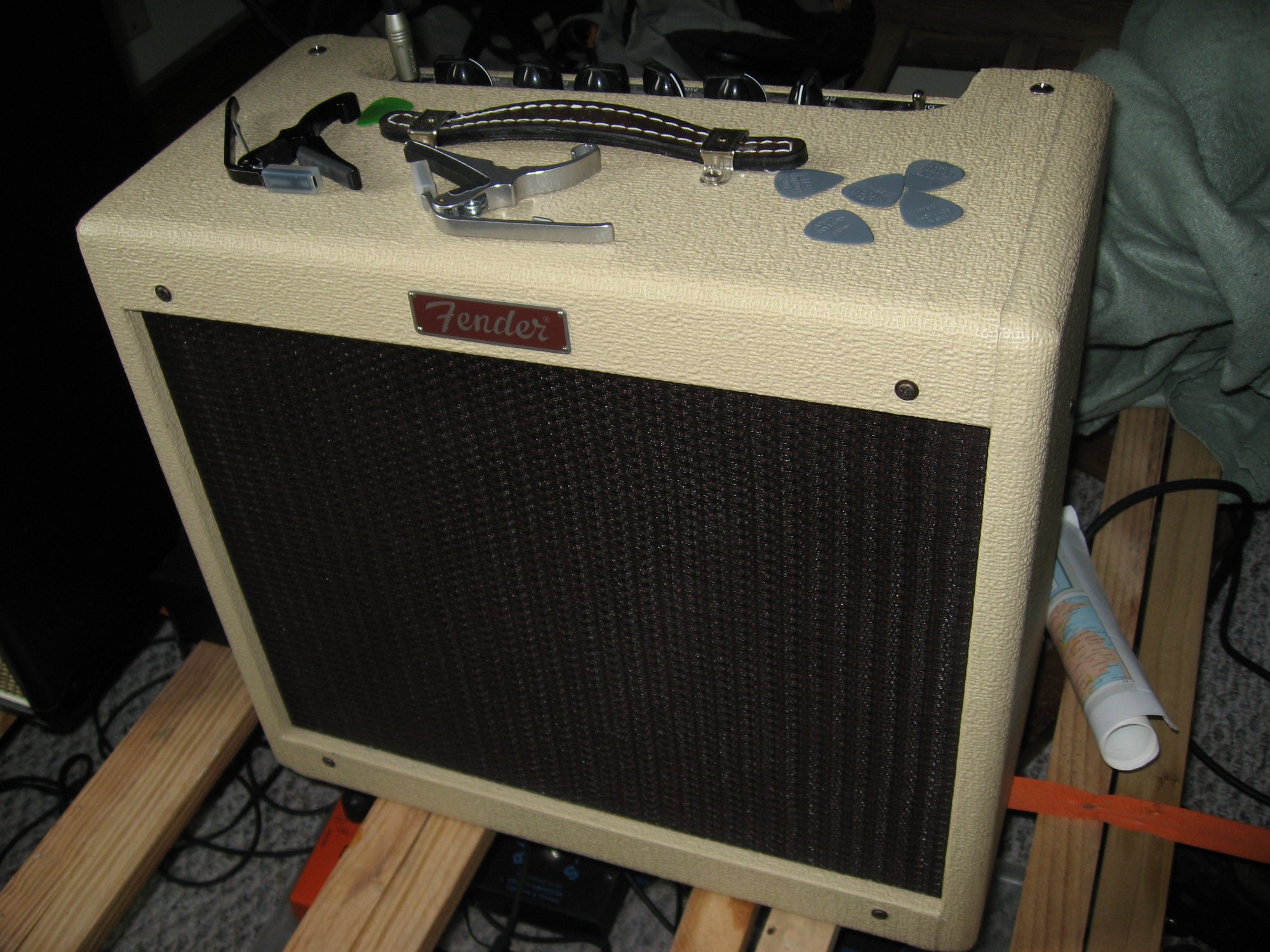
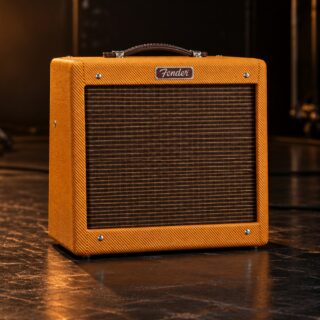
Fender Blues Junior with blonde cosmetics, photographed in 2010. Photo: Fender blues junior blonde.jpg by Tiled, via Wikimedia Commons, CC BY-SA 3.0. Proportionally resized and JPEG re-encoded; image framing may be cropped by the article layout. Source: https://commons.wikimedia.org/wiki/File:Fender_blues_junior_blonde.jpg License: https://creativecommons.org/licenses/by-sa/3.0/
Fender Blues Junior 30-year guide: EL84 circuit explained, generation history, J.J. Cale verified, tone recipes, speaker swaps and 2026 buying guide.
There is a version of the Fender story that involves blackface Deluxe Reverbs, Twin Reverbs with JBLs, and Dual Showmans loud enough to shift stage monitors. That story is real, beloved, and extensively documented. But there is another Fender story — quieter, more practical, statistically far more common — that plays out in a 15-watt box that weighs 31.5 pounds and costs less than $800. It goes like this: you carry the amp in yourself, you set it in front of the kick drum or in the monitor gap, and you mic it with a 57. The sound man is happy. The sound is Fender. Your back thanks you. That story belongs to the Blues Junior.
Fender introduced the Blues Junior in 1995 and it has not stopped selling since. Rick Heins, Fender’s senior product manager and the man who oversaw the most recent revision, described it in 2025 as “probably the most-bought Fender tube amp of all time — and that includes the vintage ones.” That is a staggering claim from a company whose vintage catalogue includes some of the most coveted amplifiers in history. It is also almost certainly true. The Blues Junior is everywhere: in studios, on backlines, in bedrooms, in church halls, in the rehearsal rooms of bands you will never hear and on the stages of artists who long since had the budget for something more exotic but kept the Junior because nothing else did the job so honestly.
This is not a story about an amp that changed the sound of rock and roll. The Blues Junior arrived in 1995 already knowing what it was: a portable, affordable, reliable tube combo that brought genuine Fender DNA to players who could not afford the vintage originals and did not want a solid-state substitute. Thirty years later, the argument for it is identical. The formula has not changed because it did not need to.
Origin: Mike Lewis and the Case for Fifteen Watts
The Blues Junior was Mike Lewis’s idea. Lewis was a product designer at Fender whose fingerprints, in Heins’ words, are “all over Fender’s history, from the Custom Shop to Gretsch to ukuleles.” The context for the Junior was the early 1990s, when Fender was still recovering from the CBS years — a period in which the tube amp line had been gutted in favour of solid-state designs that pleased the accountants and disappointed the players. Lewis’s solution was the “Tweed Series,” launched in 1995, which brought tubes back to affordable Fender combos. The Blues Junior was the entry point: the smallest, lightest, cheapest fully tube amp in the range, sitting below the Blues Deluxe, the Blues DeVille, and the Pro Junior in the hierarchy.
The target retail price was around $399. Lewis’s brief was explicit: a tube amp that working players could afford, that was built to be carried and gigged, not displayed. The goal was “road dogs” — the sort of amp that takes a knock in a van without complaining and sounds like Fender when you turn it on. The word “affordable” in the original design brief was not a concession. It was the point.
The EL84 power tube choice was the design decision that defined the amp’s character and distinguished it from the rest of the Fender range. Fender has traditionally been a 6L6 and 6V6 house — the circuits that produce the clean, glassy headroom associated with blackface Deluxe Reverbs and Twin Reverbs. Lewis chose EL84s, the tubes associated with British amplifiers like the Vox AC30, for a specific set of reasons. EL84s have a characteristic sparkle and what players describe as touch sensitivity: the relationship between pick attack and output volume is more immediate and dynamic than a 6L6, so the amp responds to how hard you dig in rather than compressing the dynamics uniformly. They also break up earlier, producing overdrive at lower volume levels. And at 15 watts — a deliberate figure, loud enough for a club with a microphone, quiet enough for a studio without one — EL84s deliver the kind of compressed, harmonic drive that makes a small amp sound like it means something.
The result was an amp that, despite carrying Fender’s name and Fender’s clean-voiced preamp topology, sounds nothing like a blackface Deluxe Reverb. That distinction matters. The Blues Junior is not a small blackface amp. It is its own thing, and understanding what that thing is explains why it has lasted thirty years while other affordable combos have come and gone.
Inside the Circuit: What 15 Watts Actually Means
The Blues Junior runs a straightforward single-channel all-tube signal path that has been incrementally refined across four generations without changing its essential character. Three 12AX7 preamp tubes handle input gain, the tonestack, and the reverb recovery circuit. Two EL84 power tubes run in push-pull configuration in cathode-biased Class A operation. A solid-state rectifier converts AC to DC — which means no power-supply sag and a stiff, immediate response compared to a rectifier tube. Fixed bias is used throughout: the power tubes run at a preset current that Fender determined at the factory, with no external adjustment points on the original designs.
The tone controls — Bass, Middle, and Treble — are a passive Fender-voiced stack that works on the same principle as a blackface circuit: a presence control operating on the tone after the preamp, before the master stage. The Volume knob is a preamp volume; the Master knob governs the overall output level. This means the two controls interact: you can set the preamp volume (Volume knob) to drive the preamp tubes into saturation and then control the overall loudness with the Master. In practice, this is how the amp sounds best — Volume up into the 5–7 range, Master adjusted for room level. Running both at unity is how players describe the Junior as underpowered or thin; running the preamp hotter with the master pulled back is how the same players discover the amp was never the problem.
The Fat switch is a midrange boost wired into the preamp stage, roughly equivalent to a 3–6dB push around 500Hz to 1kHz. It thickens single-coil tones, adds presence to humbuckers, and functions as a mild lead boost with no added gain — just a rounder, fuller tonality. From the Blues Junior IV onward, the Fat switch is remotely controllable via the included one-button footswitch.
Spring reverb is driven by a solid-state operational amplifier circuit rather than a dedicated reverb driver tube. The op-amp approach keeps the component count down and the cost manageable, but it also means the reverb circuit does not add the warmth and coloration that a 12AX7 reverb driver contributes to a Deluxe Reverb or a Super Reverb. The Blues Junior reverb is clean, functional, and pleasant without being exceptional. The Blues Junior IV revision specifically improved the reverb taper — the way the reverb amount changes as you rotate the knob — making it easier to set moderate reverb without the original’s slightly awkward on/off feel at low settings.
The fixed bias is the element that has most shaped the Junior’s reputation among technicians and modifiers. EL84s in fixed bias on the Blues Junior run “hot” — meaning the tubes draw significant idle current, which burns them faster than a conservatively biased design and generates heat. Early green-board Blues Juniors could eat through a set of EL84s in under a year of regular use. Fender addressed this progressively across generations, and the IV runs cooler than the original, but the bias characteristic of the design is structural: it contributes to the amp’s responsive, compressed feel as much as the EL84s themselves do. Many owners add an aftermarket bias trim pot so they can back the bias off slightly and extend tube life.
One important note on the cabinet: Fender’s official spec sheet for the Blues Junior IV lists the cabinet material as 3/4″ particle board, not pine. Some limited editions and special runs have used pine or other materials, and the 30th Anniversary edition was widely described as having a pine cab, but the standard IV is particle board. This matters because pine cabinets are lighter, more resonant, and contribute audibly to the amp’s character. When players report that a specific FSR or Anniversary model “sounds different from a standard one,” the cabinet material is a credible part of the explanation.
Generation by Generation: Thirty Years of Refinement
The Blues Junior’s history divides cleanly by circuit board colour and production location, with the major named revisions layered on top of those fundamental changes.
| Generation | Years | Board | Country | Speaker | Key Character |
|---|---|---|---|---|---|
| Original (Rev A–D) | 1995–2001 | Green | USA (Corona, CA) | Fender-branded | Darker, more bass-heavy; reverb after master (can be noisy) |
| Cream Board (Rev A–C) | 2001–2010 | Cream/Tan | Mexico (Ensenada) | Fender-branded | Brighter, more treble emphasis; reverb before master (quieter) |
| Blues Junior III | 2010–2018 | Cream | Mexico | Fender Lightning Bolt / A-Type variants | “Sparkle” circuit mod; shock absorbers; dog-bone handle; larger jewel light |
| Blues Junior IV | 2018–present | Black | Mexico | Celestion A-Type (12″, 50W, 8Ω) | Modified preamp (fuller, clearer); smoother reverb taper; footswitch included |
| 30th Anniversary IV | 2025 (limited) | Black | Mexico | Celestion G12M-65 Creamback | Western tolex; ’59 Bassman grille cloth; leather handle; pine cab; certificate of authenticity |
The green board–to–cream board transition in 2001 is the most consequential change in the amp’s history and also the most contentious among owners. When production moved from Corona, California to Ensenada, Mexico, the circuit board was redesigned entirely. The green board reverb inserts the reverb signal after the master volume, which means the reverb level is independent of the master setting but is also running at a lower signal level where noise becomes more audible. Cream-board models move the reverb to before the master, so the wet signal is amplified along with the dry signal — quieter in practice, but with different gain structure. The two designs sound demonstrably different to players who spend time with both. Green-board advocates describe a warmth and mid-focus that the cream boards replaced with a brighter, more scooped character. Cream-board advocates point to the better reverb noise floor and note that the brighter voicing takes pedals more cleanly. Both camps are right. They are describing real differences in two real amps.
The Blues Junior III added primarily cosmetic and ergonomic changes: a “sparkle” circuit modification that brightened the top end further, shock absorbers to reduce mechanical resonance between the tank and cabinet, and the “dog bone” handle that replaced the moulded plastic strap of the cream-board era. The Lightning Bolt speaker was a Fender-branded driver that various owners have identified as an OEM unit from different manufacturers depending on the production run — not the most transparent naming scheme, but typical of Fender’s approach to OEM components across all its amps.
The Blues Junior IV is the version Fender currently sells and the one Rick Heins describes as “my baby.” The preamp modification added fullness and definition in the clean channel and increased clarity when the amp is pushed into overdrive. The Celestion A-Type speaker is a well-regarded mid-forward driver with a tight bass and extended, slightly reserved top — the sound described in the Guitar World 30th Anniversary review of the sister Hot Rod Deluxe as “mid-forward, tight bass, slightly reserved highs.” For a clean platform amp, it is a good match. For players who want something warmer or with more natural compression, the speaker swap options are discussed below.
Famous Players: J.J. Cale and the Honest Roster
The Blues Junior’s famous player story is the opposite of a typical amp feature’s famous player story. It is not a list of guitar heroes endorsing their rig. It is a single primary-source verified player, a candid explanation of why he chose it, and an honest account of why the amp’s actual constituency does not look like a classic rock hall of fame.
The primary verified Blues Junior player is J.J. Cale — the Tulsa-born songwriter whose fingerprints are on virtually every guitar-based blues rock record of the last fifty years. Eric Clapton built two significant hits from Cale compositions (“After Midnight” and “Cocaine”) and described his relationship to Cale’s style as that of a disciple rather than a peer. Clapton could write his own equipment specifications. Cale, characteristically, had different priorities.
In a December 2003 Vintage Guitar magazine interview with Dan Forte, Cale described his amp selection in his own words: “My amp is a Fender Blues Junior. I have an old 4×10 original ’59 Bassman and a ’65 Twin Reverb with JBLs, but I can’t pick them up; the Blues Junior I can pick up. When you put JBLs in a Twin, you better have a roadie or you better be 18 years old. As the years went by and I got older and my back got worse, my amps kept getting smaller and smaller. The Blues Junior has one 12; they put a mic on it, it’s plenty loud.”
That quote is everything the Blues Junior is about. Cale was 63 at the time and had a working Bassman and a Twin Reverb in his studio. He was not using the Junior because he could not afford anything better. He was using it because it solved a real problem — portability — without sacrificing anything that mattered to his sound. The Blues Junior’s 31.5 lbs is half a Twin’s weight and a fraction of its dimensional footprint. Cale ran his magnetic pickup through the Junior and a Danelectro Convertible’s piezo output through a separate Crate Limo battery amp — a stereo rig that came entirely to under 50 lbs combined. That is a solo touring rig with genuine tube warmth, usable anywhere, controllable by one human over 60 with a bad back. No other affordable tube amp solved that problem as cleanly in 2003 or since.
Standard calendar verification tells the story before any deeper research is needed: the amp launched in 1995, which immediately eliminates any artist claim tied to recordings made before that date. More to the point, the players most often associated with the Blues Junior in online discussions — John Frusciante, Billie Joe Armstrong — are not documented on this specific amp by primary sources. Frusciante’s live and studio work of the 1990s and 2000s centres on Marshalls and vintage Fenders. Armstrong’s main amplifiers are Marshall Plexi derivatives. Both players have warm associations with affordable or vintage gear, which is probably why the Blues Junior appears next to their names in aggregator databases, but no first-hand source, rig rundown, or interview places either on a Blues Junior specifically.
The Blues Junior’s real constituency is the category of player who never appears in a gear article: the working club guitarist who does not want to carry a Twin, the session musician who needs a reliable small combo, the worship player who values touch sensitivity and clean headroom, the home recording artist who discovered that a Blues Junior at 50% volume in a 10×12 room sounds better than anything in a software plugin library. These are not the players whose gear makes headlines. They are the reason the amp has outsold everything else in Fender’s tube range for thirty years.
Tone Character: What EL84s Do That 6L6s Don’t
Understanding the Blues Junior’s sound requires separating it from what a Fender amp is supposed to sound like. A blackface Deluxe Reverb has 6V6 power tubes and a tube-rectified power supply. The result is a specific kind of clean — wide and open, with a slight sag as the power supply yields under heavy pick attack — and an overdrive character that compresses softly before breaking up. A ’65 Princeton Reverb Reissue does the same with slightly less output. A Vox AC15C1 runs EL84s in cathode bias and produces an earlier, more compressed breakup with a pronounced midrange chime. The Blues Junior shares the AC15’s tube complement but has Fender’s tonestack and preamp topology, producing a genuinely hybrid character: the bottom-end authority and clean-voiced treble of American design with the touch-sensitive, mid-forward breakup of a British power stage.
The specific EL84 quality that defines the Junior’s playing feel is compression. When you dig in hard, the power tubes saturate slightly, adding even-order harmonics and reducing the transient spike of the attack. The result sounds thicker and more controlled than the attack does through a solid-state amp, and has a musical sweetness that cleans up when you back off the pick attack or the guitar’s volume knob. This is what Fender’s own description means by “touch sensitivity” — the amp responds to the mechanical energy of your picking, not just the output level of the guitar’s pickups.
The clean headroom is generous for 15 watts. At moderate volume levels, the Blues Junior IV stays genuinely clean through most pickup types. A Telecaster bridge pickup will start to push the preamp into light overdrive somewhere between Volume 5 and 7, depending on how hard you pick. A Les Paul through a humbucker will be in the same range. The Fat switch, engaged, brings the clean headroom down slightly and thickens the breakup point — which is why many Blues Junior owners leave it on as their default setting and use it as a de facto solo switch in reverse (switching it off drops the mids and cleans up the tone for chord work).
Tone Recipes: Seven Settings Worth Knowing
Classic Telecaster Clean (Country, Chicken Pickin’): Volume 4, Master 5–6, Treble 6, Middle 5, Bass 4, Reverb 3, Fat off. The A-Type speaker’s tight bass works in your favour here — you get the note definition that single-coil country picking needs without the low-end wobble that causes problems in a dense band mix. Position the amp at knee height pointing up or tilt it back slightly on the stage to project above the floor bounce.
Blues Crunch (Single-Coil into Mild Overdrive): Volume 6–7, Master 4, Treble 5, Middle 6, Bass 4, Reverb 4, Fat on. This is the setting that earns the Junior its name. The power tubes are working, the pick attack adds compression, and the midrange is up in the vocal register where a single-coil Stratocaster lives at its best. Roll back the guitar’s volume knob to clean up, roll it forward to push harder — the dynamic range in this window is wider than most players discover at lower volumes.
Humbucker Clean Platform (Jazz Chords, R&B): Volume 3–4, Master 6–7, Treble 5, Middle 4, Bass 5, Reverb 5, Fat off. Keep the preamp light to avoid the midrange push that humbuckers can pile up in the 500–800Hz range. The reverb at 5 adds space without swamping the note definition that jazz playing needs. This is J.J. Cale’s end of the amp — the clean, almost studio-monitor setting that lets the guitar’s own character come through, with just enough tube warmth to separate it from a PA speaker.
Edge of Breakup (Recording, Roots Rock): Volume 6, Master 4, Treble 5, Middle 6, Bass 4, Reverb 2, Fat on. Mic the amp close with a Shure SM57 off-axis at the cone’s edge to capture the second-harmonic texture without excessive top-end spike. At this setting, pick dynamics control everything: a light pick on the strings stays clean; a firm downstroke breaks up into warm overdrive. Record a part at both intensities without changing a control.
Pedal Platform Lead (Drive Pedal in Front): Volume 4, Master 5, Treble 5, Middle 5, Bass 4, Reverb 4, Fat off. The Blues Junior wants to stay clean as a pedal platform — push it too hard from the preamp and you are stacking gain structures without intention. With the amp clean and open, a Tube Screamer-style overdrive pedal in front adds the mid-forward compression of the Ibanez TS9 circuit while the amp adds the tube response and speaker character. The Fat switch becomes a solo boost when engaged mid-song.
Gritty Rhythm (Cranked for Stage Volume): Volume 7–8, Master 2–3, Treble 4, Middle 7, Bass 3, Reverb 3, Fat on. This is the “bedroom volume” inverse of the platform setting above — preamp working hard, master pulled back, midrange forward to cut through. The compressed, harmonically rich character of the output stage in this range is the sound the Blues Junior’s EL84s were designed to produce. Back off the Middle to 5 if the midrange honks in a dense mix.
30th Anniversary Creamback Setting (Open, Pedal-Forward): Volume 4, Master 6, Treble 6, Middle 5, Bass 4, Reverb 4, Fat off. The Celestion G12M-65 Creamback in the Anniversary edition softens the A-Type’s mid-forward character and opens the top end. Run a Klon-style overdrive or transparent boost in front to add sustain without compressing the Creamback’s natural headroom. The combination produces a detailed, articulate lead sound that suits the amp’s EL84 compression without the typical A-Type midrange push.
The Pedal Platform: Why the Blues Junior Works So Well with Drive Pedals
Fender’s own product manager calls the Blues Junior “a great pedal platform” and the guitar world has collectively agreed: the amp appears on more pedalboards than any other single-platform tube combo currently in production. The reason is structural, not accidental.
A good pedal platform does three things: it has enough clean headroom to let a drive pedal shape the overdrive character rather than blending with preamp distortion; its EQ voicing is flat enough that pedals sit in the frequency spectrum as intended rather than fighting the amp’s own colour; and it responds to the dynamics of the pedal’s output rather than compressing them further. The Blues Junior’s EL84 stage does all three in the 15-watt range. The clean channel (Volume below 5) gives a drive pedal a transparent foundation. The amp’s slightly elevated midrange response (due to the EL84 character) enhances most drive pedals’ natural character rather than fighting it. And the output stage’s dynamic response means that a Klon or a Boss SD-1 feeding the Blues Junior sounds different at different pick attack levels, which is the definition of a musical, responsive pedal platform.
What does not work as well: high-gain distortion pedals with substantial low-end. The Blues Junior’s tight bass response through the A-Type speaker can produce a harsh, spiky character when saturated with modern high-gain designs. Players who run a metal zone or aggressive fuzz through the Junior often find the combination too brittle. The cure is either a different speaker (the Celestion Greenback and Creamback both warm the bottom considerably), an EQ pedal after the drive to roll off below 100Hz, or switching to an amp more architecturally suited to modern high-gain territory like the Marshall DSL40CR.
Reverb and modulation pedals work exceptionally well. The Blues Junior’s own spring reverb is serviceable; layering an ambient reverb pedal or a tape echo like the Strymon El Capistan behind it creates a depth that the small cabinet amplifies rather than absorbs. Run modulation effects (chorus, phaser, tremolo) in the signal path before the amp. Run time-based effects (delay, reverb) after, or use an EQ in the effects loop if you add one via mod — the stock Blues Junior IV has no effects loop, which is a real limitation for effects routing at studio volumes.
Speaker Swaps: The Single Most Effective Modification
Rick Heins, Fender’s own product manager, said in 2025 that “the speaker is the easiest way to change an amp’s character.” He listed every major speaker manufacturer the Blues Junior has worked with over thirty years: Celestion (Greenbacks, Vintage 30s, Creambacks), Jensen (Alnico and ceramic), and Eminence (Cannabis Rex, Red White & Blues). The Blues Junior’s 12″ speaker opening takes standard 12″ drivers and the cabinet’s depth accommodates most speakers without modification. A speaker swap costs $50–$150 and requires basic soldering skills.
The Celestion G12M Greenback (25W, 8Ω, ~$90) is the classic British alternative. It warms the mid-frequency push, softens the top-end spike that the A-Type can produce with humbuckers, and adds a pleasing compression character in the 800Hz–2kHz range. If you find the standard Blues Junior IV bright or harsh with single-coils, the Greenback is the first swap to try.
The Celestion G12M-65 Creamback (65W, 8Ω, ~$130) is what Fender chose for the 30th Anniversary edition. It splits the difference between the Greenback’s vintage warmth and the A-Type’s modern definition — more open than the A-Type, less compressed than the Greenback, with an extended top end that makes clean chords and reverb-heavy playing particularly satisfying. The 65W rating means it handles the amp’s 15 watts with significant headroom, keeping the driver damped and controlled even at stage volume.
Jensen C12N (Alnico, 50W, ~$120) brings a different character entirely: American warmth, a focused midrange with a slight nasal quality, and the Alnico compression that vintage Fender players associate with pre-CBS recordings. It is the closest you can get to the sound of a boutique Fender combo in a Blues Junior cabinet for under $150.
Eminence Cannabis Rex (50W, ~$80) is a darker, rounder British-flavoured driver with a “woody” low-mid character that pairs particularly well with humbucker guitars and blues playing. Many Blues Junior owners who found the stock speaker too bright for their playing style have settled on the Cannabis Rex as their permanent replacement.
The Modding Scene: Thirty Years of Aftermarket Engineering
No affordable tube amp in history has attracted as dedicated a modification community as the Blues Junior. The amp’s simple, accessible circuit — single board, easy to probe, widely documented — combined with its mass-market availability created conditions for a full secondary industry. Bill Machrone’s billmaudio.com, which ran for many years as the central archive of Blues Junior modifications, documented dozens of circuit changes addressing everything from the fixed bias to the reverb circuit to the output coupling capacitors.
The three most commonly undertaken modifications are the bias pot (adding an adjustable bias trim to bring the tubes down from the “hot” factory setting and extend their life), a reverb correction (for green-board amps, rerouting the reverb signal to before the master volume to reduce noise), and output capacitor changes (substituting higher-quality film capacitors for the stock electrolytics in the signal path). Speaker swaps are technically simpler but mechanically require the most physical access. All of these modifications void the warranty, and all of them can cause damage or electrical hazard if done incorrectly — valve amplifiers run at voltages that are genuinely dangerous to touch. Follow a schematic, discharge the filter capacitors before probing, and know the risks before opening the chassis.
Rick Heins’ diplomatic view: “People are always chasing tone. They think mods will get them closer to the sound in their head. I’ve played modded Juniors and they can be cool, but personally I’ve never needed to mod mine.” The mod culture exists because players care about the amp. The flip side of that observation is that a significant percentage of used Blues Juniors have been modified to some degree, and buying a used one requires an inspection of the circuit, not just a listening test.
How It Compares: Blues Junior versus the Neighbouring Amps
Fender Blues Junior IV vs Fender Hot Rod Deluxe IV: The Hot Rod Deluxe is 40W, 41 lbs, 6L6-powered with a drive channel and a Master volume that sits post-phase-inverter. The Blues Junior is 15W, 31.5 lbs, EL84-powered and single channel. The Junior has more touch sensitivity, more natural compression, and is easier to get into natural tube saturation at bedroom volumes. The HRD is louder, has more clean headroom for big-hall applications, and has a dedicated drive channel (albeit one with its own character quirks). If you need one amp for home and occasional stages, the Junior; if you need one amp for mid-to-large venues with a drive channel on board, the HRD.
Fender Blues Junior IV vs Vox AC15C1: Both are 15W EL84 combos, both are pedal platforms, both are beloved by working musicians. The AC15’s Top Boost channel has a more pronounced treble-biased British character; the Blues Junior is rounder and warmer on the clean channel. The AC15 is heavier (22kg vs 14.3kg) and more expensive (US street ~$900+ vs $790). The AC15 has no effects loop; neither does the Junior. In a direct comparison at matched volume, the AC15 has more chime and jangle; the Junior has more warmth and mid-weight. Both handle pedals beautifully; your genre preference is the deciding factor.
Fender Blues Junior IV vs Fender ’65 Princeton Reverb Reissue: The Princeton runs a single 6V6 for 12 watts, with a tube rectifier, tube-driven reverb, and tremolo on board. It is the purest “Fender clean” available in a small combo — the sound of every 1960s studio session and folk-era recording you ever loved. The Junior is significantly louder, more touch-sensitive in the power stage, and far cheaper (the Princeton reissue retails at ~$1,099). Choose the Princeton for recording and small venues where authentic Fender voice is paramount; choose the Junior for gigging and versatility.
Fender Blues Junior IV vs Fender Blues Deluxe Reissue: The Blues Deluxe is 40W, 1×12″, 6L6-powered — essentially the Hot Rod Deluxe without the drive channel, in a tweed-style cabinet. It is louder, heavier, and closer to blackface Deluxe Reverb territory in voicing. The Blues Junior is the pragmatic club amp; the Blues Deluxe is the stage amp that wants to stay clean and let the guitar do the speaking. At twice the wattage and significantly more weight, the Deluxe is a serious upgrade in headroom but a significant step backward in portability.
Fender Blues Junior IV vs Fender Pro Junior IV: The Pro Junior is the Blues Junior’s little brother — 15W, EL84s, but a single-input, no-reverb, no-tonestack simplicity that distils the amp concept to its barest core. It has no Bass, Middle, or Treble controls; it is entirely touch-and-guitar-volume responsive. If you want something even simpler, smaller (it is smaller than the Junior), and designed to let a drive pedal do all the work, the Pro Junior is the answer. If you need reverb on board and a tonestack, the Junior is the more practical tool.
Fender Blues Junior IV vs Vox AC4C1-12: The AC4C1-12 is 4 watts through a 12″ Celestion, single channel, EL84-powered, with a bright switch and volume only. It is designed for recording and bedroom use where the Blues Junior would still be too loud at its natural saturation point. If your goal is a tube amp with genuine EL84 character at apartment volumes, the Vox is the more targeted solution. The Blues Junior is louder, more featured, and more stage-able.
Buying New vs Buying Used
The Blues Junior’s longevity on the market means the used supply is enormous, parts availability is excellent, and independent service technicians know the circuit cold. This is an amp worth buying used for any player who is comfortable with the basics of tube amp acquisition: check that the tubes are not visually damaged or microphonic, verify that both the Volume and Master pots sweep without noise or dead spots, confirm that the reverb tank rattles are minimised (a common complaint on units that have been transported without padding), and inspect the speaker cone for tears or voice coil drag.
| Model | New (2026) | Used (2026 Street) | Notes |
|---|---|---|---|
| Blues Junior IV (Black) | $789.99 (Fender/Sweetwater) | $400–550 | Current production; best warranty support |
| Blues Junior IV (Lacquered Tweed / FSR) | $949.99 (Sweetwater exclusive) | $500–650 | Eminence RWB speaker; lighter, more vintage character |
| 30th Anniversary IV | $1,049.99 (while stock lasts) | $700–900 | Limited edition 2025; G12M-65 Creamback; already collectible |
| Blues Junior III | Discontinued | $300–450 | Shock absorbers; check for sparkle circuit and Lightning Bolt speaker |
| Cream Board (2001–2010) | Discontinued | $200–350 | Brighter than green board; reverb before master; solid workhorse |
| Green Board (1995–2001, US-made) | Discontinued | $250–450 | Darker, more bass-heavy; vintage character; check reverb noise |
The green-board green boards are command a premium on the used market from players who prefer their darker character, despite being the oldest version of the amp. For buyers who want a gig-ready tool without the vintage search overhead, a Blues Junior III in good condition at $350–$400 is excellent value: it has the improved ergonomics of the III revision and a tonestack that has been refined through fifteen years of player feedback. The only used-market trap is a modded Blues Junior sold as stock. Ask specifically whether the amp has been modified; look inside for aftermarket potentiometers on the chassis, new capacitors on the board, or a changed speaker that does not match the description in the listing.
Ownership Notes: What Thirty Years of Player Feedback Has Established
The reverb tank rattles. Every Blues Junior owner has encountered this to some degree. The reverb tank sits inside the cabinet on springs, and at certain frequencies the tank resonates with the cabinet itself, producing a mechanical buzzing that is audible during chord decay. The Blues Junior III’s shock absorbers helped; the Blues Junior IV continues the approach. The practical fix is to wrap the tank in a thin foam sleeve (craft foam from any hardware store, cut to size) which dampens the contact vibration without blocking the tank’s acoustic coupling to the cabinet. Do not over-dampen — completely isolating the tank from the cabinet changes the reverb character.
The fixed bias and hot-running tubes mean tube life is shorter than on other amps in this class. Plan for EL84 replacement every 12–18 months with regular use — two to four nights per month of gigging. The good news is that EL84s are among the least expensive common power tubes ($15–30/pair for solid brands), and the Blues Junior IV’s chassis is accessible. The bad news is that bias is fixed: you are installing the new tubes and hoping the matched pair falls within the manufacturer’s intended window. For the price of the amp, this is an acceptable trade-off; for players who want predictable bias control, the aftermarket bias pot modification gives you that option for around $5 in parts and an hour of work.
The single top handle is functional but the grip ergonomics are adequate rather than excellent at 31.5 lbs. The molded plastic strap on the Blues Junior IV is tighter on the hand than the III’s dog-bone handle. For regular carry — across a parking lot, up a flight of stairs — it is fine. For long-distance carrying on regular gigging, consider a purpose-built amp bag with a shoulder strap; Blues Junior-specific cases are available from several manufacturers and the amp’s consistent dimensions across generations mean a case from any generation fits all.
There is no effects loop on the standard Blues Junior IV. This is the single most consequential design limitation for players who use time-based effects at bedroom volumes. Without a loop, any delay or reverb pedal runs in front of the amp and gets amplified along with the dry signal. At stage volumes this is not a problem — the mix of wet and dry before the input is how most players use drive + delay chains regardless. But at home volumes, where you might want the amp’s volume control to govern only the dry signal while the reverb tail remains at a fixed level, the lack of a loop is a genuine constraint. The solution is either to accept the limitation (most players do), add an external loop device in the signal chain, or find one of the relatively rare Blue Junior FSR or special editions that had a loop added at the factory.
FAQ
Is the Fender Blues Junior loud enough for band rehearsal?
Yes, with caveats. A miked Blues Junior at stage volume is adequate for any setting. Unmiked in a room with a drummer who plays at reasonable volume, the Junior can keep up but has minimal headroom — you will be at or near Volume 7–8, at which point the amp is in its natural saturation zone rather than its clean platform zone. If you need clean Fender headroom in a live, unmiked rehearsal setting, the Blues Deluxe Reissue (40W) or a Hot Rod Deluxe is more appropriate. For miked use or home/studio use, the Junior’s 15 watts is genuinely more than enough.
What is the difference between the Blues Junior IV and the Blues Junior III?
The IV (2018–present) has a modified preamp circuit that Fender describes as providing greater tonal definition and clarity, a smoother-taper reverb control, and the Celestion A-Type speaker replacing the III’s Lightning Bolt. The IV also includes the one-button footswitch for the Fat switch; the III required it as a separate purchase. The III had shock absorbers and the “dog bone” handle; the IV uses a different handle design. The circuit change is real and audible: IV players generally report a fuller, rounder clean tone at moderate volumes compared to the III’s brighter character.
Why does the Blues Junior use EL84 tubes instead of 6L6s like a typical Fender?
Mike Lewis, the amp’s designer, chose EL84s specifically for their touch sensitivity and earlier breakup at 15 watts. EL84s produce a chimey, mid-forward saturation character that responds to pick attack more dynamically than 6L6s at the same power level. The result is an amp that sounds and feels different from any other Fender combo — closer in character to a Vox than to a blackface Deluxe, despite having Fender’s tonestack and voicing. There may also have been practical reasons: tube sourcing for 6V6s and 6L6s was difficult in the early 1990s, and EL84s were reliably available from European manufacturers.
What is the Fat switch and when should I use it?
The Fat switch is a preamp-stage midrange boost that adds approximately 3–6dB in the 500Hz–1kHz range. It thickens the tone, pushes the amp into breakup slightly earlier, and makes single-coil guitars sound fuller and more rounded. Use it as a default-on setting for single-coil playing and switch it off for a cleaner, more scooped sound with humbuckers. Many Blues Junior owners invert this logic: they run Fat on all the time and switch it off as a “lead cleanup” to cut the midrange and gain for chord sections. The footswitch (included with the IV) makes this change mid-song without bending over.
Does the Blues Junior have an effects loop?
No, the standard Blues Junior IV does not have an effects loop. This is a common point of frustration for players who want to run time-based effects at controlled volumes or route a send-return pedal loop. The workaround is to run all effects in the instrument-level signal path before the amp’s input. For most playing situations this is how effects are used anyway. Some special editions and Factory Special Runs have included a loop; check the specific model’s specification if a loop is a requirement. A competent technician can add an effects loop to a Blues Junior as a modification, though this falls into the category of voiding the warranty and risks the circuit if done incorrectly.
Green board or cream board — which is better?
Neither is objectively better; they are genuinely different. Green boards (1995–2001, US-made) have a darker, more bass-heavy character and a noisier reverb circuit (signal inserted after the master volume). Cream boards (2001+, Mexico) are brighter, have a quieter reverb circuit (signal before the master), and respond slightly differently to overdrive pedals in front. Players who prefer vintage warmth and are willing to manage the reverb noise floor tend to prefer green boards. Players who use the amp as a pedal platform and want a clean, bright foundation tend to prefer cream boards. The Blues Junior III and IV are cream-board derivatives with incremental improvements on the baseline established in 2001.
What speaker upgrade makes the biggest difference to the Blues Junior’s tone?
The speaker swap is universally described as the single most effective modification for changing the Blues Junior’s character. For warmer, less bright tone: the Celestion G12M Greenback (25W) or Eminence Cannabis Rex. For the Fender-endorsed upgrade path: the Celestion G12M-65 Creamback as used in the 30th Anniversary edition. For vintage American warmth: Jensen C12N (Alnico) or Jensen P12N. For tighter, more defined modern tone: keep the stock Celestion A-Type and address the voicing through the tone controls or EQ pedal. Speaker swaps are soldering-level difficulty — disconnecting two wires, connecting two new ones — and represent the best return on time-and-money investment of any modification on this amp.
Is the Fender Blues Junior a good first tube amp?
Yes, and Fender specifically designed it to be. Rick Heins confirmed in 2025 that being someone’s first step into the world of tube amps was always part of the amp’s design brief. The single channel eliminates channel-switching complexity; the Fat switch and reverb are the only performance-accessible features; the controls are self-explanatory; and the 15W output is safe to experiment with in most domestic and small venue settings. The one thing a first-time tube amp owner needs to understand: this amp runs hot (EL84 fixed bias), tubes will need replacement, and the retail cost of those tubes is a running expense not present with solid-state alternatives. Budget for a set of EL84s every year or two — roughly $20–40 — and the Blues Junior IV at $790 remains one of the best-value authentic tube amps in any price bracket.
Image credits
- Top image: Fender blues junior blonde.jpg by Tiled. CC BY-SA 3.0. Full source frame retained; proportionally resized and JPEG re-encoded. This derivative is licensed under CC BY-SA 3.0.
Latest News
Related
On This Day
Monday 9 November
From this week: