Standing Tall and Screaming: The Marshall 1960A Is Rock’s Most Iconic 4×12 Cabinet — Here’s Why It Still Defines the Sound of Live Guitar
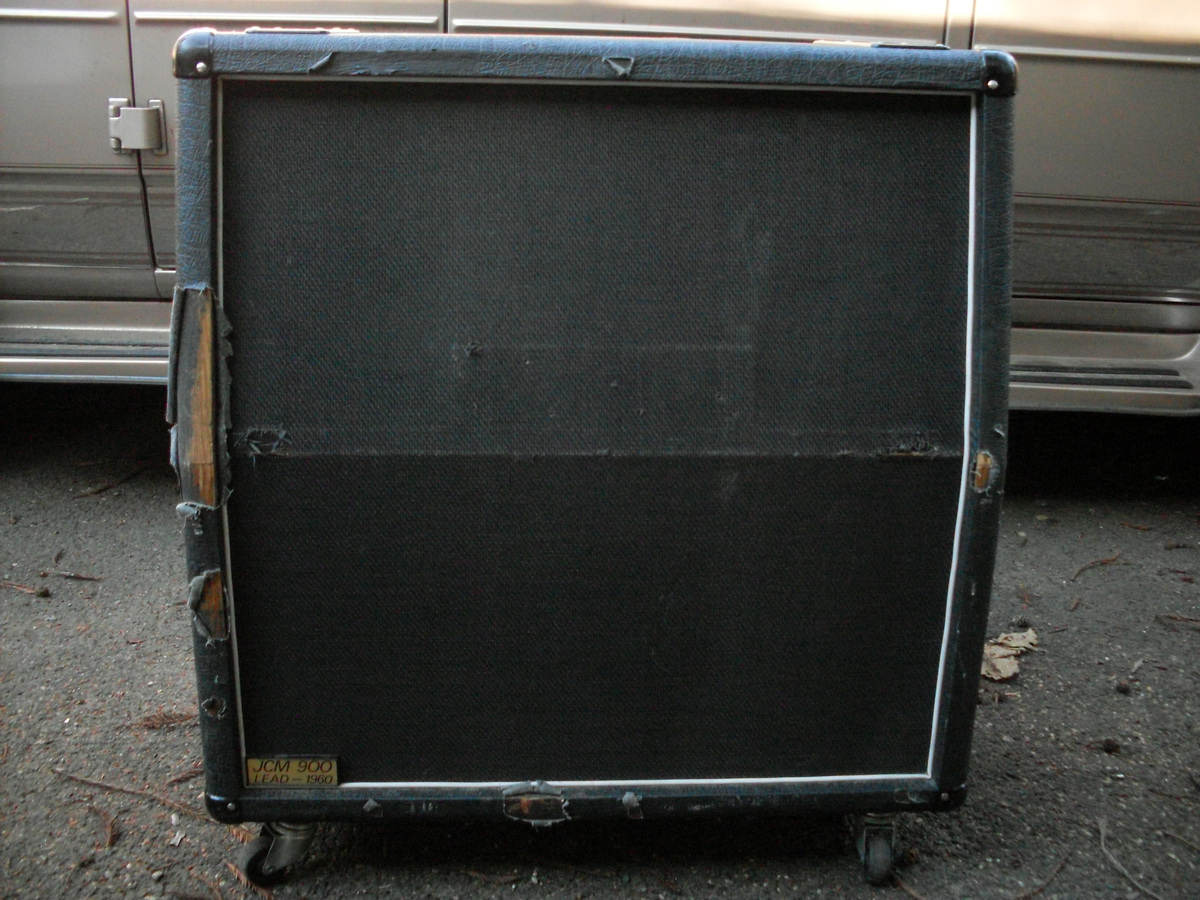
Road-worn Marshall 1960A slant cabinet with damaged covering and its large logo missing. Photo: “Marshall 1960A Cab” by Roadside Guitars (source notice: “COPYRIGHT, 2007”), CC BY-SA 2.0 (https://creativecommons.org/licenses/by-sa/2.0/). Full frame resized and re-encoded for web; adaptation under CC BY-SA 2.0. Source: https://www.flickr.com/photos/roadsideguitars/3214237010/
The Marshall 1960A 4x12 angled cabinet: 60-year history, G12T-75 specs, famous players, variant guide, tone recipes, and expert buying advice for used cabs.
There is a shape so embedded in the visual language of rock that even people who have never held a guitar can identify it from across a stadium: a black rectangular tower, wrapped in textured vinyl, grille cloth framed by white piping, four 12-inch cones lurking behind that fabric like barely-contained chaos. That shape is the Marshall 1960A angled 4×12 cabinet. And it didn’t get there by accident.
The 1960A has been stacked behind Jimi Hendrix, Jimmy Page, Pete Townshend, Angus Young, Kurt Cobain, Billie Joe Armstrong, Ray Toro, and literally hundreds of others. It is, according to Marshall’s own data, the world’s best-selling 4×12 cabinet family. Not the best-selling boutique cab. Not the best-selling British cab. The best-selling 4×12 on the planet, full stop.
And yet — if you search for what the 1960A actually sounds like, how it got here, which players actually use it (as opposed to which names get copy-pasted into a marketing blurb), and why the difference between the angled A and the straight B actually matters — the answers tend to be scattered, speculative, or wrong. This is that article. Welcome to the definitive guide to the Marshall 1960A.
The Birth of the Stack: Jim Marshall’s 1962 Garage Experiment
The story starts not with the 1960A, but with a problem Jim Marshall was trying to solve in 1962. His brand-new JTM45 head — conservatively rated at around 30 watts, not 45 watts as is often incorrectly stated — had a consistent bad habit: it destroyed 2×12 cabinets. The 15-watt, 12-inch Celestion speakers available at the time simply couldn’t handle the JTM45’s power when cranked up. They burned out. They blew. They died on stage.
Marshall’s fix was, in his own telling, not complicated. “It occurred to me that four speakers would probably do the trick,” he said years later. “They’d be able to handle the amp’s power and also give me the projection I was after. There was nothing brilliant about the design either — I just made it as small as possible for easier transport.” The result was the first Marshall 4×12, constructed in his Hanwell garage. That first cabinet was a straight-front design — effectively what we now call the 1960B.
It sounded great. Jim Marshall didn’t love how it looked. “When I put a head on top of that first 4×12, it looked terrible to me,” he recalled. “It didn’t look ‘designed’ at all — it was just a small box sitting on top of a bigger one.” His solution: angle the upper half of the speaker baffle so that the top two drivers point slightly upward, giving the stack a more unified silhouette that matched the head’s dimensions. That aesthetic fiddle — not any acoustic calculation — created the angled cabinet we now call the 1960A.
The sonic dividend was a happy accident. “At first I didn’t even realize there was a sonic advantage to having the top speakers angled slightly upward,” Marshall admitted with characteristic modesty. “But then I went to a gig and noticed it right away.” The angled baffling gave the cabinet wider sound dispersion — more “throw,” in engineer-speak — and made the top two drivers easier for the guitarist to hear at stage level without craning their neck toward the floor. You can hear what you’re playing without burying your head in the backline. That’s not a trivial improvement at volume.
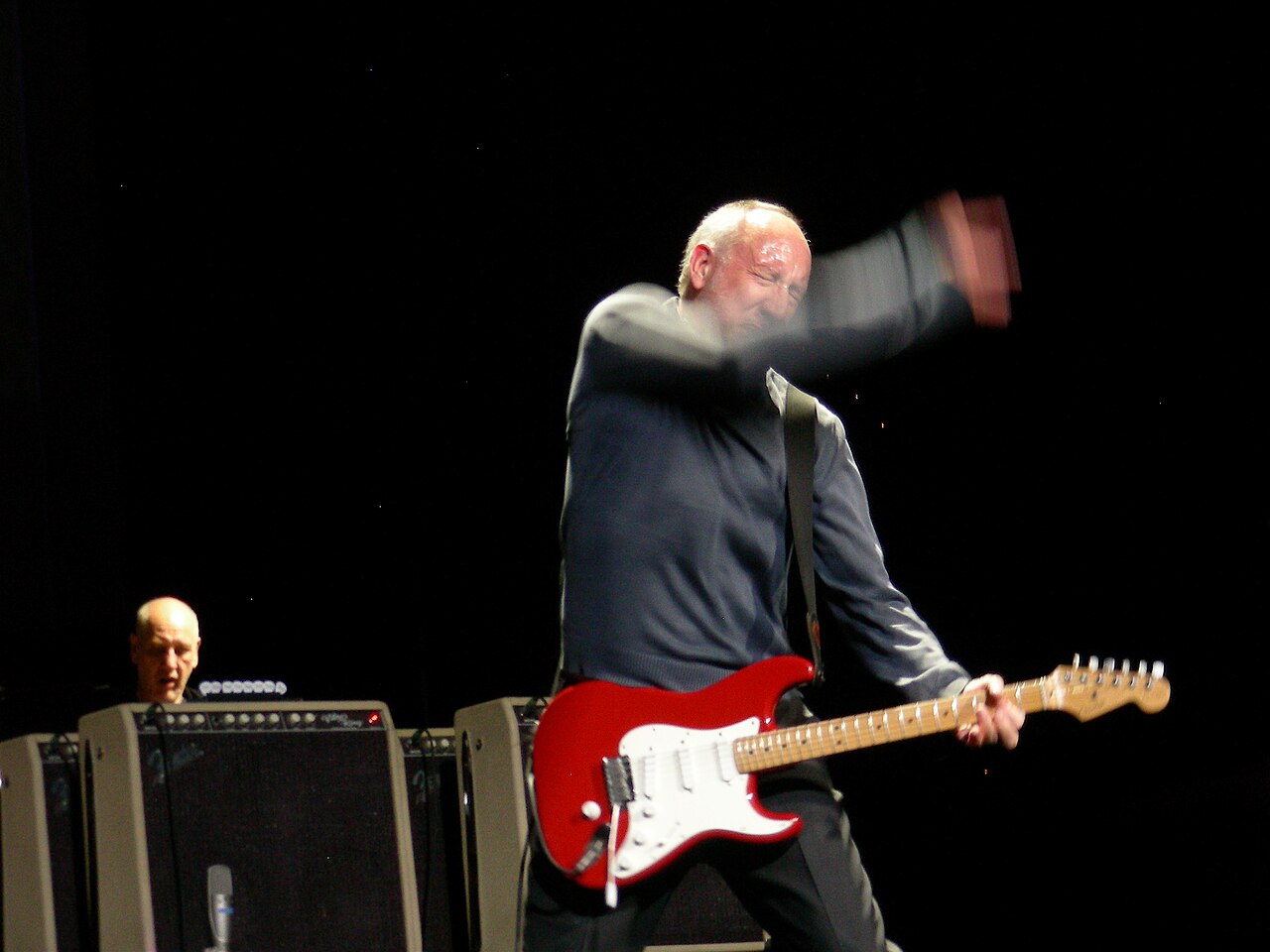
By mid-1964, Pete Townshend of The Who had taken things further still. He wanted more power, more sonic real estate, and — in a quintessentially Townshend fashion — more sheer physical intimidation. He approached Jim Marshall requesting a single 8×12 cabinet to use with the new 100-watt heads. Marshall reportedly built the prototypes, but they were impractical on the road — too heavy, too unwieldy. The compromise was elegant: pair an angled 4×12 (the 1960A) on top of a straight 4×12 (the 1960B), run both from a single 100-watt head, and you effectively have an 8×12 in two portable pieces. The Marshall stack was born. By the mid-1960s, Jimi Hendrix, Jimmy Page, Jeff Beck, and Eric Clapton had all adopted variations of this setup, and the visual template of rock guitar was set for the next sixty years.
That early 4×12 was loaded with what Celestion could offer at the time — the G12M Greenback, rated at 25 watts. Four speakers gave the cab a total handling of 100 watts, just enough for the contemporary heads. The fully-enclosed back was another pivotal design choice. Unlike the open-back combos Fender was building in California, Marshall’s sealed box enhanced low-end and lower-midrange response while adding damping that made the small speakers sound bigger and more focused. The 1960-series cabinet has remained closed-back ever since. Construction was Baltic birch plywood — chosen for rigidity and transport survivability, but acoustically significant too. Baltic birch yields clearer, more neutral, more articulate tone than the solid pine Fender used in its tweed-era designs. That clarity is part of why a Marshall cabinet sounds like a Marshall cabinet even before you’ve plugged in a single amp.
What the 1960A Is — And Why It Sounds Brighter Than the 1960B
The designation system is simpler than it looks. The 1960 is the model family — Marshall’s main 4×12 production line, in continuous production since 1962 and the direct ancestor of every current variant. The suffix letter tells you the baffle orientation: A = angled (slant), B = straight. Any further letters or numbers after that indicate a speaker variant: V for vintage-voiced Celestion G12M speakers, X for Celestion Greenbacks, HW for the handwired-series G12H-30 version.
The current production 1960A uses four Celestion G12T-75 speakers (16Ω, 75 watts each), totalling 300 watts handling in mono. It’s made in the UK at Marshall’s factory in Bletchley — not outsourced, not a licensed production. Designed and engineered in the UK, built in the UK. At $1,099.99 new, it is not a bargain purchase, but it is an authentic one.
So why does the 1960A sound brighter than the 1960B? There are two mechanisms. First, the angled top speakers project outward and upward, so the high-frequency content (which is the most directional component of guitar sound) disperses more widely across the room. Stand to the side of a 1960A and you hear more treble than you’d get from the equivalent position next to a 1960B. Second, the angled baffle introduces a subtle acoustic interaction between the two upper and two lower drivers: they’re no longer fully phase-aligned at the listening position because they’re physically offset. The result is a livelier, more three-dimensional high-frequency character that many players describe as “brighter” but which is more precisely “more dispersed and spatially complex.” The 1960B is slightly more focused and directional — marginally more thump, less spread. Neither is “better.” They serve different architectural functions. Stack them and you get both.
Specs at a Glance
| Spec | Value |
|---|---|
| Configuration | 4×12″, angled/slant top baffle |
| Speakers | 4× Celestion G12T-75 (16Ω, 75W each) |
| Power handling (mono) | 300W |
| Power handling (stereo) | 150W |
| Impedance (mono) | 16Ω or 4Ω (selectable via input choice) |
| Impedance (stereo) | 8Ω |
| Inputs | 2× ¼” jack |
| Cabinet construction | Baltic birch plywood, closed-back |
| Covering | Black levant vinyl |
| Grille | Salt ‘n’ pepper cloth, white piping border |
| Width | 770 mm / 30.3″ |
| Height | 755 mm / 29.7″ |
| Depth | 365 mm / 14.4″ |
| Weight | 36.5 kg / 80.5 lbs |
| Made in | UK (Bletchley) |
| Price (new, 2026) | From $1,099.99 |
A Speaker Story: From Greenback to G12T-75
One of the most important things to understand when shopping for a 1960A — new or used — is that the speaker complement has changed three times in the cabinet’s history, and each change produced a substantially different sound. “Marshall 1960A” is a model number, not a timeless tonal constant. Here’s the timeline.
The Greenback era (mid-1960s to early 1980s). The original 4×12 cabs used Celestion G12M speakers — the “Greenback,” so named for the green magnet cap on the rear. These are 25-watt, 12-inch units with a relatively high-frequency rolloff, a warm and compressed character, and a natural harmonic saturation when pushed hard. They are the speaker behind every legendary Hendrix, Page, Beck, and Townshend recording of the late 1960s. The G12M’s soft high-end and prominent 2–3kHz presence made the cranked Super Lead sound simultaneously incandescent and musical rather than harsh. G12M-loaded vintage 1960As are now highly collectible. Four genuine Pulsonic-cone G12Ms in a mid-1960s cab can represent $2,000–4,000 in speakers alone.
The G12-65 interlude (late 1970s to mid-1980s). As amplifier power crept upward — from 50W to 100W heads becoming the norm — and as rock stages became larger, the 25-watt G12M found itself underpowered for reliable stage use. Celestion’s response was the G12-65, a 65-watt driver with a more extended frequency response, flatter midrange, and notably more headroom before breakup. This is the speaker Angus Young used extensively, loaded into 1960AX and 1960BX cabinets. It has a tighter, clearer character than the Greenback — still warm, but more articulate and less compressed. The G12-65 era roughly corresponds to 1978–1983 production cabs, though there is overlap. If you find a used 1960A with G12-65s still intact, you have something genuinely useful; these speakers fetch $80–120 each individually.
The G12T-75 era (early 1980s to present). When Marshall introduced the JCM800 series in 1981, the 100-watt high-gain heads demanded a speaker that could handle the new output cleanly and efficiently. Celestion’s answer was the G12T-75 — 75 watts, with a smooth upper-midrange response that avoids the harsh 2–3kHz presence peak of the later Vintage 30, a more extended bass response, and excellent definition under high-gain attack. This is the speaker in every current production 1960A, and it has defined the sound of British rock and metal from the JCM800 era to the present. Under high gain, the G12T-75 has a tight, punchy low-end — more controlled than a Greenback — with a pronounced presence peak around 3.5kHz that cuts through a full band mix without requiring much EQ at the desk.
The practical upshot for used buyers: if the serial or date code puts a cab in the mid-1960s, it probably has Greenbacks. Late 1970s to early 1980s, likely G12-65s. 1983 onward, G12T-75s are the probable spec, with some overlap years. Pull the grille and look at the speaker backs before you buy.
The 1960A Family Tree
Marshall currently makes or has recently made the following variants of the angled 1960A concept. Each is a different instrument tonally.
1960A (current production): 300W, 4× Celestion G12T-75 (16Ω/75W). The workhorse — tight, punchy, excellent under JCM800, DSL, and JVM series heads. The most versatile option for high-gain playing. $1,099.99 new.
1960AV: 280W, 4× Marshall G12 Vintage by Celestion (essentially the current production Celestion G12M-25 Greenback-voiced speaker). More compressed, warmer, softer on the high end than the standard 1960A. This is the variant Slash uses — his signature 1960AV-based cabs are the Celestion Vintage-loaded version, not the G12T-75 model. The AV sits between the Greenback character and the G12T-75’s modernity. Currently $1,199.99 at most retailers.
1960AHW: 120W, 4× Celestion G12H-30 “Heritage” (30W, pre-aged), Handwired Series. Specifically built to pair with the 1974X and 2061X hand-wired reissue heads. The G12H-30 has the Greenback warmth with slightly better bass extension and a touch more power handling. Sonically closer to the classic 1960s studio tone than any other current 1960A variant. $1,399.99 new.
1960AX: 100W, 4× Celestion G12M-25 Greenback (25W). The vintage-spec purist option — current production Greenbacks, which are faithful reproductions of the original cone and magnet design. Lowest power handling, most compression and saturation, most authentic 1960s tone. Pairs best with heads below 50W; running a 100W Super Lead into a 1960AX at full power will stress the speakers. $1,199.99 approximate.
Understanding these variants matters for matching a cabinet to your head. The G12T-75 in the standard 1960A handles a 100-watt DSL or JVM without drama. The Greenbacks in the 1960AX do not, and shouldn’t be used that way.
Famous Players: Verified and Honest
Here is what the primary sources actually show.
The Verified 1960A Players
Pete Townshend (The Who) holds the historical claim to credit for the Marshall stack concept itself — the angled 4×12 on top of the straight 4×12. His 1964–65 negotiations with Jim Marshall over the impossibly impractical 8×12 cab proposal effectively birthed the two-cabinet stack format. The early 1960-series cabs Townshend used were Greenback-loaded and often pushed to destruction on stage — intentionally, frequently, gloriously. He didn’t use the current G12T-75 version, but he is the reason the 1960A exists in its paired-with-a-straight-cab form.
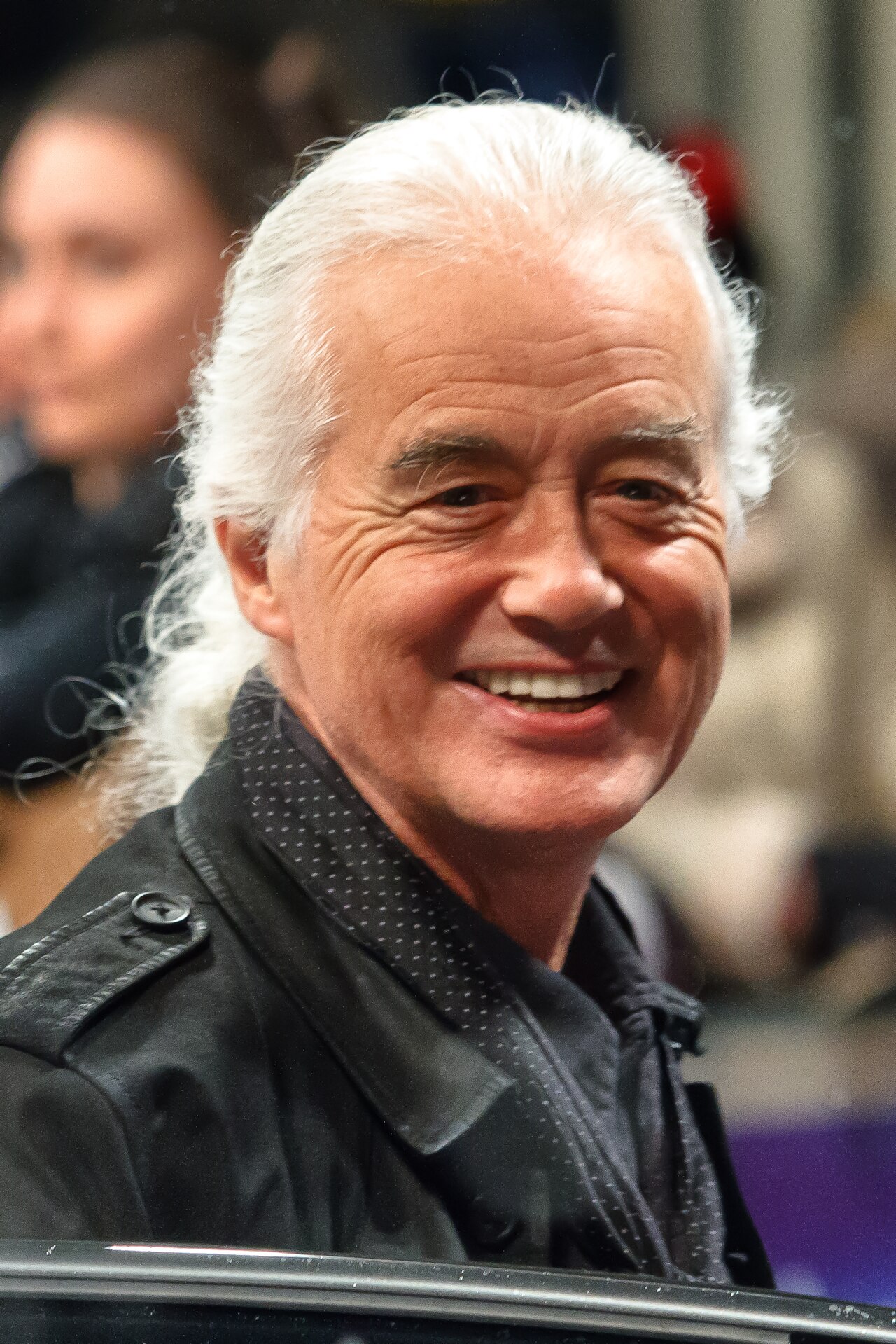
Jimi Hendrix and Jimmy Page operated in the same early Marshall 4×12 ecosystem — Greenback-loaded cabinets behind Super Lead 100s, driving sounds that remain reference points for anyone trying to understand what the 1960-series does when it’s working correctly. Hendrix’s Woodstock rig was a wall of Marshall stacks; Page’s Kashmir-era and Whole Lotta Love tones were recorded in part through Marshall 4×12 cabs. Again, the vintage speaker spec is the honest caveat here.
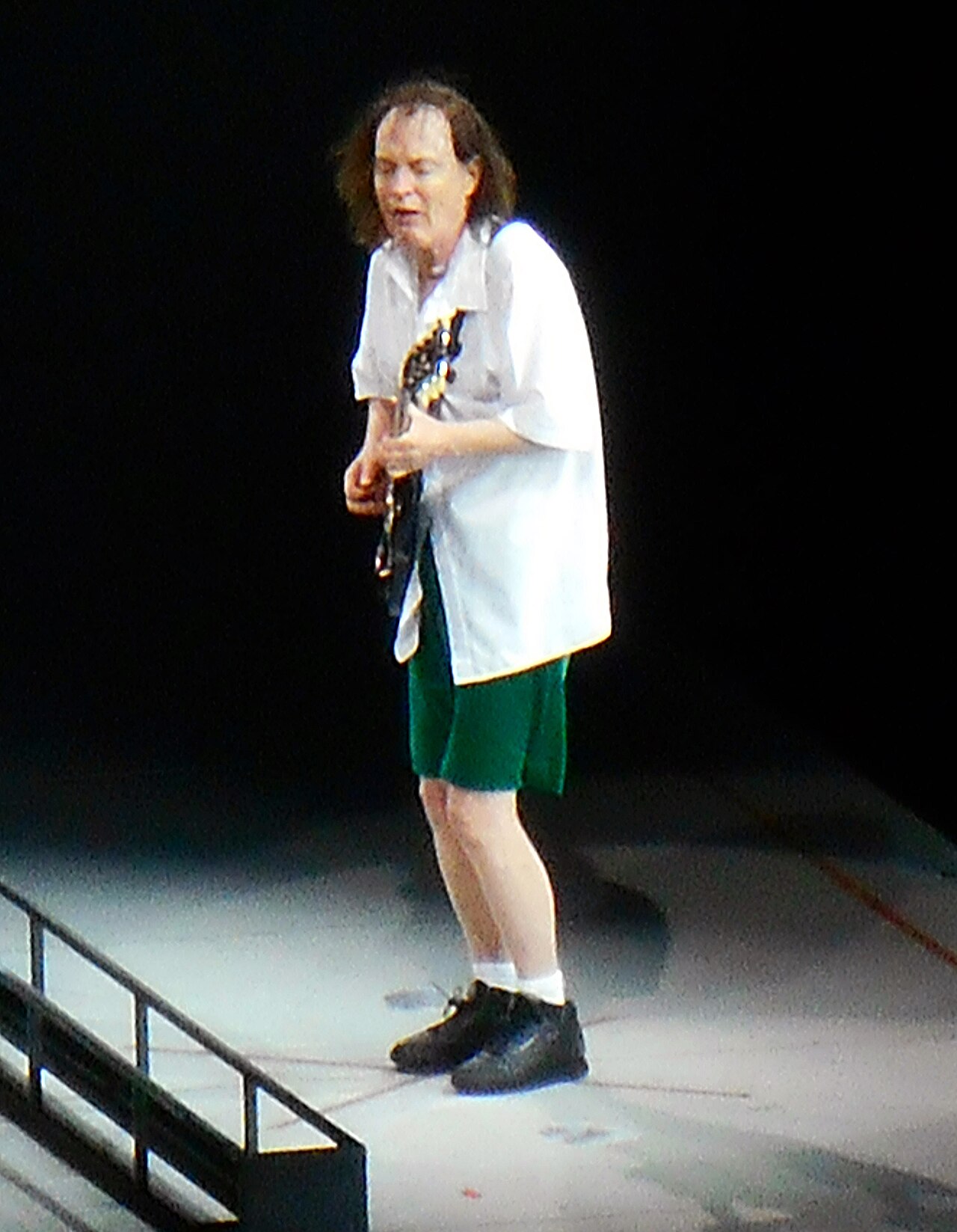
Angus Young (AC/DC) provides the most specifically documented connection to the modern 1960A model. Equipboard’s documentation includes a video timestamped at the Flick of the Switch tour rehearsals (1983) with a 1960A cab visible at 0:17. The associated album also appears in Equipboard’s album-usage data for the 1960A. Angus’s primary cabs through the JTM45/Super Lead era used G12-65 speakers (1960AX/BX variants), but by the early 1980s, the transition to G12T-75 or G12-65 cabs was underway across Marshall’s production. Treat him as a documented 1960-series user with model/speaker caveats for the earliest period.
Kurt Cobain provides one of the cleanest video verifications on the Equipboard database: Nirvana’s live performance of “Territorial Pissings” at the Paramount in Seattle, 1991 (released as Live at the Paramount, 2019), contains clear footage of a Marshall 1960A 4×12 cabinet in Cobain’s stage rig, as referenced and timestamped in the NirvanaVEVO video. He paired 1960A cabs (and 1960AV cabs in other periods) with Fender Twin Reverbs and various Marshall heads; the 1960A was part of his wall-of-amp approach to achieving a sound that was simultaneously clean, distorted, and physically overwhelming.
Billie Joe Armstrong (Green Day) is documented on Equipboard with specific 1960A and 1960B cabs in his amp setup — multiple 300-watt 4×12 units forming the physical backdrop of Green Day’s stage production across their arena and stadium touring years. Armstrong runs modified Hot Rod DeVilles into the Marshalls in his “clean” rig, plus various distorted channels.
Ray Toro (My Chemical Romance) provides the cleanest direct-quote verification in this article. In a Seymour Duncan interview, Toro stated explicitly: “Right now I’m using Marshall JCM 2000s, the DSL100 with two 1960A cabinets.” That is a named model, from the musician’s own mouth, in a published interview. The DSL100 (covered at Rank 433 in this series) into the 1960A is precisely the kind of high-gain British pairing this cabinet was designed for. Not in the guitarist DB; prose only.
What the Primary Sources Show
Slash uses 1960AV cabinets, not the standard 1960A. His Marshall signature rigs — built around the Silver Jubilee 2555 and the subsequent JCM Slash signature amp — are paired with 1960AV-based cabs loaded with Celestion G12M Vintage speakers, not the G12T-75 units in the current 1960A. The Slash Signature cabinet (the 1960AV SLASH variant) uses Vintage 30-voiced or G12M-Vintage Celestions and has cosmetic differences from the standard AV. Slash is thus a verified Marshall 1960-family cabinet user, but the specific model is the 1960AV, not the 1960A. That’s not a knock — the AV is an excellent, distinct cabinet — but it’s the correct attribution.
Gary Moore died in February 2011. He cannot use, endorse, or be documented on any product released or verified after that date. Gary Moore did use Marshall stacks in his career — vintage Super Leads through 1960-series cabs was a standard part of his sound — but “Gary Moore uses the 1960A” as a present-tense claim is untrue, and it’s been untrue since February 2011. Gary Moore’s documented gear belongs to a different era and different specific cabinet models.
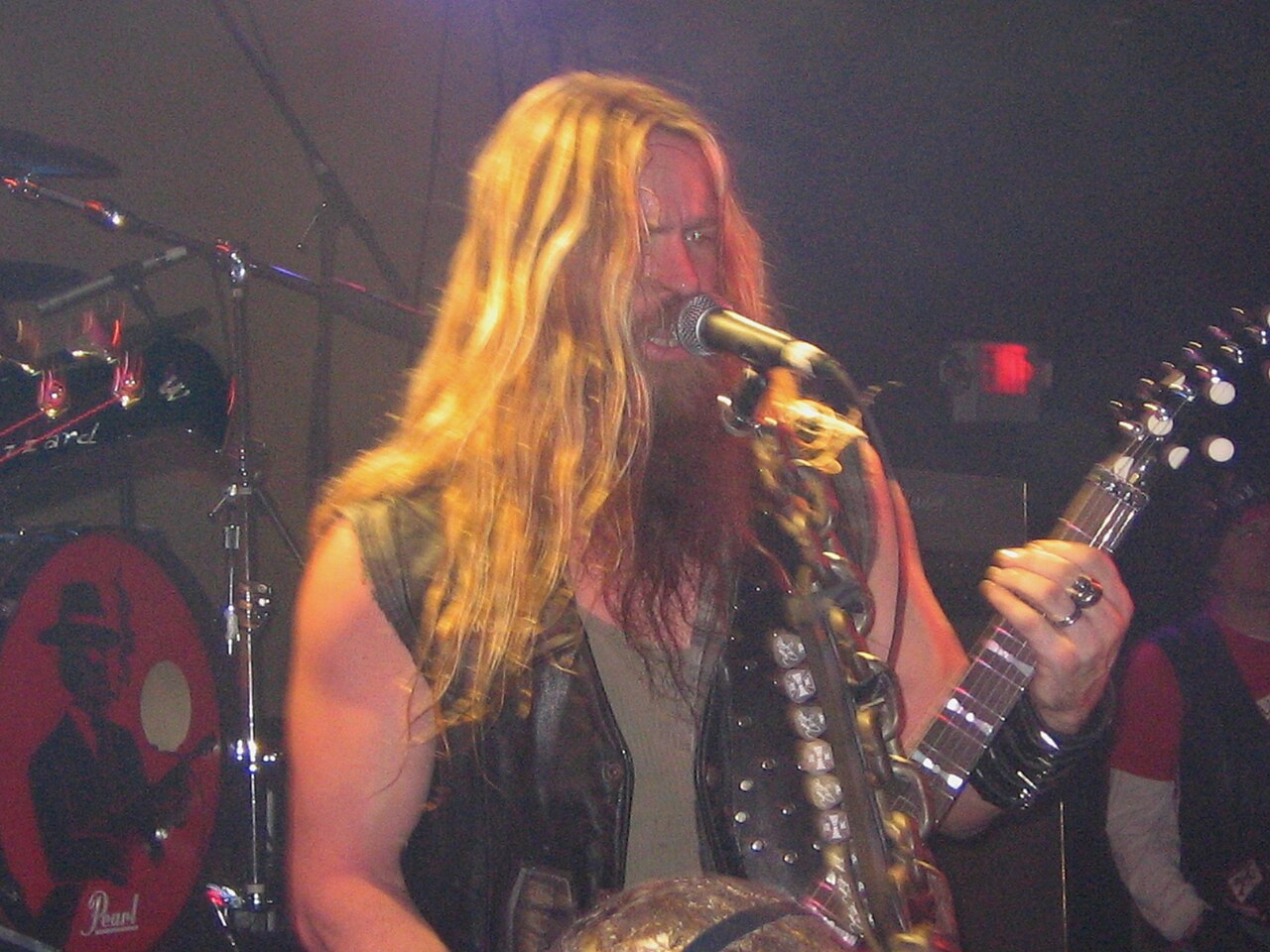
Zakk Wylde and Kerry King both use Marshall JCM800 heads as core components of their rigs, and Marshall 4×12 cabinets appear in both their live setups in various photographs and rig documentation. Neither’s primary-source material (Zakk Wylde‘s documented rigs, Kerry King‘s documented rigs) specifically pinpoints the 1960A versus the 1960B or other variants. Both are plausible 1960-family users; neither is cleanly verified on the specific 1960A model in primary-source documentation.
Tom Morello is the most interesting case. His signature RATM tone comes from a Marshall JCM800 2205 50-watt head — but that head runs through a Peavey 4×12 cabinet loaded with Celestion G12K-85 speakers. His original gear was stolen before a gig in the late 1980s, and the replacement rig he found at a local shop included the 2205 head and the Peavey cab. He fell in love with that combination specifically, locked in his settings, and has used essentially that pairing ever since. Some documentation references a Marshall 1960B (straight) in certain rig configurations, but his signature distorted sound is the JCM800 into the Peavey — not a 1960A. Tom Morello’s documented cab situation is genuinely unusual: the iconic Marshall-amp tone you know from Rage Against the Machine and Audioslave is going through a Peavey.
The honest picture: the 1960A is genuinely used by hundreds of professionals — Equipboard lists 195 verified artists — precisely because it is the industry-standard 4×12 and pairs with virtually every Marshall head ever made. The cabinet is ubiquitous enough that claims about it are almost impossible to falsify by logic alone. But “almost certainly uses one” is not the same as “verified on this specific model,” and this series maintains that distinction.
Tone Recipes and Settings
1. Classic Plexi Stack Tone — Big Room, British Crunch
Head: Marshall 1987X Plexi (50W). Run into the 1960A at 16Ω. Both channels linked (short ¼” cable from Normal channel low input to Treble channel low input; guitar into Treble channel high input). Set Volume to around 7, Treble at 6, Middle at 5, Bass at 5, Presence at 6. Let the speakers and the room do the work. You’re not going for clean — you’re going for that 1967 live recording where you can feel the cabinet pressure in the chest. The G12T-75s will push slightly harder and cleaner than a Greenback at the same setting; lower the head’s bass control by 1 if the low-end is too boxy.
2. JCM800 High-Gain British Rock — The 1980s Standard
Head: Marshall JCM800 2203 or 2204. 1960A at 16Ω. Add an Ibanez TS9 Tube Screamer in front (drive around 9 o’clock, level at 5 o’clock, tone at noon) to tighten the input and push the preamp stage harder. Amp settings: Preamp volume at 3–4, Master volume at 6–7, Treble 7, Middle 5, Bass 5, Presence 6. The G12T-75 loves this kind of wide-bandwidth push — it stays defined in the low-mids where cheaper speakers get loose and ill-defined. Result: the guitar tone from a hundred NWOBHM and ’80s hard rock albums.
3. DSL100 Modern Metal — Scooped and Surgical
Head: Marshall JCM2000 DSL100 into 1960A. Use the Ultra Gain channel. Gain at 7, Volume at 5–6, Treble 6.5, Middle 4 (the mid-scoop is intentional here), Bass 6, Presence 6, Resonance 5. The G12T-75’s relatively flat upper-midrange keeps this from going nasty — the speaker is doing as much work as the amp’s EQ. This is Ray Toro’s general territory: the pick attack bites clearly, the palm-mutes have weight without mud. Add a Boss SD-1 or Pro Co RAT 2 in front to add texture and tighten the attack further.
4. Low-Watt Amp Into a Big Box — The “Wrong” Pairing That Works
Run a Marshall 2061X (20W, EL84 power amp) into the 1960A at the 16Ω setting. This is considered counterintuitive — a 20W head into a 300W cabinet — but the physics work in your favour. The G12T-75s will not distort; the power amp will. You get a clean, loud, dynamically rich sound where the character comes entirely from the 2061X’s EL84 push-pull stage and its silicon diode rectifier response. At moderate stage volumes, this is one of the most touch-sensitive settings available on any Marshall stack. The 1960A’s width fills the room; the 2061X’s character fills the tone.
5. The Full Stack — Stereo Bi-Amplified or Wet-Dry
Pair the 1960A with a matching 1960B (straight). Run two separate amp channels or a stereo wet-dry rig: dry signal into the 1960B (16Ω, tight and focused), effected or clean signal into the 1960A (16Ω, dispersed and bright). Each cab handles 150W stereo at 8Ω if run from a single dual-channel head, or 300W each if driven from separate mono heads. The combined spatial width of eight 12-inch Celestion G12T-75 drivers in a single rig is physically and sonically overwhelming in a way that no modelling rig or 2×12 setup can replicate. This is what a “wall of Marshalls” actually sounds like when you’re standing in front of it. Mic the centre of each cab (SM57 at 1 o’clock position on the cap edge, about an inch off the grille) and pan slightly — not 100% L/R, more like 20–25° — for a studio recording that spreads without losing mono focus.
How the 1960A Stacks Up: Cabinet Comparisons
Marshall 1960A vs Marshall 1960B
Same cabinet, different baffle angle. The 1960B’s straight front means all four speakers project directly forward — slightly more focused, slightly more low-mid thump, slightly less high-frequency dispersion than the slanted 1960A. Most players who own one own both and run them as a stack. Solo, the 1960B is the “tighter” choice in a mix; the 1960A the “brighter” and more spatially complex option. If you can only have one, the 1960A’s wider dispersion serves most stage configurations better, but the 1960B’s focus suits smaller rooms and recording setups where you’re sitting directly in front of the cab. Both are $1,099.99 new.
Marshall 1960A vs Marshall 1960AV
The AV loaded with Celestion G12M Vintage speakers is a warmer, softer, more compressed cabinet. The G12T-75 in the standard 1960A has more low-end extension, tighter transients, and a crisper attack — it handles high-gain better and stays defined at lower frequencies. The AV’s G12M Vintage compresses more readily under hard attack and rolls off the upper-mids in a way that sounds organic and musical with lower-gain and vintage-voiced heads, but can feel dark and soft under a modern high-gain preamp. Slash uses the AV specifically because the Silver Jubilee’s bright character benefits from the AV’s warmth. If your amp is already bright, the AV is the better pairing. If your amp is mid-focused or high-gain, the standard 1960A is the more accurate tool.
Marshall 1960A vs Marshall 1960AHW
The 1974X combo and the 2061X head from the Handwired Series were designed to pair with the 1960AHW, which uses Celestion G12H-30 Heritage speakers (pre-aged, 30W each, 120W total). The G12H-30 sits between the G12M’s warmth and the G12T-75’s articulation — more bass extension than the Greenback, more midrange complexity than the T-75. The 1960AHW is the most expressive, dynamic option in the current lineup. At 120W total handling, it’s also the most easily overdriven, which is an advantage with lower-power vintage-spec heads. It’s not the right cab for a 100W DSL. It’s the right cab for an 18W or 20W Handwired head at moderate volumes. Price: $1,399.99 new.
Marshall 1960A vs Mesa/Boogie 4×12
Mesa’s standard 4×12 (traditionally loaded with Celestion Vintage 30s) has a different tonal footprint than the 1960A. The V30 has a prominent peak around 3.5kHz with a pronounced mid-scoop below it — more scooped-sounding, more “scooped American” versus “punchy British,” more glassy high-end, less fundamental warmth. Mesa cabs are significantly heavier than the 1960A and use a different plywood specification. If your amp has a naturally mid-forward character (JVM, DSL, most British designs), the 1960A’s G12T-75 complements that midrange naturally. If your amp is already voiced with a mid-scoop (Rectifier series, Peavey 5150/6505 family), a Mesa V30 cab may accentuate the scoop to the point of thinness. The 1960A is the more versatile, more tonally neutral pairing across a wider range of amp types.
Marshall 1960A vs Orange PPC412
Orange’s PPC412 is also a closed-back 4×12 loaded with Celestion Vintage 30s — so many of the Mesa observations apply. The Orange cab has a characteristically darker, denser plywood construction that some engineers describe as “woollier” in the low-mids compared to the 1960A’s Baltic birch clarity. The Orange is built like a small building and weighs accordingly. It pairs beautifully with Orange heads (which are voiced to match it) but can be too warm and compressed when combined with a bright British head like a Plexi or JCM800. The 1960A is the more promiscuous pairing — it works with more head types simply because its character is more neutral than the distinctly coloured Orange combination.
Buying Guide: New, Used, and Vintage
New ($1,099.99). Buying new gets you the G12T-75 spec you expect, a warranty, and the certainty that the tolex, grille, and inputs are in perfect condition. Marshall’s UK build quality on the 1960 series is consistent. There is no reason to pay a premium at a specific retailer — the cab is the cab. Find the best shipping deal or nearest store and buy from there. Note: the 1960A and 1960B are sold separately; a “stack” requires both cabs and a head, and they’re three separate purchases.
Used (typical range: $400–750). The used market for 1960As is robust and well-populated. Most cabs on the market are in good structural condition — Baltic birch is durable, and 1960 cabs are built to touring standards. Key checks before buying used:
- Speaker condition. Pull the grille (four corner screws) and inspect all four speakers visually. A torn or creased cone is a recone job ($80–100 per speaker at a reputable shop; budget $350+ for a full recone on all four). A rubbing voice coil — which you check by pressing very gently on the cone centre and listening for a scratching sound — is an immediate red flag. Four working G12T-75s in a used cab are worth $200–280 in parts alone, making a clean used 1960A a strong value proposition when speakers are intact.
- Input jacks. Plug into both inputs and verify mono operation (single amp, one input) and stereo operation if relevant to your rig. Corroded jacks are a cheap fix but confirm you know what you’re buying.
- Tolex condition. Cosmetic damage to the vinyl covering does not affect sound. Significant delamination around the back edges or corners can indicate moisture damage — press on those areas and check for soft or crumbling substrate. A small amount of tolex cosmetic wear at the corners is universal on gigged cabs; it’s meaningless tonally.
- Warp check. Place the cab on a flat floor and verify it sits evenly. A twisted or warped cab (from prolonged storage in an unventilated garage or van) can affect driver alignment and create rattles at volume.
Vintage (1960s–1970s Greenback-era cabs). Budget $1,500–4,000 or more depending on condition and speaker originality. Cabs from 1966–1972 with original Pulsonic-cone G12Ms in good condition are the most sought after and the most consequential tonally. The checkerboard-pattern tolex (available on some 1972–1973 models) commands a modest additional premium. Before paying vintage prices, verify speaker authenticity — Pulsonic-cone originals have a paper label inside the driver with a specific code pattern. Replacement speakers in a “vintage” cab are worth far less than originals, and this matters enormously to the final price negotiation. Get a specialist to inspect before committing serious money to a vintage piece.
Living With a 1960A
The 1960A weighs 36.5 kilograms / 80.5 pounds. That is not a small number. Loading it in and out of a van without a second person is technically possible and practically ill-advised — the cab is front-heavy due to the speaker mass and awkward to carry solo through tight backstage corridors. Invest in a quality 4×12 dolly/cart, take the handles seriously when they’re available on the cab, and book the second pair of hands. Serious back injuries in guitar players are more often caused by cab wrangling than by playing technique.
The closed-back design means the 1960A is directional. Where you stand relative to the cabinet changes what you hear considerably. At stage level, standing behind and above the cab gives you a notably different sound than standing at the player’s position. Mic placement is more critical than with open-back designs: the standard SM57 at the cap edge, one inch off-axis (so the magnet isn’t directly in the capsule’s path) is the textbook starting point, but experiment with the exact clock position between 12 o’clock (direct centre, more presence) and 2 o’clock (off-centre, softer, more even). Distance matters too: moving the mic back 3–6 inches from the grille adds room ambience and reduces upper-midrange harshness under high gain.
Impedance matching is non-negotiable. The 1960A has two inputs: use the left (mono) input for 16Ω mono operation; use both inputs for 2×8Ω stereo operation (8Ω per side). Do not run a 16Ω-minimum head into the 4Ω tap of the cab, or vice versa — a single-step impedance mismatch won’t blow a transformer instantly, but sustained mismatches shorten transformer and output tube life. Match the amp’s output impedance selector to the cab’s input configuration before every session.
The G12T-75 speakers in the current 1960A do not require break-in under careful use — they will open up and become slightly more articulate over the first 10–20 hours of play, but they won’t be noticeably “stiff” new the way some boutique speakers are. Run them at moderate volume initially if the concept of break-in matters to you; the difference is audible but not dramatic.
Storage: keep the 1960A indoors, away from sustained moisture and extreme temperature swings. Baltic birch plywood is resilient but not waterproof; long-term storage in a damp van or garage will eventually delaminate the plywood substrate and degrade the tolex bond. A fitted cab cover is $30–50 and will protect the tolex through years of gigging.
Frequently Asked Questions
What’s the difference between the 1960A and the 1960B?
The 1960A has an angled (slant) top baffle: the top two speakers point slightly upward, giving wider sound dispersion and a slightly brighter projected tone. The 1960B is straight — all four speakers face directly forward, producing a more focused, slightly tighter sound. Both use the same G12T-75 speakers and 300W/16Ω mono specification. They’re commonly paired as a full stack: 1960A on top, 1960B on the bottom.
What head wattage can I safely run into the 1960A?
The 1960A handles 300W mono, which means any head from 1W to 300W is safely within specification. The G12T-75 speakers (75W each, four total) give enormous headroom above anything from a 5W practice amp to a 100W DSL. If you’re running a handwired 20W EL84 head, the speakers will never stress — you’re using about 7% of the cab’s rated capacity. The Handwired Series companion cab is the 1960AHW (G12H-30, 120W) which is specifically voiced for those heads, but the standard 1960A is not harmed by low-watt heads. Do not confuse the stereo rating (150W) with mono operation — in mono, 300W is the limit.
Is the 1960A good for home use?
It is wildly impractical and partially wonderful for home use, depending on your definition of “home.” The cabinet needs to be driven to at least moderate volume levels before the G12T-75 speakers begin to exhibit their character — at bedroom levels through a silent attenuator, you’re mostly hearing the head. If you have a space that can accommodate the volume and weight, the 1960A will show you what your amp is capable of in ways a 1×12 or 2×12 cannot. If “home use” means an apartment at 9pm, you need a different solution regardless of cab choice.
What’s the difference between the 1960A and the 1960AV?
The 1960AV uses Marshall G12 Vintage speakers by Celestion — essentially a current-production G12M-25 Vintage-voiced driver. The standard 1960A uses G12T-75s (75W, 300W total vs the AV’s 280W). The AV is warmer, more compressed, more vintage-voiced, with a natural high-frequency rolloff that suits vintage-style heads. The 1960A is tighter, more extended, better under high-gain. Slash uses the 1960AV; Ray Toro uses the 1960A. Those two guitarists tell you a lot about the tonal difference.
Can I mix different heads into the 1960A?
If you mean “can I run two heads into the two inputs simultaneously” — technically yes in a stereo configuration, with both heads matched at 8Ω and the cab run stereo. In practice, this is risky: accidentally connecting both heads at 16Ω mono into the same jacks can cause ground loops and, in extreme mismatches, transformer stress. If you want a wet-dry or A/B head setup, use an ABY pedal or a purpose-built load box and feed one head at a time, or run a proper stereo rig with the cab split correctly. Consult a tech if you’re unsure — output transformer repairs are expensive.
How does the 1960A sound with a Fender amp?
Better than you’d expect, different from a Marshall head. Fender’s clean architecture (Bassman, Twin Reverb, Deluxe-family designs) is not voiced to fight the G12T-75’s upper-midrange character — they actually complement each other. The G12T-75 adds some warmth and mid-presence that Fender’s more open-backed designs lack; the result is a fuller, slightly more British-flavoured clean tone. Kurt Cobain ran Fender Twin Reverbs alongside Marshall heads into 1960-series cabs, and that combination — Fender for clean breadth, Marshall for grind, both into the same cabs — is a significant reference point for anyone chasing that early-1990s alternative rock texture.
What’s the best mic placement for recording the 1960A?
Start with one SM57 at the cap edge (the boundary between the cone and the dust cap) of the upper-right or lower-left speaker (the off-centre position gives a more balanced response than dead centre), positioned at 1–2 inches off the grille cloth, pointing slightly off-axis (so the mic body is at roughly 30° to the speaker cone axis rather than perfectly perpendicular). This captures the presence and attack of the G12T-75 without the harsh ring that pure on-axis placement can introduce under high gain. Add a second mic (a Royer R-121 ribbon or a Sennheiser e906 flat against the grille for proximity and warmth) blended 30–40% with the 57 for studio recordings. For live use, a single SM57 or Audix i5 on the cap edge is the industry-standard starting point; trust the engineer’s ears over theoretical placement once the volume is up.
What did the original 1960A sound like compared to the current one?
The original 1960A (mid-1960s, Celestion G12M Greenback-loaded) sounded warmer, softer, and more compressed than the current G12T-75 model. The Greenback’s 25W rating and its natural high-frequency rolloff produced a creamier, more forgiving tone that required less EQ to sound musical — but it broke up more easily under hard playing and couldn’t handle high-wattage heads reliably. The G12T-75 is the modern answer: more headroom, tighter transients, more extended bass response, better handling of high-gain preamp stages. Both versions produce the characteristic “Marshall 4×12 sound” — that breadth, that push, that chest-level low-mid presence — but the vintage version is warmer and the current production version is more precise.
Image credits
- Zakk Wylde: Joanna Corwin, Wikimedia Commons, CC BY-SA 3.0.
- Angus Young: TheACDCDoctor, Wikimedia Commons, CC BY-SA 4.0.
- Jimmy Page: Avda, Wikimedia Commons, CC BY-SA 3.0.
- Pete Townshend: Kubacheck, Wikimedia Commons, CC BY 2.0.
- Top image: Marshall 1960A Cab by Roadside Guitars (source notice: COPYRIGHT, 2007). CC BY-SA 2.0. Full frame resized and re-encoded for web. This adaptation is also CC BY-SA 2.0.
Latest News
Related
On This Day
Monday 9 November
From this week: