Vox AC15C1: The Amp That Put British Chime Back Within Reach
The Vox AC15C1 explained: Dick Denney's 1958 circuit, the 2010 Custom redesign, full specs, seven tone recipes, honest player facts and buying advice.
There is a particular sound that walks into a rehearsal room and instantly makes a band sound more expensive than it is. It is bright without being brittle, it compresses when you dig in, it turns a cheap strum into something that rings, and it has been the sonic signature of British guitar music since Cliff Richard’s backing band plugged into one in a Sussex-built cabinet in 1958. For roughly fifty of the years since, getting that sound meant either finding a sixty-year-old amplifier and paying for a recap, or buying a hand-wired boutique tribute at boutique prices.
Then, in January 2010, Vox quietly replaced a model most players had never quite loved with one they could not stop buying. The AC15C1 is not a rare amp. It is not a collector’s piece. It has no mystique, no serial-number registry, no forum arguments about which year is the good one. It is a Chinese-built, printed-circuit-board combo that sits in guitar shops in every city on earth with a price tag most working players can actually reach. And it is, by a wide margin, the most successful vehicle the Vox voice has ever had.
This is a feature on what that amp actually is — where the circuit comes from, what Vox got right, what the official spec sheet gets wrong, which famous-player claims survive contact with a calendar, and how to make it sound like the records.
Where the AC15 Came From: A Trade Embargo and a Man Named Dick Denney
The AC15 exists because British guitarists in the mid-1950s could not buy American amplifiers. Fender’s line was subject to a trade embargo, which made it both difficult and ruinously expensive to import, and even if you got one home you needed a step-up converter to run it on the UK’s 220-volt mains. Rock and roll was arriving from America faster than the equipment to play it was.
Tom Jennings, an accordion player who had founded Jennings Musical Industries, saw the gap. JMI was already building instrument amplifiers, but none of them were designed for electric guitar. In 1957 Jennings recruited his friend Dick Denney — an engineer who had tried and failed to sell his own amplifier designs — to build one.
What Denney produced matters more than it usually gets credit for. Most guitar amplifiers of the period, including Fender’s and Gibson’s, were adaptations of reference circuits published in valve-manufacturer application handbooks. Denney’s preamp was his own work, designed specifically around the behaviour of an electric guitar, with an output stage adapted from JMI’s organ amplifiers. The result was named the AC1/15: AC because it ran on alternating current rather than the noisier DC supply of some rivals, 1/ because it was the first Vox model designed for guitar, and 15 because it produced fifteen watts — genuinely powerful for 1958. The name was soon shortened to AC15.
It launched in January 1958, built in Sussex, in a cream Rexine “TV-front” cabinet with diamond-patterned grille cloth. The control panel sat on top of the chassis facing backwards, because guitarists at the time stood in front of their amps rather than behind them. Two channels, Normal and Vibrato, two inputs each, a volume per channel and one shared tone control. Two ECC83 valves in the preamp, two EL84s in a cathode-biased Class A output stage with no negative feedback loop, and a 5Z4 rectifier. The vibrato circuit was lifted wholesale from JMI’s own Vibravox effects unit.
The Fast Evolution, and the Amp It Accidentally Created
From late 1959 the AC15 changed rapidly. Denney rebuilt the second channel around an EF86 pentode, which gave it a thicker, more muscular voice than any triode preamp of the era, and swapped the rectifier to an EZ81. The Vibravox circuit was replaced by a simpler ECF82-driven tremolo, moved to the back panel, then moved forward again a few months later around an ECC82. By 1960 the amp had a tremolo/vibrato selector, a speed knob (depth lived on an internal trimmer), a bright switch for the Normal channel and a Top Cut control working on the output stage.
The speaker moved from a Goodmans Audiom 60 to the Celestion T530 — the driver the world now knows as the Celestion Alnico Blue. The cabinet went two-tone, then to the fawn-over-diamond look that became the Vox house style, and picked up brass vent louvers and a leather handle.
And then it got outgrown. Within two years of launch the AC15 was too quiet for the rooms rock and roll bands were suddenly filling. Hank Marvin — one of the amp’s earliest and most influential users, and the man who would play an AC15 on The Shadows’ first UK number one, “Apache”, in 1960 — went back to Vox and asked for something louder so he could be heard over screaming audiences. Vox’s first answer, in spring 1959, was a TV-front AC15-style amp with the two EL84s swapped for a pair of EL34s. It lasted a year. In 1960 Vox went back to EL84s, used four of them, added a second 12″ speaker, and created the AC30.
Here is the fact that makes the AC15 worth an article of its own rather than a footnote in the AC30’s: the AC30’s preamp and tone stack were redesigned in 1960. The AC15 was not. It is therefore not simply an AC30 with half the power — the two amps diverged, and the AC15 kept a character of its own that a significant number of players actively prefer.
Black and basketweave coverings arrived in 1963. The AC15 was discontinued in 1964. A twin-speaker version, the AC15 Twin, limped on until 1966, when JMI discontinued every amplifier it made except the AC30 Twin and the AC50 Super Twin. John Lennon received an AC15 Twin in 1962. The Rolling Stones, The Kinks and The Yardbirds all cut early records through AC15s before graduating to AC30s.
The Long Road Back: 1996, 2004, 2010
Vox, by then owned by Korg, brought the AC15 back in 1996 — the first AC15 in twenty-six years. The AC15TBRX carried an AC30-style Top Boost circuit (TB), reverb (R) and a reissued Celestion Alnico Blue (X). It sold well, but in 2004 Vox cancelled the TBX line in favour of moving AC15 and AC30 production to China under a new Custom Classic banner. That amp was the AC15CC1: one channel, one input, a Wharfedale GSH12-30 speaker, no output-stage tone cut, and a chassis you had to pull out of the cabinet to change a valve.
In January 2010 Vox replaced it with the AC15C1. The naming is simple once you see it: C for Custom, 1 for one speaker. What changed was not cosmetic:
- Two channels and two inputs — Normal and Top Boost — where the CC1 had one of each.
- A Tone Cut control acting on the power section, restoring a defining Vox feature the CC1 lacked.
- A genuine Celestion G12M Greenback in place of the Wharfedale.
- Valves accessible without removing the chassis — the valve bases sit on a separate small board pointing downwards through the bottom of the chassis.
- A footswitch that is now an optional extra rather than included, which is the one thing that got worse.
Vox has kept adding to the family since — a hand-wired AC15 in the Heritage Series in 2007, and a further hand-wired AC15 released in 2025 aimed at replicating the originals as closely as possible. But the C1 is the one that became ubiquitous.

What Is Actually Inside an AC15C1
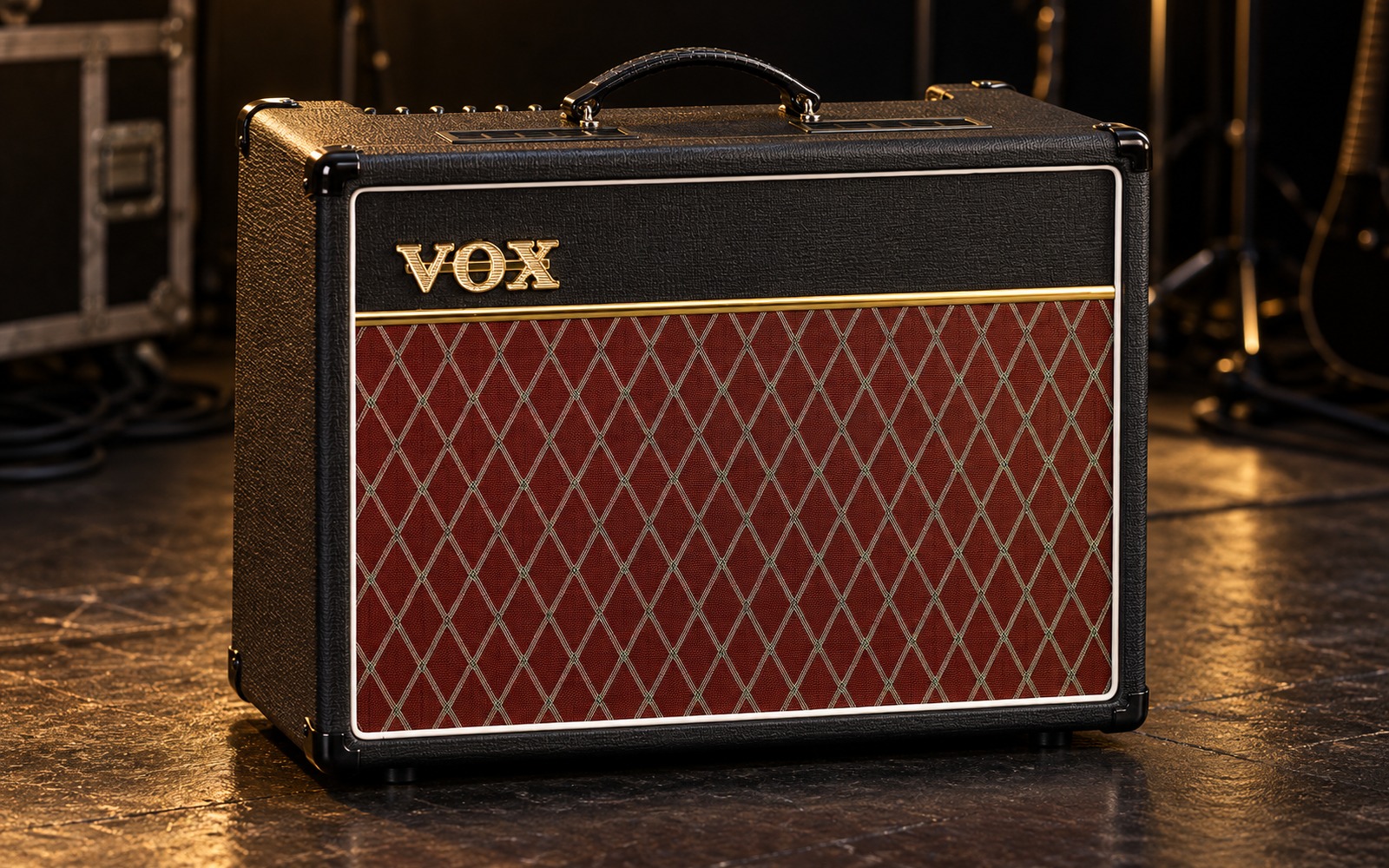
Strip the marketing and the AC15C1 is a two-EL84, cathode-biased combo with a solid-state rectifier, a Top Boost tone stack, a post-phase-inverter treble cut, a master volume, spring reverb and tremolo, in a 48-pound cabinet with a 12″ Greenback.
The output section is where the character lives. Two EL84s in cathode bias means there is no bias adjustment to set — the valves self-bias, they are always conducting, and they begin to compress early. That is the mechanical reason a small Vox feels springy and alive at volumes where a fixed-bias American amp is still stiff and clean. EL84s also push forward in the upper midrange and clip fast and grainy rather than slow and smooth. Everything people describe as “chime” and everything they describe as “honk” comes out of the same two bottles.
The Top Boost channel carries the interactive Treble and Bass pair inherited from the AC30’s famous circuit. Interactive is the operative word: the Treble control audibly changes how much bass you have and vice versa, and on this tone stack the Bass control removes low-mid as readily as it adds it. Set these two fast and carelessly and you get the classic Vox failure mode — an over-bright, slightly waxy top end. Set them slowly and against each other and the amp opens up.
The Normal channel has a single volume and no EQ at all. It is not a lesser channel; it is a different one, flatter and more open, and it is the natural home for a treble booster or a dirt pedal you want to hear undisguised. The two channels are not footswitchable — you choose by which input you plug into. This is the amp’s most-complained-about limitation and, in practice, the one most owners never notice, because most of them live permanently on Top Boost.
The Tone Cut works backwards from every other tone control you own: it operates on the power section and it cuts treble as you turn it clockwise. Treat it as a master presence, set it last, and understand that a great many owners have never touched it.
The Master Volume is the modern addition that makes this amp practical. The original AC15 had none. With it you can wind the channel volume up into EL84 compression and then bring the room level back down to something a neighbour will tolerate. It is not a perfect solution — the amp still sounds best when the speaker is moving — but it is the difference between an amp you use and an amp you admire.
Reverb and tremolo are both onboard and both footswitchable via the optional VFS2A. The reverb is a real spring tank and it is voiced usefully dark. The tremolo is the classic Vox amplitude wobble, with Speed and Depth.
There is no effects loop. There is a 16-ohm internal speaker, an external speaker jack and an extension jack on the back panel.
A Source Conflict Worth Printing: How Many Preamp Valves?
Retailer and tube-vendor listings for the AC15C1 consistently specify three 12AX7/ECC83 preamp valves plus two EL84s, and replacement tube kits sold for this specific model are built on that count. Premier Guitar’s own launch coverage of the Custom Series, however, describes the amp as having two 12AX7/ECC83 preamp valves. We have not been able to reconcile the two from primary documentation — Vox’s published specification page lists only “EL84” under tube complement and does not enumerate the preamp at all. Buy tubes on the three-valve assumption, because that is what the retube kits sold for this chassis contain, but be aware the discrepancy exists in print.
A Second Oddity: Vox’s Own Spec Sheet Is Wrong
Vox’s official product page for the AC15 Custom lists the controls as “Master Volume, Master Tone Cut, Normal Volume, Top Boost Volume, Top Boost Bass, Top Boost Treble, Speaker Level, Tremolo (Depth, Speed)”. There is no Speaker Level control on an AC15C1. There is a Reverb level control, which the same page’s own product description explicitly advertises (“footswitchable spring reverb”). The specification table has simply mislabelled it. It is a small thing, but it is the sort of thing that sends a buyer looking for a feature that does not exist, so: the knob between the tone controls and the tremolo section is Reverb.
Specifications
| Specification | AC15C1 | AC15C1X | AC15C2 | AC15CH (head) |
|---|---|---|---|---|
| Output power | 15 W RMS | 15 W RMS | 15 W RMS | 15 W RMS |
| Output valves | 2 x EL84, cathode bias | 2 x EL84, cathode bias | 2 x EL84, cathode bias | 2 x EL84, cathode bias |
| Rectifier | Solid-state | Solid-state | Solid-state | Solid-state |
| Speaker | 1 x 12″ Celestion G12M Greenback | 1 x 12″ Celestion Alnico Blue | 2 x 12″ Celestion G12M Greenback | None — requires cabinet |
| Internal impedance | 16 ohms | 16 ohms | 16 ohms | 8/16 ohm selectable |
| Channels | Normal + Top Boost (not footswitchable) | Normal + Top Boost | Normal + Top Boost | Normal + Top Boost |
| Controls | Normal Volume; TB Volume, Treble, Bass; Reverb; Tremolo Speed & Depth; Tone Cut; Master Volume | Identical | Identical | Identical |
| Onboard effects | Spring reverb + tremolo, footswitchable | Same | Same | Same |
| Effects loop | None | None | None | None |
| Dimensions (W x D x H) | 602 x 265 x 456 mm / 23.70 x 10.43 x 17.95″ | Same | Larger | Compact head |
| Weight | 22 kg / 48.5 lb | ~23 kg / ~50 lb | Substantially heavier | Light |
| Footswitch | VFS2/VFS2A, sold separately | Sold separately | Sold separately | Sold separately |
| Construction | Two PCBs: main board with pots, separate valve-base board | Same | Same | Same |
| Country of manufacture | China | China | China | China |
The Limited Editions
Vox has run a steady stream of limited AC15C1 variants, and because the differences are almost entirely in the speaker and the covering, they are a genuinely useful way to buy a different amp voice for the same money:
- AC15C1-TV — television-front cabinet, a direct nod to the 1958 original.
- AC15C1-CM / cream limited — cream vinyl covering with a Celestion Creamback, one of the most popular modern Celestion drivers.
- AC15C1-G12C — a limited run using the G12C from Warehouse Guitar Speakers of Kentucky, with leather-textured vinyl replacing basketweave. Reviewed by Nick Guppy for MusicRadar in September 2019 at £695/$699, this is the most interesting of the bunch: the Warehouse driver has a 1.5″ voice coil, a 35 oz ceramic magnet, a seamed cone, roughly 2 dB more sensitivity, a 75-watt power rating against the Greenback’s 25, and a resonant frequency of 134 Hz against the Greenback’s 75 Hz. Guppy’s conclusion was that it smooths the bottom end, extends the treble and balances the midrange grind for a more articulate solo tone — “a singular transatlantic accent” on a British amp, and a more boutique feel that “sits comfortably alongside other EL84-powered US exotica costing three or four times the price.”
That resonant-frequency gap is the single most useful number in this article for anyone considering a speaker swap. A driver resonating at 134 Hz behaves completely differently in a small cabinet from one resonating at 75 Hz, which is why a Greenback AC15 sounds thicker and browner and a Warehouse-loaded one sounds looser and more open at the bottom.
Famous Players: What Survives the Calendar Test
This is where a lot of AC15C1 coverage falls apart, so we are going to be blunt about it.
The names most commonly attached to this amp in gear listings are Brian May, The Edge, George Harrison, Tom Petty and Rory Gallagher. That is an AC30 roster, and it has been copy-pasted onto the AC15C1 by association. Run it against a calendar and most of it collapses on contact:

- Rory Gallagher died in 1995. The AC15C1 was announced in January 2010. He could not have played one. His documented Vox history is AC30s from 1963 onward, driven by a Dallas Rangemaster.
- George Harrison died in 2001. Same problem, nine years wider. His Vox history is AC15 to AC30 to AC50 to AC100 across 1962–66 — genuinely an early AC15 user, but the amp in question was a JMI product, not a Chinese Custom Series combo.
- Brian May is alive and still touring, but his amp is and has always been the AC30 — specifically the Top Boost models, and famously played on the Normal channel with a treble booster in front. There is no documented AC15C1 in his rig.
- The Edge is an AC30 player, and the specific amp is a 1964 chassis in a 1970s cabinet with mismatched speakers. Not an AC15 of any kind.
- Tom Petty died in 2017, and the AC15 credit in his camp — like most Heartbreakers amp credits — properly belongs to Mike Campbell, whose documented Vox is an AC30, not an AC15C1.
So who actually plays one? The honest answer has two tiers, and the useful one is the second.
Tier one: the AC15 lineage, not the C1
The AC15 as a circuit has a serious modern following among players who found the AC30 too loud and too polite. Kevin Shields of My Bloody Valentine has discussed introducing the AC15 alongside a Vox AC4 into his recording setup. J Mascis has been explicit about the tracking amps on I Bet On Sky: “I used a ’59 Vox AC15 and a Tweed Deluxe and a Tweed Bandmaster.” Alex Turner of Arctic Monkeys has been photographed with an AC15 paired with a Selmer Zodiac Twin 30 on the Suck It and See tour. All three are real AC15 users; none of those specific citations is a C1.
Tier two: the one C1-specific claim that holds up
Caleb Followill of Kings of Leon is the strongest modern AC15C1 association we can document. Photographs place two Vox AC15 combos behind him at Governors Ball, and a further photograph from Kings of Leon’s iHeartRadio Theater performance in Los Angeles shows a Vox AC15C1-CM Limited Edition specifically — the cream-covered Creamback variant. Flagged honestly: this identification comes via Equipboard, an aggregator, working from photographs rather than from an interview or a rig rundown. It is photo-based rather than testimonial, which puts it a tier below a Premier Guitar rig rundown, but it is a real image of a real amp on a real stage, and it is more than any of the five names on the standard list can offer.
The reusable lesson: the AC15C1 is fifteen years old and costs less than a good pedalboard. Touring professionals who want this voice at scale generally buy AC30s, hand-wired Voxes or boutique EL84 amps, and the players who use C1s in anger are mostly in studios, in support slots and in the ten thousand bands nobody writes rig rundowns about. That is not a weakness of the amp. It is the reason it exists.
Tone Recipes
1. The Jangle (Rickenbacker/Telecaster chime)
Top Boost Volume 10 o’clock, Treble 2 o’clock, Bass 11 o’clock, Tone Cut 9 o’clock, Reverb 10 o’clock, Master to taste. Neck-and-middle or a Rickenbacker 330 on both pickups. This is the Peter Buck / Johnny Marr territory the AC15 was built for. If it sounds thin, add Bass before you cut Treble — remember the interaction.
2. Edge-of-Breakup Rhythm
Top Boost Volume 1 o’clock, Treble 12, Bass 12, Tone Cut 11 o’clock, Master 10 o’clock. The EL84s are just starting to compress. Roll your guitar volume to 7 and the amp cleans up completely; roll to 10 and it snarls. This is the setting that sells AC15s.
3. Full Cathode Grind
Top Boost Volume 3 o’clock, Treble 11, Bass 1 o’clock, Tone Cut 1 o’clock, Master as high as you dare. Fat, mid-heavy, compressed Vox overdrive. The Tone Cut is doing real work here — without it this setting is unlistenably fizzy.
4. Normal Channel + Treble Booster
Normal input, Volume 2 o’clock, Tone Cut 11 o’clock. Treble booster in front, wide open. This is the Rory Gallagher and Brian May architecture applied to the smaller amp — and it works better on an AC15 than on an AC30 precisely because you reach saturation at a survivable volume.
5. Pedal Platform
Top Boost Volume 11 o’clock, Treble 1 o’clock, Bass 11 o’clock, Tone Cut 10 o’clock, Master 1 o’clock. Clean but not sterile, with headroom for an Ibanez TS9 or a Klon Centaur to do the shaping. The AC15’s midrange forwardness means Tube Screamers can stack up honky — back the pedal’s tone control off further than you would into a Fender.
6. Surf and Spring
Top Boost Volume 10 o’clock, Treble 3 o’clock, Bass 10 o’clock, Reverb 2 o’clock, Tremolo Speed 11 o’clock, Depth 1 o’clock, Tone Cut 9 o’clock. The onboard reverb is darker than a Fender tank, which actually suits this better than people expect.
7. Bedroom Chime
Top Boost Volume 12, Treble 1 o’clock, Bass 12, Tone Cut 12, Master 8 o’clock. The honest version: at genuinely quiet levels the Master saves you, but a 12″ Greenback needs air moving through it to sound like itself. If you play at this volume permanently, an AC10C1 or AC4C1-12 will make you happier than an AC15 with the Master at 8 o’clock.
All settings assume a clock face, Top Boost input unless stated, and Master Volume set to whatever the room allows. Get the channel volume to where the amp sounds alive first, then use Master to set the level — not the other way round.
Pedals That Suit This Amp
The AC15’s voice is forward in the mids and quick to compress, which changes what works in front of it.
- Treble boosters are the historically correct answer and still the best one. Into the Normal channel they turn the amp into something enormous.
- Clean boosts like the Xotic EP Booster push the front end without adding EQ colour the tone stack will amplify.
- Low-gain overdrives — the Boss BD-2 in particular — layer well because they add grit without stacking more midrange onto an already mid-forward amp.
- Big Muff-style fuzz is the classic mismatch that works anyway: the Big Muff Pi scoops mids exactly where the AC15 piles them up, and the two cancel into something usable.
- Delay has to go straight into the front because there is no effects loop. Analogue-voiced units like the MXR Carbon Copy, the Deluxe Memory Man or the Strymon El Capistan handle that better than pristine digital repeats, which get muddied by preamp gain.
How It Compares
vs Vox AC30C2
The AC30C2 is the same family with four EL84s, two 12″ speakers and roughly twice the power — and about 70 lb of weight. It is louder and cleaner for longer, which is exactly the problem for most players. The AC15C1 gets to the good part of the volume curve at a level that does not require earplugs and a road crew. Remember also that the AC15 preamp was never redesigned the way the AC30’s was in 1960: these are cousins, not scaled versions of each other.
vs Vox AC15HW1 Hand-Wired
The AC15HW1 is the same idea built properly: point-to-point wiring, a valve rectifier, no PCB. It sounds looser, sags more and responds more dynamically. It also costs multiples of the C1, has fewer features, and — for most players in most rooms, through most microphones — the gap is smaller than the price difference suggests.
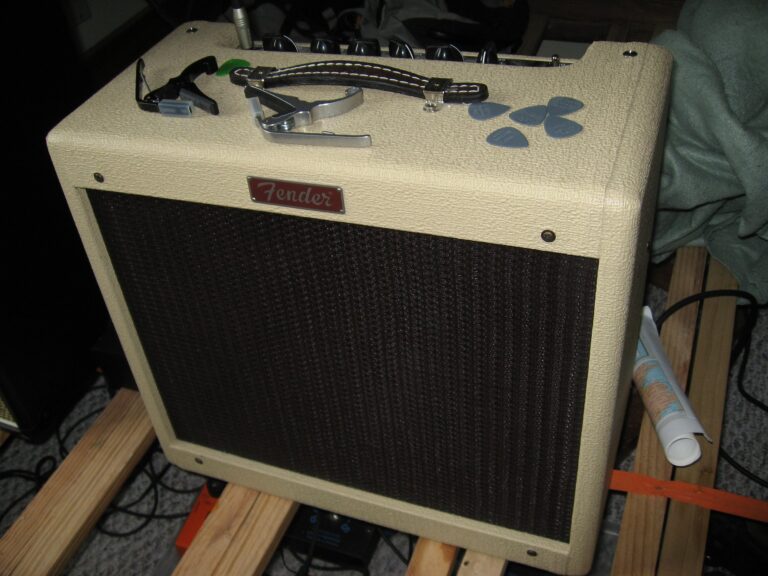
vs Fender Blues Junior
The Blues Junior is the AC15C1’s direct commercial rival and its tonal opposite: EL84s but a fundamentally American voicing, scooped rather than mid-forward, brighter and less compressed. The Fender is lighter and cheaper. The Vox is better built, has two usable channels, real tremolo and a better reverb. If you want jangle, chime and grind, this is not a close contest.
vs Fender ’65 Princeton Reverb Reissue
The Princeton Reverb is the other default small studio amp on earth, and it is the cleaner, darker, more forgiving choice. Fixed-bias 6V6s, a scooped midrange, a genuinely great reverb. The AC15 is louder, more aggressive and far more present in a band mix. Studios that can afford one of each own one of each for exactly that reason.
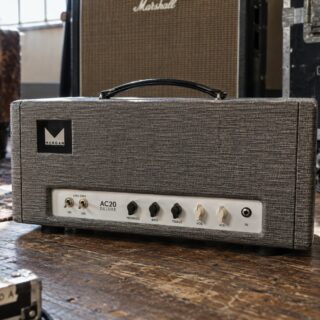
vs Morgan AC20 Deluxe / Dr. Z Maz 18 Jr.
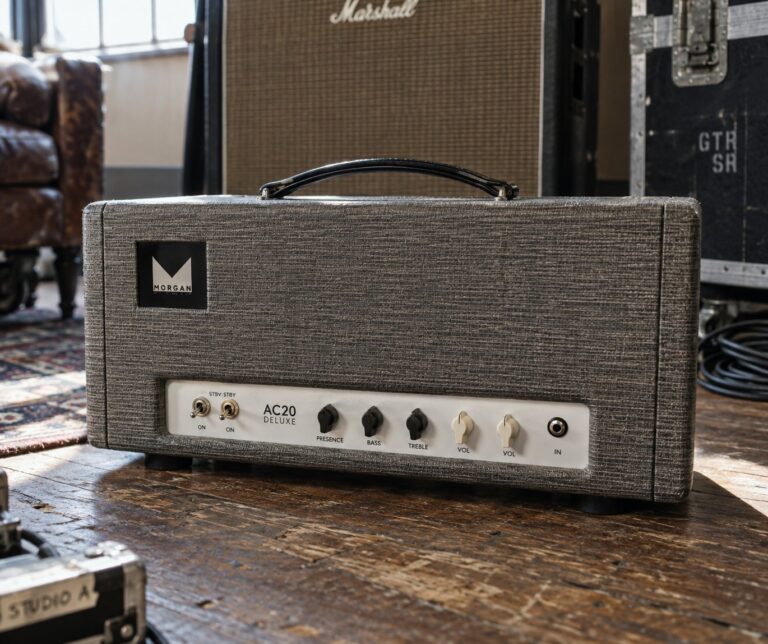
The Morgan AC20 Deluxe and the Dr. Z Maz 18 Jr. are the boutique EL84 amps the AC15C1 is constantly measured against. They are hand-built, better-componented, more refined and typically two to four times the price. The MusicRadar verdict on the G12C limited edition is the fair summary of where the C1 sits: it can get into that league sonically while staying in the real world on price.
vs Matchless Lightning
The Matchless Lightning is the Californian reinterpretation of this exact idea — 15 watts, EL84s, a Vox-derived voice built to a standard rather than a price. If the AC15C1 is the argument that you can get 90% of the sound for 20% of the money, the Lightning is the argument for the remaining 10%.
Buying Guide
Buying new
As of mid-2026 the AC15C1 sits in the mid-hundreds to low four figures depending on market and dealer, with the AC15CH head listed around $1,149.99 at Musician’s Friend and bundle packages at Sweetwater around $1,099. Vox runs frequent limited editions, so the model you compare in a shop this month may not be on the shelf next month.
The decisions, in order of how much they matter:
- Greenback (AC15C1) or Alnico Blue (AC15C1X)? The Blue is brighter, chimier, faster to compress and considerably more expensive. It is also only rated 15 watts, meaning a 15-watt amp is driving it right at its limit, which is exactly why it sounds the way it does. The Greenback is browner, thicker and more forgiving. There is no correct answer, but the Greenback is the better first AC15.
- Combo or head? The AC15CH gives you the same circuit with 8/16-ohm selection and lets you choose your own cabinet. If you already own a 2×12, this is the smart buy.
- One speaker or two? The AC15C2 spreads the same 15 watts across two 12s. It is wider and less directional and noticeably heavier. Most people who want that should be looking at an AC30 instead.
- Limited editions. If a Creamback or Warehouse-loaded C1 is available at the same price as a standard one, audition it. You are getting a meaningfully different amp for the same money.
Buying used
Sixteen years of production means a deep used market, and used AC15C1s are one of the genuine bargains in guitar amplification. What to check:
- Confirm it is a C1, not a CC1. The Custom Classic has one input and no Tone Cut. Sellers use the names interchangeably. Look at the front panel, not the listing title.
- Check the speaker against the badge. Greenbacks and Alnico Blues are both worth real money and both get swapped out. An “AC15C1X” with a Greenback in it is an AC15C1 with a wrong badge or a missing speaker.
- Valves are consumables. Cathode bias means no bias adjustment is required when you retube, which makes this one of the easiest amps in the world to maintain — but tired EL84s are the single most common cause of a used AC15 sounding flat and lifeless. Budget for a retube on any amp with unknown history and judge it afterwards.
- Listen for PCB-mounted jack wear. Years of cable-yanking on a board-mounted input jack is the characteristic failure mode of amps built this way.
- Ask whether the footswitch is included, because it was not in the box originally and is a real cost to replace.
- Lift it. 48.5 lb in a cabinet with one handle and no wheels is heavier than the “small amp” framing suggests — it weighs more than a Fender Deluxe Reverb.
Living With One
Weight and portability. 22 kg / 48.5 lb, 602 x 265 x 456 mm. It is a one-hand carry for a short distance and a two-hand carry for a long one.
Retubing. Two EL84s and (per the retube kits) three 12AX7s. Cathode bias means no bias setting. The valve-base board points downwards through the bottom of the chassis, which is the whole reason Vox redesigned this amp — you can change valves without dismantling it. Expect to replace output valves every one to three years with regular gigging.
Speaker swaps. The internal speaker is 16 ohms. If you swap, match that impedance or use the external jack correctly. The Creamback and Warehouse G12C options Vox itself has shipped are the safest starting points for anyone unsure — Vox has already done the compatibility work.
Attenuation. There is no built-in power scaling, no half-power switch and no attenuator. The Master Volume is the only volume-management tool onboard. This is consistent across the entire modern Vox tube range — the single factory exception anywhere in the line is the 15-watt switch on the Brian May limited-edition AC30.
Recording. A 15-watt EL84 combo mic’d with a dynamic off-axis is one of the most reliable recorded guitar sounds available at any price, which is the real reason so many of these live in studios. The absence of an effects loop matters far less on a track than it does on a stage.
Gigging. Fifteen watts through an efficient 12″ driver is loud enough for pubs, clubs and small theatres, and will hold its own against a drummer if you are prepared to let it break up. For anything bigger, mic it — that is what everyone else is doing.
Frequently Asked Questions
Is the Vox AC15C1 really Class A?
The output stage is cathode-biased with no bias adjustment, which is what everyone in the guitar industry means when they say Class A, and Vox and its retailers use the term freely. Whether it meets the strict engineering definition at all output levels is an argument that has been running for decades and has never once changed how an amp sounds. The audible consequences — early compression, no bias to set, always-conducting valves, dense harmonic bloom — are real regardless of what you call it.
Can I footswitch between the Normal and Top Boost channels?
No. Channel selection is made by which input you plug into. The footswitch controls reverb and tremolo only. MusicRadar’s review flagged this as the amp’s chief limitation while noting that most owners live permanently on Top Boost anyway.
Does the AC15C1 have an effects loop?
No. Time-based effects go in front of the amp. Analogue-voiced delays and reverbs handle that better than pristine digital ones.
What is the Tone Cut control actually doing?
It rolls off treble in the power section, and it works in reverse — turning it up cuts more. Think of it as a global presence control and set it after everything else.
Is the AC15C1 just half an AC30?
No, and this is the most persistent myth about the model. The AC30’s preamp and tone stack were redesigned in 1960; the AC15’s were not. The two circuits diverged and the AC15 kept a distinct voice, which is precisely why some players prefer it beyond the volume question.
Greenback or Alnico Blue — which should I buy?
The Alnico Blue is brighter, more chiming and compresses earlier, and it costs significantly more. The Greenback is thicker, browner and more forgiving of bright guitars and bright rooms. If the amp is going to be your only amp, start with the Greenback.
Is it loud enough to gig with?
Yes for small and medium rooms, with the caveat that 15 watts of cathode-biased EL84 gets loud by breaking up rather than by staying clean. If you need clean headroom at volume, you want an AC30C2 or a Fender Deluxe Reverb instead.
How much better is the hand-wired AC15?
Meaningfully but not proportionally. The AC15HW1 and the 2025 hand-wired AC15 add point-to-point construction and valve rectification, which brings sag and a looser feel. Against that, the C1 gives you reverb, tremolo and a master volume for a fraction of the money. Buy the hand-wired one because you want it, not because you think the C1 is holding you back.
Do I need a treble booster?
Not need — but the Normal channel exists for essentially this purpose, and a treble booster into it is the historically correct way to hear what this circuit does at full tilt. It is also the cheapest transformative upgrade available for the amp.
The Verdict on Its Place
The AC15C1 is not a legendary amplifier and it never will be. It has no provenance, no hand-wiring, no serial-number mystique and no famous owner whose name will sell it. What it has is a sixty-eight-year-old circuit idea, executed competently, in a package a working guitarist can actually afford, with the two features — a master volume and onboard reverb — that the original AC15 lacked and that make the difference between an amplifier you own and an amplifier you use.
Dick Denney designed the AC15 in 1957 because British players could not get the amps they wanted at a price they could pay. Sixty-eight years later, that is still the most accurate description of what this amp is for.
Image credits
- Top image: GuitarGangsters AI-generated reference illustration, not a photograph.
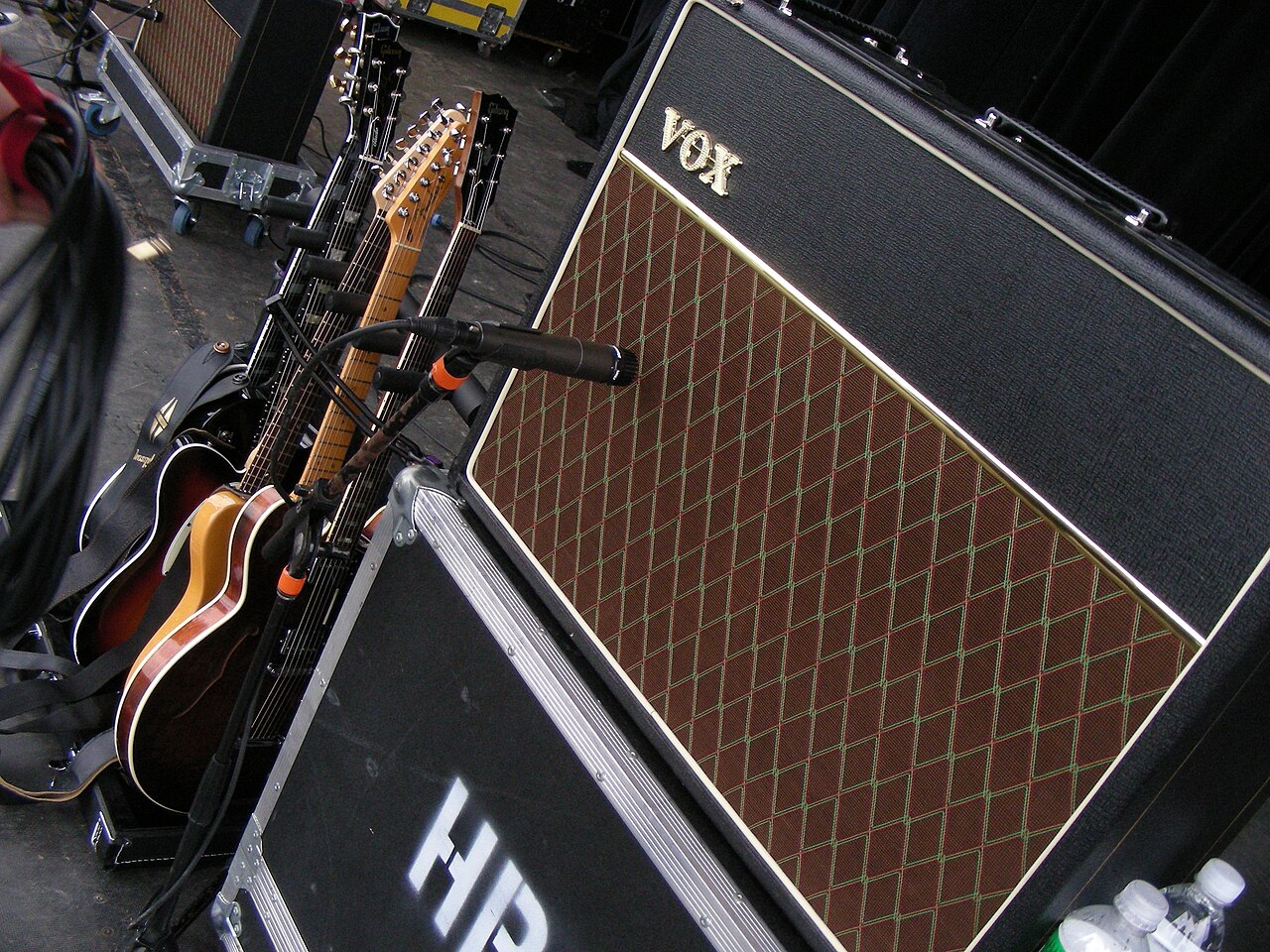
- A Vox AC30 amplifier on tour with guitars in front of it: John Athayde, Wikimedia Commons, CC BY 2.0.
- The Edge: iinchicore, Wikimedia Commons, CC BY-SA 4.0.
- Rory Gallagher: Heinrich Klaffs, Wikimedia Commons, CC BY-SA 2.0.
- Fender Blues Junior: Fender blues junior blonde, Wikimedia Commons, CC BY-SA 3.0.
Latest News
Related
On This Day
Monday 9 November
From this week: