Ovation Adamas 1687GT: The Carbon-Fiber Guitar That Refused To Be A Gimmick
Ovation Adamas 1687GT: carbon fiber top, Quintad bracing, USA build. Full specs, verified players from Nancy Wilson to Bob Marley, tone and buying tips.
Most “space-age” guitars from the 1970s are punchlines now. The Adamas is not. Nearly fifty years after Charles Kaman’s engineers pressed the first carbon-fiber-and-birch soundboard into a parabolic fiberglass bowl, the Ovation Adamas 1687GT is still being hand-laid in the United States, still costs more than a very good Martin, and still sounds like nothing else you can plug into a PA. It is the rare piece of gear where the marketing story and the engineering story are the same story — and where the guitar genuinely could not have been made by a traditional luthier, because a traditional luthier would never have started from an aerospace lab.
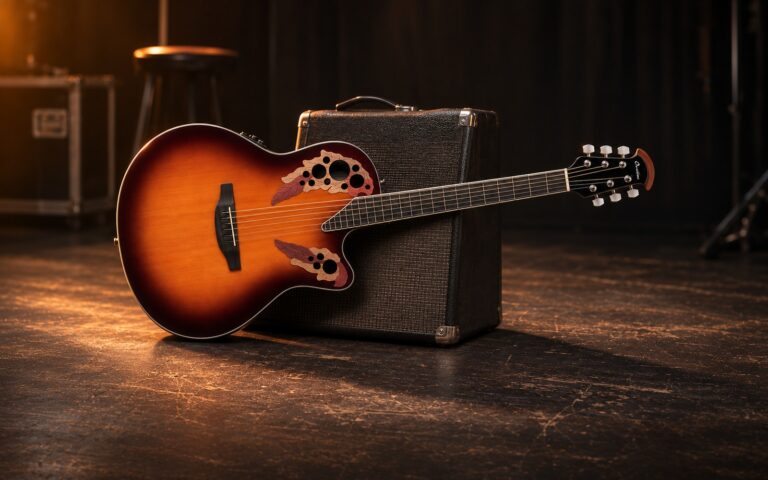
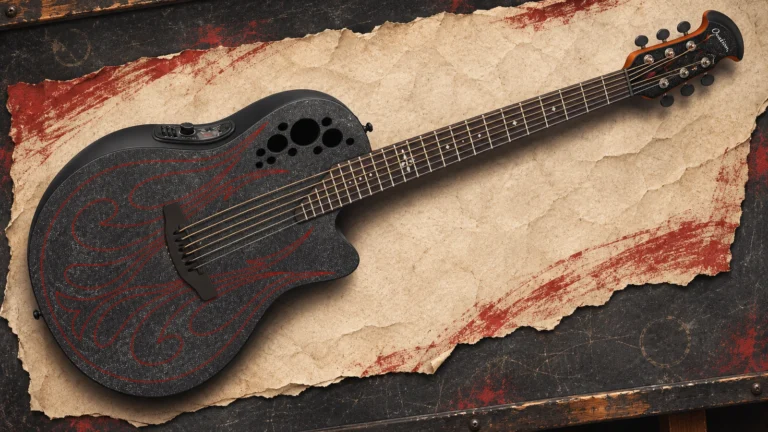
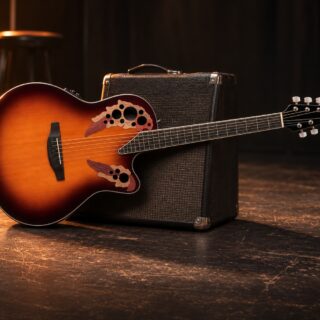
The 1687 is the flagship: six strings, deep bowl, no cutaway, multiple soundholes clustered on the upper bout, exotic hardwood epaulettes framing them, and a top so thin that Ovation had to invent a bracing system just to hold it in place without killing it. The GT is the current production version of that guitar. Carry one into a room full of dreadnought players and you will get one of two reactions: reverence, or a joke about a canoe. Both are earned. Neither is the whole picture.
Operation Ovation: How A Helicopter Company Ended Up Building The World’s Strangest Acoustic
Charles H. Kaman founded Kaman Aircraft in 1945 and spent the next two decades solving rotor-blade vibration problems. He was also a serious guitarist — good enough that Tommy Dorsey reportedly tried to hire him — and when his aerospace company’s engineers found themselves with spare capacity in the mid-1960s, Kaman pointed them at the acoustic guitar. The internal project name was, inevitably, Operation Ovation.
The first prototype in 1965 used a flat synthetic back. It was structurally unstable. The fix was the thing that made the brand: a parabolic bowl in Lyrachord, a glass-fiber composite, replacing the traditional flat back and bent sides entirely. The bowl is stiffer than wood, which means it reflects rather than absorbs, which means more of the string’s energy stays in the top. The first production Ovation shipped in November 1966. Within two years Glen Campbell had an exclusive deal and two signature models, and the roundback stopped being a curiosity and started being a category.
The Adamas Problem: If The Bowl Is Solved, Fix The Top
By the early 1970s Kaman’s people had run out of interesting things to do with the back of the guitar and turned their attention to the front. The question they asked was an engineer’s question, not a luthier’s: what material would you choose for a soundboard if you had no tradition to respect and were optimizing purely for stiffness-to-weight ratio?
The answer was carbon graphite. The Adamas soundboard — Ovation named it the Fibronic Soundboard — is a sandwich: two ultra-thin skins of carbon-graphite fiber bonded to a birch veneer core. The whole assembly is roughly a third the thickness of a spruce top and considerably stiffer for its weight. Because it is stiffer, it needs less bracing. Because it needs less bracing, more of its surface area is free to move. And because carbon fiber does not care about humidity, the guitar behaves the same in a Phoenix summer and a Helsinki winter — a genuinely useful property that acoustic players who tour internationally learn to appreciate the hard way.
Two other innovations came in the same package. The Kaman Bar is an aluminum neck-reinforcing system running the length of the neck, borrowed conceptually from aircraft spar design. And the soundhole was moved. A traditional central soundhole sits in the acoustically most active real estate on the top; Ovation’s argument was that clustering multiple smaller holes on the upper bout, framed by decorative hardwood epaulettes, leaves the center of the soundboard uninterrupted and free to vibrate, while placing the sound output closer to the player’s ear. Whether you find that convincing or not, it is a coherent piece of reasoning, and it is why an Adamas looks the way it looks.
The Paper Trail: 1977 To Now
Ovation’s own archived price lists date the Adamas launch precisely. The line appears as new on a U.S. price list effective 1 August 1977, at $2,200 to $2,350 — a staggering figure for a guitar in 1977, roughly triple a good Martin dreadnought at the time. A January 1978 list from Ovation Instruments Inc. of New Hartford, Connecticut covers standard, twelve-string, wide-neck and electric variants in four colors (Red, Beige, Blue, Brown), $2,200 to $2,550, all F.O.B. New Hartford and all including case and case cover. A 1979 list, now shipping F.O.B. Moosup, Connecticut, adds Black as a fifth color and prices acoustic-electric versions at $2,395. A 1978 development brochure signed by Charles Kaman himself walks through the Fibronic Soundboard construction and the Kaman Bar in detail.

The model numbering is worth decoding because it survives into the current catalog. 1687 is the six-string deep-bowl non-cutaway Adamas I. The suffix is the color: -2 Red, -5 Black, -7 Beige, -8 Blue, -9 Brown. So a 1687-7 is a beige-burst deep-bowl Adamas I, and a modern 1687GT-7 is the same guitar in the same finish, built to current spec. Adamas II (the 1581) was the more affordable sibling with a Lyrachord rather than composite-heavy build; the 2087 and 2080 numbers cover cutaway and deep-contour variants.
Ownership of the brand has changed hands more than once — Kaman to Fender in 2007, the New Hartford factory closed in June 2014 after a 47-year run, Drum Workshop bought the brand in 2015 and reopened New Hartford as a custom shop specifically to keep building Adamas, and GEWA Music of Germany acquired Ovation, Adamas and Applause in a deal inked in September 2020, with GEWA Music USA taking over US distribution on 1 February 2021. Through all of that, the Adamas kept being built in the United States. That is not nothing.
What The GT Actually Is
The current 1687GT carries an MAP of $5,399. That is not a typo and it is not a vintage price — it is what Ovation asks for a new one today, and it puts the Adamas in direct competition with high-end Collings, Santa Cruz and Bourgeois flat-tops rather than with anything else in Ovation’s own catalog.
What you get for it is the full flagship recipe. The carbon-fiber top is fitted using what Ovation calls AST — Adamas Suspended Top — a mounting approach that lets the ultra-thin soundboard vibrate more freely than a conventionally glued-in top. Underneath it is Ovation’s patented Quintad bracing, a five-point system designed specifically for the stiffness characteristics of carbon fiber rather than adapted from wood-top X-bracing. The bowl is deep, in fiberglass, and hand-laid. The neck, fingerboard and bridge are all walnut — an unusual choice that gives the guitar a slightly warmer, drier attack than ebony would, and which has been Adamas practice since 1977. The headplate and bridge are carved rather than flat-cut. Fingerboard inlays are maple. The body binding is a composite rope. Tuners are gold Schaller M6s. The nut and saddle are bone.
Electronics are an OCP-1K pickup running into an OP-Pro Studio preamp with onboard tuner — a system Ovation developed with input from working artists, and one that is far more capable than the three-band-and-a-tuner circuits found further down the range on instruments like the Ovation Celebrity Elite CE44. It ships with a case, and with DR Dragon Skin DAP-12 light-gauge strings, .012–.054, made in the USA.
Ovation Adamas 1687GT — Specifications
A note on the spec sheet: retailer listings vary slightly on details like fret count (22 medium nickel-silver frets and a 10″ radius appear on several major dealer pages) and on string gauge, with some listing Adamas-branded .012–.053 rather than the DR set Ovation currently specifies. These are the normal drift of a model that has been in production, on and off, for five decades. Where dealer copy and Ovation’s own product page disagree, the manufacturer page is the one to trust — though as we found when documenting the CE44, Ovation’s own pages are not immune to internal contradiction either.
Famous Players: What Actually Holds Up
This is the section where most Adamas write-ups go badly wrong, because the guitar was heavily advertised in the late 1970s and the ad copy has been recycled as fact for forty years. Here is what survives verification.
Nancy Wilson — verified, and in a museum
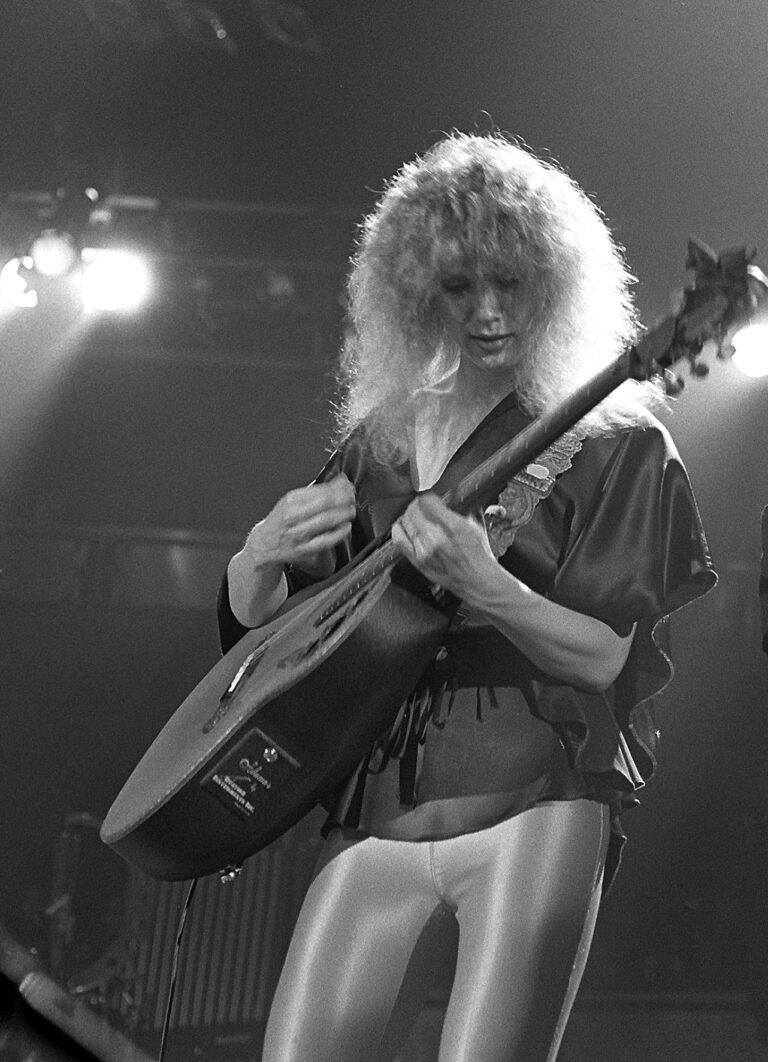
Nancy Wilson of Heart is the single strongest 1687 association, and it is documented to a degree that almost no artist-gear claim ever is. Her instrument is a 1978 Ovation Adamas 1687-7, serial number 477-92, built specifically for her, and it was exhibited at the Metropolitan Museum of Art in New York as part of Play It Loud: Instruments of Rock & Roll in 2019 — where it was photographed in detail, serial number and all. She toured it heavily through Heart’s late-1970s run. The reasons are exactly the reasons the guitar exists: a carbon-fiber top does not shift with stage humidity, a fiberglass bowl survives being loaded in and out of trucks, and the under-saddle system cuts through a loud rock band in a way that a miked spruce dreadnought simply will not. She has since retired it, which is why it lives in exhibition cases now rather than on stages.
Wilson’s bandmate in Heart‘s original lineup, guitarist Roger Fisher, also appears in the used market attached to a 1978 1687-7 in reverse beige burst — a Reverb listing describes an instrument made for him. Dealer provenance claims deserve more skepticism than a Met exhibition label, so treat that one as plausible rather than proven.
Bob Marley — verified on film, model identified
Bob Marley played an Adamas 1687 in reverse beige burst on a widely circulated live performance of “Redemption Song” filmed around 1980, and the same guitar appears in other live photographs from the period, which is the difference between a borrowed instrument and one he actually owned. Its whereabouts after his death in 1981 are unknown. Marley was already an Ovation player — a 1975 1612-4 Custom Balladeer is documented in his gear — so the Adamas was a step up within a brand he already trusted rather than a one-off endorsement prop.

Glen Campbell and Marcel Dadi — the 1978 campaign
Glen Campbell was Ovation’s foundational artist from 1968 and appears alongside Nancy Wilson and French fingerstyle master Marcel Dadi in original 1978 Adamas promotional advertising. That is solid evidence of association with the line and with the company. It is weaker evidence about any specific instrument, because artists in a brand’s flagship launch campaign are photographed with whatever the brand hands them. Campbell’s defining Ovation work — the sound that sold roundbacks by the container-load — was done on his Balladeer-derived signature models through the late 1960s and 1970s, not on an Adamas.
Al Di Meola and Melissa Etheridge — real relationships, different instruments
Al Di Meola is a genuine, long-standing Ovation artist. He picked up the brand in the Return to Forever era because Chick Corea wanted unaccompanied acoustic solos in the show and Di Meola needed something that would survive being amplified at rock volume; he used Ovation acoustic-electrics extensively through the late 1970s and 1980s, including on Friday Night in San Francisco with Paco de Lucía and John McLaughlin, and later received a 1769 signature model. Melissa Etheridge likewise has signature Adamas and Ovation models to her name, including twelve-strings in the 1598-MEII and W597-MEII lines.
Both are credited with input into the OP-Pro preamp — the circuit family fitted to the current 1687GT. That is the honest connection: their fingerprints are on the electronics in this guitar, not on this exact model number. Neither is documented on a 1687 specifically. Their signature instruments are their signature instruments.
John Lennon — no
Some gear databases attach John Lennon to the Adamas. This does not survive contact with a calendar. The Adamas reached production in 1977; Lennon had withdrawn from recording and performing by then and did not return to public musical activity until the Double Fantasy sessions in 1980, where his acoustic work is documented on other instruments. There is no photographic, video or session evidence connecting him to an Adamas of any model. It appears to be a case of “famous acoustic guitarist” being pattern-matched onto “famous acoustic guitar,” which is how most false gear attributions are born.

The pattern worth remembering
The verified 1687 players cluster in a specific window — roughly 1978 to 1982 — and share a specific problem. Nancy Wilson, Bob Marley and the touring fingerstyle players of that era all needed an acoustic guitar that could be plugged into a large PA, played at volume next to drums, and hauled across continents without going out of adjustment. Before the Adamas, the honest answer to that problem was “you can’t.” That is the guitar’s actual historical function, and it is a better story than a list of names.
Getting A Sound Out Of It
The Adamas is not a guitar you EQ like a dreadnought. Carbon fiber has a fast attack, a long sustain, an extended top end and a bass response that is powerful but tight rather than woolly. The characteristic failure mode is brittleness in the 2–4 kHz region, and every good Adamas tone starts by managing that.
Solo fingerstyle, amplified — the “let it ring” setting
Set the OP-Pro Studio flat and start from the room, not the guitar. Bass at 12 o’clock. Mid pulled back very slightly, around 11 o’clock. Treble at 11 o’clock — resist the urge to add high end; the carbon top is already generating more than a spruce guitar would. At the desk, a gentle shelf cut above 8 kHz and a narrow 2–3 dB dip somewhere between 2.5 and 3.5 kHz will take the glassiness off without dulling the note definition. Add a plate or hall reverb at 20–25% wet with a 1.8-second decay. The long natural sustain of the top does a lot of the work reverb usually does, so less is more.
Strumming in a loud band — the “Nancy Wilson” setting
This is what the guitar was built for. Bass at 1 o’clock for weight against a bass guitar and kick drum. Mids at 2 o’clock — counterintuitive on an acoustic, but midrange is what survives in a dense mix, and scooping it is the single most common mistake acoustic players make on stage. Treble at 10 o’clock. High-pass filter at the desk at 80–100 Hz to kill the low-frequency energy that the deep bowl generates and that nobody in the audience can hear anyway. If you are getting feedback, the deep bowl is the culprit before the top is: a soundhole cover on the multi-hole cluster is awkward, so use a notch filter around 100–130 Hz instead and move away from the wedge.
Recording — two sources, always
The single most useful thing to know about an Adamas in a studio is that the piezo and a microphone hear two different guitars, and the composite of the two is better than either. Put a small-diaphragm condenser about 30 cm out, aimed roughly at the twelfth fret rather than at the soundhole cluster (the offset soundholes mean the usual aiming rule does not apply). Run the OP-Pro Studio direct into a DI on a second channel. Check polarity, nudge the DI a millisecond or two later to time-align with the mic, then blend — typically 70% mic, 30% DI for solo work, inverting toward the DI as the arrangement gets busier. The DI supplies attack and definition; the mic supplies air and body.
Fingerpicked, alternate tunings
The carbon-fiber top’s stiffness means it holds up under the reduced tension of dropped tunings far better than a thin spruce top does — DADGAD, open C and drop-D voicings stay articulate rather than going flabby. Roll the bass back to 11 o’clock to compensate for the added low-string energy, leave mids flat, treble at noon. This is the territory where the Adamas earns comparisons to what players like Michael Hedges and Leo Kottke demanded of an amplified acoustic, even though both built their sounds on wood-topped instruments.
How It Compares
Against the rest of the Ovation range
The gap between an Adamas and everything below it in the Ovation catalog is enormous, and it is worth being blunt about. The Celebrity Elite CE44 is an imported instrument with a solid spruce top and a Lyrachord bowl at roughly a tenth the price. It shares the silhouette and the multi-soundhole layout. It shares almost nothing else — not the top material, not the bracing, not the build location, not the electronics tier. If someone tells you an Adamas is “just an expensive Ovation,” they have not played one. Adamas II (the 1581 family) sits between the two: Adamas construction philosophy at a lower price point, historically listed at roughly $1,595–$1,695 against the Adamas I’s $1,995–$2,390 in 1983.
Against wood flat-tops at the same money
At $5,399 the honest comparison set is high-end American flat-tops — and the honest verdict is that they are different tools rather than better or worse ones. A Collings or a Santa Cruz will give you more warmth, more complexity in the midrange, more of the woody bloom that acoustic guitarists have been chasing since the 1930s, and a resale market that is deep and predictable. The Adamas gives you more headroom, more sustain, more consistency across climates, a plugged-in sound that needs less help, and a resale market that is thin and opinionated. If you are recording solo acoustic records with a pair of condensers in a treated room, buy the wood guitar. If you are playing amplified in front of a band four nights a week in four different climates, the Adamas is the more rational instrument and it is not close.
Against nylon and classical instruments
This is a different universe, but worth a line for anyone cross-shopping “high-end acoustic.” Instruments like the José Ramírez 1a, the Kremona Solea Artist Series or the Alhambra 4P are built on the opposite principle: maximally responsive, minimally reinforced, entirely acoustic, and utterly dependent on being played in a quiet room. The Adamas was designed by people asking how to make an acoustic guitar work in an environment those instruments cannot survive. Both approaches are correct. They are just answering different questions. The Cordoba GK Studio Negra sits closer to a middle ground, being a nylon-string designed from the outset to be amplified.
Against modern all-carbon guitars
Rainsong, Emerald, McPherson, Composite Acoustics and Klos all now build entirely from carbon fiber, and several of them do it very well for less money. What none of them have is the Adamas’s hybrid approach — carbon skins over a birch core rather than pure composite — which is why an Adamas sounds noticeably less clinical than a first-generation all-carbon guitar. It also has a bowl rather than a flat back, which changes the internal reflection behavior entirely. If you want a carbon guitar that sounds like a wood guitar, look at the modern all-carbon builders. If you want a carbon guitar that sounds like an Adamas, there is exactly one option.
Buying Guide
New
Buy on the finish, because everything else is fixed. The five colors — Reverse Beige Burst, Reverse Red Burst, Reverse Blue Burst, Black and Reverse Brown Burst — are functionally identical instruments. The “reverse burst” is dark at the center and lighter at the edges, the inverse of a traditional sunburst, and it is one of the most recognizable finishes in the acoustic world. Beige is the classic and the one most associated with Marley and Wilson; Black is the sleeper choice and hides stage wear best.

Play it before you buy it if you possibly can. The Adamas is a genuinely polarizing instrument and a $5,399 mistake is an expensive one. The two things to check in a shop: whether the bowl sits comfortably on your leg (some players never adapt; a strap and playing standing solves it for most), and whether the amplified tone works for you, since that is 80% of what you are paying for.
Used and vintage
The vintage market for 1977–1985 Adamas guitars is active and reasonably well documented, helped enormously by the archival work at Ovation Tribute, which has catalogued price lists, catalogs, patents and schematics by model number. Serial numbers on early examples encode useful information and are worth cross-referencing before you pay.
What to check on a vintage example, in order of expense to fix:
- Neck angle and the Kaman Bar. The aluminum reinforcement is durable, but a badly stored guitar can still develop a high action that requires a neck reset — and a neck reset on an Adamas is not a job most acoustic techs will take on. Sight the neck and measure the action before anything else.
- Top delamination. Rare, but catastrophic when it happens. The carbon-birch-carbon sandwich can separate at the edges after extreme heat exposure. Look at the top under raking light for any bubbling or lifting near the binding.
- Bowl cracks. Fiberglass is tough but not indestructible; a hard impact can crack the bowl. Repairable, but check for previous repairs and ask what was used.
- Electronics. Original 1970s and 1980s stereo FET preamps are period-correct and increasingly fragile. Replacement is straightforward and does not meaningfully hurt value on a player-grade instrument, but a fully original working example commands a premium.
- Epaulettes. The exotic hardwood soundhole surrounds are inlaid and can lift with age. Cosmetic, but it is a bargaining point.
Model number cheat sheet
- 1687 — Adamas I, six-string, deep bowl, no cutaway. The flagship.
- 1687GT — current production version of the above.
- 1581 — Adamas II, the more affordable sibling.
- 1689 — twelve-string Adamas.
- 2087 / 2087GT — cutaway deep-contour Adamas.
- 1680 — woven carbon fiber top variant.
- 1687-Reissue — later reissue of the original spec.
Living With One
The Adamas is the least demanding acoustic guitar you will ever own in terms of maintenance and one of the most demanding in terms of technique adjustment.
On maintenance: forget humidity. Genuinely. A carbon-fiber top and a fiberglass bowl do not move with the seasons, which means no humidifier, no case hygrometer, no winter cracks, no summer bellying. For anyone who has lost a good spruce-topped guitar to a dry apartment, this alone is worth a significant amount of money.
On ergonomics: the deep bowl is a real issue for some players and a non-issue for others, and there is no way to know which you are without sitting down with one for twenty minutes. The bowl wants to roll off your thigh. Solutions in ascending order of commitment: play standing with a strap, use a strap while seated, buy a purpose-made roundback support cushion, or accept that this is not your guitar. Do not buy one online on the assumption that you will adapt.
On the top end: a new Adamas can sound aggressive to ears trained on wood. Give it a few weeks and a string change. The DR Dragon Skin factory set is coated and bright; a set of uncoated phosphor bronze in the same gauge takes a noticeable amount of edge off, and many long-term owners settle there. Ovation’s own Adamas-branded phosphor bronze sets are the safe default if you want the intended voice.
On amplification: the OP-Pro Studio runs on a nine-volt battery and the guitar will tell you when it is low, but the Adamas is more sensitive to battery voltage than most acoustics — a dying battery shows up as compressed transients before it shows up as noise. Change it before shows, not during them.
On resale: be realistic. The Adamas has a devoted following and a small one. A clean vintage example finds a buyer; a mint modern GT can sit. Buy it because you want to play it for twenty years, which is a reasonable expectation given the materials — this is one of the very few acoustic guitars where “it will outlive you” is a straightforward engineering statement rather than a marketing one.
Frequently Asked Questions
Is the Ovation Adamas 1687GT made in the USA?
Yes. Ovation’s own product listing specifies USA manufacture with a hand-laid bowl. This is one of the key distinctions between the Adamas line and Ovation’s imported Celebrity and Applause ranges, and a significant part of what justifies the $5,399 MAP.
What is the difference between the 1687 and the 1687GT?
The 1687 is the original model designation dating to the 1977 launch; the GT is the current production specification of that same guitar, carrying modern refinements including AST suspended-top mounting, Quintad bracing, and the OCP-1K pickup with OP-Pro Studio preamp. The core recipe — carbon-fiber-and-birch top, deep bowl, walnut neck and fingerboard, multiple offset soundholes, exotic hardwood epaulettes — is unchanged.
Does a carbon-fiber top open up over time like a wood top?
No, and that is the point. Wood soundboards change as their cellular structure relaxes over years of vibration; carbon fiber does not. An Adamas sounds essentially the same on day one and in year thirty. Whether that is a feature or a loss depends entirely on what you value — you never wait for it to arrive, and you never lose it.
Did Bob Marley really play an Adamas?
Yes. He is filmed playing an Adamas 1687 in reverse beige burst on a live performance of “Redemption Song” from around 1980, and the same instrument appears in other live photographs from the period. He was already an Ovation player, having used a 1975 1612-4 Custom Balladeer. What happened to the Adamas after his death in 1981 is not publicly documented.
Where is Nancy Wilson’s Adamas now?
Her 1978 Adamas 1687-7, serial number 477-92, built specifically for her, has been exhibited publicly — most notably at the Metropolitan Museum of Art in New York in the Play It Loud: Instruments of Rock & Roll exhibition in 2019. She retired it from touring some years ago; it now circulates through museum exhibitions rather than venues.
Do I need to humidify an Adamas?
No. Neither the carbon-fiber top nor the fiberglass bowl responds to humidity changes the way wood does. You can store an Adamas in conditions that would destroy a traditional acoustic. This is arguably the strongest practical argument for owning one, particularly for touring players and anyone living in an extreme climate.
Is the deep bowl uncomfortable to play sitting down?
For some players, yes. The rounded back has no flat surface to rest on your thigh and tends to rotate away from you. Most owners solve it with a strap — worn seated or standing — or with a purpose-made roundback cushion. A minority never get comfortable with it. Try before you buy if at all possible.
Is the Adamas worth $5,399 when carbon guitars from other makers cost less?
That depends on what you are buying. Rainsong, Emerald, Composite Acoustics and McPherson build excellent all-carbon instruments at lower prices, and if you simply want a weatherproof acoustic, they are the sensible value choice. The Adamas offers something none of them do: the carbon-over-birch hybrid soundboard, the bowl geometry, the Quintad bracing, USA hand-building, and fifty years of a specific and recognizable voice. You are buying an Adamas, not a carbon guitar. If those are the same thing to you, buy something cheaper.
Image credits
- Al Di Meola: Andreas Lawen, Fotandi, Wikimedia Commons, CC BY-SA 4.0.
- Al Di Meola: Andreas Lawen, Fotandi, Wikimedia Commons, CC BY-SA 4.0.
- Nancy Wilson: Jim Summaria, Wikimedia Commons, CC BY-SA 3.0.
- Bob Marley: Dennis Morris; Distributed by Island Records, Wikimedia Commons, Public domain.
- John Lennon: Tony Barnard, Los Angeles Times, Wikimedia Commons, CC BY 4.0.
Latest News
Related
On This Day
Monday 9 November
From this week: