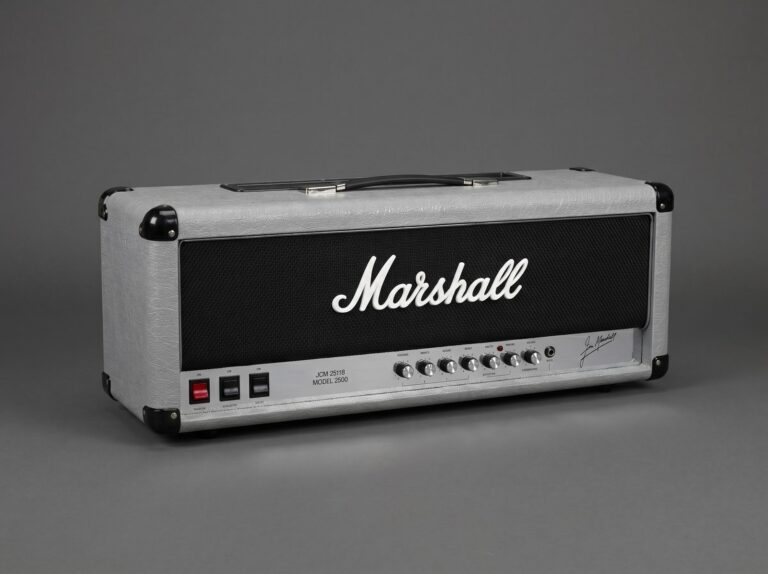
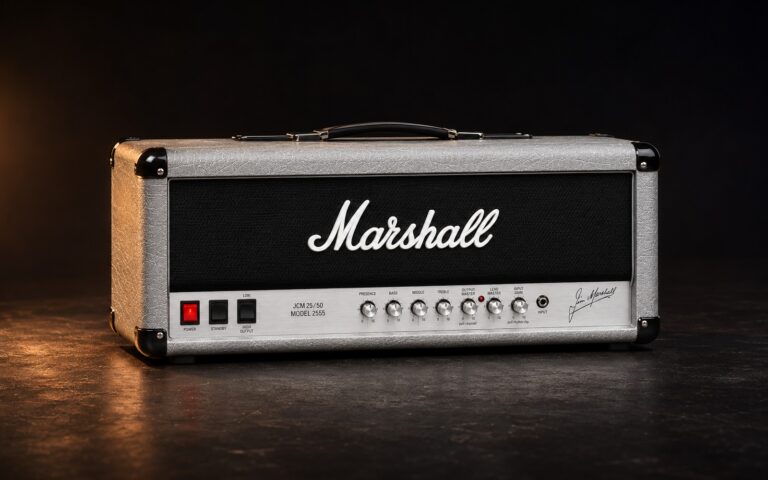
Marshall 2525H Mini Jubilee: The Bantamweight Bruiser That Carries a Full-Sized Legacy
The Marshall 2525H Mini Jubilee delivers authentic Silver Jubilee tone in a 20W head built in England. Small box, massive British attitude.
There is a certain kind of audacity in taking one of the most iconic amp names in rock history and shrinking it down to something you can throw in the back of a hatchback. That is exactly what Marshall did in January 2015 when they walked into NAMM in Anaheim and unveiled the 2525H Mini Jubilee — a 20-watt small-box head that carries the preamp DNA of the legendary Silver Jubilee in a package that weighs less than most boutique pedalboards. The guitar community noticed immediately. Not because Marshall needed to prove anything, but because the Mini Jubilee raised a question that genuinely matters to working players: can you get that particular flavour of late-1980s British voltage violence in a format that doesn’t require a roadie, a chiropractor, or a dedicated truck?
The Silver Jubilee story begins in 1987. Marshall had been building amplifiers since 1962 — Jim Marshall’s first production model, the JTM45, arrived that year and put a British stamp on the sound of rock guitar that has never quite worn off. Twenty-five years later, in the year the company celebrated its silver anniversary, Marshall also marked fifty years of Jim Marshall himself working in the music business. The commemorative amp series was designated JCM25/50 — 25 for the amplifier company’s anniversary, 50 for Jim’s half-century in music. The resulting amps, with their silver and grey vinyl tolex, chrome hardware, and distinctive circuit architecture, were produced for one year only and then discontinued. That scarcity, combined with the fact that the amps genuinely sounded extraordinary, turned the original 2555 Silver Jubilee into one of the most sought-after heads ever produced in Bletchley. By the mid-1990s, good original 2555 examples were already climbing in price. By 2015, they were firmly in collectible territory.
The 2525H Mini Jubilee arrived alongside the full-sized 2555X Silver Jubilee Reissue, which brought the 100W/50W circuit back in accurate form after nearly three decades. But where the 2555X was aimed at players who needed full stage power and the original’s authentic heft, the 2525H addressed a different constituency: the bedroom recordist, the gigging musician who plays mid-sized rooms, the home studio builder who wants transformer saturation and EL34 push without blowing out the neighbours. Twenty watts from a pair of EL34 tubes built in England to the same standard as the flagship — that is a very specific and very attractive proposition.
What Makes the Silver Jubilee Circuit Different
Before getting into the specifics of the 2525H, it helps to understand why the Silver Jubilee circuit earns its legendary status rather than simply borrowing it from the amps that came before. The original 2555 was built on JCM800 architecture but diverged from it in ways that matter enormously to the ear.
The critical differentiator is the Rhythm Clip function. This is germanium diode clipping introduced into the Input Gain preamp stage, engaged by pulling the Input Gain knob outward. The result is asymmetrical soft clipping — a warmer, rounder, more harmonically complex form of overdrive than simple hard clipping. The character is fundamentally different from what the JCM800 offers: where the JCM800 clips with a certain angular precision that became the signature of 1980s heavy metal, the Silver Jubilee clips with what players often describe as a velvet edge — still aggressive, still British, but with a midrange richness and touch sensitivity that opens up the dynamic range considerably.
In practical terms, the Silver Jubilee circuit gives you effectively four distinct voicings from a single-channel architecture. Clean, with Input Gain and Output Master set conservatively. Rhythm Clip engaged on the clean channel — that warm, pushed crunch. Lead channel, with the Output Master switched to Lead Master via the footswitch. And Lead channel with Rhythm Clip engaged simultaneously — the thickest, most saturated setting available from the amp, stacking preamp drive with diode clipping for a density that blurs the line between a driven British amplifier and a dedicated high-gain machine. This is the 2525H’s central party trick, and it is the same trick the full-sized original has been performing since 1987.
The 2525H inherits this circuit directly from the 2555X Reissue, which itself was built from Marshall’s original production diagrams. Not a recreation, not an approximation — the same electrical topology that produced the sound that made the Silver Jubilee famous. Scaled to 20 watts, the power section uses two EL34 tubes where the original used four, but the preamp section’s three ECC83 (12AX7) stages are faithful to the architecture that generates the Silver Jubilee’s characteristic voice. The smaller power section means you can push the output valves into saturation at much lower volume levels, which is precisely what makes the 2525H useful to players who cannot run a 100-watt head anywhere near its sweet spot without structural damage to the building.
Specifications
Construction and Build
The 2525H is built at Marshall’s Bletchley factory in England — the same facility responsible for the 2555X, the Studio Vintage series, and every other UK-made Marshall. This is not a throwaway detail. Marshall’s Bletchley production carries a standard of construction and component selection that differs from their offshore budget lines, and the Mini Jubilee is assembled to the same tolerances and quality controls as the company’s flagship products.
Cosmetically, the 2525H is unmistakably a Silver Jubilee. The silver and grey vinyl, the chrome panels, the distinctive styling that made the original stand out against the standard black and gold Marshall aesthetic — all of it is present. The small-box format means the overall chassis is compact by Marshall standards, and the result is an amp that looks like a proper British head that has been put through a shrink ray rather than a cheap miniaturized interpretation.
The five-jack speaker output section on the rear panel gives the 2525H real-world flexibility: 1×16Ω for a single high-impedance cab, 1×8Ω for a standard cab, 1×4Ω for low-impedance loads, 2×16Ω for two high-impedance cabs in parallel, and 2×8Ω for two standard cabs. There is also a DI output for silent recording or front-of-house applications, though the lack of a speaker mute option means the DI works best in conjunction with a cab load or an external loadbox when true silent operation is required. The rear panel also houses a series effects loop — useful for time-based effects such as delay and reverb that benefit from sitting after the preamp rather than before it.
The 20W/5W power switching deserves particular attention. This is not an attenuator in the traditional sense — it is a genuine power stage switching mechanism that alters the operating conditions of the output section, reducing the actual wattage generated rather than simply dissipating it as heat. At 5 watts, the EL34s are running at a significantly lower plate voltage, which changes not just the volume but the character of the power stage saturation. Players often find the 5W setting produces a looser, more compressed feel as the tubes are pushed harder relative to their reduced headroom. At home volumes, 5W mode can get the output stage genuinely cooking at levels that do not require ear protection.
Famous Players: Honest Assessment for the 2525H Specifically
The Silver Jubilee name carries a weight of famous associations that is worth both acknowledging and clarifying carefully, because the distinction between users of the full-sized original 2555 and players who specifically use the 2525H Mini matters for anyone looking to the famous-player angle as evidence of the amp’s sonic character.
Slash is the name most immediately associated with the Silver Jubilee, and that association is real and well-documented. Slash adopted the original 2555 during the Guns N’ Roses Appetite for Destruction touring era and has used various Silver Jubilee heads — including the 2555SL Slash Signature edition produced in a limited run of 3,000 units from 1996 to 1997 — as the backbone of his live rig ever since. The current slashparadise.com equipment documentation confirms he runs original 2555 and 2555SL heads alongside JCM800 2203 heads and the AFD100 Slash Signature. There is no documented instance of Slash using the 2525H Mini Jubilee specifically in live or studio performance. He uses full-power heads because he plays arenas and stadiums with roadie support; the Mini is not part of that context. The sound connection is genuine; the model-specific attribution is not.
Joe Bonamassa is similarly well-documented as a Silver Jubilee devotee. Premier Guitar’s rig rundowns and multiple verified gear features confirm he runs multiple original 2555 heads, often alongside a Dumble Overdrive Special and various vintage Marshall and Fender pieces. His documented Silver Jubilee usage is for the full 100W heads, not the 20W Mini. Like Slash, his association with the Jubilee sound is authentic; his use of the 2525H specifically is not documented.
John Frusciante used a 2555 Silver Jubilee as the dirty half of his live rig during the Chili Peppers’ stadium-era shows — multiple primary sources including Vintage Guitar USA (April 2009) and confirmed tour footage from Slane Castle place the amp in his rig. Again, this is the full-sized original. The 2525H did not exist when Frusciante was building his Jubilee-centric rig, and there is no primary source placing him on the Mini.
Alex Lifeson used a Silver Jubilee circuit for Rush’s Clockwork Angels period (2012 album and tour), but his documented model is the 2553 — the 50W/25W small-box original, not a 100W 2555 or the 20W 2525H Mini. His Lerxst Omega signature amp is based on the Silver Jubilee preamp circuit. The 2525H is a different product at a different power level.
The honest conclusion: all four of these names are legitimate Silver Jubilee players with primary-source verification on the full-sized original circuit. None is documented as a specific 2525H Mini Jubilee user. This is, in one sense, to the Mini’s credit — it earns its reputation from the circuit it carries and the factory that builds it, not from celebrity retrofit. Players who buy the 2525H are buying a piece of the same electrical architecture that informed some of the most famous sounds in rock history, at a power level and price point that makes it accessible to gigging musicians who don’t travel with a truck.
Playing the 2525H: What the Circuit Does in Practice
The Mini Jubilee’s clean channel is more capable than its classification as a “clean” channel might suggest. With Input Gain between 1 and 4 and Output Master set for appropriate room volume, the amp produces a clear, articulate, wide-bandwidth British clean that takes pedals exceptionally well — there is headroom and a natural transparency that makes overdrives and boosts land with full character rather than being muddied by a compressed preamp. A Ibanez TS9 Tube Screamer into the clean channel at moderate gain settings produces a classic mid-forward pushed tone that sits in a mix with authority.
Pulling the Input Gain knob to engage the Rhythm Clip on the clean channel is the move that distinguishes the Silver Jubilee from other Marshall architectures. The germanium diode clipping introduces a soft, asymmetrical overdrive that feels warm without being muddy — chords retain their harmonic complexity even under saturation, single-note lines have a singing quality that is genuinely difficult to replicate with a boost pedal into a standard JCM800 topology. The Rhythm Clip is the amp’s personality in a single control pull, and at 20 watts it becomes available at genuinely usable home and small-venue volumes.
The Lead channel, accessed via footswitch or by pulling the Output Master knob, brings in more preamp gain with the Lead Master serving as an independent volume control for the dirty side. The gain is available in quantity, but the Silver Jubilee’s gain character is structured differently from the JCM800 — there is more midrange density and a less spiky upper midrange, which means the Lead channel can cover everything from early blues-rock crunch to the outer edges of 1980s hard rock without becoming harsh. Stacking a Boss SD-1 Super Overdrive in front of the Lead channel tightens the low end and adds harmonic content that pushes the amp toward the heavier end of its range without sacrificing note definition.
Running a Pro Co RAT 2 into the clean channel with its own distortion engaged is a different approach that works particularly well at the 5W power setting — the RAT’s filter control can tame any upper harmonic edge, and the smaller power section adds a subtle warmth that turns the RAT’s aggression into something more musical.
Tone Recipes and Settings
Tone Recipe 1: Classic Jubilee Lead
Input Gain: 6 (push/normal, not pulled). Lead Master: 7. Output Master: pulled for Lead channel, set at 5. Treble: 7. Bass: 5. Middle: 5. Presence: 6. Power: 20W. This is the straightforward Silver Jubilee lead voice — plenty of preamp saturation, midrange punch, British brightness without harshness. With a Gibson Les Paul Standard, this setting produces the full humbucker-into-Jubilee sound that powered some of the most iconic hard rock records of the late 1980s and early 1990s. Roll the guitar’s volume back to 7 or 8 for a slightly cleaner, more dynamic variation that cleans up on the picking hand.
Tone Recipe 2: Rhythm Clip Crunch
Input Gain: 4 (pulled to engage Rhythm Clip). Lead Master: not in use (Output Master controls level). Output Master: 5–6, normal position. Treble: 6. Bass: 6. Middle: 6. Presence: 5. Power: 20W. This is the signature Jubilee crunch — warm, germanium-clipped overdrive with exceptional chord clarity. Classic rock rhythm parts breathe here in a way that hard-clipping circuits simply cannot replicate. The Rhythm Clip at moderate Input Gain settings is one of the most touch-sensitive and expressive tones the amp produces, and it takes a Gibson SG Standard beautifully — the SG’s midrange naturally complements the Jubilee’s warmth.
Tone Recipe 3: Bedroom Jubilee (5W Mode)
Input Gain: 7 (pulled for Rhythm Clip). Output Master: pulled for Lead channel, set at 3. Lead Master: 4. Treble: 6. Bass: 5. Middle: 6. Presence: 4. Power: 5W. At 5 watts with both the Rhythm Clip engaged and the Lead channel active, the amp enters genuine power stage saturation territory at a volume level appropriate for late-night practice. The EL34s are running hard relative to their available headroom, introducing a compression and warmth that would require cranking a full-sized amp to dangerous levels to replicate. The result is not a neutered version of the amp’s character — it is a different, arguably more intimate expression of the same circuit.
Tone Recipe 4: Pushed Clean
Input Gain: 6 (normal, not pulled). Output Master: normal position, 4–5. Treble: 7. Bass: 4. Middle: 4. Presence: 7. Power: 20W. The clean channel at moderate gain, without Rhythm Clip, with treble and presence elevated. The result is a crystalline British clean with genuine headroom that takes single-coil pickups exceptionally well — a Stratocaster in this setting produces a glassy, transparent tone with a subtle warmth that distinguishes it from Fender clean tones. Heavy pick attack at the lower strings produces a small amount of natural grit that adds character without crossing into overdrive territory.
Tone Recipe 5: Full Saturation Stack
Input Gain: 8 (pulled for Rhythm Clip). Lead Master: 6. Output Master: pulled for Lead channel, set at 4. Treble: 6. Bass: 6. Middle: 5. Presence: 6. Power: 20W. An Ibanez TS9 Tube Screamer set with Drive at minimum and Level at maximum as a clean boost in front. This stacks the Tube Screamer’s midrange character, the Rhythm Clip’s germanium softness, and the Lead channel’s preamp gain into a single dense, harmonically complex wall of saturation. Sustain is essentially infinite at moderate playing volumes. This setting rewards single-note lead playing — chords at high gain levels become congested, but single-note lines sing with a focus and harmonic richness that is the Silver Jubilee architecture at its peak expression.
Tone Recipe 6: Blues Grind
Input Gain: 5 (pulled for Rhythm Clip). Output Master: normal position, 6. Treble: 5. Bass: 7. Middle: 7. Presence: 4. Power: 20W. Bass and middle boosted, presence rolled back. The Rhythm Clip at this setting produces a thick, woody blues overdrive with excellent sustain and a vocal quality on bends. A Pro Co RAT 2 with Filter fully clockwise and Distortion low as a post-boost works well here — the RAT’s filter tames any harshness and adds a different kind of clipping character that layers interestingly with the Jubilee’s germanium stage.
Tone Recipe 7: Studio Direct
Input Gain: 5 (pulled for Rhythm Clip). Lead Master: 5. Output Master: pulled for Lead channel, set at 3. Treble: 7. Bass: 5. Middle: 6. Presence: 5. Power: 5W. Using the rear-panel DI output into a loadbox or interface with an impulse response plugin simulating a Celestion Greenback in a closed-back 2×12″. The DI output captures the amp’s preamp and early power stage character directly, and at 5W the power tubes are contributing their saturation character even at a level where the loadbox doesn’t need to handle significant wattage. This is the configuration that makes the 2525H a genuine silent-recording tool for home studios.
Comparisons with Related Marshall Heads
vs Marshall 2555X Silver Jubilee Reissue
The Marshall 2555X Silver Jubilee Reissue is the full-sized version of exactly the same preamp circuit, at 100W/50W rather than 20W/5W. The 2555X runs four EL34s where the 2525H runs two. Sonically, the character of the preamp stage is as close to identical as circuit scaling allows. The differences are practical and power-related: the 2555X opens up the power section saturation only at much higher volume levels, which makes it the correct tool for large stages and players with appropriate PA support. The 2525H saturates at attainable volumes. If you play rooms larger than 300–500 capacity regularly and have backline support, the 2555X is the correct choice. If you record at home or play mid-sized venues, the 2525H achieves the circuit’s character at a fraction of the environmental and logistical cost.
vs Marshall 2555 Silver Jubilee (Original 1987)
The original 1987 Marshall 2555 Silver Jubilee is a different proposition: an investment, a piece of guitar history, and genuinely not identical to the 2525H in the way it sounds at volume. Original 2555s were built with specific component tolerances, capacitor values, and transformer characteristics that have shifted over four decades of aging. Many players find original 2555s slightly more touch-sensitive and harmonically complex, though whether this is genuine circuit character or component drift varies by example. Used prices for good original 2555 heads run from $2,500 to $4,000+ for 100W examples. The 2525H at $1,349.99 new provides the same preamp topology, UK manufacturing, and EL34 power stage character without the provenance premium. For players who want the sound rather than the artefact, the 2525H is the rational choice.
vs Marshall 2203X JCM800 Reissue
The Marshall 2203X JCM800 Reissue is a 100W single-channel head built on the architecture that preceded the Silver Jubilee. The JCM800 has a tighter, more aggressive clipping character — silicon diodes define its preamp saturation, and the result is a brighter, more cutting overdrive that is the backbone of 1980s thrash and hard rock. The Silver Jubilee circuit is warmer and more complex in its midrange character. If your goal is tight, percussive modern rock or metal, the JCM800 architecture often delivers more useful high-gain articulation. If your goal is classic hard rock crunch and lead with more touch sensitivity and harmonic warmth, the Silver Jubilee circuit in the 2525H provides something distinctly different.
vs Marshall 1987X Plexi Reissue
The Marshall 1987X Plexi Reissue is 50W of vintage-spec 1960s Marshall — no master volume, no gain channel, no Rhythm Clip. The Plexi architecture requires significant output stage saturation to generate the kind of warm overdrive that the Silver Jubilee circuit can produce at much lower volumes. The Plexi is the correct choice for players whose primary goal is vintage British clarity and warmth at stage volumes where they can push a 50W output section. The 2525H is the correct choice for players who want contemporary flexibility — two channels, switchable power, effects loop, DI — combined with a Jubilee-derived preamp character. Different tools, different contexts, both legitimate.
vs Boss Katana 100 MkII
The Boss Katana 100 MkII is a solid-state modelling amplifier that can approximate a range of Marshall tones through DSP emulation. At approximately $400, it represents a dramatically different price point from the 2525H at $1,349.99. The Katana is a genuinely capable practice and recording tool, and its Marshall-inspired voicings are convincing at lower volumes. The fundamental difference is physical: the 2525H generates its tone through actual tube saturation, transformer interaction, and the chemical reality of germanium diode clipping. These are analog processes with tactile and harmonic properties that differ measurably from DSP emulation at the level experienced players notice. The Katana is the right choice for players with strict budget constraints. The 2525H is the choice for players who want the physical reality of the Silver Jubilee circuit.
Buying Guide: New and Used
Buying New
The Marshall 2525H Mini Jubilee is currently available new at $1,349.99 from Sweetwater (verified July 2026) and through authorised Marshall dealers internationally. Sweetwater also offers the 2525H paired with the 2536A 2×12″ Silver Jubilee slant cabinet as a half-stack bundle at $2,099.00 — a meaningful saving versus purchasing the components separately if you intend to pair them. A limited-edition version in a special finish is available at $1,499.99 as a Sweetwater exclusive. Buying new from an authorised dealer provides access to the Marshall warranty, a new-condition set of ECC83 and EL34 tubes, and current production tolerances.
Buying Used
Used 2525H examples have appeared consistently on the secondhand market since the amp’s 2015 introduction. Typical used prices in good condition range from $800 to $1,100 depending on condition and included accessories. Key inspection points: verify the power switching function operates correctly in both 20W and 5W modes; test all five speaker output jacks for continuity; engage and disengage the Rhythm Clip repeatedly to confirm the pull pot operates smoothly — worn pull pots are the most common maintenance item on Silver Jubilee circuit amps; check the footswitch jack and confirm channel switching operates reliably. The 2525H has accessible bias adjustment points, which simplifies tube maintenance compared to the original 2555 that required chassis removal for re-biasing.
Ownership Notes
The 2525H is biased for EL34 tubes at the factory, and the standard EL34 set is the correct power tube for preserving the Silver Jubilee circuit’s intended character. Some owners have experimented with EL34 variants from different manufacturers — JJ, Mullard reissues, Tung-Sol — and report subtle variations in headroom and compression. The general consensus in the Marshall Forum and Rig-Talk communities is that matched EL34 pairs from any reputable current manufacturer maintain the circuit’s core character adequately.
The effects loop on the 2525H is series — signal goes through the send, into the effect, returns, and continues to the output section. This works well for time-based effects (delay, reverb, chorus) that benefit from sitting after the preamp’s overdrive stages. Placing high-gain pedals in the effects loop is less effective; the loop is intended to add spatial effects to an already-established tone rather than to generate gain itself.
The DI output is useful for silent recording, but players who want truly transparent silent performance should consider pairing the 2525H with an external loadbox such as the Universal Audio OX or the Fryette Power Station. These devices present a proper speaker load to the output section, allow the power tubes to operate under realistic conditions, and capture the resulting tone via built-in or external cabinet impulse responses. Running the 2525H at 5W into a proper loadbox at bedroom volumes is the closest practical approximation of what the amp sounds like at full-volume performance conditions.
The included footswitch handles channel switching between clean and lead. Players who want remote control of the Rhythm Clip function will find that this is a manual operation — pulling the Input Gain knob — and cannot be triggered via footswitch. This is a direct carry-over from the original 1987 Silver Jubilee circuit design. Many players simply leave the Rhythm Clip engaged throughout a set and use the Lead Master versus Output Master differential to manage their two main tones.
The 2525H does not have onboard reverb. Players accustomed to Fender or Vox amps with spring reverb will need to add this via a pedal or the effects loop. The amp’s dry tone is structured to support pedal additions well — the clean channel especially provides a neutral enough foundation that reverb pedals add naturally without fighting the preamp character.
Frequently Asked Questions
What is the difference between the 2525H and the 2525C?
The 2525H is the head-only version, requiring an external speaker cabinet. The 2525C is a 1×12″ combo that integrates the same amplifier circuit with a Celestion G12M-25 Greenback speaker in a closed-back cabinet. The 2525H provides more flexibility in cabinet choice and is generally preferred by players who use multiple cabs or who want to run the 2×12″ Silver Jubilee cabinet. The 2525C is the more portable self-contained solution. Sonically, the differences arise from the cabinet — a closed-back 1×12″ has a tighter, more focused sound compared to an open or larger format cabinet.
Is the 2525H circuit identical to the original 1987 2555?
The preamp circuit is derived from the same original Marshall production diagrams used for the 2555X Silver Jubilee Reissue. The power section is scaled from four EL34s to two to achieve the 20W output level. Component values may differ from 1987 production examples due to component availability and specification updates, and individual original 2555 amps vary considerably due to age and service history. The 2525H is an authentic Marshall-built implementation of the Silver Jubilee circuit at lower power, not a clone of any specific original unit.
Can the 2525H achieve the Slash tone?
The 2525H carries the same preamp architecture that Slash uses in his full-sized 2555 and 2555SL heads — the Rhythm Clip and lead channel voicing are the same circuit topology. The primary differences are power and output stage character. Slash runs four EL34s at 100W through large 4×12″ cabinets at loud volume levels, creating a specific power tube saturation and low-end weight that 20W through a smaller cab cannot fully replicate. For home practice and recording, the 2525H captures the preamp character of the Jubilee sound convincingly. For an exact stadium-level replication, the power differential and cabinet format matter.
What speaker cabinet pairs best with the 2525H?
Marshall’s own 2536A 2×12″ Silver Jubilee slant cabinet is the purpose-designed match, loaded with Celestion V-Type speakers in matching Silver Jubilee cosmetics. Many players also run the 2525H through a 4×12″ cabinet — 20W is sufficient to drive a 4×12″ at rehearsal and small-venue volumes. Popular 4×12″ pairings include the Marshall 1960A and 1960B with Celestion Vintage 30 or Greenback speakers. For portable rigs, a quality 1×12″ cab with a Celestion G12M-25 Greenback provides the classic British tone pairing.
How does the 5W mode sound compared to 20W?
The 5W mode reduces the plate voltage to the output section, changing both the volume and the character of the power stage. At 5W, the EL34s are running harder relative to their available headroom, which introduces earlier power tube saturation and a slightly looser, more compressed feel. Many players find the 5W mode produces the most interesting tones at home volumes — the output stage is contributing its own compression and harmonic content in a way that is similar to what happens when a 100W amp is pushed at stage volume. The 5W mode is not simply a quieter 20W — it is a distinct operating condition with its own sonic characteristics.
Does the 2525H have a speaker emulated output for silent recording?
The rear panel DI output provides a signal that can be routed directly to a recording interface, but it is not a speaker-emulated output with built-in cabinet impulse response simulation. For recording without a microphone and physical cabinet, most players pair the DI output with a loadbox or use an external cabinet IR plugin in their DAW. This provides a silent recording solution while preserving the amp’s physical output stage interaction.
Is the Rhythm Clip footswitchable?
No. The Rhythm Clip is engaged and disengaged by physically pulling the Input Gain knob outward. This is a direct carry-over from the original 1987 Silver Jubilee circuit design. There is no way to add remote switching for the Rhythm Clip without a circuit modification. Many players either leave the Rhythm Clip engaged throughout a performance and use the Lead channel for their highest-gain sounds, or leave it disengaged and use the clean channel as a genuine clean foundation.
What does the 2525H weigh and how portable is it?
The 2525H head is significantly lighter than a full-sized Marshall — the small-box format and two-output-tube design result in a chassis that is substantially more manageable than the 2555X or a JCM800. The companion 2525C combo weighs approximately 41.8 pounds — heavy for a 20W combo but reasonable given UK-made build quality. The head-plus-2×12″-cabinet configuration is the most popular option among players who want the Silver Jubilee look and sound at a manageable size that still fits in a standard vehicle without crew support.
Image credits
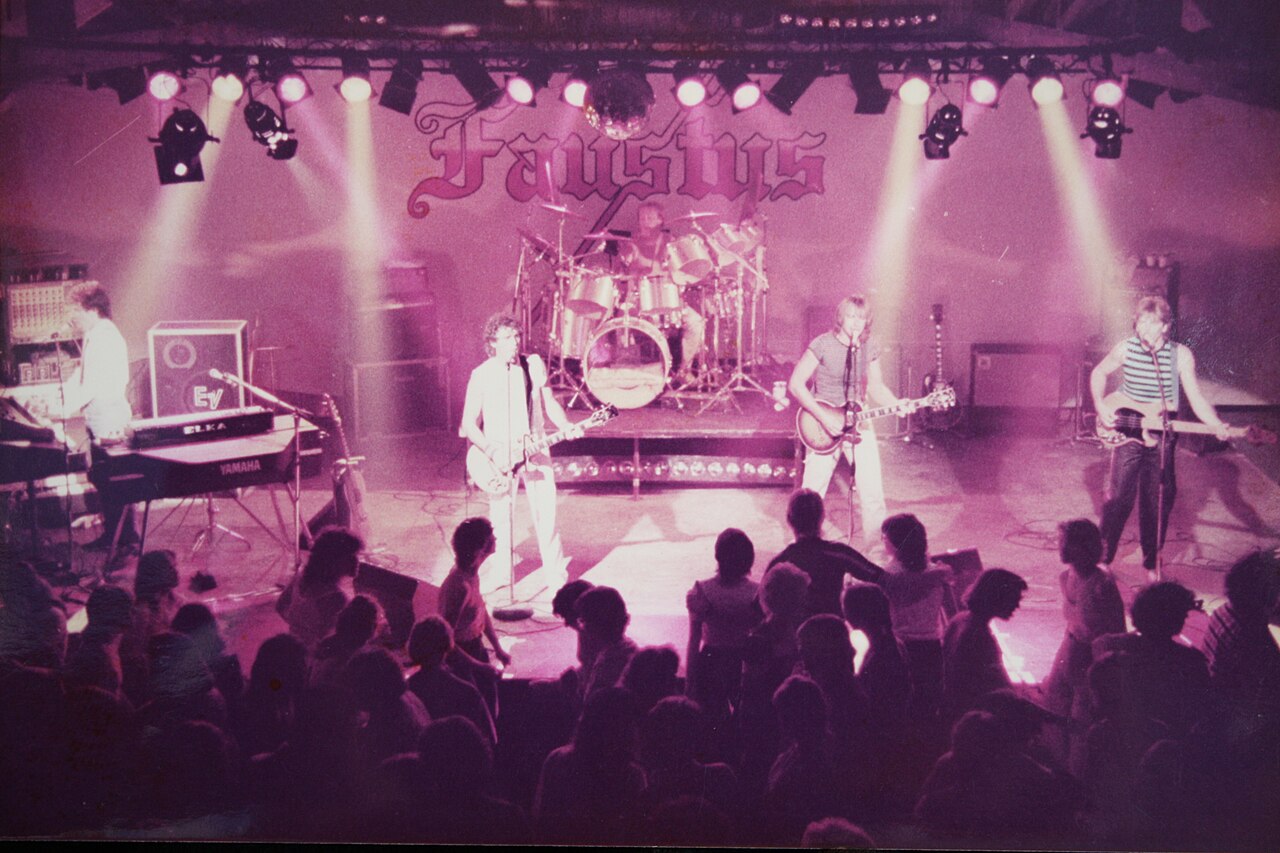
- A band on a lit stage in front of a crowd: Dhagely, Wikimedia Commons, CC BY-SA 4.0.
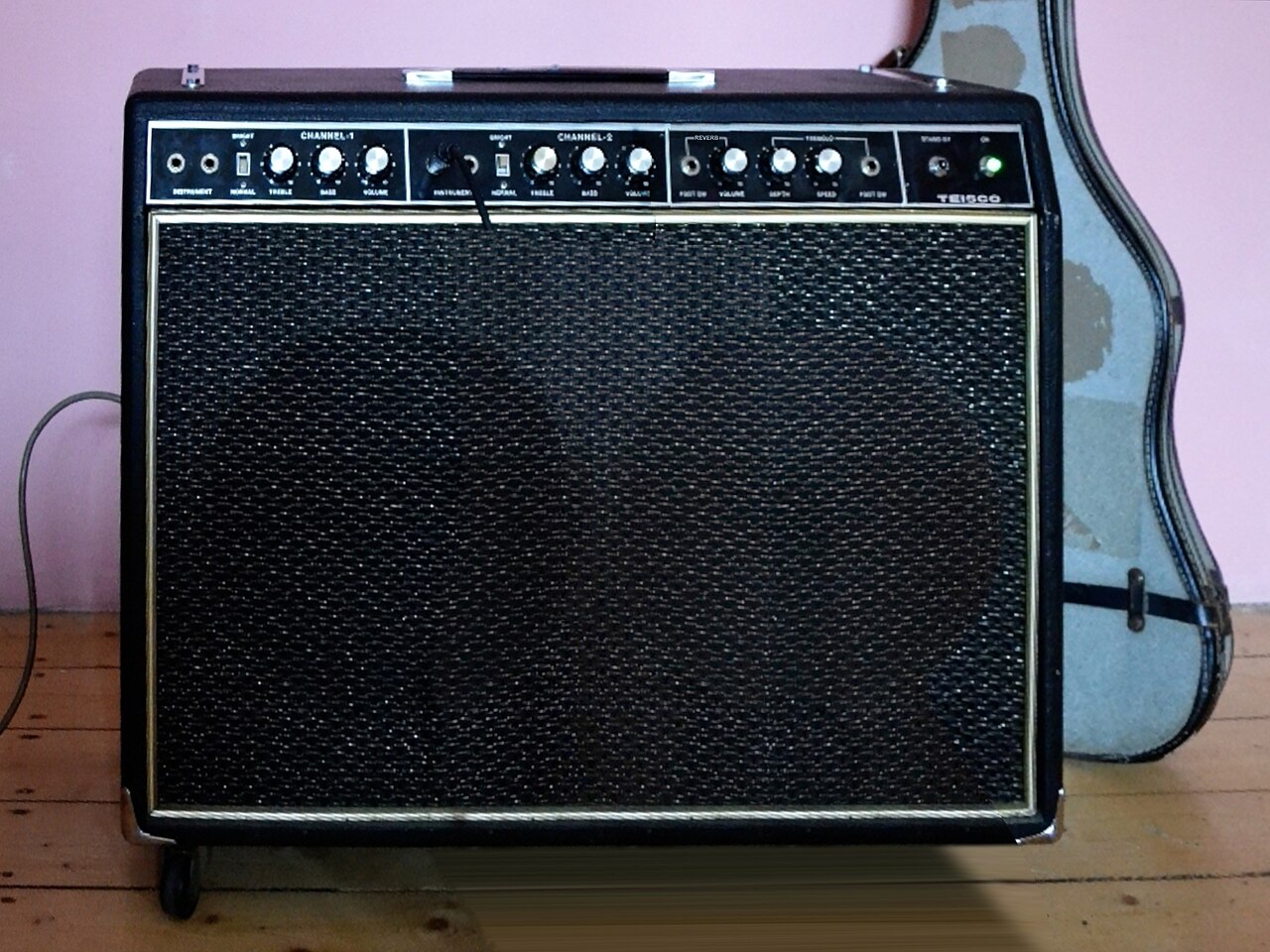
- A tube combo amp: Teisco & Framus.jpg: DeLerkim derivative work: User:Clusternote, Wikimedia Commons, CC BY-SA 3.0.
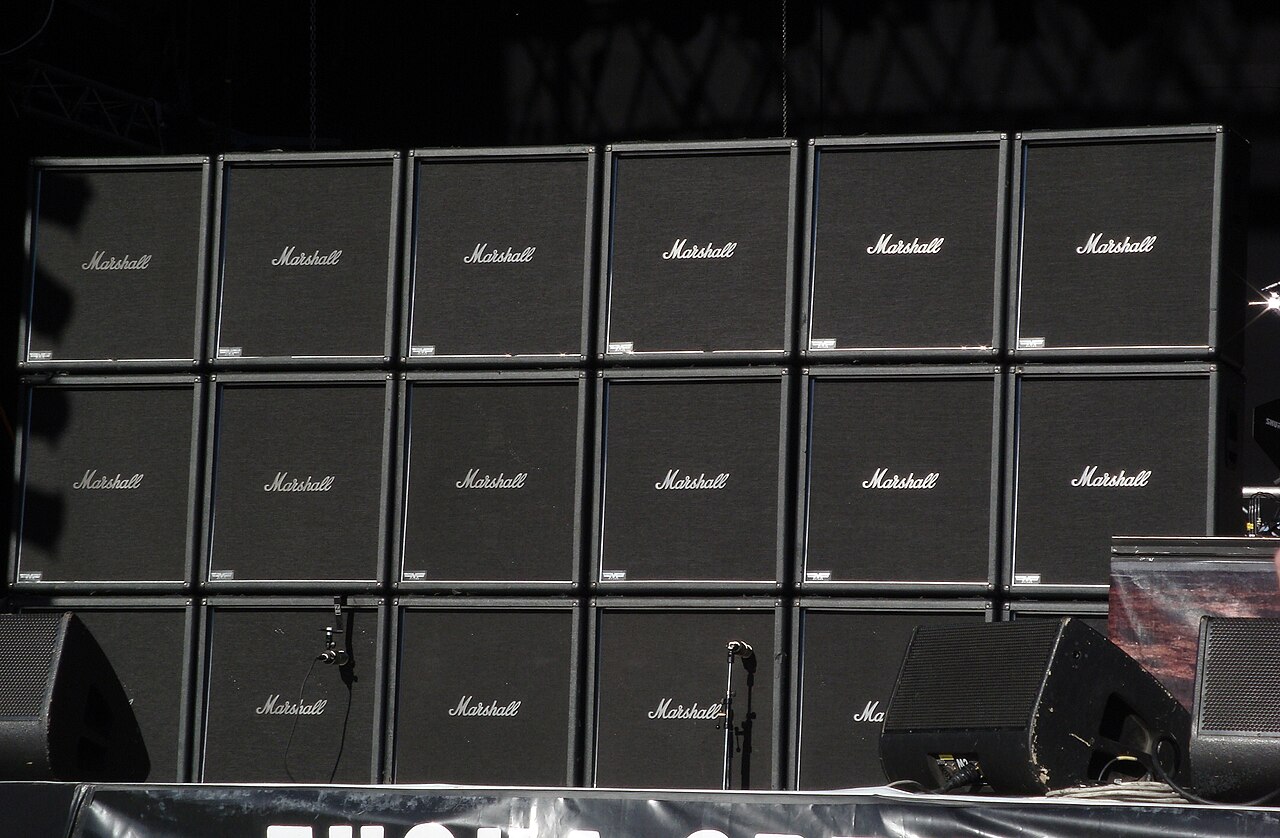
- A wall of Marshall speaker cabinets: Jaakonam, Wikimedia Commons, CC BY-SA 3.0.
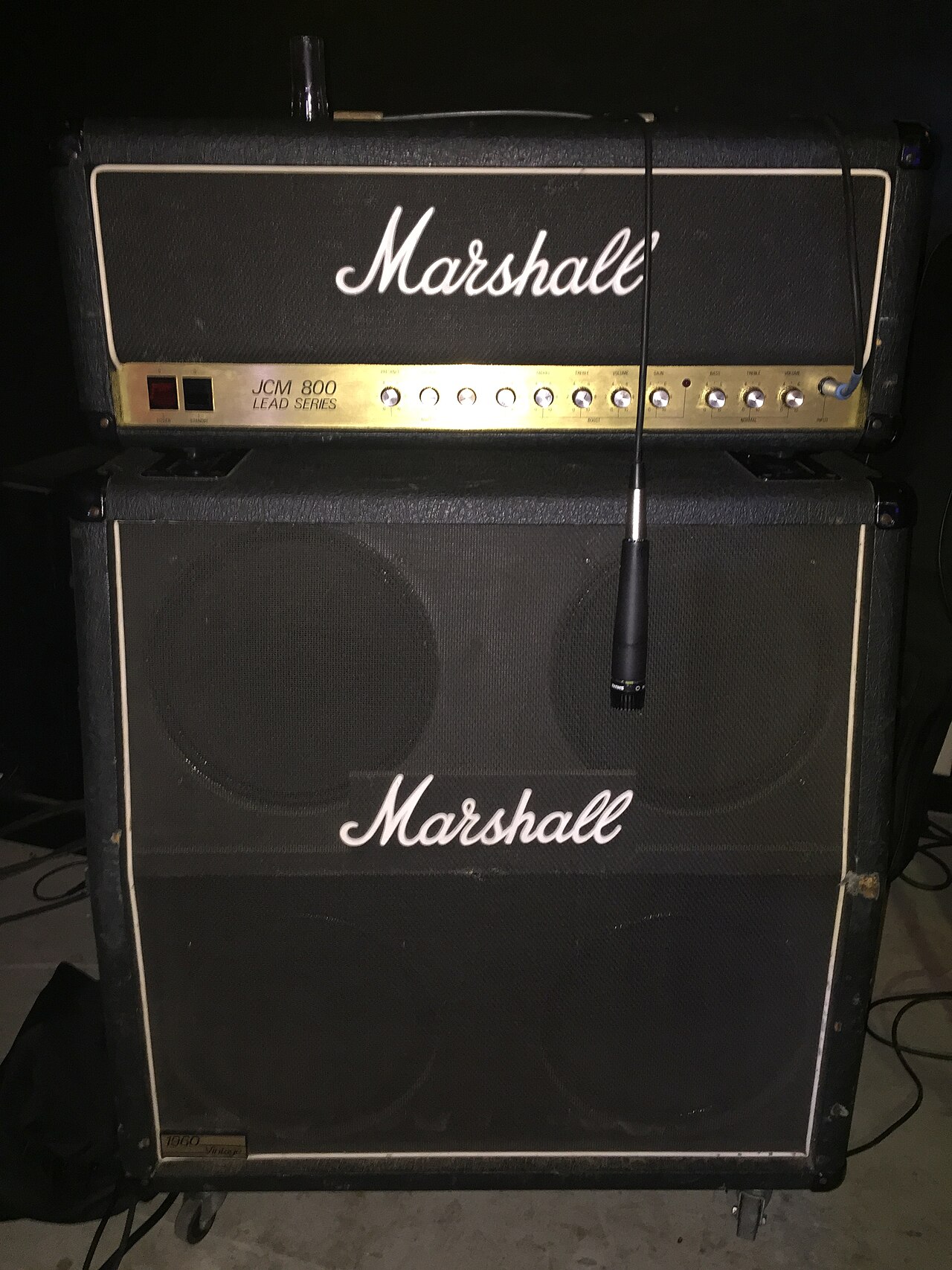
- A Marshall JCM800 head on a Marshall cabinet: John2112, Wikimedia Commons, CC BY-SA 4.0.
Latest News
Related
On This Day
Monday 9 November
From this week: