
Gear Timeline
There is a bend. One specific bend. A bend that has been played more times, in more contexts, by more guitarists who were trying to sound like someone else, than perhaps any other single guitar gesture in the history of the blues. You know it when you hear it: a slow, deliberate pull downward on the string, the note rising with a vocal quality that suggests something between a sob and a shout, held at the peak until it aches, then released. That bend belongs to Albert King. It belongs to him so completely that even when Stevie Ray Vaughan — the most gifted blues guitarist of the generation that followed — played it, you immediately heard Albert. The student never fully escaped the teacher, and the teacher set a standard so high that the escape was probably impossible anyway.
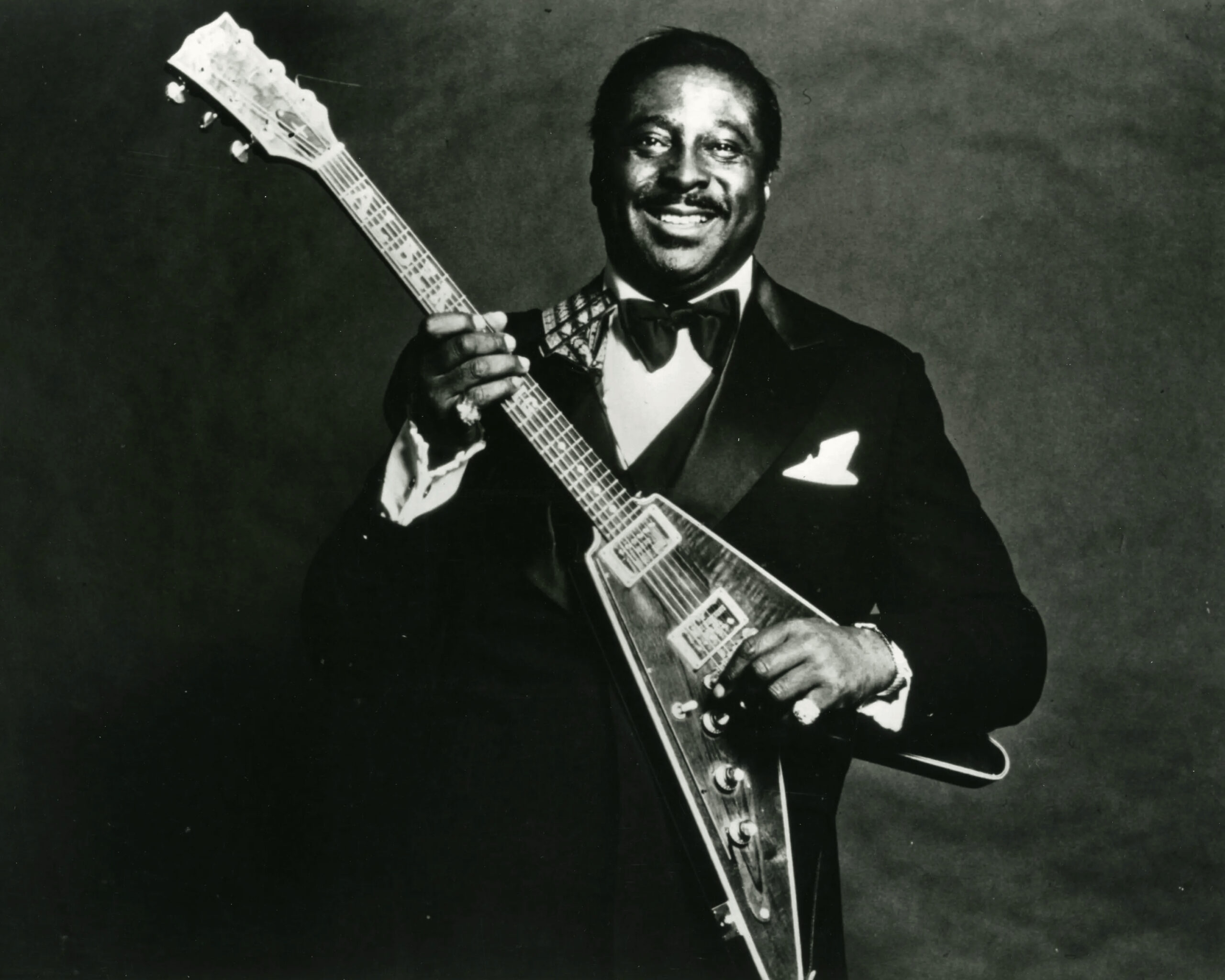
Albert Nelson — born April 25, 1923, in Indianola, Mississippi, into the same general patch of Delta earth that produced B.B. King — became Albert King when he moved north and started playing for money. He was 6 feet 4 inches tall, weighed 250 pounds, and drove a bulldozer in his day jobs before the music took over completely. They called him “The Velvet Bulldozer” — the paradox of a man of enormous physical presence who could play with heartbreaking delicacy. He was left-handed. He played right-handed guitars. He played them upside down, with the high E string at the top of the fretboard and the low E at the bottom. He tuned to an unusual open tuning that nobody else used. He played with his fingers, not a pick. He ran through solid-state amplifiers when every serious guitarist was using tubes. He broke every rule that blues guitar had established, and every rule he broke produced a sound that has never been fully replicated by anyone who played by the actual rules.
Born Under a Bad Sign — the 1967 Stax Records album that introduced Albert King to the world beyond the chitlin circuit — is one of the foundational documents of electric blues. Its title track, backed by Booker T. & the MGs and the Memphis Horns, is the song that Cream covered and thereby introduced King to an entire generation of white rock listeners who otherwise might never have found him. Eric Clapton heard Albert King. Jimi Hendrix heard Albert King. Joe Walsh heard Albert King. And then, most consequentially, Stevie Ray Vaughan heard Albert King, absorbed him so thoroughly that he acknowledged the debt openly and repeatedly, and carried the King tradition into an era that might otherwise have passed it by.
The gear that produced all of this — a single Flying V guitar played upside down, some solid-state amps, no pedals, and hands that understood how to squeeze tone from strings in a way that defied conventional explanation — is the subject of this guide. What Albert King did with minimal equipment and maximal feeling remains the gold standard for a certain kind of blues guitar statement: direct, emotional, technically unorthodox, and instantly recognizable from the first note. The Velvet Bulldozer ran very light gear. The impression he left was permanent.
He was inducted posthumously into the Rock and Roll Hall of Fame in 2013. Rolling Stone ranked him number 13 on their list of the 100 Greatest Guitarists of All Time. He died on December 21, 1992, in Memphis. His influence did not.
Background: From the Cotton Fields to Stax Records
The biographical facts of Albert King’s early life carry the specific gravity of the Delta blues tradition — a gravity that is not metaphorical but literal, rooted in the actual conditions of Black life in the American South in the first half of the twentieth century. Born in Indianola, Mississippi (a town also claimed as home by B.B. King, though the two were not related), Albert was the son of a sharecropper father who played guitar. The guitar entered his awareness early, as it did for most Delta bluesmen of his generation — not as a recreational hobby but as a form of expression that was one of the few available outlets for people with few economic or social options.
When Albert was eight, his widowed mother moved the family to eastern Arkansas, where he worked as a farmhand on a cotton plantation. This is the labor that formed the physical dimension of his playing — the hands that picked cotton and later operated a bulldozer developed a specific strength and callus formation that directly influenced how he approached the guitar. He was left-handed, but learning guitar from scratch in the rural South in the 1930s meant learning on whatever guitar was available, which was always a right-handed instrument. Rather than struggle to restring it or play in the awkward left-handed-with-right-handed-strings configuration, King simply flipped the guitar over and learned to play with the strings in reverse order — high E at the top, low E at the bottom. This accident of circumstance created the most unconventional technical approach in blues guitar history, and produced the most distinctive tone and phrasing vocabulary in the genre.
The mechanics of upside-down left-handed guitar playing are worth understanding because they explain much of what makes Albert King’s sound irreplaceable. When a right-handed player bends a string, they push upward toward the higher strings. When King bent a string — playing left-handed with the strings reversed — he pulled downward, toward the lower strings. The physical mechanics are completely different. The resulting note has a different attack profile, a different tonal characteristic at the peak of the bend, and a different decay. This is not a subtle difference audible only to trained ears — it is a fundamental difference in the physics of how the note is produced, and it is the reason that every right-handed guitarist who has ever tried to replicate an Albert King bend has come close but never all the way there. The technique is built into his body in a way that simply cannot be copied by anyone whose body is configured differently.
He moved to Gary, Indiana, in the early 1950s, fell into the Chicago blues scene, and made his first recording — “Bad Luck Blues” for the Parrot label — in 1953. The Chicago years were formative but not yet definitive. He was learning the idiom, building his repertoire, and acquiring the first version of the guitar that would define his career. He performed in St. Louis from 1956, and it was during his St. Louis period that he acquired the 1959 Gibson Flying V that would become the original Lucy.
The move to Memphis and the signing with Stax Records in 1966 was the turning point. Stax was the label that had created the Memphis soul sound — Otis Redding, Sam and Dave, the Mar-Keys — and it was run by people who understood that soul and blues were not separate traditions but expressions of the same emotional vocabulary. When Albert King came in with his upside-down Flying V and his impossible bends and his voice that could level a room, and Stax put him in a studio with Booker T. & the MGs and the Memphis Horns, the result was exactly as extraordinary as it sounds. “Born Under a Bad Sign” (1967) was the first significant release, and it remains one of the definitive recordings in the history of American music. Every note on that record sounds like something that has been waiting to be played and has finally been given permission.
The Cream cover of “Born Under a Bad Sign” on Wheels of Fire (1968) brought Albert King to the attention of a massive white rock audience. Clapton’s version is brilliant in its own right, but it is also fundamentally different — the British blues interpretation of an American original. The original has something the cover doesn’t have and can’t have: the specific physical weight of Albert King’s fingers on those strings, in that tuning, through those amps, played with that life behind them. Rock audiences who heard Cream and then sought out Albert King were universally astounded by the difference.
The 1970s were musically uneven — King made some records that tried to update his sound for the funk era with mixed results — but his live performances remained towering. The 1980s brought a resurgence, largely on the coattails of Stevie Ray Vaughan’s explosion into mainstream consciousness. SRV acknowledged King as a primary influence in every interview that touched on his roots, and the acknowledgment was genuine and specific. The two recorded together for the 1983 PBS television program In Session, a document of one of the great master-student relationships in blues history. Albert King sounds like himself. Stevie Ray Vaughan, playing alongside him, sounds like the most gifted student a teacher ever had. The difference is still audible.
The Rig: Albert King’s Guitars, Amps, and Effects
Albert King’s rig is, by the standards of guitar hero equipment lists, almost insultingly minimal. No pedal collection. No boutique amp obsession. No vintage tone-chasing. Just a Flying V played the wrong way around, some loud solid-state amplifiers, and hands that were unlike anyone else’s. What he got from this setup was unlike anything anyone else has gotten from anything.
Guitars
The original Lucy — named, Albert eventually revealed, for Lucille Ball — was a 1959 Gibson Flying V made from korina wood. This is important: the 1958-1959 Gibson Flying Vs were the original production run, made from korina (also called African limba wood) rather than the mahogany used in later reissues. Korina is a lighter wood with a distinctive tonal character — brighter and more resonant than mahogany, with a particular clarity in the upper frequencies that contributes to the note definition that makes Albert King’s bends so individually audible. The 1959 korina Flying V is one of the rarest and most sought-after electric guitars in existence; Gibson made only a handful of them before discontinuing the design in 1959 due to poor initial sales. King bought his in St. Louis in the late 1950s when his career was beginning to take off. He used it on virtually all of his important Stax recordings — the definitive records of his career, including “Born Under a Bad Sign” and the material on Live Wire/Blues Power. The guitar was stolen from him at some point in the late 1960s, reportedly lost in a craps game (the stories vary), and later recovered. Steven Seagal — the actor and devoted blues guitar collector — owns it today, having purchased it in Memphis after it had reportedly been hidden for twenty years. Seagal describes it as “the most important blues guitar in the world, period.”
After the original Lucy was lost, Gibson reportedly gave King a mid-1960s Flying V to replace it. This is the guitar on which “Born Under a Bad Sign” itself was recorded — meaning the most famous Albert King song was recorded not on the famous Lucy but on this replacement model. The 1966 V is a mahogany-body instrument rather than korina, which gives it a slightly different tonal character — warmer, with more low-mid weight. King played it extensively through the late 1960s and early ’70s, until the Erlewine Lucy arrived. This guitar is also now in Steven Seagal’s collection.
The third major guitar in the King legend is the custom Flying V built by luthier Dan Erlewine. The story of its creation is one of the more charming episodes in guitar history: Erlewine had seen King at the Ann Arbor Blues Festival in 1970 and was struck by the setup. In 1971, he met King at a show in Ann Arbor and offered to build him a true left-handed Flying V — the first Lucy had been a right-handed guitar played upside down, with all the ergonomic compromises that entailed. King agreed, came to Erlewine’s shop the very next day, and Erlewine took measurements and specifications directly from King’s existing guitar. King made two specific requests: his name inlaid on the fretboard, and the name “Lucy” on the peghead. Erlewine built the guitar from a 125-year-old piece of black walnut — not korina, not mahogany, but walnut, giving it yet another tonal character. The finished Lucy was delivered in May 1972. It became King’s primary touring guitar for the rest of his career. The guitar survived a tornado that left it underwater for 24 hours in the mid-1980s (Erlewine subsequently did restoration work), survived the general rigors of decades of touring, and is now also in Steven Seagal’s collection. Erlewine has made subsequent copies from the same slab of walnut — he estimated in 2009 that he had enough wood for approximately twenty more.
For King’s 64th or 65th birthday in 1987 or 1988, Billy Gibbons — guitarist of ZZ Top and a devoted King fan — commissioned luthier Tom Holmes to build a custom archtop Flying V-style guitar as a gift. This “pink Lucy” (named for its finish) became King’s primary instrument in his final years, used until his death in 1992. It is now housed at the Stax Museum in Memphis. The commission by Gibbons — one guitar hero giving another guitar hero a custom instrument as a birthday present — is one of the more touching episodes in the blues guitar story.
A separate custom V-style guitar built by luthier John Bolin, also commissioned by Gibbons, also now at the Stax Museum. The various Lucys have accumulated into something approaching a mythology of the single instrument — each version built on and extending the identity of its predecessors, all named the same name, all sharing the fundamental V-shape and upside-down left-handed configuration that made Albert King who he was.
It cannot be overstated how significantly King’s unconventional setup affected his tone and technique. Playing a right-handed guitar left-handed with the strings reversed means that the bass strings are on the bottom and the treble strings on top — the opposite of a properly restrung left-handed instrument. When King performed his signature bends, he was pulling strings downward (toward the floor) rather than pushing upward (toward the ceiling). This downward pull engages different muscles, produces a different physical force profile on the string, and creates a different note shape at the moment of the bend’s peak. The note blooms differently, decays differently, and has a different harmonic texture at full bend pitch. Additionally, King played exclusively with his fingers — no pick — which gives the attack a softer, more vocal quality than a plectrum produces. The combination of downward bends with fingertip attack produces the sound that is, simply, Albert King.
King’s tuning and stringing are among the most studied mysteries in blues guitar history. According to Dan Erlewine, who had direct knowledge from building King’s guitar, Albert used strings gauged .009, .012, .024 wound, .028, .038, .050 — a set with a noticeably light top end relative to the heavier bottom strings. He tuned to C, F, C, F, A, D (low to high) — an open tuning that doesn’t correspond to any standard tuning and that King apparently developed entirely independently. Steve Cropper, who produced many of King’s Stax albums, remembered a slightly different tuning: C, B, E, F#, B, E — which he says allowed King to create a one-finger Em chord by raising F# to G. The discrepancy between these accounts suggests that King’s tuning may have varied, or that even the people closest to his recording sessions couldn’t always nail down exactly what he was doing. One consistent element: King reportedly never touched the low string (low D or C, depending on which tuning account you follow) when he played solos, treating it effectively as a drone or simply ignoring it. This further reduced his effective playing range but concentrated his phrasing on the middle and upper strings where his bending technique was most developed.
Amps
Albert King’s amplification choices were the subject of genuine bewilderment among guitarists who knew his tone and couldn’t reconcile it with his equipment. The expectation was tubes. The reality was transistors. The output was magnificent regardless.
King’s primary amplification for much of his career was the Acoustic brand solid-state amplifier — specifically the 270 head and later the 370, which he ran into an Acoustic 2×15 cabinet with a built-in high-frequency horn. The Acoustic brand (not to be confused with acoustic guitars) made solid-state bass and guitar amplifiers that were loud, clean, and considered by most guitarists to be tonally inferior to tube amps. King made them sound magnificent. His technique — the heavy finger attack, the dramatic bends, the way he squeezed tone from the strings — produced a sound through solid-state amplification that nobody with a tube amp has quite replicated. This is, as with his upside-down technique, partly a physics argument: King’s physical relationship to the strings was so unlike any other guitarist’s that his signal into any amplifier was simply different from what anyone else was putting in. The solid-state amp’s clean, uncolored response may have actually served him better than tube compression would have — letting the raw character of his playing speak without the smoothing effect of output transformer saturation.
In his later career, King used the Roland Jazz Chorus 120 — another solid-state amplifier, this one famous for its ultra-clean response and built-in chorus effect, which King used for additional stereo width. The JC-120 is one of the cleanest, most transparent amplifiers ever built, with essentially zero natural distortion or harmonic addition. The fact that Albert King could make this amp sound the way it sounds when he plays through it is either a testament to his transcendent tone or a demonstration that gear really is secondary to the player — probably both.
King was also photographed and documented using various Peavey solid-state amplifiers throughout his career. Peavey’s American-made, working-musician-priced gear was practical and loud — exactly the priorities King applied to his amplification choices. He needed volume. He needed reliability. He was not chasing vintage warmth. He was already warm. The amp just had to be loud enough to fill the room.
There is a persistent rumor, mentioned in interviews with people who were present at the Stax sessions, that King may have recorded some of the classic Stax sides through a small tweed Fender amplifier — possibly a Fender Harvard, similar to the one Steve Cropper used as a studio amp. This would mean the impossibly warm, clear tone on “Born Under a Bad Sign” came from a small, modest tube combo rather than the massive solid-state rigs he used live. The rumor has never been definitively confirmed or denied. What it suggests is that the recording chain — the specific microphone, the specific Stax studio rooms, the Stax engineers’ approach to recording — may have contributed as much to the classic King studio tone as his amplifier choice. This is plausible and consistent with what is generally known about how the Stax sound was achieved: often with modest equipment in rooms that had developed a specific acoustic character from years of recording.
Effects
Albert King’s effects setup is one of the shortest paragraphs in any gear guide covering a guitarist of his stature.
Albert King did not use guitar effects pedals on his most important recordings and rarely used them live. His signal chain was, in most documented configurations, guitar directly into amplifier. No overdrive. No fuzz. No wah. No delay. No reverb beyond whatever natural room sound was captured by the studio microphones. The tone that has been analyzed, imitated, and reverenced for fifty years was produced with no processing whatsoever beyond the guitar, the cord, and the amp. This is worth sitting with for a moment, particularly for contemporary players who have been trained by guitar culture to believe that tone comes from pedals and that more processing equals more character. Albert King’s tone has more character than almost any processed guitar sound in recorded history, and it came from nothing except a Flying V played upside down through a solid-state combo into a room.
The one documented exception to King’s no-effects approach was an occasional MXR Phase 100 that appeared in his setup in the late 1970s — a period when he was experimenting with a more contemporary sound in response to changing commercial conditions. The phaser represents his concession to the era’s taste for electronic processing, but it was not a central or consistent part of his sound. By his career’s end, he had largely returned to the clean setup that characterized his classic period.
This deserves to be stated explicitly: Albert King’s “effect” was his hands. The physical relationship between his fingers and the strings — the downward bends, the fingertip attack, the specific pressure and speed of his vibrato, the way he held notes at their peak before releasing — produced tonal characteristics that no electronic processing could add to or remove from his sound. His tone came from him. The gear just had to be loud enough and clean enough to let what came from him reach the audience.
Playing Style & Tone Philosophy
Albert King’s playing style is built on a paradox: enormous physical technique in service of extreme emotional restraint. His bends are technically demanding — pulling strings downward against their natural resistance, across an unusual tuning, with fingers rather than a pick — but the musical use of those bends is the opposite of display. He plays fewer notes than almost any blues guitarist of comparable stature. He holds each note longer. He lets silence do more work. He understood, with an instinct that no amount of technical training could instill, that the note you don’t play is sometimes the most powerful note in the phrase.
The signature bend — the long, slow, moan-like pull up to pitch from below — is his primary musical statement. It appears in his playing the way a specific vowel sound appears in a singer’s voice: not as a technique to be deployed but as an extension of his expressive personality. The bend is not what he does with the guitar. The bend is what he sounds like. Every guitarist who has tried to copy it has produced something that sounds like a copy precisely because for them it is a technique being applied, not an expression being made.
His vibrato — the oscillation at the top of a held note — is wide, slow, and deliberate. B.B. King’s vibrato is famously fast and intense; Albert King’s is its opposite, a wide, almost lazy wave that gives sustained notes a vocal, speech-like quality. The width of the vibrato, combined with the downward mechanics of his bends, produces the “crying” quality that blues critics have always associated with his playing. It sounds like a human voice making a sound that human voices can’t quite make.
His approach to phrasing is deeply conversational — he plays fills between vocal lines rather than solos over them, in the classic blues call-and-response tradition. The guitar answers the voice. Then the voice answers the guitar. The record of this dialogue is “Born Under a Bad Sign,” where every guitar phrase exists in relationship to the vocal and the ensemble, never departing for its own sake. This is the opposite of the extended solo that became the dominant form of electric blues guitar expression after Clapton and Hendrix — King’s guitar is always in conversation, never in monologue.
His tone philosophy, to the extent he articulated one, was essentially practical: he wanted to be heard, and he wanted to sound like himself. The Flying V because it was comfortable and looked good. The solid-state amps because they were loud and didn’t require maintenance. No pedals because he didn’t need them. Light strings on top so he could bend them. Heavy strings on bottom so they’d have body. This is not a tone philosophy in the boutique guitar sense — it is a working musician’s pragmatism applied to the problem of expressing a very specific emotional vocabulary through an electric guitar. It worked better than any more deliberate approach could have.
How to Sound Like Albert King
Getting anywhere near Albert King’s tone requires confronting the fundamental truth that most of his sound is in his technique, not his gear. The gear helps. It will not be enough on its own.
Guitar: A Flying V with humbuckers is the historically correct choice, but King himself said he chose the V for feel and playability rather than tone. Any dual-humbucker guitar with enough midrange presence and sustain can approximate the tone territory. A Gibson ES-335 or Les Paul will get you into the neighborhood. The key is humbuckers — single-coils don’t have the body and warmth that King’s sound requires. If you’re going for absolute authenticity: a Flying V, restrung to a light-top/heavy-bottom gauge (.009/.010 on the treble strings, heavier on the bass), and played with fingers rather than a pick.
Amp: Clean and loud. The historical choice is solid-state (Roland JC-120 is the most accessible modern equivalent to the Acoustic amps he used), but a clean tube amp at the edge of breakup will also work. The key is that the amp is not doing the distortion work — any distortion in King’s tone comes from the guitar’s pickups being driven hard by his attack, not from amp saturation. The Roland JC-120 is genuinely excellent for this application: its clean, transparent response and built-in chorus approximate the character of King’s later live sound more accurately than most alternatives.
Amp Settings (Roland JC-120 or clean tube amp equivalent):
| Control | Setting (0–10) | Notes |
|---|---|---|
| Volume | 5–7 | Loud enough for the pickup to drive the input naturally |
| Bass | 5–6 | Full but controlled — not muddy |
| Mid | 6–7 | Present and forward — the midrange carries the bends |
| Treble | 5–6 | Clear without harshness |
| Presence / Bright | 4–5 | Moderate — not harsh, not dull |
| Reverb | 1–2 | Just a touch for room feel — King was essentially dry |
The Technique: This is where the work actually is. Practice bending strings from below pitch up to the target note slowly, with control — not the fast, whipping bend of rock guitar but a slow, deliberate pull that takes the note through its full journey from below to above pitch. Practice holding the bend at its peak with vibrato — wide, slow oscillation. Play with your fingertips rather than a pick if possible, even just for specific phrases, to approximate the softer attack character. And practice leaving space: after you play a phrase, stop. Count the beats. Let the room breathe. Then play the next phrase. King’s most powerful moments are often the silences between his statements.
Tuning note: Playing in standard tuning (or Eb if you tune down a half step as SRV did) will not replicate King’s specific harmonic quality, but it will allow you to apply his techniques in a familiar context. If you want to explore his actual tuning, King’s most commonly cited tuning is C, F, C, F, A, D — but be prepared for the fact that this is an extremely unusual tuning and very few existing chord charts or scale maps apply.
Influence & Legacy
To understand Albert King’s influence on subsequent generations of guitarists, you need only look at the list of players who have explicitly named him as a primary influence: Jimi Hendrix, Eric Clapton, Joe Walsh, Stevie Ray Vaughan, Gary Moore, Robert Cray, John Mayer, Joe Bonamassa. This is not a peripheral influence affecting a small corner of the guitar world — it is a foundational influence that shaped the mainstream trajectory of electric blues guitar from the late 1960s onward.
The most significant vector of King’s influence was Stevie Ray Vaughan, who absorbed King so thoroughly that the connection is audible in essentially everything SRV recorded. The specific bends, the phrase shapes, the use of open-string drones, the wide vibrato, the conversational relationship between guitar and voice — all of it traces directly to Albert King. Vaughan acknowledged this without embarrassment, calling King one of his primary teachers and saying that everything he knew about the blues started there. The 1983 In Session television recording, where the two performed together, is as close to a direct lineage documentation as the blues has ever produced.
The “Born Under a Bad Sign” legacy extends beyond blues into rock in ways that are sometimes not fully credited. Cream’s version introduced the song and its composer to millions of people who subsequently sought out the original. This pattern — rock bands covering Albert King songs and thereby pointing their audiences toward the source — happened multiple times with multiple bands across multiple decades. King benefited commercially from this attention and, more importantly, the tradition of serious investigation that he represented — the deep blues tradition of the Mississippi Delta transmitted through the Memphis soul infrastructure of Stax — was kept alive and accessible for successive generations.
His equipment choices deserve a final word in the context of influence. Albert King playing solid-state amplifiers and producing the most emotionally devastating blues guitar tone of his generation is a standing rebuke to gear fetishism of all kinds. The tone is in the hands. The hands are informed by the life. The life was Albert King’s specific, irreplaceable life — cotton fields, bulldozers, craps games, Stax Records, Lucy named for Lucille Ball, and bends that nobody has ever fully explained or replicated. No amount of vintage tube amp acquisition changes that equation. You get the Albert King tone by having Albert King’s hands. Short of that, you do the best you can with what you’ve got, and listen to the records, and stay humble.
For a sense of how King fits into the broader three-Kings tradition of blues guitar, the comparison with B.B. King’s approach to tone and phrasing at #11 is essential — two men from the same general region of the same state who developed approaches to the electric guitar so individually distinctive that they sound nothing alike, despite sharing a genre, a generation, and for a while, a surname. And for an understanding of how King’s influence flowed into the rock world, look no further than Stevie Ray Vaughan’s gear and technique at #6 — the student who came closest to the teacher and who spent his entire career making sure the teacher got the credit he deserved.
The third King of this triumvirate, Freddie King, at Freddie King’s guitars and gear at #32, completes the picture of how three unrelated men with the same surname and the same instrument created the template for everything that has been called electric blues ever since. Albert King’s contribution to that template — the upside-down bends, the solid-state conviction, the volcanic restraint — is the one that has proven most technically unreachable and most emotionally necessary. The Velvet Bulldozer left no forwarding address. He just left the music.
Frequently Asked Questions: Albert King Guitars & Gear
What guitar did Albert King play?
Albert King played Gibson Flying V guitars almost exclusively throughout his career, universally naming his guitars “Lucy” after Lucille Ball. His primary guitars were: the original Lucy, a right-handed 1959 Gibson Flying V made of korina wood (now owned by Steven Seagal); a 1966 Gibson Flying V on which “Born Under a Bad Sign” was recorded (also Seagal’s); the Dan Erlewine-built custom black walnut Flying V delivered in May 1972 (also with Seagal); and the final Lucy, a custom archtop Flying V built by Tom Holmes in 1987 and commissioned by Billy Gibbons as a birthday gift, now at the Stax Museum in Memphis. All of these guitars were played left-handed with the strings in standard right-handed orientation — turned upside down so that the high E string was at the top of the neck.
Why did Albert King play guitar upside down?
Albert King learned guitar left-handed on right-handed guitars because those were the only instruments available to him growing up in rural Arkansas in the 1930s. Rather than restring the guitar for left-handed playing, he simply flipped it over and learned to play with the strings reversed — high E at the top of the fretboard, low E at the bottom. This created his unique technical approach: when he bent strings, he pulled downward (toward the floor) rather than upward as right-handed players do. This physical difference in the mechanics of his bends produces a note with different attack, peak, and decay characteristics than a conventional bend — which is the primary reason his bends have never been fully replicated by any right-handed player despite decades of attempts.
What amps did Albert King use?
Albert King used solid-state amplifiers throughout the majority of his career, in defiance of the guitar world’s conventional preference for tube amplification. His primary stage rigs used Acoustic brand solid-state heads (the 270 and 370 models) driving 2×15 cabinets with built-in high-frequency horns. He later used the Roland Jazz Chorus 120 — another solid-state amp — and various Peavey solid-state amplifiers. The specific amplifier used on the classic Stax recordings (Born Under a Bad Sign, Live Wire/Blues Power) is uncertain; some accounts suggest a small tweed Fender combo similar to the one Steve Cropper used in the Stax studios. King’s tone was not dependent on amp choice — it came from his hands.
What effects did Albert King use?
Albert King used essentially no effects on his most important recordings. His signal chain was typically guitar straight into amplifier with no processing. This means the extraordinary tone on “Born Under a Bad Sign,” “Crosscut Saw,” and the Stax recordings generally was achieved with zero effects. In the late 1970s, he occasionally used an MXR Phase 100 as his sound evolved, but this was not a consistent part of his setup. King’s approach was the antithesis of pedal-driven tone: everything came from his hands, his tuning, and the natural character of his instruments.
What tuning did Albert King use?
Albert King used an unusual open tuning that was essentially his own invention. According to luthier Dan Erlewine, who built King’s custom Lucy guitar: C, F, C, F, A, D (low to high). Producer Steve Cropper recalled a slightly different configuration: C, B, E, F#, B, E. These accounts may reflect variations in King’s tuning across different periods or recording sessions, or simply the difficulty of documenting an unconventional system after the fact. King reportedly never touched the lowest string during solos, treating it as an unused bass drone. His string gauges (per Erlewine) were .009, .012, .024 wound, .028, .038, .050 — a notably light top end for aggressive bending combined with heavier lower strings for body.
Who did Albert King influence?
Albert King’s influence on subsequent generations of guitarists is profound and well-documented. Jimi Hendrix, Eric Clapton, Joe Walsh, Gary Moore, Robert Cray, and John Mayer have all cited him as an influence. His most significant student was Stevie Ray Vaughan, who absorbed King’s phrasing and technique so thoroughly that the connection is audible in virtually everything SRV recorded. Vaughan acknowledged the debt openly, calling King one of his primary teachers, and the two recorded together for the 1983 PBS television program In Session. Cream’s cover of “Born Under a Bad Sign” introduced King to a massive white rock audience in 1968, creating the cross-genre connection that kept his influence alive and growing for decades after it was initially established.
Is Albert King in the Rock and Roll Hall of Fame?
Albert King was posthumously inducted into the Rock and Roll Hall of Fame in 2013 — more than twenty years after his death in Memphis on December 21, 1992. John Mayer delivered the induction speech, and a group of blues artists performed a tribute set. King had previously been inducted into the Blues Hall of Fame in 1983. Rolling Stone ranked him number 13 on their 100 Greatest Guitarists of All Time list in 2011. The posthumous nature of his Rock and Roll Hall of Fame induction was a source of considerable frustration among blues music advocates, many of whom felt the recognition had come far too late for a musician of his historical significance.