The AC30 Unchained: How Vox’s Head Format Finally Made 30 Watts Manageable
The Vox AC30CH Custom Head adds a reactive attenuator and effects loop to the AC30 circuit. Full specs, verified artists, tone recipes, and buying guide.
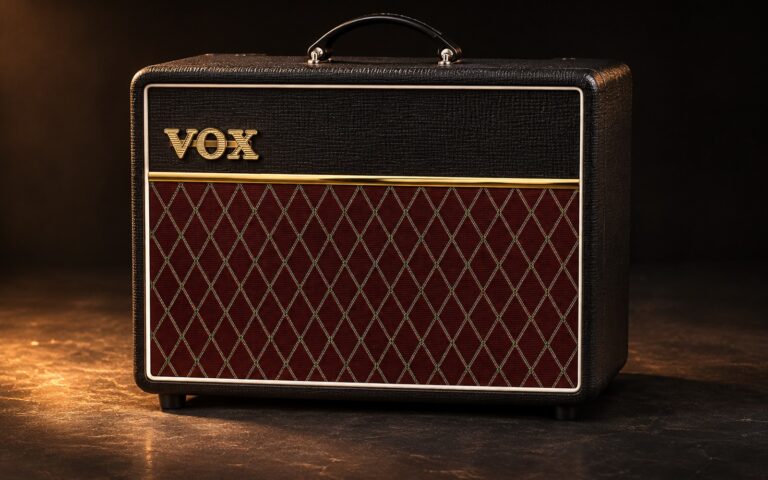
The Vox AC30 combo is one of the great immovable objects of rock and roll. Heavy, loud, and wilfully inconvenient, it demands worship on its own terms. You don’t carry an AC30. You load it into a van and hope nothing goes wrong with your back. The moment you plug in, the negotiations are over — the amp wins. For sixty-odd years, guitarists have accepted this deal because the sound it offers in return is simply too good to refuse.
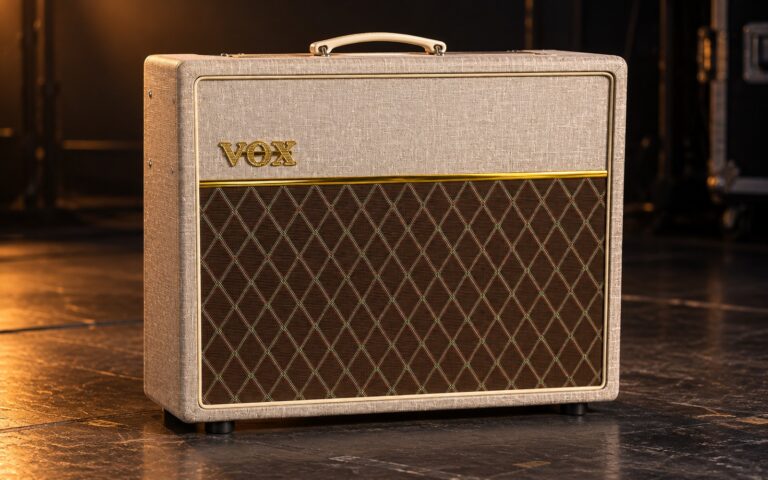
The AC30CH Custom Head, announced at NAMM in January 2016, represents Vox’s attempt to make that deal slightly more equitable. Strip away the fixed cabinet, mount the 30-watt EL84 circuit in a standalone head enclosure, add a reactive attenuator that knocks output down from 30 watts to 15 to roughly a third of a watt, throw in an effects loop (something the combo still lacks), and let the player choose which cabinet they want to stare at. The sound stays. The immovability becomes negotiable.
It’s worth being precise about what the AC30CH is, because the name carries enormous historical weight that belongs to earlier amplifiers. The circuit here is the same PCB-based, China-built design found in the AC30C2 combo — not a hand-wired recreation of the 1960s originals, not a point-to-point tribute to the amps The Beatles or Hank Marvin plugged into. What the AC30CH offers is the modern Custom Series voicing in a format that adds genuine touring flexibility, bedroom-to-stadium scalability, and the ability to pair it with speaker configurations the combo format physically prevents. That’s the deal on offer, and understood clearly, it’s a very good one.
Sixty-Five Years of British Chime: The AC30 Story
Vox built its first amplifiers in the mid-1950s at the Jennings Musical Instruments factory in Dartford, Kent. The original AC15 — fifteen watts, two EL84 power tubes — arrived in 1958, aimed squarely at the skiffle and nascent rock and roll market beginning to push British club PA systems to their limits. By 1959 and 1960, demand from a rapidly professionalising club circuit pushed Jennings to double the wattage. The result was the AC30: four EL84s running in cathode bias (eliminating the need for a bias adjustment every time you changed tubes), paired with an EF86 or ECC83 Normal channel and the Top Boost circuit that would define the sound of British pop for the next decade.
The endorsement deal that made the AC30 immortal came in 1962, when Vox’s Tom Jennings arranged for The Beatles and The Shadows to receive the amplifiers that would underpin their world domination. John Lennon and George Harrison used AC30s on early Beatles recordings; Hank Marvin built the entire sound of The Shadows’ run of instrumental hits — “Apache,” “Wonderful Land,” “Foot Tapper” — through them. The AC30 became synonymous with the British Invasion that crested between 1963 and 1966, its chiming, complex treble and warm midrange the sonic fingerprint of the era.
The original company changed hands multiple times through the 1970s and 1980s, production moving between British facilities and overseas, quality becoming inconsistent enough that serious players often sought out pre-CBS-era originals from the early 1960s at significant premium. In 1992, Japan’s Korg Corporation acquired Vox, bringing manufacturing discipline and consistent quality control that made the brand a reliable touring option again. Today’s Custom Series is built in China under Korg’s quality regime, with R&D handled at Vox’s UK headquarters. The result is an amplifier that sounds unmistakably Vox while costing less — and behaving more predictably — than anything built in Dartford in 1962.
The AC30CH arrived as part of a 2016 expansion of the Custom Series lineup, paired with the AC15CH head announced simultaneously. The commercial logic was straightforward: the AC30C2’s fixed 2×12 format made it genuinely difficult to transport, and a significant percentage of players were buying the combo and immediately considering external cabinet options anyway. The head format resolved those frustrations while adding the Reactor Technology attenuator that had no equivalent in the combo range — addressing the perennial AC30 complaint that 30 watts of cathode-biased EL84 headroom is extraordinary in a band context but thunderous and anti-social at home.
Inside the AC30CH: Circuit, Controls, and What’s New
The chassis design follows the same approach established across the Custom Series: a robust steel frame supporting two main printed circuit boards. The control board sits vertically at the top of the chassis, holding all the panel controls; the valve-base board runs horizontally below it, holding the four EL84 power tubes and their associated ECC83 preamp stages. Access requires removing a wooden panel fastened by woodscrews on the underside — less elegant than a side-open chassis but workable for tube replacement.
Both channels — Normal and Top Boost — offer High and Low sensitivity input jacks. Normal provides a single Volume control; Top Boost adds Treble and Bass tone controls. The shared Master section includes Master Volume, Tone Cut (the power-stage filter that rolls off treble harshness at higher volumes), Reverb Level and Tone, and Tremolo Speed and Depth. The rear panel carries the Reactive Attenuator’s three-position chickenhead rotary switch, two external speaker output jacks (8 or 16 ohms, selectable), the effects loop Send and Return jacks, and the footswitch socket.

The effects loop deserves emphasis, because it’s one of the most significant practical differences between the AC30CH and the AC30C2 combo. The combo has no effects loop — pedals run in front of the preamp or not at all, which is the traditional Vox approach and works beautifully for time-based effects running into the front end. The AC30CH’s loop adds flexibility: rack processors, stereo chorus, reverb units and noise gates that benefit from post-preamp placement now have a proper home. Sweetwater’s listing notes the loop offers “switchable levels to accommodate rack and stompbox effects” — both +4dBu professional and -10dBV consumer impedance matching are supported via a level switch.
The Vox Reactor Technology attenuator uses speaker impedance information fed back to the circuit to preserve the amp/speaker interaction at reduced volume — the idea being that conventional resistive attenuators simply absorb power without maintaining the loading relationship between output stage and speaker that generates an amp’s dynamic character. Vox claims the AC30CH sounds and feels the same at one-third watt as at 30. Players and reviewers broadly confirm that the lowest setting is dramatically quieter and still usable, which represents a genuine achievement for an amp whose stock in trade is controlled cathode-biased saturation.
The channels remain non-linkable via jumper cable, as with all PCB-era Custom Series amps. If you want both Normal and Top Boost simultaneously — the classic trick on vintage AC30s and early-reissue amps — you need an external A/B/Y box feeding both input pairs. The VFS2 footswitch (sold separately) handles reverb and tremolo bypass.
Specifications
Famous Players: What the Evidence Actually Shows
Common lists name Brian May, The Edge, George Harrison, Tom Petty, and Rory Gallagher as artist connections. Two of those five fail the most basic possible test before we even get to photographs or interviews.
George Harrison died in November 2001. Rory Gallagher died in June 1995. The AC30CH was announced at NAMM in January 2016 — fifteen years after Harrison’s death, twenty-one years after Gallagher’s. No further investigation is required. Both were genuine AC30 players who left deep marks on the instrument’s history: Harrison through the earliest Beatles recordings, Gallagher through a brutal touring career that turned the AC30’s cathode-biased breakup into a tool for Irish blues of uncommon intensity. Neither played an AC30CH. The confusion arises because Vox’s brand heritage is so strongly associated with these players that any AC30 product attracts their names automatically, regardless of whether the specific instrument existed while they were alive.
Brian May‘s AC30 connection is genuine, meticulously documented, and entirely specific to the combo format. His live and recording rig has always centred on AC30 combos run in parallel — multiple amps miked simultaneously to build the layered orchestral density that defines Queen’s guitar sound. His Vox signature product is the MV50-BM, a NuTube-based micro-head that models the AC30 Normal channel + Treble Booster interaction. No primary source documents him using an AC30CH head. The architecture of his rig — where the speaker cabinets within the combos are integral to the final sound — makes a standalone head somewhat at odds with his approach.
The Edge‘s AC30 history is built on vintage AC30TBs, the Top Boost-equipped 1960s models, and — per confirmed Premier Guitar Rig Rundowns — modified 2016 AC30 combos. The AC30CH head format doesn’t appear in any documented U2 backline. His is a combo-centric rig, where speaker placement and number of boxes are integral to the spatial effects he constructs.
Tom Petty (d. October 2017) was a documented AC30 user — he spoke of his “old brown AC30” in Guitar Player and other publications — but his instruments were vintage combos, and no primary source places him on an AC30CH. There was technically a 2016–2017 window during which he was alive and the amp existed, but finding evidence of him using this specific model would require documentation that doesn’t appear to exist.
Turning to Equipboard’s documented AC30CH roster (10 artists listed), the most interesting cases are Noel Gallagher, Tony Iommi, and J Mascis.

Gallagher’s AC30 use is one of the best-documented artist/amp relationships in British rock. From the earliest Oasis recordings through his High Flying Birds work, the AC30 has been a constant presence in his live and studio setup. His Equipboard listing on the AC30CH is plausible in a way that some of the other attributions are not — he’s an active performer with the means and inclination to use current-production Vox equipment. His listing should be treated as “plausible and Equipboard-confirmed, without a direct interview quote specifying this model.”
Tony Iommi’s Vox connection is historically vivid but temporally specific. The earliest Black Sabbath rehearsals and some of the earliest sessions used AC30 combos — the chime and breakup audible on proto-Sabbath recordings from 1969 is distinctly Vox. But Iommi moved to Laney amplification very early in Sabbath’s career, and the Laney relationship has defined his sound for fifty years. His presence on the AC30CH Equipboard listing reflects the AC30’s general association with his early career rather than evidence of him using a 2016-vintage head. It appears in the same category as the calendar debunks: Equipboard maps the amp to the player based on historical association rather than per-SKU verification.
The J Mascis attribution comes with a concrete problem: the Equipboard entry notes a photo of his live pedal board “from September 2014.” The AC30CH was not announced until January 2016 — sixteen months after that photo. The head visible in the September 2014 image must therefore be a different model: possibly an AC30H2, an earlier head variant, or a hand-wired unit. Mascis — known for his massive, feedback-rich guitar tone built on cranked vintage amplifiers — is absolutely a plausible AC30 head user, but the Equipboard attribution to this specific SKU doesn’t survive the timeline. His full gear history is worth exploring separately.
Among the less-prominent Equipboard names, Brendon Urie of Panic! at the Disco carries the strongest institutional validation: Vox’s own official artist page features him, confirming a genuine relationship with the brand. Whether his AC30 use extends to the CH head specifically isn’t documented with a direct quote, but the brand connection is real. Mick Mars of Mötley Crüe is quoted saying “I use a Vox AC30, a Hiwatt and a Marshall, and hook them all together” — but that quote doesn’t specify a head format or a model year, and Mars’s documented Mötley Crüe rig was Marshall-dominated. Chris Wolstenholme of Muse appears in a home studio photograph with what Equipboard identifies as an AC30CH — home studio use for recording tone experiments is a legitimate if low-intensity association for a rock bassist.
The Sound: Chime, Compression, and the 30-Watt Ceiling
Words like “chime” and “jangle” have become so attached to Vox that they’ve started to mislead. They suggest thinness, brightness, an amp that rewards a light touch and punishes anything harder. The AC30CH is not that amp. Nick Guppy’s MusicRadar review (June 2016) put it precisely: both heads have “a distinct midrange emphasis,” and the chime is a harmonic character layered on top of that midrange warmth — not the primary voice, but the crown of it.
The Normal channel is where players tend to find the AC30’s widest frequency response and cleanest headroom. Driven hard — Master Volume halfway up, Normal Volume cranked, Tone Cut just past noon to tame the fizz — it opens into a warm, slightly dark breakup that owes more to cathode-bias compression than to preamp clipping. The response is immediate, dynamic, and highly pickup-sensitive: humbuckers read as warm and punchy, single coils as bright and articulate. The Normal channel at moderate gain into a V212C Greenback cabinet is the sound of the early Shadows, of Harrison’s early-Beatles clean tone, of every windswept British pop record made before 1967.
The Top Boost channel adds its Treble and Bass controls to cut through those shared associations and find a narrower, more aggressive personality. Maximum Bass and minimum Treble — unusual, but effective — gives you a woolly, almost Marshall-like crunch with the cathode-bias compression holding everything together. Maximum Treble and restrained Bass with a Top Boost Volume around 7 is the classic Rickenbacker-and-AC30 tone: chiming, harmonically complex, a little dangerous. The Tone Cut acts on the master output, trimming the top end of whatever both channels produce — essential for controlling the amp in smaller rooms where the high-frequency content of four cranked EL84s at 30 watts can turn into ear-shredding chaos.
The spring reverb is longer and more complex than in the AC15 models. Reverb Tone adjusts the tonal character of the decay — rolled off for a vintage cave-reverb sound, open for a more modern shimmer. The tremolo is smooth and regular, period-correct in character, exactly the kind of motion that underpins early-1960s surf and British Invasion. With tremolo at slow speed and depth around 3, and the reverb washing behind it, the AC30CH in the V212C enclosure creates a complete texture that would have been impossible to fake in 1962 with multiple separate rack pieces.

Five Tone Recipes
Recipe 1: British Invasion Jangle (Rickenbacker or Gretsch Hollow)
Normal channel. Volume at 7, Master Volume at 5, Tone Cut at noon, reverb moderate (Level 4, Tone open). No effects loop — plug straight in. Top Boost off. The Normal channel’s warmth rounds off the inherent brightness of a Rickenbacker 360/12 or Epiphone Casino, leaving the harmonic shimmer without the ice-pick top end. Add a slow tremolo (Speed 2, Depth 2.5) for the full mid-1960s British Invasion effect. Target room volume: loud enough to hear the open-back V212C breathing, not loud enough to anger a neighbour. This is where the 15W attenuator setting earns its keep.
Recipe 2: Cranked Top Boost — the Noel Gallagher Setting
Top Boost channel. Volume at 8–9. Master Volume at 5–6. Tone Cut at 1 o’clock. Treble at 6, Bass at 5. Into a Fender Telecaster or Gibson Les Paul. This is the AC30’s most iconic modern incarnation — the sound of Noel Gallagher‘s Oasis recordings, where the Top Boost channel pushed past clean into a harmonically dense, slightly nasal crunch that sits in the centre of a dense studio arrangement without masking the vocal. At 30 watts into two Greenbacks it’s genuinely loud; use the 1/3W attenuator setting for home practice at this dial position and accept a slight character change at the very bottom of the dynamic range.
Recipe 3: Queen-Ish Wall (Big Muff + Normal Channel)
Normal channel. Volume at 6. Master Volume at 6–7. Tone Cut at 1 o’clock. Place an Electro-Harmonix Big Muff Pi in the effects loop (Loop Level switch to -10dBV). Sustained level from the Big Muff; Tone control on the pedal around noon. The Normal channel’s midrange warmth brings focus to the Big Muff’s scooped character, and the Greenback pair handles the low end without flabbiness. This is not Brian May’s actual rig — his sustain comes from cathode-bias power amp clipping through a Rangemaster-driven Normal channel, not from a fuzz pedal — but it approximates the frequency balance without a vintage treble booster in the chain.
Recipe 4: Indie Reverb Wash (Tape Echo in Loop)
Top Boost channel. Volume at 5 (just below the clean break). Master Volume at 4. Tone Cut at noon. Reverb Level at 3, Tone at 10 o’clock. Place an Electro-Harmonix Deluxe Memory Man or digital equivalent in the effects loop, long delay time (~700ms), feedback at 30–40%. The loop placement means the delay trails appear after the preamp saturation rather than feeding back into it — cleaner trails, more controllable. With a semi-hollow and pick harmonics this is the sound of early 2000s British indie: Embrace, Doves, Elbow’s guitar textures.
Recipe 5: Attenuated Bedroom Crunch
Top Boost channel. Both volumes at 10. Master Volume at 8. Tone Cut at 1 o’clock. Attenuator at its lowest setting (~1/3W). This is the AC30CH’s most unique capability — running the amp at or near full internal saturation at a volume you can play next to a sleeping partner. The Reactor Technology attenuator maintains enough of the amp/speaker interaction to preserve the dynamic response; the tone is slightly more compressed and less airy than at full power, but the EL84 power-stage saturation character survives the reduction in a way that a simple resistive load doesn’t achieve. Into 8Ω for the lowest load impedance the amp will accept.
How It Compares
The most direct comparison is with the Vox AC30C2 combo, which shares the same basic circuit. The AC30C2 costs less ($1,399.99 at Sweetwater) and includes its two Greenbacks in a fixed cabinet — you don’t need to buy a separate V212C. Against that saving, the AC30CH adds the Reactor Technology attenuator (absent from the combo) and the effects loop (also absent). Whether those additions are worth the price premium depends on how you use the amp: for a player who records at home, the attenuator is transformative; for a player who only gigs and has a consistent backline, the combo’s fixed format is simpler to manage.
The Vox AC15CH sits directly below in the head range, at ~$1,099–$1,149 new. Halving the power (two EL84s instead of four) means the AC15CH’s clean ceiling is reached at lower volume — useful for smaller venues, recording studios, and rehearsal rooms. The AC30CH’s extra headroom means cleaner cleans at loud volumes — more useful for large stages. Both have the Reactor Technology attenuator; the AC30CH adds the effects loop the AC15CH lacks. Budget and venue size are the deciding factors.

The Vox AC30HW2 Hand-Wired represents the other end of the quality spectrum. Point-to-point turret board construction, no PCB, 30W into two EL84 pairs — but no effects loop, no attenuator, and a price that approaches $2,800 new. Players who need point-to-point construction for their own reasons should look there; players who need the attenuator and effects loop stay with the CH.
Stepping outside the Vox family, the Marshall DSL20CR ($799) gives you 20 watts of EL34 crunch in a combo with a built-in attenuator, at roughly half the AC30CH’s price. The character is fundamentally different — Marshall’s compressed midrange crunch rather than Vox’s harmonically open chime — and you’d need an external effects loop. It’s a different amp entirely, not a budget substitute.
The Fender Blues DeVille 410 covers roughly similar power territory (40 watts, four EL84s) at similar price, but the open Fender character — clean headroom-oriented, with a different tube loading arrangement — is nothing like the Vox response. These amps share wattage and a power tube family and nothing else important.
Buying Guide: New, Used, and What to Inspect
New AC30CHs are readily available at $1,649.99 from Sweetwater and major retailers. The V212C companion cabinet runs separately; buying the AC30Stack (head + V212C together) saves a small amount over buying separately and ensures the components are matched cosmetically. If you’re buying just the head to use with an existing cabinet, confirm your cab’s impedance before connecting — the AC30CH offers 8Ω or 16Ω output jacks, and mismatching output and cabinet impedance by a significant margin shortens transformer life.
Used market pricing as of 2026 starts around $899–$1,100 for clean examples on Reverb, with full-stack (head + V212C) packages appearing at $1,200–$1,500. The AC30CH is a relatively recent design with no chronic reliability issues documented across forums, which means used examples from 2016–2022 represent straightforward value if the tubes are relatively fresh and the controls are clean.
When inspecting a used AC30CH, power it up and cycle through all three attenuator positions. Crackling or volume inconsistency at the attenuator switch suggests contact wear or oxidation inside the attenuator circuit — addressable by a tech but worth factoring into the price. Work every pot through its full range and listen for scratching or dead zones, particularly the Top Boost Treble and Bass controls, which are used frequently and can oxidise. Verify both speaker output jacks carry signal and the effects loop passes audio cleanly in both directions. The tube access panel on the underside should come off without drama; if the screws are stripped or the panel shows signs of repeated forced removal, ask why.
Ownership Notes
The AC30CH runs hot, particularly in the lower 1/3W attenuator position where the output stage is saturating into the attenuator circuit. Allow adequate ventilation on stage and in the studio — don’t mount it flat against a wall or enclose it in a rack case without ventilation planning. The EL84 power tubes are cathode-biased, which means they self-adjust to a degree when you change tubes — you won’t need a formal rebias appointment every time. However, matched sets of EL84s are worth requesting when replacing all four; mismatched tubes in a cathode-biased quad will still work but will wear unevenly.
The Celestion G12M Greenbacks in the companion V212C are 25W per speaker — with two in parallel or series, the cabinet handles 50W total if wired in series (16Ω) or 12.5Ω if in parallel (8Ω nominal). At 30W output and the Greenbacks’ 25W individual rating, you’re within headroom at full power; neither speaker is being pushed past its design limit. At the 1/3W attenuator setting the headroom is so generous it’s irrelevant.
The effects loop’s -10dBV/+4dBu level switch is easy to overlook but important for tone. Running a standard stompbox delay at +4dBu level will overload its input; most time-based pedals want -10dBV. Rack processors generally prefer +4dBu. Getting this wrong produces distortion in the loop signal that’s easily misattributed to a failing tube or the amp itself.
Keep the VFS2 footswitch cable short and tucked at stage — the reverb and tremolo bypass it provides are genuinely useful live, but the footswitch socket is on the rear panel, and a long cable looping around a dark stage is a trip hazard. The footswitch does not handle channel switching; if your set requires moving between Normal and Top Boost mid-song, you’ll need a Y-cable feeding both channel inputs simultaneously (blended sound only — not channel-to-channel switching) or a dedicated switcher unit.
FAQ
What’s the actual difference between the AC30CH and the AC30C2 combo?
The AC30CH adds the Vox Reactor Technology attenuator (30W/15W/~1/3W) and a switchable effects loop — neither of which appears on the AC30C2 combo. The combo includes two Celestion G12M Greenbacks in a fixed cabinet; the head requires a separate cabinet purchase. The circuit is otherwise the same PCB-based design. Price difference at new street price: approximately $250 in favour of the combo.
Can you link the Normal and Top Boost channels?
Not via jumper cable, as was possible on vintage AC30s and some earlier Vox reissues. The PCB-era Custom Series, including the AC30CH, does not support channel linking. You can feed both channels simultaneously from a stereo effects send or A/B/Y box, which blends both channel characters — a popular approach for players who want the warmth of Normal and the bite of Top Boost simultaneously.
Does the attenuator preserve the amp’s feel and tone?
Significantly better than a simple resistive power attenuator. The Reactor Technology circuit feeds speaker impedance information back to the attenuator to maintain the amp-speaker loading relationship at reduced power. At the 15W position the change from 30W is minimal to most ears. At 1/3W there’s more compression and slightly less air in the open-back cabinet’s response, but the EL84 saturation character survives in recognisable form. It’s the most useful thing the CH format adds over the combo.
Why doesn’t the effects loop have a footswitch?
This is exactly the complaint MusicRadar’s reviewer raised in June 2016. The VFS2 footswitch handles reverb and tremolo bypass; the effects loop and channel selection are both manual-only operations. For a player using the loop for a wet/dry stage setup or needing to bypass effects loop processing mid-song, an external loop switcher is the solution. It’s a real limitation for live work, though less significant in studio use where you’re not switching mid-take.
What cabinet works best with the AC30CH?
Vox’s own V212C — two Celestion G12M Greenbacks, open-back — is the designed companion and the combination used in reviews. Open-back is the right format for the AC30’s voice: it emphasises the harmonic complexity of the Greenbacks’ cone break-up and maintains the airy, three-dimensional quality that closed-back cabinets tend to compress. Players with a closed-back 4×12 who want to try the AC30CH through it will hear a more punchy, compressed character; correct, but different. The AC30CH’s 8Ω and 16Ω output options cover most cabinets.
Is the AC30CH too loud for home use without the attenuator?
At full 30 watts through two Greenbacks it’s emphatically not a home amp — it’s loud enough to be genuinely uncomfortable at close range and to generate neighbour complaints at medium volume in most housing situations. The attenuator’s 1/3W setting is the answer; at that level the amp can be played without ear protection in a normal room, and the tone is sufficiently preserved to make the exercise worthwhile. This is the core use case the AC30CH offers that the combo cannot match in the same way.
How heavy is the AC30CH, and is it manageable for gigging?
The head itself is 18.8 kg / 41.5 lbs — heavy for a head, but lighter than the AC30C2 combo (which runs to around 30 kg). The V212C cabinet adds its own weight; total system weight with the companion cab approaches the combo’s territory. The practical advantage of the head format is that you can carry the amp and cabinet separately into a venue rather than manoeuvring the combined weight of a 30-watt 2×12 combo through doorways. Whether this constitutes “manageable” depends on your physical situation and how many stairs are involved.
Which tube type matters most for tone in the AC30CH?
The four EL84 power tubes. Cathode-biased EL84s at the edge of saturation are the defining voice of the AC30 family — their response is fast, their compression is smooth, and their harmonic content at medium to high volumes is the source of the characteristic “chime.” Preamp tube swaps have a smaller effect than in a fixed-bias amp, partly because the cathode-bias arrangement stabilises the operating point. If you want to experiment, start with the EL84 power quad before touching the preamp chain.
Image credits
- Rory Gallagher: Heinrich Klaffs, Wikimedia Commons, CC BY-SA 2.0.
- The Edge: iinchicore, Wikimedia Commons, CC BY-SA 4.0.
- Tony Iommi: Marek Krajcer (Maross), Wikimedia Commons, CC BY-SA 3.0.
- Noel Gallagher: Freddyballo, Wikimedia Commons, CC BY-SA 4.0.
Latest News
Related

On This Day
Monday 9 November
From this week: