The Amp That Chimed Its Way Into History: Vox AC30C2 30W 2×12 Combo
Vox AC30C2: 30W, two Celestion Greenbacks, 4× EL84. Full specs, famous players verified, and five tone recipes for the iconic British combo amp.
There is a sound so specific, so geographically particular, that audio engineers use it the same way a costume designer reaches for a Union Jack — not to suggest British-ness, but to invoke it. That crystalline top-end shimmer, those compressed EL84 harmonics blooming under a hard pick attack, that impossible quality of being simultaneously clean and already on fire: it is the sound of the Vox AC30. And the AC30C2 is the version you can walk into a shop and buy today for $1,799.99.
This article covers the Vox AC30C2 in the only way the amp deserves — thoroughly. We trace the circuit back to a 1957 sketch on Dick Denney’s workbench, document which famous guitarists actually used one (and which were using something adjacent), walk through five practical tone recipes, and address the real-world practicalities that no one mentions in the marketing copy. The AC30 story is one of the great stories in amplifier history. Here it is.
Origin and History: How the AC30 Was Born
The story begins not with a guitarist in a rehearsal room but with a salesman’s problem. Tom Jennings ran Jennings Musical Industries (JMI) out of a shop in Dartford, Kent, importing and distributing musical instruments during the post-war boom in British pop music. By the mid-1950s, the electric guitar had arrived in Britain with Buddy Holly, Elvis, and Eddie Cochran records smuggled across the Atlantic, and British teenagers wanted to play one — loudly.
Dick Denney was JMI’s designer and a working guitarist, and in late 1957 he sketched a 15-watt amplifier using three EF86 preamp tubes and two EL84 power tubes that he called the AC15. The designation meant nothing exotic: AC for alternating current (as opposed to DC-powered battery amps), 15 for the wattage. JMI began production in 1958, and it was an immediate success with the emerging British pop scene. The AC15’s glassy, responsive clean tone and the particular breakup character of EL84 tubes driven into class-A operation — producing rich second-order harmonics that the ear interprets as warmth rather than distortion — made it the amp of choice for a generation of British guitarists before they had quite worked out why.
The AC30 was born from a phone call. Hank Marvin of The Shadows — the pre-Beatles instrumental group who were, for a crucial window in the early 1960s, the most influential electric guitarists in Britain — rang JMI and told them the AC15 wasn’t loud enough. His Stratocaster was getting swamped. Denney’s response was characteristically engineer-logical: he doubled the output section. Four EL84 power tubes instead of two, a larger cabinet, a second 12-inch speaker to move more air. The resulting amplifier — the AC30/4 Twin — debuted in 1959 at 30 watts with two 12-inch Celestion speakers, four inputs, and two channels (Normal and Vibrato). It was immediately, unmistakably itself.
The Vibrato channel on those first AC30s used an EF86 tube in the preamp, a tube that was notoriously microphonic and sensitive to interference. Denney replaced it with a 12AX7 (ECC83 in British nomenclature) in 1961, giving the amp a more robust and consistent preamp stage. That same year, the circuit received the modification that would define its sonic character for the next sixty-five years: the Top Boost. Drawing on the tone circuit architecture of a Gibson-Vanguard GA77 amplifier from the mid-1950s, Denney and the JMI team added an additional ECC83-driven gain stage with separate bass and treble controls. Initially sold as a retrofit module bolted to the back panel, the Top Boost was integrated directly into the chassis from late 1963, and the resulting AC30TB (Top Boost) became the definitive model. The interactive treble and bass controls on the Top Boost channel — which affect each other as you turn them, rather than operating independently — are the reason the AC30 sounds like an AC30 rather than any other 30-watt EL84 combo.
Between 1963 and 1968, JMI built what historians of British amplification now call the golden-era AC30s: copper-panel top-boost models, grey-panel Burndept and Westrex-chassis versions, all built in Dartford with Celestion Alnico Blue speakers. The Beatles, The Shadows, The Kinks, The Rolling Stones in their Yardbirds days, Pete Townshend before he discovered that Marshall stacks would become his signature — all of them played through JMI-made AC30s during these years.
JMI ceased trading in 1968. The brand passed through Thomas Organ Company, then Norlin Music, then Korg — the Japanese instrument conglomerate that purchased the Vox brand in 1992. Korg closed the last UK manufacturing facility at Wellingborough in 1993. The final Vox amplifiers built on British soil came from a Marshall subcontracting arrangement that ended in 2004. Since then, all standard Vox production has been manufactured overseas, the current AC30C2 assembled in Vietnam.
The Korg-era circuit is a faithful recreation of the golden-era topology: same EL84 power section, same interactive Top Boost EQ, same Tone Cut control operating in the power stage rather than the preamp (a deliberate design choice that allows you to tame brightness without losing gain structure). The main additions are spring reverb, a tremolo effect, an effects loop, and a master volume — creature comforts absent from the original JMI designs. Whether the Vietnamese-assembled AC30C2 sounds identical to a 1964 copper-panel TB is a debate the vintage market settles daily on Reverb: original JMI examples in working condition sell for $3,000 to $8,000+, which is the market’s verdict on the question.
Specifications
The Circuit: What Actually Makes It Sound Like an AC30
The AC30C2’s character comes from three interlocking design decisions that are unusual enough to warrant explanation.
First: the power section runs in class-A. Most guitar amplifiers run in class-AB, which is more efficient — the output tubes share the signal, one pushing while the other pulls. Class-A keeps all four EL84s active for the entire signal cycle. Less efficient (more heat, shorter tube life, more power consumption for a given output), but the distortion character is different: primarily even-order harmonics, which the ear perceives as musical warmth and compression rather than grit. When you push an EL84 in class-A, it sings rather than snarls.
Second: the Tone Cut control. This is not a tone control in the conventional sense — it does not operate in the preamp stage but in the power stage, attenuating the signal between the phase inverter and the output transformer. Turning it down (clockwise on most Vox controls, counterintuitively) makes the amp darker without changing the gain structure. This means you can have a fully saturated power section running hot while keeping the high-frequency content in check — a combination that produces the amp’s characteristic compressed, harmonically rich sound at usable volumes.
Third: the Top Boost channel’s treble and bass controls are highly interactive. Unlike most amp EQs where treble and bass adjust independently, the TB circuit’s components are wired so that the controls affect each other. This is why AC30 users talk about “finding the sweet spot” on the EQ rather than dialling in target frequencies — you’re working with a system that responds more like a voice than a parametric EQ.
Famous Players: Who Actually Used One
The Vox AC30 appears on more classic recordings than almost any other amplifier, and the AC30C2 is the current production continuation of that circuit. The player list below is verified against primary sources. Where famous names are associated with the AC30 family but specifically with different models or variants, that distinction is stated.
The Edge (U2) — Verified
The Edge’s relationship with the AC30 is one of the most thoroughly documented musician-instrument partnerships in rock history, and it predates almost everything U2 became famous for. His primary instrument is a 1964 AC30TB — the original copper-panel JMI model — which has appeared on every U2 album. A Premier Guitar Rig Rundown documented his live touring rig using two 2015 Vox AC30TBs handwired by Dave Clarke alongside two 2016 Vox AC30s that Clarke had modified. He has stated in interviews that he owns more than thirty AC30s.

The Edge does not simply use an AC30 as a clean platform — he uses it as a component in a time-delay architecture, running multiple delays in parallel to create the rhythmic, interlocking patterns that define U2’s sound. The AC30’s top-end chime and the particular way its spring reverb colours transients are not separable from how his delay lines behave. Playing “Where the Streets Have No Name” through a Fender Twin Reverb sounds like a cover version. Through an AC30 it sounds like the record.
Brian May (Queen) — Verified
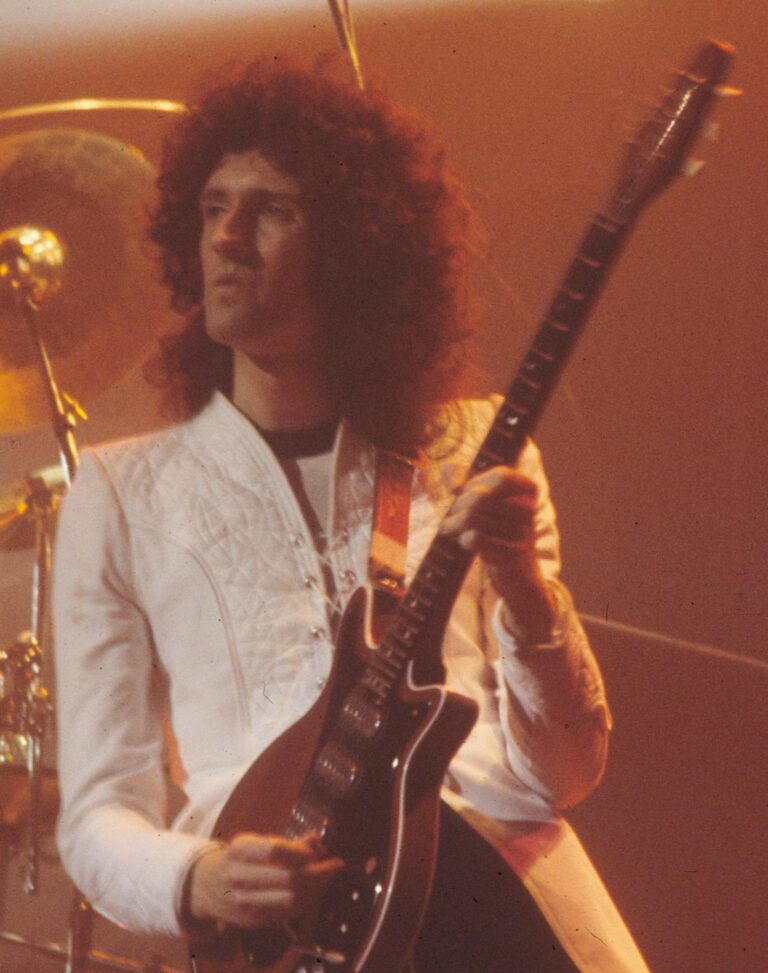
Brian May’s Vox AC30 rig is one of the most analysed guitar setups in rock, and it is extensively documented on his own official website (brianmayworld.com) and by guitar builder Greg Fryer, who has worked with May’s original equipment. The rig is built on a single principle: a Dallas-Arbiter Rangemaster treble booster hitting the Normal channel of an AC30 with the volume control at maximum.
May purchased his first Rangemaster second-hand to record Queen’s debut album (recorded June to November 1972). The treble booster adds approximately 30dB of boost concentrated in the upper frequencies before the signal hits the preamp, driving the EL84s into heavy saturation. The result is a compressed, harmonically dense sustain — the violin-like singing quality audible on “Bohemian Rhapsody,” “Killer Queen,” “Tie Your Mother Down,” and dozens of other Queen recordings. May himself has credited Rory Gallagher‘s early rig — the Irish blues-rock guitarist who used an identical treble booster/AC30 combination — as the inspiration for adopting the setup.
This specific combination — Rangemaster into Normal channel at full volume — creates a sound that cannot be replicated by simply cranking the Top Boost channel. The Normal channel’s simpler preamp circuitry responds differently to the boosted input signal; the result has more midrange compression and less high-frequency articulation than the Top Boost channel, which is exactly why May chose it.
Jonny Greenwood (Radiohead) — Verified
Jonny Greenwood’s first AC30 was a 1990s reissue AC306TB, acquired around 1997. He has subsequently owned two AC30TBX models, a Dave Peterson-modified AC30, and an AC30C2 — this specific model. His Vox amps are consistently loaded with Celestion Alnico Blue speakers rather than Greenbacks, a detail worth noting for players trying to replicate his tone. The core architecture (EL84 output section, Top Boost channel, spring reverb) is what matters for most applications.

The Radiohead context is important: Greenwood uses the AC30 as an everything-platform, running it clean as a chiming jangle machine, using it as the platform for fuzz and distortion pedals, and exploiting its natural compression for volume-swell passages. On OK Computer and Kid A, the AC30 is often the throughline between Greenwood’s heavily processed guitar parts — the stable core that the more extreme textures are built on. Ed O’Brien, Radiohead’s other guitarist, also uses AC30s as a central component of his rig, making them a genuinely shared-infrastructure choice for the band.
George Harrison and the Beatles — Historical Context
The Beatles’ relationship with the AC30 is real, well-documented, and frequently overstated simultaneously. Harrison and Lennon used AC30s extensively during the early 1960s — on the recordings and touring that established Beatlemania. The distinctive jangly treble of their early work, audible on “I Want to Hold Your Hand,” “She Loves You,” and the Hamburg recordings, is in significant part AC30 chime on Rickenbackers and Gretsch hollow-bodies.
However: by the time they were recording Help!, Rubber Soul, and Revolver — the records that define their most influential period — they had moved to larger Vox models, principally the AC50 and AC100, to handle increasingly large venues. The AC30 is the sound of early Beatles. The circuits you’re playing through on an AC30C2 are the same topology — EL84 output, the same preamp gain stages — just with sixty additional years of refinement and Vietnam-assembled PCBs instead of UK-built handwiring.
Noel Gallagher — Verified, but It’s the C2X Not the C2
This distinction must be stated plainly: Noel Gallagher is one of the most famous Vox AC30 players alive, and his specific model is the AC30C2X — fitted with Celestion Alnico Blue speakers — not this AC30C2 (which uses Celestion G12M Greenbacks). The two amps share the same circuit and cabinet. The difference is entirely in the speaker. Alnico Blues compress and break up earlier, with a warmer top end and a slightly earlier onset of speaker distortion. Greenbacks are tighter, have a more ceramic-ferrite midrange presence, and distort at a slightly higher signal level.
The “Wonderwall” and “Champagne Supernova” chimey jangle is Alnico Blue speaker character as much as it is AC30 circuit character. An AC30C2 with Greenbacks will get you to the same neighbourhood, but it is not the same house. This is useful information, not a knock on the C2 — the Greenback version has its own distinct character that many players prefer for its tighter low end and slightly more aggressive midrange voicing.
Other Documented Players
Dave Davies of The Kinks used AC30s throughout the band’s 1960s peak — the snarling, aggressive tone on “You Really Got Me” is AC30 through a Framus Caravelle speaker that Davies deliberately cut with a razor blade and held together with a knitting needle, creating a primitive fuzz effect that predated commercial fuzz pedals. Paul Weller and The Jam built their angular post-punk attack through AC30s, and Weller has maintained a lifelong relationship with the amp across his solo career. Matthew Bellamy of Muse has used AC30s as part of an elaborate modular rig, exploiting the amp’s top-end sensitivity for his effects-heavy approach. Richard Thompson, one of Britain’s finest guitarists, has used AC30s throughout a career spanning six decades of British folk-rock. Pete Townshend used AC30s with The Who before commissioning the Marshall full-stack format — understanding that historical sequence helps explain why the AC30 and the Marshall Plexi sound so different despite both being 1960s British valve designs aimed at the same problem of stage volume.
Tom Petty used a late-1970s AC30 as his primary touring and recording amp for much of The Heartbreakers’ career, the amp providing the slightly compressed jangle that sits under his Rickenbacker twelve-string work on “American Girl” and “The Waiting.” Petty stated in interviews that he and Mike Campbell both used 30-watt Voxes for years, tried switching to Marshalls and Fenders, then returned to the AC30. He is not in the Equipboard-tracked database for this specific model, but the association is documented through his own statements.
Hank Marvin of The Shadows — the guitarist whose phone call prompted Dick Denney to build the AC30 in the first place — is perhaps the amp’s most historically central user. The Shadows’ tremolo-heavy, Alnico-bright instrumentals of 1960-1963 were the sound that defined what an electric guitar could do in Britain before The Beatles changed the frame of reference entirely.
Tone Recipes and Settings
Recipe 1: The Edge Atmospheric Clean (U2 Arena Delay Platform)
Channel: Top Boost. TB Volume: 5. Treble: 7. Bass: 4. Master: 4. Tone Cut: 4. Reverb: On — Tone 6, Level 3. Tremolo: Off. Add multi-tap delay (800ms primary tap, 1200ms secondary, dotted-eighth feel) and a subtle chorus or modulation effect. Play with a clean, articulate right-hand attack — the AC30 responds to dynamics in a way that other amps don’t. The amp is doing almost nothing except providing the chimey foundation; the spatial depth comes entirely from delay and reverb. This is a setup that rewards playing slightly behind the beat and letting the delay lines fill the space.
Recipe 2: Brian May Crunch (Treble Booster into Normal Channel)
Channel: Normal. Normal Volume: 10 (fully open). Master: 2. Tone Cut: 8 (very dark on the power stage). Reverb: Off. Tremolo: Off. In front of amp: Dallas Rangemaster-style treble booster (modern equivalents: Catalinbread CB30, Hornby-Skewes-replica units, Effectrode Tube-Vibe booster section). The booster pushes the Normal channel’s EF86-successor preamp stage into saturation — the master volume keeps actual output manageable. At very low master settings you get all the harmonic richness without the stage volume. This requires a treble booster with output high enough to actually drive the Normal channel; a standard clean boost will not achieve the same result. The Tone Cut dialled dark offsets the booster’s treble emphasis and produces May’s characteristic warm-but-focused sustain.
Recipe 3: Jangle/Indie Chime (Kinks/R.E.M./Early Radiohead)
Channel: Top Boost. TB Volume: 5. Treble: 8. Bass: 3. Master: 5. Tone Cut: 5. Reverb: On — Tone 7, Level 2 (subtle room reverb only). Tremolo: Off. This is the AC30 doing what it does most naturally: clean, brilliant, with just enough power-section warmth to keep the treble from sounding harsh. Rickenbackers and Telecasters are the natural pairing. Back off the guitar volume to 7–8 for a slightly rounder response, or push to 10 for full jangle. A compressor (Keeley 4-Knob, MXR Dyna Comp) in front adds sustain without changing the amp’s basic character.
Recipe 4: Fuzz Platform (Radiohead/Shoegaze)
Channel: Normal. Normal Volume: 6. Master: 5. Tone Cut: 6. Reverb: Off (use a reverb pedal in the FX loop instead, for more control over pre/post-fuzz positioning). Tremolo: Off. Place a silicon fuzz (EHX Big Muff, Swollen Pickle, or a Russian Big Muff clone) before the Normal input. The Normal channel’s simpler gain structure handles high-gain fuzz input differently from the Top Boost — less interactive EQ, more direct saturation. Keep the Tone Cut moderate to preserve low-end body under the fuzz. An EHX Electric Mistress (or Holy Grail) in the FX loop adds the Greenwood-characteristic chorus shimmer under the fuzz without the frequency-cancellation that happens when flangers sit before a fuzz.
Recipe 5: Tom Petty Heartland Clean (Mid-Tempo American Rock)
Channel: Top Boost. TB Volume: 4. Treble: 6. Bass: 5. Master: 5. Tone Cut: 5. Reverb: On — Tone 6, Level 2. Tremolo: Off (or very slow Rate 2, Depth 2 for light movement on sustained chords). In front: a compressor (Boss CS-3, Diamond CPR-1, or Empress Compressor) at subtle settings — attack medium-slow, release medium-fast, 4–6dB of gain reduction at most. The Greenback speaker’s midrange response complements a Telecaster or a Strat with the middle pickup selected, giving the chord work the slight push that differentiates a well-recorded rhythm track from a thin live guitar sound.

All controls below on a 0–10 scale unless noted. Controls listed in order: Channel Volume → Treble (TB channel only) → Bass (TB channel only) → Master Volume → Tone Cut → Reverb On/Off (Tone, Level if on) → Tremolo On/Off.
How Does It Compare?
Vox AC30C2X ($1,999.99)
The same amplifier with Celestion Alnico Blue speakers instead of G12M Greenbacks. The circuit is identical; the speakers are not. Alnico Blues have a warmer, slightly earlier-breaking character — they compress more at a lower signal level, produce a rounder high-end, and have a more mid-scooped response in the upper mids compared to Greenbacks’ more forward ceramic-ferrite presence. The C2X is the choice for Noel Gallagher-type British indie jangle. The C2 is the choice for tighter, more controlled response and slightly more aggressive midrange. If you’re going to replace the speakers in either amp, the $200 price difference is largely moot.
Vox AC15C1 ($649.99)
Fifteen watts, one 12-inch Celestion G12M Greenback. The same fundamental circuit in a smaller, lighter, cheaper package. The AC15 is the better choice for home recording, small venues, and bedroom players — the lower wattage means you reach power-section saturation at a more manageable volume. The AC30C2’s second speaker provides a meaningful difference in low-frequency authority and overall headroom; if you’re playing with a drummer in any room with ambient noise, you will hear the difference. If you’re recording directly or playing into a power attenuator, the AC15 gets you 90% of the character at 60% of the price.
Marshall Studio Classic SC20H + 1×12 Cabinet
A 20W (switchable to 5W) Marshall in the 1959SLP Plexi circuit family, priced around $1,099.99 for the head plus $599–800 for a decent 1×12 cabinet. The tonal comparison is instructive: Marshall EL34 saturation versus Vox EL84 class-A compression. The Marshall produces more midrange gain and a more aggressive, directed overdrive character — the British rock sound of the JCM2000 lineage. The AC30C2 has more sparkle and dimensional quality in the high-mid register, responds more dynamically to picking attack, and sits in a band mix differently — higher in the frequency spectrum, occupying the 3–6kHz chime range rather than the 600Hz–2kHz grunt zone that Marshall saturation fills. They are not the same thing. If you want AC/DC, you want the Marshall. If you want U2 or Queen, you want the Vox.
Orange Rocker 32 ($1,499.99)
Thirty watts (switchable to 15W or 7W), two 10-inch Celestion Ten 30 speakers, two channels. The Orange has a built-in power attenuator that the AC30C2 lacks entirely, which makes it significantly more practical for players who need studio-volume operation without an external attenuator. Tonally, Orange occupies a different character space: warmer low-mids, a more saturated midrange gain structure, and less of the upper-mid sparkle that defines the AC30. If your priority is power management at low volumes, the Orange wins on flexibility. If your priority is chimey British top-end, the Vox wins.
Fender Blues Deluxe Reissue ($999.99)
Forty watts, one 12-inch Eminence Cannabis Rex, two channels, spring reverb. A substantial power advantage over the AC30C2 at a lower price point — the Blues Deluxe occupies the warm, round Fender clean space rather than the chimey Vox space. American versus British — 6L6 power tubes versus EL84, Jensen/Eminence voicing versus Celestion voicing, Fender’s gentle low-mid warmth versus Vox’s upper-register transparency. If you primarily play blues, country, or soul, the Fender will likely suit you better. If you primarily play British rock from 1963 to the present, the Vox will.
Buying Guide
New
The AC30C2 retails at $1,799.99 from Sweetwater and zZounds as of mid-2026. The VFS2A footswitch ($79.99) is required to footswitch the reverb and tremolo — it does not come in the box, which is an unusual omission at this price point. Budget for the footswitch unless you don’t plan to use the effects in a live setting.
The Tone Cut and effects loop distinguish the AC30C2 from vintage JMI models. The spring reverb is genuinely good — warm and responsive in the way that a physical spring tank sounds different from digital reverb. The tremolo is less useful live (hard to keep in time without a footswitch, and the Rate/Depth controls are on the top panel where you can’t reach them while playing), but excellent for recording. The effects loop is true bypass, which matters: when it’s disengaged, your signal runs straight through the amp’s own circuitry without touching the FX loop components.
Used
AC30C2s appear on Reverb regularly in the $900–$1,400 range depending on age and condition. The AC30C2 was introduced in its current form around 2008; earlier models (pre-2015 approximately) differ in minor ways, primarily the reverb tank quality. The main things to check on a used example:
First, the speaker condition. Celestion G12M Greenbacks are not inexpensive to replace ($100–130 each, so $200–260 for a pair), and blown speakers are a common used-amp issue. For individual-speaker checks, use a qualified amplifier technician; do not connect a speaker output to another amplifier or an unspecified cabinet simulator. Listen for torn surrounds, voice coil rub, or lack of high-frequency response in one speaker versus the other.
Second, the tube condition. An AC30 with original tubes will likely need a retube — four EL84s and three 12AX7s, with biasing required after EL84 replacement. A technician retube and bias job typically runs $150–200 including tubes. Budget for this on any used purchase more than three years old.
Third, the reverb tank. Spring reverb tanks degrade with rough handling — if the amp has been in a van, the springs may have shifted. Test the reverb by gradually increasing the Level control; if there’s excessive sloshing, clicking, or a weak response at normal settings, the tank needs replacement. A Vox-compatible tank is a £30–50 part.
The vintage market alternative: Vox AC30s from the 1990s and early 2000s Korg era appear regularly for $600–900. These are Korea-assembled examples (Rose-Morris and early Korg production) that split opinion among AC30 aficionados — some consider them tonally equivalent to current production, others hear meaningful differences in transformer quality. A 1990s AC30 at $700 in good condition is a credible alternative to a new AC30C2 at $1,799.99 if you’re budget-constrained.
Ownership Notes
The Volume Problem
Thirty watts of class-A EL84 power is louder than the number suggests. The AC30 is a famously loud amplifier — players consistently report that it is comparable in perceived volume to a 50-watt Marshall at similar settings. This is partly the class-A output stage, partly the two-speaker configuration, and partly the AC30’s frequency response, which emphasises the 2–6kHz range where human hearing is most sensitive. In a rehearsal room with a drummer, the AC30C2 at Master Volume 5–6 is almost certainly enough. At Master Volume 8–10, it is a serious stage amp.
The corollary: if you’re buying an AC30C2 for home use and expect to use it at bedroom volumes, you will be disappointed. The amp’s natural EL84 saturation and the power-stage Tone Cut interaction produce their best character between Master Volume 4 and 8. Below 3, the amp is functional but does not sound like the recordings you’re trying to emulate. A power attenuator (Rivera RockCrusher, Two Notes Torpedo Captor, or similar) is a practical addition for anyone who needs the amp’s character at low volumes — budget an additional $200–400 for this.
Tube Biasing
The AC30C2 uses a fixed-bias circuit for the EL84 output tubes, which means replacing EL84s requires a bias adjustment by a qualified technician. This is not a self-biasing amp like some budget designs. The correct bias current varies by tube brand and specimen, and incorrect bias causes premature tube failure and potentially transformer damage. Do not replace EL84s and assume they’ll be fine without biasing. A set of four EL84s costs $40–70; the bias job costs $40–80 at a competent shop. Combined: $80–150 for a complete output tube replacement, perhaps every two to three years of regular use.
Speaker Replacement
The Celestion G12M Greenback is a 25-watt speaker. Thirty watts of amplifier power divided across two 25-watt speakers means 15 watts per speaker at full output — well within safe operating range. Do not push the amp into extended clipping at high volumes, which can exceed instantaneous peak power and damage speakers.
Common upgrade paths: Celestion Alnico Blues ($100–120 each) are the period-correct speaker for vintage-circuit AC30s and significantly change the amp’s character toward the warmer, earlier-breaking Alnico voicing. Gold Series Celestions (Blue’s gold-dust magnet variant) are less expensive at $70–80 each and occupy similar territory. Keeping the stock Greenbacks and accepting their ceramic-ferrite character is also entirely defensible — many players prefer the tighter response.
The Standby Switch
Use it. Let the amp warm up for 30 seconds on standby before bringing it to full operation, and return it to standby before powering down. This extends tube life meaningfully — the inrush current at cold startup is the primary cause of early tube failure. The AC30’s high-tension power supply benefits from the gradual warm-up that the standby switch enables.
Cabinet Construction
The current AC30C2 cabinet is not made of solid wood. Reviewers on multiple retail sites note the cabinet material as an MDF-based composite rather than the Baltic birch plywood of earlier production. This is relevant for two reasons: weight (MDF is heavy, which partly explains the 32.2kg heft) and resonance characteristics. The cabinet’s internal volume and bracing still contribute to the amp’s acoustic character, but the resonant properties of MDF differ from solid wood. This is an acknowledged compromise of current-production Vox manufacturing.
Frequently Asked Questions
What’s the difference between the AC30C2 and the AC30C2X?
The circuit is identical. The difference is entirely in the speakers: the AC30C2 uses Celestion G12M Greenbacks (ceramic ferrite magnets, 25W each, tighter low end, more articulate upper mids). The AC30C2X uses Celestion Alnico Blues (alnico magnet, 15W each, earlier compression onset, warmer highs, slightly mid-scooped character). The C2X costs approximately $200 more. If Noel Gallagher’s jangle is your target, the C2X is closer. If a tighter, more controlled response is what you need, the C2 wins.
Is 30 watts loud enough for gigging?
Almost certainly yes, and possibly too loud for smaller venues without PA support. The AC30 is notoriously loud for its rated wattage — class-A EL84 operation and the two-speaker configuration push perceived volume well above what the number implies. In a band with a drummer, Master Volume 5–6 is typically sufficient. At Master Volume 8–10, the AC30C2 is a serious stage amplifier that will compete with any other combo in rock contexts.
Does the AC30C2 have a master volume?
Yes — unlike vintage JMI-era AC30s, the current AC30C2 has a Master Volume control in addition to the individual channel volumes. The Tone Cut control also operates in the power stage and affects the amp’s overall brightness and apparent volume. The combination of channel volume, master volume, and Tone Cut gives considerably more tonal flexibility than original AC30 designs.
Can I use it at home/bedroom volumes?
Functionally yes, sonically it’s a compromise. The AC30’s best tones emerge between Master Volume 4 and 8 — below that, the power-stage saturation and EL84 character that define the amp’s sound are not fully engaged. If home-volume use is your primary scenario, consider either the AC15C1 (15W, same character, more manageable) or purchasing a power attenuator alongside the AC30C2.
What pedals work well with the AC30C2?
The Normal channel is an excellent overdrive and fuzz platform — its simpler preamp structure handles high-gain pedals with less frequency-response interaction than the Top Boost channel. The Top Boost channel is a better clean platform for transparent overdrives (Ibanez TS9, Boss SD-1, King of Tone) where the amp’s own interactive EQ benefits from the pedal’s harmonic addition rather than competing with it. Delay and reverb pedals work extremely well in the FX loop, where they’re post-preamp and can be footswitched independently of the amp’s effects. A treble booster into the Normal channel (as per Brian May’s setup) produces some of the most characterful AC30 tones achievable.
The amp is described as “class-A” — what does that mean for the sound?
In class-A operation, all output tubes are active across the entire signal cycle — no tube is ever cut off. This produces primarily even-order harmonic distortion when the tubes are pushed into saturation, which the ear perceives as warmth and compression rather than harshness. The practical effect is that the AC30C2 responds to dynamics in a distinctive way: pick harder and the amp gets slightly louder and slightly more compressed; pick lighter and it cleans up. This dynamic interactivity — sometimes called “touch sensitivity” — is why AC30 players talk about dialling in the amp and then using their picking technique to control the tone, rather than adjusting controls.
Is the AC30C2 made in the UK?
No. Current production is assembled in Vietnam. The original JMI-era AC30s were built in Dartford, Kent. After JMI ceased trading in 1968, production moved internationally — Italy, Korea, and eventually Vietnam under Korg’s ownership. The circuit design (schematic, component values) is maintained by Korg and is a faithful representation of the original topology. Whether the assembly location matters sonically is a legitimate debate; the vintage market prices a 1964 JMI AC30TB at $3,000–8,000, which suggests some buyers believe it does.
What’s the warranty and what should I know about reliability?
New AC30C2s from authorised dealers come with a manufacturer warranty through Korg USA (contact: voxsupport@korgusa.com). The main reliability considerations are: tubes (expect a retube at regular intervals; budget accordingly); the spring reverb tank (susceptible to damage from rough transport); and the EL84 bias, which must be set correctly after any output tube change. The amp is not unusual in its failure modes compared to other all-tube combos of this type. A good amp technician familiar with Vox circuits should be within reach in any major market.
Image credits
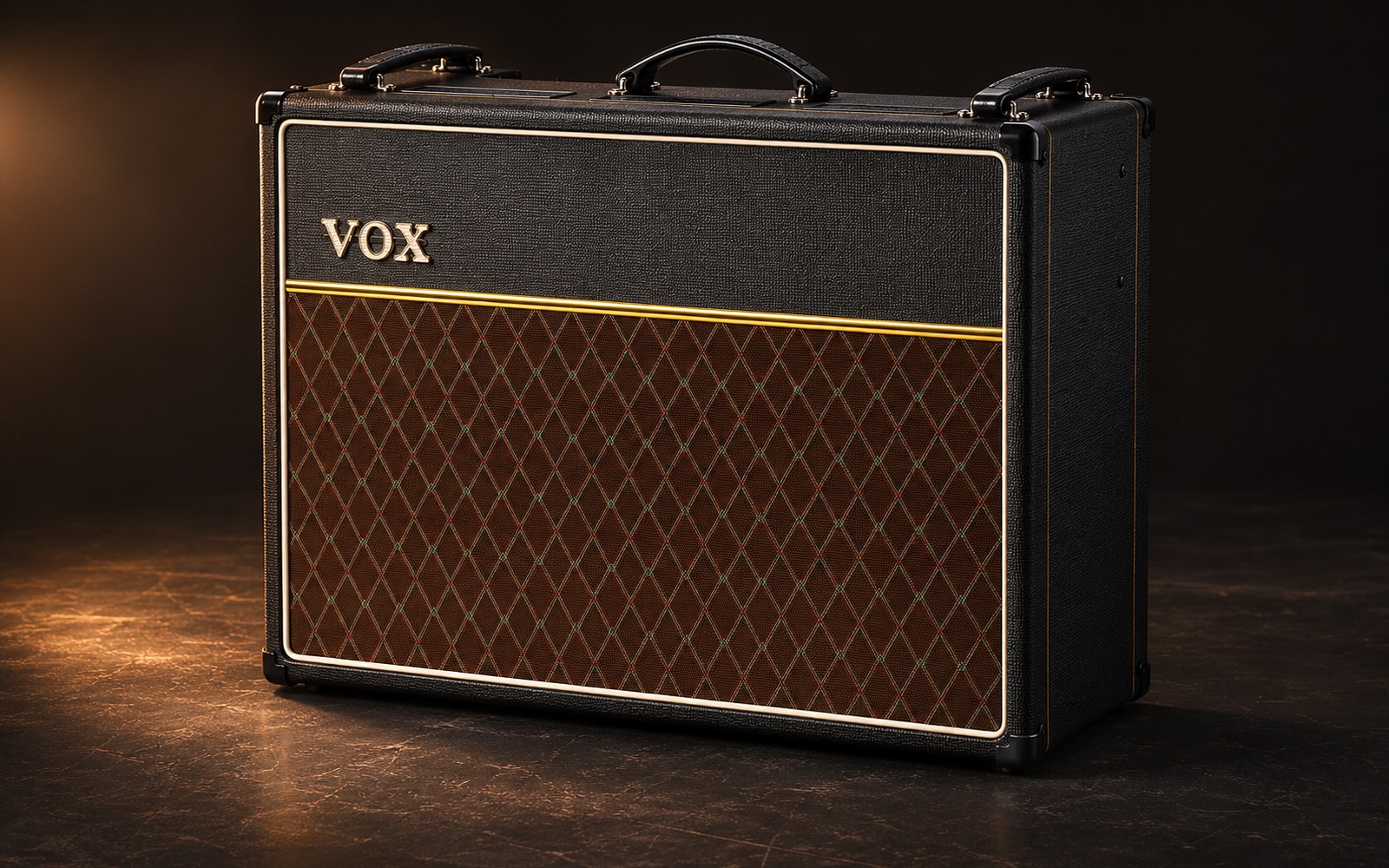
- Top image: GuitarGangsters AI-generated reference illustration, not a photograph.
- The Edge: iinchicore, Wikimedia Commons, CC BY-SA 4.0.
- The Edge: by Joe Ahorro, Wikimedia Commons, CC BY-SA 4.0.
- Jonny Greenwood: radiohead in amsterdam by Michell Zappa, Wikimedia Commons, CC BY-SA 2.0.
- Brian May: Carl Lender, Wikimedia Commons, CC BY-SA 3.0.
Latest News
Related
On This Day
Monday 9 November
From this week: