Designed to Be Perfect: The Ernie Ball Music Man John Petrucci Majesty
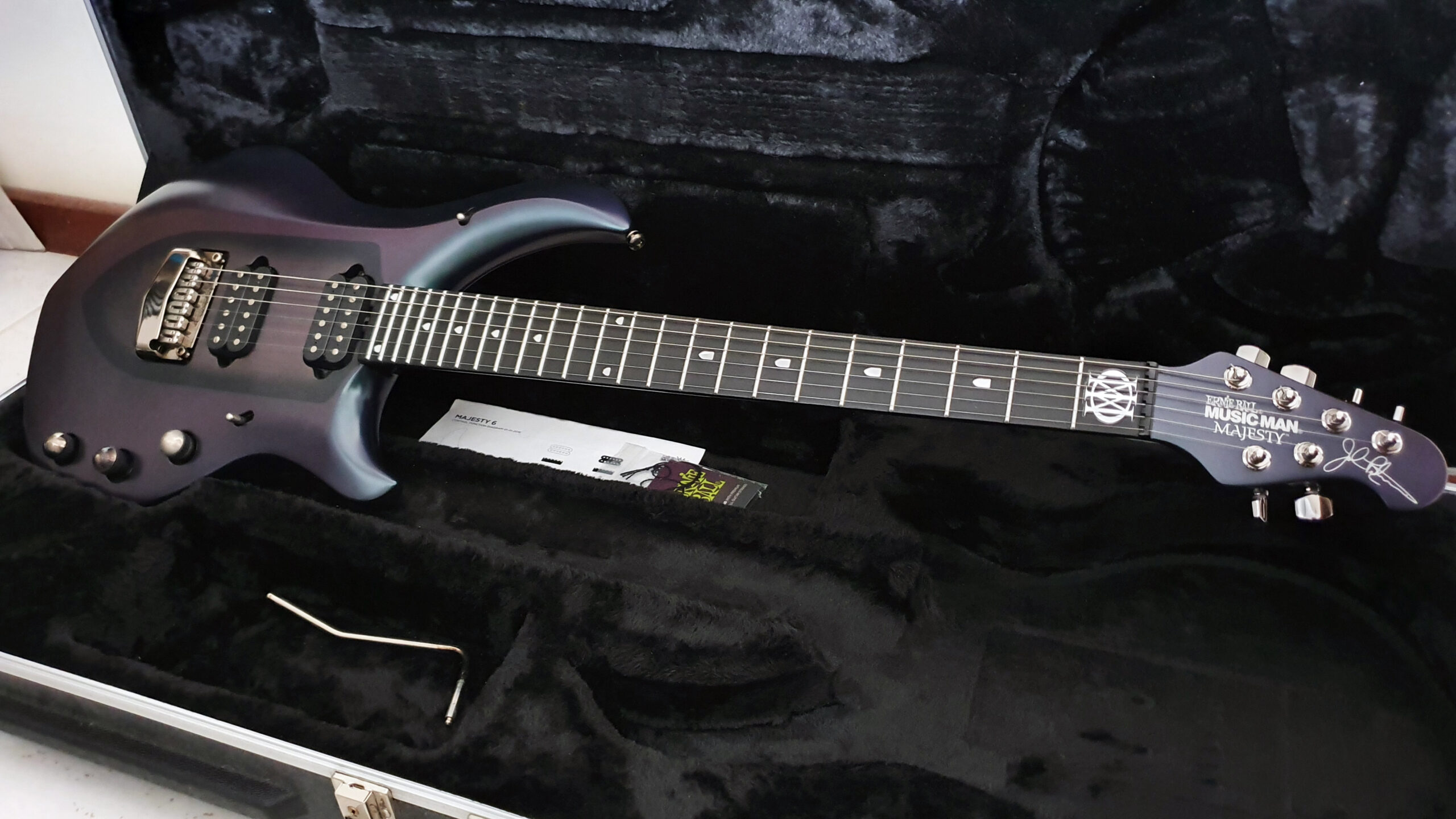
Ernie Ball Music Man Majesty (2016, Arctic Dream). Photo: Rachmaninoff, CC BY-SA 4.0, via Wikimedia Commons (File:EBMM Majesty Arctic Dream 2016.jpg).
The Ernie Ball Music Man John Petrucci Majesty: neck-through body, piezo bridge, DiMarzio humbuckers, 24 stainless frets. Prog metal's most ambitious guitar.
In 2014, when Ernie Ball Music Man unveiled the Majesty to the guitar-playing public, some people hated it. “That’s the ugliest thing I’ve ever seen,” went the reaction in certain corners of the internet. The body shape was unlike anything that had come before — angular where it needed to be, swooping where it didn’t, designed more like a concept car than an instrument. John Petrucci himself has recalled the polarized early response with a knowing smile. “It turns out,” he said, “it was the most successful instrument we ever could have imagined.”
Ten years on from its launch, the Majesty has celebrated its own anniversary in silver with a limited edition that sold out immediately, been played on stages from Tokyo to São Paulo, anchored some of the most technically demanding progressive metal recordings of the modern era, and quietly become the reference instrument for a generation of guitarists who believe that the electric guitar still has unexplored territory to map. It exists at the intersection of two obsessions: John Petrucci’s refusal to accept that his current guitar is good enough, and Ernie Ball Music Man’s willingness to build whatever he needs to find out.
This is the story of that intersection.
Before the Majesty: The JP Line and a Twenty-Year Partnership
To understand what the Majesty is, you need to understand what it replaced — or rather, what it ran alongside. John Petrucci has been one of the most influential figures in progressive metal guitar since Dream Theater’s 1992 breakthrough album Images and Words. His technique — relentless alternate picking, sweeping arpeggios, legato runs, melodic phrasing that balances technical ferocity with genuine emotional weight — set a standard that a generation of guitarists has spent decades chasing.
Before his partnership with Ernie Ball Music Man, Petrucci played Ibanez guitars, including the distinctive JPM100 series with its Picasso-inspired graphic artwork and custom DiMarzio wiring. When that relationship ended in the late 1990s, Petrucci found a new home with Ernie Ball Music Man, and the JP signature line was born. The original EBMM JP guitars were bolt-on superstrats built to demanding specifications — large frets, low action, high-output DiMarzio pickups — and they evolved continuously over two decades into the JP6, JP7, JP12, JP15, and beyond.
By the early 2010s, the JP line had become one of the most respected signature guitar families in the world. But Petrucci wanted something different. Not a refinement of the bolt-on JP platform, but an entirely new architecture. He specifically wanted a neck-through-body instrument — a construction method he had never explored in a signature guitar, one that would deliver sustained resonance and seamless upper-fret access in a way that bolt-on geometry fundamentally cannot. The result was the Majesty: a guitar designed not as an evolution but as a parallel statement of what Petrucci’s ideal instrument could be.
It debuted in 2014. By 2019, Petrucci was using Majesty guitars as his primary instruments on tour and in the studio. By the time Dream Theater recorded Distance Over Time in 2019, the Tiger Eye limited edition Majesty — a maple-top, alder-winged variant produced in a run of 300 — was the instrument at the center of the album’s sound. The Majesty had not just survived its contentious introduction. It had become the definitive Petrucci instrument.
Engineering from the Inside Out
Every design choice on the Majesty begins with a problem Petrucci identified in every other guitar he’d ever played, and works backward from its solution. This is not marketing language — it is the literal description of how the instrument was developed.
Neck-Through Construction and Tonewoods
The Majesty’s defining structural feature is its neck-through-body design, in which the neck and a central section of the body are carved from a single piece of wood — typically Honduran mahogany — and the body wings are attached on either side. This eliminates the neck joint entirely, removing a potential point of energy loss and creating a more resonant, more sustaining instrument than any bolt-on or set-neck construction can produce at equivalent price points.
The body wings are carved from okoume, alder, or basswood depending on the specific model variant, chosen for their tonal complementarity to the mahogany center block. Premium variants feature figured maple tops — the Tiger Eye with its flame maple, the Magliano with its custom hand-stained flamed maple shield — adding visual drama while contributing a slight brightening of the top-end response. Hand-selected tonewoods are imported exclusively from sustainably sourced suppliers, and each body and neck is individually kiln-dried to achieve low moisture content before machining begins.
The result of this tonal wood architecture, as Petrucci describes it, is “a rich, three-dimensional guitar sound” — warm in the midrange from the mahogany, clear and defined at the top end from the maple, balanced and controlled through the full frequency range. Every note sustains naturally and fully. The guitar does not choke in the upper register. It rings.
The Body Shape: Form Follows Function
The Majesty’s body silhouette is the element that attracted the most initial controversy and the most subsequent admiration. The extended upper horn — longer and more pronounced than any conventional double-cutaway — places the body’s center of gravity directly above the strap button, eliminating neck dive completely. The instrument hangs perfectly horizontal, allowing the fretting hand to move freely without compensating for a downward-tilting headstock. Players who spend four hours on stage performing complex music at high tempos will tell you that this is not a minor ergonomic detail. It is the difference between a guitar that fights you and one that disappears.
The deep lower cutaway provides completely unobstructed access to all 24 frets. There is no body contact anywhere on the neck, no awkward reaching over a body horn, no compromise in the highest positions. Combined with a neck profile optimized for fast playing — slim but not exaggeratedly thin, comfortable for both chord work and single-note runs — the Majesty’s physical relationship with a guitarist is calibrated to precision in a way that conventional body shapes, constrained by historical templates, cannot match.
The control layout reflects the same ergonomic priority. Volume and tone knobs are positioned in line, closer to the body’s center than on most guitars, keeping them accessible without shifting picking-hand position during performance. The three-way magnetic pickup toggle and piezo/magnetic selector are recessed into the body, preventing accidental activation. Everything is where it needs to be because Petrucci calculated where it needed to be, not where it had always been.
Fingerboard and Frets
The Majesty’s fingerboard is ebony — a tonewood associated with snap and clarity, complementing the warmth of the mahogany neck. The radius is 17 inches, significantly flatter than vintage-style instruments and even flatter than most modern superstrats, which commonly offer 12″–16″ compound radius options. A 17″ flat radius means that string bending anywhere on the neck produces no fretting-out, no notes dying as the string meets the radius curve. At high speeds, under heavy string bending, playing a 17″ radius instrument versus a 9.5″ vintage radius is the difference between technique expressed freely and technique constrained by geometry.
Twenty-four medium-jumbo stainless steel frets cover the entire fingerboard. Stainless steel frets are harder and more wear-resistant than conventional nickel-silver wire, meaning they maintain their crown geometry for years rather than months under heavy playing. They also provide a slightly brighter, more articulate attack — picking dynamics translate with exceptional fidelity, which matters enormously when the guitar is being played at the speed and precision Petrucci demands. The first fret features a custom JP inlay — a shield motif that became the Majesty’s visual signature — and the compensated nut (Music Man’s patented design) ensures accurate intonation from the open strings upward.
Pickups: DiMarzio Dreamcatcher and Rainmaker
From the first Majesty through the 2019 redesign, the pickup specification evolved significantly. Early models used DiMarzio Illuminator humbuckers — powerful, detailed, voiced for the dense harmonic content of progressive metal. In 2019, Petrucci and DiMarzio developed entirely new pickup designs: the Dreamcatcher in the bridge position and the Rainmaker in the neck, voiced specifically to complement the Majesty’s tonal wood combination and deliver the full range of tones Petrucci’s playing demands.
The Dreamcatcher (bridge) is optimized for the articulated, percussive rhythm tone that defines Dream Theater’s heavier passages — tight low end, forward-projecting mids that cut through dense mixes, enough output to drive high-gain amplifiers without over-saturating them. The Rainmaker (neck) provides the fluid, singing lead tone that characterizes Petrucci’s melodic playing — warm without being muddy, responsive to pick attack in a way that captures dynamic nuances across an extended range of expression. Both pickups are direct-mounted to the body rather than to pickup rings, increasing resonant coupling and contributing to the guitar’s sustain characteristics.
The push/push volume knob activates a 20+ dB onboard active gain boost — a feature that allows Petrucci to switch from rhythm to lead volume without touching a pedal or footswitch, managing dynamics entirely from the guitar. The push/push tone knob enables coil splitting in the middle pickup-selector position, adding a single-coil character option that dramatically expands tonal range. A separate 3-way toggle manages the relationship between magnetic and piezo outputs, while a recessed push button in the back cavity switches between mono and stereo output — enabling independent routing of the magnetic and piezo signals to separate amplifiers or channels.
The Piezo System: When the Acoustic World Opens
The Majesty’s piezo pickup system is perhaps its most distinctive feature and the one most often underestimated by players encountering the instrument for the first time. Fishman Powerbridge piezo saddles are fitted to each string position of the custom floating tremolo, capturing the natural mechanical vibration of the strings at the bridge rather than relying on magnetic flux. The result is a genuinely convincing acoustic-like tone — warm, woody, resonant — that can be blended with or substituted for the magnetic humbucker output entirely.
In a live Dream Theater context, Petrucci uses the piezo system for passages that call for acoustic guitar textures within an electric guitar performance. Rather than switching instruments between sections — a logistical complication in complex compositions — he can dial in a blend of magnetic and piezo signal that achieves the right textural quality for each musical moment, controlled from the guitar itself. For the clean, atmospheric sections that punctuate Dream Theater’s compositions, the piezo system is not an academic novelty. It is a performance tool with real musical consequences.
The Tremolo System
The custom John Petrucci Music Man floating tremolo is a chrome-plated, hardened steel design built to handle the dual demands of tuning stability and piezo saddle integration. Schaller M6-IND locking tuners at the headstock and the guitar’s angled headstock design (reducing break angle and string tension at the nut) contribute to the system’s overall stability. The tremolo is not a Floyd Rose-style locking design — Petrucci uses a floating tremolo with conventional fine tuners and standard string loading, allowing faster string changes and easier intonation adjustment while still providing the mechanical stability his playing requires. String gauge is .010–.046 for six-string variants, reflecting Petrucci’s preference for a balance between playability and tonal weight.
The Petrucci Tone: Recipes for the Majesty
John Petrucci’s sound is immediately recognizable: tight, articulate, warm in the midrange, with attack that translates every picking nuance without harshness at the top end. He achieves it through a combination of guitar, amplification, and technique that rewards close study.
The Core High-Gain Sound
Petrucci’s primary amplifier throughout most of his career has been some version of the Mesa/Boogie Mark series, culminating in the Mesa/Boogie JP-2C — his 2016 signature model, a recreation of the legendary Mark IIC+ circuit he has described as his “Holy Grail” amplifier. The JP-2C’s lead channel, voiced for the tight, mid-forward response that defines Petrucci’s rhythm tone, is the foundation of his sound on virtually every Dream Theater album from 2016 onward.
A useful starting point on the Mesa JP-2C (or any Mesa Mark-voiced amplifier): Gain around 6 — Petrucci does not use maximum saturation, preferring a gain level at which pick attack still registers dynamically rather than compressing into uniform overdrive. Bass at 5–5.5, providing body without flub. Mids at 5, using Mesa’s graphic EQ to further sculpt — Petrucci often employs a slight mid-scoop on the graphic EQ while keeping the channel mid control moderate, creating the “V” curve that tightens the sound in a dense mix. Treble at 5–6, smooth rather than cutting. Presence at 5–6. The graphic EQ is crucial: boost at 80 Hz and 6.6 kHz while cutting through the 400–800 Hz region gives the sound its characteristic presence without harshness.
Before the amp, Petrucci has used various overdrive pedals to tighten the input — a modded Tube Screamer, the Analog Man King of Tone, or the Mesa Grid Slammer — all run at low drive and boosted level to firm up the note attack and slightly compress the dynamic range before the preamp stage. This “tightening” approach is characteristic of high-gain players who want clarity at speed: the overdrive pedal is not adding gain but shaping it, making fast passages more articulate rather than more distorted.
The Clean and Crunch Tones
Dream Theater compositions routinely move through dramatic tonal shifts within a single song, requiring Petrucci to access genuinely clean, sparkling tones alongside his high-gain lead sounds. The Majesty’s piezo system handles much of the acoustic texture, but the magnetic pickups’ clean capability matters enormously for passages like the intro sections of “Metropolis Pt. 1” or the quieter moments of “The Astonishing” album.
Clean channel settings on a Mesa Mark-style amp: Gain at 3, Bass at 5, Mid at 3, Treble at 7, Presence at 5. The Majesty’s neck pickup in this setting produces a crisp, piano-like clean tone — bright without glassiness, defined without thinness. Roll the Majesty’s volume back to 7–8 for added warmth. The Rainmaker neck pickup’s Alnico character produces an appealing vintage warmth in clean settings that its specification might not immediately suggest.
For effects, Petrucci’s signature TC Electronic Dreamscape pedal — his custom chorus/flanger/vibrato unit — adds the lush, modulated textures that have defined Dream Theater’s atmospheric passages since the 1990s. A warm analog delay (or the Axe-FX III’s tape echo models) provides depth on lead lines. Petrucci tends to keep his effects chain relatively simple and functional, letting the guitar and amp carry the tonal weight. “A lot of guitarists try too hard,” he has noted. “They clutter their signal chain with different pedals and wind up unhappy with the results. If you just get a good sound with your guitar, your amp and your speaker, you’ll be off to a good start.”
The Majesty’s Acoustic Mode
For players wanting to explore the piezo system seriously: engage the piezo output through a clean acoustic amplifier or direct into a DI box running to a PA system. The Fishman Powerbridge system works best when the signal is kept clean and uncolored — a flat EQ response and minimal compression preserves the natural woody character of the piezo transducers. Blending 30–40% piezo into a clean magnetic signal creates a hybrid acoustic-electric texture useful for the introductory passages of complex compositions. Full piezo into a dedicated acoustic channel gives genuine acoustic guitar believability — not a perfect replica, but convincing enough to eliminate the need for a second instrument in most live contexts.
The Majesty Across a Decade: Model Evolution
The Majesty has evolved continuously since its 2014 introduction, with each year’s release introducing refinements, new tonewoods, upgraded electronics, and limited-edition variants that have become significant collector’s pieces.
The original 2014 Majesty introduced the architecture that all subsequent models share: neck-through mahogany construction, piezo bridge system, 24 stainless frets, 17″ radius ebony fingerboard, and the active boost/coil-split electronics. Early models used DiMarzio Illuminator pickups.
The 2019 Majesty represented the most significant specification change in the line’s history: new DiMarzio Dreamcatcher (bridge) and Rainmaker (neck) pickups, developed specifically for the Majesty’s tonal characteristics. The Tiger Eye limited edition — mahogany neck with alder wings and flame maple top, limited to 300 pieces in six and seven-string configurations — was the most prestigious variant and remains among the most sought-after on the used market.
The 20th Anniversary Majesty (2021), released to mark the two-decade partnership between Petrucci and Ernie Ball Music Man, featured a flame maple shield in a Honey Butter Burst mahogany body, gold hardware, ebony fingerboard with gold JP/shield inlays, and a laser-etched anniversary tremolo backplate. Hand-numbered and signed.
The 10th Anniversary Majesty (2024), celebrating ten years specifically of the Majesty instrument, debuted in Silver Chalice finish with new custom-covered DiMarzio Rainmaker and Dreamcatcher humbuckers — the covers themselves a new design element that changed the visual character of the pickups without altering their spec. Hand-numbered, signed, and priced at $3,999.
For 2025, Ernie Ball Music Man added glow-in-the-dark side dots across the Majesty line for improved stage visibility — a practical touring musician’s detail that reflects the instrument’s DNA — and introduced Dark Side and Gold Eclipse finishes across six, seven, and eight-string configurations.
The Majesty and Its Contemporaries
No guitar exists in isolation from its competitive landscape, and the Majesty occupies a specific position within it. Understanding where it fits relative to other premium prog and metal instruments reveals what makes it genuinely distinct.
The Ibanez JEM7V is the other great prog-rock signature instrument of the modern era — Steve Vai‘s lifetime collaboration with Ibanez producing an equally iconic instrument with its own architectural DNA. Where the Majesty is a neck-through construction optimized for sustain and upper-fret access, the JEM is a bolt-on with a monkey-grip handle and Vai’s specific aesthetic sensibility. Both instruments represent decades of artist collaboration with a single manufacturer. Both reward players who have internalized one style of play. They are not really competitors — they are expressions of different musical philosophies.
The PRS Custom 24 is a guitar the Majesty is frequently compared to in terms of price and premium positioning. The Custom 24 is more tonally versatile in a genre-spanning sense — it moves from jazz to country to metal with relatively little resistance. The Majesty is more specifically optimized: every element is calibrated for the extended-range, high-gain, technically demanding music Petrucci plays. It is not a jazz instrument. It is not trying to be. As a dedicated progressive metal platform, it has no equals at its price point.
Joe Satriani‘s Ibanez JS series and Paul Gilbert‘s Ibanez PGM line represent the other major sustained artist signature collaborations from the same era — each producing instruments shaped by a specific virtuoso’s lifetime of playing, each accumulating their own dedicated following. The Majesty competes in this category: instruments that don’t pretend to be for everyone, that are unapologetically optimized for a particular musical vision and the players who share it.
Against the EVH Wolfgang Standard, the Majesty represents a different point on the premium spectrum: where the Wolfgang is about hot-rod simplicity — one humbucker voice optimized to lethal efficiency — the Majesty offers tonal complexity through its piezo system, coil-split capability, and multi-channel electronics. The Wolfgang costs approximately one-third of the Majesty’s retail price. Each is the correct instrument for the player whose musical needs it addresses.
Sterling by Music Man: The Accessible Alternative
For players who want access to the Majesty platform without the premium American-made price tag, Sterling by Music Man — Ernie Ball Music Man’s offshore production partner — produces the JP70 and related Petrucci models. These instruments share the JP body shape from the bolt-on signature line rather than the Majesty’s neck-through architecture, but they provide the DiMarzio pickup voice, quality hardware, and ergonomic DNA of the Petrucci collaboration at prices accessible to intermediate players.
Players who have compared the Sterling JP line to the USA Majesty consistently report that the Sterling delivers a significant proportion of the experience — strong playability, good pickup performance, quality hardware — at a fraction of the cost. The neck-through construction of the USA Majesty, the stainless steel frets, the piezo bridge system, and the active electronics are the specific features not replicated at the Sterling level, and they are the features that define the Majesty as an instrument. But for players developing the technique to fully use those features, the Sterling JP models represent a logical progression point.
Buying the Majesty: What to Know
New Production Models
Current Majesty production models retail in the $3,200–$4,000 range for standard six-string variants, with seven and eight-string configurations and limited editions commanding higher prices. Limited edition variants — Anniversary editions, artist-specific colourways, custom run exclusives — frequently sell through quickly on initial release and command significant premiums on the secondary market within months. The 10th Anniversary Majesty at $3,999 was considered strong value for a hand-numbered, signed limited edition and sold accordingly.
Each standard Majesty ships with an EBMM-branded Mono gig bag and a certificate of authenticity. The guitar arrives factory-set to Petrucci’s specifications: .010–.046 string gauge, action calibrated for low, fast playing. Players who prefer different string gauges should budget for a professional setup, as the floating tremolo will require spring tension readjustment when string gauge changes.
Used Market
The secondary market for Majesty guitars is active and reasonably well-supplied, though demand consistently outpaces supply for desirable limited editions. Standard production models from 2017 onward can be found in excellent condition for $2,200–$2,800. The Tiger Eye limited editions (2019) regularly command $3,500–$4,500 or more — considerably above their original retail price — reflecting their desirability and limited production numbers.
When evaluating a used Majesty: check fret condition carefully, as stainless steel frets are durable but show distinctive wear patterns different from nickel frets. Test the piezo system thoroughly — each saddle saddle carries an individual transducer, and malfunctions in one saddle produce an obvious imbalance in the acoustic output. Verify the active boost preamp battery compartment (located in the back cavity) and ensure the electronics function at full voltage. The tremolo pivot points should be smooth and the locking tuners should engage and release cleanly.
The Seven-String and Eight-String Variants
The Majesty’s architecture translates exceptionally well to extended range configurations. The seven-string Majesty adds a low B string, extending the downward range available for the dense, low-register riff work that characterizes much of modern progressive metal. The eight-string pushes further to a low F#. Both extended range variants maintain the same neck-through construction, ergonomic body shape, piezo bridge system, and electronics package as the six-string, scaled appropriately. Dream Theater’s increased use of seven-string instruments over their career trajectory has made Petrucci’s extended-range Majesty variants some of the most visible and discussed instruments in the progressive metal world.
Frequently Asked Questions
What makes the Majesty different from Petrucci’s JP signature series?
The primary architectural difference is neck-through-body construction versus the JP series’ bolt-on neck joint. Neck-through construction delivers enhanced sustain and seamless upper-fret access that bolt-on designs cannot match. The Majesty also introduced the piezo bridge pickup system and the active onboard boost/coil-split electronics not present in the JP line. The body shape is entirely different — the Majesty’s ergonomic contours and extended upper horn represent a fundamentally new design rather than a refinement of the JP template. In practical terms, the Majesty feels different in the hands and sustains differently under the fingers.
Does the Majesty work for styles other than progressive metal?
Yes, but it’s specifically optimized for high-output, technically demanding electric guitar playing. The DiMarzio Dreamcatcher and Rainmaker humbuckers produce a warm, powerful tone that works across hard rock, fusion, and heavy metal applications. The piezo system extends usefulness into acoustic-adjacent territory. However, the guitar is not particularly well-suited to vintage blues or country applications where a lighter, more reactive pickup response is desirable — the high-output DiMarzio humbuckers and active boost electronics are calibrated for a different world. Players who primarily play classic rock or blues might find the Majesty’s voice more than their playing requires. Players who push demanding modern music will find it ideally matched.
Is the piezo bridge pickup system difficult to use?
The switching system is logically organized and becomes intuitive quickly. A three-way toggle selects between magnetic only, piezo only, or a blend of both. Independent volume controls for the magnetic and piezo outputs allow custom mixing. A push/push button in the back cavity switches between mono output (both signals mixed to a single output) and stereo (separate outputs for magnetic and piezo — useful for routing to dedicated electric and acoustic channels simultaneously). The main learning curve is managing the mono/stereo selection and understanding the signal flow, which typically takes a single setup session to internalize.
What amplifier does Petrucci use with the Majesty?
John Petrucci’s primary amplifier since 2016 has been the Mesa/Boogie JP-2C, his signature head based on the Mark IIC+ circuit. For live touring, he combines the JP-2C with a Fractal Audio Axe-FX III for effects processing, running through Mesa 2:90 power amplifiers in a wet/dry/wet configuration. For players who don’t have access to Mesa/Boogie amplifiers, the Axe-FX III (or equivalent neural/modeler devices) with Mesa Mark IIC+ or Mark IV profiles provides the most accurate approximation of his live tone. Budget-conscious players can approximate the essential character with any high-gain amp that offers controllable mid-forward response and tight low-end definition.
What string gauge does John Petrucci use on the Majesty?
Petrucci uses Ernie Ball custom gauge strings: .010–.046 for six-string instruments and .010–.056 for seven-string configurations. These gauges represent a balance between playability (not so heavy that technique becomes labored) and tonal weight (sufficient to produce the full-bodied sound his playing requires). The floating tremolo is factory-set for .010–.046 on the six-string; changing to significantly lighter or heavier strings will require spring tension readjustment to maintain the bridge’s proper parallel position.
How does the Majesty compare to a PRS Custom 24 for prog and metal?
The PRS Custom 24 is a more tonally versatile instrument across genres — its combination of mahogany body, maple top, and PRS-voiced pickups produces a pleasing character across an unusually wide range of styles. The Majesty is more specifically calibrated: every element is optimized for the demands of progressive metal, from the 17″ flat radius and 24 stainless steel frets to the high-output DiMarzio humbuckers and active boost. If you play exclusively demanding modern electric guitar music, the Majesty’s specific optimizations give it an edge. If your playing spans a wider range of styles, the PRS’s versatility may serve you better. Both are excellent instruments at premium price points; they answer different questions.
Can you remove the Majesty’s tremolo arm and play it as a fixed-bridge guitar?
The Majesty’s custom floating tremolo arm can be removed when not in use, and the guitar plays perfectly well without it. However, unlike a Floyd Rose system, the Majesty’s tremolo cannot be decked or blocked into a fixed position without physical modification — it will continue to respond to changes in string tension. Players who prefer completely fixed-bridge playing may find a Music Man JP non-trem variant or a different guitar more appropriate. For players who use the tremolo occasionally rather than extensively, the Majesty’s standard setup works perfectly well with the arm simply removed between uses.
The Majesty at Ten: What It Proved
When the Majesty was unveiled in 2014, the reaction split predictably between the traditionalists who found its appearance alien and the forward-thinking players who immediately understood what Petrucci and Ernie Ball Music Man had built. A decade later, the Majesty has proved the forward-thinking players correct.
It proved that a signature guitar could be genuinely innovative rather than conventionally refined — that the collaboration between a virtuoso with specific, demanding requirements and a manufacturer willing to execute without compromise could produce something that changes the terms of conversation around what a guitar should be. The neck-through construction, the ergonomic body, the piezo integration, the active electronics — none of these were novel ideas in isolation. Their combination in a single instrument designed with this level of coherence and precision was.
The Majesty also proved something about John Petrucci himself: that after twenty-plus years of refining the bolt-on JP platform, he still had a different guitar in him. That the desire to improve, to reconsider, to start from different premises and see what emerged, hadn’t exhausted itself in two decades of iteration. The Majesty is the guitar of a player who never accepted that any current instrument was finished.
Pick one up, plug it in, play the first few notes. You’ll understand immediately why some people hated the way it looked and why everyone who played it came away converted.
Image credits
- A sunburst electric guitar on a sofa: Gray Guitars, Wikimedia Commons, CC BY-SA 4.0.
- A workshop corner with tools and a guitar: Ancepicris, Wikimedia Commons, CC BY-SA 3.0.
- A pearl pickguard on an electric guitar: MalcolmX86, Wikimedia Commons, CC BY-SA 3.0.
- Top image: Rachmaninoff, Wikimedia Commons, CC BY-SA 4.0.


Latest News
On This Day
Monday 9 November
From this week: